© 2018 IJSRST | Volume 5 | Issue 3 | Print ISSN: 2395-6011 | Online ISSN: 2395-602X Themed Section: Science and Technology
Introduction to Mobile Cloud Computing and Battery
Optimization in Mobile Devices
Nidheesh. S. N1, Namitha. N. Deshpande2
1Department of Computer Science, PES University, Bangalore, Karnataka, India 2Department of Computer Science, PESIT BSC, Bangalore, Karnataka, India ABSTRACT
With the recent advances in the field of science and technology, there has been a steep increase in the number of people using smartphones connected to the internet. This has opened up countless new possibilities to be explored in the field of Mobile Cloud Computing as a potential technology for mobile network providers and cloud computing services. The basic framework of the Mobile Cloud Computingis to integrate cloud services in the mobile environment providing the user with a multitude of benefits such as increased battery life, increased storage and bandwidth, decrease in the power consumed by the mobile device, with increased security and privacy of the user’s data. In this paper, we give an overlay of the definition and architecture of mobile cloud computing and explore the possibilities of the implementation of this technology in increasing the battery power of a mobile device.
Keywords: Mobile Cloud Computing, Computational Offloading, Battery optimization, Power Consumption
I.
INTRODUCTIONA. What is Cloud computing?
Cloud computing is an Information Technology model which enables the user to access the configurable system resources and also avail higher level services with least management effort and comparatively faster speed, often over the Internet. This has led to the development of mobile device applications such as Google Apps, Twitter and many more renewing the way we make use of Communication Technology. Cloud computing is all about sharing resources to attain consistency and carrying out tasks with greater efficiency with increasing size or speed of operation. Third-party clouds help the organizations to focus on their main/essential business rather pay out unwanted time on computer framework and maintenance. Sometimes the administrators might occur unexpected operating expenses, to overcome this issue cloud provides ―pay-as-you-go‖ model. After the launch of Amazon EC2 in 2006, there are has been significant
amount of growth in this field due to availability of high holding ability networks, low-cost computer devices and storage spaces as well as virtualization, service-oriented architecture and self-governing and utility computing.
B. Advantages and benefits of cloud computing
The Organisations need not invest on data centres and servers, instead only pay when they make use of/consume resources (pay-as-you-go) .
Hundreds of customers are aggregated in the cloud, which helps the organisations to focus on their core business.
Organisations using cloud computing can
eliminate the task of guessing the
infrastructure capacity. It helps the user to access as much or as little as needed.
It allows the organisation to focus on their customer needs and not on infrastructure expenses.
It is easy to utilize your application in multiple regions in just a click away.
C. Mobile Cloud Computing
A combination of cloud-computing along with mobile-computing which is a
human-computer interaction enabling data
transmission and wireless networks, to not only provide business opportunities to mobile network providers and cloud computing companies but to unify a plethora of
information which can be accessed
unrestricted, with infinite storage and mobility which can be used by any mobile device anywhere with an internet connection, regardless of heterogeneous environments and different platforms.
Basically mobile cloud computing uses cloud computing to deliver applications to mobile devices. Using a cloud, applications can be built, revised and sent to various devices with different operating systems. Thus every mobile device can access applications via the mobile cloud which otherwise cannot be supported.
Mobile cloud computing enables users to have a secure and fast connection to a sea of integrated information from various sources regardless of the place of origin or where it resides. When a mobile application is created and made public, the IT[18] professionals usually do not have the resources to maintain and manage the application. However the mobile cloud providers help them run the application whilst allowing modifications and updates to the application. Demanding applications put a strain on the device and reduces its performance. Integrating a flexible
cloud infrastructure will help with difficult workloads.
Mobile devices (E.g., Smartphone and tablet PC) are increasingly becoming an essential part of day to day human activities as the most effective, efficient and reliable communication tools. Not bounded by time and place of usage.
Table 1
1
MCC
Mobile Cloud Computing
2
BTS
Base Transmission
Station
3
HA
Higher Architecture
4
IP
Internet Protocol
5
LaaS
Infrastructure as a
Service
6
PaaS
Platform as a Service
7
SaaS
Software as a Service
8
AWS
Amazon Web Service
9
GCP
Google cloud Platform
10
SSS
Simple Storage Service
11
GAE
Google App Engine
12
AMR
Amazon Map Reduce
13
RPC
Remote Procedure Call
14
VNC
Virtual Network
Computing
15
PC
Personal Computer
16
RBF
Remote Buffer
Framework
17
Power
Consumption Difference
18
IT
Information Technology
19
API
Application Program
Interface
II.
WORKING PROCEDUREA. Mobile cloud computing architecture
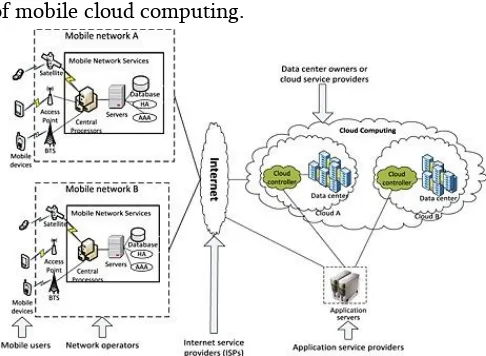
central processor transmits a signal to the servers that are connected to the mobile network providers.
Once the request is received by the mobile network providers they provide services such as authorization, authentication and accounting based on the HA [3] which acts as a router and provides information based on the user’s location so that the IP[4] address does not have to change every time the user connects to the internet and the information of the user which is already stored in their database.
The processed information is provided to the user via the cloud services. This mechanism is also known as
tunnelling. The cloud has service oriented
architecture with the support of API’s [19] and multiple programming models which benefits the end user with the required information. It also involves creating market oriented clouds and a web based delivery system in the clouds.
The details of cloud architecture can be explained
using the TrustCube architecture, E-Recall
architecture, Layered architecture, Open Mobster architecture and many more. But in this paper we focus on the Layered and Open Mobster architecture of mobile cloud computing.
Figure 1. Architecture of Mobile Cloud Computing
We first focus on the Layered Architecture which contains in its upper layers, Infrastructure as a Service[5] (IaaS), Platform as a Service[6] (PaaS) and
Software as a Service[7] (SaaS) along with data centre layer.
1) IaaS : Here the cloud service provider usually hosts information that is present in an on-premises data centre including a virtualization and hypervisor layer supporting servers, storage and a networking hardware system. When a user prefers aIaaS, then he has a pay-per-use basis where he pays only for the services used. Thus clients save cost as they pay for only the services used. Amazon Web Services [8] (AWS), Google Cloud Platform [9] (GCP), Simple Storage Service [10] (SSS) are some of the private providers for IaaS cloud services. This kind of a cloud structure can be dynamically shrunk or expanded according to the users need.
2) PaaS : This gives the users an advanced platform to build, repair, test and deploy custom applications. Here the third party provides the hardware and software tools required for the application development over Platform as a Service cloud computing. Hence the client does not have to externally install the tools that are required to run the new application. It helps provide a resilient and optimized environment where key processes such as the application hosting and java development can be provided by the cloud services. Platform as a Service cloud computing also enables development teams not present at the same location to work together on a same project. Google App Engine [11] (GAE), Microsoft Azure, Amazon Map Reduce [12] (AMR) are some of the cloud services providing PaaS.
eliminates the cost of hardware acquisition which the companies will require if they run and maintain the applications on their own servers. It also provides services such as software licensing, installation and support. Salesforce is a leading SaaS[10] provider. To allow multiple sharing folders and files simultaneously Microsoft’s Live Mesh is also preferred.
4) Data Centre Layer: A hardware facility and cloud infrastructure is provided by this layer. A plethora of servers linked to a high speed broadband are maintained in the data centre to provide services to the client. In most cases, a data centre is built in places where there is high power stability and where the risk of disaster is next to zero.
5) The data centre layer plays a crucial role in this layered architecture due to the fact that some sort of a hardware backup is always required in case the software is hacked or it fails. It also contains lots of servers holding up the cloud.
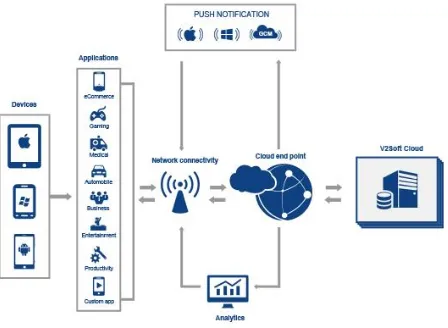
Figure 2. Layered Architecture of Mobile Cloud Computing
Although the Mobile cloud computing architecture is lay red, it is not necessary that the top layers need to be built on the layers below it. Services provided by one layer maybe provided by other layers also. For example data storage facility is provided by both the
IaaS[5] and the PaaS[6] mobile cloud computing models. Overall, the layered architecture provides the users with flexibility and reliability.
B. Open Mobster Architecture
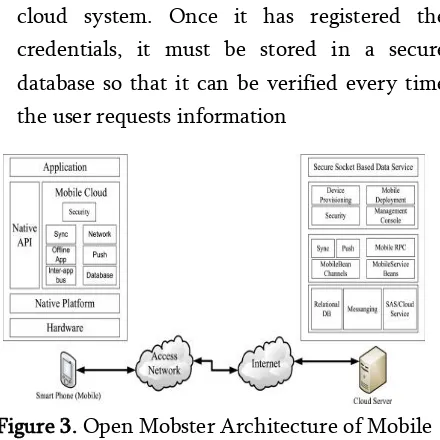
The open mobster architecture is an advanced cloud based platform that can be used for the incubation and development of cloud connected mobile applications. It aids in the seamless transition and synchronization between the data that is present in the cloud and the information that is available in the device. It provides a basic body framework for the production of end-to-end Location Aware Apps. It provides features such as RPC [13] (Remote Procedure Call) which is essential in invoking cloud based services in a mobile device connected to the internet. It is a server-side layered business structure where any low level programmer can become an app developer using cloud based services on the open mobster platform. There is a fixed RPC - API structure that is used to maintain the procedural calls.
The method of uniting cloud data and information stored in the mobile so that the client has unrestricted access to the information is categorised under the following procedures
1) Sync: It is maintained and controlled on the open mobster platform. Any changes made to the data present on the mobile device or on the cloud is automatically backed up and synced. Changes made will appropriately be reflected the next time the user boots up the application or according to the setting set by the user
2) Offline Application: An offline application is an unrestricted and secure platform to co-ordinate between low level services. Once the users set the setting to sync automatically, the application will manage all synchronisation settings
services and the mobile devices. The underlying functioning of network need not be explained
4) Security: The in-built security component provides authentication and authorization services to confirm if the device which has requested for the information has in fact the clearance to access the information that is present in the cloud. A device needs to be securely provisioned before it has access to the cloud system. Once it has registered the credentials, it must be stored in a secure database so that it can be verified every time the user requests information
Figure 3. Open Mobster Architecture of Mobile Cloud Computing
Overall the open mobster has some similarities compared to the layered architecture system but it includes more features and has a better user interface.
III.
OPTIMIZATIONA. Computational Offloading to Extend Energy in Mobile Devices
Energy efficiency is a basic factor for mobile devices. Poor processing ability and limited energy have become serious issues for Smartphones. To overcome these issues, efforts have been made to offload the tasks from mobile client onto the cloud with greater computational ability. The mobile devices in traditional computational ability find it difficult to execute high-bandwidth occupying videos; we can
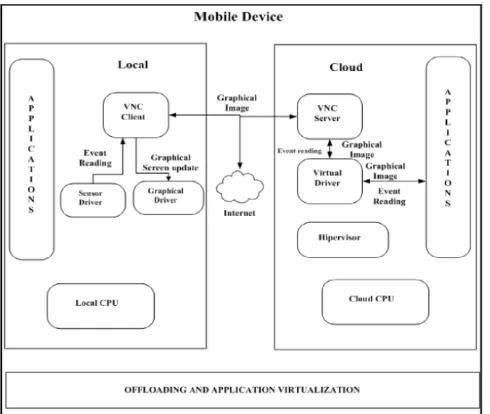
the cloud to minimize the computation time required and battery usage. Here we are going to focus on computational offloading, which can be used to save energy in battery dependent devices i.e., mobiles. An input device, namely, a Virtual Network Computing [14] (VNC) client is loaded onto the local mobile device and connected to the VNC [14] server, which is installed in the cloud. This reduces the energy consumption in devices by 67.19% when compared to traditional methods.
Previously, mobile devices were only used to send text messages or to make calls. They did not support any kind of applications. Due to the tremendous growth in the field of web and multimedia recently, mobile devices have gained enough preparation ability, an efficient battery and other such factors. Mobile devices are made to use cloud services along with mobile environment which together is termed as Mobile Cloud Computing (MCC) [1]. There are many applications accessing cloud services today, namely, Gmail, Google Maps, Microsoft Live Mesh, Apple’s MobileMe and many more.
There are four essential methodologies implied to spare the energy and expand battery life
Adopting new semiconductor technology
Forbear from wasting energy Execute programs slowly
Eliminate computation altogether
B. Offloading Computation to Save Energy
Computation Offloading is a system that transfers resource-intensive computations from a mobile device to server or cloud. Cloud based computation offloading enhances applications processing ability, utilizing less battery and performs tasks that were not able to execute previously due to lack of mobile services. Also, cloud provides storage services. As demonstrated in the architecture part, combining
mobile environment with cloud computing
determines a collection of issues and problems, with real difficulties to be resolved.
In cloud computing, the hardware is sufficiently capable to handle the services and facilities, however for the mobile devices, the software is less compatible than what is required. Hence, mobile devices alone cannot perform the complex computations in required execution time. The amount of mobile gadget clients and mobile application offerings are rising real quick. Nowadays, everybody use smartphones. These devices have capacities equivalent to those of modern day PC’s. However, there are limitations for mobile devices.
Figure 4. General Architecture of Mobile Cloud Computing
C. The Proposed Model
The framework architecture is the novel model that characterises the structure, behaviour and other features of the bodywork. A construction modelling is a formal description and representation of a framework. The framework architecture involves
system components, properties of these components and the connections between them.
The novelty of our proposed system is that it not only considers resource utilization and future consumption demand, but takes offloading based decisions considering factors like delay tolerance, favourable network bandwidth, cloud capacity and energy consumption. This makes the proposed model better than already existing traditional offloading framework. Fog computing (Cisco, 2013) provides the type environment to users where they can store and process their application using the resources available in the neighbouring devices, creating cloud like environment. The proposed framework suits very well with fog and edge computing application thereby reducing the load on host device making it more user friendly. Issues related to limited battery life can be resolved by virtualization. The local machine can be a laptop or PC [15]. A remote machine can be workstation.
Figure below shows that the cloud is an enormous layer of new and large number of services. The act of accessing a remote servers system, instead of a local server or PC [15] , provides storage, processing and overseeing of information. In the cloud, virtual images from mobile devices are stored, starting in the physical mobile device. Whenever a particular application containing the image is accessed from physical mobile device, essential parameters such as execution time, memory usage, power consumption and so on are estimated. If offloading is enabled, then the control is passed onto series of input events of VNC [14].
mouse and console events starting from one device onto the next.
Figure 5. Novel Software Architecture for Offloading
D. Analysis of Energy for Offloading
For offloaded services, the energy consumption for offloading should not be greater than the power of execution.
Let us assume that there are computation instances. Let be the speed of cloud server,
be the speed of mobile device.
The task takes ⁄ seconds on the server and ⁄ seconds on the mobile device. Let be the bytes of information traded by
cloud and the mobile device, be the bandwidth, it takes ⁄ seconds to transmit the information.
Assume mobile expends watts in figuring, for idling and for sending and receiving information.
Available primary memories are And , average execution time is and predicted tolerance delay is . And is the power consumption by local mobile device and cloud respectively.
There is a necessity for an application to execute in cloud if the following three conditions are true
1.
3.
The bandwidth of the network should be higher to transfer and receive data. If all the above mentioned conditions are met, then load the application to the cloud.
Total Energy = +
Energy is saved when the bandwidth is sufficiently large. should be tolerable both during offloading and execution. Every time the application is accessed on physical mobile device, basic measurements such as execution time , size of the application and delay tolerance ( ) are calculated.
E. Calculation of Energy Consumption in Local Devices
We have to make note of the current available capacity of our system before running an application. Only then the application should be executed. After completing the execution of the application, take note of the capacity. An important thing to be taken care of is to terminate all the background applications. Finally, calculate the difference between two capacities to find out the total power consumption.
F. Calculating Power Consumption in the Cloud System
We have to make sure that all the background running applications are terminated. Using the IP address and password establish a remote instance, login is validated to access the cloud. Before running the application, the current capacity is noted down. Only then the application is executed. In the cloud system, select the application to be executed. After completion of execution, note the capacity of the system. Finally, calculate the difference between these two capacities to find out the total power consumption. (table of values)
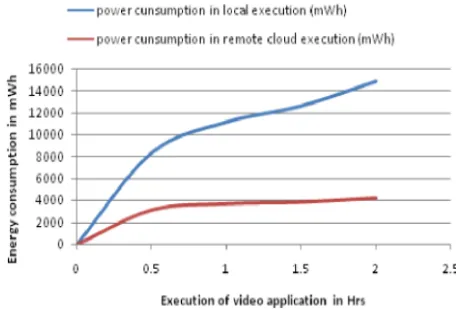
show that the power consumption can be reduced by offloading complex applications to the remote cloud. Much energy can be saved, which indicates that the user can have longer battery life compared to local execution.
Table 2
Let us consider a local machine running a video that is stored in the device. The energy consumed by the central processing unit is shown by the blue line and whereas the power consumed when it is streamed from the cloud is shown by the red line. We can see how there is significantly less power consumed when it is streamed from the cloud.
This is represented in figure shown below. It is a graph showing the power consumed by a device during local execution and power consumed by the device during remote cloud execution.
Figure 6. Graph comparing power consumptions IV . APPLICATIONS
A. Mobile Cloud Computing Applications
1) Mobile commerce: For commerce using
mobile devices, we use a business model, mobile commerce (commerce). The m-commerce applications generally handle tasks such as mobile ticketing, mobile payments and transactions, mobile messaging and so on. They are used in many classes and hence their functioning can be divided as shopping, finance and advertising. These applications have to overcome numerous challenges such as high complexity of mobile configurations, low network bandwidth and security. Hence these applications are integrated with cloud computing.
2) Mobile learning: Mobile learning (m-learning) is based on the concept of electronic learning
and mobility. Traditional m-learning
applications have many drawbacks such as insufficient educational resources, low transmission rate, high cost of networks and devices. Cloud-based m-learning applications are introduced to resolve these issues. For example, accessing a cloud with large storage capacity provides learners high processing speed, richer resources in terms of data size and longer battery life. Another application of
MCC [1] in learning implemented for
researches and undergraduate genetics
students is ―Cornucopia‖ and ―plantation
pathfinder‖ implemented to provide
collaborative spaces and information for visitors visiting gardens.
3) Mobile healthcare: To minimize the
limitations of traditional treatment, we use applications of MCC [1] in medical field. Mobile healthcare (m-healthcare) assists the user in maintaining patient health records, saving storage space and also privacy of the services provided. There are mainly five health care applications provided by MCC in
the present environment, namely,
Intelligent emergency management system, Health-aware mobile devices, General access to health-care records, General lifestyle incentive management
4) Mobile Gaming: Mobile game (m-game) is a potential market for service providers. We can offload game engines requiring large resources such as graphic resources to the cloud with the help of m-game. Offloading can save significant amount of energy, which increases the playing time for the user. The objective is to increase the user’s experience considering the communication and computing costs. 5) Other practical applications: These may
include Keyword-based searching, Voice-based searching, Tag-Voice-based searching
In addition, there are MCC [1] applications used to detect traffic lights for the blind, to control different corners in house using a mobile device and many more. Thereby, we can conclude that MCC [1] is probably a current technology with enormous applications in the near future.
V. CONCLUSION
Mobile Cloud Computing is one of the technologies of the future as it combines the best features of both Mobile Computing and Cloud Computing. It provides us with an elegant solution to the battery problems and limitations in the modern day smartphones and gives us an efficient solution to the storage problems. That traction will push the revenue of Mobile Cloud Computing to $5.7 billion.
With that in mind, this paper has provided a brief overview of this potential technology and how it has applications in not only the security but also in the e-commerce and healthcare sectors.
We wish to conduct more research on specific applications of MCC which will play an important
role in the implementation of this technology. Finally the future research details have been outlined.
IV.
REFERENCES
[1]. ProfDinh, Hoang T.; Lee, Chonho; Niyato, Dusit; Wang, Ping, "A survey of mobile cloud computing: architecture, applications, and approaches" , Wireless Communications & Mobile Computing , Volume 13 (18)-Dec 25, 2013
[2]. Khan, Atta ur Rehman; Othman, Mazliza; Khan,
Abdul; Abid, Shahbaz; Madani, Sajjad,
"MobiByte: An Application Development Model for Mobile Cloud Computing" Journal of Grid Computing , Volume 13 (4)-Apr 23, 2015
[3]. Wang, Ning; Wu, Jie, "Maximizing the user's benefit in the mobile cloud computing" Association for Computing Machinery — Oct 3, 2016
[4]. "Mobile cloud computing: innovation and creativity perspectives" International Journal of Technology Marketing, Volume(12) 1- Jan 1,2017
[5]. Bahl, Paramvir; Han, Richard Y.; Li, Li Erran; Satyanarayanan, Mahadev, "Advancing the state of mobile cloud computing" Association for Computing Machinery — Jun 25, 2012
[6]. Hayes, Brian, "Cloud computing"
Communications of the ACM , Volume 51 (7)-Jul 1, 2008
[7]. Ko, Jaejun; Lee, Jongwon; Choi, Young-June, "Computation offloading for energy efficiency of smart devices" Association for Computing Machinery — Sep 11, 2017
[8]. Thanapal, P.; Durai, M.A. Saleem, "Energy saving offloading scheme for mobile cloud computing using CloudSim" International Journal of Advanced Intelligence Paradigms , Volume 10 (1-2): 18-Jan 1, 2018
allocation in mobile cloud computing" EURASIP Journal on Wireless Communications and Networking , Volume 2014 (1)-Nov 28, 2014 [10]. Rupinder Pal Kaur Amanpreet Kaur Assistant