
DEVELOPMENT AND CHARACTERIZATION OF SOLID DISPERSIONS OF CEFPODOXIME PROXETIL WITH PEG 6000
5
0
0
Full text
(2) Dhoka Madhura V et al. IRJP 2 (5) 2011 152-156 same composition. CP-PEG 6000 SD system, prepared by kneading method, showed an improvement in dissolution rates of CP from the solid dispersions as compared with the pure drug and physical mixtures. Hence this study presents preparation of solid dispersions of Cefpodoxime Proxetil with PEG as the hydrophilic carrier and their characterization. MATERIALS AND METHODS Materials Cefpodoxime proxetil and PEG 6000 were obtained as a gift sample from Maxim Pharmaceuticals, Pune and Colorcon Asia Ltd. (Goa, India) respectively. All other chemicals and reagents were of analytical grade. Methods Preparation of solid dispersions by Kneading Method (KM) CP and PEG 6000 in the ratios of 0.5:1, 0.75:1, 1:1, 1:0.5 and 1: 0.75 were mixed and triturated well. Each one was kneaded thoroughly by using sufficient methanol and resultant mass was dried for 20 min. at 30°C and finally passed through 60mesh. The powder fraction passing through 60 meshes was collected.9 Preparation Of Physical Mixtures (PM) PMs were prepared by taking CP and PEG 6000 in a ratio of optimized composition and simply mixing it well. The mixture was sieved and the powder fraction passing through 60 mesh was collected for dissolution studies.3, 5 Evaluation Of Prepared Solid Dispersions Assay Solid dispersions equivalent to 10 mg of CP were weighed accurately and dissolved in a suitable quantity of methanolic 0.1 N HCl. The solutions were filtered and drug content was determined by measuring absorbance at 262 nm by UV spectrophotometer (JASCO, V-550, Japan) after suitable dilution. Standard curve for the estimation was prepared in methanolic HCl in the concentration range of 12-20 µg/ml. In this concentration range, good linearity was observed with correlation coefficient of 0.9987. The percentage yield of each formulation was calculated by referring calibration curve.5 Determination Of Saturation Solubility Saturation solubility was determined by using shake flask method. Excess quantities of CP and prepared SDs were added in 25 ml distilled water in conical flasks which were then put in orbital shaker at 37°C and at 100 rpm for 72 hrs. Absorbance of resulting solution was measured on UV spectrophotometer at 262 nm. Calculations were done with by referring calibration curve.3, 5. IRJP 2 (5) May 2011. Determination Of pH Dependent Solubility Shake flask method same as that for saturation solubility was used with 0.1N HCl and phosphate buffer pH 6.8 as solvents.5 In Vitro Dissolution Studies In vitro dissolution studies of prepared solid dispersions were carried out in 900 mL of 0.1 N HCl as a medium using USP Apparatus 2 (paddle method) (10, 11)with three replicates. The paddle rotation speed was 75 rpm, and a temperature of 37 ± 1 °C was maintained. In all experiments, 5 mL of dissolution sample was withdrawn at 15, 30, 45 and 60 min, filtered using a 0.45-mm Whatman filter, and replaced with an equal volume of fresh medium to maintain a constant total volume. Samples were analysed by UV spectrophotometry at 262 nm (JASCO, V-550, Japan). (10, 11) Cumulative percentages of drug dissolved from the solid dispersions were calculated by using PCP disso software.12 From above evaluation tests, optimized formulation was confirmed which was then subjected to following tests. Fourier Transform Infrared Spectroscopy Optimized solid dispersion and CP were subjected to FTIR spectroscopic studies. FTIR spectra were recorded on the samples prepared in potassium bromide (KBr) discs by means of hydrostatic press, using FTIR spectrophotometer (460 plus, Jasco- Japan). The scanning range was 4000 – 400 cm-1 and the resolution was 2 cm-1. Dsc Studies The DSC thermogram of CP and its optimized SD were recorded using Differential scanning calorimeter (DSC 823 Mettler Toledo, Japan). Approximately 1-3 mg of Cefpodoxime Proxetil or its SD containing equivalent amount of drug was heated in a closed pierced aluminum pan from 30 °C to 300 °C at a heating rate of 10°C/min under a stream of nitrogen at a flow rate of 40ml/min. RESULTS AND DISSCUTION All the prepared SDs showed assay results in between 98-100% which complies with USP specifications (Table No.1and 2). SDs prepared in 1:1 ratio of CP and PEG 6000 showed maximum increase in Saturation solubility, pH dependent solubility and in vitro dissolution profile as compared to other ratios. Hence same composition i.e 1:1 was selected for the preparation of physical mixture. The observed increase in the solubility of CP in solid dispersions is thought to be attributable to the solubilization effect of the PEG 6000. The solubilization effect of the carriers may be found because of the formation of concentrated diffusion layer into which the drug dissolves prior to its release into the aqueous medium.. Page 152-156.
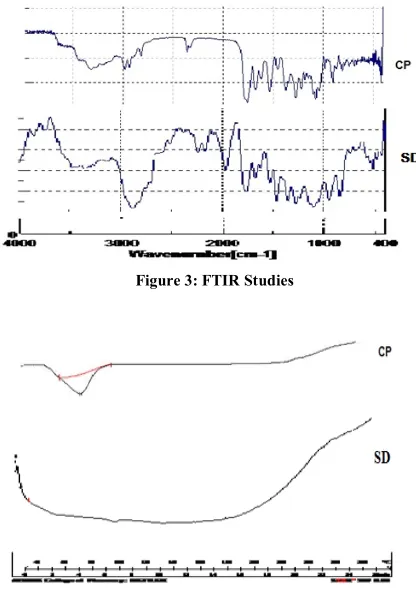
(3) Dhoka Madhura V et al. IRJP 2 (5) 2011 152-156 Estimation Of Cefpodoxime Proxetil CP was estimated at 262 nm using UV spectrophotometer (Jasco V-550, Japan). Standard curve for the estimation was prepared in methanolic 0.1 N HCl in concentration range of 12-20 µg/ml. In this concentration range good linearity was observed with the correlation coefficient (R2) 0.9987. The graph (Figure 2) obeyed the Beer-Lambert’s law in the selected concentration range. Fourier Transform Infrared Spectroscopy FTIR studies were done to detect the possible interactions between the CP and PEG 6000. The characteristic peaks of CP and PEG are retained in physical mixtures and in solid dispersion (Figure 3). It was revealed that there were no differences in the positions of the absorption bands, hence providing evidence for the absence of interactions in the solid state between CP and PEG. Differential Scanning Calorimetric Studies DSC studies revealed that, sharp endothermic fusion peak corresponding to melting point of CP observed at approximately 84 oC in the thermogram of pure CP. The peak observed for the melting of CP is found to be absent in that for SDs with PEG 6000 carriers (Figure 4). The complete disappearance of drug melting peak observed in the DSC thermogram of SDs with PEG 6000 can be attributed to uniform drug dissolution in the carriers. Dissolution Studies The dissolution rate of pure Cefpodoxime Proxetil was very poor and during 60 min a maximum about 38.40% of the drug was released. One of the reasons for the poor dissolution rate of CP is poor wettability. It was found that the dissolution rate of the drug increased by using hydrophilic carrier (PEG) in physical mixture as well as SD batches as compare to CP. This was due to the increase in solubility of drug by the presence of hydrophilic carrier surrounding the drug particles. Figure no 5 shows comparative release profile of various solid dispersions of CP with PEG 6000, physical mixture containing 1:1 ratio of CP : PEG and CP. From release profile it can be seen that dissolution of CP in solid dispersions increases as compared to pure drug and physical mixture. This increase in the dissolution rate may due to increase in CP wettability, solubilization of CP by carriers. It was found that the drug release from physical mixture is greater than that of the CP and slower than that of solid dispersions. From the results, it was conclude that the dissolution rate of CP increased by preparing solid dispersion with PEG.. IRJP 2 (5) May 2011. CONCLUSION From the present study it can be conclusively stated that, the aqueous solubility, pH dependent solubility and dissolution rate of CP can be in increased by preparing SDs with help of hydrophilic carriers like PEG 6000. Results obtained by different characterization techniques (FTIR, DSC) clearly indicated that the Kneading method leads to the formation of interaction between CP and PEG 6000 to form solid dispersions with improved dissolution rate. Hence, from preset study, it can be said that, problem of low bioavailability of CP due to low solubility may be handled by preparing Solid dispersions of Cefpodoxime proxetil with hydrophilic carriers like PEG 6000. ACKNOWLEDGEMENT The authors are grateful to Maxim Pharmaceuticals, Pune and Colorcon Asia, Goa for providing gift samples of Cefpodoxime proxetil and PEG 6000 respectively. Authors are thankful to Dr. Mrs. A.R.Madgulkar, Principal AISSMS College of pharmacy, Pune for providing all the facilities. REFERENCES 1. Todd WM. Cefpodoxime Proxetil: a comprehensive review. International Journal of Antimicrobial Agents 1994; 4, 37-62. 2. Date AA, Nagarsenker MS. Design and evaluation of selfnanoemulsifying drug delivery systems (SNEDDS) for cefpodoxime proxetil. International Journal of Pharmaceutics2007; 329, 166-172. 3. Arora S, Sharma P, Irchhaiya R, Khatkar A, Singh N and Gagoria J. Development, characterization and solubility study of solid dispersion of cefpodoxime proxetil by solvent evaporation method. International Journal of ChemTech Research 2010; 2, 1275-1280. 4. Kakumanu VK, Arora V, Bansal AK. Investigation of factors responsible for low oral bioavailability of Cefpodoxime Proxetil. International Journal of Pharm 2006; 12, 155-165. 5. Dhoka M, Joshi P, Gawande V. Preparation and evaluation of solid dispersions of cefpodoxime proxetil. Journal of Pharmacy Research 2009; 2(9), 1481-1484. 6. Leuner C, Dressman J. Improving drug solubility for oral European Journal of delivery using solid dispersions. Pharmaceutics and Biopharmaceutics 2000; 50, 47–60. 7. Vasconcelos T, Sarmento B, Costa P. Solid dispersions as strategy to improve oral bioavailability of poor water soluble drugs. Drug discovery today 2007; 12, 1068-1075. 8. Kai T. Oral absorption improvement of poorly soluble drug using solid dispersion technique. Chem. Pharm. Bull (Tokyo) 1996; 44(3), 568-571. 9. Modi A, Tayade P, Enhancement of Dissolution Profile by Solid Dispersion (Kneading) Technique AAPS PharmSciTech 2006; 7, E1-E6. 10. USP30 – NF25, Official Compendia of Standard, Asian edition 2007; 1092. 11. Patel N, Chotai N, Patel J, Soni T, Desai D, and Patel R. Comparison of In Vitro Dissolution Profiles of OxcarbazepineHP b-CD Tablet Formulations with Marketed Oxcarbazepine Tablets. Dissolution Technologies 2008; 28-34. 12. Ketkar A., Patil V., Paradkar A. PCP Disso v2.08 software.. Page 152-156.
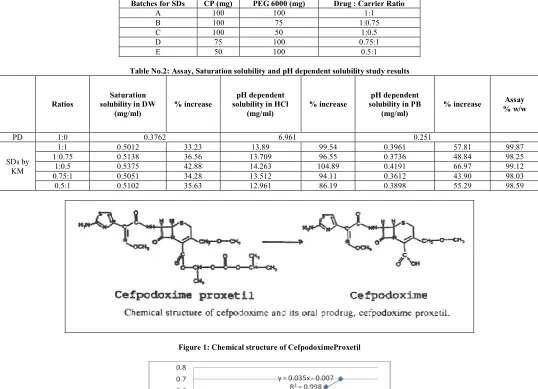
(4) Dhoka Madhura V et al. IRJP 2 (5) 2011 152-156 Table 1: Composition of Batches Containing Cefpodoxime Proxetil and PEG 6000. CP (mg) PEG 6000 (mg) Drug : Carrier Ratio Batches for SDs A 100 100 1:1 100 75 1:0.75 B C 100 50 1:0.5 D 75 100 0.75:1 E 50 100 0.5:1 Table No.2: Assay, Saturation solubility and pH dependent solubility study results. Ratios. PD SDs by KM. Saturation solubility in DW (mg/ml). 1:0 1:1 1:0.75 1:0.5 0.75:1 0.5:1. % increase. pH dependent solubility in HCl (mg/ml). 33.23 36.56 42.88 34.28 35.63. 13.89 13.709 14.263 13.512 12.961. 0.3762 0.5012 0.5138 0.5375 0.5051 0.5102. % increase. pH dependent solubility in PB (mg/ml). 99.54 96.55 104.89 94.11 86.19. 0.3961 0.3736 0.4191 0.3612 0.3898. 6.961. % increase. 0.251 57.81 48.84 66.97 43.90 55.29. Assay % w/w __ 99.87 98.25 99.12 98.03 98.59. Figure 1: Chemical structure of CefpodoximeProxetil. Figure 2: Calibration curve of CP in 0.1 N HCl. IRJP 2 (5) May 2011. Page 152-156.
(5) Dhoka Madhura V et al. IRJP 2 (5) 2011 152-156. Figure 3: FTIR Studies. Figure 4: DSC Studies. Figure 5: Mean (n = 3) in vitro dissolution profiles of solid dispersions of CP. Source of support: Nil, Conflict of interest: None Declared. IRJP 2 (5) May 2011. Page 152-156.
(6)
Figure
Related documents
Our audits of the consolidated financial statements referred to in our report dated January 24, 1996 appearing on page 28 of the 1995 Annual Report to Shareowners of
High Dose Nitrate Ingestion Does Not Improve 40 km Cycling Time Trial Performance in Trained Cyclists3.
ADL: Activity of daily living; CI: Confidence interval; CVD: Cardiovascular disease; ESRD: End-stage renal disease; CKD-MBD: Chronic kidney disease-mineral bone disorder; DOPPS:
He has nearly above 11 years of teaching experience and his research interest includes developing numerical methods for solving nonlinear equation, system of linear and
Abstract: Lysosomal acid lipase (LAL) de fi ciency is a metabolic (storage) disorder, encom- passing a severe (Wolman disease) and attenuated (Cholesterol ester storage disease)
Living the Flourish Question: Positivity as an Orientation for the Preparation of Teacher Candidates
In this article, the authors unpack taken-for-granted elements in a question central to their research and teaching: “What if the primary role of teachers is to learn how to thrive as
This Optometric Clinical Practice Guideline on Care of the Patient with Accommodative and Vergence Dysfunction describes appropriate examination, diagnosis, treatment, and
