IOSR Journal of Engineering (IOSRJEN)
e
-ISSN: 2250-3021,
p
-ISSN: 2278-8719
Vol. 3, Issue 1 (Jan. 2013), ||V2|| PP 31-37
Ferromagneto Toroidic Space Groups
M.Vijaya Laxmi
1, S.Uma Devi
2 1 PhD scholar, 2Professor,Department of Engineering Mathematics, Andhra University, Visakhapatnam
Abstract:- The full symmetry group of the crystal is called its Space group. The elements of space group are Combinations of the point group operations and translations. The 440 Ferroelectric space groups, viz the Heesch –shubnikov space groups, which are symmetry groups of Ferroelectric electric-dipole arrangements in crystals are already derived [4]. In this paper, we show that although Ferromagnetotoroidic point groups are 57, the number of Ferromagnetotoroidic spacegroups sum upto 728, and three Ferromagnetotoroidic spacegroups are tabulated by using Opechowski and Guccione symbols.
Keywords: space groups, Ferroelectric space groups, Ferromagnetotoroidic space groups, Magnetic space groups, point groups and grey groups
I.
INTRODUCTION
D.B.Litvin has tabulated 440 Ferroelectric Space groups, via the Heesch – shubinkov (Magnetic) space groups. Opechowski and Guccione [4]derived 1191 types of Symbols of magnetic space groups [6] belov, et al, tabulated 1651 types of magnetic space groups, which are the direct product of a space group and the time inversion group. Here we list, Ferromagnetotoroidic space groups by using the Opechowski – guccione symbols. Aizu classified all possible ferroic phase transistions into 773 Species (Aizu, 1970) each species is given the Symbol G11 F H represents the transition between a paramagnetic phase point group symmetry G11 and a lower symmetry phase of symmetry H . The F denotes ferroic.
A fourth type of primary ferroic crystals, a ferrotoroidic crystal, has been recently observed (Van Aken etal, 2007) where the domains are distinguished by a toroidal moment (Gobatsevich et al 1983, Schmidt 2001, 2003a), is an extension of extend Aizu’s species characterization and Schmidt’s Classification of species into ensembles to include ferrotoroidic crystals by including the domain-state distinguish ability by a spontaneous toroidal moment.
So, in addition to the ferroelectric, ferromagnetic, and ferroelastic primay ferroic crystals where domain states differ respectively by spontaneous polarization, magnetization and strain, there is a observed fourth type of primary ferroic crystal (B.B.Van Aken etal ) where domain states differ in spontaneous toroidal moment (A.A.Gorbatsevich, H.Schmid etal, ) T(s) is the spontaneous toroidal moment and Vector S with Components si ~ (E X H ) i is the source of the toroidal moment in the same way as electric and magnetic fields are source Vectors for Polarization and magnetization respectively. The physical property associated with each toroidic term is given in table 1 (D.B.Litvin 2008)
Table 1:
1. Spontaneous toroidal moment Ferrotoroidic av
2. Toroidic Susceptibility Ferrobitoroidic [V2]
3. Piezotoroidic Coefficient Ferroelastotoroidic av [V2] 4. Magneto toroidic Coefficient Ferromagentotoroidic eV2 5. Electrotoroidic Coefficient Ferroelectrotoroidic av2 6. Piezoelectric Coefficient Ferroelastoelectric V[v2]
Here first column given S.No Second column give physical property and 3rd & 4th Columns give Corresponding Ferroic Type and John Symbol.
Ferromagneto Toroidic Space Groups
II.
CRYSTALLOGRAPHIC POINT GROUP
Some Symmetry elements can exist together in the same crystal. There are 32 possible combinations altogether. A symmetric Survey of these combinations is called crystallographic point groups.
Grey Group: Let G be one of the 32 Crystallo-graphic point groups and 11 consists of identity and time inversion operator R 2. The direct product of G and 11, which is designated G1 1 is known as grey group 32 point groups in which R2 does not occur explicitly or in Combination with Symmetry operations are known as ordinary point groups.
Magnetic Point groups: The 58 groups in which R2 does not occur explicitly but occurs in combination with the symmetry operations are known as magnetic variants are (C.J.Bradly and Cracknel, 1972) of the 32 ordinary point groups. These 32 ordinary and 58 magnetic variants are known as magnetic point groups.
Space group: The full Symmetry group of a crystal is called its space group. The elements of spacegroup are Combinations of the point group operations and translations.
III.
FERROMAGNETOTOROIDIC SPACE GROUPS
Let F denote a Crystallographic group type. The magnetic super family of Crystallographic groups of the type F (opechowski, 1986) consists of
a) Groups of type F
b) Groups of type F1 1, where 1 1 denotes time inversion group consisting of the identity 1 and time inversion 1 1
c) Groups of type F (D) = D+ (F-D) 1 1 where D is a Subgroup of index two of F. Groups of this type will also be denoted by M2
The Third set of groups divided into two sub divisions.
i) Groups M T, where D is an Equi-translation Subgroup of F. ii) Groups MRwhere D is an equi-class subgroups of F.
Table II:
Further Let P, M, T and € ij denote the four quantities polarization, Magnetization, Toroidal moment and Strain respectively (Aizu), Aizu have given all possible ferroic phase transitions into 773 species (Aizu, 1970). Each Species was characterized by three physical properties T, Spontaneous magnetization, polarization and strain. This is extended to the ferrotoroidic crystals which are given in table II. The characteristic transformation properties of a toroidal moment, along with that of other three primary Ferroics under elements of the group T II = { I, T, I I , T I } are given in table II . The toroidal moment is differentiating that it is reversed by both spatial and time inversion so, the toroidal moment tensor invariant under the group H of a species G11FH.The 773 species of phase transistions G11FH (Aizu 1970) respresent transitions between a paramagnetic phases of point group symmetry G11 and a lower symmetry phase. The 773 species of phase transitions G11FH (Aizu, 1970) represent transitions between a paramagnetic phases of point group symmetry G11 and a lower symmetry phase. Each species is characterized by four physical properties, ability to distinguish among the single domain states that arise due to the phase transition. These four physical properties are spontaneous toroidalmoment, spontaneous magnetization, spontaneous polarization, and spontaneous strain respectively. In the same manner the fourth types of primary and secondary Ferroic physical properties are given (3). So, here we determine the Ferromagnetotoroidoc point groups 57 and the corresponding Ferromagnetotoroidic space groups 645 (by sing opechowski and Guccione symbols), rest of the tables are available with the authors.
Ferromagneto Toroidic Space Groups
If follows from character Table II and the vector properties of P, M and T that the maximal symmetry group of a polarization vector P is ∞ m 1I
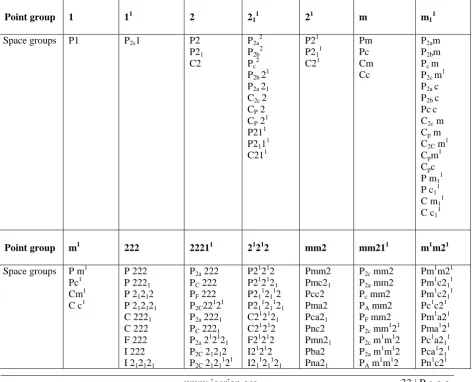
of a magnetization vector M is ∞/mmI, and toroidalmanent vector ∞/m Im, this is Heesch – Shubnikov groups. Which Heesch – shubnikov groups have a point group that is a subgroup of ∞m11. In a similar manner Heesch – Shubnikov groups have a point group that is a subgroup of ∞/mm I, or ∞/m Im. Here we list, Ferromagnetotoroidic space groups by using the opechowski & Guccione Symbols, and they are given in table IV.
Table III: the fifty ferromagnetotoroidic point groups.
1 11
2 211 21
m m1
1
m1
222 22211 21212
mm2 mm211 m1m21 m1m12
4 411 41
4 411 41
422 42211 41221 42121
4 mm 4 mm11 41m1m 4m1m1 42 m 42 m11 4121m 421m1
3 311
32 3211 321
3m 3m11 3m1
6 611 61
622 62211 61212 62121
6mm 6mm11 61m1m 6m1m1
23 2311
432 43211 41321
Table IV: The 728 ferromagnetotoroidic point groups.
Point group 1 11 2 21 1
21 m m1 1
Space groups P1 P2s1 P2
P21 C2
P2a 2
P2b2 Pc2 P2b 21 P2a 21 C2c 2 CP 2 CP 21 P211 P2111 C211
P21 P211 C21
Pm Pc Cm Cc
P2am P2bm Pc m P2c m1 P2a c P2b c Pcc C2c m Cp m C2C m1 Cpm1 Cpc P m1
1
P c11 C m11 C c11
Point group m1 222 22211 21212 mm2 mm211 m1m21
Space groups P m1 Pc1 Cm1 C c1
P 222 P 2221 P 21212 P 212121 C 2221 C 222 F 222 I 222 I 212121
P2a 222 PC 222 PF 222 P2C22121 P2a 2221 PC 2221 P2a 2
1 2121 P2C 21212 P2C 2121121
P21212 P212121 P2112112 P21121121 C212121 C21212 F21212 I21212 I21121121
Pmm2 Pmc21 Pcc2 Pma2 Pca21 Pnc2 Pmn21 Pba2 Pna21
P2c mm2 P2a mm2 Pc mm2 PA mm2 PF mm2 P2c mm121 P2c m
1 m12 P2a m1m12 PA m1m12
Pm1m21 Pm1c211 Pm1c211 Pc1c21 Pm1a21 Pma121 Pc1a21
1
Ferromagneto Toroidic Space Groups
CP2221CP 2121211 C2C 222 CP222 C1222 C2C 22121 CP21212 CP22121 C121221 C121221 FC222 FC22
1 21 IP222 IP21212 IP 212121 IP 21121121 P 22211 P 222111 P 2121211 P 21212111 C 222111 C 22211 F 22211 I 22211 I 21212111
P 221211 P 2121121 C 22121
1
C 22121
Pnn2 Cmm2 Cmc21 Ccc2 Amm2 Abm2 Ama2 Aba2 Fdd2 Imm2 Iba2 Ima2
P2a mc21 P2b mc21 Pc mc21
Pnc211 Pmn2111 Pba211 Pna211 1 Pnn211 Cmm211 Cmc211 Ccc211 Amm211 Abm211 Ama211 Aba211 Fmm211 Fdd211 Imm211 Iba211 Ima211
Pnc121 Pm1n211 Pmn121
1
Pb1a21 Pn1a211 Pna1211 Pn1n21 Cm1m21 Cm1c211 Cmc1211 Cc1c21 Am1m21 Amm121 Ab1m21 Abm121 Am1a21 Ama121 Ab1 a21 Aba121 Fm1m21 Fd1d21 Im1m21 Ib1 a21 Im1a21
Point group m1m12 4 411 41 4 411 41
Space groups Pm1m12 Pm1c121 Pc1c12 Pm1a12 Pc1a121 Pn1c12 Pm1n121 Pb1a12 Pn1a121 Pn1n12 Cm1m12 Cm1c121 Cc1c12 Am1m12 Ab1m12 Am1a12 Ab1a12 Fm1m12 Fd1d12 Im1m12 Ib1a12 Im1a12
P4 P41 P42 P43 I4 I41
P2C4 PP4 P14 P2C41 PP41 P2C42 PP42 P142 P2C421 PP43 IP4 IP41 IP41 IP411 P411 P4111 P4211 P4311 I411 I4111
P41 P411 P42
1
P431 I41 I411
P 4
I 4
P2C4
PP4
P14
IP4
P411
I411
P41
I41
Point group 422 42211 41221 42121 4 mm 4 mm11 41m1m
Space groups P422 P4212 P4122 P41212
P2C422 PP422 P1422 P2C41221
P41221 P412121 P41
1 221 P4112121
P42121 P421121 P412
1 21 P4121121
P4mm P4bm P42cm P42nm
P2c4mm Pp4mm P14mm P2c41m1m
Ferromagneto Toroidic Space Groups
P4222P42212 P4322 P43212 I422 I4122
PP41221 P2C4212 P2C4
1 21
1 2 PP4122 PP411221 P2C4222 PP4222 P14222 P2C421221 PP421221 P2C42212 P2C42
1 21
1 2 PP4322 PP431221 IP422 IP41221 IP42121 IP41212 IP4122 IP411221 IP412121 IP411212 P42211 P421211 P412211 P4121211 P42221
1
P422121 1
P432211 P4321211 I42211 I412211
P421221 P4212121 P43
1 221 P4312121 I41221 I411221
P422121 P4221121 P432
1 21 P4321121 I42121 I412121
P4cc P4nc P42mc P42bc I4mm I4cm I41md I41cd
P2c41m m1 P2c41 m1m1 Pp4
1 mm1 P141 m1m1 P2c41 b1m P2c41 bm1 P2c4 b1m1 Pp42 cm Pp421 cm1 P142 nm P142 n1m1 Pp4cc Pp41cc1 Pp42mc Pp42
1 mc1 Ip4mm Ip41m1m Ip41m m1 Ip4m1 m1 Ip4cm Ip41c1m Ip41c m1 Ip4c1 m1 P4mm11 P4bm11 P42cm11 P42nm1
1
P4cc1 1
P4nc11 P42mc11 P42bc11 I4 mm11 I4 cm11 I41md11 I41cd11
P421c1m P421cm1 P42
1 n1m P421nm1 P41c1c P41c c1 P41n1c P41n c1 P421m1c P421mc1 P421b1c P42
1 bc1 I41m1m I41mm1 I41c1m1 I41cm1 I411m1d I411md1 I411c1d I411cd1
Point group 4m1m1 42 m 42 m11 4121m
421m1 3 311
Space groups P4m1m1 P4b1m1 P42c
1 m1 P42n1m1 P4c1c1 P4n1c1 P42m
1 c1 P42b1c1 I4m1m1 I4c1m1 I41m
1 d1 I41c1d1
P42m
P42c
P421m
P421c
P4m2 P4c2 P4b2 P4n2 I4m2 I4c2 I42m
P2c42m Pp42m P142m P2c421m1 Pp412m1
P14 2m1
Pp42c
Pp412c1
P2c421m
P2c4121m1
P2c4m2
Pp4m2
P14m2
P4121m P4121c P41211m P41211c P41 m21 P41 c21 P41 b21 P41 n21 I41 m21 I41 c21 I41 21 m I41 21 d
P421m1 P421c1 P4211m1 P4211c1 P4m121 P4c121 P4b121 P4n121 I4m121 I4c121 I421m1 I421d1
P3 P31 P32 R3
Ferromagneto Toroidic Space Groups
I42d P2c41m12
Pp41m21
Pp4c2
Pp41c21
P2c4b2
P2c4b 1
2
P14n2
Ip4m2
Ip41m12
Ip4c2
Ip4c121
Ip42m
Ip4121m
Ip4 1
2m1
Ip421m1
Point group 32 3211 321 3m 3m11 3m1
Space groups P312 P321 P3112 P3121 P3212 P3221 R32
P2C312 P2C321 P2C3212 P2C3221 P2C3112 P2C3121 RR32 P31211 P32111 P311211 P32121
1
P322111 R3211
P3121 P3211 P31121 P31211 P32121 P32211 R321
P3m1 P31m P3c1 P31c R3m R3c
P2C3m P2C3m11 P2C31m P2C31m1 RR3m RR3m1 P3m11 P31m1 1
P3c111 R31c11 R3m11
P3m11 P31m1 P3c11 P31c1 R3m1 R3c1
Point group 6 611 61 622 62211 61212 62121
Space groups P6 P61 P65 P62 P64 P63
P2C6 P2C6
1
P2C62 P2C621 P2C64 P2C614 P611 P6111 P6511 P621
1
P6411
P61 P61 1
P651 P621 P641 P631
P622 P6122 P6522 P6222 P6422 P6322
P2C622 P2C6
1 221 P2C6222 P2C621221 P2C6422 P2C641212 P62211 P612211 P652211 P62221
1
P642211
P61212 P61
1 212 P65 1212 P62 1212 P64 1212 P63 1212
P62121 P612
Ferromagneto Toroidic Space Groups
P6311 P632211
Point group 6mm 6mm11 61m1m 6m1m1 23 2311 432
Space groups P6mm P6cc P63cm P63mc
P2C6mm P2C61m1m P2C61m m1 P2C6m1m1 P6mm11 P6cc11 P63cm11 P63mc11
P61m1m P61m m1 P61c1c P61cc1 P631c1m P631cm1 P631m1c P631mc1
P6m1m1 P6c1c1 P63c1m1 P63m1 c1
P23 F23 I23 P213 I213
PF23 IP23 IP213 P2311 F2311 I2311 P21311 I21311
P432 P4232 F432 F4132 I432 P4332 P4132 I4132
Point group 43211 41321
Space groups
PF432 PF4232 IP432 IP41321 IP4132 IP41132 P43211 P423211 F43211 I43211 P433211 I413211
P41321 P42 1321 F41321 F411321 I41321 P431321 P411321 I411321
IV.
CONCLUSION
Opechowki and Guccione gave 1191 types of symbols of magnetic space groups .D.B.LITIVN have tabulated 440 ferroelectric space groups by using Opechowki and Guccione symbols,also D.B.Litvin have tabulated 1,2 and 3 magnetic space groups. So here ferromagnetotoroidic space groups by using Opechowki and Guccione symbols are calculated. Ferromagnetotoroidic property is exhibited in solid nano crystal NaNbo3 with space group p21ma (c2V)
REFERENCES
[1]. Aizu, K. (1970), Phys. Rev. B, @, 754-772[2]. Litvin, D.B., Acta Cryst. (2008) A 64, 316-320 [3]. Litvin, D.B., Acta, Cryst, (2007), Section A [4]. Litvin, D.B.Acta. Cryst. (1968). A 42, 44-47
[5]. ASchER, E & Janner, A.G.M… properties of Shubnikov point groups. Battelle institute, Geneva, Switzerlavel.
[6]. Rosa Lia Guccione, A Thesis of Magnetic Space groups
[7]. W. opechowski and R.Guccione, in magnetism, edited by G.T.Rado and H.Suhl (Academic, Newyork, 1965), Vol II A, P. 105.