Original Research Article
Alcohol consumption among immigrant construction workers and
its correlates, a need for action
Rajeshkannan S.
1*, Parthiban P.
2, Murali Mohan Reddy G.
1INTRODUCTION
Alcohol use is an important public health problem, especially in developing countries like India. Alcohol is by far the most used and misused psychoactive substance in the workforce. Alcohol consumption by the workers is associated with loss of productivity and considerable economic burden to the society.1 Harmful consumption of alcohol is a major public health challenge globally associated with workplace productivity loss.2 Presently alcohol policy in India takes a moral stand rather than a scientific approach towards understanding and dealing
with the problem of alcoholism. The construction sector is an ever-growing industry worldwide. In India, it has registered enormous growth during last few decades. The prevalence of alcohol use among construction workers was found to be 15.8% in a study by Laad et al.3 In the construction sector, the majority of employees are aged between 15 to 45 years. They are single and often have to migrate depending on their place of work. Therefore in this population, abuse of substances such as alcohol and tobacco are common.3,4 In the construction industry, there is heavy physical work and the living and
ABSTRACT
Background: In developing countries, although the construction industry is making rapid strides, the health of the migrant construction workers is almost neglected. Among the major industries, construction workers have one of the highest alcohol abuse rates. Their working patterns, lack of recreational activities, lack of education, misconceptions and taboos make construction workers indulge in Alcohol abuse.
Methods: A cross-sectional community-based study was done in old Mahabalipuram road of Chennai on 300 immigrant construction workers working in the construction field at least for the past one year using WHO recommended AUDIT (alcohol use disorders identification test) questionnaire to estimate the prevalence of alcohol use and associated factors.
Results: The prevalence of alcohol consumption was 55.7%. The majority (56%) of alcoholics consumed alcohol once or less in a month. 81% of alcoholics had AUDIT scores below 8, 17% between 8 to 15. None scored more than 20. There was no statistically significant difference between the educational qualification, age with regards to prevalence of alcohol consumption. Male gender (p<0.001) influenced substance use.
Conclusions: The prevalence of alcohol use (55.7%) among construction workers was very high compared to the general population. Specific intervention programs are warranted to reduce the future burden of alcohol use related morbidity among these workers.
Keywords: AUDIT, Alcohol use, Abuse, Construction workers
Department of Community Medicine, 1Chettinad Hospital and Research Institute, Kelambakkam, 2Govt. Vellore Medical College, Pennathur Post, Adukkamparai, Vellore, Tamil Nadu India
Received: 13 July 2018
Revised: 21 August 2018
Accepted: 22 August 2018
*Correspondence:
Dr. Rajeshkannan S.,
E-mail: [email protected]
Copyright: © the author(s), publisher and licensee Medip Academy. This is an open-access article distributed under the terms of the Creative Commons Attribution Non-Commercial License, which permits unrestricted non-commercial use, distribution, and reproduction in any medium, provided the original work is properly cited.
working environment are untidy especially in developing countries like India. The presence of unhygienic environment, working patterns, lack of recreational activities and make them indulge in substance abuse. A variety of factors like personal attitudes and beliefs, social customs and practices, affordability, availability and cost of the substance being abused are involved.5 Taboos, lack of education and misconceptions that alcohol may increase concentration, decrease anxiety and tension, besides inducing a feeling of pleasure also may play a role in its abuse. Among the major industries, the highest rates of heavy alcohol use were found among construction workers.6 The need of the study arises in a developing country like India, where the construction industry is making rapid strides as the health of the workers are almost neglected. There is also a paucity of data on the pattern and associated factors of alcohol use in construction industry. There are only a very few community-based studies that have evaluated the prevalence of alcohol use in construction workers in India.
The results from these studies will go a long way understanding the magnitude of the problem and social factors leading to alcohol use in migrant construction workers besides giving an insight for taking specific interventional measures at the community level. Hence, we conducted a cross-sectional study to determine the prevalence of alcohol use in immigrant construction workers using AUDIT questionnaire and to assess the associated factors and pattern of alcohol consumption in the study population. The outcome measure of interest is the total score on the 10-item AUDIT. The Alcohol Use Disorders Identification Test (AUDIT) was designed by World Health Organization (WHO) in the 1980s and has been widely validated in several countries including India.7-9
METHODS
Study design:
Cross-sectional community-based study (with individual face to face interview).
Study area
The study area was old Mahabalipuram road area of Chennai metropolitan city, which is having a high density of migrant construction worker establishments.
Reference population
The study population was representative of the whole of migrant construction workers in Chennai.
Inclusion criteria
Migrant construction workers working in the construction field at least for the last one year.
Study period
The data collection for the study period was done between September 2015 to October 2016.
Sample size
Based on various studies reported, the prevalence of tobacco was taken at 20%. Assuming 5% absolute precision and, 95% confidence level the required sample size was 245. Thus approximately 300 individuals were included in the study.
Selection of study subjects
Any living area of construction workers accommodating more than 100 people was taken as a study unit. Approximately 100 such study units were identified and a serial number was allotted to each of them. By using simple random sampling 30 such study units were selected to be included in the final study. From each of the study units, 10 participants were selected by simple random sampling after allotting serial numbers to the residents. Thus the sampling method used was multi-stage simple random sampling.
Study tools
World health organization (WHO) recommended alcohol use disorder identification test (AUDIT) was used to collect data regarding alcohol use in the study population. Pilot survey
A pilot survey will then be carried out on twenty individuals to test the feasibility of the administration of tools in the field setting.
Ethical considerations
Approval of Institute Ethics Committee, Chettinad Hospital and Research Institute was obtained. Informed written consent in the mother tongue of the participants was obtained from the respondents prior to recruitment in the study (Annexure I). All possible information regarding the study was being given to the respondents. Confidentiality of the respondents was maintained. Respondents were given the option of quitting from the study if so desired by them. No element of compulsion was exerted.
Analysis of data
deviation, t-test, Chi-square tests were used appropriately for analysis.
RESULTS
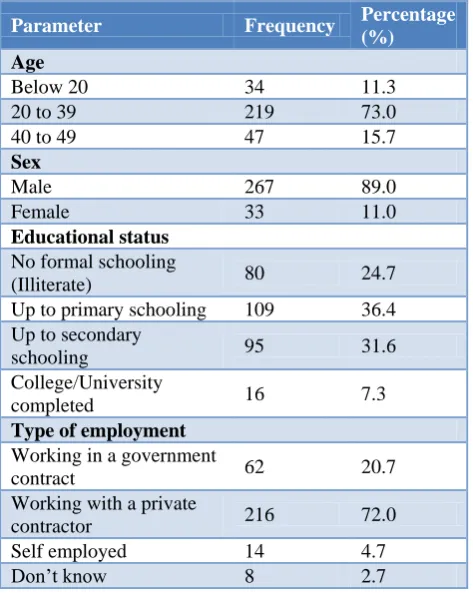
A total of 323 persons were contacted and 23 (7.1%) of them refused to participate. Busy with the work, feeling tired and not interested were the reasons for non-participation. A total of 300 participants were included in the final analysis. Majority of the study a participant were between 20 to 39 years (73%) and the proportion of people below 20 years and 40 years above 40 years was 11.3% and 15.7% respectively. The majority (89%) of the participants were males and females constituted only 11% of the study subjects. Out of 300 participants, 24.7% were illiterates, 36.4% studied up to primary school, 31.6% completed schooling up to secondary school and only 7.3% of them completed formal education beyond high school. Majority of them were working with the private contractors (72%), the remaining people were either involved in government outsourced work or self-employed (Table 1).
Table 1: Socio-demographic characteristics of study population (N=300).
Parameter Frequency Percentage
(%)
Age
Below 20 34 11.3
20 to 39 219 73.0
40 to 49 47 15.7
Sex
Male 267 89.0
Female 33 11.0
Educational status
No formal schooling
(Illiterate) 80 24.7 Up to primary schooling 109 36.4 Up to secondary
schooling 95 31.6
College/University
completed 16 7.3
Type of employment
Working in a government
contract 62 20.7
Working with a private
contractor 216 72.0
Self employed 14 4.7
Don’t know 8 2.7
Only 24% of the study participants were free from substance use. So, the proportion of participants using at least one substance was 76%. The proportion of participants reporting alcohol consumption was 55.7%. A significant proportion of the study participants were users of multiple substances. The proportion subjects who are both smokers and alcoholics was 18.3%, 19.7% of the
people were using both smokeless tobacco and alcohol. 8.3% of the subjects were using all the three substances, i.e. tobacco smoke, smokeless tobacco and alcohol (Table 2).
Table 2: Summary of substance use among construction workers (N=300).
Parameter Frequency Percentage
(%)
No substance abuse 72 24.0
Anyone substance abuse (alcohol or smoking or smokeless tobacco)
128 76.0
a. Alcohol 167 55.7
b. Smoking and alcohol 55 18.3 c. Smokeless tobacco and
alcohol 59 19.7
d. All the substances 25 8.3
Out of 167 alcoholics, the majority (56%) of them reported that they are consuming alcohol once or less in a month. The proportion of people reporting the frequency of 2 to 4 times a month, 2 to 3 times a week and more than 4 times a week were 25%, 11% and 8% respectively (Figure 1).
Figure 1: Frequency of alcohol consumption (N=167).
Figure 2: Risk stratification of alcoholics basing on AUDIT score(N=167).
8% 11%
25% 56%
0% 10% 20% 30% 40% 50% 60%
4 or more times a week 2 to 3 times a week 2 to 4 times a month Monthly or less
Proportion
Frequency
135 (81%)
29 (17%)
3 (2%) 0
20 40 60 80 100 120 140 160
Below 8 8 to 15 16 to 20
Num
ber
Risk stratification of alcoholics was done taking a various cut off levels of AUDIT score, each of which indicates the degree of drinking and warrants the need for a different kind of intervention. Out of 167 alcoholics, 135 (17%) were having AUDIT scores below 8, there were 29
(17%) people with AUDIT scores between 8 to 15 and 3(2%) of the subjects were there between 16 and 20. None of the current study subjects had to AUDIT score more than 20 (Figure 2).
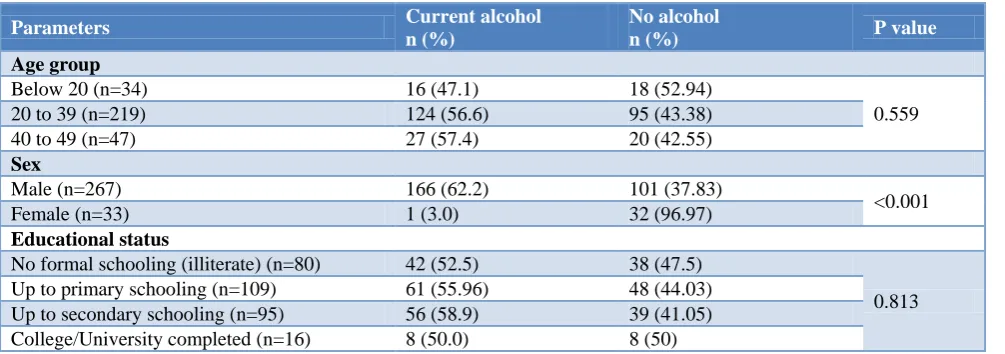
Table 3: Influence of various socio demographic factors on various substance use.
Parameters Current alcohol
n (%)
No alcohol
n (%) P value
Age group
Below 20 (n=34) 16 (47.1) 18 (52.94)
0.559
20 to 39 (n=219) 124 (56.6) 95 (43.38)
40 to 49 (n=47) 27 (57.4) 20 (42.55)
Sex
Male (n=267) 166 (62.2) 101 (37.83)
<0.001
Female (n=33) 1 (3.0) 32 (96.97)
Educational status
No formal schooling (illiterate) (n=80) 42 (52.5) 38 (47.5)
0.813 Up to primary schooling (n=109) 61 (55.96) 48 (44.03)
Up to secondary schooling (n=95) 56 (58.9) 39 (41.05) College/University completed (n=16) 8 (50.0) 8 (50)
The prevalence of alcohol consumption showed increasing trend with increasing age of the individual. But the difference in prevalence across different age groups was statistically not significant (p value 0.559). The prevalence was 62.2% in males and only 3% in females and the difference was statistically significant (p<0.001). No statistically significant difference was observed between the educational qualification of the person and the prevalence of alcohol consumption (Table 3).
DISCUSSION
According to the WHO Global status report on Alcohol and Health 2014, 38.3% of world’s population consumes alcohol regularly and One fourth to One-third of the male population drinks alcohol in India and the use amongst women in increasing.1,10 Alcohol use patterns are heterogeneous ranging from alcohol dependence to hazardous and harmful drinking, with each part of the spectrum requiring a different approach to screening, diagnosis and management.11 Construction labourers confront many stressors which pose challenges to their physical and mental health and their work is characterized by instability and low, unpredictable wages. Their working conditions under which day labourers operate are often physically hazardous. Further, the majority of day labourers experience abuse by their employers, intimidation by authorities, and harassment by the communities in which theyseek employment.12 The unique stressors associated with the migratory, working, and living circumstances of these labourers make them vulnerable to risk factors that may affect their physical health status, mental health, and drinking patterns. After getting ethical approval, we did a cross-sectional community-based study on 300 immigrant construction
were using at least one substance for abuse.17 Kumar et al in their study found that in general population, Prevalence was more among males (16.8%) as compared to that among females (1.3%).17 Multiple logistic regression analysis in their study revealed that middle age (15–44 years), male gender (OR=11.23), illiteracy (OR=6.16), lower education levels (OR=2.57) and smoking (OR=17.78) were independently associated with alcohol use.
In our study, male gender was a statistically significant factor in determining alcohol use (P value <0.001). In our study, almost all the alcoholics were males (99% - 166 out of 167) and were aged between 20 to 40 years (74% - 124 out of 167). Corrao et al also reported that the predominant age group affected was 31-40 years in their study similar to our study.5 Laad et al in their study also observed that nearly 50% of workers were among 21-30 years of age.3 Most of the workers involved in substance abuse were illiterate in their study and 62% of their workers belonged to poor socio-economic group similar to our study. In our study, no statistically significant difference was observed between the educational qualification of the person and the prevalence of alcohol consumption. Corrao et al reported that in their study alcohol abuse was associated with marital status (p<0.001) (prevalence of 55.55% among separated subjects) and education (p<0.05) (prevalence of 28.18% among subjects with middle school diploma). Consistent with earlier studies, our study also found that lower the education, higher the prevalence of alcohol use but without statistical significance.3,5,14 The prevalence of alcohol consumption showed increasing trend with increasing age of the individual in our study. A significant proportion of the study participants in our study were users of multiple substances. In our study, the majority (56%) were consuming alcohol once or less in a month. 81% had AUDIT scores below 8. None of the study subjects had to AUDIT score more than 20. 19% had scored above 8 in AUDIT. A score of 8 or more is considered to indicate hazardous or harmful alcohol use. Corrao et al also reported that alcohol abuse has affected the 21.3% of workers in their study similar to our study.5 Presently alcohol policy in India takes a moral stand rather than a scientific approach towards understanding and dealing with the problem of alcoholism. Workers in the construction industry are single and are often migrating. Their working patterns, lack of recreational activities make them indulge in substance abuse. Our study adds to the very few community-based studies that have evaluated the prevalence of alcohol use in construction workers in India and these results will go a long way understanding the magnitude of the problem besides creating awareness for taking interventional measures at the community level. The need of the hour is to devise an immediate intervention program so as to reduce the burden of morbidity due to alcohol use among construction workers. There is a need for regular health education sessions focussing on behaviour change,
especially aimed at alcohol cessation. Screening camps for alcohol-related cancers can be planned for these high-risk groups of construction workers. Services ranging from counselling to deaddiction therapies and affordable supply of pharmacological agents for those in need is essential. The health of the labourers working in the construction industry should be dealt on a priority basis by the government of India.
CONCLUSION
The prevalence of alcohol consumption seems to be quite high among construction workers. Majority of the alcoholics also have other substance abuse like smoking and tobacco chewing. The proportion is significantly higher in males, as compared to females. About one fifth of the alcoholics had AUDIT score of more than 8 indicating problem drinking.
Funding: No funding sources Conflict of interest: None declared
Ethical approval: The study was approved by the Institutional Ethics Committee
REFERENCES
1. World Health Organization. Global status report on alcohol and health. 2014.
2. Thørrisen MM, Skogen JC, Aas RW. The associations between employees’ risky drinking and sociodemographics, and implications for intervention needs. BMC Public Health. 2018;18(1):735.
3. Laad PS, Adsul BB, Chaturvedi RM, Shaikh M. Prevalence of substance abuse among construction workers. Paripex Indian J Res. 2013;2(3):280–3. 4. Cook RF, Hersch RK, Back AS, McPherson TL.
The prevention of substance abuse among construction workers: A field test of a social-cognitive program. J Prim Prev. 2004;25(3):337–57. 5. Corrao CR, Fratarcangeli M, Capitanelli I. [Alcohol use in the construction industry: results of a survey]. G Ital Med Lav Ergon. 2012;34(3):507–10.
6. Bush DM, Lipari RN. Substance Use and Substance Use Disorder by Industry. The CBHSQ Report. Rockville (MD). US: Substance Abuse and Mental Health Services Administration; 2013: 1–18. 7. Saunders JB, Aasland OG, Babor TF, de la Fuente
JR, Grant M. Development of the Alcohol Use Disorders Identification Test (AUDIT): WHO Collaborative Project on Early Detection of Persons with Harmful Alcohol Consumption—II. Addiction. 1993;88(6):791–804.
8. Pal HR, Jena R, Yadav D. Validation of the Alcohol Use Disorders Identification Test (AUDIT) in urban community outreach and de-addiction center samples in north India. J Stud Alcohol. 2004;65(6):794–800.
in developing countries: a comparison of 2 screening measures in India. Alcohol Clin Exp Res. 2009;33(12):2057–66.
10. Rathod SD, Nadkarni A, Bhana A, Shidhaye R. Epidemiological features of alcohol use in rural India: a population-based cross-sectional study. BMJ Open. 2015;5(12):e009802.
11. Li Q, Babor TF, Hao W, Chen X. The Chinese translations of Alcohol Use Disorders Identification Test (AUDIT) in China: a systematic review. Alcohol Alcohol. 2011;46(4):416–23.
12. Bacio G, Moore A, Karno M, Ray L. Determinants of problem drinking and depression among Latino Day laborers. Subst Use Misuse. 2014;49(8):1039– 48.
13. Gache P, Michaud P, Landry U, Accietto C, Arfaoui S, Wenger O, et al. The Alcohol Use Disorders Identification Test (AUDIT) as a screening tool for excessive drinking in primary care: reliability and validity of a French version. Alcohol Clin Exp Res. 2005;29(11):2001–7.
14. Santini M, Bancone C, Bresciani M, Bigoni F, Silva G, Riva MM, et al. Survey on alcohol and
construction workers. G Ital Med Lav Ergon. 2012;34(3):521–5.
15. Peacock A, Leung J, Larney S, Colledge S, Hickman M, Rehm J, et al. Global statistics on alcohol, tobacco and illicit drug use: 2017 status report. Addiction. 2018.
16. Mosconi G, Riva MM, Lorenzi S, Silva G, Bartolozzi F, Pavesi G, et al. [Alcohol and construction workers]. Med Lav. 2007;98(6):493– 500.
17. Ganesh Kumar S, Premarajan KC, Subitha L, Suguna E, Vinayagamoorthy, Kumar V. Prevalence and Pattern of Alcohol Consumption using Alcohol Use Disorders Identification Test (AUDIT) in Rural Tamil Nadu, India. J Clin Diagn Res. 2013;7(8):1637–9.