Original Research Article
Study to assess the knowledge and health seeking behaviour of mothers
of under 5 children in the catchment area of G.M.C., Bhopal
Rama Singodiya Lodha, Dinesh Kumar Pal, Shipra Verma*, Veena Melwani,
Amreen Khan, Harshima Sawlani, Akhil R. Nair
INTRODUCTION
Under 5 mortality rate is considered as the best indicator of social development and wellbeing. Therefore, it is important that the U5MR remains on the lower side. Mothers should be well equipped with the knowledge of a healthy living in order to increase greater utilization of resources, promotion of healthy lifestyle, and greater adoption of healthy practices. India contributes to 25% Under 5 deaths occurring worldwide every year.1
Almost 1/3rd die of infectious cause, nearly all of which are preventable. According to WHO (2015), the most common cause of mortality are pneumonia- 13% and
diarrhoea– 9%. According to NHFS-4 (MP fact sheet) Prevalence of diarrhoea in the last 2 weeks - 9.5% and Prevalence of symptoms of (ARI) -2.1%.2 Large number of maternal and child deaths are attributable to three delays- the delay in deciding to seek care, the delay in reaching the appropriate health facility and the delay in receiving quality care once inside the institution.3
The differences in the health related knowledge and practices stems out of poverty leading to illiteracy, low socioeconomic background. There are certain myths and taboos surrounding the immunization of the children and many a times parents fall for these traps. Therefore a study was conducted to explore and assess the knowledge
ABSTRACT
Background: Under 5 mortality rate is considered as the best indicator of social development and well being. Low U5MR indicates better social development as children are most vulnerable during the first 5 years. Almost 1/3rd die of infectious cause, nearly all of which are preventable.
Methods: A cross- sectional interventional study was done on 105 mothers with children under the age group of 5 years. Knowledge and practice about diarrhoea, pneumonia and immunization was assessed first followed by and educational intervention which was later followed by post intervention interview of the same mothers after a gap of 1 month. The increment in the knowledge was then assessed.
Results: 41.9% belonged to the age group of 20-25 years. 94.11% of the mothers knew what diarrhoea is and only 47.61% could tell minimum 3 signs of dehydration. 32.38% could tell the specific signs of pneumonia. 90.47% mothers knew that immunisation prevents children from diseases. The overall knowledge scores improved significantly (p<0.0001) after a gap one month.
Conclusions: The knowledge appeared to improve significantly after an education intervention. The immunization coverage was found to be adequate.
Keywords: Under 5 children, Diarrhoea, Immunization
Department of Community Medicine, Gandhi Medical College, Bhopal, Madhya Pradesh, India
Received: 18 July 2018
Revised: 22 August 2018
Accepted: 23 August 2018
*Correspondence:
Dr. Shipra Verma,
E-mail: [email protected]
Copyright: © the author(s), publisher and licensee Medip Academy. This is an open-access article distributed under the terms of the Creative Commons Attribution Non-Commercial License, which permits unrestricted non-commercial use, distribution, and reproduction in any medium, provided the original work is properly cited.
and practices of mothers of under 5 children in context of health seeking behaviour as mothers are usually the sole caretakers and the burden of responsibility falls on them.
METHODS
The study was conducted in Fatehgarh, field practice area of Department of Community Medicine, Gandhi medical college, Bhopal, over a period of three months from October 2017 to December 2017. A list of household was prepared and 105 houses were selected by purposive sampling. The teams did a house to house survey to find out the mothers who have children under the age group of 5 years and has suffered from diarrhoea or pneumonia at least once in the past 1 one year. All the mothers with such history were included in the study. A team of two interviewers interviewed one mother at a time on a predesigned pretested questionnaire and assessed the knowledge and practice of mothers in context of
diarrhoea, pneumonia and immunization. After conducting the interviews, an educational intervention of the interviewed mothers was done with the help of demonstration and power point presentations followed by post intervention interview of the same mothers after a gap of one month. Thereafter, the increment in the knowledge was observed. The data was analysed using Epi info 7 software.
RESULTS
105 mothers of Under 5 children participated in the study. Majority of the mothers i.e. 41.9% belonged to the age group of 20 - 25 years. 35.23% of the mothers belonged to middle socioeconomic status according to modified B.G. Prasad scale. The monthly expenditure on health is Rs. ≤500 in 62.85% of the households. As far as treatment seeking behaviour is concerned, 82.85% of the mothers believed in going to a doctor (Table 1).
Table1: Socio demographic characteristics of mothers of study population.
S. No. Variables Frequency
(n=105)
Percentage (%)
1. Age group
(in years)
20-25 44 41.9
26- 30 37 35.2
>30 24 22.85
2. Education status
Illiterate 15 14.28
Primary 16 15.23
Secondary 50 47.61
Higher secondary 13 12.38
Graduate 11 10.47
3. Religion Hindus 51 48.57
Muslim 49 46.66
4. Occupational status Working 9 08.57
Housewife 91 86.66
5. Socio economic status
Upper class 09 08.57
Upper middle class 05 04.76
Middle class 37 35.23
Lower middle class 32 30.47
Lower class 17 16.19
6. Monthly expenditure on health
≤500 66 62.85
500-≤1000 13 12.38
>1000 26 24.76
7. Health seeking behaviour Appropriate care 87 82.85
No appropriate care 18 17.14
Table 2: Treatment seeking behaviour of mother not seeking doctor for treatment.
S. No. Treatment seeking behaviour Frequency (n=18) Percentage (%)
1. Home treatment with Ayurvedic remedies 7 38.8
2. Self treatment 8 44.4
3. Waited for the illness to subside 2 1.90
4. Healer 1 0.9
94.11% of the mothers knew what diarrhoea is while only 47.61% could tell minimum 3 signs of dehydration (dry tongue, sunken eye etc.) 87.61% were aware about the
mothers knew the shelf life of ORS solution. Hand washing is the best preventive practice in case of diarrhoeal and associated infections and majority of the females i.e. 88.57% knew the correct way to wash hands is with medicated soap and water. The study was done in winter months and hence knowledge about ARI/ Pneumonia was also assessed. 92.38% of the mothers
knew what fever is and only 67.61% would seek treatment when the child has fever rest 32.38% believed in self-treatment at home. Only half of the participants had heard about pneumonia (through doctors or in newspaper) while only 32.38% could tell the specific signs of pneumonia (chest in drawing, fast breathing) (Table 3).
Table 3: Knowledge of mothers regarding diarrhoea, pneumonia and immunization.
S.No. Variables Frequency (n=105) Percentage (%)
Knowledge regarding Diarrhoea
1. Definition of diarrhoea 96 94.11
2. Signs of dehydration (minimum 3) 50 47.61
3. Awareness about ORS solution 92 87.61
4. Correct preparation of ORS solution 82 78.09
5. Shelf life of ORS solution 71 67.61
6. Correct way to wash hands 93 88.57
Knowledge regarding Pneumonia
1. Knowledge about fever (high temperature) 97 92.38
2. Seeking care in fever 71 67.61
3. Self treatment at home 34 32.38
4. Ever heard of pneumonia 50 47.61
5. Specific signs of pneumonia 34 32.38
Knowledge regarding immunization
1. To prevent children from diseases 95 90.47
2. Fever after few vaccinations 62 59.04
3. Contraindications to few vaccines 42 40
4. First vaccine given at birth 88 83.80
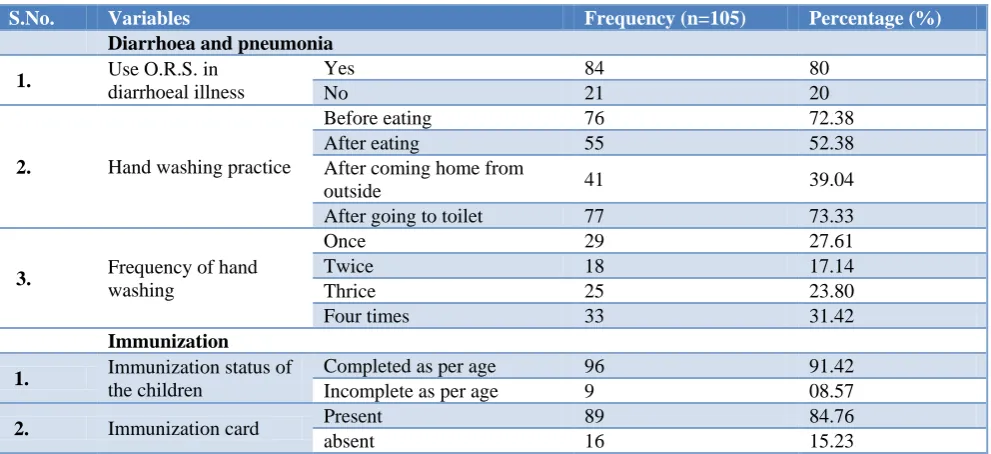
Table 4: Practices of mothers regarding diarrhoea, pneumonia and immunization.
S.No. Variables Frequency (n=105) Percentage (%)
Diarrhoea and pneumonia
1. Use O.R.S. in
diarrhoeal illness
Yes 84 80
No 21 20
2. Hand washing practice
Before eating 76 72.38
After eating 55 52.38
After coming home from
outside 41 39.04
After going to toilet 77 73.33
3. Frequency of hand
washing
Once 29 27.61
Twice 18 17.14
Thrice 25 23.80
Four times 33 31.42
Immunization
1. Immunization status of
the children
Completed as per age 96 91.42
Incomplete as per age 9 08.57
2. Immunization card Present 89 84.76
absent 16 15.23
The assessment of the participants about knowledge on immunization is fairly good with 90.47% mothers knowing that immunisation is given to children to prevent children from diseases. 59.04% of them knew that fever is a side effect of some of the vaccinations. 40% of the
As far as health related practices of the mother are concerned, 80% of the mothers use ORS in diarrhoeal illness and only 31.42% of the mothers use to wash hands four times including one before cooking, after using washroom, before feeding the child and after coming from outside. 91.42% of the children were found to be immunized as per age whole only 84.76% of the mothers had immunization card of the child with them (Table 4).
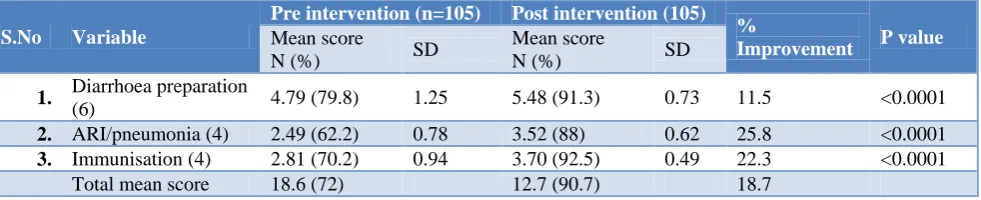
The total mean score post intervention came out to be 90.7% and the percentage improvement was 18.7%. The overall knowledge scores improved significantly
(p<0.0001) after a gap one month (Table 5). Figure 1: Reasons for incomplete immunization of the
children.
Table 5: Percentage improvement in the mean score of the mothers of study population post intervention.
S.No Variable
Pre intervention (n=105) Post intervention (105)
%
Improvement P value
Mean score
N (%) SD
Mean score
N (%) SD
1. Diarrhoea preparation
(6) 4.79 (79.8) 1.25 5.48 (91.3) 0.73 11.5 <0.0001
2. ARI/pneumonia (4) 2.49 (62.2) 0.78 3.52 (88) 0.62 25.8 <0.0001
3. Immunisation (4) 2.81 (70.2) 0.94 3.70 (92.5) 0.49 22.3 <0.0001
Total mean score 18.6 (72) 12.7 (90.7) 18.7
DISCUSSION
In the present study, 47.61% female completed school till secondary, this is in conformity with the study conducted by Datta et alin which 43% of the females completed school till secondary standard.4 The monthly expenditure on health is ≤500 Rs in 62.85% of the study participants which equates with the socioeconomic status of the participants as majority of them i.e. 35.23% belonged to middle socioeconomic status and 30.47% belonged to low socioeconomic status and most of the income is spent on rent and buying groceries for the house.
In a study conducted by Datta et alonly 1.3% mothers were able to answer the signs of dehydrations whereas in a study conducted by MacDonald et al in Indonesia, 38% of them others could identify then signs of dehydration which is similar to the present study in which 47.61%,mothers could answer this question with confidence.4,5 In the present study 87.61% mothers were aware about the ORS solution and only 78.09% could correctly tell about the method of preparation of ORS which is similar to the studies done by Datta et aland Bhatia et al where the awareness about ORS solution among mothers came out to be 90.6% and 86.7% respectively.4,6 It was heartening to know that 88.57% of the mothers knew the correct way to wash hands in contrast to the works done earlier where only half of the participants were aware of this knowledge. Only 80% mothers were practising the use of ORS in diarrhoea which highlights a better condition if compared to the work done by Datta et alin Maharshtra where only 60% mothers were using ORS in diarrhoea management.4
97.38% mothers were aware about fever which should have been answered by all the participants taking into account that fever is one of the most common complaints in a child. With the advent of government policies and programmes, establishment of anganwadis and PHCs, it is expected that people will seek care are by a physicians if their child is ill but in the present study only 67.61% of the participants believed in visiting a doctor for any complain and rest practised treatment at home which is unfortunate if compared to the work of Bham et al in Pakistan where 89% of the mothers sought care by a medical practitioner in case of any childhood illness.7 In the present study about half of the participants were not aware of pneumonia. 32.38% of the mothers knew about the specific signs of pneumonia which is on similar lines to the study conducted by Ferdous et al in Bangladesh where 29% of mothers had prior understanding of signs and symptoms of pneumonia.8
90.47% of the mothers were aware that vaccination prevents children from diseases which is in consistent to the finding by Siddiqui et alin Maharashtra where 96.9% mothers were aware of this knowledge and less compared to the work done by Mereena et al where 100% participants know that vaccination prevents diseases.9,10 59.04% of the mothers were aware that vaccination does have fewer side effects, fever being the commonest answer which is similar to the studies done by Siddiqui et al in Maharashtra where 67% mothers has knowledge about some adverse reactions after vaccination, fever being one of the commonest.9 Siddiqui et al in Maharashtra found that 78% mothers had the knowledge about contraindications of immunization, fever; allergy to
0 1 2 3 4 5 6
name a few which highlights the pitiful state of affairs in the present study where only 40% mothers were aware of the contraindication following immunization taking into consideration that knowledge about contraindication of immunization is important so that the vaccine could work to its full potential which could be hampered if the child has diarrhoea or any anaphylactic reaction after a previous dose.9 Majority of the mothers that is 83.80% did know that the first vaccine is administered at birth which is almost same as the work done by Ahmed et al where 86% parent knew the timing of the first dose in vaccination schedule.11 It is heartening to not that 91.42% children under the age five were immunised as per age and 84.76% families had properly kept the immunisation card which is in stark contrast to the study done by Angadi et alin which only 34.8% children were fully immunized and 69% families had immunization card with them.12 Upon further investigation, it was found that out of 8.57% children who were not immunised as per age, 5.7% stated the fear of side effects as the main reason while only 2.9% were not informed about the immunization schedule which contradicts with the study done by Angadi et al in which 97% families reported lack of knowledge regarding schedule and only 13% reported the fear of side effects as the reasons for missing immunisation on time.12
CONCLUSION
The knowledge appeared to improve significantly after an education intervention which suggests that regular health educational programmes for mothers should be held especially in urban slum areas involving health workers. The immunization coverage was found to be adequate which can be because of urban health centre nearby which regularly disseminates the information about immunization and its importance. During our intervention, we learned about the common issues people face in govt. setups like long waiting time, lack of attention during treatment, impolite behaviour from the staff and unavailability of medicines. These are some of the major findings which can be worked upon and the belief of people on government setup could be restored.
ACKNOWLEDGEMENTS
I hereby acknowledge all the participants who helped in providing the information and all the students who helped in completion of the study.
Funding: No funding sources Conflict of interest: None declared
Ethical approval: The study was approved by the Institutional Ethics Committee
REFERENCES
1. World Health Organization. Global Health Observatory data. Geneva: World Health Organization, 2016.
2. International Institute for Population Sciences (IIPS) and ICF. 2017. National Family Health Survey (NFHS-4), 2015-16: MP. Mumbai: IIPS., 2016 3. Park, K. Park's textbook of preventive and social
medicine. 24th ed. Jabalpur: Banarasidas Bhanot; 2017: 611.
4. Datta V, John R, Singh VP, Chaturvedi P. Maternal knowledge, attitude and practices towards diarrhea and oral rehydration therapy in rural Maharashtra. The Indian J Pediatr. 2001;68(11):1035-7.
5. MacDonald SE, Moralejo DG, Matthews MK. Maternal understanding of diarrhoea-related dehydration and its influence on ORS use in Indonesia. Asia Pacific J Public Health. 2007;19(1):34-9.
6. Bhatia V, Swami HM, Bhatia M, Bhatia SP. Attitude and practices regarding diarrhoea in rural community in Chandigarh. Indian J Pediatr. 1999;66(4):499-503.
7. Bham SQ, Saeed F, Shah MA. Knowledge, Attitude and Practice of mothers on acute respiratory infection in children under five years. Pakistan J Med Sci. 2016;32(6):1557.
8. Ferdous F, Dil Farzana F, Ahmed S, Das SK, Malek MA, Das J, et al. Mothers’ perception and healthcare seeking behavior of pneumonia children in rural Bangladesh. ISRN Family Med. 2014;2014. 9. Siddiqui NS, Gaikwad AK, Kuril BM, Ankushe RT,
Doibale MK, Pund SB, et al. Is mothers’ knowledge and practice regarding childhood immunization compliant with immunization completeness?. Int J Community Med Public Health. 2017;4(3):775-80. 10. Mereena SR, Sujatha R. A study on knowledge and
attitude regarding vaccines among mothers of under five children attending pediatric OPD in a selected hospital at Mangalore. IOSR J Nursing Health Sci. 2014;3(5):39-46.
11. Ahmed SM, Abd-El Rahman TA, Masoed ES. Mothers' awareness and knowledge of under five years children regarding immunization in Minia city Egypt. Life Sci J. 2013;10(4):1224-32.
12. Angadi MM, Jose AP, Udgiri R, Masali KA, Sorganvi V. A study of knowledge, attitude and practices on immunization of children in urban slums of Bijapur city, Karnataka, India. J Clinical Diagnos Res: JCDR. 2013;7(12):2803.