A Study of Job-Education Match/Mismatch
among working professionals- An Indian
Perspective
Prof. Vinay R. Patil Prof. Shailendra R. Patil
Assistant Professor Assistant Professor
Department of Management Studies Department of Management Studies DKTEs’s Textile & Engineering Institute, Ichalkaranji (An
Autonomous Institute), Maharashtra (India), PIN: 413115
DKTEs’s Textile & Engineering Institute, Ichalkaranji (An Autonomous Institute), Maharashtra (India), PIN: 413115
Abstract
The present study is aimed at empirical investigation of job-education match/mismatch amongst professionals working both in industry and academic institutions in India. The intention of the study is to investigate the type of, and the degree to which such a match/mismatch exists. Moreover, the research focuses on different aspects related to job-education match/mismatch. Job-education match/mismatch though is difficult to measure but by using traditional indicators like, satisfaction level of employees, their promotion ability, their level of earning etc., it is possible to overcome the rigidity of the topic to greater extent. Keeping this in sight, the attempt has been made in the current study to collect the opinion of employees to know the degree to which they consider their job and education matches/mismatches and its consequences on employee morale. The study also intends to identify various degree fields where greater mismatch is observed and the possible reasons behind it. The data used for the study has been collected both through primary and secondary sources and employees associated with industry and academics.
Keywords: Career Management, Employee Placement, Knowledge Management, Talent Management
_______________________________________________________________________________________________________
I. INTRODUCTION
Ever since independence, India has witnessed a progressive change in its education system which is seldom quoted as the important contributors to its economic and social development. Much of this progress especially in higher education is seen not only in public institutions but also in private institutions. It was believed nearly for a century that education leads to a good job, but the emerging gaps at the level of higher education are being seen as major constraints. In recent decades the higher education sector has expanded rapidly, but the increase in the number of graduates has not been matched by an increase in high-skilled jobs. Many graduates are finding themselves working in jobs that would in previous generations have been filled by non-graduates; such a mismatch is quoted as vertical mismatch due to over education. In some cases mismatch is caused due to under education where an individual is having skills inferior to what is required by job.
It is also evident that another type of mismatch exists especially when the type of education or skills that an individual is having is inappropriate for the job. However, in recent decades an increase in overeducated workers rather than the undereducated workers in the job market has been observed. Gone is the era when education-job mismatch was considered as a temporary phenomenon, later economists and sociologists began considering this as a serious concern with its significant socio-economic costs at individual, firm and national level. Thus the significance of undertaking current study has been felt with a view to identify the type of, and the degree to which, employee job and their education match or mismatch.
II. OBJECTIVES OF THE STUDY
1) To study the type of, and the degree to which, job-education match/mismatch pertains amongst working professionals of semi-urban area in India.
2) To identify the possible reasons (both controllable and uncontrollable) behind the existence of job-education mismatch. 3) To know the amount of potential employees associated with relatively lower levels of jobs.
4) To analyse the impact of job-education match/mismatch on employee morale.
III. SIGNIFICANCE OF THE STUDY
1) The study would be very beneficial to HR professionals to understand the type of job-education mismatch and the degree to which it is present in the industry.
IV. REVIEW OF LITERATURE
Education mismatch, generally, refers to the lack of coherence between the required and offered educational level for a given job (Betti, Agostino, & Neri, 2007). The issue of education mismatch has a long history and it had been first identified in the 1870’s (Gladwell, 2008). In a report written under the title of “Relation of Education to Insanity” by United States commissioner of education, Jarvis, first revealed this concept. In this report he claimed that out of the 1,741 cases of insanity he studied, “over-study” was responsible for 205 (cited by Edwin & Hessel, 2011). As they mentioned, much attention was not paid on the issue of education mismatch. However, since the 1970s, considerable attention has been paid on this concept as supply of educated workers seemed to outpace the demand in the labor market (Freeman, 1975). Freeman (1975) predicted in his book of “The Overeducated Americans”, about a situation with substantial oversupply of college graduates is likely to remain for many years to come (Edwin & Hessel, 2011).
As noted by Sloane (2003), workers may be mismatched if the level of schooling is appropriate but the type of schooling is not. Sloane uses the example of an English major working as a statistician. This paper examines the match between a worker’s schooling and job by considering whether the field of study in college is related to the current job.
John Robst (2006), in his study on job-education mismatch focused to answer three questions: Firstly what proportion of college graduates work in jobs unrelated to their field of study? Secondly, which degree fields lead to greater mismatch? And lastly, does working outside the degree field affect earnings? The study concluded that Fifty-five percent of individuals report that their work and field of study are closely related. While Forty five percent of workers report that their job is only partially related or not related to their field of study. Workers who are mismatched earn less than adequately matched workers with the same amount of schooling. The wage effects in this paper vary depending on the field of study. Graduates from majors that emphasize general skills (e.g., liberal arts) have a higher likelihood of mismatch, but relatively low costs to be mismatched. Some majors emphasize occupation specific skills and mismatched workers incur substantial costs.
Giorgio Di Pietro and Peter Urwin have focused on over-education with a study of the effects of over-schooling on wages and on-the-job search in Italy. They presented the results of several specifications for their regression equations in an attempt to test the validity of various theories, which have been put forward to explain the wage effects of over-education - including an analysis of the extent to which the impact of over-qualification reflects an underutilization of skills. Besides this the attempt was also to identify whether a university degree was a ‘formal’ requirement for a given and also whether the employee feels that their level of education is appropriate for actually ‘carrying out’ the job. The data are taken from a survey carried out by ISTAT (National Statistical Italian Centre) in 1998 on individuals who graduated from all Italian universities in 1995. The study concludes that graduates, whose level of education exceeds the adequate or formally required level of education for their job, receive lower wages than their peers with similar level of schooling in jobs for which they are suitably qualified. It was concluded that over-education is a stronger predictor of the probability that Italian graduates will seek alternative employment, when compared to skill underutilization.
Shujaat Farooq (2011) through his study has made an attempt to estimate the incidences of job mismatch in Pakistan. The study has divided the job mismatch into three categories; education-job mismatch, qualification mismatch and field of study and job mismatch. Both the primary and secondary datasets have been used in which the formal sector employed graduates have been targeted. This study has measured the education-job mismatch by three approaches and found that about one-third of the graduates are facing education-job mismatch. In similar, more than one-fourth of the graduates are mismatched in qualification, about half of them are over-qualified and remaining half are under-qualified. The analysis also shows that 11.3 percent of the graduates have irrelevant and 13.8 percent have slightly relevant jobs to their studied field of disciplines. Our analysis shows that women are more likely than men to be mismatched in field of study
V. RESEARCH GAP
From the above review of the literature it is observed that most of the research work has been done to identify the impact of job-education mismatch at individual level like on wages, worker participation etc. The subsequent section also shows that not much of research has been made to know job-education match/mismatch in Indian industries and academic institutions. Keeping in view the importance for researchers and policy makers in the industry/academics, the present study aims to contribute in knowledge by analyzing the incidences of various types of job mismatches, the degree to which they exist, the possible reasons behind it and its consequences both at individual and firm level.
VI. SCOPE OF THE STUDY
The data for the study has been collected and analyzed in relation with job-education match/mismatch from randomly selected industries and academic institutions of Kolhapur district India.
1) Persons contacted
The study has been carried out by providing questionnaire to randomly selected employees of both industry and academic institutions.
The study focuses mainly on the type of and the degree to which job-education match/mismatch exists, the possible reasons behind such a mismatch and its consequence at individual and organizational level.
3) Analytical Scope
The analytical scope covers the fulfilment of the objectives set forth for the study. 4) Functional Scope
The study is confined to offer some meaningful suggestions to HR professionals, researchers and the policy makers in the industry and academic institutions on the basis of analysis to eradicate job-education mismatch if any.
VII.RESEARCH METHODOLOGY
The data necessary for the current study has been collected both through primary and secondary sources as explained below. 1) Primary Source
The current study uses a survey method, and hence the questionnaire has been prepared, which contains close-ended type of questions. Some responses are based on point scale to indicate attitudinal aspects of employees and the remaining are simple multiple choice questions.
2) Secondary Source
Sources such as previous research, previous records, magazines, websites, books and articles related to the current study have been referred and used as secondary source.
3) Universe and Sampling
The universe of the topic under study is employees of service and manufacturing industries as well as employees of academic institutions located in Kolhapur district. The simple stratified random sampling method is used to select the employees as respondents to this survey.
No of industries selected: 20
No of academic institutions selected: 5 Population of Research: 1000
Sample Unit: Employees of Randomly selected industries and academic institutions. Sample Size: 150
Sampling Method: Random sampling.
VIII. LIMITATIONS OF THE STUDY
1) The study has been conducted within the specified time period and hence change in opinion of employees and relevant data in the subsequent period find no place in the current study.
2) Selective sample size may not be a true representative of whole universe.
3) Employees at times were reluctant to answer the questions accurately and hence the possibility of leniency at employees’ part cannot completely be ruled out.
4) It involves lot of complex human behavioral attributes which require a comprehensive study over a period of time.
IX. DATA ANALYSIS & INTERPRETATION Table – 1
Presents the Degree of Vertical Mismatch of Job and Education amongst Employee
Type of
Organization Particulars
Response Feel over qualified for the
current job
Feel under qualified for the current job
Qualification is in tune with the job
Industry
No of
employees 24 12 64
Percentage 24 12 64
Academics
No of
employees 3 0 47
Percentage 6 0 94
24% of professionals working in Indian industries feel overqualified for the job they hold currently and 12% of them feel that they are under qualified for the job (See Fig.I). If these numbers are taken collectively then we can conclude that 36% of working professionals in Indian industries feel that there is vertical mismatch of their job and education. Whereas only 6% of employees in Indian academic institutions believe that there is vertical mismatch of their job and education.
Hypothesis: 1
Hypothesis Testing
The degree of freedom (DF) in the present case is calculated using the formula, DF = (r - 1) * (c - 1)
Where, ‘r’ is the number of levels for one categorical variable and ‘c’ is the number of levels for the other categorical variable. Therefore, DF = (2- 1) * (3 - 1)
= 1*2 DF = 2
The calculated value of chi-square for the data obtained is found to be 16.054, which is greater than table value at 5% significance level for degree of freedom 2 and hence we reject the null hypothesis. So we can say that there is relationship between type of organization and vertical mismatch of job and education.
a) Interpretation I
From the survey it is observed that vertical mismatch of job and education is evident in industry than in academic institutions. Table – 2
Presents Degree of Horizontal Mismatch of job and Education amongst Employees
Type of
Organization Particulars
Employees’ response about frequency of performing duties of other field/specialisation/department other than their job expertise.
Always Many a times Sometimes Never
Industry
No of
employees 11 17 52 20
Percentage 11 17 52 20
Academics
No of
employees 12 24 12 2
Percentage 24 48 24 4
11% of professionals working in Indian industries feel that other than their job expertise they always perform duties of other field/specialization or department. 17% of them say they perform such duties many a times (See Fig.II). If these numbers are taken collectively then we can conclude that 28% of working professionals in Indian industries feel that there is horizontal mismatch of their job and education. Whereas in Indian academic institutions, 24% of employees believe that they always perform such duties and 48% of them say they perform such duties many a times. Clearly this indicates that 72% of employees in Indian academic institutions believe that there is horizontal mismatch of their job and education.
Hypothesis: 2
1) H0= There is no relationship between type of organization and horizontal mismatch of job and education. 2) H1= There is relationship between type of organization and horizontal mismatch of job and education.
Hypothesis Testing
The degree of freedom (DF) in the present case is calculated using the formula, DF = (r - 1) * (c - 1)
Where, ‘r’ is the number of levels for one categorical variable and ‘c’ is the number of levels for the other categorical variable. Therefore, DF = (2- 1) * (4 - 1)
= 1*3 DF = 3
The calculated value of chi-square for the data obtained is found to be 27.3361, which is greater than table value at 5% significance level for degree of freedom 3 and hence we reject the null hypothesis. So we can say that there is relationship between type of organization and horizontal mismatch of job and education.
a) Interpretation. II
Fig. 2: Degree of Horizontal Mismatch of Job and Education
Table – 3
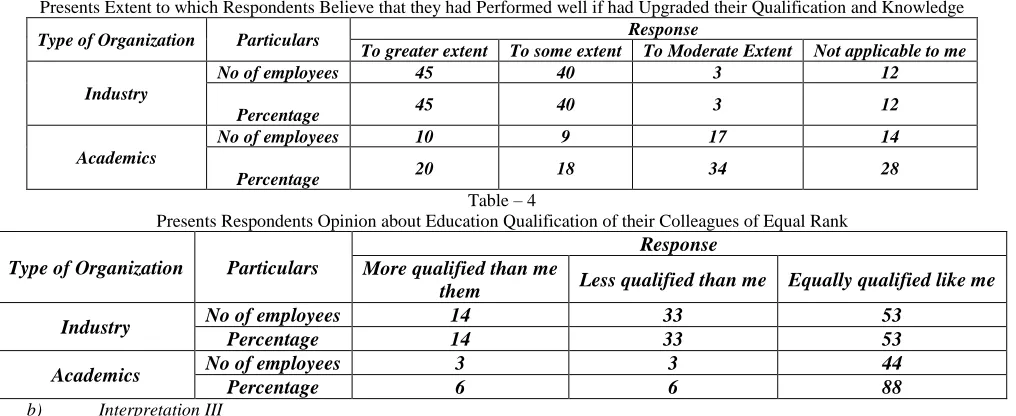
Presents Extent to which Respondents Believe that they had Performed well if had Upgraded their Qualification and Knowledge
Type of Organization Particulars Response
To greater extent To some extent To Moderate Extent Not applicable to me
Industry
No of employees 45 40 3 12
Percentage 45 40 3 12
Academics
No of employees 10 9 17 14
Percentage 20 18 34 28
Table – 4
Presents Respondents Opinion about Education Qualification of their Colleagues of Equal Rank
Type of Organization Particulars
Response More qualified than me
them Less qualified than me Equally qualified like me
Industry No of employees 14 33 53
Percentage 14 33 53
Academics No of employees 3 3 44
Percentage 6 6 88
b) Interpretation III
It is observed that 45% of employees in Indian industries to a greater extent believe that they had performed their job well if had upgraded their qualification and knowledge, whereas 40% of employees believe that it would have helped them to some extent. On the contrary 20% of employees working in Indian academic institutions to a greater extent believe that they had performed their job well if had upgraded their qualification and knowledge, whereas 18% of employees in such institutions believe that it would have helped them to some extent (See Fig. III).
The probable reasons behind it could be, either candidate in Indian industries get selected for higher posts with minimum of qualification, or even, the perfectly placed candidates at times perform duties of higher order as they become experienced irrespective of their qualification.
c) Interpretation. IV
Fig. 3: Extent to which Respondents Believe that they had Performed well if had Upgraded their Qualification and Knowledge
Fig. 4: Respondents Opinion about Education Qualification of their Colleagues of Equal Rank
Major Findings
1) Vertical mismatch of job and education is observed to be more in Indian industries than in academic institutions. Almost one among every four employees in Indian industries feels overqualified, whereas almost one amongst every 8 employees feels under qualified for the job with which they are associated.
2) When it comes to academic institutions in India, horizontal mismatch of Job and Education is observed to be more than vertical mismatch. Almost 72% of employees working in academic institutions believe that they often tend to perform duties of other field/specialization/department other than their job expertise.
3) Almost one among two employees in Indian industries believes that he or she would have performed well if had upgraded his or her qualification and knowledge. This is a clear indication of vertical mismatch of job and education.
4) Almost one among every three employees in Indian industries believe that their colleagues who perform same job or who are of equal rank, are educationally less qualified than them, this is again an indication of vertical mismatch of job and education. 5) It is concluded that, in India, vertical mismatch of job and education is more evident in industries, whereas horizontal mismatch
is more evident in academic institutions.
X. CONCLUSION
graduates in India to shift to the place where they can seek their career opportunities and as a result majority of workers are contended with their current job irrespective of whether their Job and Education match or mismatch.
REFERENCES
[1] Alba-Ramirez, A. (1993). Mismatch in the Spanish labour market: over education? Journal of Human Resources, 28 (2), 259–278.
[2] Farooq, S. (2011). Mismatch Between Education and Occupation: A Case Study of Pakistani Graduates. The Pakistan Development Review, Pakistan Institute of Development Economics, vol. 50(4), pages 531-553.
[3] Pietro, G.D and Urwin, P. (2006). Education and skills mismatch in the Italian graduate labour market. Applied Economics Volume 38, 2006 - Issue 1.