Constructing Efficient Certificate-based
Encryption with Paring
Yang Lu* and Jiguo Li
College of Computer and Information Engineering, Hohai University, Nanjing, China Email: {luyangnsd, ljg1688}@163.com
Junmo Xiao
Institute of Communication Engineering, PLA University of Science and Technology, Nanjing, China Email: [email protected]
Abstract—The certificate-based encryption (CBE) is a new PKC paradigm which combines traditional public-key encryption (PKE) and identity based encryption (IBE) while preserving their features. CBE provides an efficient implicit certificate mechanism to eliminate third-party queries for the certificate status and to simply the certificate revocation problem. Therefore, CBE can be used to construct an efficient PKI requiring fewer infrastructures. In addition, it also solves the key escrow problem and key distribution problem inherent in IBE. In this paper, we construct an efficient CBE scheme with paring and prove it to be CCA-secure in the random oracle model based on the hardness of the Bilinear Diffie-Hellman Inversion assumption. When compared with other existing CBE schemes, our scheme has obvious advantage in the computation performance.
Index Terms—certificate-based encryption, pairing, p-BDHI assumption, random oracle model
I. INTRODUCTION
In Eurocrypt 2003, Gentry [1] introduced the notion of certificate-based encryption (CBE), which combines identity-based encryption (IBE) and traditional PKI-supported public key encryption (PKE) while preserving their features. CBE provides an implicit certification mechanism for a traditional PKI and allows a periodical update of certificate status. As traditional PKIs, each user in CBE generates his own public/private key pair and requests a lived certificate from the CA. This long-lived certificate has all the functionalities of a traditional PKI certificate. But, CA generates the long-lived certificate as well as short-lived certificates (i.e., certificate status). A short-lived certificate can be pushed only to the owner of the public/private key pair and acts as a partial decryption key. This additional functionality provides an implicit certification so that the sender is not required to obtain fresh information on certificate status and the recipient can only decrypt the ciphertext using his private key along with an up-to-date short-lived certificate from its CA. The feature of implicit certification allows us to eliminate third-party queries for
the certificate status and simply the public key revocation problem so that CBE does not need infrastructures like CRL [29] and OCSP [30]. Therefore, CBE can be used to construct an efficient PKI [21] requiring fewer infrastructures than previous proposals [32-35]. Furthermore, there is no key escrow problem (since the CA does not know the private keys of users) and key distribution problem (since the certificates need not be kept secret) in CBE.
PKEs) and to build CBE schemes without resorting to the random oracle model. Recently, Wang et al. [15] proposed a certificate-based proxy cryptosystem based on Gentry’s CBE scheme. Moreover, Morillo and Ràfols [8] proposed the first construction of CBE scheme secure in the standard model. Galindo et al. [7] proposed an improved CBE scheme based on the CBE scheme in [8]. In parallel to CBE, Kang et al. [13] proposed the security notion of certificate-based signature (CBS) that follows the idea of Gentry’s CBE scheme and provided a concrete CBS scheme in the random oracle model. However, Li et al. [16] pointed out that this signature scheme was insecure against the key replacement attack. They refined the security model of CBS given in [13] and constructed a new CBS scheme which is secure in the random oracle model. Moreover, Au et al. [17] propose a new notion called certificate-based ring signature, which is the ring signature in certificate based cryptography setting.
In this paper, we propose a new efficient CBE scheme with pairing by combining the SK-IBE scheme [20,21] with a traditional ElGamal-like cryptosystem [22], and prove it to be CCA-secure in the random oracle model. Due to the advantage of SK-IBE in the computation performance, our CBE scheme requires computing no parings in the encryption algorithm and computing only one pairing in the encryption algorithm. When compared with other existing CBE schemes [1,7,8], our scheme has obvious advantage in the computation performance.
II. BACKGROUNDDEFINITIONS
Throughout the paper, G1 and G2 denote two additive cyclic groups of prime order q and GT a multiplicative
cyclic group of the same order. P1 denotes a generator of
G1 and P2 denotes a generator of G2.M is an isomorphism from G2 to G1 with M (P2) = P1. Note that from [25], we can either assume that M is efficiently computable or make our security proof relative to some oracle which computes M. For us, a bilinear paring is a map e:G1uG2 o GT with following properties:
Bilinear: For all PG1, all QG2 and all a,bZ we have e(aP,bQ) = e(P,Q)ab.
Non-degenerate: e(P1,P2)z1 .GT
Computable: For all PG1 and QG2,e(P,Q) can be efficiently computed.
A bilinear paring satisfying the three properties above is said to be an admissible bilinear map. Typically, the map e can be derived from either the Weil or Tate paring on an elliptic curve over a finite field.
The security of the CBE scheme in this paper is proved based on the difficulty of the following problem which is introduced in [21,24].
p-Bilinear Diffie-Hellman Inversion (p-BDHI)
Assumption: For an integer p and a random element
*
q
xZ , *,
2 2
P G P1 M(P2), e: G1u G2 o GT, given
, computing
2
1 2 2 2 2
( ,P P xP x P, , , x Pp , )
! 1/
1 2
( , ) x
e P P is hard. In [21], Chen and Cheng have proved that the p-BDHI assumption and the standard Bilinear Diffie-Hellman (BDH) assumption are polynomial time equivalent, i.e., if
there exists a polynomial time algorithm to solve BDH, then there exists a polynomial time algorithm for 1-BDHI, and vice versa.
III. CERTIFICATE-BASEDENCRYPTION
In this section, we briefly review the definition and security model for CBE. These definitions are taken from [3, 12], where the original definitions given in [1] were reconsidered.
Definition 1. A certificate-based encryption (CBE)
scheme is a tuple of five PPT algorithms (Setup, SetKeyPair,Certify,Enc,Dec) such that:
y Setup is a probabilistic algorithm taking as input a security parameter k. It returns the certifier’s master-key skCA and public parameters params that include the
descriptions of a finite message (plaintext) space MSPC, a finite ciphertext space CSPC, and two string spaces T and/. We consider params to be an implicit input to the rest of the algorithms.
y SetKeyPair is a probabilistic algorithm that outputs a public/private key pair <pk,sk>.
y Certify is a deterministic certification algorithm that takes as input <skCA,WT,id/, pk>. It returns a
short-live certification Certid,W, which is sent to the user. Here W
is a string identifying a time period, while id contains other information needed to certify the user, and pk is the user’s public key.
y Enc is a probabilistic algorithm taking as inputs <W, id,pk,M>. It returns a ciphertext C for message M.
y Dec is a deterministic algorithm taking <Certid,W,sk,
C> as input in time periodW. It returns either a message M or the special symbol A indicating a decryption failure.
Naturally, it is required that these algorithms must satisfy the standard consistency constraint, that is for all MMSPC,Dec(Certid,W,sk,C)=M where C=Enc(W,id,pk,
M;V), Certid,W = Certify(skCA,W,id,pk) and <pk,sk> is a
valid public/private key pair.
The adaptive chosen-ciphertext security for CBE is defined against two different types of adversaries. The Type I adversary 1 has no access to the master-key and
models an uncertified user. The Type II adversary 2 models an honest-but-curious certifier who possesses the master-key skCA attacking a fixed user’s public key.
Game 1: The challenger runs Setup algorithm, gives
params to the adversary 1 and keeps skCA to itself.
Phase 1. The adversary 1 interleaves certification and
decryption queries, handles these queries as follows:
On certification query <W, id, pk, sk>, checks that id/ and <pk, sk> is a valid key-pair. If so, it runs Certify on input <skCA,W,id,pk> to generate Certid,W; else
it returns A.
On decryption query <W,id, pk,sk, C>, checks that id/ and <pk, sk> is a valid key-pair. If so, it runs Certify on input <skCA, W, id, pk> to obtain Certid,W and
These queries may be asked adaptively, that is, they may depend on the answers to previous queries.
Challenge. On challenge query <Wch,idch,pkch,skch,M0,
M1>, where M0,M1MSPC are of equal length, checks that idch/, <pkch,skch> is a valid key-pair and <Wch,idch,
pkch,skch> was not the subject of a certification query in
phase 1. If so, it picks a random bit b{0, 1}, encrypts Mb under the challenge public key pkch and sends the
resulting ciphertext C* to 1; else it returns A.
Phase 2. As in phase 1, with the restriction that <Wch,
idch, pkch, skch, C*> is not the subject of a decryption
query and <Wch, idch, pkch, skch> is not the subject of a
certification query.
Guess. The adversary 1 outputs a guess b'{0, 1}
and wins the game if b = b'.1's advantage in this game
is defined to be Adv(1) := |2Pr[b = b']-1|.
Game 2: runs Setup algorithm, gives params and
skCA to the adversary 2. then runs SetKeyPair to
obtain a key-pair <pkch,skch> and gives pkch to 2.
Phase 1. 2 issues a series of decryption queries of
the form <W,id,C>. On this query, checks that id/. If so, it runs Certify on input <skCA, W, id, pkch> to obtain
Certid,W and outputsDec(Certid,W,skch,C); else it returns A.
These queries may be asked adaptively.
Challenge. On challenge query <Wch, idch, M0, M1>, where M0,M1MSPC are of equal length, checks that
idch/. If so, it picks a random bit b{0, 1}, encrypt Mb
under the challenge public key pkch and sends the
resulting ciphertext C* to 2; else it returns A.
Phase 2. As in phase 1, with the restriction that <Wch,
idch,C*> is not the subject of a decryption query.
Guess. 2 outputs a guess b'{0, 1} and wins the
game if b = b'.2's advantage in this game is defined to
beAdv(2) := |2Pr[b = b']-1|.
Definition 2. A CBE scheme is secure against adaptive chosen ciphertext attacks (or IND-CBE-CCA) if no polynomial-time adversary has non-negligible advantage in either Game 1 or Game 2.
Similarly, we can define the weak security notion IND-CBE-CPA for CBE schemes, in which the adversaries are disallowed to issue any decryption queries.
IV. ANEFFICIENT CBE SCHEME
In this section, we first build a basic CBE scheme called BasicCBE which is IND-CBE-CPA secure. Then we extend BasicCBE to an IND-CBE-CCA secure CBE scheme called FullCBE by using a security enhancing transformation introduced in [11].
A. BasicCBE
The scheme BasicCBE is consisted of the following five polynomial time algorithms:
Setup: Given a security parameter kZ+, the parameter generator takes the following steps:
1. Generate three cyclic groups G1,G2 and GT of prime
order q, an isomorphism M from G2 to G1, and a bilinear pairing map e: G1 u G2 o GT. Pick a random
generatorP2G2and set
1 ( 2)
P M P .
2. Pick a random *
q
sZ and computePpub sP1. 3. Computeg e P P( ,1 2).
4. Pick two hash functions 1:{0,1}* q
*
H oZ and
for some integer .
2: {
n T T
H G uG o 0,1} n!0
The message space is {0 . The ciphertext space is
. The system parameters are params = {q, G ,1}n
* 1 {0,1}
n
G u 1,
G2, GT, M, e, n, P1, P2, g, Ppub, H1, H2}. The certifier’s master key is s.
SetKeyPair: This algorithm picks a randomxZq*as a user’s private key SK and sets the corresponding public key as PK = gx.
Certify: On input <s, W, id, PK>, this algorithm
outputs , 2
1
1 ( || || ) id
Cert P
H id PK s
W
W .
Enc:On input <W,id,PK,M>, this algorithm performs the following steps:
1. Check that PK is inG2, if not output A. This checks the validity of the public key.
2. ComputeQid H1( ||W id||PK P) 1Ppub.
3. Pick a random and compute the ciphertext
C= <U,V > =
*
q rZ
2
, ( r, r id
rQ M H g PK )
!.
Dec: On input <Certid,W, SK, C = <U, V > >, this
algorithm computes the plaintext
2( ( , , ), ( ( , , )) )
SK id id
M VH e U Cert W e U Cert W .
In the above construction, the certificates are short signatures computed using a signature scheme considered in [28]. As proven in Theorem 3 of [28], this signature scheme is existentially unforgeable under chosen-message attack [27] in the random oracle model, provided that the k-sCCA1 assumption is sound in G2.
The consistency of the construction is easy to check as we have
, 1 1
( , id ) ( ( ( || || ) pub), e U Cert W e r H W id PK PP
2 1
1
) ( || || ) P
H W id PK s ( ,1 2)
r r e P P g .
B. FullCBE
The scheme FullCBE is consisted of the following five polynomial time algorithms:
Setup: As in the BasicCBE. In addition, we select two hash functions 3:{0,1}* q
*
H oZ and .
Now, the message space is {0 and the ciphertext space
is for some integer .
4:{0,1} {0,1}
n n
H o
,1}n
0
* 1 {0,1}
n k
G u k0!0
SetKeyPair: As in the scheme BasicCBE.
Enc:On input <W,id,PK,M>, this algorithm performs the following steps:
1. Check that PK is in , if not output A. This checks the validity of the public key.
2
G
2. ComputeQid H1( ||W id||PK P) 1Ppub. 3. Pick a random *
q Z
V and compute r = H3(M||V||W ||id ||PK).
4. Compute and output the ciphertext C= <U,V,W >
= , 2( , ), 4( .
r r id
rQ V H g PK M H
V)!
Dec: On input <Certid,W, SK, C = <U, V, W>>, this
algorithm computes V = V H2(e(U, Certid,W), (e(U,
Certid,W))SK), and then M WH4( )V . The message is
accepted iff U r H( 1(W ||id||PK !)P1Ppub) with r = H3(M||V||W||id ||PK).
V. SECURITYPROOF
To prove the security of FullCBE, we define the following two public key encryption schemes called BasicPub-I and BasicPub-II.
The public key encryption scheme BasicPub-I is specified by following three algorithms:
Keygen: Given a security parameter kZ+, the
parameter generator takes the following steps:
1. Generate the parameters {q, G1,G2,GT,M,e,n,P1,
P2,g} which are identical to the ones of NewBasicCBE. 2. Pick a random sZq* and compute Ppub sP1 .
Randomly choose different elements and
compute
*
i hZq
2
1
i P
h s for 0d i q1.
3. Pick a random *
q
xZ and compute PK = gx.
4. Pick a hash functionH2:GTuGT o{0,1}n.
The message space is {0 . The ciphertext space is
. The public key isK ,1}n
* 1 {0,1}
n
G u pub= {q, G1,G2,GT,M,e,
n, P1, P2, g, Ppub, x, PK, h0 , 1 2 1
1 ( ,h )
h sP ,…,
1 1
1 1
1 ( q ,
q h
h s
2)
P , H2} and the private key is Kpri
= 2
0
1 P h s .
Encrypt: To encrypt M, this algorithm picks a
random *and computes the ciphertext q
rZ
C= <U,V> = ( 0 1 ), 2( , . r r pub
r h P P M H g PK
)!
Decrypt: Given the ciphertext C = <U, V>, this algorithm computes the plaintext
2( ( , ), ( ( , )) )
x pri pri
M VH e U K e U K .
The public key encryption scheme BasicPub-II is specified by following three algorithms:
Keygen: Given a security parameter kZ+, the
parameter generator takes the following steps:
1. Generate the parameters {q, G1,G2,GT,M,e,n,P1,
P2,g} which are identical to the ones of BasicCBE. 2. Pick a random sZ*q and compute Ppub sP1 .
Randomly choose an element *.
0 q h Z
3. Pick a random *
q
xZ and compute x PK g .
4. Pick a hash functionH2:GTuGT o{0,1}n.
)
The message space is {0 . The ciphertext space is
. The public key isK ,1}n
* 1 {0,1}
n
G u pub= {q, G1,G2,GT,M,e,
n,P1,P2,g,s,Ppub,PK, h0,H2} and the private key is Kpri
= x.
Encrypt: To encrypt M, this algorithm picks a
randomrZq*and computes the ciphertext C= <U,V> = ( 0 1 ), 2( ,
r r pub
r h P P M H g PK
!.
Decrypt: Given the ciphertext C = <U, V>, this algorithm computes the plaintext
2 2 2
0 0
1 1
( ( , ), ( ( , ))Kpri)
M V H e U P e U P
h s h s
.
In the following, we first prove the security of the scheme BasicCBE based on the security of the PKE schemes defined above.
Lemma 1. Suppose that H1 is a random oracle and
that there exists a Type I IND-CBE-CPA adversary 1
against BasicCBE with advantage H(k) which makes at most q1 distinct queries to H1. Then there exists an
IND-CPA adversary against BasicPub-I with advantage at least H(k)/q1.
Proof.We show how to make use of the adversary 1
to construct an IND-CPA adversary against BasicPub-I.
The IND-CPA challenger starts an IND-CPA Game by running the algorithm of BasicPub-I.Keygen to generate a public key Kpub= {q, G1,G2,GT,M,e,n,P1,P2,g,Ppub,x,
PK,h0, 1 2 1
1 ( ,h P)
h s ,…, 1 1
1 1
1 ( q ,
q h
h s
2)
P , H2} and the
corresponding private key Kpri= 2 0
1 P
h s . The challenger
passes Kpub to . Now, interacts with 1 as follows:
Setup: chooses an index I with1d dI q1. Then
gives 1 the BasicCBE public parameters params = {q,
G1,G2,GT,M,e,n,P1,P2,g,Ppub,H1,H2} where H1 is a random oracle controlled by as described below.
H1-queries: At any time 1 can query the random
oracleH1. To response to these queries maintains a list of tuples <(W||id||PK)i,hi,Certi> indexed by (W||id||PK)i as
explained below. We refer to this list as the . The list
is initially empty. When
1
list H
1 queries the oracle H1 at a point (W||id||PK)i, responds as follows:
1. If the query (W||id||PK)i already appears in
the 1listin a tuple <(W||id||PK)
with H1((W||id||PK)i) = hi.
2. Otherwise, if the query is on the Ith distinct
W||id||PK, then returns H1((W||id||PK)I) = h0 and adds the tuple <(W||id||PK)I,h0,A> into the 1 .
list H
3. Otherwise, selects a random integer hi (i > 0)
from Kpub which has not been chosen by and adds the
tuple <(W||id||PK)i,hi, 2
1
i P
h s > into the . responds
with H
1
list H
1((W||id||PK)i) = hi.
Phase 1:1 launches Phase 1 of its attack by making a series of certification queries. Let <W,id,PK,SK> be a certification query issued by 1. On this query, first
searches list . If W||id||PK is not on the list, queries
H
1
list H
1(W||id||PK). Then checks the value Cert in the tuple <(W||id||PK), h, Cert>: if CertzA, responds with Cert;
otherwise, aborts the game (Event 1).
Challenge: At some point, 1 decides to end Phase 1 and outputs <Wch, idch, PKch, SKch, M0, M1> on which it wants to be challenged. responds as follows:
1. If the Ith query on H1 has not been issued, inserts the tuple <(Wch||idch||PKch),h0,A> into 1 .
list H
2. Otherwise, if (Wch||idch||PKch)z (W||id||PK)I, then
aborts the game (Event 2).
3. Otherwise, gives the pair <M0, M1> as its
challenge. chooses a random bit b{0,1}, encrypts Mb
and responds with the ciphertext Cch. Then forwards
Cch to 1.
Phase 2: As in phase 1, with the restriction that <Wch,
idch,PKch,SKch> is not the subject of a certification query. Guess: Finally, 1 outputs its guess b' for b, outputs the same b' as its own guess.
Obviously, if does not abort during the simulation
then 1’s view is identical to its view in the real attack.
As shown above, could abort when one of the
following events happens: (1) Event 1, denoted by 1:
1queries the certification for Wch||idch||PKch at some point;
(2) Event 2, denoted by 2:1 wants to be challenged on <Wch, idch, PKch> and (Wch||idch||PKch) z (W||id||PK)I.
Notice that 2 implies that 1. Hence, the probability
that does not abort during the simulation is
Pr[ 1 2] = Pr[ 2] = 1/q1. This shows that ’s advantage is at least H(k)/q1.
Lemma 2. Suppose that H2 is a random oracle and
that there exists an IND-CPA adversary against BasicPub-I with advantage H(k) which makes at most q2
distinct queries to H2. Then there exists an algorithm to
solve the q1-BDHI problem with advantage at least H(k)/q2.
Proof. Algorithm is given as input a random q1
-BDHI instance <q, G1, G2, GT, M, e, P1, P2, xP2,
x2P2,…, 1
q
x P2> where x is a random element from
*
q Z .
finds 1/
1 2
( , ) x
e P P with advantage at least H(k)/q2 by
interacting with as follows:
Setup: Algorithm first simulates the algorithm
Keygen of BasicPub-I to create the public key as below: 1. Randomly choose different and let
f(z) be the polynomial
1
* 0, , q 1
h ! h Zq
1 1
1
( ) qi ( i)
f z
zh .Reformulate f(z) to get 1 1
0
( ) q i [ ]
i q i
f z
¦
c z Z z0 ( )
q i i i
Q
¦
c x P f x Q1 (Q2). The
constant term c0 is non-zero because hiz0 and ci are
computable from hi.
2. Compute 1 1 ,
2 2 P2 M
1
( )
f x P andg e Q Q( 1, 2).
3. Compute
2 0 1 0
( ( ) ) ( ) ( ) ( ) pub
P M xf x P h f x P xh f x P1.
4. Compute 1 2
0
( ) ( ) /( ) q j
i i j j
f z f z zh
¦
d z and1 2
2 2 0 2
1
( ) q j i j j i
Q f x P d x P
x h
¦
for 1d i q1.5. Compute
2 2
0
( ) *
2 0 2 2 0 2 1 2
( ( ), ) ( , )f x c T eM Q c P Q c P e P P
.
6. Pick a random *and compute PK = g q
yZ y
.
Now, passes the public key Kpub= {q, G1,G2,GT, M, e, n, Q1, Q2, g, Ppub, y, PK, h0 ,
1 0 2 1
1 (h h , Q
h x
) ,…, 1
1
1 0 2 1
1 ( q ,
q
h h Q
h x
) , H2} and
the private key is Kpri = 2
1 Q
x which does not know. H2
is a random oracle controlled by . Note that
0 1 2 1 2
1
(( i ) pub, ) ( , ) i
e h h Q P Q e Q Q
h x
for1d di q11
and e h Q( 0 1Ppub,Kpri) e Q Q( 1, 2). Hence Kpub is a valid
public key of BasicPub-I.
H2-queries: At any time can query the random
oracleH2. To response to these queries maintains a list of tuples <J1,J2, ]> where 2 1
y
J J . We refer to this list as . The list is initially empty. When queries the
oracleH
2
list H
2 at a point <J1,J2>, responds as follows: 1. If the query <J1,J2> already appears in the in
a tuple <J
2
list H
1,J2,]>, then responds with H2(J1,J2) = ]. 2. Otherwise, chooses a random , returns
H
{0,1}n
]
2(J1,J2) = ] and inserts a new tuple <J1,J2,]> to 2 .
Challenge: Adversary outputs two messages M0 and
M1 on which it wants to be challenged. chooses a
random and a random , and then defines the challenge ciphertext to be C
{0,1}n
R rZq*
ch = <U,V> = <rQ1,R>. Observe that the decryption of Cch is 2( , )
y VH J J
where ( , ) ( 1, 2)
r x pri
e U K e Q Q
J .
Guess: After outputs its guess, picks a random
tuple <J1, J2, ]> from 2 . first computes
list H
1 1
r T J , and
then returns 02
1 *
( /T T )c . Note that 02
1 1
*
1 2
( /T T )c e P P( , )x
if
1 1 2
( , )x
T e Q Q .
Next, we analyze ’s probability of outputting the correct answer.
Let be the event that issues a query
for 2( ( 1, 2) , ( 1, 2) ) r ry
x x
H e Q Q e Q Q at some point during the
simulation above. We first show that Pr[ ]tH(k). As H2
are random oracles, Pr[ wins | ] = 1/2. Then we have that
Pr[ wins] d Pr[ ]+1
2(1- Pr[ ]) = 1 2+
1 2Pr[ ], Pr[ wins] t Pr[ wins | ] Pr[ ]
= 1
2(1- Pr[ ]) = 1 2
-1 2Pr[ ]. It follows that H(k) =|2Pr[ wins] -1|d Pr[ ].
Assume that has issued q2 distinct queries to H2.
Hence, we know that produces the correct answer with probability at least H(k)/q2.
Lemma 3. Suppose that H1 is a random oracle and
that there exists a Type II IND-CBE-CPA adversary 2
against BasicCBE with advantage H(k) which makes at most q1 distinct queries to H1. Then there exists an
IND-CPA adversary against BasicPub-II with advantage at least H(k)/q1.
Proof.We show how to make use of the adversary 2
to construct an IND-CPA adversary against
BasicPub-II. The challenger starts an IND-CPA Game by running algorithm Keygen of BasicPub-II to generate a public key Kpub= {q, G1,G2,GT,M,e,n,P1,P2,g,s,Ppub,PKch, h0,
H2} and the corresponding private key Kpri = xch, and
passingKpub to . Now, interacts with 2 as follows:
Setup: chooses an index I with1d dI q1. Then
gives 2 the BasicCBE public parameters params = {q,
G1,G2,GT,M,e,n,P1,P2,g,Ppub,H1,H2} where H1 is a random oracle controlled by as described below, s as the certifier’s master key, and PKch as the challenge
public key.
H1-queries: At any time 2 can query the random
oracleH1. To response to these queries maintains a list of tuples <(W||id||PKch)i,hi,Certi> indexed by (W||id||PKch)i
as explained below. We refer to this list as the . The
list is initially empty. When
1
list H
2 queries the oracle H1 at a point (W||id||PKch)i, responds as follows:
1. If the query (W||id||PKch)i already appears in
the 1 in a tuple <(W||id||PK list
H ch)i,hi>, then responds with
H1((W||id||PKch)i) = hi.
2. Otherwise, if the query is on the Ith distinct
W||id||PKch, then returns H1((W||id||PKch)I) = h0 and adds the tuple <(W||id||PKch)I,h0> into the 1 .
list H
3. Otherwise, selects a random integer and
adds the tuple <(W||id||PK
*
i hZq
ch)i,hi> into the . responds
with H
1
list H
1((W||id||PKch)i) = hi.
Challenge: At some point, 2 outputs <Wch, idch, M0,
M1> on which it wants to be challenged. responds as follows:
1. If the Ith query on H1 has not been issued,
inserts the tuple <(Wch||idch||PKch),h0> into 1 .
list H
2. Otherwise, if (Wch||idch||PKch)z (W||id||PKch)I, then
aborts the game (Event 1).
3. Otherwise, forwards <M0, M1> to as its
challenge. chooses a random bit b{0,1}, encrypts Mb
and responds with the ciphertext Cch. Then forwards
Cch to 2.
Guess: Finally, 2 outputs its guess b' for b, outputs the same b' as its own guess.
Obviously, if does not abort during the simulation
then 2’s view is identical to its view in the real attack.
As shown above, could abort when the following event
happens: Event 1, denoted by : 2 wants to be challenged on <Wch, idch, PKch> and (Wch||idch||PKch) z
(W||id||PKch)I. Hence, the probability that does not abort
during the simulation is Pr[ ] = 1/q1. This shows that
’s advantage is at least H(k)/q1.
Lemma 4. Suppose that H2 is a random oracle and
that there exists an IND-CPA adversary against BasicPub-II with advantage H(k) which makes at most q2
distinct queries to H2. Then there exists an algorithm to
solve the 1-BDHI problem with advantage at least H(k)/q2.
Proof. Algorithm is given as input a random
1-BDHI instance <q, G1,G2,GT,M,e,P1,P2,xP2> where x is a random element from Zq*. finds
1/ 1 2
( , ) x e P P by
Setup: Algorithm first simulates algorithm Keygen of BasicPub-II to create the public key as below.
1. SetQ2 xP2, Q1 M(Q2) xP1 andg e Q Q( 1, 2).
2. Pick a random *
q
sZ and compute Ppub sQ1 . Randomly choose an element *.
0 q h Z
3. Pick a random yZq* and compute
2
1 2 1 2
( , ) ( , ) y
y x
PK e P P e Q Q .
Now, passes the public key Kpub= {q, G1,G2,GT, M, e, n, Q1, Q2, g, s, Ppub, PK,h0, H2} where H2 is a
random oracle controlled by . The corresponding
private key is Kpri = 2
y
x which does not know. Note
that 0 1 2 1 2
0
1
( pub, ) ( ,
e h Q P Q e Q Q
h s
). Hence Kpub is a
valid public key of BasicPub-II.
H2-queries: At any time can query the random
oracleH2. To response to these queries maintains a list
of tuples <J1,J2,]>. We refer to this list as . The list
is initially empty. When queries the oracle H
2
list H
2 at a point <J1,J2>, responds as follows:
1. If the query <J1,J2> already appears in the in
a tuple <J
2
list H
1,J2,]>, then responds with H2(J1,J2) = ]. 2. Otherwise, chooses a random , returns
H
{0,1}n
]
2(J1,J2) = ] and inserts a new tuple <J1,J2,]> to 2 .
list H
Challenge: Adversary outputs two messages M0 and
M1 on which it wants to be challenged. chooses a
random and a random , and then defines the challenge ciphertext to be C
{0,1}n
R *
q rZ
ch = <U, V> =
=
0 1 1
( ), r h P sP R
! ( 0 1 pub),
r
h Q P R
x
!. Observe that
the decryption of the ciphertext Cch is
2
2 2 1 2 0
1
( ( , ), ( , ) )
y r x x
V H e U P e Q Q
h s
.
Guess: After outputs its guess, picks a random
tuple <J1, J2, ]> from 2 and returns
list H
1 2
yr
J . Note
that
1 1
2 ( ,1 2)
yr e P P x
J if 2 ( 1, 2) 2
y r x x e Q Q
J .
Let be the event that issues a query
for 2
2(*, ( 1, 2) )
y r x x
H e Q Q at some point during the simulation above. Using the same methods in Lemma 2, we can prove that Pr[ ]tH(k). Assume that has issued
q2 distinct queries to H2. Hence, we know that produces the correct answer with probability at least H(k)/q2.
By combining the above four lemmas, we have the following theorem directly:
Theorem 1. If hash functions H1 and H2 are modeled
as random oracles, then BasicCBE is IND-CBE-CPA secure under the p-BDHI assumption.
The scheme FullCBE is modified from the scheme BasicCBE by using a security enhancing transformation introduced in [11]. It has been proved that this transformation can generically upgrade any IND-CBE-CPA secure CBE scheme into an IND-CBE-CCA secure one in the random oracle model. Therefore, we have
Theorem 2. If hash function H3 is modeled as a
random oracle and BasicCBE is IND-CBE-CPA secure, then FullCBE is IND-CBE-CCA secure.
VI. PERFORMANCECOMPARISON
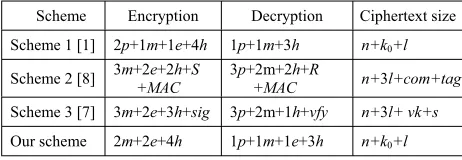
In this section, we will make a computation performance comparison of the scheme FullCBE and other existing CBE schemes [1,7,8]. Here, we consider four major operations in all the CBE schemes, i.e., pairing (p), multi-exponentiation (m), exponentiation (e) and hash (h). Among these operations, the pairing operation is considered as the heaviest time-consuming one in spite of the recent advances in the implementation technique [26]. The ciphertext size is expressed by the length n for the plaintext, the length k0 for the random string used in the encryption algorithm, and the length l for an element in G1( or G2), while com and tag refer to the size of the commitment string for the commitment scheme and the message authentication code used in the scheme proposed by Morillo and Ràfols [8], vk and s refer to the size of the verification key and the signature for the one-time signature scheme used in the scheme presented by Galindo, Morillo and Ràfols [7].
Considering the pre-computation, the detailed computation performance of all the CBE schemes is listed in Table I. We can see that our CBE scheme has better computation performance than other CBE schemes, especially in the encryption algorithm. Although, Scheme 2 and Scheme 3 do not require computing any pairings in the encryption algorithm too, they require additional building blocks to guarantee the security of the resulting schemes. Compared to Scheme 1, our scheme requires one more multiplication operation and exponentiation operation in the encryption algorithm. However, our scheme is still more efficient because two pairing operations in the encryption algorithm of Scheme 1 are much more time-consuming. Moreover, Scheme 1 and Scheme 3 both require the maptopoint operation [23] to map a string to an element in G1 (or G2) which is inefficient and slower than the general hash function used in our scheme which maps a string to an element inZq*.
TABLE I. PERFORMANCE COMPARING OF THE CBE SCHEMES
Scheme Encryption Decryption Ciphertext size
Scheme 1 [1] 2p+1m+1e+4h 1p+1m+3h n+k0+l
Scheme 2 [8] 3m+2e+2h+S +MAC
3p+2m+2h+R
+MAC n+3l+com+tag Scheme 3 [7] 3m+2e+3h+sig 3p+2m+1h+vfy n+3l+ vk+s
VII. CONCLUSION
In this paper, we present an efficient pairing-based CBE scheme and prove it to be secure in the sense of IND-CBE-CCA in the random oracle model based on the hardness of the p-BDHI problem. Regarding the computation performance, our scheme does not require computing any pairings in the encryption algorithm and need to compute only one pairing in the decryption algorithm. When compared with other existing CBE schemes, our scheme has obvious advantage in the computation performance.
ACKNOWLEDGMENT
This work is supported by the National Natural Science Foundation of China (No.60673070) and the National High Technology Research and Development Program of China (No. 2007AA01Z409).
REFERENCES
[1] C. Gentry, “Certificate-based encryption and the certificate revocation problem,” In Advances in Cryptology - EUROCRYPT’03, Ploand, LNCS 2656, pp. 272-293, 2003. [2] S. S. Al-Riyami and K.G. Paterson, “Certificateless public
key cryptography,” In Advances in Cryptology-ASIACRYPT 2003, Taiwan, LNCS 2894, pp. 452–473, 2003.
[3] S. S. Al-Riyami and K.G. Paterson, “CBE from CL-PKE: a generic construction and efficient schemes,” In Public Key Cryptography – PKC’05, Switzerland, LNCS 3386, pp. 398-415, 2005.
[4] D.H. Yum and P.J. Lee, “Identity-based cryptography in public key management,” In EuroPKI 2004, Greece, LNCS 3093, pp. 71-84, 2004.
[5] D.H. Yum and P.J. Lee, “Generic construction of certificateless encryption,” In ICCSE’04, Italy, LNCS 3040, pp. 802-811, 2004.
[6] D. Galindo, P. Morillo, and C. Ràfols, “Breaking Yum and Lee generic constructions of certificateless and certificate-based encryption schemes,” In EuroPKI 2006, Italy, LNCS 4043, pp. 81-91, 2006.
[7] D. Galindo, P. Morillo, and C. Ràfols, “Improved certificate-based encryption in the standard model,”
Journal of Systems and Software, vol. 81(7), pp. 1218-1226, 2008.
[8] P. Morillo and C. Ràfols, “Certificate-based encryption without random oracles,” Cryptology ePrint Archive, Report 2006/12.
[9] Y. Lu, J. Li, and J. Xiao, “Applying the Fujisaki-Okamoto conversion to certificate-based encryption,” In 2008 International Symposium on Electronic Commerce and Security, China, pp. 296-300, 2008.
[10] Y. Lu and J. Li, “A general and secure certificate-based encryption construction,” In 3rd ChinaGrid Annual Conference, China, pp. 182-189, 2008.
[11] Y. Lu, J. Li, and J. Xiao, “Generic construction of certificate-based encryption,” In 9th International Conference for Young Computer Scientists, China, 2008, in press.
[12] B.G. Kang and J.H. Park, “Is it possible to have CBE from CL-PKE?” Cryptology ePrint Archive, Report 2005/431. [13] B.G. Kang, J.H. Park, and S.G. Hahn, “A certificate-based
signature scheme,” In CT-RSA 2004, USA, LNCS 2964, pp. 99-111, 2004.
[14] Y. Dodis and J. Katz, “Chosen-ciphertext security of multiple encryption,” In TCC 2005, USA, LNCS 3378, pp. 188-209, 2005.
[15] L. Wang, J. Shao, Z. Cao, M. Mambo, and A. Yamamura, “A certificate-based proxy cryptosystem with revocable proxy decryption power,” In Indocrypt 2007, India, LNCS 4859, pp. 297-311, 2007.
[16] J. Li, X. Huang, Y. Mu, W. Susilo, and Q. Wu, “Certificate-based signature: security model and efficient construction,” In EuroPKI 2007, Spain, LNCS 4582, pp. 110-125, 2007.
[17] M.H. Au, J.K Liu, W. Susilo, and T.H. Yuen, “Certificate based (linkable) ring signature,” In ISPEC 2007, HongKong, China, LNCS 4464, pp.79-92, 2007.
[18] M. Bellare and P. Rogaway, “Random oracles are practical: a paradigm for designing efficient protocols,” In 1st ACM Conference on Communications and Computer Security, USA, pp. 62-73, 1993.
[19] R. Canetti, O. Goldreich, and S. Halevi, “The random oracle methodology, revisited,” In STOC’98, USA, pp. 209-218, 1998.
[20] R. Sakai and M. Kasahara, “ID based cryptosystems with pairing on elliptic curve,” Cryptology ePrint Archive, Report 2003/054.
[21] L.Q. Chen and Z.H. Cheng, “Security proof of Sakai-Kasahara’s identity-based encryption scheme,” Cryptology ePrint Archive, Report 2005/226.
[22] T.E. ElGamal, “A public key cryptosystem and a signature scheme based on discrete logarithms,” In Advances in Cryptology- CRYPTO’84, USA, LNCS 196, pp.10–18, 1985.
[23] D. Boneh. and M. Franklin, “Identity-based encryption from the Weil pairing,” In Advances in Crptology - CRYPTO’01, USA, LNCS 2139, pp.213-229, 2001. [24] D. Boneh and X. Boyen, “Efficient Selective-ID Secure
Identity Based Encryption without Random Oracles,” In
Advances in Cryptology - EUROCRYPT 2004, Switzerland, LNCS 3027, pp.223–238, 2004.
[25] N. Smart and F. Vercauteren, “On computable isomorphisms in efficient pairing based systems,” Cryptology ePrint Archive, Report 2005/116.
[26] P.S.L.M. Barreto, H.Y. Kim, B. Lynn, and M. Scott, “Efficient algorithms for pairing-based cryptosystems,” In
Advances in Cryptology - CRYPTO 2002, USA, LNCS 2442, pp.354-368, 2002.
[27] S. Goldwasser, S. Micali, and R. Rivest, “A digital signature scheme secure against adaptive chosen-message attack,” SIAM J. Computing, vol.17(2), pp. 281–308, April, 1988.
[28] F. Zhang, R. Safavi-Naini, and W. Susilo, “An efficient signature scheme from bilinear pairings and its applications,” In Public Key Cryptography – PKC’04, Singapore, LNCS 2947, pp.277–290, 2004.
[29] R. Housley, W. Polk, W. Ford, and D. Solo, “Internet X.509 Public Key Infrastructure certificate and certificate revocation list (CRL) profile,” RFC 3280, IETF, 2002. [30] M. Myers, R. Ankney, A. Malpani, S. Galperin, and C.
Adams, “X.509 Internet Public Key Infrastructure online certificate status protocol – OCSP,” RFC 2560, IETF, 1999. [31] P. Guttman, “PKI: It’s not dead, just resting,” IEEE
Computer, vol. 35, pp. 41–49, 2002.
[32] S. Micali, “Novomodo: scalable certificate validation and simplified PKI management,” In 1st Annual PKI Research Workshop, USA, pp. 15-25, 2002.
[33] S. Micali, “Efficient certificate revocation,” Technical Report TM-542b, MIT Laboratory for Computer Science, 1996.
[34] M. Naor and K. Nissim, “Certificate revocation and certificate update,” In 7th Annual USENIX Security Symposium, USA, pp. 217-228, 1998.