Neural Network Approaches for Software
Development Time Estimation: A Review
Vidisha Agrawal1, Vishal Shrivastava2
Department of Computer Science and Engineering, ARYA college of Engineering and IT, Jaipur, Rajasthan, India
Abstract: Software effort estimation calculates the effort necessary to complete the project, in term of scheduling, acquiring resources, and meeting costs. The aims of researchers have been: first is to determine which technique has the greatest effort prediction accuracy and secondly to propose new or combined techniques that could provide better estimates. Most of the research has focused on the construction of formal models and the early models were typically statistical regression-based. This paper presents an Adaptive Neuro-Fuzzy Approach for Software Development Time Estimation. This proposed technique is aimed at building and evaluating a Neuro - fuzzy model for software project development time. The forty one modules were used as a data set. Our proposed approach is software development time estimation method show the proposed ANFIS model gives new approach and ideas as compared to different types of neural network models. In the proposed method accurate estimation of software development time will be done and the results of Neuro Fuzzy approach will be compared with different types of neural network models based upon various parameters such as Root Mean Squared Error (RMSE), Relative Standard Deviation (RSD), Magnitude of Relative Error (MRE), Mean Magnitude of Relative Error (MMRE), Balanced Relative Error (BRE) and Prediction (Pred).
Keywords: Soft computing, Adaptive, Neuro-Fuzzy Inference System (ANFIS), RMSE MRE, BRE, RSD, MMRE, BRE, Prediction.
I. INTRODUCTION
Software Engineering (SE) [1] is the application of a systematic, disciplined, quantifiable approach to the development, operation, and maintenance of software and it provides the fundamentals, principles and skills needed to develop and maintain high quality software products. Some of the areas of SE are: Requirement, design, construction, testing, and management.
Software Engineering Management includes planning and measurement of SE; in this context, the topic software development effort estimation (SDEE) [2] is presented. Development effort estimates [14] are required by project managers for planning and for controlling the process of software development projects. So, Software projects development can be considered as the most uncertain and complex project when compared to other types of engineering projects, because their activities involve an intangible product and these are continually changing in response to customers’ requirements and the development of new technology. Based on the results of several investigations of software development projects, the main areas responsible for project failure were found to be as follows: project goal setting, project scheduling, project staffing (availability and capabilities), customer requirements, unmanaged risks, improper project execution, stakeholder politics, and commercial pressures. The success of a software project will be highly dependent on the Project Planning Phase, which involves those activities that determine a project’s scope, scheduling, cost, resources, and risks. Therefore, while this phase is critical in all cases of project management, so it is a special phase in a software development project, but the main activities in the software project planning phase are effort estimation and risk management. These two activities together with quality estimation become the major issues in the success of software development project and the accuracy of the results will provide the great support in project execution phase.
To date is the most popular technique [4] in the literature. It attempts to represent the relationship between effort and one or more characteristic of a project; the main cost driver in a model is usually taken to be some notion of software size (e.g. the number of lines of source code). Its general form is a linear regression equation, or by a group of non-linear regression equations as those used by Boehm.
C. Machine learning
In recent years machine learning techniques have been used as a complement or alternative to the previous two techniques. Fuzzy logic models are included in this category as well as neural networks, genetic programming, regression trees and case-based reasoning. Software cost and schedule estimation supports the planning and tracking of software projects. Effectively controlling the expensive investment of software development is of paramount importance.
II. ARTIFICIALNEURALNETWORK(ANN)
The feed forward multi-layer network with back propagation learning is the most commonly used structure in the field of software cost estimation [16]. The network contains neurons arranged in layers with each neuron is connected to every neuron of the lower layer forming a complete graph. The cost drivers or project attributes are fed as inputs at the input layer which propagates across subsequent layers of processing elements known as neurons and generates effort estimation in terms of Person-Months (PM) at the output layer. ANN [5] follows a two-step process. In step 1 threefold validation is employed for the training of the non-linear adjustment (ANN) [28]. This is followed by predicting stage in step 2. At this stage, a new project is presented to the trained system. The training process of an ANN [17] is a non-linear and non-constrained optimization problem, where a search takes place for a minimum of the error function between the network output and the desired output. This cost function traditionally is the mean square error (MSE).
A. Fuzzy Logic
The three main steps to apply fuzzy logic for effort prediction are: Step 1: Fuzzification: It converts crisp input to fuzzy output.
Step 2: Fuzzy Rule Based System: Fuzzy logic systems use fuzzy IFTHEN rules. Once all crisp input values are fuzzified into their respective Linguistic values, the fuzzy inference engine accesses the fuzzy rule base to derive.
Step 3: Defuzzification: It converts fuzzy output into crisp output.
An adaptive software effort estimation model incorporating different fuzzy logic system is developed to handle imprecision and uncertainty in software attributes of COCOMO-II model. Ahmed’s Type-2 Fuzzy logic System (FLS) which evaluates the performance of a prediction system developed using the framework for handling imprecision and uncertainty when size is provided as a precise but uncertain input is an another example of fuzzy system software cost estimation. The prediction system consists of two stages: nominal effort prediction and EAF (Effort Adjustment Factor) prediction. The outputs of both the stages are merged (multiplied) to produce the actual effort.
B. Adaptive Neuro Fuzzy Approach
Figure1: ANFIS Architecture
[image:4.612.111.541.100.261.2]The proposed method estimates the software development time accurately by proposed Adaptive Neuro Fuzzy Inference System (ANFIS) as it is a combination of Fuzzy Logic and Neural Network so ANFIS takes advantages from fuzzy logic and neural network. This ANFIS constructs a Fuzzy inference system by using given training data set whose membership function parameters are adjusted by back propagation algorithm or in combination with least square type of method. Figure.2 shows a high level diagram of the proposed ANFIS. Inputs and their membership functions appear to the left of the ANFIS structural characteristics, while outputs and their membership functions appear on the right.
Figure 2: Diagram of proposed ANFIS
III. LITERATURESURVEY
regression models was conducted based on the size of the projects. Results demonstrate that the MLP model can surpass the regression model when small projects are used, but the log-linear regression model gives better results when estimating larger projects.
Rama Sree P,Prasad Reddy,Sudha K.R [8] “Hybrid Neuro-Fuzzy Systems for Software Development Effort Estimation” (2012) this paper represent is an attempt to experiment different types of Neuro-Fuzzy Models. Two case studies are used for this purpose. The first is based on NASA-93 dataset and the other is based on Maxwell-62 dataset. They have analyzed case studies using six different criterions like Variance Accounted For (VAF), Mean Absolute Relative Error (MARE), Variance Absolute Relative Error (VARE), Mean Balance Relative Error (Mean BRE), Mean Magnitude Relative Error (MMRE) and Prediction.
Divya Kashyap, Ashish Tripathi,Prof. A.K.Mishra [9], “Software Development Effort and Cost Estimation: Neuro-Fuzzy Model” (2012) discussed Neuro-Fuzzy model. Neuro-Fuzzy models are the combination of Artificial Neural Network and Fuzzy Logic. Artificial Neural Network has the ability to learn from previous data. It model complex relationships between both independent variables (cost drivers) and dependent variables (effort). Fuzzy logic simulates the human behavior and reasoning. Fuzzy logic is basically used in situation where decision making is very difficult and conditions are not clearly defined. Facts that may be dismissed are focused in this technique.
Urvashi Rahul Saxena, S.P.Singh [10], “Software Effort Estimation Using Neuro-Fuzzy Approach” (2012) in this paper they explore Neuro-fuzzy techniques to design a suitable model to utilize improved estimation of software effort for NASA software projects. Comparative Analysis between Neuro-fuzzy model and the traditional software model(s) such as Halstead, Walston- Felix, Bailey-Basili and Doty models is provided. The evaluation criteria are based upon MMRE (Mean Magnitude of Relative Error) and RMSE (Root mean Square Error). Integration of neural networks, fuzzy logic and algorithmic models into one scheme has resulted in providing robustness to imprecise and uncertain inputs.
Vachik S. Dave, Kamlesh Dutta [11], “Comparison of Regression model, Feed-forward Neural Network and Radial Basis Neural Network for Software Development Effort Estimation” (2011) they have compared Neural Network models and regression model for software Development effort estimation. The comparison reveals that the Neural Network (NN) is better for effort prediction compared to regression analysis model. Further, we have compared two Neural Network models- Feed-Forward Neural Network (FFNN) and Radial Basis Neural Network (RBNN). The evaluation of the models is based on Mean Magnitude Relative Error (MMRE).
IV. PROPOSEDMETHOD
The proposed ANFIS model [12] is a first-order Sugeno type fuzzy inference system with 3-inputs and 1-output. Each input has generalized bell type membership functions and the output has a constant membership function. The standard dataset as proposed by Lopez-Martin et.al. has been used for the experimentation purposes. They used the sets of system development projects, where the Development Time (DT), Dhama Coupling (DC), McCabe Complexity (MC) and the Lines of Code (LOC) metrices were registered for 41 modules. Since all the programs were written in Pascal, the module categories mostly belong to procedures and functions. The development time of each of the forty-one modules were registered including five phases: requirements understanding, algorithm design, coding, compiling and testing. To estimate the time accurately, first we select the modules from the Lopez Martin data set which have least variations and then train our ANFIS model with the training data as shown in Table 1.
Table1: Training Data
INPUTS OUTPUT
MC DC LOC
2 0.083 10 15
2 0.125 9 15
2 0.125 9 16
2 0.167 8 18
2 0.167 10 15
2 0.167 10 15
2 0.167 10 18
2 0.2 10 14
2 0.2 10 15
3 0.083 17 22
3 0.125 11 19
3 0.125 15 18
3 0.125 15 19
3 0.143 13 21
3 0.143 14 20
3 0.143 14 21
3 0.143 15 19
3 0.143 15 20
3 0.167 13 15
3 0.167 14 13
3 0.2 18 19
5 0.143 22 24.5
5 0.143 22 24.5
4 0.077 16 21
4 0.077 31 21
Therefore, the number of rows of the training data is equal to the number of training data pairs, and, since there is only one output, the number of columns training data is equal to the number of inputs plus one.
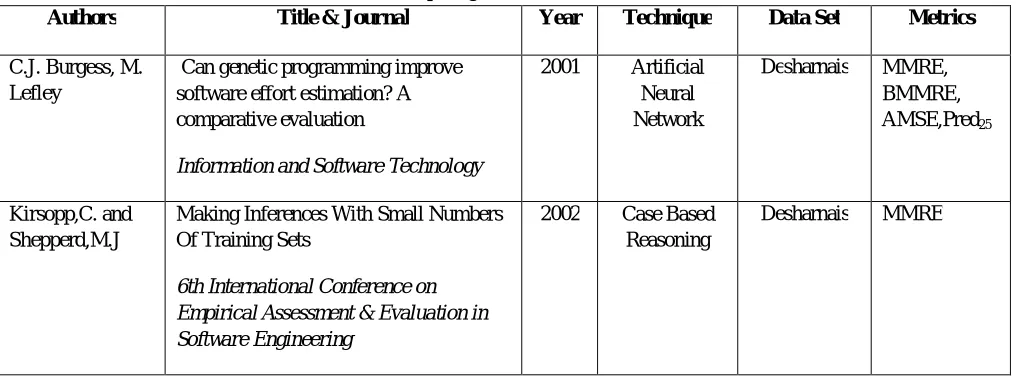
[image:6.612.36.544.487.676.2]A summary of several important soft computing based effort estimation models along with their approach is as shown in table 2.
Table 2
Soft computing based effort estimation models
Authors Title & Journal Year Technique Data Set Metrics
C.J. Burgess, M. Lefley
Can genetic programming improve software effort estimation? A comparative evaluation
Information and Software Technology
2001 Artificial Neural Network
Desharnais MMRE,
BMMRE, AMSE,Pred25
Kirsopp,C. and Shepperd,M.J
Making Inferences With Small Numbers Of Training Sets
6th International Conference on Empirical Assessment & Evaluation in Software Engineering
2002 Case Based Reasoning
Luiz F. Capretz, Jing Ren, Danny Ho
Estimation Third International
Conference On Quality Software PERC
IMPR
Harsh Kumar Verma, Vishal Sharma
Handling Imprecision in Inputs using Fuzzy Logic to Predict Effort in Software Development
IEEE 2nd International Advance Computing Conference
2010 Fuzzy Logic Cocomo81 Pred25
MMRE
Iman Attarzadeh, Siew Hock Ow
Improving Estimation Accuracy of the COCOMO II Using an Adaptive Fuzzy Logic Model
IEEE International Conference on Fuzzy Systems
2011 Fuzzy Logic Cocomo81
NASA
MMRE
Pred25
Prasad Reddy P.V.G.D , Sudha K.R,Rama Sree P
Application Of Fuzzy Logic Approach To Software Effort Estimation
International Journal Of Advanced Computer Science And Applications
2011 Fuzzy Logic NASA VAF,MARE
VARE,MEAN BRE,MMRE
PRED30
V. CONCLUSION
To increase the performance of software effort estimation models under the quickly changing computing environment. If the dataset has more linear data points, it is easier to estimate. The Neuro-Fuzzy Model which uses more number of rules would give correct results as practically all the combinations of inputs are being represented as rules for the fuzzy inference system. Software Development Time Estimation results show that the proposed ANFIS model gives outstanding results as compared to different types of neural network models. This model is suitable for various areas of software development such as Effort estimation, Cost Estimation.
REFERENCES
[1] S.Basha and P.Dhavachelvan, “Analysis of Empirical Software Effort Estimation Models” in International Journal of Computer Science and Information Security (IJCSIS), Vol. 7, 2010.
[2] B.Hughes and M.Cotterell, “Software Project Management”, Tata McGraw-Hill, 2006.
[3] T.Gruschke, “Empirical Studies of Software Cost Estimation: Training of EffortEstimation Uncertainty Assessment Skills”, 11th IEEE International Software Metrics Symposium, IEEE, 2005.
[4] Mrinal Kanti Ghose, Roheet Bhatnagar and Vandana Bhattacharjee, “Comparing Some Neural Network Models for Software Development Effort Prediction”, IEEE conference , 2011.
[5] J. Jantzen, “Neuro- Fuzzy modeling”, Reort no 98-H-874, 1998.
[6] Xishi Huang et al., “A Neuro-Fuzzy Model for Software Cost Estimation”, Proceedings of the Third International Conference on Quality Software (QSIC’03), IEEE, 2003.
[7] Nassif Bou Ali, Ho Danny, Capretz Fernando Luiz, “Towards An Early Software Estimation Using Log-Linear Regression and A Multilayer Perceptron Model”, 2013, pp. 144-160.
Engineering (IOSRJCE), Vol. 2, pp. 12-14, July-Aug. 2012.
[10] Urvashi Rahul Saxena, S.P.Singh, “Software Effort Estimation Using Neuro-Fuzzy Approach”, CSI 6th International Conference, pp.1-6, Sept.2012. [11] Vachik S. Dave, Kamlesh Dutta, “Neural Network based Software Effort Estimation & Evaluation criterion MMRE”, International Conference on Computer
& Communication Technology (ICCCT), pp.347-351, 2011.
[12] N. Sharma1, A. Bajpai and M. R. Litoriya, “A Comparison of Software Cost Estimation Methods: A Survey”, The International Journal of Computer Science and Applications (TIJCSA), Vol.1, no. 3, ISSN – 2278 – 1080, May 2012.
[13] T. R. Benala, S. Dehuri and R. Mall, “Computational Intelligence in Software Cost Estimation: An Emerging Paradigm”, ACM SIGSOFT Software Engineering Notes Page, Vol. 37, no.3, 2012.
[14] J.S. Pahariya, V. Ravi and M. Carr, “Software Cost Estimation using Computational Intelligence Techniques”, World Congress on Nature & Biologically Inspired Computing (NaBIC 2009) IEEE, 2009.
[15] C.J. Burgess, M. Lefley, ” Can genetic programming improve software effort estimation? A comparative evaluation”, Information and Software Technology, pp.863–873, 2001.
[16] Anish Mittal, Kamal Parkash and Harish Mittal “Software Cost Estimation Using Fuzzy Logic”, ACM SIGSOFT Software Engineering Notes Page , Vol 35 no. 1, November 2010.
[17] Harsh Kumar Verma, Vishal Sharma, “Handling Imprecision in Inputs using Fuzzy Logicto Predict Effort in Software Development” , IEEE conference, 2010.
[18] G. D. Boetticher, “An assessment of metric contribution in the construction of a neural network-based effort estimator”, Proceedings of Second International Workshop on Soft Computing Applied to Software Engineering, 2001.
[19] A.R.Venkatachalam, “Software cost estimation using artificial neural networks”, in: Proceedings of the International Joint Conference on Neural Networks, pp. 987–990, 1993.
[20] J. Ryder, “Fuzzy modeling of software effort prediction”, Proceedings of IEEE Information Technology Conference, Syracuse, NY, 1998.
[21] Allidri et al., “COCOMO Cost Model Using Fuzzy Logic”, 7th International Conference On RFuzzy Theory & Technology Atlantic City, New Jersey, February27-March3, 2000.
[22] Heejum Park and Seung Baek, “An Empirical validation of a neural network model for software effort estimation”, Expert System with Application,Elsevier, pp.929-937, 2007.
[23] Dinesh C.S. Bisht and Ashok Jangid, “Discharge Modelling using Adaptive Neuro-Fuzzy Inference System”, International Journal of Advanced Science and Technology,Vol. 31,pp.99-114, June 2011.
[24] Mrinal Kanti Ghose, Roheet Bhatnagar and Vandana Bhattacharjee, “Software Development Effort Estimatiom- Neural Network Vs. Regression Modelling Approach”, International Journal of Engineering and Technology, Vol. 2(7), pp. 2950-2956, 2010.
[25] Divya Kashyap, Ashish Tripathi,Prof. A.K.Mishra, “Software Development Effort and Cost Estimation: Neuro-Fuzzy Model”, IOSR Journal of Computer Engineering (IOSRJCE), Vol. 2, pp. 12-14, July-Aug. 2012.
[26] M. Chemuturi, “Software Estimation Best Practices, Tools & Techniques: A Complete Guide for Software Project Estimator” , 2009.