Journal of Chemical and Pharmaceutical Research, 2016, 8(11):92-96
Research Article
CODEN(USA) : JCPRC5
ISSN : 0975-7384
92
Antimicrobial Activity of Medicinally Important Plant -
Cissus
quadrangularis
Linn against some Pathogenic Bacteria
Selvamaleeswaran P
*, Manimaran E and Sureshkumar M
Department of Biotechnology, Muthayammal College of Arts & Science, Rasipuram, Namakkal ,Tamilnadu, India
____________________________________________________________________________
ABSTRACT
The plants Cissus quadrangularis was collected from kolli hills, Namakkal DT, Tamilnadu. The plant stems were collected and it was dried for room temperature (37 oC) for 10-15 days. The dried stems were grinded as course powder then the powder was filled in soxhlet apparatus. Crude extracts were prepared from that powder using different solvents like Petroleum ether, isopropyl alcohol, ethyl acetate and ethanol. The antimicrobial activities of the extracts were tested against four microorganisms. The antimicrobial activities of Cissus quadrangularis stem extracts were assessed by the presence or absence of inhibition zones and zone diameter values. The Kirby – Bauer method is used for the antimicrobial activity of Cissus quadrangularis stem extracts. Among the four crude extracts of Cissus quadrangularis, the Petroleum ether and Ethyl acetate showed good antimicrobial activity against all the tested microorganisms, Ethanol showed moderate inhibition activity, and Isopropyl alcohol showed least antimicrobial activity against all organisms.
Keywords: Cissus quadrangularis; Antimicrobial; Petroleum ether; Ethyl acetate; Kirby – Bauer
_________________________________________________________________________________
INTRODUCTION
The plant Cissus quadrangularis Linn is an indigenous medicinal plant of India. It is also known as vitis quadrangularis. It certainly belongs to family vitaceae. This is distributed throughout India particularly in tropical regions. The plant was chiefly known as edible stemmened vine in English, perandi in Tamil. It is freshly cactus like, jointed climber, tendrils simple, leaves simple or lobed, cordate, serrate, dentate, flowers or small, greenish white, bisexual and tetramerous. Calyx is cup shaped, fruits globose or obovoid fleshy berries, succulent, very acrid, dark purple to black and stem is buff colored with greenish ting [1].
It has been prescribed in Ayurvedic and siddha as an alternative traditional medicine. It has anthelmintic, dyspeptic, digestive, tonic, analgesic in eye and ear diseases, and in the treatment of irregular menstruation and asthma. The whole plant is used in oral re-hydration, while the leaf, stem and root extracts are important in the management of various ailments [2].
93
MATERIALS AND METHODS
Plant collection
The medicinal plant Cissus quadrangularis was collected from kolli hills, Namakkal DT, Tamilnadu.
Test microorganisms and microbial culture
Four bacterial strains were utilized in this study namely Escherichia coli (MTCC 2844), Proteus mirabilis (MTCC 9242), Staphylococcus aureus (MTCC 9886) & Bacillus subtilis (MTCC 8141). The cultures were obtained from the MTCC, Chandigarh, India.
Methods
Preparation of plant extracts
Stems of plant Cissus quadrangularis were collected from kolli hills Namakkal. Collected plant material was shade dried and grinder with 2mm diameter mesh. The powdered plant materials (50g) were extracted successively with 200ml of petroleum ether, isopropyl alcohol, ethanol and ethyl acetate by using soxhelt extractor for 48 hours at a temperature not exceeding the boiling point of the solvent. The residues obtained were stored in a freezer at -800c until further tests [4].
Disc diffusion method/Kirby – Bauer method
Willy Kirby, A.W Bauer and their colleagues developed it in the early 1960,s at the university of Washington medical school.
Muller Hinton Agar medium was prepared by using clean sterile conical flask and kept it for sterilization. After sterilization, the medium was poured into the sterile Petri plates and allowed to solidify. The bacterial culture was inoculated in the peptone water and kept in the shaker for 7 – 8 hours. Then, the culture was swabbed on the surface of the Muller Hinton Agar medium by using sterile cotton swabs. The sample was added in to the sterile disc, this kept in hot plate different concentration (100µg, 200µg, 300µg, 400µg, 500 µg). Then, the plates were incubated in to the incubator for 24 hours at 370C.
RESULTS
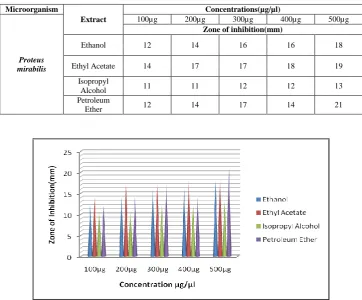
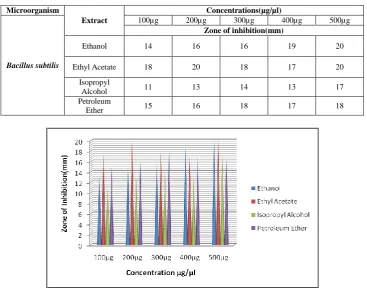
The result clearly shows that the plant Cissus quadrangularis stem extract exist antimicrobial activity. The antimicrobial activity of Cissus quadrangularis stem extracts were assessed by the presence or absence of inhibition zones and zone diameter values. The Kirby – Bauer method is used for the antimicrobial activity test of Cissus quadrangularis stem extracts. Among the four crude extracts of Cissus quadrangularis, the Petroleum ether and Ethyl acetate showed good antimicrobial activity against all the tested microorganisms, Ethanol showed moderate inhibition activity, and Isopropyl alcohol showed least antimicrobial activity against all organisms. The growth inhibitory effect of Cissus quadrangularis extracts against four pathogenic microorganisms are represented in Table 1-4.
Table 1: Antibacterial activity of various extracts of Cissus quadrangularis against E.coli.
Microorganism
Extract
Concentrations(µg/µl)
E .coli
100µg 200µg 300µg 400µg 500µg
Zone of inhibition(mm)
Ethanol 15 18 17 18 20
Ethyl Acetate 21 21 23 25 25
Isopropyl
Alcohol 18 19 21 22 23
Petroleum
94
[image:3.595.116.479.262.562.2]Figure 1: Antibacterial activity of various extracts of Cissus quadrangularis against E.coli
Table 2: Antibacterial activity of various extracts of Cissus quadrangularis against Proteus mirabilis
Microorganism
Extract
Concentrations(µg/µl)
Proteus mirabilis
100µg 200µg 300µg 400µg 500µg
Zone of inhibition(mm)
Ethanol 12 14 16 16 18
Ethyl Acetate 14 17 17 18 19
Isopropyl
Alcohol 11 11 12 12 13
Petroleum
Ether 12 14 17 14 21
Figure 2: Antibacterial Activity of various extracts of Cissus quadrangularis against Proteus mirabilis
Table 3: Antibacterial activity of various extracts of Cissus quadrangularis against Staphylococcus aureus
Microorganism
Extract
Concentrations(µg/µl)
Staphylococcus aureus
100µg 200µg 300µg 400µg 500µg
Zone of inhibition(mm)
Ethanol 13 16 15 17 18
Ethyl Acetate 16 18 17 19 20
Isopropyl
Alcohol 12 13 12 13 14
Petroleum
95
[image:4.595.115.483.297.587.2]Figure: 3 Antibacterial activities of various Extracts of Cissus quadrangularis against Staphylococcus aureus
Table 4: Antibacterial activity of various extracts of Cissus quadrangularis against Bacillus subtilis
Microorganism
Extract
Concentrations(µg/µl)
Bacillus subtilis
100µg 200µg 300µg 400µg 500µg
Zone of inhibition(mm)
Ethanol 14 16 16 19 20
Ethyl Acetate 18 20 18 17 20
Isopropyl
Alcohol 11 13 14 13 17
Petroleum
Ether 15 16 18 17 18
Figure: 4 Antibacterial activities of various extracts of cissus quadrangularis against Bacillus subtilis
DISCUSSION
96
Cissus quadrangularis stem extracted with five solvents (Petroleum ether, chloroform, ethyl acetate, ethanol and aqueous extract) were tested for antimicrobial activities against Escherichia coli, Staphylococcus aureus, Pseudomonas aeruginosa, Proteus mirabilis, Penicillium sp, Mucor sp, Aspergillus Niger and Candida albicans by disc diffusion method. Among the five extracts, aqueous extract showed maximum antibacterial and antifungal activity against Pseudomonas aeruginosa and Mucor sp, Chloroform and ethyl acetate extracts were ineffective against Proteus mirabilis and Penicillium sp, [5].
The invitro antibacterial activity of different extracts of Cissus quadrangularis Linn (Vitaceae) against some Gram-negative and Gram-positive bacteria, were investigated. The methanol and ethyl acetate extract showed high activity against the bacteria tested [6]. Extracts of Cissus quadrangularis L. were tested for antioxidant activity by beta-carotene linoleic acid model and also by 1, 1-diphenyl-2-picrylhydrazyl model. The ethyl acetate extract and methanol extract of both fresh and dry stems further exhibited antimicrobial activity against Gram-positive bacteria, including Bacillus subtilis, Bacillus cereus, Staphylococcus aureus, and Streptococcus species. The results of the study have some implications in the use of Cissus quadrangularis as an antibacterial agent and also as an antioxidant in several applications. [7].
CONCLUSION
The results of this study have shown that the stem extracts of Cissus quadrangularis have great potential as antimicrobial agents in the treatment of infectious organisms. Further detailed investigation of the active components of the plant for the exact mechanism of action will contribute greatly to the development new pharmaceuticals.
ACKNOWLEDGEMENTS
The authors thank the management of Muthayammal Educational Charitable Trust, Rasipuram, Namakkal Dt, Tamil Nadu, India for their encouragement and infrastructure facilities to carry out this work.
REFERENCES
[1] RP Rastogi; BN Mehrotra. Compendium of Indian Medicinagl Plants, Part I, Publication and information directorate, 1995, 104.
[2] M Jainu; CS Devi. J Clin Biochem Nutri, 2003, 34, 43-47.
[3]K Balasubramanian; N Jayalakshmi; R Vidhya; A Prasad; G Khaleefathullah Sheriff; K Kathiravan; K Rajagopal; MS Sripathi.J Basic Clin Pharm, 2010, 1(1).
[4] AA Aliero; AJ Afolayan. African J Biotechnol, 2006, 5(4), 369-372.
[5] JR Anitha ; S Akila; KG Velliyur ; D Sudarsanam . J Herbal Med Toxicol 2010, 4(2) 177-180. [6] ND Kashikarand. Ind J PharmSci, 2006, 68 (2), 245-247.