Journal of Chemical and Pharmaceutical Research, 2015, 7(3):1191-1196
Research Article
CODEN(USA) : JCPRC5
ISSN : 0975-7384
Research and application of the rough multi-attribute lattice order
decision-making
Li Lihong, Sun Jie *, Bai Bin and Liu Baoxiang
College of Sciences, Hebei United University, Tangshan, Hebei, China
____________________________________________________________________________________________
ABSTRACT
According to the shortages of optional plan and optimal solution in decision-making system, we put forward a new rough lattice order decision-making model, which is based on the rough decision-making analysis method of dominant relation. The method of rough decision-making analysis, based on dominance relation, is discussed in the article, also provide new method of selection, establish partial order relation based on P-set and present construction method of optional plan lattice structure, which is based on dominance relations, thus we can choose optimal scheme reasonably. Finally, an application instance will be given.
Key words: Dominance relation; rough set; lattice order decision-making
_____________________________________________________________________________________________
INTRODUCTION
Rough set theory proposed by Pol and scientist Pawlak in 1982 is a theoretical method studying incomplete, uncertain knowledge and data expression, learning and concluding. It is a new mathematical tool that deals with the fuzzy and uncertain knowledge. Its main idea is that, decision or classification rules, under the premise of keeping the classification function unchanged, induced through the reduction of knowledge. However, because of the effects of the environment that is complex and uncertain and the preference of the decision maker, information incompletion, information uncertainty and preference information have become significant features of the actual decision system. The multi-attribute decision-making problem with preference of incomplete information has attracted more and more attentions. Dominance relation rough set theory proposed by Greco has provided a new idea to deal with the multi-attribute decision-making problem of preference information. In Greco’s theory, dominance relation is used to signify the preference information of the decision maker in the form of knowledge. It is good for dealing with the multi-attribute decision-making problems with preference information.
The lattice is a kind of order structure which enjoys wide application in the treatment of preference relation. The lattice is able to make the fuzzy and indistinct preference of decision maker’s decisions ordered and structured. In this paper, the authors apply rough set theory in multi-attribute lattice order decision. Dominance relation is used to replace the indiscernible relation of classical rough sets to work out rough approximations of knowledge, and the lattice order theory is used to obtain decision-making information or decision-making results in order to achieve better classification and determine the preference orderings of the schemes faster.
THE ANALYSIS METHOD OF ROUGH DECISION BASED ON DOMINANCE RELATION
There are some basic concepts of the information system based on dominance relation.
Definition 1:The given decision-making system
S
=<
U
,
A
,
V
,
f
>
,∀
x
,
y
∈
U
,setP
⊆
A
, forq
∈
P
, ifx
yS
q representsx
inferior toy
xS
qy
andxS
qy
representsx
non-inferior toy
, thenI
q∈PS
qis called theObviously, the dominance relation is partial ordering relation, presenting reflexivity and transitivity.
Definition 2: For given set
P
⊆
A
,∀
x
,
y
∈
U
, under the dominance relation, theP
partial set ofx
is defined as( )
x
{
y
U
:
yD
x
}
D
P=
∈
P+
and the
P
ofx
is defined asD
P( )
x
=
{
y
∈
U
:
xD
Py
}
−
by partial set.
Suppose that the object set
U
is divided as the decision class of limited number according to decision-making preference attribute, and setCl
u=
{
Cl
t,
t
∈
1
,
2
,
L
,
n
}
≥
.
If
{
x
∈
Cl
ry
∈
Cl
s,
0
≤
s
≤
r
≤
n
}
⇒
{
xS
qy
∧
¬
yS
qx
}
, written asCl
rf
Cl
s. The upward and downwardunions of these categories are respectively represented as: s
t s t
Cl
Cl
≥ ≥
=
U
, s
t s t
Cl
Cl
≤ ≤
=
U
among
which
t
,
s
∈
{
1
,
2
,
L
,
n
}
.x
∈
Cl
t≥means thatx
at least belongs to categoryCl
t;x
∈
Cl
t≤means thatx
at most belongs to categoryCl
t. Obviously, each object ofCl
t≥is better than or at least equal to each object ofCl
t≤.U
Cl
Cl
=
n=
≤ ≥
1 ,
Cl
n=
Cl
n≥
,
Cl
1≤=
Cl
1,Cl
t≤−1=
U
−
Cl
t≥,t
=
2
,
3
,
L
,
n
. That is to say, the decision makerhas assigned objects in the decision table to categories in accordance with the following comprehensive evaluation. The worst object belongs to category
Cl
1, the best belongs to categoryCl
n, and other objects belong to theremaining category
Cl
t. According to this principle, the higher the value oft
, the better the categoryCl
twill be.Definition 3: Suppose the decision system
S
=<
U
,
A
,
V
,
f
>
, the given setP
⊆
A
,Cl
t≥⊆
U
, under the dominance relation, the lower approximation, the upper approximation and the boundary region ofCl
t≥ arerespectively defined as
P
( )
Cl
t≥=
{
x
∈
U
:
D
P+( )
x
⊆
Cl
t≥}
,P
( )
Cl
t≥=
{
x
∈
U
:
D
P−( )
x
I
Cl
t≥≠
φ
}
andCl
t≥is defined as
Bn
P( ) ( ) ( )
Cl
t≥=
P
Cl
t≥−
P
Cl
t≥ .Similarly, those of are
P
( )
Cl
t≤=
{
x
∈
U
:
D
P-( )
x
⊆
Cl
t≤}
,P
( )
Cl
t≤=
{
x
∈
U
:
D
P+( )
x
I
Cl
t≤≠
φ
}
andBn
P( ) ( ) ( )
Cl
t≤=
P
Cl
t≤−
P
Cl
t≤ .LATTICE ORDERED CHOICE BASED ON ROUGH SET FORMAT
Definition 4: Suppose decision system
S
=<
U
,
A
,
V
,
f
>
, the given setP
⊆
A
,Cl
t≥⊆
U
,( )
≥−
Cl
tP
and( )
≤−
Cl
tP
are respective the rough lower approximations ofCl
t≥andCl
t≤,then( )
t tt
P
Cl
Cl
U
≥U
−
≥
=
is the risk taking alternative scheme set and( )
t t
t
P
Cl
Cl
U
≤U
−
≤
=
is the conservativealternative scheme set.
Definition 5: If the decision system
S
=<
U
,
A
,
V
,
f
>
,a
i∈
U
, the given setP
⊆
A
, there is[ ]
i( )k ikk i k i i
p
a
a
x
a
x
a
x
a
v
=
1 −1+
2 −2+
L
+
−1+
, of whichk
is the number of elements in setP
;a
ijrepresents the corresponding element of item
i
in setU
with respect to itemj
in setP
, thusv
p[ ]
a
i iscalled
P
- assignment function, andV
p=
{
v
p[
a
1],
v
p[
a
2],
L
,
v
p[
a
n]}
is calledP
- assignment function set.Definition 6: If the decision system
S
=<
U
,
A
,
V
,
f
>
,… , the given setP
⊆
A
, pV
is aP
- assignmentfunction set.
∀
v
p[
a
i],
v
p[
a
j]
∈
V
p , if there isik k
i k i i
p
a
a
x
a
x
a
v
=
−+
−2+
L
+
2 1 1
]
[
andv
pa
j=
a
jx
k−+
a
jx
k−2+
L
+
a
jk2 1 1
]
[
, there will be:(3) If
a
i1<
a
j1,
a
i2<
a
j2,
L
,
a
ik<
a
jk ,v
p[
a
j]
is called strictly prior tov
p[
a
i]
, writtenas
v
p[
a
i]
<
v
p[
a
j]
.According to the definition 6, the dominance relation of
P
- assignment function setV
p presents the following natures:Character 1: Reflexivity. For any
v
p[
a
i]
, there will bev
p[
a
i]
=
v
p[
a
i]
.Character 2: Antisymmetry, if
v
p[
a
i]
≤
v
p[
a
j]
andv
p[
a
j]
≤
v
p[
a
i]
, thenv
p[
a
i]
=
v
p[
a
j]
.Character 3: Transitivity. If
v
p[
a
i]
≤
v
p[
a
j]
andv
p[
a
j]
≤
v
p[
a
k]
, thenv
p[
a
i]
<
v
p[
a
k]
.In conclusion, under dominance relation of “
≤
”, setV
pmakes up partial order set.As for the partial order set
(
V
p,
≤
)
, supposex
andy
are two arbitrary element so of the partial setV
p,if
x
≤
y
ory
≤
x
,x
andy
are regarded as comparable, otherwisex
andy
are not comparable, written asx
y
.Definition 7: Suppose the decision system
S
=<
U
,
A
,
V
,
f
>
,(
V
p,
≤
)
is a partial order set. If any two elements have both supremum and infimum,V
pcan make up a lattice in regard to partial order “≤
”and “≤
” is called a lattice order ofV
p.In the partial set
(
V
p,
≤
)
, the given setP
⊆
A
, there will bev
p[
a
i],
v
p[
a
j],
v
p[
a
l]
∈
V
p:(1) If
a
i1<
a
j1, anda
i1<
a
l1,a
i2<
a
j2, anda
i2<
a
l2,…,jk ik
a
a
<
anda
ik<
a
lk(k is the number of the elements in setP
),v
p[
a
i]
is then called the infimum ofv
p[
a
j]
andv
p[
a
j]
, writtenas
v
p[
a
i]
=
inf(
v
p[
a
j],
v
p[
a
l])
.(2) If
a
i1>
a
j1, anda
i1>
a
l1,a
i2>
a
j2, anda
i2>
a
l2,…,jk ik
a
a
>
anda
ik>
a
lk (k is the number of the elements in setP
),v
p[
a
i]
is then called the supremum ofv
p[
a
j]
andv
p[
a
j]
, writtenas
v
p[
a
i]
=
sup(
v
p[
a
j],
v
p[
a
l])
.For the limited partial order set
(
V
p,
≤
)
, if each element inV
pis represented with a small circle on the same plane:if
a
p
b
, there isc
, anda
p
c
p
b
is met; puttingb
abovea
and linkinga
andb
with a licne, the graph worked out is called the Hasse graph of the partial order set(
V
p,
≤
)
. Hasse graph can intuitively and vividly presents the relationship among the various elements in partial order sets.SAMPLE ANALYSIS
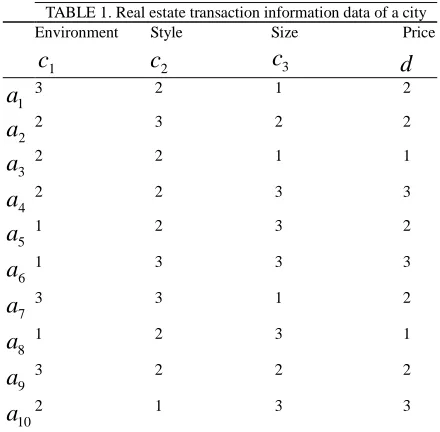
The real estate database of a city has accumulated a lot of data information about the real estate transaction. There are ten alternative schemes, the sets of which are represented with
{
a
1,
a
2,
L
,
a
10}
. Before making decisions, theTable 1 Real estate transaction information data of a city
TABLE 1. Real estate transaction information data of a city Environment Style Size Price
1
c
c
2c
3d
1a
3 2 1 22
a
2 3 2 23
a
2 2 1 14
a
2 2 3 35
a
1 2 3 26
a
1 3 3 37
a
3 3 1 28
a
1 2 3 19
a
3 2 2 210
a
2 1 3 3In this table,
}
,
,
,
,
,
,
,
,
,
{
a
1a
2a
3a
4a
5a
6a
7a
8a
9a
10U
=
is the alternative scheme set. For regional environmentc
1: if it belongs to the inner ring region, it is written as 3;if it is between the inner and the outer ring, it is written as 2; and ifit is between the inner and the outer ring, it is written as 2;if it belongs to the outer ring region, it is written as 1. For
the type of housing
c
2the high-rise is written as 3;the small high-rise is written as 2; and the multi-level is written as1. For the size of area
c
3, the large is written as 3; the medium is written as 2 and the small is written as 1. For the decision attributesd
, if the price is high, it is written as 3; if the price is middle, it is written as 2; and if the price is low, it is written as 1.Suppose the buyer pays more attention to the regional environment and the type of housing, setting
P
=
{
c
1,
c
2}
. According to the decision attribute, the samples are divided into three decision classes:}
)
,
(
,
{
1
a
U
f
a
d
lowprice
Cl
=
∈
p=
=
{
a
3,
a
8}
}
,
,
,
,
{
}
)
,
(
,
{
9 7 5 2 1 2a
a
a
a
a
e
middlepric
d
a
f
U
a
Cl
p=
=
∈
=
}
,
,
{
}
)
,
(
,
{
10 6 4 3a
a
a
highprice
d
a
f
U
a
Cl
p=
=
∈
=
Obviously:}
,
,
,
,
,
,
,
,
,
{
1 2 3 4 5 6 7 8 9 103 2 1 1
a
a
a
a
a
a
a
a
a
a
Cl
Cl
Cl
Cl
=
=
≥
U
U
3 2 2
Cl
Cl
Cl
≥=
U
=
{
a
1,
a
2,
a
4,
a
5,
a
6,
a
7,
a
9,
a
10}
3 3
Cl
Cl
≥=
=
{
a
4,
a
6,
a
10}
2 1 2
Cl
Cl
Cl
≤=
U
{
,
,
,
,
,
,
}
9 8 7 5 3 2
1
a
a
a
a
a
a
a
=
}
,
,
,
,
,
,
,
,
,
{
1 2 3 4 5 6 7 8 9 10 3 2 1 3a
a
a
a
a
a
a
a
a
a
Cl
Cl
Cl
Cl
=
=
≤
U
U
result calculated by rough decision analysis method based on the dominance relation is as follows (
P
=
{
c
1,
c
2}
):}
,
,
{
)
(
a
1a
1a
7a
9D
p+=
,(
)
{
,
,
,
,
,
,
}
10 9 8 5 4 3 1
1
a
a
a
a
a
a
a
a
D
p−=
;}
,
{
)
(
a
2a
2a
7D
p+=
,(
)
{
,
,
,
,
,
,
}
10 8 6 5 4 3 2
2
a
a
a
a
a
a
a
a
D
p−=
;}
,
,
,
,
,
{
)
(
a
3a
1a
2a
3a
4a
7a
9D
p+=
,(
)
{
,
,
,
,
}
10 8 5 4 3
3
a
a
a
a
a
a
D
p−=
;}
,
,
,
,
,
{
)
(
a
4a
1a
2a
3a
4a
7a
9D
p+=
,(
)
{
,
,
,
,
}
10 8 5 4 3
4
a
a
a
a
a
a
D
p−=
;}
,
,
,
,
,
,
,
,
{
)
(
a
5a
1a
2a
3a
4a
5a
6a
7a
8a
9D
p+=
,(
)
{
,
}
8 5 5
a
a
a
D
p−=
;}
,
,
{
)
(
a
6a
2a
6a
7D
p+=
,(
)
{
,
,
}
8 6 5 6
a
a
a
a
D
p−=
;}
{
)
(
a
7a
7D
p+=
,(
)
{
,
,
,
,
,
,
,
,
,
}
10 9 8 7 6 5 4 3 2 1
7
a
a
a
a
a
a
a
a
a
a
a
D
p−=
;}
,
,
,
,
,
,
,
,
{
)
(
a
8a
1a
2a
3a
4a
5a
6a
7a
8a
9D
p+=
,(
)
{
,
}
8 5 8
a
a
a
D
p−=
;}
,
,
{
)
(
a
9a
1a
7a
9D
p+=
,(
)
{
,
,
,
,
,
,
}
10 9 8 5 4 3 1
9
a
a
a
a
a
a
a
a
D
p−=
;}
,
,
,
,
,
,
{
)
(
a
10a
1a
2a
3a
4a
7a
9a
10D
p+=
,(
)
{
}
10 10
a
a
D
p−=
;}
,
,
,
,
{
)
(
Cl
2a
1a
2a
6a
7a
9P
≥=
− ,
P
Cl
=
a
a
a
a
a
a
a
a
a
a
=
U
≥ −}
,
,
,
,
,
,
,
,
,
{
)
(
2 1 2 3 4 5 6 7 8 9 10}
,
,
,
,
{
)
(
)
(
)
(
10 8 5 4 3 2 2 2a
a
a
a
a
Cl
P
Cl
P
Cl
Bn
P=
−
=
≥ ≥ ≥ ;}
,
{
)
(
Cl
2a
5a
8P
≤=
− ,
U
a
a
a
a
a
a
a
a
a
a
Cl
P
≤=
=
−
}
,
,
,
,
,
,
,
,
,
{
)
(
2 1 2 3 4 5 6 7 8 9 10}
,
,
,
,
,
,
,
{
)
(
)
(
)
(
10 9 7 6 4 3 2 1 2 2 2a
a
a
a
a
a
a
a
Cl
P
Cl
P
Cl
Bn
P=
−
=
≤ ≤ ≤According to the intention of the buyers to choose middle priced houses, if other condition attributes are satisfying, the high priced ones may also be accepted. There will thus be the risk taking alternative scheme set
}
,
,
,
,
,
{
)
(
2 2 1 2 5 6 7 92
P
Cl
Cl
a
a
a
a
a
a
U
=
≥=
−
≥
U
andP
- assignment functionsets
V
p=
{
v
p[
a
1]
,
v
p[
a
2],
v
p[
a
5]
,
v
p[
a
6],
v
p[
a
7],
v
p[
a
9]
}
According to the definition 6:
2
3
]
[
a
1=
x
+
v
p ,v
p[
a
2]
=
2
x
+
3
,v
p[
a
5]
=
x
+
2
,v
p[
a
6]
=
x
+
3
,v
p[
a
7]
=
3
x
+
3
,v
p[
a
9]
=
3
x
+
2
through calculation ,
a
7is the optimal scheme.The Hasse graph is as follows:
7
a
9
a
1a
a
26
a
5
a
priced is the limit. There will be the conservative alternative scheme set
}
,
,
,
,
,
{
)
(
2 2 1 2 5 7 8 92
P
Cl
Cl
a
a
a
a
a
a
U
=
≤=
−
≤
U
P
- assignment function setV
p=
{
v
p[
a
1]
,
v
p[
a
2],
v
p[
a
5]
,
v
p[
a
7],
v
p[
a
8]
,
v
p[
a
9]}
According to the definition 6:
2
3
]
[
a
1=
x
+
v
p ,v
p[
a
2]
=
2
x
+
3
,v
p[
a
5]
=
x
+
2
,v
p[
a
7]
=
3
x
+
3
,v
p[
a
8]
=
x
+
2
,v
p[
a
9]
=
3
x
+
2
through calculation,
a
7is the optimal scheme. The Hasse graph is as follows:9
a
a
27
a
5
a
a
81
a
CONCLUSION
Rough decision analysis based on dominance relation can make better generalization and practicability research on lattice order decision model. It is development and improvement of rational behaviour decision theory. In this paper, rough set theory is applied to lattice order decision theory; an insightful analysis of the lattice order natures of the alternative scheme set is made; and lattice structure is constructed in order to achieve better classification and determine the preference orderings of the schemes faster.
Acknowledgments
Supported by National Science Fund of China (NO.61370168), National Science Fund of Hebei Province China (NO.A2012209030)
REFERENCES
[1]Guo Yaohuang. Shanghai Science and Technology Press, 2003. [2]Zhao Keqin. Zhejiang Science and Technology Press, 2000.
[3]Guo Chunxiang, Guo Yaohuang. Systems Engineering-Theory Methodology Applications, 2004, 13(5) 463–466. [4]Jiang Yunliang, Xu Congfu, Computer Science, 2006, 33(1) 205–209.
[5]Zhou Lei, Shu Lan. Fuzzy Systems and Mathematics, 2006, 20(4):111-116. [6]Li Lihong, Jing Junna. ICICA. Tangshan:CCIS,2010:78-84.
[7]Sun Jie, Li Lihong, Li Yan , Liu Baoxiang. Journal of Chemical and Pharmaceutical Research, 2014, 6(4):52-58. [8]Guo ChunXiang, Guo Yaohuang. Systems Engineering, 2006, 24(2)92–95.
[9]Wang Guohua, Liang Liang. University of Science and Technology of China press, 2006.
[10]Liu Baoxiang, Yang Yafeng, Li Yankun. International Conference on Engineering and Business Management ,
2010, 1440–1442.