Application of Halbach Magnet Array
in designing a Permanent Magnet
Synchronous Machine
Zain Anjum1, Aravind C.V.2, Erwan Sulaiman3 and Shahrukh Adnan K.4
ABSTRACT
This paper discusses a novel permanent magnet machine design. In designing few simple aspects of design must be considered such as weight, cost, the operating speed, variation in speed and torque. The basic idea of designing a new model is to increase the performance of the system whilst keeping the efficiency of the machine as high as possible. Knowing the significance of improving the currently available wind turbine models in the market the idea of Halbach array is implemented using permanent magnets. Hence, a permanent magnet synchronous machine is designed using software and the finite element method is applied on the design to analyze the behavior of the machine. Based on the first Halbach model with a ratio of 1:1 five more models are made and analyzed to choose the most suitable design.
Keywords: Wind Energy; Permanent Magnet; Halbach Array; Finite Element Method
1. INTRODUCTION
In the power generation industry, the electromechanical conversion of energy plays a vital role. Therefore, improving the efficiency of the generators is extremely significant in order to fulfill the energy demands around the world. Usually in a system where the energy is converted a high amount of energy is lost in conversion in terms of mechanical transmission, power loss in the wires etc. Studies show that using a permanent magnet design inside a generator or motor can improve the efficiency of the system. With more research on this type of technology a good design can be generated solving one of the main problems faced by the power generation industry. Permanent magnets have been in the market for a very long time now but recently due to advancement in power electronics controlling the operation of the motors a good increase in permanent magnets based designs is observed [1]. For wind turbine application the main things to consider are high torque and efficiency on low speeds. Because the wind does not move the rotor at a high speed it just moves the rotor at low speed therefore the torque must be high [2]. Permanent Magnet Generators were introduced in the wind turbines in the early 2000s. Ever since then the market for these types of generators is on a boom. In the past 4 years starting from 2011 until now the use of permanent magnet generators has increased radically.Statistics show the increase to be from 17% to about 40% which means the future is bright for this type of technology. The main reason for the increase is that using PMGs increases the efficiency along with flexibility and reliability [3].
Many big companies are carrying out intense research on PMGs by studying the basics principles in order to make this technology as efficient as possible. To design a great generator or motor finite element method
1 Research student, Taylor’s University, Selangor, Malaysia, Selangor, Malaysia, Email: [email protected]
2 Senior Lecturer, School of Engineering, Taylor’s University, Selangor, Malaysia, Selangor, Malaysia, Email: [email protected]
3 Research Leader, Research Center for Applied Electromagnetics, Universiti Tun Hussein Onn Malaysia, Email: [email protected]
rotation of the shaft to produce mechanical energy this energy can then be converted into electrical energy by using a generator [5]. At present there are two generally used configurations of wind turbines which are horizontal-axis and vertical-axis turbines. But the most common one used is the horizontal-axis type this is because in this case the rotating blades are in parallel to the wind stream. In horizontal axis wind turbines, the rotating axis is parallel to the ground. On the other hand, in a vertical wind turbine the rotating axis is perpendicular to the ground. Horizontal axis can produce a lot more energy compared to the vertical axis wind turbines mainly because of the size of the propellers. But both these designs have their application for small scale application a horizontal axis turbine is recommended but for electricity generation in power plants the best choice would be the horizontal axis turbine [6]. In a typical turbine design the blades are connected to an axle which is connected to a gear box. This gearbox steps up the rotational speed of the shaft from the propeller to the shaft that goes inside the generator because to produce electricity high rotational speed is required. The speed of the generator can vary causing fluctuation in the electricity produced due to unpredictable wind speed. Therefore, to overcome this problem a constant speed turbine should be used that can adjust to the extreme conditions. A generator is a device that converts mechanical energy to electrical energy. The generator does not create electricity it simply converts the mechanical energy acquired from an external source into electrical energy. Basically Inside an electrical generator either AC or DC the operation depends upon the Faraday’s magnetic induction principle. Inside a generator the coil is rotated by an external force this motion cuts the flux generated by the magnet and generates electricity. In this case we are using a permanent magnet generator hence the rotor has permanent magnets attached to it which are self-excited and as the rotor rotates it cuts the magnetic field which results in production of current [7].Wind is created by uneven heating by the sun on different parts of the earth. This difference in temperature generates a change in pressure in the atmosphere causing the wind to flow. Looking at this in a positive way a wind turbine can be made to generate power from this free energy source. The wind flowing across the blades of the wind turbine results in rotating of the shaft which then converts this motion into electricity. Even though wind energy is free it still has drawbacks. It is believed that making a wind power farm is very expensive and does not generate enough electricity to recover the cost. Looking at this as an opportunity the idea of designing a new generator for wind turbine is selected [8]. Finite element method (FEM) is a numerical method to solve linear and non-linear partial differential equations of a given system. It starts of by constructing the design of your desired motor in 2D or 3D depending on your needs. Moving on the material properties of the different parts inside the motor can be configured along with the excitation pattern of the magnets and coils. Moving on mesh of the system is generated that breaks the given structure into very small finite elements [9]. As the finite element model is made the simulation is run to obtain the results these results can be seen and interpreted to understand the behavior of the constructed model. After this the results can be analyzed and compared to understand to make sure that you get the most accurate results. If these results obtained are not what is expected the model can still be modified in many different ways to reach a point where the results are extremely accurate [10].
2. GENERAL ARCHITECTURE
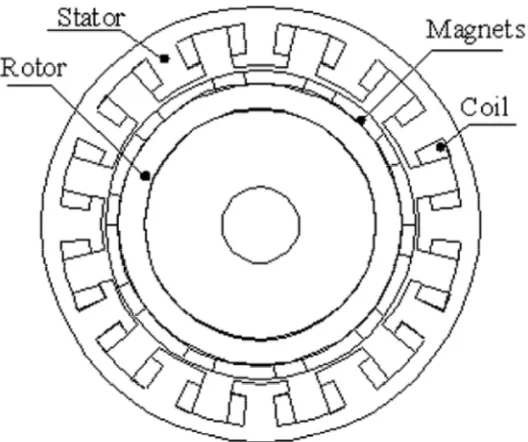
Figure 1: Front view of the design
Table 1
Machine design parameters
Parameters Value
Machine
Outer diameter 50 mm
Stack length 50 mm
Shaft diameter 8.8 mm
Shaft length 100 mm
Air-gap 0.5 mm
Rotor
Number of poles 10
Outer diameter of the rotor 32.4 mm
Inner diameter of the rotor 26.4 mm
Arc length of the pole 20.024 mm
Stator
Number of slots 12
Inner diameter of the stator 36.4 mm
Outer diameter of the stator 50 mm
Arc length of the stator 14.94 mm
Area of the coil 38.52 mm2
[image:3.612.49.559.231.642.2]3. PARAMETER EVALUATION
The power constant is given by Equation (1).
.
t T P
i (1)
where T is the torque in newton meters and i represent the current in the coil in Amperes. The generator constant is given as in Equation (2).
g Pt K
i (2)
The loss in the generator due to winding is given as in Equation (2).
P = I2 R (3)
where Pt is the power constant and P is the resistive power loss in watts, I is the current in the coil in amperes whilst the R represents the resistance of the coil in ohms.
The generator constant square density for the designed generator is as in Equation (4). This is used as a comparative analysis parameter as it helps to compare of any generators as the power density is compared to the volume of the machine making it as a ratio of comparison.
/
Pm Kg P
G
V V (4)
where Pm is the generator constant and V represents the volume of the machine.
[image:4.612.138.474.280.382.2]Figure 2: Exploded view of the design
Figure 4: Pole size of north and the Halbach
4. RESULTS AND DISCUSSIONS
4.1. Magnetic Flux Characteristics
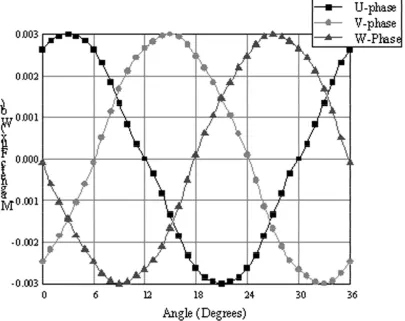
To visualize the flow of magnetic flux in the machine a three phase current source is placed in the circuit with star connection of the coils and a current of 5 amperes is applied and the result is plotted. Figure 5 shows the plotted results to understand the pattern of the flux flowing in U, V and W phases.
4.2. Dynamic Characteristics
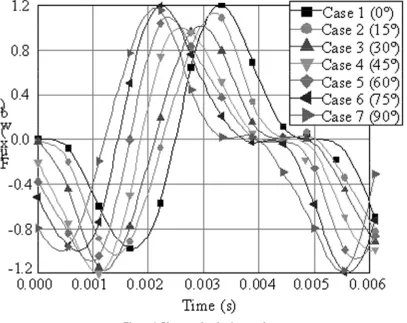
[image:5.612.103.508.415.736.2]In order to determine the best phase angle of the machine a few different cases are made by keeping all the parameters of the machine same and the machine is run on the speed of 300 rpm and the phase angle of the supply is altered from 0 to 90 with an increment of 15 . Hence 7 different cases are generated these cases are simulated and the results are recorded. To analyze the results, the graph in figure 6 below is plotted. The angle with almost same negative and positive peak is chosen so in this case 60 gives the most impressive result therefore 60 angle is selected as the base for further analysis.A torque analysis is carried out on the machine here 3 different models are studied. The first model is a 1:1 Halbach model where the north pole has the same size as the Halbach magnet. In the second model the Halbach idea is removed and the conventional method is used so the non Halbach model is designed and the size of the north pole is equal to the size of south pole of the magnet. The third model is the one designed and claimed to be the best one. All these designs are simulated and the results for the torque produced by all these models are plotted as a graph in figure 7 below. Analysis of this graph show that the non Halbach model is giving a little higher torque but the torque is not stableit is random higher at some point and lower at the other point meaning the torque is not stable. On the other hand, the torque for the Halbach models with 1:1 and 1:2 seems to be stable. But the 1:2 has a higher torque than the 1:1 model.
Table 2 above shows the results of the calculations done on 5 different models with ratios 1:1, 1:2, 1:3, 1:4 and 1:5. The model with the ratio 1:2 clearly gives the highest motor constant square density hence this model is chosen as the base model.
5. CONCLUSION
To recapitulate, the paper contributed a new approach towards measuring relative cost-efficiency of different wind power models. One earlier model of 1.5KW PMSG based 3-bladed VAWT was taken for evaluation and it was compared with another model of 200W PMSG based hybrid VAWT. Both model was tested and developed in Matlab Simulink. After comparison by applying Weight to Power Ratio, the newer and smaller version of VAWT was found to be cost-effective. Afterwards, a laboratory prototype of the developed smaller version of VAWT was built to test the open circuit performance in order to confirm low voltage performance. Having accomplished satisfactory performance, the model was sent for fabrication and upon arrival tested for error calculation. Lastly, analysis was done and it was found out the prototype voltage performance error was significantly high at higher wind speed. It was found out due to the limitation of matching the high number of pole, the prototype was built with 8 poles only whereas the proposed system consisted of 16. Due to the insufficient amount of pole number, the prototype was unable to produce enough voltage compared to the manufactured model and thereby causing the estimated error to be high. In short, method used in this paper could be useful to further research model and could give us a relative idea in cost-efficiency.
REFERENCE
[1] A.L. Rogers J.F. Manwell, J.G. McGowan. Wind Energy Explained – Theory, Design and Application. John Wiley and Sons Ltd., second edition, 2009.
[2] World Wind Energy Association, “New Record in Worldwide Wind Installation,” 5 February 2015. [Online]. Available: http://www.wwindea.org/new-record-in-worldwide-windinstallations/. [Accessed 15 March 2015].
[3] S.M. Muyeen, Junji Tamura, T. Murata, Stability Augmentation of a Grid-connected Wind Farm, Springer-Verlag London Limited, 2009.
[4] MD Shahrukh A. khan, R. Rajkumar, Rajparthiban K., CV Aravind, ‘Optimization of Multi-Pole Permanent Magnet Synchronous Generator based 8 Blade Magnetically Levitated Variable Pitch Low Speed Vertical Axis Wind Turbine’, Applied Mechanics and Materials, Vol. 492, pp 113-117, 2014.
[5] K. A. MdShahrukh, R. K. Rajprasad, R.K. Rajparthiban., C. Aravind, “A Comparative Analysis of Three-phase, Multi-phase and Dual Stator Axial Flux Permanent Magnet Synchronous Generator for Vertical Axis Wind Turbine”, Applied Mechanics and Materials Vols. 446-447 (2014) pp 709-715.
[6] MdShahrukh A. Khan, Rajprasad K. R., C. Aravind, “Performance analysis of 20 Pole 1.5 KW Three Phase Permanent Magnet Synchronous Generator for low Speed Vertical Axis Wind Turbine”, Energy and Power Engineering, (2013), pp. 423-428.
[7] NASA, “Priorities in Space Science Enabled by Nuclear Power and Propulsion,” National Academies Press, 2008, ISBN: 0309100119
[8] Mollenhauer, Klaus, Tschöke, Helmut, “Handbook of Digital Engines,” Springer, 2010.
[image:7.612.52.560.92.161.2][9] K. Yazawa, A. Shakouri, “Cost-effective waste heat recovery using thermoelectric system”, Birck and NCN Publications, 2012, p. 1199.
Table 2
Parameter calculation for 5 models with different Halbach ratios
Parameter 1:1 1:2 1:3 1:4 1:5
Pt (Power Constant) 0.0571036 0.0930896 0.0822786 0.0756144 0.0723822
Kg (Generator Constant) 0.0040086 0.0065352 0.0057762 0.0053084 0.0050815