© 2017, IRJET | Impact Factor value: 6.171 | ISO 9001:2008 Certified Journal
| Page 626
Effect of prestressing force, cable profile and eccentricity on post
tensioned beam
Ajinkya S. Dixit
1, V.G. Khurd
21
Student of P.G., M.E.Civil,-Structure Sanjay Ghodawat Institutions, Atigre,Shivaji University, Kolhapur, India
2Assistant Professor,Civil Engg. Department, Sanjay Ghodawat Institution Atigre, Shivaji University,
Kolhapur, India
---***---Abstract -
The main objective of this study was to developthree-dimensional finite element modeling (3D-FEM) of Post Tensioned Concrete Beam that can be used to investigate the effect of eccentricity, Prestressing force and Cable profile for concentrated point loading. The accuracy of the results obtained from static analysis using ANSYS is validated by comparing it with analytical study. The variables studied include the effect of Eccentricity, Prestressing force and Cable profile on the responses of the Post Tensioned Concrete Beam So we concluded that Eccentricity, Prestressing force and Cable profile should be taken into consideration while designing the Post Tensioned Concrete beam. Developed 3D-FE modelling is suitable for identifying the effect of different design features on the response of Post Tensioned Concrete Beam.
Key Words: 3D-FE, static analysis, Eccentricity, cable profile, Software Indulge (ANSYS 14.0)
SCOPE OF STUDY
The scope of this study is limited to investigate the effect of eccentricity, Prestressing force and Cable profile and to determine the structural static properties such as deflections and stress distributions. For that Rectangular prestressed concrete beam is taken for the analysis. The ANSYS 14.0 package program is used as a tool of this finite element analysis. The prestressed concrete beam is modelled as simply supported where one end is hinged and another end is roller support. Isotropic materials are used over the beam sections
1. INTRODUCTION
Concrete structural components exist in buildings and bridges in different forms. Understanding the response of these components during loading is crucial to the development of an overall efficient and safe structure. In Prestressed concrete members, stresses are induced during the construction in such a way that they can resist stresses caused by externally applied loads. Prestressed concrete is most suitable for long span structural elements like beams and girders, where larger bending moment results in greater depth of beam or girder. (Chouragade, M., 2013)
In most of the cases of prestress beam, Tendons are located with eccentricities towards the soffit of beams to counteract the sagging bending moments due to transverse loads Consequently, the concrete beam deflects towards (camber) on the application or transfer of prestress. Since the bending moment at every section is product of the prestressing force and eccentricity, the tendon profile itself will represent the shape of B.M.D. The method of computing deflection of beams with different cable profiles is outlined below (Krishna Raju N. 2011) There are a number of approaches for the study of the behaviour of concrete structures, viz., experimental, numerical, theoretical, etc. Finite Element Analysis (FEA) is a numerical one which provides a tool that can accurately simulate the behaviour of concrete structures. ( Joshuva, N. R.,et al., 2014).
The use of computer software to model the elements has been proved to be convenient, faster and extremely cost-effective compared to experimental analyses. This study presents an analytical investigation of the effect of prestressing force, cable profile and eccentricity on post tensioned concrete beams in the finite element software package ANSYS 14.0
2. LITERATURE STUDY
Literature survey was carried out to comprehend the linear and nonlinear behaviour of post tensioned concrete beams and the applicability of the finite element software packages in simulating the behaviour of the beams.
© 2017, IRJET | Impact Factor value: 6.171 | ISO 9001:2008 Certified Journal
| Page 627
behavior of unbonded post-tensioned beams to compare analysis results with experimental results and investigated the effects of various prestressing forces on the flexural behavior of post-tensioned beams. The nonlinear flexural behavior of post-tensioned concrete beams, a 3-D finite element model was developed using ANSYS. In order to validate the developed finite element model, four post-tensioned beams were tested at the structures laboratory of California State University, Fullerton and the test results were compared with the analysis results. Kasat, A. S. & Varghese, V., (2012), discussed a study of prestressed concrete beams using finite element analysis to understand the response of prestressed concrete beams due to transverse loading:
3. RECTANGULAR PRESTRESSED BEAM
A Rectangular beam of cross-section 252 mm deep and 152.4 mm wide and span of 3.657 m is prestressed by means of 2 wires of 5.43 mm diameter located 63.5 mm from bottom of the beam. Assuming the prestress in the steel as 950 N/mm2. If a concentrated pt. load of 5 KN is imposed on the Beam, evaluate the maximum working stress in concrete. The density of concrete is 24 KN/m3.
Material Properties
1. Grade of Concrete – M35
2.Modulus of Elasticity - 5700√fck=5700√35 =33721.65N/ mm2 (34000 N/ mm2)
3. Characteristic strength of concrete =35 N/mm2
4. Characteristic strength of High Tensile Wire 1862 N/ mm2
5.Modulus of Elasticity ES =2.1
Figure 1.Detail sketch of beam
Analytical solution
Loading Calculations
i) Self-weight =0.254 X0.154X1 X 24= 0.91 N
ii) Concentrated load = WL =5KN at the center of the beam
Eccentricity for Prestressing Wire
At Centre 63.5mm
3.1 Prestressing force
Pp=950X
=20000N each Area of C/S
A=254X 152.4=38709.6 mm2
Moment of inertia =
I= =208.11X
Section modulus
Z= = =163.86 x
3.2 Moments at center of Beam
a) Due to Self-Weight
Ms =
b) Due to Live Load
ML=
c) Due to Prestressing Wire Mp = Pp X e
=40 X 0.0635 =2.52kNm
3.3Stresses in Beam
a) Direct Stress
=1.03 N/
b) Bending stress due to Prestress
= 15.37 N/
C) Bending stress due to Self-weight
=9.27 N/
d) Bending Stress due to Live Load
=27.88 N/
3.4Resultant Stresses
i) At initial stage
a)
=1.03 – 15.37 +9.27 =5.07 N/ (T)
b)
© 2017, IRJET | Impact Factor value: 6.171 | ISO 9001:2008 Certified Journal
| Page 628
ii) At final stagea)
=1.03 – 15.37 +9.27+27.88 =22.81 N/ (C)
b)
– L =1.03 + 15.37 – 9.27 – 27.88
= 20.75 N/ (T)
3.5 Deflection in Beam
a) Due to self-weight Ys =
=
=0.30 mm(downward) b) Due to point load
YL = =
= 0.72 mm(downward)
[image:3.595.318.547.179.302.2]Total downward deflection =1.06mm
Table 1. Result of beam for central deflection and Top and Bottom Fibre Stresses
S.r no Description Result(analytical) 1 Central
Deflection 1.06mm 2 Extreme Fibre Stresses (Final Stage) A Top Fibre 22.81 N/mm2(C)
B Bottom Fibre 20.75 N/mm2(T)
4. MODELLING IN ANSYS
In this section, the post tensioned beam response is examined for Straight tendons, Trapezoidal tendons, Parabolic tendons (Central anchors), Parabolic tendons (Eccentric anchors) Sloping tendons (Eccentric anchors) analysis as shown in Figures below then following observations are noticed. In most of the cases of prestress beam, Tendons are located with eccentricities towards the soffit of beams to counteract the sagging bending moments due to transverse loads Consequently, the concrete beam deflects towards (camber) on the application or transfer of prestress. Since the bending moment at every section is product of the prestressing force and eccentricity, the tendon profile itself will represent the shape of B.M.D. The method of computing deflection of beams with different cable profiles is outlined below (Krishna Raju N. 2011) Following Cable Profile Were Modelled in ANSYS;
1. Straight tendons
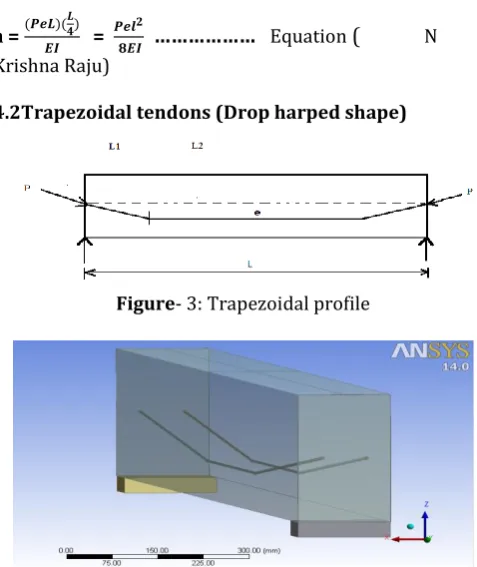
2. Trapezoidal tendons (Drop harped shape)
3. Parabolic tendons (Central anchors and Eccentric anchors)
4. Sloping tendons (Eccentric anchors)
4.1 Straight tendons
Figure- 2: Straight profile Tendon modelled in ANSYS
Figure 2. shows a beam with a straight tendon at a uniform eccentricity below the centroidal axis. If upward deflection is considered as negative=Prestressing Force (20000 N Per wire), L=length(3657.6mm)
Profile1 with eccentricity 63.5mm
Profile 2 with eccentricity 50mm and Profile 3 with eccentricity 40mm
a = =
………
Equation(
N Krishna Raju)4.2Trapezoidal tendons (Drop harped shape)
Figure- 3: Trapezoidal profile
[image:3.595.58.265.398.500.2] [image:3.595.312.551.450.734.2]© 2017, IRJET | Impact Factor value: 6.171 | ISO 9001:2008 Certified Journal
| Page 629
[image:4.595.310.556.87.233.2]A draped tendon with trapezoidal profile is shown in figure 3 and 4 considering the B.M.D., the deflection at the Centre of the beam is obtained by taking the moment of area of B.M.D. over one-half of span. Thus
= ] .. Equation (N Krishna Raju)
Where, L1 = 1346.2 mm L2 = 965.2mm Profile1 with eccentricity 63.5mm
Profile 2 with eccentricity 50mm and Profile 2 with eccentricity 40mm
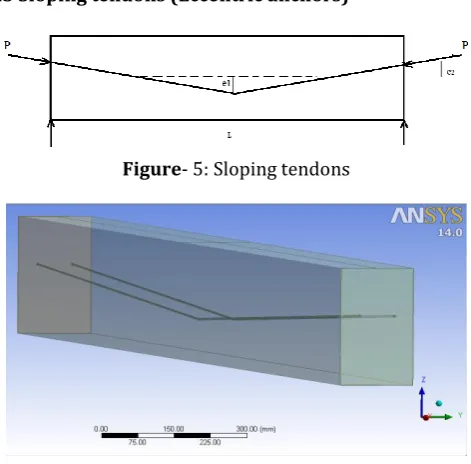
4.3 Sloping tendons (Eccentric anchors)
Figure- 5:Sloping tendons
Figure- 6: Triangular Profile modelled in ANSYS
As shown in figure 5 and 6 there were 3 profiles modelled First Profile was modelled with eccentricity 63.5 mm at center. second profile modelled with e1=50 at center and
e2 =13.5 mm at end and third profile modelled with e1=50
at center and e2 =13.5 mm at end.
……Equation (N Krishna Raju)
4.4Parabolic tendons (Central anchors and Eccentric anchors)
Figure- 7:Parabolic tendons with Eccentric anchors)
Figure- 8: Parabolic tendons modelled in ANSYS
Figure 7 and 8 shows a beam with parabolic tendon having an eccentricity e1 at the Centre of span and e2 at the
support section. The resultant deflection at the Centre is obtained as the sum of the upward deflection of the beam with a parabolic tendon of eccentricity (e1+e2) at the
Centre and zero at the support and the downward deflection of a beam subjected to a uniform sagging bending moment of intensity Pe2throughout the length
consequently the resultant deflection becomes
a =
….….
Equation (N Krishna Raju)Eccentricity for first profile 63.5mm with concentric anchors and for second and third profile same as in above profile mentioned in triangular profile
5.RESULT OBTAINED FROM SOFTWARE ANSYS
As mentioned in above chapter all profile was modelled with cable profile and eccentricity. And solution obtained from Ansys for each cable profile, eccentricity and prestressing force is compared below.
5.1Comparison of profile for various eccentricities
Graph 1. straight tendon for eccentricities
0.55
0.45
0.38 0.45 0.54
0.6
0 0.2 0.4 0.6 0.8
eccentricity 63.5
eccentricity 50
eccentricity 40
de
fle
ctio
n
in
m
m
Load 5KN ANSYS Result-Straight Tendon
[image:4.595.43.279.239.471.2] [image:4.595.310.554.551.698.2] [image:4.595.41.287.659.731.2]© 2017, IRJET | Impact Factor value: 6.171 | ISO 9001:2008 Certified Journal
| Page 630
Graph 2. Sloping tendon for eccentricities
Graph 3. Trapezoidal tendon (drop harped shape)
Graph 4. Parabolic Tendon with eccentricities
5.2 Comparison of eccentricity for various profile
Graph 5. Eccentricity 63.5mm
Graph 6. eccentricity e1=50mm &e2=13.5mm
Graph 7. Eccentricity e1=40mm &e2=23.5mm
Graph 8. Effect of prestressin
g force on upward
Deflection6. CONCLUSION
In the present work, three-dimensional finite element analysis of post-tensioned concrete beam using commercial software ANSYS is presented. From study following conclusion can be drawn
A) Result obtained from ANSYS for effect of cable profile on the response post tensioned beam which is validated Analytically.
0.38
0.27
0.17 0.55
0.70225 0.80473
0 0.5 1 Eccentricity 63.5 Eccentricity 50 Eccentricity 40 de form at io n in m m Load 5KN ANSYS Result -Sloping Tendon
Upward deflection Total doward deflection
0.84
0.66
0.51
0.22
0.4 0.4
0 0.5 1
Eccentricity
63.5 Eccentricity50 Eccentricity40
de fo rm at ion in m m Load 5KN
ANSYS Result -Trapezoidal Tendon
Upward deflection Total doward deflection
0.45
0.32
0.24 0.4
0.66 0.71
0 0.2 0.4 0.6 0.8 Eccentricity 63.5 Eccentricity 50 Eccentricity 40 de form at io n in m m Load 5KN
ANSYS Result -Parabolic Tendon
Upward deflection Total doward deflection
0.55
0.84
0.35 0.45
0.62 0.22 0.55 0.4 0 0.5 1
Straight tendon Trapozoidal Tendon sloping Tendon Parabolic Tendon d ef o rm atio n in m m load 5KN ANSYS Result -Eccentricity 63.5mm
Upward deflection Total doward deflection
0.45
0.66
0.27 0.32 0.54
0.4
0.7 0.66
0 0.5 1 Straight tendon Trapozoidal Tendon sloping Tendon Parabolic Tendon d ef o rm ati o n in m m load 5KN ANSYS Result -Eccentricity e1=50mm
&e2=13.5mm
Upward deflection Total doward deflection
0.38
0.51
0.17 0.24 0.6 0.4 0.8 0.71 0 0.5 1 Straight tendon Trapozoidal Tendon sloping Tendon Parabolic Tendon de form at io n in m m load 5KN
ANSYS Result -Eccentricity e1=40mm &e2=23.5mm
Upward deflection Total doward deflection
0 0.5 1 1.5
40000 50000 60000 70000 80000
up wa rd d ef le ct io n in m m Prestressing Force
Effect of Prestressing Force on deflection
totol deflection Straight Tendon
Trapezoidal Tendon Sloping Tendon
© 2017, IRJET | Impact Factor value: 6.171 | ISO 9001:2008 Certified Journal
| Page 631
I. As we provide eccentricity 63.5 mm for Straight, Trapezoidal, sloping and parabolic cable profile the result shows that the Trapezoidal tendons gives the maximum upward deflection compared to other profile. As shown in figure 10 and 11
Figure10 Maximum Upward deflection for e = 63.5mm
Figure11 Minimum downward deflection for e=63.5mm
II. Sloping tendons gives the minimum upward deflection compared to other profiles.
B) Result obtained for effect of Eccentricity and prestressing force on the response of the post tensioned concrete beam.
I. As we provide cable at eccentricity 63.5mm,50mm and 40 mm from Centre line of beam. Result shows that as eccentricity decreases towards Centre line upward deflection also reduces simultaneously.
II. Out of above cable profile Trapezoidal profile gives maximum upward deflection for eccentricity 63.5mm and also required minimum prestressing force than remaining and Sloping cable profile shows minimum upward deflection compared to other.
7. REFERENCES
1. Chouragade, M., “Analysis of stress in anchorage zone using ANSYS” International Journal of Innovative Research in Science & Engineering ISSN 2347-3207(2013)
2. Barbosa, A.F., Ribeiro, G.O., “Analysis of reinforced concrete structures using ANSYS nonlinear concrete model” In: Idelsohn, S., Onate, E., and Dvorkin, E. (Eds.), Computational Mechanics: New trends and applications, pp. 1-7, 1998
3. Dawari, V. B.,and Vesmawala, G. R., “Application Of Nonlinear Concrete Model For Finite Element Analysis Of Reinforced Concrete Beam” International Journal of Scientific & Engineering Research, Volume 5, Issue 9, September-(2014) ISSN 2229-5518
4. Fanning, P., “Nonlinear Models of Reinforced and Post-tensioned Concrete Beams”, Electronic Journal of Structural Engineering,vol 2 (2001), pages (111-119)
5. Joshuva, N. R., Saibabu, S., Sakaria, E. P., Lakshmikandhan, K. N., Sivakumar, P., “Finite Element Analysis of Reinforced and Pre-Tensioned Concrete Beams” International Journal of Emerging Technology and Advanced Engineering ,ISSN 2250-2459, Volume 4, Issue 10, (October 2014)
6. Kasat, A.S., varghese, V., “finite element analysis of prestressed concrete beams” International journal of advanced technology in civil engineering,issn: 2231 –5721, volume-1, issue-3, 2012
7. Kim, U., Chakrabarti, P. R., & Choi, J. H., “Nonlinear finite element analysis of unbonded post-tensioned concrete beams” Challenges, Opportunities and Solutions in Structural Engineering and Construction – Ghafoori (ed.) 2010 Taylor & Francis Group, London, ISBN 978-0-415-56809-8
8. Maroliya, M. K., “Comparative Study Of Flexural Behaviour Of Reinforced Concrete Beam And Prestressed Concrete Beam” International Journal of Engineering Research and Applications (IJERA) ISSN: 2248-9622 Vol. 2, Issue 6, November- December 2012,
9. Scordelis, A. C., “Computer Models for Nonlinear Analysis of Reinforced and Prestressed Concrete Structures” PCI Journal ( December 1984)
© 2017, IRJET | Impact Factor value: 6.171 | ISO 9001:2008 Certified Journal
| Page 632
flexural behaviour of RC beams using ANSYS” International Journal Of Civil And Structural Engineering Volume 2, No 1, 2011
11. Yapar, O., Basu ,p. k., Nordendale N., “Accurate finite element modeling of pretensioned prestressed concrete beams” Engineering Structures 101 (2015) 163–178
3. Standard Codes
1. IS1343, “Code of practice for prestress concrete”, Second Revision.
2. IS 456-2000. “Indian Standard Plain and Reinforced Concrete – Code of Practice”, Fourth Revision.
4. Books
1. N Krishna Raju “Prestressed Concrete” Fourth Edition Tata McGraw-Hill, New Delhi, 2011. 2. S. Ramamrutham “Prestressed Concrete” Fifth
Revised and Enlarged Edition.
BIOGRAPHIES
Mr. Ajinkya S. Dixit (1) is masters of
structural engineering student at Sanjay Ghodawat Group of Institution, Atigre, Kolhapur
Prof. V.G. Khurd (2) is Assistant