© 2017, IRJET | Impact Factor value: 5.181 | ISO 9001:2008 Certified Journal | Page 732
Soil structure interaction of RC building with different foundations and
soil types
Suman
1, Dr.Sunil Kumar Tengali
21
M.Tech Computer Aided Structural Engineering REVA University Bengaluru-560064, India
2
P.G.Co-ordinator, Computer Aided Structural Engineering REVA University Bengaluru-560066, India
---***---
Abstract: Conventional structural design methods neglect the Soil Structure Interaction (henceforth SSI) effects. Ignoring of SSI is reasonable for light structures in relatively hard soil such as low rise buildings and simple rigid retaining walls. The effect of SSI, however, becomes very dangerous for heavy structures resting on relatively soft soils such as clay silt. Most of the designers do not consider the soil structure interaction i.e. Soil layers and its subsequent effect on structure during earthquakes. When a structure is subjected to ground motion, coupling action takes place at the foundation and overturning of structure occurs, and thus changes the motion of the ground. By considering soil-structure interaction, makes a structure more strengthening and thus, increasing the natural period of the structure compared to the corresponding rigidly supported structure. The present work emphasizes the importance of soil structure interaction in the analysis. To study this effect, a G+7 storeyed building with vertical irregularities located in zone IV is analyzed using SAP2000 by considering different soil properties and different types of foundations. Conclusions will be drawn for the selection of suitable foundation to avoid failure of the structure.
Key Words: Soil structure interaction, pile foundation, raft foundation, time period, Maximum displacement.
Introduction:
The construction of high-rise building, medium height buildings and small areas for usually used the pile and raft Foundations to support the structure under the soft grounds and reclaimed land. The normal conditions of soil the building is subjected to lateral loads and moments due to structural eccentricity of the footing. During an earthquake, the Seismic waves circularize or pass through soil layers then the additional bending moments are developed in the pile and Raft due to kinematic loads applied by the superstructure to substructures, as well as deformation of the Surrounding soil. Both inertial loads and soil deformation effects the ground acceleration during an earthquake event. During strong earthquake two effects on the pile and raft foundation, firstly pile behave nonlinear as well as raft while surrounding soil is soft ,
secondly, large amount of inertia forces are generated in the soil it cause the separation of sub-soil and footing so it may causes the failure of the structure, so the study of soil structure Interaction is one of the beneficial effects on the seismic response of the building, it decreases the frequency of the building , and also it increases the flexibility of the building and story drift, lateral deflection compared to the corresponding rigidly supported structure.
Problem statement:
This paper analysis of vertical irregularity of building and consideration of soil structure interaction under seismic loading. Aimed with purpose, the vertical irregular building (G+7) with pile foundation is analyzed by using SAP 2000 subjected to the combination of gravity load and seismic load under specific zone. Compare the same building with raft foundation and consideration of soil structure interaction; it is analyzed by using the SAP2000 software. Results are compared structural building with and without soil structure interaction.
Objectives:
The based on previous case study deals with the effect of soil structure interaction on RC building. The objective of this present work is to study with and without soil structure interaction effect of layered soil on structural behavior of building supported on pile and raft foundation when subjected to seismic load. During dynamic loading the consideration of fixed support reduces the overall strength of the structure and brings out changes in frequency as well as natural time period of the structure. So following objectives are determine to increasing the time period of the building.
[1]The comparison between vertical irregular of building supported by pile foundation with and without soil structure interaction.
© 2017, IRJET | Impact Factor value: 5.181 | ISO 9001:2008 Certified Journal | Page 733
Methodology:RC frame structure supported by a pile and raft foundations of two high rise buildings (G+7) this both the buildings are designed by considering the with and without soil structure interaction subjected to a seismic forces. These buildings are analyzed by using the Response spectrum method using SAP2000. Seismic analysis was carried out by using the IS1893-2002 part 1.
[a]Input data for building: bay of 2*1 and its width is 4m and length is 8m and height of the building is 24m, Size of column is 400mm*1400mm and size of beam 400mm*800mm and slab thickness is 175mm,imposed load 2KN/m2 floor, finish 1.5KN/m2, wall load 9.68KN/m2,wall thickness 200mm.[b]Input data for pile: length of pile 8.2m,size concrete pile cap size800mm*1400mm, pile groups1x1 for c-1,c-3,c-4,c-6 and 2x1 for c-2,c-5.
[c]Input data for raft: cross section 520mm*520mm, depth of raft 800mm.
[d]Response spectrum data: Seismic zone factor 0.24, damping ratio 0.05, soil type (2) medium,
In all models considered in plan of structural RC building, same number of storeys for all the soil condition models and using materials are also same for all models.
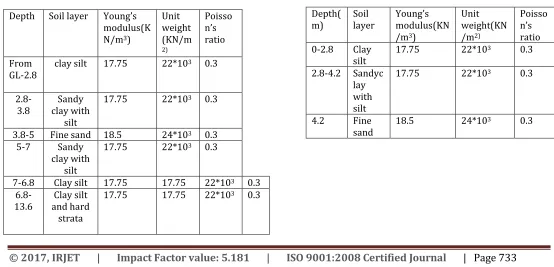
Soil layer properties for pile foundation.
The Pile foundation should be located at the down to the refusal strata, in this paper depth of pile foundation is considered as 8.2m.
Soil layer properties for pile foundation.
Depth Soil layer Young’s modulus(K N/m3)
Unit weight (KN/m 2)
Poisso n’s ratio
From
GL-2.8 clay silt 17.75 22*10
3 0.3
2.8-3.8 clay with Sandy silt
17.75 22*103 0.3
3.8-5 Fine sand 18.5 24*103 0.3 5-7 Sandy
clay with silt
17.75 22*103 0.3
7-6.8 Clay silt 17.75 17.75 22*103 0.3
6.8-13.6 and hard Clay silt strata
[image:2.612.328.575.89.239.2]17.75 17.75 22*103 0.3
Fig.1.Models of Pile foundation of RC building with and without consideration of soil layer
Soil layer properties for raft foundation.
In this model depth of the raft foundation is 4.2m
Table 2: soil layer properties for raft foundation
Depth(
m) Soil layer Young’s modulus(KN /m3)
Unit weight(KN /m2)
Poisso n’s ratio 0-2.8 Clay
silt 17.75 22*10
3 0.3
2.8-4.2 Sandyc lay with silt
17.75 22*103 0.3
4.2 Fine
sand 18.5 24*10
[image:2.612.27.581.479.746.2]© 2017, IRJET | Impact Factor value: 5.181 | ISO 9001:2008 Certified Journal | Page 734
Fig.2.Models of raft foundation of RC building with andwithout consideration of soil layer
Result and discussions:
The analysis of RC framed structure using SAP2000 has been performed for different combinations of soil layer for Pile and Raft foundations. To determining the time period, Horizontal displacement, maximum displacement, storey shear, and story drift at different storey level, by using the Response spectrum analysis.
Type1 and Type 1.1 RC framed structure of pile foundation with and without consideration of soil layer models Type2- and Typ2.1- RC framed structure of raft foundation with and without consideration of soil layer models.
[1] The comparison between vertical irregular of building supported by pile foundation with and without soil structure interaction.
1)Time period:
For the Strcture of Pile foundation model with and without soil structure interaction models time period in sec
Table 3:No of mode v/s time period
[image:3.612.335.562.108.470.2]
Fig 3: No of mode v/s time period
Overall observing the time period for the pile foundation of RC frame building with and without consideration of soil layer, in that increasing the time period of the structure is type 1 i.e. RC framed structure of pile foundation with soil layer.
2) Maximum displacement:
The raft foundation of RC frame structure with and without consideration of soil structure interaction model displacement in y direction displacement (mm) is tabulated
0 0.2 0.4 0.6 0.8
1 3 5 7 9 11
T
im
ep
erio
d
No of mode TIME PERIOD
type1 Sec
type1.1 Sec
Mode No’s Type1 Type1.1
1 0.71254 0.697265
2 0.4042 0.403997
3 0.39979 0.389005
4 0.20046 0.201187
5 0.13875 0.136412
6 0.12865 0.129284
7 0.127131 0.127972
8 0.085936 0.080506
9 0.082447 0.078662
10 0.07914 0.067227
11 0.078903 0.066392
© 2017, IRJET | Impact Factor value: 5.181 | ISO 9001:2008 Certified Journal | Page 735
Table4:Number of storey V/maximum displacementFig 4: No of storey v/s Displacement
From above graph shows the considering of soil structure interaction displacement is7.39% times higher than the without considering soil structure interaction of the model i.e. type 1
[2]The comparison between vertical irregular of building supported by raft foundation with and without soil structure interaction
1) Time period:
The time period for the mat foundation of RC frame structure with and without soil structure interaction in sec
[image:4.612.49.261.108.527.2]Table 5: No of mode V/s Time period
Fig 5: No of mode v/s Time period
With consideration of soil layer model time period is maximum i.e.9.5%than the type 2.1.
2)Maximum displacement:
The raft foundation of RC frame structure with and without consideration of soil structure interaction model displacement in y direction displacement (mm) is tabulated
[image:4.612.345.581.110.425.2]
Table 6: Number of storey v/s displacement
No of storeys Type2 Type2.1 1
0.02038 0.51747
2 0.91485 1.65899
3 1.94455 2.67829
4 2.88252 3.60549
5 3.80138 4.53749
0 2 4 6 8 10 12 14 16
1 2 3 4 5 6 7 8
D
ispla
ce
m
ent
No of stories
Displacement for Y direction
type 1
type1.1
0 0.5 1 1.5
1 3 5 7 9 11
T
im
e
pe
rio
d
No of modes Time period
type2 Sec
type 2.1 Sec No of
Storey’s Type1 Type1.1
1 0.8293 0.7498
2 2.9595 2.8236
3 5.0911 4.8847
4 7.1115 6.8551
5 8.879 8.593
6 10.0685 9.7002
7 12.8979 12.0127
8 13.7978 12.8484
Mode
No’s Type2 Type2.1
1 1.154432 1.258663 2 0.356193 0.416646 3 0.343799 0.39509 4 0.189451 0.211855 5 0.157322 0.163065 6 0.129431 0.140021
7 0.12337 0.139844
8 0.089241 0.099421 9 0.078835 0.08855 10 0.068761 0.078139
11 0.0598 0.064695
© 2017, IRJET | Impact Factor value: 5.181 | ISO 9001:2008 Certified Journal | Page 736
6 4.68943 5.44962
7 5.89052 6.7461
8 6.3187 7.20957
Fig.6. No of mode V/s Time period
The raft foundation without consideration of soil structure interaction shows the maximum displacement is 14.10% of more than the with consideration of soil structure interaction model.
The raft foundation of RC frame structure with consideration soil structure interaction model is within the permissible limit as per the IS 1893 part (1) 2002 clause 7.11.1.
0 1 2 3 4 5 6 7 8
1 2 3 4 5 6 7 8
D
ispla
ce
m
ent
No of stories Displacement for y direction
Type 2
Type 2.1
Conclusion:
The pile foundation of RC frame structure with consideration of SSI as per above discussion we observed that the time period is increases and also it gives the more flexibility for the building and frequency is decreases. In case of raft foundation time period is decreases with consideration of SSI due to presence of medium soil to soft soil. And In case of pile foundation of RC frame structure with consideration of SSI,displacement is more in above the ground storey level .Very negligible displacement below ground storey due to presence of consideration of SSI in case of raft foundation RC frame structure with consideration of SSI, displacement is minimum and without consideration of soil layer model shows the maximum displacement at above the ground storey but it doesn’t exceeded the as per IS 1893-2002 part I so it is feasible to improve the stiffness in elements by providing infill or bracings.
References
[1]. S.Thusoo, K.Modi, R.Kumar, H.Madahar (2015) the “Response of building with soil structure interaction with varying soil types”.
[2]. P. Sharma, I. Pal Singh, Ankit (2014) “soil Structure Interaction Effect on Asymmetrical building with shear soil”.
[3].Er.Puneet Sharma et.al (2014) “The analysis of soil structure interaction effects on asymmetrical RC Building with shear wall by using STADD pro”