© 2018, IRJET | Impact Factor value: 6.171 | ISO 9001:2008 Certified Journal | Page 3493
A Review On Secured CDA Generation Based on Cloud Computing
System
1
Prof. Sachin A. Murab,
2Shalaka V. Mahajan
1Professor, Department of CSE, JCOET Yavatmal, Maharashtra, India 2PG Student, Department of CSE, JCOET Yavatmal,Maharashtra, India
---***---Abstract - Successful deployment of Electronic Health Record
helps improve patient safety and quality of care, but it has the prerequisite of interoperability between Health Information Exchange at different hospitals. The Clinical Document Architecture (CDA) developed by HL7 is a core document standard to ensure such interoperability, and propagation of this document format is critical for interoperability. Unfortunately, hospitals are reluctant to adopt interoperable HIS due to its deployment cost except for in a handful countries. A problem arises even when more hospitals start using the CDA document format because the data scattered in different documents are hard to manage. In this paper, we describe our CDA document generation and integration Open API service based on cloud computing, through which hospitals are enabled to conveniently generate CDA documents without having to purchase proprietary software. Our CDA document integration system integrates multiple CDA documents per patient into a single CDA document and physicians and patients can browse the clinical data in chronological order. My system of CDA document generation and integration is based on cloud computing and the service is offered in Open API. Developers using different platforms thus can use our system to enhance interoperability. Also additional development of CDDS(Clinical Disease Diagnostic System) and provision of encryption and decryption at both the ends so as to work in a more secured environment and to generated more secured CDA.
Key Words: Health information exchange, HL7, CDA,
CDDS, cloud computing, software as a service
1. INTRODUCTION
CDA is basically developed in order to generate the clinical document in a more structured and sorted way. Considering the various problems of dada maintenance this CDA is developed. Health Level Seven has established CDA as a major standard for clinical documents. CDA is a document markup standard that specifies the structure and semantics of ‘clinical documents’ for the purpose of exchange. The first version of CDA was developed in 2001 and Release 2 came out in 2005 [18]. Many projects adopting CDA have been successfully completed in many countries. Active works are being done on improving semantic interoperability based onopenEHR and CEN13606 [7].To establish confidence in HIE interoperability, more HIS’s need to support CDA. However, the structure of CDA is very complex and the production of correct CDA document is hard to achieve
© 2018, IRJET | Impact Factor value: 6.171 | ISO 9001:2008 Certified Journal | Page 3494 documents in the CDA format approved by the National
Institute of Standards and Technology (NIST). Third, if this service is provided for free at low price to hospitals, existing EHR are more likely to consider adoption of CDA in their practices. This paper is organized as follows. Further detailed explanations are given on the format of CDA document, cloud computing, and the overall architecture of our proposed system. Later it describes the efficacy of the proposed system and contrasts it to different HIE systems in various countries to highlight the strength of our system [15].
2. EXISTING WORK
The CDA is a document markup standard for the structure and semantics of an exchanged "clinical document". A clinical document is a documentation of observations and other services with the following characteristics: Persistence Stewardship Potential for authentication Context Wholeness Human readability „An existing CDA document is a defined and complete information object that can exist outside of a message, and can include text, images, sounds, and other multimedia content. [19]
The CDA is generated considering the complexities that were faced in the HER document. The main focus is to develop a document structure that can be implemented easily by any of the hospitals across the world. A standard and less complex structure is developed in CDA.
Interoperability is a requirement of recent electronic health record (EHR) adoption incentive programs everywhere. One approved structure for clinical data exchange is the continuity of care document (CCD). While primarily designed to promote communication between providers during care transitions, coded data in the CCD can be re-used to aggregate data from different EHRs. This provides an opportunity for provider networks to measure quality and improve population health from a consolidated database. Challenges to interoperability were catalogued and potential quality metrics evaluated based on available content. This research highlights the promise of CCDs for population health and recommends changes for future interoperability standards. [7]
The Clinical Element Model (CEM) is a strategy designed to represent logical models for clinical data elements to ensure unambiguous data representation, interpretation, and exchange within and across heterogeneous sources and applications. The current representations of CEMs have limitations on expressing semantics and formal definitions of the structure and the semantics. Here we introduce our initial efforts on representing the CEM in OWL, so that the enrichment with OWL semantics and further semantic processing can be achieved in CEM. The focus of this paper is the CEM meta-ontology where the basic structures, the properties and their relationships, and the constraints are defined. These OWL representation specifications have been
reviewed by CEM experts to ensure they capture the intended meaning of the model faithfully. [20]
Successful deployment of Electronic Health Record helps improve patient safety and quality of care, but it has the prerequisite of interoperability between Health Information Exchange at different hospitals. The Clinical Document Architecture (CDA) developed by HL7 is a core document standard to ensure such interoperability, and propagation of this document format is critical for interoperability. Unfortunately, hospitals are reluctant to adopt interoperable HIS due to its deployment cost except for in a handful countries. A problem arises even when more hospitals start using the CDA document format because the data scattered in different documents are hard to manage. In this paper, we describe our CDA document generation and integration Open API service based on cloud computing, through which hospitals are enabled to conveniently generate CDA documents without having to purchase proprietary software. Our CDA document integration system integrates multiple CDA documents per patient into a single CDA document and physicians and patients can browse the clinical data in chronological order. Our system of CDA document generation and integration is based on cloud computing and the service is offered in Open API. Developers using different platforms thus can use our system to enhance interoperability. [13]
It would allow healthcare professionals to manage the complete electronic healthcare record of the patient regardless of which institution generated each clinical session. Clinical archetypes are fundamental for the consecution of semantic interoperability, but they are built for particular electronic healthcare record standards. Therefore, methods for transforming archetypes between standards are needed. In this work, a method for transforming archetypes between ISO 13606 and openEHR, based on Model-Driven Engineering and Semantic Web technologies, is presented. [3] This simply specifies with the generation of well structured and organized fields development in the CDA document and its whole architecture.
The design and development of a kind of fully comply with an HL7 standard clinical CDA document editor for generating standard CDA standard XML file, and can extract the other clinical commercial software generating clinical document XML- related content, and modified into standard CDA XML documents, used for data exchange, data mining and clinical decision support. [8] The basic modulation of CDA is done as using the modules as follows:
1. The CDA Document
© 2018, IRJET | Impact Factor value: 6.171 | ISO 9001:2008 Certified Journal | Page 3495 clinical document exchanges between heterogeneous
software systems. A CDA document is divided into its header and body. The header has a clearly defined structure and it includes information about the patient, hospital, physician, etc [16]. The body is more flexible than the header and contains various clinical data. Each piece of clinical data is allocated a section and given a code as defined in the Logical Observation Identifiers Names and Codes (LOINC).
The fields developed in each section are categorized in a systematic manner. Different subcategories are inserted in a CDA document depending on the purpose of the document, and we chose the Continuity of Care Document (CCD) because it contains the health summary data for the patient and it is also widely used for interoperability [19]. Notable data included in CCD are listed as required. A document generated is well structured and nicely categorized so that it can be referred and well understood by any its users.
2. Cloud Computing
Cloud computing refers to both the applications delivered as services over the Internet and the hardware and systems software in the data centers that provide those services [5]. The user pays fee depending on the amount of resources allocated, such as network, server, storage, applications and services. Currently, three major types of cloud computing service exist: SaaS, PaaS and IaaS [17]. In another way the readily available clouds that are are free to use and has no subscriptions fees can also be used alternatively. This provides the users with no extra payments. Simply choose the platform the user need to work on and its all done.
3. CDA Generation System Based on Cloud Computing
The overall architecture of how CDA documents can be generated on the health information systems of different hospitals by using our cloud computing-based CDA generation system is simply shown among two hospitals that are supposed to exchange the data in CDA. [3]. Hospital A and Hospital B are to be considered to show that it is easy to generate CDA documents on a variety of platforms if done via cloud. Means hospital A and hospital B can easily maintain their own databases and can share only required data with each other sharing a same cloud platform.
4. CDA Integration System Based on Cloud Computing
Deals with all the details that are needed to be considered while designing an organizational architecture and data is saved accordingly onto the cloud [15]. All the details once entered onto the database are hence all maintained by a cloud. Sharing a same cloud n number of hospitals can hence maintain their CDA on a same cloud.
3. PROPOSED WORK
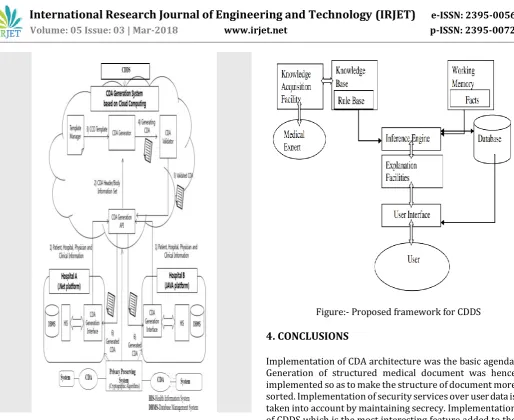
We are working on an online cloud which is freely available on internet and it demands no extra payments as the cloud platform for my CDA and a local level SQL database as the cloud platform for the CDA generation and integration system. Database of hospitals will be used as the server location using SQL database management system. Java (JDK 7.0) is used for CDA document generation and integration system and Tomcat 6.0.26 is selected as the web server platform for service deployment. As proposed this will develop the CDA document integration and integration system and deployed the system on the local Cloud Server. Hospitals conveniently generate and integrate CDA documents by exploiting the API offered by our system. More secured CDA development is the aim behind the proposal of this system in a desired structure. Every document generated is supposed to be formed in a standardized format or architecture only, on both the data bases and onto the cloud as well. Also doctors are provided with the feature to compare their patients medical or health symptoms and can predict the disease he\she is suffering from by fetch the existing data or information saved earlier with respect to the recently visited patients and this falls under CDDS module. The proposed framework is shown in the figure as follows named Proposed framework for CDDS. For CDDS purpose the Apriori Algorithm will be used. The CDDS(Clinical Disease Diagnostic System) mainly helps the registered doctors to fetch the available data records of the past patients and hence can compare the symptoms of new patient so as to get the detailed information about the disease the patient is currently suffering from. The data and documents once sent from the hospitals databases will be then collected on to the cloud that is used to generate the same document on it. Here use of a cloud based system is done to maintain all the data that is been collected from the n number of hospitals. Collection of all the medical related data or medical cases from some hospitals from the city your prefer is needed to be done. Regular follow ups are needed to be taken so as to collect all the data of desired patients from different hospitals and hence the data will be stored on the databases of that hospital. This concept is shown the figure named The architecture of CDA integration system based on cloud computing. Further the data from the hospitals databases will be sent on the cloud by using API. Also the privacy preserving system used here will totals work on the primary key generation techniques called encryption and decryption so as to work in a more secured environment as shown in the figure named Privacy Protection System (Encryption and Decryption). The use of RSA algorithm will be done for this purpose. Main purpose behind this is to maintain secrecy i.e. the data is mandatorily been protected from being hacked or used by any of the unauthorized parties. And the generation of more secured CDA onto the existing one will be the primary aim. The overview of this work is shown in the figure named Privacy Protection System (Encryption and Decryption) as follows.
© 2018, IRJET | Impact Factor value: 6.171 | ISO 9001:2008 Certified Journal | Page 3496 Figure:- The architecture of CDA integration system
[image:4.595.251.551.35.337.2]based on cloud computing
[image:4.595.39.294.488.658.2]Figure:-Privacy Protection System (Encryption and Decryption)
Figure:- Proposed framework for CDDS
4. CONCLUSIONS
Implementation of CDA architecture was the basic agenda. Generation of structured medical document was hence implemented so as to make the structure of document more sorted. Implementation of security services over user data is taken into account by maintaining secrecy. Implementation of CDDS which is the most interesting feature added to the CDA. Development of secured organizational architecture over the existing one.
REFERENCES
[1] Marcel Müller, Thomas Frankewitsch, Thomas Ganslandt, Thomas Bürkle, Hans-Ulrich Prokosch, “The Clinical Document Architecture (CDA) Enables Electronic Medical Records to Wireless Mobile Computing”, MEDINFO 2004 M. Fieschi et al. (Eds) Amsterdam: IOS Press © 2004 IMIA. All rights reserved.
[2] T. Benson, “Principles of Health Interoperability HL7 and SNOMED”, New York, NY, USA: Spinger, 2009.
[3] Catalina MARTÍNEZ-COSTA, Marcos
MENÁRGUEZ-TORTOSA, JesualdoTomás FERNÁNDEZ-BREIS 1
Departamento de Informática y Sistemas, Universidad de Murcia, Spain, “Towards ISO 13606 and openEHR Archetype-Based Semantic Interoperability”, Medical Informatics in a United and Healthy Europe K.-P. Adlassnig et al. (Eds.) IOS Press, 2009 © 2009 European Federation for Medical Informatics. All rights reserved. Doi: 10.3233/978-1-60750-044-5-260.
© 2018, IRJET | Impact Factor value: 6.171 | ISO 9001:2008 Certified Journal | Page 3497 University of Massachusetts, Amherst, MA, USA, “Clinical
data management: Current status, challenges, and future directions from industry perspectives”, Open Access Journal of Clinical Trials 19 June 2010.
[5] H. A. J. Narayanan and M. H. Giine, “Ensuring access control in cloud provisioned healthcare systems,” in Proc. IEEE Consumer Commun. Netw. Conf., pp. 247–251, Jan. 2011.
[6] P. V. Gorp, M. Comuzzi, A. Fialho, and U. Kaymak, “Addressing health information privacy with a novel cloud-based PHR system architecture,” in Proc. IEEE Int. Conf. Syst., Man, Cybern., pp. 1841– 1846, Oct. 2012.
[7] John D. D’Amore, MS1, Dean F. Sittig, PhD1, Adam Wright, PhD2, M. SriramIyengar, PhD1 Roberta B. Ness, MD, MPH3 1School of Biomedical Informatics and 3School of Public Health at the University of Texas Health Science Center, Houston, TX; 2Division of General Medicine, Brigham and Women’s Hospital, Boston, MA,”The Promise of the CCD: Challenges and Opportunity for Quality Improvement and Population Health”,AMIA AnnuSymp Proc.2011; 2011: 285– 294.Published online 2011 Oct 22.
[8] Jun He, Liang Xiao, “Based on the Complete CDA Standard Clinical Document Editor Research and Development”, Journal of Software Engineering and Applications, 2013, 6, 78-81 doi:10.4236/jsea.2013.63b017 Published Online March 2013
[9] (2013). NIST CDA guideline validation.[Online].
Available:http://cda-validation.nist.gov/cda-validation/validation.html
[10] Prakash G L,Dr.ManishPrateek and Dr.InderSingh,“Data Encryption and Decryption Algorithms using Key Rotations for Data Security in Cloud Computing”, International Journal Of Engineering And Computer Sciences ISSN:2319-7242 Volume 3 Issue 4 April, 2014 Page No. 5215-5223.
[11] Moshood A. Hambali, Adewole K. S., “Rule based expert system for disease diagnosis”, in ResearchGate, March 2015
[12] Sung-Hyun Lee, Joon Hyun Song, and II KonKim,”CDA Generation and Integration for Health Information Exchange Based on Cloud Computing System”, in IEEE transactions on services computing, Vol.9, March/April2016
[13] Swathi.J 1, Sharmila.B2, Reena.R3 and Kapila Vani.R.K4, “Mapping CDA Documents for Health Information Exchange from Multiple Hospitals using Cloud Computing System”, INTERNATIONAL RESEARCH JOURNAL OF ENGINEERING AND TECHNOLOGY (IRJET) VOLUME: 04 ISSUE: 02 | FEB -2017
[14] M.Mounika Aradhana#1 ,Ch.Nagamani*2, Ravi Kumar Tenali#3 #1 M.Tech, CSE, Andhra Loyola Institute of engineering & Technology, Vijayawada. #2,3 Assistant Professor, CSE, Andhra Loyola Institute of engineering &
Technology, Vijayawada “Clinical Document architecture (CDA) Development and Assimilation for Health Information Exchange Based on Cloud Computing System”, SSRG International Journal of Computer Trends and Technology (IJCTT) - Special Issue – April 2017
[15] Jing Zhao, PanagiotisPapapetrou, Lars Asker,HenrikBostrom,”Learning from heterogeneous temporal data in electronic health records”, Journal of Biomedical Informatics 65(2017) 105-119
[16]Book-Cross institutional data exchange using the clinical document architecture & source
[17] www.engr.uconn.edu/~steve/Cse5810/delarosa.pdf
[18]GayanPerera, Lars Pedersen, David Ansel, Myriam Alexander, H.MichaelArrighi,PaulAvillach,NadiaFoskett, Rosa Gini, Mark F.Gordon, UshaGungabissoon,Miguel-Angel Mayer, Gerald Novak,PeterRijinbeek, GianlucaTrifiro, Johan van der Lei, Pieter J. Visser, Robert Stewart,”Dementia prevalence and incidence in a federation of European Electronic Health Record databases: The European Medical Informatics Framework resource”,G.Perera et al. / Alzheimer’s & Dementia(2017)1-10
[19] HL7 Clinical Document Architecture Document by Bob Dolin, MD, FACP, FACMI Chair, HL7
[20]Cui Tao, PhD Craig G. Parker, MD, MS Thomas A. Oniki, PhDJyotishmanPathak, PhD Stanley M. Huff, MD Christopher G. Chute, MD, DrPHDepartment of Health Sciences Research, Mayo Clinic College of Medicine, Rochester, MN Intermountain Health Care, Salt Lake City, UT,”An OWL Meta-Ontology for Representing the Clinical Element Model”