Mobile Based Learning and Examination: Students
and Instructors Perceptions from Different Arab
Countries
Ayham Fayyoumi1, Heba Mohammad1, Hossam Faris2
1
Department of Information Systems, Al-Imam Muhammad ibn Saud Islamic University, Riyadh, KSA; 2Department of Business Information Technology, The University of Jordan, Amman, Jordan.
Email: [email protected], [email protected], [email protected] Received November 20th, 2013; revised December 11th, 2013; accepted December 18th, 2013
Copyright © 2013 Ayham Fayyoumi et al. This is an open access article distributed under the Creative Commons Attribution License, which permits unrestricted use, distribution, and reproduction in any medium, provided the original work is properly cited. In accor- dance of the Creative Commons Attribution License all Copyrights © 2013 are reserved for SCIRP and the owner of the intellectual property Ayham Fayyoumi et al. All Copyright © 2013 are guarded by law and by SCIRP as a guardian.
ABSTRACT
The online education market is expanding both globally and locally; Arab countries are paying special attention to the growth of this sector. Reports showed that the e-learning market arrived at $27.1 billion in the year 2009 and is ex- pected to surpass $49.6 billion by the year 2014. This paper presents and surveys the perception of students and in- structors regarding mobile learning and mobile examination system in some Arab countries. Many universities in the Arab world are under progress in the implementation of this new technology and many have already implemented it. Strong tools are required to improve e-learning system of education. This research supports the transition of education from conventional methods to m-learning and m-exam systems. The purpose of this research is to study the perception of both instructors and students regarding mobile learning and mobile examination systems. The introduction of such systems to the educational process requires people involved to have basic technical skills and to be aware of the benefits of such systems. Results showed different perspectives from three countries; also showed that online examination sys-tems could be very helpful, but many factors should be considered and they should be implemented carefully to guar-antee the successful adoption, fairness and reliability.
Keywords: m-Learning; Mobile Based Exam System; m-Examination Fairness; Instructors Attitude towards m-Exam;
Students Perception of m-Exam
1. Introduction
The advancement in the field of communication and in- formation technologies has created new opportunities especially in the field of education [1] (Shehabat & Ma- hdi, 2009). Online learning is gradually being imple- mented by almost every country in the world because technology in education not only provides students to organize their learning but also provides them access to large quantity of information over which teacher has no control [2] (Salah, 2009: pp. 221-229). The use of infor- mation technology including web based technology is increasing rapidly in education; web based education provides students with extra knowledge; this technology is used in many ways including web based learning [3] (Fahad, 2009).
2. Mobile Learning and Mobile Exam
System
also being taught by this method [6] (Tarhini, Hone, & Liu, 2013). The ways in which online education is im- plemented differ noticeably from region to region. Such programs are particularly beneficial for many people who are not economically, physically or geographically able to achieve traditional education [7] (Milani, 2008: pp. 149-150).
Mobile learning is a technology that uses wireless communication to support the transmission of educa- tional content (test, video, voice, or multimedia) to mo- bile devices that provide freedom of time and location, it represents two main characteristics of mobile wireless technology that is reachability and mobility [8] (Al- mekhlafi & Almeqdadi, 2010: pp. 165-175). The point which must be kept in mind is that, almost all mobile network providers in the Arab world are providing com- mercial packages that offer broad band internet connec- tion for mobile devices in very economical and afford- able prices [9] (Olufemi, 2008: pp. 53-66).
Mobile based exam system is not declared as the per- fect system, because of its own advantages and disad- vantages [10] (Ruth Stephen, 2010: pp. 78-82). This re- search paper talks about the perceived usefulness of m-learning and mobile examination system among in- structors and students, this paper also provides a quanti- tative research study that examines the collected data regarding mobile exam system. Two questionnaires were developed and were sent to the instructors and students (males and females) in the Arab region, this survey in- cluded some universities from three Arab countries namely Jordan, United Arab Emirates, Saudi Arabia.
3. Methodology
Two questionnaires has been developed and distributed to the students and faculty of different colleges/universi- ties at the three Arab countries (United Arab Emirates, Jordan, and Saudi Arabia. Two educational institutes from each of the above mentioned countries were se- lected and from each country 100 students (50 male and 50 female) and 30 faculty members (15 male and 15 fe- male) were selected randomly for the survey. Response rate was very acceptable, about 62% of students and about 90% of faculty have responded.
The questionnaire comprised of three sections, first part was related to the demographic questions such as age, gender, college/university, teaching experience, dis- cipline. In the second part computer and internet literacy of the instructor and student were tested and the third part included the perception of students and instructors regarding m-learning and m-examination.
4. Instructors Survey Results
Two educational institutes from each of the above men-
tioned three countries were examined and the following results were retrieved.
4.1. Computer Literacy of the Instructors
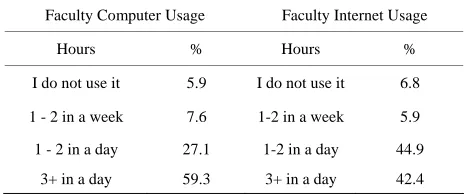
The second section of the questionnaire was related to the computer literacy of the faculty. Results show that 95% of the respondents are having personal computer (PC), 92% of the respondents are having email address, and only 32% of the respondents are having website. Only 14.4% faculty had previously taught a course through mobile devices (including laptops). In terms of computer usage, 59.3% of the faculty members re- sponded that they use computer more than three hours in a day, 5.9% of the faculty members responded that they do not use computer, 7.6% of the faculty responded that they use computer 1 - 2 hours in a week and 27.1% re- sponded that they use computer 1 - 2 hours in a day. 42.4% of the faculty members responded that they use internet more than three hours in a day and 6.8% replied that they do not use internet, 5.9% replied that they use internet 1 - 2 hours in a week and 44.9% replied that they spend 1 - 2 hours in a day using internet (Table 1).
Results show that 39% of the teachers surveyed said that they use computers or the internet to create or upload instructional materials, 34% responded that they use computers or the internet for administrative record keep- ing, and less than 10% reported that they access com- puters and internet to find model lesson plans and to ac- cess research and best practices.
4.2. Attitude of Faculty towards Mobile Based Exam System and m-Learning
[image:2.595.306.540.639.736.2]Third part of the questionnaire was related to the percep- tion of the instructors/faculty members related to the mo- bile examination system and m-learning method, for this part of the questionnaire, a five-point Likert scale criteria was used, where 1 = totally agree, 2 = agree, 3 = no idea, 4 = disagree and 5 = totally disagree. Survey showed that 55.1% of the total faculty members of all the three coun- tries (Jordan, United Arab Emirates, and Saudi Arabia) regarded that m-learning and mobile examination will
Table 1. Computer literacy of faculty at educational insti- tutes of Arab countries.
Faculty Computer Usage Faculty Internet Usage
Hours % Hours %
I do not use it 5.9 I do not use it 6.8
1 - 2 in a week 7.6 1-2 in a week 5.9
1 - 2 in a day 27.1 1-2 in a day 44.9
make a qualitative help in the process of learning and teaching students. 84% of the faculty members agreed that it will increase the self learning process of students. 39.9% of the faculty members declared that it will make students’ evaluation more difficult. However, 83% of the faculty members who showed their interest in mobile examination system and m-learning were of age 43 or below (Table 2).
Moreover, according to the instructors; m-learners should have many characteristics, for instance, being able to learn independently in isolation with positive view towards learning. Moreover, they should have good computer and internet skills and must be able to make the best use of time. Also, they must be self-disciplined and should enjoy working and studying alone.
In addition, faculty involved in mobile based teaching must have some capabilities; such as, being proficient in using computer/mobile devices and internet. Also, they should have interest to integrate themselves and students with technology, and should be able to deliver lecture through any media which involves technology.
5. Students Survey Results
Students were also surveyed in the same manner as the instructors. The second part of the survey was related to the computer literacy among the students of the three countries.
5.1. Computer Literacy among the Students
[image:3.595.308.537.486.579.2]Results show that 97% of the surveyed students of the three Arab countries are having personal computer (PC), 96% of the respondents are having email address and only 11% of the student are having website. 62.4% of the surveyed students responded that they use computer more than three hours a day, 1.3% said that they do not use computer, 6.2% replied that they use computer 1 - 2
Table 2. Perception of faculty at educational institutes of Arab countries regarding m-learning and mobile exam sys- tem.
Respond Ease in
learning
Students evaluation
will become difficult Qualitative help
Totally
disagree 9.3% 19% 6.8%
Disagree 21.2% 24.3% 21.2%
No idea 15.3% 17.8% 16.9%
Agree 31.4% 19.9% 31.4%
Totally
agree 22.9% 20% 23.7%
Total 100% 100% 100%
hours in a week and 30.1% replied that they use com- puter 1 - 2 hours in a day. 59.4% of the students an- swered that they use internet more than three hours in a day, 46.6% answered that they use internet 1 - 2 hours in a day, 10.6% responded that they use internet 1 - 2 hours in a week and 2.2% replied that they do not use internet (Table 3).
5.2. Attitude of Students towards Mobile Based Exam System and m-Learning
Data obtained shows that 70% of the students agreed on the point that their learning skills are enhanced through m-learning. 60% of the students claimed that mobile examination is useful, 96% of the students agreed on the fact that m-learning is very useful and is very helpful for those students who live at remote areas and cannot attend the university or educational institute daily. 19.3% of the students responded that this way of examination will not be fair. It is also observed that students use internet and computer more than teachers (Table 4).
6. Additional Analysis and Data Variations
6.1. Variation of Data with Countries
[image:3.595.57.291.589.733.2]Perception of instructors/faculty members and students obtained at the three Arab countries was almost similar to each other with only slight differences in the percentages of the level of interest in m-learning and mobile exami- nation (Table 5).
Table 3. Computer literacy of university students of Arab countries.
Student Computer Usage Student Internet Usage
Hours % Hours %
I do not use it 1.3 I do not use it 2.2
1 - 2 in a week 6.2 1 - 2 in a week 10.6
1 - 2 in a day 30.1 1 - 2 in a day 46.6
3+ in a day 62.4 3+ in a day 59.4
Table 4. Perception of university students of Arab countries regarding m-learning and mobile exam system.
Respond Enhanced learning
Skills
Usefulness of Examination
Totally disagree 4.1% 9.2%
Disagree 9.3% 10.1%
No Idea 16.6% 20.7%
Agree 50.2% 49.6%
Totally agree 19.8% 10.4%
[image:3.595.309.539.618.736.2]Table 5. Perception of m-learning among students and instructors at different Arab countries.
Faculty Students
Country % Preferred
m-Learning
% favoured Mobile
Based Exam Country % Preferred m-Learning
% favoured Mobile Based Exam
Jordan 50.3 19.4 Jordan 73.2 43.1
United Arab Emirates 50.9 19.6 United Arab Emirates 76.3 43.8
Saudi Arabia 50.5 19.3 Saudi Arabia 70.6 43.3
It can be seen from the table that the survey results of the instructors/faculty members and students of the three countries regarding this new technology is almost similar, if we neglect the slight differences so we can analyze that almost 50% of the faculty in all of these countries fa- voured m-learning. We can also say that an average more that 80% teachers were not in the favour of mobile based exam system. Moreover, from the data it is clear that the faculty of United Arab Emirates (UAE) were slightly more in favour of m-learning.
It can be seen from the data of the students that the students of the United Arab Emirates (UAE) passionate to embrace this new technology, there is a similarity be- tween the thoughts of the students of Jordan and Saudi Arabia. The lowest percentage regarding the preference of this new technology among students is in Jordan, but data is not varying too much.
6.2. Variation of Data with Gender
There is also variation in data with respect to the gender; it is observed that the perception of female respondents was different from that of the male respondents (Tables 6 and 7).
From the above data we can observe that the percent- age of computer usage and internet usage among the male respondents is more than that of the female respon- dents, the reason behind this may be cultural and/or so- cial factors, which plays a vital role in this regard. 69.3% of the male students use computer more than three hours in a day, whereas only 49.2% of female students use computer more than three hours in a day. Same case is with faculty members, 64.3% of the male instructors use computer more than three hours in a day, whereas only 53.4% of the female instructors use computer more than three hours in a day.
6.3. Unfairness of Mobile Examination
The issue of mobile learning and mobile based exams in particular, is a hot topic. Many universities are striving to put the regulations and rules to manage and guarantee the fairness and successful implementation of such environ- ments. We have examined wither or not there is an asso-
ciation between the unfairness of the mobile examination form one side, and the role (instructor/student) and gen- der of instructor and students from the other side.
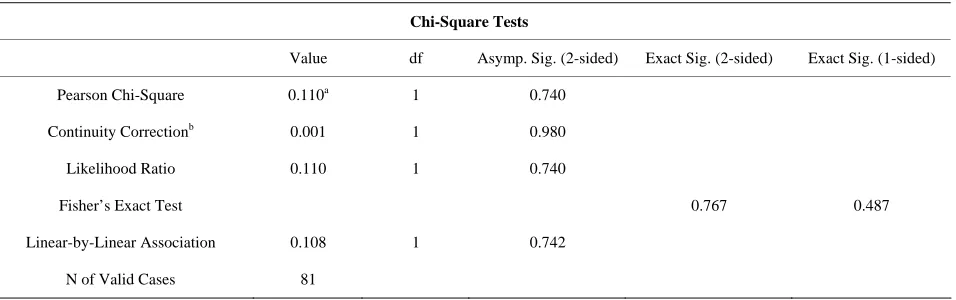
In view of the chi-square tables (Tables 8 and 9), it is noted that the level of significance is more than 0.05 that is 0.109 reflecting that there is no association between gender of students and their perception of mobile exami- nation unfairness. Moreover, it is clear that the level of significance is above 0.05 that is 0.742 indicating that there is no association between gender of instructors and mobile examination unfairness.
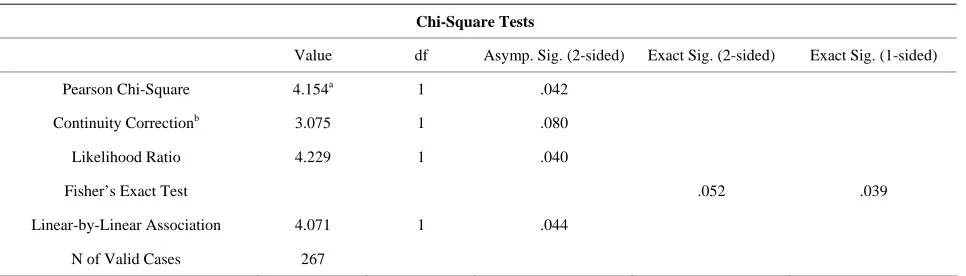
However, when looking at the association between the role of people involved (instructor or student) and the mobile examination unfairness, we found that the sig- nificance level is less than 0.05 that is 0.042 showing that there is association between the role and mobile exami- nation unfairness. Therefore, role (instructor/student) is related to mobile exam unfairness.
This might motivate us to investigate this issue in more details. In fact, the development of a reliable and trusted mobile exam systems is important. Moreover, the understanding the factors that impact its successful im- plantation and reliability is significant, in particular in the context of the Arab countries (Table 10).
7. Research Findings
Data collected from the questionnaire was analysed using the statistical software SPSS 14.0, the statistical analysis of the data collected showed many findings related to the perception of instructors/faculty members regarding to mobile based exam system. Findings are summarized as follows:
1) Computer competency
Familiarity with computer technology plays an impor- tant role in forming the attitudes of faculty/instructors and student towards the m-learning and m-examination method. There is a strong relationship between the level of computer competency and acceptance of m-learning. The age of faculty may be a factor in the association be- tween computer technology literacy and the level of re- luctance to accept any mode of m-learning.
Table 6. Percentage of computer usage and internet usage among male and female students.
Male students Female students
Hours Internet %age Computer %age Hours Internet %age Computer %age
I do not use it 3.1 0.5 I do not use it 7.1 5.0
1-2 in a week 5.2 5.1 1-2 in a week 9.2 12.1
1-2 in a day 24.5 25.1 1-2 in a day 40.2 33.7
[image:5.595.56.539.252.354.2]3+ in a day 67.2 69.3 3+ in a day 43.5 49.2
Table 7. Percentage of computer usage and internet usage among male and female instructors.
Male Instructors Female Instructors
Hours Internet %age Computer %age Hours Internet %age Computer %age
I do not use it 3.9 5.7 I do not use it 6.4 5.6
1-2 in a week 5.8 5.8 1-2 in a week 10.1 8.9
1-2 in a day 42.9 23.1 1-2 in a day 40.3 32.1
3+ in a day 47.4 64.3 3+ in a day 43.2 53.4
Table 8. Chi-square test (Students gender * Unfairness of mobile exam).
Chi-Square Tests
Value df Asymp. Sig. (2-sided) Exact Sig. (2-sided) Exact Sig. (1-sided)
Pearson Chi-Square 2.566a 1 0.109
Continuity Correctionb 1.715 1 0.190
Likelihood Ratio 2.611 1 0.106
Fisher’s Exact Test 0.148 0.095
Linear-by-Linear Association 2.514 1 0.113
N of Valid Cases 186
a0 cells (0.0%) have expected count less than 5. The minimum expected count is 8.74. bComputed only for a 2 × 2 table.
Table 9. Chi-square test (Instructor gender * Unfairness of mobile exam).
Chi-Square Tests
Value df Asymp. Sig. (2-sided) Exact Sig. (2-sided) Exact Sig. (1-sided)
Pearson Chi-Square 0.110a 1 0.740
Continuity Correctionb 0.001 1 0.980
Likelihood Ratio 0.110 1 0.740
Fisher’s Exact Test 0.767 0.487
Linear-by-Linear Association 0.108 1 0.742
N of Valid Cases 81
a
[image:5.595.64.540.383.532.2] [image:5.595.63.541.572.722.2]Table 10. Chi-square test (Role * Unfairness of mobile exam).
Chi-Square Tests
Value df Asymp. Sig. (2-sided) Exact Sig. (2-sided) Exact Sig. (1-sided)
Pearson Chi-Square 4.154a 1 .042
Continuity Correctionb 3.075 1 .080
Likelihood Ratio 4.229 1 .040
Fisher’s Exact Test .052 .039
Linear-by-Linear Association 4.071 1 .044
N of Valid Cases 267
a0 cells (0.0%) have expected count less than 5. The minimum expected count is 10.58. bComputed only for a 2 × 2 table.
coming a barrier for instructors in the adoption of the mobile exam system and m-learning is the lack of incen-tives and technological infrastructure. Faculty members also commented that qualified staff is not available at the lab for help.
3) Mode of m-learning
Survey showed that majority of the teachers’ preferred m-learning system in combination with traditional method of teaching and evaluation, most of the teachers expressed their views that technology is a great tool in m-learning but human factor would always be present in teaching and evaluation of students.
Majority of the students of Arab countries showed their interest in this technology, but this interest is not for all the disciplines, the students of engineering, medicine and accounting were not much interested in m-learning and mobile exam system, they preferred class room teaching rather than online learning because according to them these subjects are relatively tough and requires practical training and to properly understand it instructor must be present physically for support and guidance.
4) Advantages and disadvantages
This technology is a great tool in learning and teaching process, instructors declared that m-learning promotes self learning, increases the learning quality, and makes the process of teaching easy, flexible and provides them access to vast information.
Teachers also commented that through this technology they can deliver their point of view to students in less time and with more clarification [11] (Burgess, 2008: pp. 131-138).
Most of the instructors accepted the fact that m-learn- ing and mobile exam system would reduce the time which is consumed in checking and assessing of students copies manually.
Female students of these countries regarded m-learn- ing system as an ideal system for females who cannot attend the university/college daily.
5) Mobile examination system
Most of the teachers were not in the favour of mobile examination system because according to them, students cannot be properly evaluated or judged through this process, some teachers who supported mobile examina- tion said that this system would reduce the practice of cheating and favouritism in examination [12] (Patel and Aghayere Oct 2006). However, many others believed that it is unfair method of testing would increase the risk of cheating, unless some factors are taken into considera- tion; for instance, that every student gets different ques- tions.
6) Age factor
Results indicate that there is also an age factor in- volved in the acceptance of this technology; it is ob- served that faculty members who were of age 45 or be- low were more passionate to accept this technology as compared to those who were above 45; this clearly indi- cates that older faculty members are reluctant to accept this new technology [13] (Elango & Selvam, 2008: pp. 31-104).
7) Self confidence
It is observed that most of the teachers and students are confident enough to relate their education with tech- nology, according to majority of them; implementation of this new technology is not a difficult job, according to them lack of facilities and awareness is a major factor that is acting as a barrier in the adoption of this technol- ogy.
8) Awareness
m-learning is related to the use of computers and web- sites only and very few were fully aware about the bene- fits, outcomes and usage of the mobile based learning and examination process. It is also seen that the students and faculty members who are not very proficient in the computer applications and internet usage are not in fa- vour of mobile based examination system and m-learning [14] (Kahiigi et al., 2008: pp. 77-88).
8. Conclusions
This study shows clearly that within the study context a considerable number of instructors and students consider m-learning to be synonymous with technology. The real academic drive behind m-learning is to analyse and use technology as a tool to serve educational purposes. The economics involved in teaching online courses usually include higher production costs depending on the diffi- culty of the topic and the media used for example HTML pages, streaming-video presentation, flash animation and interactive content.
The study suggests that cultural elements can play a significant role in making positive attitudes of faculty and student towards m-learning. A significant number of students and faculty members believe that Arab culture, institutions, and societies are ready for the m-learning model of teaching. Therefore, any educational strategy that intends to embed m-learning into the educational system should add this point of view into consideration. Furthermore, this study shows that computer literacy among faculty members acts as a barrier in the imple- mentation and popularization of the m-learning model at Arab countries. The major barrier that is faced with the m-learning model at Arab universities seems to be lack of academic vision behind the acceptance of the m-lear- ning model. Success in the implementation of this tech- nology can only be achieved by proceeding and seeking instructive and pedagogical approach. It is clear that m-learning and mobile examination system will not pros- per in Arab countries until and unless both faculty and students are well prepared. Policies, rules and regulations at the universities of Arab countries must adjust to the changes brought about by this new technology. Moreover, incentives should be given to faculty who want to teach and implement the m-learning model. Arab universities should revise their policies and steps must be taken to create awareness regarding this technology among both students and instructors.
In three Arab countries including Saudi Arabia, United Arab Emirates (UAE), and Jordan, and maybe in many others, these technologies are still in its developing phase and can be used as a tool that can be strategically used to improve student and faculty relation.
9. Recommendations
Based on the above findings, it is recommended that fol- lowing steps must be taken to enhance teachers’ and stu- dents’ abilities and competencies with regard to mobile based exam system.
1) To adopt this technology, interest regarding com- puter and internet among the respondents must be devel- oped, because it is seen from the survey that respondents who use internet and computer more showed greater in- terest in technology as compared to those who make use of computer and internet relatively less.
2) Awareness among the respondents should be cre- ated regarding this new technology, since the acceptance of this new technology by instructors and students is based on their awareness. Moreover, workshops and seminars must be organized at the university and college level to enhance instructor, student and technology inte- gration.
3) Teachers should be provided with the facilities in- cluding hardware and software, this should also be trained to the students. In addition, faculty should be provided with some release time so that they could prac- tice and plan about the integration of technology with students at the class room.
4) Faculty and students should be encouraged, teachers should be provided with incentives for proper integration of technology in the classrooms. Moreover, technology integration in relationship to curriculum goals and out- comes should also be investigated.
5) Effects of technology integration on students’ achievement and attitude should be investigated and proper steps should be taken.
6) Online examination systems could be very helpful, but many factors should be considered and they should be implemented carefully to guarantee the successful adoption, fairness and reliability.
REFERENCES
[1] S. Issa and M. Saad, “E-Learning and Its Impact to the Educational System in the Arab World,” International Conference on Information Management and Engineering, IEEE, 2009.
[2] S. Al-Fadhli, “Instructor Perceptions of E-Learning in an Arab Country: Kuwait University as a Case Study,” E- Learning and Digital Media, Vol. 6, No. 2, 2009, pp. 221-229. http://dx.doi.org/10.2304/elea.2009.6.2.221 [3] N. Fahad, “Students’ Attitudes and Perceptions towards
The Effectiveness of Mobile Learning in King Saud Uni- versity, Saudi Arabia,” The Turkish Online Journal of Educational Technology, Vol. 8, No. 2, 2009, Article ID: 10.
Vol. 63, 2012, pp. 484-488.
[5] A. Salem, D. Steve and A. Thamer, “Assessing the Im- pact of e-Learning Systems on Learners: A Survey Study in the KSA,” Procedia—Social and Behavioral Sciences, Vol. 47, 2012, pp. 98-104.
[6] T. Ali, H. Kate and X. H. Liu, “Factors Affecting Stu- dents’ Acceptance of e-Learning Environments in De- veloping Countries: A Structural Equation Modeling Ap- proach,” International Journal of Information and Edu- cation Technology, Vol. 3, No. 1, 2013, pp. 54-59. [7] M. Manuela, “Cultural Impact on Online Education Qual-
ity Perception,” The Electronic Journal of e-Learning, Vol. 6, No. 2, 2008, pp. 149-160.
[8] A. G. Almekhlafi and F. A. Almeqdadi, “Teachers’ Per- ceptions of Technology Integration in the United Arab Emirates School Classrooms,” Educational Technology & Society, Vol. 13, No. 1, 2010, pp. 165-175.
[9] O. Olufemi, “Pedagogical Approaches and Technical Subject Teaching through Internet Media,” The Elec-
tronic Journal of e-Learning, Vol. 6, No. 1, 2008, pp. 53- 66.
[10] R. Stephen, “Is E-Learning Really Working? The Tril- lion-Dollar Question,” IEEE Computer Society, 2010, pp 78-82.
[11] J. Burgess, “Is a Blended Learning Approach Suitable for Mature, Part-time Finance Students?” The Electronic Journal of e-Learning, Vol. 6, No. 2, 2008, pp. 131-138. [12] P. Jimmy and A. Abi, “Students’ Perspective on the Im-pact of a Web-Based Discussion Forum on Student Learning,” IEEE Computer Society, 2006.
[13] R. Elango, V. K. Gudep and M. Selvam, “Quality of e- Learning: An Analysis Based on e-Learners’ Perception of e-Learning,” The Electronic Journal of e-Learning, Vol. 6, No. 1, 2008, pp. 31-44.