http://dx.doi.org/10.4236/oje.2013.38062
Selective use patterns of woody plant species by
local communities in Mumbwa Game Management
Area: A prerequisite for effective management of
woodland resources and benefit sharing
Chansa Chomba1*, Vincent Nyirenda2, Mitulo Silengo1
1School of Agriculture and Natural Resources, Disaster Management Training Centre, Mulungushi University, Kabwe, Zambia; *Corresponding Author: [email protected], [email protected]
2Zambia Wildlife Authority, Directorate of Research P/B 1 Chilanga, Zambia
Received 27 August 2013; revised 27 September 2013; accepted 5 October 2013
Copyright © 2013 Chansa Chomba et al. This is an open access article distributed under the Creative Commons Attribution License,
which permits unrestricted use, distribution, and reproduction in any medium, provided the original work is properly cited.
ABSTRACT
Selective patterns of human uses of woody plants in Mumbwa Game Management Area were investigated using quantitative survey methods. Major causes of human encroachment into the wildlife zone were assessed so that appropriate management actions could be taken to ensure continued supply of goods and services to the local community. Woody plant species were found to be diverse with 93 species recorded in the study area. Of these, the community utilized 92 (99%) in different ways. Trees were cut for various reasons, major ones being; building poles, fire wood, fibre, fruit collection, medicine, bee honey collection, house hold tools and utensils and clearing for agriculture. Clearing for agriculture was the most damaging, because it involved removal of below and above ground woody biomass of all sizes and suppression of their regeneration during cultivation in subse-quent years. Of the recorded human uses, 2366 kg of woody plant material was consumed per
head/yr−1 as fire wood. The day to day
consump-tion of firewood varied with season. In the cold season (May-August), a 26 kg (mean weight) bundle of firewood was consumed in three days while in the warm season it lasts five days.
Cer-tain species were particularly selected;
Julber-nardia paniculata, Pericopsis angolensis, Bra- chystegia speciformis, Brachystegia boehmii, Julbernardia globiflora, Brachystegia longifolia,
and Pteleopsis anisoptera. In building and con-
struction, differences were observed in the spe-
cies and size of poles was used. The mean sizes of roofing poles were 3.5 metres long and 0.18 metres mid-length girth. Wall poles were 2.4 metres long and 0.40 metres mid-length girth. For the main house of about two rooms each, there were an average number of 48 poles in the
roof (45,859.2 cm3) and 28 (284,653.6 cm3) in the
wall. Clearing for agriculture was the main cause of damage to woody plants in the Game Man-agement Area. The extension of human settle-ments into the wildlife zone and towards the Ite- zhi-tezhi road is likely to increase loss of woody vegetation, and will have a negative impact on the habitat for wildlife.
Keywords:Utilization; Woody Plants; Local
Community; Agriculture
1. INTRODUCTION
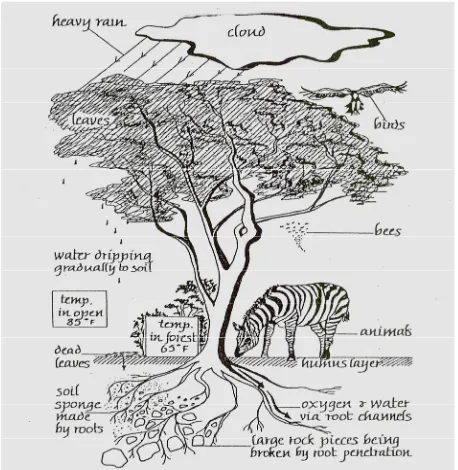
Woody plants are central to the livelihood systems of thousands of rural and urban dwellers in Africa [1-8]. A range of products from woodlands support rural living by way of medicines, food, building timber and fuel (Figure 1). Ecologically, trees play an important role in
control-ling soil erosion by intercepting rain drops, providing a habitat to many organisms and also creating a micro cli-mate which both man and beast utilize (Figure 2). They
Figure 1. Different human uses of woody plants (source: Storrs, 1968).
Figure 2. Different ecological uses of woody plants (source: Storrs, 1968).
eco-region of east and southern Africa [7].
Woodlands also provide products for towns and cities in Zambia. The most important of these is fuel, but also a source of income are non-fuel timber products including honey, bees wax, edible fruits, edible insects, vegetables, game meat, mushrooms, traditional medicine, and wood
for handicraft [8-10]. These goods and services create a demand for woody plants and even when the woodlands are located in an inhabitable escarpments and mountain-ous landscapes of rugged and rocky nature, or are pro-tected by law such as forest reserves, zoned Game Man-agement Areas or National Parks. They are still legally or illegally accessed for collection of various products [11].
In Zambia, there is a growing concern about defores-tation. An estimated 0.5% of the country’s woodlands were lost each year [12]. The figure could even be higher at the moment. Around large human settlements, this loss may be considerably higher. Although fires, especially those late in the season, are one of the principal causes of deforestation, and it is accentuated by other anthropo-genic factors. The cutting of trees for firewood and char- coal, combined with clearing for agriculture for instance, are additional causes of deforestation around large hu-man settlements, towns and major fishing areas [12]. Traditionally, firewood was collected from dead wood on the ground, often as old trees that have died of natural causes or as a product of land clearance for agriculture, but with the increase in human population, this is becom- ing less practicable and live trees are now being cut for fuel wood. Firewood cutting however, does not amount to complete clearance of woody biomass, as some of the species are preferred to others, so the true extent of the problem is not immediately obvious, and this has led to lack of awareness among the public. Other problems include declining fallow periods and the clearance of land for both small and large scale agriculture [12-16].
In protected areas such as Mumbwa Game Manage-ment Area, where conditions of multiple property rights exist with the state through ZAWA legally co-opting traditional/customary tenure to create a statutory system overlaid on a traditional one, the exploitation of re-sources is often antagonistic. This is not unique to Zam-bia, as in many parts of Africa, governments lay claim to greater amounts of land and other natural resources than they can effectively control. The result is that authority and management continue to be compromised and open access tendencies thrive.
[image:2.595.58.287.390.625.2]the Zambia Wildlife Act No. 12 of 1998. The other indi-cation of resentment is the increasing levels of illegal settlements in the wildlife zone. The increased numbers of illegal settlers and the accompanying clearing for ag-riculture and other extractive uses of vegetation exacer-bate habitat transformation/loss, weakening the status of Mumbwa GMA as a buffer to Kafue National Park. An effective GMA as a buffer zone, is intended among other things to; 1) extend those habitats contained within the National Park, 2) provide for the needs of threatened and endangered species of animals, 3) act as additional habi-tat outside the National Park boundary thereby enhancing the capacity to contain wildlife species likely to move out of the National Park [17,18], and 4) sustain trophy hunting and limited photographic safaris from which local communities benefit. The GMA is also supposed to serve other environmental protective functions such as soil and water conservation [18,19]. If a buffer zone is encroached by human settlements, its ecological func-tions wane. This is because human settlements in most instances have predictable needs for firewood and build-ing timber, such that even when settlements are on the periphery they would eventually expand deeper into the wildlife zone and overtime, the GMA would fail to meet their requirements and settlers would seek such resources from the National Park itself [8,19,20].
The aim of this study therefore, was to assess human use of the woody plants in Mumbwa GMA, focusing on clearing for agriculture, wood fuel and building poles and to a lesser extent other uses such as honey collection, medicines and house hold tools. This study targeted woody plants because they take longer time to grow than herbaceous plants. Popular woody species that are habi-tat specific slow growing and slow reproducing and which are debarked or dug out for dyes, medicine, food or horticultural purposes are particularly vulnerable to over harvesting. Studies carried out in Tanzania showed that effects of harvesting of trees for building materials or fuel wood would be more apparent if there was; com-plete removal of woody biomass, low levels of recruit-ment and suppression of coppices [11,21,22]. Harvesting of poles and laths for instance utilize much smaller stem size classes than the timber industry, but nevertheless can impact on tree recruitment and woodland structure [21, 23].
In order to develop appropriate management strategies that would ensure continued supply of goods and ser-vices on a sustainable basis, the human use of woody plants as well as their ecological importance in main-taining soils and biota should be understood. Figures 1
and 2 demonstrate the different ecological and human
uses of woody plants which should form the basis for the need to protect them, which is why this study is impor-tant.
2. METHODS AND MATERIALS
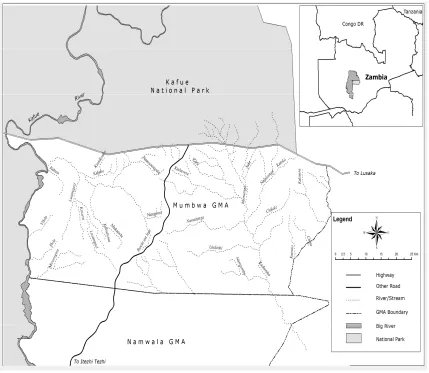
2.1. Study AreaMumbwa GMA is situated on the eastern boundary of Kafue National Park. It lies between 14˚58' and 15˚18' south and 25˚58' and 26˚58' east and covers an area ap-proximately 3370 km2 in extent (
Figure 3).
Relief and drainage comprise of an undulating land-scape with a general elevation of approximately 1000 m above sea level broken only by a ridge of over 1200 m a.s.l. in a SW-NE direction. The Nansenga and Nagoma Rivers dominate the drainage system.
Mean annual rainfall ranges from 1000 mm with mean annual rainy days of 80 except for the southern tip which has 70 days. The mean date for the onset of rains is 10th
November and the mean date for retreat is 20th March.
The evapouration rates reach the peak of 295 mm in Oc-tober, falling to 115 mm in February. These figures may however, change in view of the threats of global warm-ing and changwarm-ing weather patterns.
The geology is underlain predominantly by the Karroo- Granite complex flanked by a series of Katangan meta— sediments, shales, sandstones and siltstones to the north- west and southwest. An inlier of Katanga rocks is found towards the northwest corner of the GMA [8,24]. The GMA soils, however, are of different types with 88% of the area being covered by Orthi-eutric dystric leptosols, Chromic-haplic uxisols. These consist of well drained, shallow to moderately shallow, dark brown to dark yel-lowish brown, rocky, fine loamy to clayey soils. A small portion (approximately 12%) in the north western corner consists of moderately shallow, brown to yellowish brown, friable, clayey soils with a very weak profile de-velopment and in places imperfectly drained Orthic-dys- tric regosols [8,24].
2.2. Vegetation
The vegetation of Mumbwa GMA is typical of a pla-teau landscape, with the total number of woody plants being 450 - 500 species [8,25-27]. It is a typical miombo classified as woodland of plateau and hill comprising the following; Pure Julbernardia paniculata woodland, rarely with Brachystegia longifolia of Brachystegia
floribunda; pure Brachystegia longifolia rarely with
Jul-bernardia paniculata or Brachystegia spiciformis; almost
pure Brachystegia utilis woodland occasionally with a little Julbernardia paniculata, Brachystegia longifolia or
Brachystegia spiciformis; almost pure Brachystegia
boehmii woodland occasionally with a fair amount of
Julbernardia paniculata; pure Brachystegia spp
wood-land with little Julbernardia paniculata or Brachystegia
longifolia; pure Brachystegia bussei woodland with
Sterculia spp; almost low pure Brachystegia spiciformis
Figure 3. Location of study area, Zambia.
Brachystegia longifolia woodland with varying percent-
ages of the two co-dominants; mixed miombo woodland and various mixtures of almost all plateau species of
Brachystegia with Julbernardia paniculata.
The chief characteristic of the miombo woodland in the study area was its openness below canopy. Small trees and shrubs were scattered so that visibility within the woodland was high. The chief associates of Julber-
nardia and Brachystegia species were Acacia macro-
thyrsa, Albizia antunesiana, Azanza garckeana, Bauhinia
petersiana, Clerodendrum glabrum, Cordia spp, Grewia
flavescens, Margaritaria spp, and Ximenia caffra. Acacia
scheinfurthii, Capparis tomentosa, Clematis brachiata,
Hippocratea indica, Jasminum stenolobum, Turbina shi-
rensis and Vernonia aurantiaca were the most prominent
climbers.
The Acacia-Albizia woodland was mainly found on
the alluvial plains where it formed very open woodland with a few shrubs but abundant tall grass. The dominant species were Acacia and Albizia spp, which occurred in pure or almost pure stands accompanied by Ficus
capen-sis, Combretum imberbe, Lonchocarpus capassa,
Com-bretum ghasalense, Piliostigma thonningii, and Zizyphus
abyssinica.
2.3. Human Settlements
Settlers were either randomly distributed as deter-mined by water availability or linearly distributed along main streams, Lusaka-Mongu highway and access roads. The population was densest between the Lutale River and Nansenga stream. Since the 1990s however, settle- ments have been spreading towards Chungu stream into the wildlife zone. The total human population in the GMA was estimated at 6000 in 2000 but had increased to more than 10,000 by 2011.
2.4. Field Methodology
2.4.1. Vegetation Use Assessment
of the random points along the boundary, transect lines were laid out perpendicular to each other for 1 km into the settlement and wildlife zones respectively. There were ten transects in each zone and ten plots along each transect line. The modified Whittaker plot method was used [28]. Along each transect line, sample plots were located at random [29,30]. The plots were used to sample woody plants greater than 10 cm dbh. The diameter at breast heigh was taken to be 1.3 metres above ground [29,30] The variable measurements included; girth, height and crown diameter [29,30]. In measuring dbh circumference was measured and converted later using the formula; C = Dπ. Thus D = C/π. The basal area (BA) being calculated as πr2 while volume was calculated as
πr2h × 1/3; where C = circumference, D = diameter, H =
height, r = radius and pie (π = 3.14) is a constant.
Where tree stems branched below dbh, the individual stems were counted and their measurements combined as also applied in other similar studies [8,29]. If the branch- ing was at ground level, each stem was treated as an in-dividual tree. This was because measurements used to calculate basal area were taken at 1.3 metres above ground level. Tree height was measured using a tree height measuring rod. Canopy cover was measured using a 100 metre measuring tape laid on the ground from one edge of the crown to the other D1, the second
measure-ment being taken perpendicular to the first one as D2.
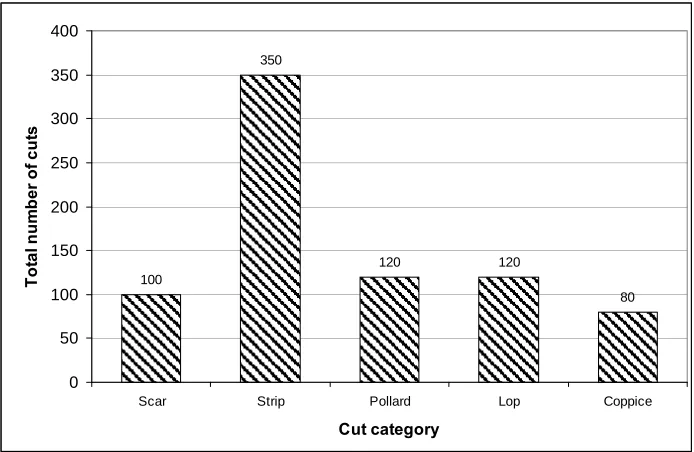
All trees of circumference greater than 10 cm dbh in each 25 m × 25 m plot were examined for any human induced damage. Human damage categories were devel-oped as described below to give an indication of the fre-quency with which a species was the most diverse in its uses and whether it may be in danger of over exploitation. Damage categories were classified as; coppice when the stem was cut below 50 cm above ground level; pollard when cut at above 50 cm; lop when branch was cut; strip when bark had been removed as in fibre collection and scarred when there are identifiable axe or other human made tool marks on the stem or branch. Difficulties were encountered where vernacular names referred to large genera and many species with one common name for different species. This was the case with Combretum and
Terminalia species. Specimens of plant species not
iden-tified in the field were taken to the herbarium for verifi-cation. Data collected was analysed using a Minitab 14.0 computer software programme. This survey was carried out in 1998 and 2011/12 seasons.
2.4.2. Questionnaire Survey
The survey covered villages located in the settlement zone of the GMA. The villages sampled were within 1 km of the wildlife zone boundary. This closeness to the wildlife zone boundary allowed the assessment to deter-mine the influences that villagers might have on the
wildlife zone. Households resident at the same locality for no less than 12 calendar months were interviewed. A pre coded questionnaire was used with the last two ques-tions being open ended, designed to reveal the many fac-ets of the respondents’ attitude towards the GMA.
2.4.3. Enumerators
To ensure gender balance, three female and three male enumerators were engaged from within the communities’ resident in the GMA. The six enumerators took meas-urements of buildings and fire wood as well as partici-pating in the Participatory Rural Appraisal. The advan-tage was that they were familiar with local species and were knowledgeable of and known to the community. Prior to starting work, the enumerators were trained for a period of two weeks during which trial questionnaires were conducted to determine their suitability for the local community.
2.4.4. Participatory Rural Appraisal
Groups of people resident in the GMA of different age groups and gender depending on the topic being dis-cussed were gathered together and information collected from them by asking questions regarding natural re-source utilization. Interviewees were assured that any answer given would not lead to any criminal proceeding. The PRA took advantage of Sunday masses, wedding parties and other public gatherings as organizing meet-ings solely for PRA were non responsive. The number of questions was limited depending on the occasion as it was found that asking too many questions led to inaccu-rate responses.
2.4.5. Building Materials and Firewood Survey
For a given human use, some plants were preferred by local people to others and are therefore, sought out and used. This provided the researchers with an indication of the relative importance of each species to the local com-munity. Species preferences were also determined from the house hold consumption surveys, which gathered data on the frequency with which species were used for certain purposes, the preferred species for each human use and reasons for their selection.
2.4.6. Measuring Wooden Structure
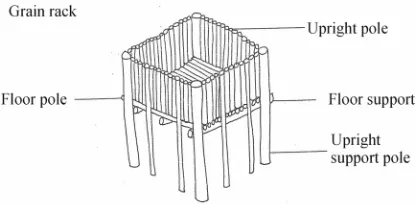
Building materials were divided into two major cate-gories: roofing poles and wall poles for houses and floor pole, horizontal and upright poles for grain racks (Figure 4). Measurements of 32 houses randomly located in
Figure 4. Conceptual use of woody plants in grain rack construction, Zambia 2012 (modified after: Chansa, 2000).
the ground to measure the length of the pole and how deep the poles were buried in the ground. Permission was sought from each house hold to enter their house and take measurements of roofing and wall poles.
2.4.7. Measuring Firewood
Units of head loads, wheelbarrow, bicycle and scotch cart towed by oxen or donkeys were measured. Bundles of firewood were weighed and the number of poles counted. In order to investigate the methods of fire wood collection used, the three female enumerators accompa-nied women on firewood collection trips. This is because women were the main firewood collectors as recorded during PRA and questionnaire survey. The enumerator allocated all the fire wood collected into categories as, felled trees, taken from woodpiles made during clearing of fields for agriculture, from standing dead trees, or gathered from the ground. Group meetings were also held to consolidate the commonest firewood collection methods. In each village, species preferences and uses of firewood were recorded from the bundles of firewood examined. All bundles of firewood examined were weighted to determine weight in kg.
2.5. Limitations
Determining species preference and classifying dam-age categories involved in some instances, relatively arbitrary approaches and subjective assignation of nu-merical values to different criteria. Although this ap-proach has been criticized by some researchers, the aim in this study was to obtain relative and not absolute val-ues of species’ preferences and damage and was there-fore effective in achieving this goal. The boundary be-tween the wildlife and settlement zones was also often arbitrary except where it was demarcated by a prominent physical feature such as a river.
3. RESULTS
3.1. Use of Woody Plants by Local Communities
In this study 93 plant species were recorded and of
these 92 (99%) were used by the local community. In fact, each one of them had more than one use (Table 1).
Fourteen were recorded for medicinal and magical uses, 21 for tools and utensils, 25 for wall poles, 33 for roofing poles, seven for firewood, 13 for fruit trees and five were reserved for hanging bee hives.
3.2. Differences in Woody Plant Density between Settlement and Wildlife Zones There were more stems and trees per hectare in wild-life zone than settlement zone. Three species were re-corded to have equal relative frequency of 5% in both settlement and wildlife zones. These were; Julbernardia
panniculata, Brachystegia boehmii and Erythrophleum
africanum. Brachystegia boehmii was the most abundant
in both settlement and wildlife zones, with relative sight-ing frequency of 14% in settlement zone and 20% in wildlife zone. Diplorynchus condylocarpon was more abundant in the settlement zone than wildlife zone 9% and 5% respectively. The mean and total basal area for all species was higher in the wildlife zone than in the settlement zone, 8420.20 cm2; 117,549 cm2 for wildlife
zone and 4346.82 cm2; 30,764 cm2 for settlement zones
respectively. Many species had been eliminated from the settlement zone as their sighting frequency was low. Species which had been eliminated in the settlement zone showed low relative sighting frequency of less than 5% in the wildlife zone. Local communities extended their use of woody plants into the wildlife zone seeking species of preference which had been eliminated in the settlement zone.
3.3. Building Materials
Thirty two buildings were surveyed, in which 36 spe-cies were recorded as being used in roofing and 25 in walling. Mann-Whitney U test showed a significant dif-ference in the number of species used for roofing and walling (P < 0.001). Woody plant species were selected depending on the human use type and special plant char-acteristics befitting that human use. Depending on the type and part of building some species were used as roofing poles and others as wall poles while others were used in both walling and roofing. Diplorynchus
condy-locarpon, Erythrophleum africanum, Parinari
curatelli-folia, Pericopsis angolensis and Burkea africana were
the five most commonly used species for roofing timber. In wall construction, Pericopsis angolensis,
Erythro-phleum africanum and Burkea africana were the three
most commonly used species (Table 1).
3.4. Pole Size Class Selection in Building Materials
[image:6.595.68.276.84.186.2]Table 1. Human uses of woody plants in Mumbwa Game Management Area, Zambia, 1998-2011.
Human uses Species name
Firewood Roof pole Wall pole Tools Fruits/Medicinal Bee honey/Other
Acacia polyacantha na * na na na na
Acacia tortilis na * na na na na
Afzelia quanzensis * na na * na *
Albizia adianthifolia na na na na na *
Albizia antunesiana na na na na na *
Albizia harveyi na na na na na *
Albizia versicolor na * * na na *
Anisophyllea boehmii na na na na * na
Azanza garckeana na na na na * na
Balanites aegyptiaca na na na na * na
Bauhinia petersiana na * na na na *
Bobgunnia madagascariensis na * * * na *
Brachystegia boehmii * * * na na *
Brchystegia longifolia * * na na na na
Brachystegia manga * na na * na *
Brachystegia spiciformis * na na * na *
Bridelia micrantha na * * na na na
Burkea africana na * * * na *
Capassa violacea na na na na na *
Combretum collinum na na * na na na
Combretum molle na na * * na na
Combretum fragrans na na * na na *
Combretum imberbe na * * na na na
Combretum spp na na * na na na
Combretum zeyheri na * * na na na
Commiphora mollis na * * na na na
Dalbergia melanoxylon na * * * na na
Dalbergia nitidula na * * * na na
Dalbergia nyasae na * * na na na
Dichrostachys cinerea na na na na * na
Diospyros kirkii na na na na * *
Diospyros mespiliformis na na na na * *
Diospyros spp na na na na na *
Diplorynchus condylocarpon na * * na na *
Ekbergia benguelensis na na na na na *
Entada abyssinica na na * na na na
Etythrophleum africanus na * * * na *
Faurea intermedia na na na na na na
Faurea speciosa * * * na na na
Flueggea virosa na na na na na *
Ficus sur na na na na na *
Ficus spp na na na na na *
Gardenia spp na na na na na *
Hexalobus monopetalus na na na na na *
Hymenocardia acida na na na na na *
Julbernardia paniculata * * * na na *
[image:7.595.77.535.108.735.2]Continued
Kigelia pinnata na na na na * *
Lannea discolor na na na na na *
Markhamia obtusifolia na * na na na na
Monotes africanus na * * na na na
Monotes glaber na na na na na *
Monotes spp na na na * na na
Ochna pulchra na * na na na na
Olax obtusifolia na na na na na *
Olfiedia dactylophylla na na na na na *
Ozoroa insignis na na na * na na
Parinari curatellifolia na * * * * na
Peltophorum africanum na * na na na na
Pericopsis angolensis * * * * na *
Pilostigma thonningii na na * na * *
Pteleopsis anisoptera * * * na na na
Pterocarpus angolensis na * * * na na
Pseudolachnostylis maprouneifolia na * * * na na
Rauvolfia caffra na na na na * *
Rhus longipes na na na na * *
Senna abbreviata na na na na * *
Sclerocarrya caffra na na na na * na
Schrebera trichoclada na * na na na na
Staganotaenia araliacea na na na na na *
Sterculia quinqueloba na na na * na na
Strychnos cocculoides na na na * * na
Strychnos innocua na na na na * *
Strychnos pungens na * na * na *
Strychnos spinosa na na na * na *
Syzygium cordatum na na na na * *
Syzyguim guineense na * * na * na
Tamarindus indica * na na na * *
Terminalia sericea na * * na na na
Terminalia spp na na na na na *
Trichilia emetica na * * * * na
Uapaca kirkiana na * * * * na
Uapaca nitida na * * na * na
Uapaca sansibarica na na na na * na
Uvariastrum hexaloboides na na na na na *
Vitex doniana na na na * * na
Ximenia americana na na na * * na
Ziziphus abyssinica na na na na na *
Zanha africana na na na na na *
Notes: Tree species whose uses were not properly defined by the local community were grouped together under other uses. Species which had more than one use or received greater damage were probably most useful to the community.
of poles varied between roofing and walling poles. Roof- ing poles were longer than walling poles. The average length for roofing poles was 3.5 metres (n = 1856 poles) and mid length girth was 0.18 metres. The walls con-sumed shorter but thicker poles than roofs. The average
wall pole length was 2.4 metres (n = 896 poles) and the mid length girth was 0.40 metres. The average number of poles in the roof was 58 and 28 for the wall. The average number of species per roof was 4 and 2 for the wall.
pleum africanum were commonly used both in roofing and walling units. For these species, relative sighting frequency was below 5% implying that their numbers were declining.
3.5. Methods of Collecting Building Poles Different methods were used to collect building poles and these were; cutting down the whole tree of desirable size (60%), climbing a tree and lopping or pollarding branches of desirable girth and straightness (30%) and re-using old poles (10%).
3.6. Firewood
3.6.1. Pole Size, Species Selected and Transport Used
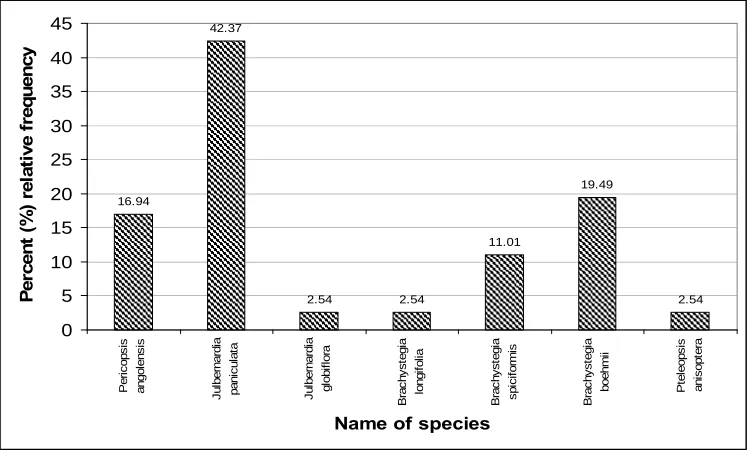
As for firewood of the total 60 bundles sampled, the average weight per bundle was 26 kg and 91 bundles or 2.3 tonnes (2366 kg) were consumed per head per year. Seven species were particularly selected for firewood. Chi-square test showed a significant difference in the selection of species for firewood (P < 0.001). The rea-sons given for the selection of species were those yield-ing good fire with embers lastyield-ing a long period of time while producing little smoke. Pericopsis angolensis in particular was chosen because it gave a hot fire and
Jul-bernardia paniculata because it gave hot embers and did
not spark (Figure 5). As regards transport, head loads
method of fire wood transportation, was the commonest 60%), bicycle 27% and wheel barrow was the least 13%.
Division of labour was based on age group and gender. Women collected most of the firewood (68%, n = 600) and of these, female children comprised 31% (n = 600).
This was probably the reason why men seemed generally unconcerned about fuel needs.
3.6.2. Methods of Collection
Four common methods of firewood collection were recorded based on 360 respondents:
1) Dead wood collected from the ground. Women and children said that this was an easy method as it did not require cutting down a tree. This method though pre-ferred by women and children was not common (15%) because it was difficult to find dead wood in the settle-ment zone. Late fires usually consumed above ground dry biomass.
2) Standing dead trees are identified and cut down. This was one of the commonest methods (30%). For hard trees such as Pericopsisangolensis, cutting was done by men, usually the husband or older male children. The mother and children would then return as demand arises to collect branches from the fallen tree. Usually only the branches were removed and large stems were abandoned unless the tree was near the homestead, in which case it would slowly be cut up until finished. Villagers con-fessed (83%, n = 180) entering the restricted wildlife zone or the adjacent National Park in search of dead trees to cut down. One of the respondents whose name could not be revealed for fear of being arrested explained that when they wanted to poach firewood from the National Park, they normally did not cut it using an axe unless it was very far (>5 km) from a Wildlife Scout’s camp as doing so nearby would alert them. Instead they used fire which was left overnight burning, returning the follow-ing day to increase the volume of fire if the tree was still standing or to break off branches if the tree had fallen.
16.94 42.37 2.54 2.54 11.01 19.49 2.54 0 5 10 15 20 25 30 35 40 45 Pe ri c o p s is a n g o le n s is J u lb er na rd ia pa ni c ul at a J u lb er na rd ia g lo b if lo ra B rac hy s teg ia lo n g if o li a B rac hy s teg ia sp ic if o rm is B rac hy s teg ia bo eh mi i P te leo ps is an is o pt er a
Name of species
[image:9.595.111.487.494.719.2]P er ce n t (% ) r el ati ve fr eq u en cy
3) The other method (30%) was the collection from wood piles. These woodpiles are made when fields are being cleared in readiness for cultivation. In this method there was less species selection as all the woody plants were cleared prior to cultivation. The sizes of poles ranged from saplings with circumference less than 10 cm (usually used in rekindling a fire) to big stems. If the field was near home, the big logs were slowly reduced to nothing by slicing off with an axe starting with the bark until the whole log has been taken. This method was most popular during the cultivation period (late October- December) when households were busy with farm work and little time was available for other activities. It saved a lot of time said one of the female respondents.
4) In this method, a preferred species was felled down and left to dry for many days. Though destructive, it was the second commonest (25%) method. Firewood collec-tors, mainly women and children returned to collect as need arose. When a tree has been felled for this purpose then it belonged to that particular household and no other person would knowingly collect the firewood without permission from the rightful owner. This method was highly selective of the most desirable species such as
Julbernardia paniculata which was chosen because it
can burn and give good embers even before it becomes completely dry.
3.6.3. Seasonality of Firewood Consumption
All the respondents in the survey (100%, n = 600) used firewood for heating, cooking and lighting. All the respondents in the survey (100%, n = 600) reported using more firewood in the cold season May-August during which time an average 26 kg bundle of firewood is con-sumed in three days time while the same quantity lasted 5 days in the warm season. In the cold season, firewood in addition to cooking was used for heating. This was also the season when maize (Zea mays), sorghum (
Sor-ghum vulgare) and finger millet (Eleusicine coracana)
are harvested. Eighty five of the respondents indicated that most wedding parties and rituals that require beer brewing were postponed to this period of the year when food was plentiful. Beer brewing, wedding parties for instance, consume more firewood per unit time than the ordinary day to day usage and bigger logs of circumfer-ence usually greater than 50 cm are used. Single women or widows with school going children reported brewing beer more often as away of raising money for school fees. Some reported to brew up to 200 litres per week. In the rainy season, firewood is piled under shelter of the roof of a kitchen or main house to keep it dry, but one re-spondent said this way of keeping firewood provides shelter for snakes and would rather have it lean against a big tree so that rain water drains off quickly.
3.7. Other Uses of Woody Plants
Honey hunting was a common practice in the local community. Many male respondents (45%, n = 280) con-firmed having collected honey from bees (Apis mellifera) at least once every year from either wildlife zone or the National Park. The honey collections seasons were; March-May and August-November.
Three common ways of locating bees were recorded. Keeping a look out on trees and the ground for bees; blowing a homemade instrument (usually made from a dry fruit of Strychnos cocculoides). The instrument pro-duced a whistle-like sound which then attracted then greater honey guide (Indicator indicator), and chance encounters of the honey guide as they walk in the bush. It was also found that bees selected host trees and were most popular in five of the recorded species (Table 1).
3.7.1. Fibre Collection
Fibre was mainly collected for domestic use. Com-mercial production of mats and baskets was not recorded. Households engaged in mat making preferred palm leaves.
Fibre was used when collecting firewood to tie it up in bundles. Fibre was not required for big logs as these would be carried by pickup truck, wheel barrow or Scot- ch-cart. For head loads, strong fibre was needed so that it could not break during transportation. Brachystegia
boehmii was the main source of fibre, but when this spe-
cies was not available other members of the genera Bra-
chystegia or Julbernardia were used. Sometimes women
recycled old fibre by soaking it in water to make it soft. Saplings of 10 cm in girth and above were used by either stripping the bark or by felling and debarking. The de- barked branches were later picked up as firewood. Dur- ing fibre collection, strips of 4 - 5 cm wide and about 1 m long were made and thus about 50% of the circumfer- ence of young trees was debarked but sometimes the whole stem was stripped. Fibre for building was col- lected by men and usually targeted larger trees.
3.7.2. Medicinal Plants, Wild Fruits and House Hold Items
1) Medicinal and Magical Value
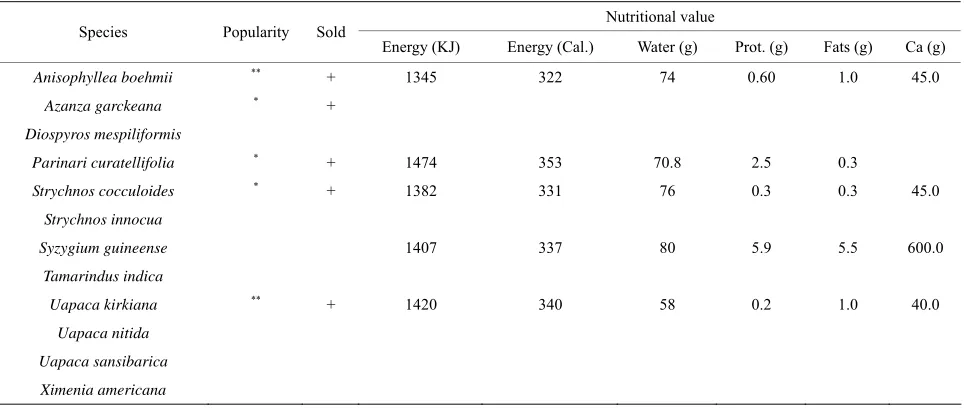
Most respondents (75%) were reluctant to reveal me-dicinal and magical uses of trees. Where names of trees were given, only the disease or condition treated was indicated with no details of how the concoction was pre-pared and how the treatment was done. Trees recorded for medicinal value are shown in Table 2.
2) Wild Fruits
Many respondents (67%, n = 120) indicated that wild fruits were important food items. Thirteen wild edible species were recorded (Table 3). All fruits were collected
Table 2. Trees of medicinal and magical values recorded in the study area, 1998-2012, Zambia.
Species Disease treated Magical value
Kigelia africana The fruit is used to enlarge male private parts
Olax obtusifolia Used as a sexual stimulant
Piliostigma thonningii Bark is used as a lucky charm
Combretum zeyheri Roots are used for treating bilharzia
Rhus longipes Charm for attracting women
Senna abbreviata Root concoction mixed with parts from other trees is used to treat venereal diseases
Diplorhynchus condylocarpon Roots and leaves are used to treat snake bites
Balanites aegyptiaca Kills bilharzia snails tail, is used as a sexual stimulant and also cures male impotence Root concoctions mixed with animal parts especially warthog
Rauvolfia caffra Used to repel visiting witches
Bauhinia petersiana Root concoctions used to treat stomach upsets
Oldfieldia dactylophylla Root concoctions used to treat venereal diseases
Dalbergia nitidula Used to treat venereal diseases and pneumonia
Ekbergia banguelensis Root concoctions are used to promote female fertility and also cures gonorrhea
Sclerocarya caffra Used to regulate sex of the child to be born as required by the couple
Table 3. Indigenous fruit trees and nutrient composition of some selected species in the study area, 1998-2011, Zambia.
Nutritional value
Species Popularity Sold
Energy (KJ) Energy (Cal.) Water (g) Prot. (g) Fats (g) Ca (g)
Anisophyllea boehmii ** + 1345 322 74 0.60 1.0 45.0
Azanza garckeana * +
Diospyros mespiliformis
Parinari curatellifolia * + 1474 353 70.8 2.5 0.3
Strychnos cocculoides * + 1382 331 76 0.3 0.3 45.0
Strychnos innocua
Syzygium guineense 1407 337 80 5.9 5.5 600.0
Tamarindus indica
Uapaca kirkiana ** + 1420 340 58 0.2 1.0 40.0
Uapaca nitida
Uapaca sansibarica
Ximenia americana
Key: En. KJ = Energy in kilojoules, En. Cal = Energy in kilocalories, Prot. = Protein; *Popular, **very popular, + sold.
Uapaca kirkiana were the most popular. Parinari
cu-ratellifolia, Anisophyllea boehmii and Uapaca kirkiana
were occasionally sold at the road side. However, half of the respondents (50%, n = 120) indicated that the ever- growing preference for exotic fruits like orange (Citrus spp), mango (Mangifera indica) and others relegates wild fruits to poor families or for using during periods of drought. Fruit trees however, were preserved in all farm plots, around homes for shade and food.
3) Household Items, Species Used and Replacement Period
Eight house hold items were recorded to have made from woody plants. There were a strong species selection for most tools and utensils. These were; mortar, pestle, cooking stick, axe handle, hoe handle, canoe making, stool and drums of various size (Table 4). The durability
[image:11.595.60.532.99.351.2] [image:11.595.58.540.378.582.2]Table 4. Household items, woody plant species used and re-placement period in years, 1998-2012, Zambia.
Name of household tool
or utensil
Tree species used period in yearsReplacement
Motar Albizia antunesiana 20
Pterocarpus angolensis 20
Terminalia spp 20
Parinari curatelifolia 20
Pestle Monotes spp 18
Burkea africana 20
Bobgunnia madagascariensis 20
Terminalia spp 18
Albizia antunesiana 15
Pericopsis angolensis 20
Cooking stick Strychnos cocculoides 5
Uapaca kirkiana 8
Ximenia Americana 5
Ozoroa reticulata 8
Pterocarpus angolensis 8
Faurea speciosa 7
Axe handle Brachystegia spiciformis 2
Dalbergia nitidula 5
Julbernardia globiflora 2
Bobgunnia madagascariensis 5
Pterocarpus angolensis 5
Hoe handle Julbernardia globiflora 2
Brachystegia spiciformis 4
Pterocarpus angolensis 4
Bobgunnia madagascariensis 4
Albizia antunesiana 5
Canoe Afzelia quanzensis 3
Stools Albizia antunesiana >20
Afzelia quanzensis >20
Brachystegia spp >20
Drums Albizia antunesiana >20
Sterculia quinqueloba >20
ceive any treatment. The species of the tree used and the treatment used were found to be the most important fac-tors determining the replacement period. This did not however, discount the extent and frequency of use which would also reduce the replacement period.
3.8. Incidences of Cut Categories
Cut categories 1 - 3 which involved cutting of the stem or branch were combined to make one category and cut categories 4 - 5 which do not involve cutting of stem or
branch formed another category. A significant difference was found between the two classes, with category 4 and 5 being the commonest. Comparison of the five catego-ries showed that stripping was the commonest form of damage Mann-Whitney U test 0.02 < P < 0.05(Figure 6).
4. DISCUSSION
4.1. Use of Woody Plants
Local communities in Mumbwa GMA utilize woody plant species in many ways to provide for their subsis-tence. The study proved that despite lower species diver-sity in miombo woodlands compared with tropical rain forests, the miombo woodland species probably provide more useful types per species than the tropical rainforest species [31]. In their study of the ethno botany in Ama-zonian Terra-Firme rain forest, found between 34 and 76 tree species which were useful in at least one way or an-other per hectare plot which was between 49% and 79% of all species present. In this study conducted in a miombo woodland, 92 (99%) of the 93 species recorded were used by local communities and many of the species had more than one human use per tree species.
Other studies on miombo woodlands in central Zambia indicate that most of the research works on vegetation and use has often over emphasized the great diversity of tropical rain forests [38]. Yet the miombo woodlands provide a great diversity of uses even if the number of species per unit area may be less than the tropical rain forest.
4.2. Differences in Plant Density between Settlement and Wildlife Zone
Of the 93 species recorded during the study, 64 were recorded in the wildlife zone and 39 in the settlement zone. The differences in species diversity are attributed to clearing for agriculture in the settlement zone. Other uses such as collection of building poles and firewood may also selectively eliminate some species which can-not tolerate the impact. Clearing for agriculture for in-stance, involves uprooting trees and subsequent suppres-sion of regeneration during cultivation. Some species however, such as Bracystegia boehmii and Diplorynchus
condylocarpon are still common in the settlement zone
probably because of the high regeneration potential and fire tolerance for the latter.
100
350
120 120
80
0 50 100 150 200 250 300 350 400
Scar Strip Pollard Lop Coppice
Cut category
Tot
a
l num
be
r of
cut
[image:13.595.125.472.86.312.2]s
Figure 6. Comparisons of cut categories; coppicing, pollarding, lopping, stripping and scarring in the study area, 1998-2012, Zambia.
chose to collect from the wildlife zone and National Park. This trend is expected to increase as settlements expand. The declining sighting frequency of some species in the settlement zone is an indication that they are being sought after for their particular characteristics. After ex-ploring different ways in which woodland resources are utilized, [8,32,33] showed that it was apparent that the increasing scarcity of miombo woodland resources in settled areas is largely a function of clearance of woody species for cultivation. This study also proves this fact.
In Mumbwa GMA, considerable tenural conflicts arise because rural household believe they have the right to use the land and the resources by virtue of proximity or historical connection to the land often leading to people extending their settlements into the wildlife zone where they access virgin land for agriculture and game meat for protein. Respondents 35 years and older especially wo- men showed great attachment to the resources of the area. Such conflicts are also experienced in other countries in the southern African sub region. In Malawi, for example, [8,32] reported encroachment by smallholders on state lands for poles, firewood, thatch, grazing and even culti- vation. The frequency of such cultivation suggests that the creation of estates has restricted small holders’ access to forest and other resources as well as access to arable land needed to meet their food requirements. In fact Na- tional Forestry Policies are directed towards limiting commercial exploitation of woodlands. The focus is on regulating woodland use and protection against wanton cutting of trees and encroachment rather than on sus- tainable utilization and management.
These limitations are extended to woodlands nontradi-
tional lands through control regimes, licensing, traffic check points, roadblocks and increased royalty collection from users of woodlands. This means that rural house- holds have no right to exploit trees growing on their land except to cut them when clearing for agriculture [8,34, 35]. There is also a tendency by foresters to consider local communities’ use of woodland for non commercial purposes a major cause of deforestation when in actual fact many human uses unless commercialized, do not have deleterious effects on regeneration of miombo woodlands. It was further documented that the dominant trend in regenerating miombo woodland in the absence of frequent hot fires or other intense disturbances is to-wards woodland [14,36]. Unless plants have been
thor-oughly uprooted during the initial disturbance, most of the subsequent development of woodland derives from re-growth of coppice from surviving stems and root-stocks. However, he also noted that marked changes in composition and very slow if any, recovery to the origi-nal state is likely in areas where Brachystegia,
Julber-nardia and other Caesalpiniodeae have been eradicated
because these trees have extremely low ability for seed dispersal and their seeds are short lived. It is not easy, however, to eradicate these species anyway. In this sur-vey, contrary to the general perception that all human uses of woody plants cause deforestation, the most de-structive was clearing for agriculture. Other human uses that were found to be destructive was the uprooting of
Rhynchosia insignis (Munkoyo roots), which are used in
The other destructive human use of woody plants which was revealed during the survey was the debarking of trees for making beehives. One of the popular species for bark bee hives is Julbernardia paniculata. Debarking kills trees but the frequency of debarking is not known. Whatever the frequency when trees die after debarking, small gaps are created in the forest, such gaps are benefi-cial to the regeneration of valuable timber species such
as Pterocarpus angolensis, so the extent to which this
practice of killing trees by debarking may be destructive or beneficial requires to be investigated [37]. What this study gathered was that honey hunting activities are ac-companied by debarking of trees for containers to carry honey, but this does not often involve debarking, al-though debarked patches are later burnt by fires making the tree hollow and reducing their value for timber [8].
Commercial charcoal production through not covered by this study can also lead to woodland depletion as de-forestation tends to be rather intensive due to wide rang-ing search for suitable species [8,38]. Human use and resource depletion has also become a factor in the pro-duction of fine hardwoods. In Tanzania use of indigenous timber was declining along with supply [39]. In Zim-babwe, the share of indigenous woods from domestic sources in overall industrial wood supply fell from 534,600 m3 to 108,500 m3 between 1975 and 1990. This
decline in the production of fine hardwoods reflected growing depletion of the stocks. In Tanzania, production in sawmills processing indigenous hardwoods dropped well below capacity in part due to depletion of wood resources in the vicinity of the mills [39].
4.3. Species and Size Class Selection for Building Poles
Poles, especially for house construction, were widely used as rafters covered in grass thatch of for walls coated with clay. More than 80% of the community in 1998 used poles with mud for walls and thatch for roofing. This number had declined to 50% in 2011. House build-ing is not done annually except for new arrivals but re-pairs and extensions especially of granaries are done annually (89%, n = 600). Larger poles were needed for centre or corner posts or where additional strength was required. If the building was for public use such as a church or mosque, the roofing poles were longer than a private dwelling house. Wall poles took fewer but thicker poles than roofing poles. This was because the wall car-ries much of the weight of the building and requirements of desirable characteristics such as durability as in resis-tance to insect attack and rotting as well as straightness were critical. Rather than collect every species in equal quantities, communities select species because of their characteristics and labour costs involved. When species of desirable characteristics are lacking, in the settlement
zone, communities will disregard the rules restricting the cutting of trees in wildlife zone and National Park which indicates lack of legitimacy of the tenure systems in the eyes of the local people.
In general, the collection of building poles was not de-structive to the woodland unless commercialized. This is because people were selective in their uses often going for durable and insect and moisture resistant species which prolong the replacement cycle after which consid-erable coppicing and regeneration would have taken place. When they return to harvest at a later time, they again select species and size classes according to human use type leaving others to grow. Additionally, each hu-man use selects different species, a tree taken for fire-wood may sometimes be different from building pole and the same goes for girth size. However, it is argued that factors other than direct collection of plants affect abun-dance [8,40]. Increased disturbance would generally de-crease diversity, yet it would inde-crease abundance of those species which thrive in disturbed environments.
Diplo-rynchus condylocarpon for instance which is fire tolerant
thrives in areas burnt annually like in the settlement zone. However, he cautioned that human uses that target sap-lings and young trees should be closely monitored be-cause these harvesting methods when combined with late fires may surprises regeneration, or for the latter, cause holes in trees and repeated fire resulting in death of the tree [41].
should be felled at 15 cm above ground and at an angle of 45˚ using a sharp axe or saw to encourage vigorous re- growth from the stump [11,41,44]. Deep ploughing on the other hand would increase the stocking rate by caus-ing root suckers to develop but only when the fallow period is long [44,45].
4.5. Firewood
Results showed that seven species were most popular species for firewood. The reason for their preference is due to their particular properties rather thjan abundance. The species chosen give good embers, hot fire, and burn easily producing little smoke. The species selection may continue for some in the future for as long as sources are nearby. However, as population increases and commer-cial charcoal production increases there would be need for intervention.
4.5.1. Areas of Intervention in the Fuel Wood Cycle
The starting point in tackling the fuel wood problem must be the multiple roles that trees perform in the envi-ronment within which people live and work. Starting by establishing people’s needs, energy planners can then go on to look at what trees would be suitable for particular areas and how long they take to grow. These decisions enable the woody biomass production system to be de-veloped and managed. By understanding and incorporat-ing the knowledge of the people, they can make available a rich tool kit for the management of the woody biomass and explore new avenues for research and development programmes led by the needs of the people.
Simply getting trees into the ground may not slow de-forestation or solve local fuel problems. Building on lo-cal traditional knowledge about uses of trees would be the most effective way of stimulating new tree growing initiatives. Where people do not generally plant trees as in the study area, management of coppicing would en-sure a steady supply. The strong traditions on coppicing recorded in this study can be used to improve harvesting. Both coppicing and pollarding can be effective methods of obtaining a sustained yield of small diameter wood from stands of trees over long period of time.
4.5.2. Fuel Wood Consumption
Regarding firewood consumption per head per year, results from other parts of the world reveal similar trends as the ones observed in the study area. For example, a survey of 518 small farm families in different parts of Nicaragua where most cooked with fuel wood, showed that consumption ranged between 1100 kg - 2865 kg per person per year. In north eastern Tanzania, in Kwemzitu village, which is near a forest reserve from which people are allowed to collect fuel wood, the annual consumption
was found to be in the range of 1636 kg - 2605 kg per head per year. The 2366 kg consumption per head per year obtained in this study is therefore in the average upper range an indication that fuel wood is not yet a lim-iting factor for households in this area.
Availability of fuel wood was a key determinant factor of how people use it [8]. In areas where it is plentiful, people may use as much as 2000 kg per head per year or more. Where scarcity has forced to switch to fuels such as straw and animal dung, fuel wood consumption may drop to zero. In villages in Lesotho and South Africa’s Transkei, where wood is scarce, the annual per capita fuel wood consumption was 288 kg and 271 kg supple-mented 271 kg and 260 kg of crop residue and dung re-spectively. But in a village in Kwazulu in South Africa where wood was abundant, consumption was 1124 kg per head per year. In areas where wood is scarcer, con-sumption is lower. Survey of six villages in Mali and Niger found people using only 440 kg - 660 kg per head per year. Similar consumption patterns were recorded in from a survey of 17 villages in Tamil Nadu, India where a range of 344 - 676 kg per head per year with an aver-age of 481 kg was recorded by [8]. In five other villaver-ages of Orissa, India, consumption ranged from 509 - 826 kg per head averaging 680 kg.
Family size also influenced per capita fuel require-ments. Larger families cooking bigger meals can be much more efficient in their use of fuel wood. In one village in Nepal, families with between 1 - 4 members used an average of 890 kg of firewood per person each year. Families with 9 members or more used less than half this amount per person, about 340 kg. Based on the above experiences it was assumed that the average fam-ily size of 9.4 (minimum = 1, maximum = 23, mean = 9.4, SE = 4.4) in the study area, which is on the larger size, it is likely that fuel wood usage would be economi-cal, but again this depends on whether firewood is com-mercialized or not [8].
4.5.3. Seasonal Use of Firewood
The second consumption of wood is dictated by wea- ther. In the study area, an average 26 kg bundle of fire- wood was consumed in three days time in cold weather and five days in warm weather. Cold weather also coin- cided with harvesting of crops and this was also the time when many traditional rituals that require beer brewing and also weeding parties are done at this time which col- lectively increases firewood consumption. For as long as these traditional rituals do not attract outside interests the fire wood demand is unlikely to outstrip supply.
4.6. Bee Honey Collection
Bee honey hunters usually debark trees usually Bra-
ing honey home. To what extent this would be damaging to woody plants needs to be examined. There are how-ever, some alternatives particularly when the community is encouraged to start bee keeping schemes. Calabashes, damaged clay pots, and bee hives made from exotic tim-ber and many others can be used, hence the frequency of debarking is likely to be low. Currently the collection method is such that when a bee colony is located, espe-cially if it is above average human height, a forked lad-der is used is made to enable the collector reach the hive or the tree is felled down. A fire is made and quite often old pieces of cloth, old tyres are burnt to lessen stinging. If the tree is not cut down a hole is made in the tree. Af-ter collecting the honey, honey hunAf-ters rarely extinguish the fire. During the August-November honey collection season, honey collectors were major causes of wild fires as reported by 20% (n = 180) respondents that honey collection caused about 80% of fire incidences. This fig-ure could not be verified as fires from fields as they be-ing cleared in readiness for cultivation were also another major source. Honey collection therefore, as a type of human use of woody plants is damaging to large trees while fires left behind may cause damage to saplings and regenerating plants.
4.7. Fibre
Results of the PRA showed that firewood collectors often re-used the old fibre by soaking it in water to soften it. The frequency with which new fibre is collected is likely to be low. Other means of fire wood transportation such as by wheelbarrow do not require tying firewood in bundles. Fibre used in construction and basket/mat mak-ing on the other hand, is treated in black clay soil to strengthen it. By doing so, its life span is increased and therefore the replacement period is often long. Although data was not collected about quantities of fibre collected, it was assumed that the overall demand for new fibre is generally low [8].
4.8. Household Items, Tools, Species Used and Replacement Period
Utensils and tools are of immense value to the rural communities’ daily lives and agricultural work; pounding food, firewood and building poles collection, all depend on locally made tools and utensils derived from wood.
In the study area, many households are made from woody plants. It was difficult in certain circumstances to take accurate girth measurements of the tree species from which the tool came from because most of them involve complete modification of the natural shape. On the whole, utensils represent low level exploitation because of the species selection and replacement cycles. Some tool making methods are however, destructive. For example,
axe handles require that the tree be uprooted to make use of the bulge at the base of the tree which has crossed grains to withstand the cutting impact, but again it is only destructive when commercialized as the replacement cycle for axe handles is approximately four years. Other items such as the motar or drums use larger trees of girth greater than 100 cm to allow for carving out a hollow, while a pestle only requires debarking and smoothening the ends, but these have a long replacement cycle of over 20 years.
4.9. Fruits
Indigenous fruits may not look as appetizing as exotics, but are often nutritious and healthier due to increasing use of insecticides and growth promoters in exotic spe- cies. Apart from yielding fruit for human consumption, they are also a source of income to small holders [46-49]. The extent to which indigenous fruit is marketed was not covered in this survey, but in other studies [48,49] it was noted that marketing depended on availability, shelf life, demand patterns and access to market, sale price and ef- fectiveness of social controls regulating the sale of these products. Quite often the availability of exotic fruits such as mango takes precedence over indigenous fruits. Low indigenous sales, as low as 1%, but high sales of up to 56% for exotic fruits have been recorded in Zimbabwe [46-49] recorded very low. Although we did not gather information on income from wild fruits in this study, income from the sale of wild fruits is expected to con- tribute significantly to women’s and children’s income. This was based on the fact that most of the trees con- served in the fields were fruit trees. These observations also agree with those obtained in Mutoko Communal Area in Zimbabwe where most of the indigenous trees conserved in home fields were edible fruit bearing spe- cies [49]. It was also noted two indigenous trees Ziziphus
mucronata and Uapaca kirkiana, both of which are edi-
ble, being planted by villagers [49].
4.10. Suggested Future Research Needs The area of sustainable use of woody plants is an area of particular interest as local communities undergo rapid social, economic and political change. The transaction of establishing and centralizing institutional mechanisms for local resource management may be high to the point where institutions such as Forestry Department and Zam- bia Wildlife Authority may only be able to maintain high value and quick return resources such as game animals. In light of the above, we suggest future research activi- ties as follows:
2) Identify simple and practicable mechanisms for strengthening local institutions and to develop method-ologies to assess the comparative value of woodland re-sources especially in relation to other land uses.
3) Examine institutional mechanisms which ensure that local communities have control over resources of their landscape in the face of possible appropriation by outside elite groups.
4) Examine how scientific/ecological recommenda-tions of using fire, coppicing and others can be feasibly be used as tools by local people to manage woodlands on traditional land.
5) Policy development that empowers local people to manage woodlands in their traditional landscape where law permits.
6) Investigates how empowerment would best be achieved, for what products and in what circumstances; so far the Community Based Natural Resources Man-agement programmes may not be wholly applied to woodland products because of their low value compared to game animals; devolution per se is no panacea to sus-tainable use but it may be crucial first step, which needs to be investigated in detail by future research.
7) As for the ability for the woodland to coppice after human use, it is at the moment not clear whether the ability to produce coppice shoots and stump survival rate is correlated with girth size or age; it is important that future research activities thoroughly address this ques-tion.
8) The other topic of importance is that while attrac-tive in theory, indigenous forest management faces seri-ous technical challenges; little is known about feasible rotation patterns and how best to incorporate controlled grazing and wood cutting into indigenous forest man-agement.
9) Develop a simple monitoring system for assessing human related threats to the ecology of the area.
10) Develop a mechanism for relating the extent of such threats to human related factors of society, popula-tion pressure, socio-economic standing, source of liveli-hood, contemporary and traditional law enforcement structures and mechanisms, incentives, environmental awareness and politics.
11) Develop a mechanism for using such information for planning and management as they relate to develop-ing the potential of sustainable use of renewable woody plant resources.
12) In this survey, we excluded woody plants of dbh of less than 10 cm; this was a weakness as has been the case with other similar vegetation studies, as this implies ex-cluding plants in the pre-sapling phase, which probably form a large reservoir for future trees; future research should consider saplings and that shoot growth among suppressed saplings is low while these plants accumulate
a relatively large below ground biomass constituting perennating tissue that regenerates new shoots following repeated shoot die back in the dry season.
5. ACKNOWLEDGEMENTS
Field assistants L. Mboote, L. Musa (late), P. Shamalundu, C. Mali-sawa, R. Chisangu, W. Sakala and M. Cheleka conducted vegetation surveys and identified tree species encountered and also assisted in the translation of names from vernacular to botanical names particularly for species used in tool making and implements. Enumerators; Jane Shim-wense, Veronica Muyanda, Wambulwawaye Mubita and Joyce Mwenda Namukombo were excellent in questionnaire surveys. We highly ap-preciate the field skills which made this project a success.
REFERENCES
[1] Campbell, B., Frost, P. and Byron, N. (1996) Miombo woodlands and their use: Overview and key issues. In: Campbell, B.N., Ed., The Miombo in Transition: Wood-lands and Welfare in Africa, Centre for International For-
estry Research, Bogor, 1-5.
[2] Campbell, B. and Byron, N. (1996) Miombo woodlands and rural livelihoods: Overview and key issues. In: Campbell, B.N., Ed., The Miombo in Transition: Wood-lands and Welfare in Africa, Centre for International
For-estry Research, Bogor, 221-263.
[3] Clarke, J., Cavendish, W. and Coote, C. (1996) Rural households and miombo woodlands, use value and man-agement. In: Campbell, B.N., Ed., The Miombo in Transi-tion: Woodlands and Welfare in Africa, Centre for
Inter-national Forestry Research, Bogor, 101-135.
[4] Bradley, P.N. and Dewees, P.A. (1993) Indigenous wood- lands, agricultural production and household economy in communal areas. In: Bradley, P.N. and McNamara, Eds.,
Living with Trees: Policies for Forestry Management in Zimbabwe, World Bank Technical Paper 210, World Bank,
Washington, 63-157.
[5] Fischer, F.U. (1993) Bee-keeping in the subsistence economy of the miombo savannah woodlands of south central Africa. Rural Development Forestry Network Pa-per, Overseas Development Institute, London, 1-2. [6] Birchenoughl, L. (1993) The impact of natural resource
utlisation on miombo woodland in Zambia. Unpublished MSc. Thesis University College of London, 1-96. [7] Hosier, R.H. (1993) Charcoal production and
environ-mental degradation. Energy Policy, 21, 491-505.
http://dx.doi.org/10.1016/0301-4215(93)90037-G [8] Chansa, W. (2000) Utilisation of woody plant species by
local communities in Mumbwa Game Management Areas, Zambia. Unpublished MSc. Thesis, University of Zim-babwe, Harare, 1-99.
[9] Nahonyo, C.L., Mwasumbi, I. and Bayona, D.G. (1998) Survey of the vegetation communities and distribution of woody plant species in Mbomipa Project area. Report No. 1 MCRI Iringa, 1-81.