IJPSR (2016), Vol. 7, Issue 8 (Research Article)
Received on 04 April, 2016; received in revised form, 02 July, 2016; accepted, 08 July, 2016; published 01 August, 2016
COMPARATIVE EVALUATION OF HEPATOPROTECTIVE EFFECTS OF EXOTIC FRUITS AND COMMON VEGETABLES EXTRACTS ON CCL4 INDUCED HEPATOTOXICITY: AN IN VITRO STUDY
Kavitha Raj V. 1, J. R. Kumar *1, S. Balasubramanian 1, S. Najunda Swamy 3, D. Keerthini 4, N.
Shambhavi 4, B. M. Kanthesh 2 and K. O. Avinash 1
Division of Biochemistry 1, Division of Molecular Biology 2, Faculty of Life Science, JSS University,
Mysuru- 570015 Karnataka India.
Department of Biotechnology 3, Sri Jayachamarajendra College of Engineering, Mysuru - 570006
Karnataka India.
Department of Biochemistry 4, JSS College of Arts, Commerce and Science, Mysuru-570025 Karnataka
India.
ABSTRACT: Liver toxicity faces a major challenge in world health issues. Many drugs are being withdrawn from the market by Food and Drug Administration (FDA) for causing drug induced hepatotoxicity. In the present study, ameliorative activity of methanoic extracts of different parts (Peel, Pulp and seed) of exotic fruits and vegetables on
carbon tetrachloride (CCl4)-induced hepatotoxicity were studied in in
vitro condition. Chicken liver cell suspension treated with CCl4 was
used for lipid peroxidation (LPO), free radical scavenging and sodium dismutase (SOD) assay. Extracts from different parts of exotic fruits and common vegetables showed potent antioxidant effect. In the present study even, methanoic extract of some unused parts (peel & seed) of vegetables and fruits showed hepatoprotective action, but among all these bottle gourd pulp (vegetable) and passion fruit pulp (exotic fruit) showed the noteworthy hepatoprotective action. Thus it is concluded that, the methanoic extracts of exotic fruits and
vegetables was observed to have notable protective activity on CCl4
induced hepatotoxicity.
INTRODUCTION: The liver is the body’s largest
glandular and principle organ for maintaining the body’s intramural environment. The liver supports almost every organ in the body in some facet and is vital for survival.
QUICK RESPONSE CODE
DOI:
10.13040/IJPSR.0975-8232.7(8).3388-93
Article can be accessed online on:
www.ijpsr.com
DOI link: http://dx.doi.org/10.13040/IJPSR.0975-8232.7 (8).3388-93
Some of these major functions include protein, carbohydrate and fat metabolism, detoxification, secretion of bile and storage of vitamin. It performs multiple critical functions to keep the body pure by filtering toxins and many drugs from the blood; transforms and excretes. Thus, to maintain a healthy liver is a crucial factor for the overall
health and well being of human1.
Even though liver has tremendous regeneration capacity, the liver injury morbidity has been increasing vigorously. Among all the causes for
Keywords:
Hepatotoxicity, CCl4 ,
Hepatoprotection, Antioxidant
Correspondence to Author: Dr. J. R. Kumar
Assistant Professor Division of Biochemistry Faculty of Life Sciences, JSS University, JSS Medical Institutions Campus, Sri Shivarathreeshwara Nagara, Mysuru, Karnataka 570015, India
hepatotoxicity, drug induced liver injury is prominent. It has an estimated annual incidence between 10 and 15 per 10,000 to 100,000 persons
exposed to prescription medications 2 and
Drug-induced acute liver failure (ALF) accounts for approximately 20% of ALF in children and a
higher percentage of ALF in adults 3. Hence
hepatotoxicity is nowadays one of the most important pharmacovigilance concerns and the leading cause for drug withdrawal on safety
grounds 4.
Chemical toxins (including acetaminophen, carbon tetrachloride, galactosamine and thioacetamide are often used as the model substances causing experimental hepatocyte injury in both in vivo and
in vitro conditions 5-8. Most of the hepatotoxic
chemicals cause damage to the hepatocytes by
inducing lipid peroxidation 9. Liver cirrhosis
induced by CCl4 is perhaps the best-studied model
of liver cirrhosis 10. CCl4 was the first toxin for
which it was shown that the injury produced is largely or entirely mediated by a free-radical
mechanism. It is believed that CCl4 is metabolized
by the cytochrome P450 system to give the trichloromethyl radical, a carbon-centred radical. Covalent binding of trichloromethyl free radicals to cell proteins is considered to be the initial step in a chain of events that eventually lead to membrane lipid peroxidation (LPO) and finally to cell
apoptosis and necrosis 11-13.
High levels of reactive oxygen species (ROS) damage cells and are involved in several human pathologies, including liver cirrhosis and fibrosis. Among the degradation products of fatty acids are reactive aldehydes, malondialdehyde (MDA), and 4-hydroxynonenal, which bind easily to functional groups of proteins and inhibit important enzyme activities. Disturbed cellular processes are most likely due to increased levels of these thiobarbituric
acid reactive species (TBARS) 14, lactate
dehydrogenase (LDH) leakage as a result of membrane breakdown and concomitant increase in
membrane permeability 15, loss of cell protection,
witnessed by GSH depletion and as a result of all these changes - cell death. The second phase of
CCl4 - induced hepatotoxicity involves the
activation of Kupffer cells, which is accompanied
by the production of proinflammatory mediators 16.
Hence, CCl4 – induced hepatotoxicity serves as an
excellent model to study the molecular, cellular and
morphological changes in the liver 17.
Hence extracts with high free radical scavenging activity/antioxidants may show hepatoprotection. Antioxidants also turn free radicals into waste byproducts, and they eventually get eliminated from the body. They also have the ability to repair previous damage to cells. However, consumption of fruits and vegetables is known to lower the risk of several diseases, and such health benefits are mainly imposed due to the presence of phytochemicals, such as polyphenols, carotenoids and Vitamin E and C.
There are approximately 5000 known plant phenolics and model studies have demonstrated
that many of them have antioxidant activity18.
Ayurveda, Siddha, Unani etc., are practiced in India and these practices take totally rely on the plant source. As a natural way, consumption of fruits and vegetables has showed therapeutic values in these traditional medicines. Majority of edible plants and its parts such as fruits, seeds, leaves and roots are also observed to have medicinal value substances, such as antioxidants, flavonoids,
tannins and other phenolics compounds19.
Therefore in the present study we have tried extracts different parts of exotic fruits and common vegetables on hepatoprotectivity.
MATERIALS AND METHODS: Chemicals:
Analytical grade Carbon Tetrachloride (CCl4) was
procured from Hi-Media Laboratory Pvt Ltd,
Bengaluru. Methanol was purchased from
Chethana chemicals, Mysore. All other chemicals used in the present study were of analytical grade.
Liver sample:
Fresh liver sample of healthy adult chicken weighing approximately 1.2-1.5 kg obtained from local slaughter house was brought to laboratory under frozen condition and used immediately.
Liver cell suspension:
Liver cell suspension was prepared by continuous
Assay for Lipid Peroxidation:
Lipid peroxidation was estimated colorimetrically
by measuring malondialdehyde (MDA) 21, 22. In
brief, 0.5 ml of homogenate treated with 0.5 ml
carbon tetrachloride and 100µg/ml of
fruit/vegetable extract along with 2 ml of a 1:1:1 ratio of TBA-TCA-HCl (TBA 0.6%, TCA 15%, HCl 0.25 N) reagent added and placed in water bath at 65°C for 15 min, cooled, and centrifuged at 5,000 rpm for 10 min at room temperature. The optical density of the clear supernatant was measured at 535 nm. Controls were prepared similarly without CCL4 for each extract. The MDA formed was calculated by using the molar extinction coefficient of thiobarbituric acid
reactants (TBARS; 1.56 x 10⁵ l/mole cm−1). The
product of LPO was expressed as nmol of MDA formed per g of tissue.
Free Radical Scavenging Assay:
Free radical scavenging activity was measured by a decrease in absorbance at 517 nm of a solution of coloured 2, 2-Diphenyl-1-Picrylhydrazyl (DPPH) in methanol brought about by the sample. To the 1ml methanolic solution of DPPH, 0.5 ml of
homogenate treated with 0.5 ml carbon
tetrachloride and 100µg/ml of fruit/vegetable extract was added. The reaction mixture was allowed to incubate for 30 min at room temperature in the dark and the absorbance of the resulting mixture was measured at 517 nm against ascorbic
acid as standard 23. Controls were prepared
similarly without CCL4 for each extract. The scavenging activity was calculated as follows:
% Radical Scavenging
Activity = [Abs control – Abs sample / Abs control x 100]
Superoxide Dismutase (SOD) assay:
The assay of SOD is based on the inhibition of the formation of NBT- diformazan which is measured
at 560nm. Cuvets containing 1.17X1O-6M
riboflavin, 0.01 M methionine, 2X10⁻⁵M sodium
cyanide, 5.6 X 1O-5M NBT, and 0.05 M potassium
phosphate at pH 7.8 were illuminated and the
absorbance was read at 560nm 24. Controls were
prepared similarly without CCL4 for each extract.
The % inhibition was calculated by
% inhibition = [Abs control – Abs sample / Abs control x 100]
Fruit and vegetable extract preparation:
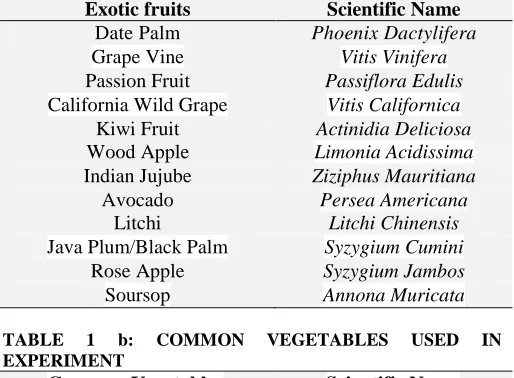
Fresh exotic fruit (Table 1a) and vegetables (Table
1b) were purchased from hopcoms and were
washed under running tap water and their peel, pulp and the seeds were separated. They were shade dried separately for over a month. The dried fruit parts were ground using a mechanical grinder. Each of the samples was approximately weighed and subjected to extraction by cold maceration with 80% methanol at room temperature. The macerate was allowed to soak in 80% methanol for 72 hours
25
. The samples were filtered after 72 hours using regular filter paper. The methanolic extracts thus
obtained was collected in the vials and stored at 4o
C.
TABLE 1a: EXOTIC FRUITS USED IN EXPERIMENT
TABLE 1 b: COMMON VEGETABLES USED IN EXPERIMENT
RESULTS AND DISCUSSION: Liver is the very important part of our body responsible for the maximum metabolic and secretary activities and therefore appears to be a sensitive target site for substances modulating biotransformation. Liver is also associated in detoxification from the
Exotic fruits Scientific Name
Date Palm Phoenix Dactylifera
Grape Vine Vitis Vinifera
Passion Fruit Passiflora Edulis
California Wild Grape Vitis Californica
Kiwi Fruit Actinidia Deliciosa
Wood Apple Limonia Acidissima
Indian Jujube Ziziphus Mauritiana
Avocado Persea Americana
Litchi Litchi Chinensis
Java Plum/Black Palm Syzygium Cumini
Rose Apple Syzygium Jambos
Soursop Annona Muricata
Common Vegetables Scientific Name
Eggplant Solanum melongena
Bitter Gourd Momordica charantia
Ivy Gourd Coccinia grandis
Tomato Solanum lycopersicum
Green chilli Capsicum frutescens
Ladies finger Abelmoschus esculentus
Cucumber Cucumis sativus
Bottle Gourd Lagenaria siceraria
Bell peppers Capsicum annuum
[image:3.612.313.570.328.517.2]exogenous and endogenous challenges like xenobiotics, drugs, viral infections and chronic
alcoholism. CCl4 has been extensively used to
study liver injury induced by ROS in the animal
models, which is closely analogous to
hepatotoxicity in humans. The toxic effects of CCl4
are the consequences of production of free radicals. Unless neutralized by radical scavengers, these peroxyl radicals in turn abstract hydrogen atoms from other lipid molecules, thereby propagating the
process of LPO 26.
The present study was planned to evaluate toxic effects of carbon tetrachloride by a biochemical parameter indicative of oxidative stress and its
amelioration by different fruits and vegetables in in
vitro.
All the plant samples with different parts of fruit and vegetable extracts showed considerable values. The peel extract of litchi fruit and california grapes was found to inhibit lipid peroxidation very effectively compared to the peel extracts of other fruits. Black plum and passion fruit showed less
effectiveness (Fig.1a). Among vegetables peel
extracts of Brinjal and Cucumber was found to inhibit peroxidation very effectively compared to the peel extracts of others but ladies finger had
least effect (Fig.1b). Apart from peel extract, the
pulp extracts also showed LPO inhibition.
Among all the pulps of vegetables, Tomato and Bottle gourd pulps were found to inhibit LPO more effectively compared to other vegetable pulp
extracts (Fig.1c) and in fruit extracts, passion fruit
and soursop were found to inhibit lipid
peroxidation more effectively (Fig.1d). The fruit
and vegetable seeds were found to exhibit some of the beneficial effects in controlling hepatotoxicity by inhibiting lipid peroxidation. Avocado and rose
apple among fruits (Fig.1e); Capsicum and bottle
gourd among vegetables (Fig.1f) showed efficient
inhibition of lipid peroxidation compared with the others.
The free radical scavenging capacity of the fruit and vegetable extracts was determined using a stable free radical DPPH. In the present investigation, snakegourd seed, bottle gaurd pulp and brinjal peel showed high free radical
scavenging activity among all the other vegetables; in fruits, litchi peel, passion fruit pulp and rose apple seed showed free radical activity against ascorbic acid as positive standard.
It is well documented that the many life forms have enzymatic and non-enzymatic antioxidant systems, which possess the ability to protect the body from damage caused by free radicals as self defensive mechanism and Superoxide dismutase is one among them. Superoxide dismutase is an antioxidant enzyme which metabolizes toxic oxidative intermediates. SOD catalyzes the conversion of superoxide radicals to hydrogen peroxide. So, the accumulation of peroxide or products of its decomposition may also be aided by
a decrease in SOD activity 27. In the present study
passion fruit pulp among fruits and bottle gourd pulp among vegetables showed high SOD activity.
FIG.1a: LPO ASSAY OF FRUIT PEEL
FIG.1c: LPO ASSAY OF VAGETABLE PULP EXTRACT
FIG.1d: LPO ASSAY OF FRUIT SEED EXTRACT
FIG.1e: ASSAY OF FRUIT SEED EXTRACT
FIG.1f: ASSAY OF VAGETABLE SEED EXTRACT
FIG.2a: DPPH ASSAY OF VAGETABLES
FIG.2b: DPPH ASSAY OF FRUITS
FIG.3a: SOD ASSAY OF VAGETABLES
CONCLUSION: This paper reports the use of whole plant (peel, pulp, seed) extracts of commonly used vegetables and exotic fruits on hepatoprotection. It showed all the extracts with potent action on hepatotoxicity. This it is concluded from the above results that even the unused parts of the exotic fruits and common vegetables methanoic extracts showed a significant anti-hepatotoxic effect on CCl4 induced liver toxicity in Invitro condition.
CONFLICT OF INTEREST: The authors have no conflict of interest.
ACKNOWLEDGMENT: The authors are grateful to Division of biochemistry, Faculty of life science,
JSS University, Mysuru for their honest
cooperation.
REFERENCES:
1. Subramonium A, Pushpangadan P. Development of Phytomedicines for liver diseases. Indian J Pharmacology 1999; 31: 166- 175.
2. Sgro C, Clinard F, Ouazir K, et al. Incidence of drug-induced hepatic injuries: a French population-based study. Hepatology 2002, 36:451.
3. Michael D. Leise, John J. Poterucha, Jayant A. Talwalkar. Drug-Induced Liver Injury. Mayo Clinic Proceedings. 2014. 89 (1): 95– 106
4. Irina Cazacu, Cristina Mogosan, And Felicia Loghin. Safety issues of current analgesics: an update. Clujul Medical. 2015. 88(2): 128–136
5. El-Sayed Mohamed El-Sayed, Eldesoqy Eldesoqy Fouda, Ahmed Mohamed Mansour, Ayman Helmy Elazab. Protective Effect of Lycopene against Carbon Tetrachloride-Induced Hepatic Damage in Rats. International Journal of Pharma Sciences, 2015, Vol. 5, No. 1: 875-881
6. Kim Y, You Y, Yoon HG et al. Hepatoprotective effects of fermented Curcuma longa L. on carbon tetrachloride induced oxidative stress in rats. Food Chem. 2014.151:148-153.
7. Remien CH, Sussman NL and Adler FR. Mathematical modeling of chronic acetaminophen metabolism and liver injury. Math Med Biol. 2014, 31(3):302-317
8. Rousar T, Kucera O, Krivakova P, Lotkova H, Kandar R, Muzakova V, et al. Evaluation of oxidative status in acetaminophen treated rat hepatocytes in culture. Physiol; Res 2009; 58:239-46.
9. Piñeiro-Carrero VM, Piñeiro EO. Liver. Pediatrics 2004 ; 113(4 Suppl):1097-106
10. Cornelius CE: Animal Models in Liver Research. San Diego: Academic Press, 1993; 37:341
11. Recknagel RO, Glende EA, Dolak JA, Waller RL. Mechanisms of carbon tetrachloride toxicity. Pharmacology & Therapeutics, 1989; 43(1):139–154.
12. Williams AT, Burk RF. Carbon tetrachloride hepatotoxicity: an example of free radical-mediated injury. Semin Liver Dis, 1990; 10:279–284.
13. Edwards MJ, Keller BJ, Kauffman FC, Thurman RG. The involvement of Kupffer cells in carbon tetrachloride toxicity. Toxicology and Applied Pharmacology, 1993; 119:275–279. 14. M. Bhadauria, S. K. Nirala, and S. Shukla. Propolis protects CYP
2E1 enzymatic activity and oxidative stress induced by carbon tetrachloride. Molecular and Cellular Biochemistry, 2007. vol.302, no. 1-2, pp. 215–224.
15. S. Sahreen, M. R. Khan, and R. A. Khan. Hepatoprotective effects of methanol extract of Carissa opaca leaves on CCl4- induced damage in rat,” BMC Complementary and Alternative Medicine. 2011, vol. 11, article 48.
16. Planaguma A, Claria J, Miquel R, et al, The selective cyclooxygenase-2 inhibitor SC-236 reduces liver fibrosis by mechanisms involving non-parenchymal cell apoptosis and PPARY activation. Faderation of American Societies of Experimental Biology Journal. Jul; 2005, 19(9):1120–1122 17. Diplock AT, Charleux JL, Crozier-Willi G, Kok FJ, Rice-Evans
C, Roberfroid M, Stahl W, Vina-Ribes J. Functional food science and defence against reactive oxidative species. British Journal of Nutrition, 1998, 80 (1 Suppl); (1): S77–S112.
18. Robards K, Prenzler PD, Tucker G, Swatsitang P and Glover W. Phenolic compounds and their role in oxidative processes in fruits. 1999. Food Chem. 66: 401.
19. Maximas H. Rose H.R , Sudha P.N, Vinayagam A and Sudhakar K. A Review on Hepatoprotective Activity of Commonly Consumed Vegetables. Der Pharmacia Lettre, 2013, 5 (5):290-304 20. Matthias Muller,Margot Schreiber, Jurgen Kartenbeck, and Gerhard Schreiber. Preparation of Single-Cell Suspensions from Normal Liver, Regenerating Liver, and Morris Hepatomas 9121 and 5123tc'. Cancer Research, 1972, 32, 2568-2576.
21. Veena Sharma , Manu Singh. Attenuation of N-nitrosodimethylamine induced hepatotoxicity by Operculina turpethum in Swiss Albino mice. Iranian Journal of Basic Medical Sciences. 2014. 17:73-80
22. Veena Sharma and Manu Singh. Antinephrotoxic efficacy of Operculina turpethum and its isolated Stigma-5, 22 dien-3-O-b-D-glucopyranoside against N -Nitrosodimethylamine induced renal carcinogenesis in male mice. International Journal of Phytopharmacy. 2014. 4 (2): 49-56
23. T. Mathangi and P. Prabhakaran. DPPH Free Radical Scavenging Activity of the Extracts of the Aquatic Fern Marsilea quadrifolia Linn. International journal of current microbiology nad applied sciences. 2013. 2(10): 534-536
24. Beauchamp C, Fridovich I. Superoxide dismutase: improved assays and an assay applicable to acrylamide gels. Anal. Biochem, 1971, (44): 276–287.
25. Newton SM, Lau C, Gurcha SS, Besra GS, Wright CW. The evaluation of forty-three plant species for in vitro antimycobacterial activities; isolation of active constituents from Psoralea corylifolia and Sanguinaria canadensis. J Ethnopharmacol. 2002; 79(1):57–67
26. Monali Patel And R. J. Verma. Eclipta Alba Ameliorates Carbon Tetrachloride-Induced Lipid Peroxidation: An In Vitro Study. International Journal of Pharma and Bio Sciences. 2013; Oct 4(4): 877 – 884
27. Khan MA, Tania M, Zhang DZ, Chen HC. Antioxidant enzymes and cancer. Chin J Cancer Res. 2010; 22:87–92.
All © 2013 are reserved by International Journal of Pharmaceutical Sciences and Research. This Journal licensed under a Creative Commons Attribution-NonCommercial-ShareAlike 3.0 Unported License.
This article can be downloaded to ANDROID OS based mobile. Scan QR Code using Code/Bar Scanner from your mobile. (Scanners are available on Google Playstore)
How to cite this article: