DESIGN AND SIMULATION OF LEAKAGE CURRENT IN SMART POWER MODULE (SPM) MOTOR DRIVE APPLICATION
SYAHFITRI BIN SAIDIN
A project report submitted in partial fulfillment of the requirement for the award of the
Degree of Master of Electrical Engineering
Faculty Of Electrical And Electronics Engineering Universiti Tun Hussein Onn Malaysia
CONTENTS
TITLE i
DECLARATION ii
DEDICATION iii
ACKNOWLEDGEMENT iv
ABSTRACT v
CONTENTS vi
LIST OF FIGURES x
LIST OF TABLES xiv
LIST OF SYMBOL AND ABBREAVIATION xv
LIST OF APPENDIXES xvi
CHAPTER 1 INTRODUCTION
1.1 General Background of Electric Motor 1
1.2 Universal Motor 3
1.2.1 Properties of Universal Motor 4
1.2.2 Applications of Universal Motor 6
1.3 DC Motor 7
1.3.1 Brush DC Motor 8
1.3.2 Brushless DC Motor 9
1.3.3 Permanent Magnet Stators 9
1.4 Smart Power Module (SPM) 10
vii
1.6 Objectives and Scopes
1.6.1 Objective 13
1.6.2 Scope of Work 14
1.6.3 Thesis Overview 14
CHAPTER 2 LITERATURE REVIEW
2.1 Introduction 16
2.2 What Is Leakage Current? 16
2.2.1 Why Is It Important? 17
2.2.2 What Causes Leakage Current? 17
2.2.3 What Is A Safe Level 18
2.3 Direct Current Motor (Dc Motor) 19
2.3.1 Principle Of Dc Motor 19
2.3.2 Detailed Description Of A Dc Motor 21 2.3.3 Working Or Operating Principle Of Dc Motor 23
2.3.4 Construction Of Dc Motor 28
2.3.5 Permanent Magnet Stators 29
2.3.6 Electrical Connections Between The Stator And Rotor 30 2.4 Electricity Consumption By Electrical Motor Systems 31
2.5 Motor Efficiency 33
2.6 Brushless DC Motors (BLDC) 35
2.6.1 Brushless Vs. Brushed Motors 36
2.6.2 Controller Implementations 38
2.6.3 Variations In Construction 38
2.6.4 Applications Of BLDC 39
2.7 Improving Energy Efficiency And Reliability In Motor Control
Applications 43
2.8 Electric Motor Efficiency 45
2.8.1 Fairchild Product Solutions For Motor Control
Applications 46
2.9 FSBF10CH60B Smart Power Module 47
2.9.1 General Description 47
2.9.2 Features 47
2.9.3 Applications 48
2.9.4 Physical Structure of SPM 48
2.10 Insulated Gate Bipolar Transistor (IGBT) and MOSFET 51
2.11 Fairchild Motion Control Design Tool 53
CHAPTER 3 METHODOLOGY
3.1 Fairchild Motion Control Design Tool 54
3.1.1 Input-Output Description 54
3.1.2 Simulation on 3-Phase PWM Inverter Loss & Temperature
Analysis for SPM2 57
3.2 Fairchild Power Train Discrete - Device Power Loss and Analysis 57 3.2.1 Power Factor Correction; AC Input 58 3.2.2 Offline & Isolated DC-DC; AC Input 58
3.2.3 Non-Isolated DC-DC; DC Input 58
3.2.4 Simulation on MOSFET FDS8884 59
3.3 Switching Loss Calculation Design Tool 59
3.4 Project Methodology 60
3.5 Project Flow Chart 61
CHAPTER 4 DATA ANALYSIS AND RESULTS
4.1 Simulation on 3-Phase PWM Inverter Loss & Temperature
Analysis 62
4.1.1 Input Parameter That Being Used In This Project 62
4.1.2 Simulation Result Of SPM2 63
4.2 Simulation On MOSFET FDS8884 71
4.2.1 Input Parameter That Being Use In This Project 71 4.2.2 Simulation Result For MOSFET FDS8884 72
ix
CHAPTER 5 DISCUSSION AND ANALYSIS
5.1 Introduction 76
5.2 Program Output From Simulation Of SPM 77
5.2.1 Summary Table 77
5.2.2 Data Used In The Simulation 78
5.2.3 Junction Temperature Versus Time 78
5.2.4 Distribution Of Losses 79
5.2.5 IGBT And MOSFET Temperature Rise Versus RMS
Phase Current 80
5.2.6 Total Module Loss And Maximum Allowable Case
Temperature Versus RMS Phase Current 81 5.2.7 Total Module Loss And Maximum Allowable Case
Temperature Versus Switching Frequency 81 5.2.8 Thermal Resistance Limited By Tj And Thermal
Resistance Limited By Ts Versus RMS Phase Current 82 5.2.9 Modulation Signal And Current Versus Time 83
5.3 Electric Motor Efficiency 83
5.4 Smart Power Module 85
5.5 Conclusion 86
LIST OF FIGURES
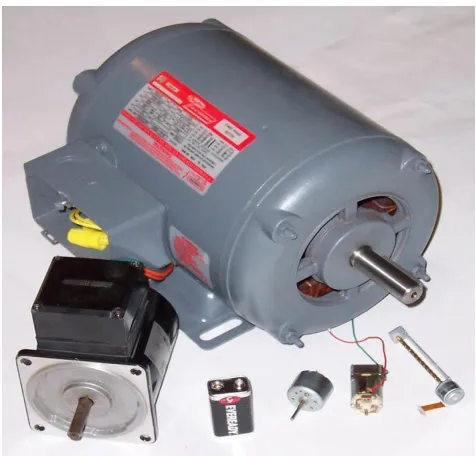
1.1 Various Electric Motors, Compared To 9 V Battery 3
1.2 Universal Motor Of A Vacuum Cleaner 7
1.3 A Brushed DC Electric Motor 10
1.4 Smart Power Module 12
1.5 Flow Diagram 13
2.1 Fleming Left Hand Rule 20
2.2 Principles Of DC Motor 20
2.3 Electric Current Flow In DC Motor 21
2.4 Basic Construction Of A DC Motor 23
2.5 Fleming Left Hand Rule 24
2.6 Principle Of DC Motor 24
2.7 Basic Principle Of DC Motor 26
2.8 Torque Of DC Motor 27
2.9 Basic Principle Of DC Motor 27
2.10 Construction Of DC Motor 28
2.11 Motor From A 3.5" Floppy Disk Drive 36
2.12 Category And Trend Of Motor Technology 42
2.13 EMDS Energy Consumption By Sector 44
2.14 Energy Efficient Motor Strategy 45
2.15 Fairchild Motor Control 46
2.16 Top And Bottom View Of SPM 48
2.17 Pin Configuration Of SPM 49
2.18 Pin Descriptions Of SPM 49
2.19 Typical VCE(SAT) (Collector-To-Emitter Voltage)
xi
2.20 Typical Turn-Off Switching Power Loss (At Tj=25°C, 125°C)
Comparison Of IGBT 51
2.21 Output Characteristics Of A MOSFET BUZ 312 (1000 V) 52 2.22 Output Characteristics Of An IGBT BUP 314 (1000 V) 52
2.23 Fairchild Motion SPM Tool 53
2.24 Example For Input Parameter 53
3.1 Input Parameter For Simulation SPM2 57
3.2 Input Parameter For Simulation MOSFET 59
3.3 Efficiency Summary From Simulation Of MOSFET 60
3.4 Flow Chart Of This Project 61
4.1 Characteristic For SPM2 63
4.2 Input Parameter For Simulation Of SPM2 63
4.3 Output Value From Simulation Of SPM2 64
4.4 Output Value From Simulation Of SPM2 64
4.5 High-Side IGBT Or MOSFET Losses And Junction
Temperature Versus Time For Full Load Conditions Specified Above. MOSFET Losses Include Body Diode Losses For
MOSFET Based Modules 65
4.6 Low-Side IGBT Or MOSFET Losses And Junction
Temperature Versus Time For Full Load Conditions Specified Above. MOSFET Losses Include Body Diode Conduction Losses
For MOSFET Based Module 65
4.7 High-Side Diode Losses And Junction Temperature Versus
Time For Full Load Conditions Specified Above 66
4.8 Low-Side Diode Losses And Junction Temperature Versus
Time For Full Load Conditions Specified Above 66
4.9 High-Side Conduction And Switching Losses Per IGBT,
Diode Or MOSFET Die Versus RMS Motor Phase Current 67 4.10 Low-Side Conduction And Switching Losses Per IGBT,
Diode Or MOSFET Die Versus RMS Motor Phase Current 67 4.11 Average IGBT Or MOSFET And Diode Junction Temperature
Rise Versus RMS Motor Phase Current. Diode Tj Will Equal
4.12 Average IGBT Or MOSFET And Diode Junction Temperature Versus RMS Motor Phase Current. Diode Tj Will Equal
MOSFET Tj For MOSFET Based Modules 68
4.13 Total Module Loss And Maximum Allowable Module Case
Temperature Versus RMS Motor Phase Current 69
4.14 Total Module Loss And Maximum Allowable Module Case
Temperature Versus Module Switching Frequency 69 4.15 Maximum Allowable Heatsink Thermal Resistance RTH(S-A)
To Maintain The MOSFET Or IGBT And Copacked Diode At The Tj_Max Value (Green Trace) Or To Limit The Heatsink To
The Maximum Heatsink Temperature Entered Above (Blue Trace) 70 4.16 Modulation Signal (Green Trace) And High-Side IGBT/MOSFET
Or Low-Side Diode Current (Blue Trace) Vs. Time 70 4.17 Input Parameter For Simulation MOSFET FDS8884 71 4.18 Schematic Diagram For Simulation MOSFET FDS8884 72
4.19 Output Waveform 72
4.20 Input Waveform 73
4.21 Switching Waveform 73
4.22 Efficiency Of MOSFET FDS8884 74
4.23 Power Loss Of MOSFET FDS8884 74
4.24 Efficiency Summary Table 75
4.25 Efficiency Chart 75
5.1 Input Parameter For Simulation Of SPM2 77
5.2 Output Value From Simulation SPM2 77
5.3 High-Side IGBT and Low-Side IGBT 79
5.4 High-Side Diode Losses And Low-Side Diode Losses 79
5.5 Distribution Of Losses 80
5.6 Characteristic Of IGBT And MOSFET 80
5.7 Total Module Loss 81
5.8 Total Module Loss 82
5.9 Maximum Allowable Heat Sink 82
5.10 Modulation Signal 83
xiii
5.12 Efficiency Of SPM 85
LIST OF TABLES
2.1 IEC 950 Safety Standards 18
2.2 IEC601-1, UL2601-1 Safety Standards 19
2.3 Comparison of Motor Trend Technology 43
2.4 Collector-Emitter Saturation Voltage & IGBT Turn-On/Off
xv
LIST OF SYMBOLS AND ABBREAVIATIONS
DC Direct Current
AC Alternating Current
SPM Smart Power Module
RPM Rounds Per Minute
EMI Electromagnetic Interference EMF Electromagnetic Field
PM Permanent Magnet
IGBT Insulated Gate Bipolar Transistor RMS Root Mean Square
BLDC Brushless Dc Motors PWM Pulse-Width Modulation VCE Collector-To-Emitter Voltage
N.C Normal Condition
S.F.C Single Fault Condition FDT Fairchild Design Tools
IEC International Electrotechnical Commission EMDS Electric Motor Drive Systems
HVAC Heating And Air Conditioning HVIC High-Voltage Integrated Circuit
PT Punch Through
NPT Non Punch Through BJT Bipolar Junction Transistor
LIST OF APPENDIXES
APPENDIX TITLE PAGE
A A Novel IGBT Inverter Module for Low-
Power Drive Applications 88
B FSBF10CH60BT Smart Power Module 96
C SIEMENS – IGBT (Insulated Gate Bipolar
Transistor) 105
D Leakage Current – Part 1 112
E A New Smart Power Module for Low Power
Motor Drives 115
F New Smart Power Modules for Very Low-
Power Drive Applications 118
G Motion Control Design Tool User Guide 121 H Improving Energy Efficiency and Reliability
CHAPTER I
INTRODUCTION
1.1 General Background of Electric Motor
An electric motor is an electric machine that converts electrical energy into mechanical energy. In normal motoring mode, most electric motors operate through the interaction between an electric motor's magnetic field and winding currents to generate force within the motor. In certain applications, such as in the transportation industry with traction motors, electric motors can operate in both motoring and generating or braking modes to also produce electrical energy from mechanical energy [1].
megawatts. Electric motors may be classified by electric power source type, internal construction, application, type of motion output, and so on [1]. Devices such as magnetic solenoids and loudspeakers that convert electricity into motion but do not generate usable mechanical power are respectively referred to as actuators and transducers. Electric motors are used to produce linear force or torque (rotary).
Perhaps the first electric motors were simple electrostatic devices created by the Scottish monk Andrew Gordon in the 1740s [3]. The theoretical principle behind production of mechanical force by the interactions of an electric current and a magnetic field, Ampère's force law, was discovered later by André-Marie Ampère in 1820. The conversion of electrical energy into mechanical energy by electromagnetic means was demonstrated by the British scientist Michael Faraday in 1821. A free-hanging wire was dipped into a pool of mercury, on which a permanent magnet (PM) was placed. When a current was passed through the wire, the wire rotated around the magnet, showing that the current gave rise to a close circular magnetic field around the wire [4]. This motor is often demonstrated in physics experiments, brine substituting for toxic mercury. Though Barlow's wheel was an early refinement to this Faraday demonstration, these and similar homopolar motors were to remain unsuited to practical application until late in the century.
3
Figure 1.1: Various electric motors, compared to 9 V battery
1.2 Universal Motor
The universal motor is a type of electric motor that can operate on both AC and DC power. They are commutated series-wound motors or shunt-wound motors where the stator's field coils are connected in series or parallel with the rotor windings through a commutator. This type of electric motor can operate well on AC because the current in both the field coils and the armature (and the resultant magnetic fields) will alternate (reverse polarity) synchronously with the supply. Hence the resulting mechanical force will occur in a consistent direction of rotation, independent of the direction of applied voltage, but determined by the commutator and polarity of the field coils.
is in continuous use. In addition, partly because of the commutator universal motors are typically very noisy [8].
1.2.1 Properties of Universal Motor
When used with AC power these types of motors are able to run at a rotation frequency well above that of the mains supply, and because most electric motor properties improve with speed, this means they can be lightweight and powerful [8]. However, universal motors are usually relatively inefficient- around 30% for smaller motors and up to 70-75% for larger ones [8].
One useful property of having the field windings in series with the rotor windings is that as the speed increases the back EMF naturally reduces the voltage across, and current through the field windings, giving field weakening at high speeds. This means that the motor does not inherently have a maximum speed for any particular applied voltage. Universal motors can be and are generally run at high speeds, 4000-16000 rpm, and can go over 20,000 rpm [8]. By way of contrast, induction motors cannot turn a shaft faster than allowed by the power line frequency.
Universal motors's armatures typically have far more coils and plates than a DC motor, and hence less windings per coil. This reduces the inductance. Motor damage may occur from over-speeding (running at a rotational speed in excess of design limits) if the unit is operated with no significant mechanical load. On larger motors, sudden loss of load is to be avoided, and the possibility of such an occurrence is incorporated into the motor's protection and control schemes. In some smaller applications, a fan blade attached to the shaft often acts as an artificial load to limit the motor speed to a safe level, as well as a means to circulate cooling airflow over the armature and field windings.
5
A negative aspect is the maintenance and short life problems caused by the commutator, as well as EMI issues due to any sparking. Because of the relatively high maintenance commutator brushes, universal motors are used in devices such as food mixers and power tools which are used only intermittently and often have high starting-torque demands. Continuous speed control of a universal motor running on AC is easily obtained by use of a thyristor circuit, while multiple taps on the field coil provide (imprecise) stepped speed control. Household blenders that advertise many speeds frequently combine a field coil with several taps and a diode that can be inserted in series with the motor (causing the motor to run on half-wave rectified AC).
Series wound electric motors respond to increased load by slowing down; the current increases and the torque rises in proportional to the square of the current since the same current flows in both the armature and the field windings. If the motor is stalled, the current is limited only by the total resistance of the windings and the torque can be very high, and there is a danger of the windings becoming overheated. The counter-EMF aids the armature resistance to limit the current through the armature. When power is first applied to a motor, the armature does not rotate. At that instant, the counter-EMF is zero and the only factor limiting the armature current is the armature resistance. Usually the armature resistance of a motor is low; therefore the current through the armature would be very large when the power is applied. Therefore the need can arise for an additional resistance in series with the armature to limit the current until the motor rotation can build up the counter-EMF. As the motor rotation builds up, the resistance is gradually cut out.
The output speed torque characteristic is the most notable characteristic of series wound motors. The speed being almost entirely dependent on the torque required to drive the load. This suits large inertial loads as the speed will drop until the motor slowly starts to rotate and these motors have a very high stalling torque.
the motor, or sometimes inductively coupled, and placed at ninety electrical degrees to the main field axis. These reduce the reactance of the armature, and improve the commutation [8].
1.2.2 Applications of Universal Motor
Operating at normal power line frequencies, universal motors are often found in a range less than 1000 watts. Universal motors also form the basis of the traditional railway traction motor in electric railways. In this application, the use of AC to power a motor originally designed to run on DC would lead to efficiency losses due to eddy current heating of their magnetic components, particularly the motor field pole-pieces that, for DC, would have used solid (un-laminated) iron. Although the heating effects are reduced by using laminated pole-pieces, as used for the cores of transformers and by the use of laminations of high permeability electrical steel, one solution available at the start of the 20th century was for the motors to be operated from very low frequency AC supplies, with 25 and 16 2⁄3 Hz (the latter subsequently redesignated 16.7 Hz) operation being common. Because they used universal motors, locomotives using this design could operate from a third rail or overhead wire powered by DC. As well, considering that steam engines directly powered many alternators, their relatively low speeds favored low frequencies because comparatively few stator poles were needed.
7
Their high speed makes them useful for appliances such as blenders, vacuum cleaners, and hair dryers where high speed and light weight are desirable. They are also commonly used in portable power tools, such as drills, sanders, circular and jig saws, where the motor's characteristics work well. Many vacuum cleaner and weed trimmer motors exceed 10,000 RPM, while many Dremel and similar miniature grinders exceed 30,000 RPM.
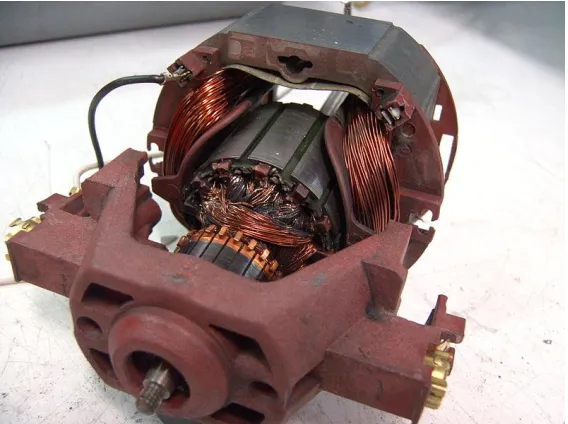
[image:19.612.186.470.298.510.2]Universal motors also lend themselves to electronic speed control and, as such, are an ideal choice for domestic washing machines. The motor can be used to agitate the drum (both forwards and in reverse) by switching the field winding with respect to the armature. The motor can also be run up to the high speeds required for the spin cycle.
Figure 1.2 : Universal motor of a vacuum cleaner
1.3 DC Motor
angle between the stator and rotor magnetic flux is maintained near 90 degrees, which generates the maximum torque [9].
DC motors have a rotating armature winding (winding in which a voltage is induced) but non-rotating armature magnetic field and a static field winding (winding that produce the main magnetic flux) or permanent magnet. Different connections of the field and armature winding provide different inherent speed/torque regulation characteristics. The speed of a DC motor can be controlled by changing the voltage applied to the armature or by changing the field current. The introduction of variable resistance in the armature circuit or field circuit allowed speed control. Modern DC motors are often controlled by power electronics systems called DC drives.
The introduction of DC motors to run machinery eliminated the need for local steam or internal combustion engines, and line shaft drive systems. DC motors can operate directly from rechargeable batteries, providing the motive power for the first electric vehicles. Today DC motors are still found in applications as small as toys and disk drives, or in large sizes to operate steel rolling mills and paper machines.
1.3.1 Brush DC Motor
The brushed DC electric motor generates torque directly from DC power supplied to the motor by using internal commutation, stationary magnets (permanent or electromagnets), and rotating electrical magnets.
9
1.3.2 Brushless DC Motor
Typical brushless DC motors use a rotating permanent magnet in the rotor, and stationary electrical current/coil magnets on the motor housing for the stator, but the symmetrical opposite is also possible. A motor controller converts DC to AC. This design is simpler than that of brushed motors because it eliminates the complication of transferring power from outside the motor to the spinning rotor. Advantages of brushless motors include long life span, little or no maintenance, and high efficiency.
Disadvantages include high initial cost, and more complicated motor speed controllers. Some such brushless motors are sometimes referred to as "synchronous motors" although they have no external power supply to be synchronized with, as would be the case with normal AC synchronous motors [10].
1.3.3 Permanent magnet stators
A PM motor does not have a field winding on the stator frame, instead relying on PMs to provide the magnetic field against which the rotor field interacts to produce torque. Compensating windings in series with the armature may be used on large motors to improve commutation under load. Because this field is fixed, it cannot be adjusted for speed control. PM fields (stators) are convenient in miniature motors to eliminate the power consumption of the field winding. Most larger DC motors are of the "dynamo" type, which have stator windings. Historically, PMs could not be made to retain high flux if they were disassembled; field windings were more practical to obtain the needed amount of flux. However, large PMs are costly, as well as dangerous and difficult to assemble; this favors wound fields for large machines.
are at least competitive with all optimally designed singly fed synchronous and induction electric machines. Miniature motors resemble the structure in the illustration, except that they have at least three rotor poles (to ensure starting, regardless of rotor position) and their outer housing is a steel tube that magnetically links the exteriors of the curved field magnets [10].
Figure 1.3: A brushed DC electric motor
1.4 Smart Power Module (SPM)
11
energy consumption, inverter technology is being increasingly accepted and used by a wide range of users in the design of their products. Power modules for inverterized motor drive applications are also part of a current trend due to the advantages that offer such as space-savings and ease of assembly [1].
Integrated power modules seem to be the solution chosen by most researchers, designers or producers in the field of motor drive applications [2]. Fairchild Semiconductor has developed a series of SPM® devices for a highly efficient integrated solution. They concentrate on the development of an intelligent integrated power module using the new concept of building structure and advanced packaging technology that is the means of achieving an excellent, cost-effective solution. The first and second series of Motion-SPM in DIP package and Mini-DIP package have been successfully introduced into the market [1]-[2]. Since then, a great number of SPM inverter systems have been implemented and continue to run successfully, which validates the very good results of SPM reliability.
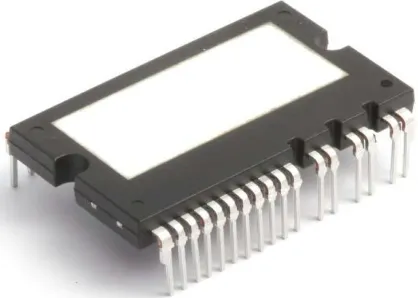
Now, Fairchild Semiconductor has taken the next step with the development of low power and cost effective SPM families in μMini-DIP SPM package, which are quite specialized for IGBT inverter application range of less than 7kW. Within such an operating power, one of the most important requirements in the system is more compactness and easier mass production process with high quality and reliability resulting in more cost-effectiveness comparing to discrete inverter solutions.
Figure 1.4: Smart Power Module
1.5 Problem Statement
The terms “energy-saving” and “quiet-running” are becoming very important in the world of variable speed motor drives. Inverter technology is being increasingly accepted and used by a wide range of users in the design of their products. For low-power motor control, there are increasing demands for compactness, built-in control, and lower overall-cost. An important consideration, in justifying the use of inverters in these applications, is to optimize the total-cost-performance ratio of the drive system. In order to meet these needs, Fairchild Semiconductor have designed and developed a new series of compact, highly functional and very efficient power semiconductor devices called the “SPM (Smart Power Module)”.
13
problems. Based on the abovementioned problems, this project will focus on the problem in order to increase the efficiency of the motor drives by using SPM.
1.6 Objectives and Scopes
1.6.1 Objective
The main purpose of this project is to design and simulate the circuit that using SPM to get the result whether it can increase the motor efficiency for home appliances application or not. There are two major topics that need to understand while doing this project which is comparison between IGBT and MOSFET devices and comparison between conventional motor and BLDC motor in terms of leakage current.
[image:25.612.118.512.403.693.2].
1.6.2 Scope of Work
The purpose of this project is to get a comparison between the usage of Smart Power Module (SPM) in motor drives application and without using SPM. Based on the studied in [7], SPM can reduce Electromagnetic Interference (EMI), leakage current, acoustic noise and increase efficiency of the motor and inverter. But, in this project only focus on how to increase the efficiency of motor in air conditioner application.
This project also requires knowledge in software skills. The scope of work in this project is as follows:-
Design the circuit parameter and demonstrate simulation via Fairchild Design Tools software.
i. Construct and build SPM circuit to perform a simulation. ii. Simulate the switching loss of SPM by using Microsoft Excel.
iii. Analyzing and comparing the results from simulation and manual calculation.
1.6.3 Thesis Overview
This thesis contains 5 chapters with appendices at the end. Each of the chapters represents of enough information for better understanding due on this project.
Chapter 1
Briefly explain the scope and objective for this project to achieve and a general view of electrical motor and smart power module.
Chapter 2
15
Chapter 3
Describe about methodology for smart power module setup and design using Fairchild Design Tools (FDT) and calculation via Microsoft Excel software.
Chapter 4
Step for smart power module simulation via FDT, switching loss calculation by using Microsoft Excel software.
Chapter 5
LITERATURE REVIEW
2.1 Introduction
In this chapter, the review on the research is done for a past semester. The review included motor efficiency and also insulated gate bipolar transistor (IGBT). These research are been done through the journals, DC motor books and from the competence person who has a great knowledge in this subject.
2.2 What Is Leakage Current?
17
2.2.1 Why Is It Important?
Electrical equipment commonly includes a grounding system to provide protection against a shock hazard if there is an insulation failure. The grounding system usually consists of a grounding conductor that bonds the equipment to the service ground (earth). If there is acatastrophic failure of the insulation between the hot (power) line and touchable conductive parts, the voltage is shunted to ground. The resulting current flow will cause a fuse to blow or open a circuit breaker; preventing a shock hazard. Obviously, a possible shock hazard exists if the grounding connection is interrupted, either intentionally or accidentally. The shock hazard may be greater than supposed because of the leakage currents.
Even if there is no insulation failure, interruption of the leakage currents flowing through the ground conductor could pose a shock hazard to someone touching the ungrounded equipment and ground (or other grounded equipment) at the same time. This possibility is of much more concern in medical applications, where a patient may be the recipient of the shock. A fatal shock could result if the patient is in a weakened condition or unconscious, or if the leakage current is applied to internal organs through patient contacts. The double insulation provided in non-grounded equipment provides protection by using two separate layers of insulation. The protection in this case is ensured because both layers of insulation are unlikely to fail. However, the conditions that produce leakage currents are still present, and must be considered.
2.2.2 What Causes Leakage Current?
The capacitance may be intentional (such as in EMI[3] filter capacitors) or unintentional. Some examples of unintentional capacitances are spacings on printed wiring boards, insulations between semiconductors and grounded heatsinks, and the primary-to-secondary capacitance of isolating transformers within the power supply.
2.2.3 What Is A Safe Level
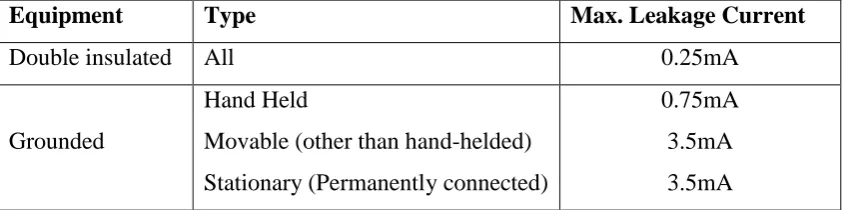
For non-medical equipment, the safe levels have been determined by an international organization and documented in the IEC 950 safety standard. Most countries around the world
[image:30.595.109.532.423.528.2]have adopted this standard. The limits are defined in Table 1.
Table 2.1 : IEC 950 Safety Standards
Equipment Type Max. Leakage Current
Double insulated All 0.25mA
Grounded
Hand Held
Movable (other than hand-helded) Stationary (Permanently connected)
0.75mA 3.5mA 3.5mA
Medical equipment leakage current limits are much lower. The requirements are summarized in Table 2. Because of the lower values of allowable leakage current in medical power supplies, it is important to substantially reduce the capacitances that cause leakage currents. This poses a
special design problem for the power supply and especially EMI filters. For example, line-toground capacitors are an important part of the EMI
19
Table 2.2 : IEC601-1, UL2601-1 Safety Standards
2.3 Direct Current Motor (DC Motor)
2.3.1 Principle of DC Motor
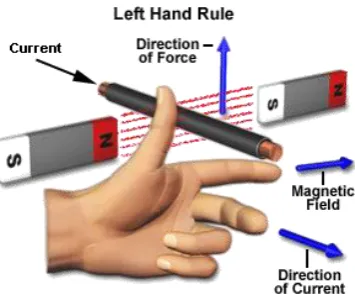
Figure 2.1: Fleming left hand rule
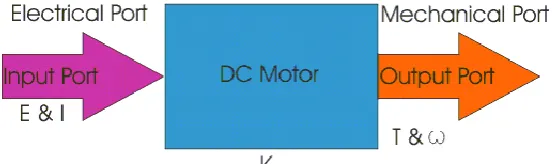
Structurally and construction wise a Direct Current Motor is exactly similar to a D.C. Generator, but electrically it is just the opposite. Here we unlike a generator we supply electrical energy to the input port and derive mechanical energy from the output port. We can represent it by the block diagram shown below.
Figure 2.2: Principles of DC motor
Here in a DC motor, the supply voltage E and current I is given to the electrical port or the input port and we derive the mechanical output i.e. torque T and speed ω from the mechanical port or output port. The input and output port variables of the Direct Current Motor are related by the parameter K.
[image:32.595.219.496.460.542.2]21
So from the picture above we can well understand that motor is just the opposite phenomena of a D.C. Generator, and we can derive both motoring and generating operation from the same machine by simply reversing the ports [12].
2.3.2 Detailed Description of a DC Motor
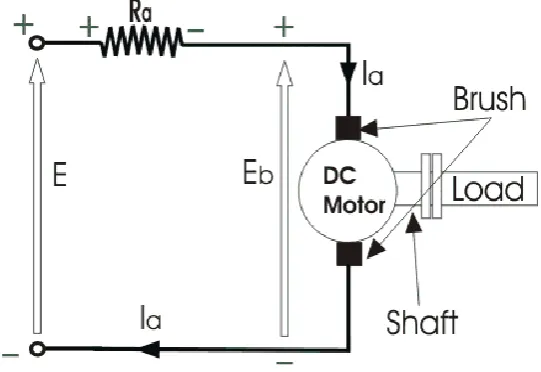
[image:33.595.233.504.498.684.2]The direct current motor is represented by the circle in the center, on which is mounted the brushes, where we connect the external terminals, from where supply voltage is given. On the mechanical terminal we have a shaft coming out of the Motor, and connected to the armature, and the armature-shaft is coupled to the mechanical load. On the supply terminals we represent the armature resistance Ra in series. Now, let the input voltage E, is applied across the brushes. Electric current which flows through the rotor armature via brushes, in presence of the magnetic field, produces a torque Tg. Due to this torque Tg the dc motor armature rotates. As the armature conductors are carrying currents and the armature rotates inside the stator magnetic field, it also produces an emf Eb in the manner very similar to that of a generator. The generated Emf Eb is directed opposite to the supplied voltage and is known as the back Emf, as it counters the forward voltage [12].
The back emf like in case of a generator is represented by
Where,
P = no of poles φ = flux per pole Z= No. of conductors A = No. of parallel paths
and N is the speed of the DC Motor.
So from the above equation we can see Eb is proportional to speed ‘N’. That is whenever a Direct Current Motor rotates, it results in the generation of back Emf. Now lets represent the rotor speed by ω in rad/sec. So Eb is proportional to ω.
So when the speed of the motor is reduced by the application of load, Eb decreases. Thus the voltage difference between supply voltage and back emf increases that means E − Eb increases. Due to this increased voltage difference, armature current will increase and therefore torque and hence speed increases. Thus a DC Motor is capable of maintaining the same speed under variable load.
Now armature current Ia is represented by
23
Now since the armature winding resistance Ra is small, this motor has a very high starting current in the absence of back Emf. As a result we need to use a starter for starting a DC Motor.
Now as the motor continues to rotate, the back Emf starts being generated and gradually the current decreases as the motor picks up speed [12].
2.3.3 Working or Operating Principle of DC Motor
[image:35.595.193.447.405.570.2]A DC Motor in simple words is a device that converts direct current(electrical energy) into mechanical energy. It’s of vital importance for the industry today, and is equally important for engineers to look into the working principle of DC motor in details that has been discussed in this article. In order to understand the operating principle of dc motor we need to first look into its constructional feature [12].
Figure 2.4: basic construction of a dc motor
Now to go into the details of the operating Principle of dc motor its important that we have a clear understanding of Fleming’s left hand rule to determine the direction of force acting on the armature conductors of dc motor.
Figure 2.5: Fleming left hand rule
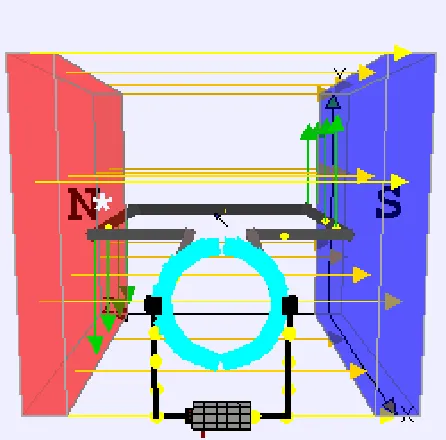
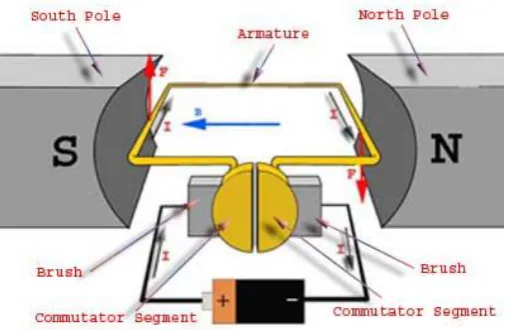
Fleming’s left hand rule says that if we extend the index finger, middle finger and thumb of our left hand in such a way that the current carrying conductor is placed in a magnetic field (represented by the index finger) is perpendicular to the direction of current (represented by the middle finger), then the conductor experiences a force in the direction (represented by the thumb) mutually perpendicular to both the direction of field and the current in the conductor [12].
For clear understanding the principle of DC motor we have to determine the magnitude of the force, by considering the diagram below.
[image:36.595.204.449.574.730.2]REFERENCES
[1] Tae-Sung Kwon, Jun-Ho Song, Jun-Bae Lee, Seung-Han Paek and Sung-Il Yong, “A New Smart Power Module for Low Power Motor Drives,” ICPE’07, pp. 695-699, 22-26 Oct. 2007.
[2] JB.Lee, BC.Cho, DW.Chung, BS.Suh, “Improved Smart Power Modules for up to 7kW Motor Drive Applications,” PESC, 2006.
[3] Tom McInally, The Sixth Scottish University. The Scots Colleges Abroad: 1575 to 1799 (Brill, Leiden, 2012) p. 115
[4] "The Development of the Electric Motor,". Early Electric Motors. SparkMuseum. Retrieved 12 February 2013.
[5] Blundel, Stephen J. (2012). Magnetism A Very Short Introduction.. Oxford University Press. p. 36. ISBN 978-0-19-960120-2.
[6] Thein, M. "Elektrische Maschinen in Kraftfahrzeugen" [Electric Machines in Motor Vehicles] (in German). Retrieved 13 February 2013.
[7] "Battery and Energy Technologies, Technology and Applications Timeline". Retrieved 13 February 2013.
[8] George Patrick Shultz, Transformers and Motors, Jun 2011
[9] William H. Yeadon, Alan W. Yeadon. Handbook of small electric motors. McGraw-Hill Professional, 2001
[10] Laughton M.A. and Warne D.F., Editors. Electrical engineer's reference book. 16th ed. Newnes, 2003
[11] Electrical4u, DC Motor or Direct Current Motor, Online Electrical Engineering Study Site, 2012
Operation Ill-Advised. Ohio Electric Motors, 2011
[14] IEA, “Tracking Industrial Energy Efficiency and CO2 Emissions, Paris,” International Energy Agency (IEA), 2007.
[15] IEA, “Energy Technology Perspectives: Scenarios and Strategies to 2050, Paris,” OECD/IEA, 2008.
[16] Brunner, C.; Borg, N.; “From voluntary to mandatory: policy developments in electric motors between 2005 and 2009,” Beitrag auf der eceee, 2009. [17] Radgen, P., “Market study for improving energy efficiency for fans,”
Stuttgart, Fraunhofer IRB Verl, 2002.
[18] Radgen, P.; Oberschmidt, J.; Corry, W.T.W., “Fans for ventilation in non residential buildings,” Karlsruhe, 2007.
[19] Paul Marshall, “The Efficiency of Single-Phase & Three-Phase Brushless DC Motors,”eHow, 2012.
[20] Carotron, Inc., “Efficient DC Motor: 3 Ways to Boost Energy Efficiency,” Carotron Inc, 2011.
[21] M. Gopal. Control systems: principles and design. 2nd ed. Tata McGraw-Hill, 2002
[22] T.G. Wilson, P.H. Trickey, "D.C. Machine. With Solid State Commutation", AIEE paper I. CP62-1372, October 7, 1962
[23] Das, A. Kumar, Method for enabling a high torque/high speed brushless DC motor, Kendro Laboratory Products, Inc., 2000
[24] Using ECM Motors in HVAC Systems, Thomasnet.com, 2013
[25] Ohio Electric Motors, “Brushless DC Motors: Low Maintenance and High Efficiency,” Ohio Electric Motors, July 2011.
[26] Ohio Electric Motors. DC Motor Protection. Ohio Electric Motors. 2011 [27] Pter Campbel. Permanent Magnet Materials and their Application. Cambridge
University Press, 1996
[29] HP SPM & System Engineering Group, “Introduction of Smart Power Module for Low-Power Motor Drives Applications,” Fairchild
Semiconductor, 2004.
[30] Energy-Efficiency Policy Opportunities for Electric Motor-Driven Systems, International Energy Agency, 2011.
[31] Improving Energy Efficiency and Reliability in Motor Control Applications, Fairchild Semiconductor, 2012
[32] Man-Kee Kim, Ki-Young Jang, Byoung-Ho Choo, Jun-Bae Lee, Bum-Seok Suh, Tae-Hoon Kim,” A Novel IGBT Inverter Module for Low-Power Drive Applications,” IEEE, 2002.
[33] Smart power module motion user’s guide, “Application note AN9070,” Fairchild Semiconductor, 2012.
[34] Abdus Sattar, “Insulated Gate Bipolar Transistor (IGBT) Basics,” IXYS Corporation.