Stabilizing effect of a magnetic field on a gas bubble produced at a microelec-trode
D. Fern´andez, M. Martine, A. Meagher, M.E. M¨obius, J.M.D. Coey PII: S1388-2481(12)00021-5
DOI: doi:10.1016/j.elecom.2012.01.016
Reference: ELECOM 4228
To appear in: Electrochemistry Communications Received date: 22 December 2011
Revised date: 19 January 2012 Accepted date: 20 January 2012
Please cite this article as: D. Fern´andez, M. Martine, A. Meagher, M.E. M¨obius, J.M.D. Coey, Stabilizing effect of a magnetic field on a gas bubble produced at a microelectrode, Electrochemistry Communications(2012), doi: 10.1016/j.elecom.2012.01.016
ACCEPTED MANUSCRIPT
1
Stabilizing effect of a magnetic field on a gas bubble produced at a microelectrode.
D. Fernández, M. Martine, A. Meagher, M. E. Möbius and J.M.D. Coey
School of Physics, Trinity College, Dublin 2, Ireland.
Keywords: Magnetoconvection, single-bubble formation, Lorentz force, hydrogen evolution reaction.
ACCEPTED MANUSCRIPT
2
Gas evolution at electrodes involves both micro- and macro-convective flow [1]. Imposition of a magnetic field during electrolysis is known to produce convection via the Lorentz force FL = j×B. When the magnetic field B is perpendicular to the electrode
surface and everywhere parallel to the current density j the force is zero. However, current arriving at the edges of an electrode has an in-plane component. As a result, the Lorentz force promotes azimuthal convection around the electrode [2, 3]. Likewise, as bubbles grow on gas-evolving electrodes, the current lines bend around the bubble and interact with the field, producing azimuthal Lorentz forces.
Koza and co-workers [4-6], working with large electrodes, found that bubble size is decreased and the fraction of the surface covered by bubbles is reduced by the field, regardless of orientation with respect to the gas-evolving electrode. They suggested that individual hydrogen bubbles are subject to a twist-off effect by the azimuthal flow. Diao et al [7], working with 0.5 mm Pt electrodes, reported that the bubble size could either increase or decrease in the applied field. However the azimuthal flow has not been observed directly. Examination of the action of the field on a single bubble is needed to understand the hydrodynamics, and it may help describe systems where many bubbles grow simultaneously. Here we study the effect of a magnetic field on a single hydrogen bubble growing at a microelectrode when the field is perpendicular to the electrode surface.
Platinum and copper microdisks 125 m in diameter, made from >99.99% pure
wires inserted in Teflon tubes and embedded in resin, were used as working electrodes. Counter-electrodes were large area platinum wires. A direct and stable reading of the overpotential with minimum perturbation of the flow generated during the reaction was obtained by using pseudo-reference electrodes of the same metal as
the working electrode. The electrolyte was 1.2 M H2SO4 solution. The working
electrode surface was either horizontal facing up or vertical, in order to allow free detachment of the bubbles formed.
A fixed current of 0.1–2.5 mA, corresponding to average current densities of 1–
20 A cm-2 at the microelectrode, was set using a EG&G PAR 273A
ACCEPTED MANUSCRIPT
3
Cryogenics superconducting magnet. A side view of the vertical field effect was obtained using a Halbach permanent-magnet ring producing a field of 0.44 T.
Bubble growth and the electrochemical response were observed simultaneously in the electromagnet or the Halbach ring. Image sequences were taken using a PCO
1200HS high-speed monochrome camera at a frame rate of 1000 s-1. Magnifications
between 3.5 and 5.2 were achieved using a Sigma 180 mm 1:3.5 Alp Macro DG lens with a 140 mm macro bellows. The hydrogen bubbles were illuminated from behind using either a PHLOX planar backlight or Fiber Light DC-950 light source a diffusion plate. The resulting greyscale images were analyzed using ImageJ software.
PVC particles have been added to the solution to follow the flow around a growing bubble. Motion tracking images were calculated from a sequence of more than 2000 superposed pictures. This allows each tracer particle in the fluid to be tracked, as well as the bubbles themselves.
Single hydrogen bubbles grow when high current densities are applied to the
microelectrode. The measured overpotential presents fluctuations that correlate
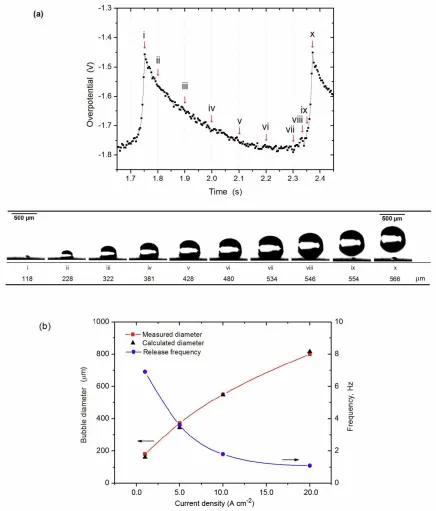
with the formation and departure of the bubbles, shown in Figure 1a). The images correspond to the times (i) to (x) marked on the :t trace.
The presence of an insulating phase on an electrode surface adds a resistive contribution to the overpotential [8], hence the fluctuations related to the growth and departure of a gas bubble [7,9,10]. The oscillations in Figure 1(a) are periodic, with a regular waveform. From their release frequency f and average current density j, the
bubble radius rb can be calculated from the gas law, assuming that all
electrolytically-generated hydrogen collects in the bubble:
rb= (3 e2jRT/8FfP0)1/3
(2)
where e is the electrode radius, R is the gas constant, T is the absolute temperature, F is Faraday’s constant and P0 is the absolute pressure of the gas, taken as atmospheric
ACCEPTED MANUSCRIPT
4
Figures 2(a) and (b) show results when a vertical field Bz is applied normal to a
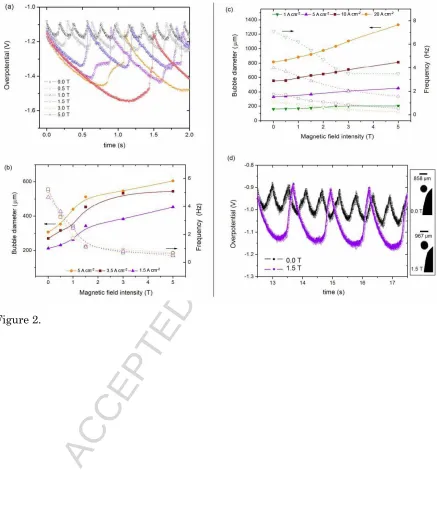
copper microelectrode. In (a), the overpotential oscillations are seen to become less frequent with increasing field. Increasing currents also reduce the release frequency and produce bigger bubbles. Bubble sizes calculated using Eq. (2) are shown in Figure 2(b) for different currents and fields. The diameter increases by 60% from 0 to 1.5 T and it is almost doubled in 5 T. Similar, but smaller increases are observed using a Pt microelectrode, over a wider range of currents, Fig 2(c). Figure 2(d) shows results when a horizontal field Bx is applied normal to a vertical platinum microelectrode.
Again, the field reduces the release frequency. At 20 A cm-2 there is an increase of
bubble diameter from 860 to 970 m in 1.5 T. Residence time is shorter on a vertical
microelectrode than a horizontal one.
Figures 3(a) and (b) show results for the tracer particles with a horizontal microelectrode. In zero field, particles settle straight down due to gravity but a few of them are dragged upwards by the released bubble. Changes of hydrodynamic pattern
are observed when Bz=0.44 T – rotational motion is induced around the bubble, which
is uninfluenced by its upward trajectory. Figures 3(c) and (d) show what happens with a vertical microelectrode. Again, in zero field the particles move only due to gravity or under the influence of bubbles flying upwards. The pattern changes clearly in 1.5 T. Helical motion is set up in front of the electrode, with particles moving from the bulk solution towards it. The electrolyte swirls around a horizontal axis and moves away from the electrode. Particles approaching from afar follow a perfectly horizontal trajectory towards the bubble. After release, bubbles fly up at a 7º angle to the vertical.
A estimate of the break-off radius of a bubble is obtained by equating the upthrust to the vertical component of the surface tension around the rim of the microelectrode of radius re is
rb = (3re2/2g)¼ (2)
Taking = 1000 kg m-3 for the density of the electrolyte and = 72 mN m-1 for the
surface tension gives rb = 450 μm, which seems to be an upper limit on the dimensions
ACCEPTED MANUSCRIPT
5
microelectrode and the electrolyte. This means that the bubble does not effectively occlude the electrode, so that overpotential fluctuations should not be used to infer the bubble size.
We can identify some consequences of applying the field, which could relate for the increase in bubble volume shown in Fig 2. The primary effect is to create the swirling movement of the electrolyte, shown by the tracer particles. The current density has a positive radial component above the bubble, and a negative one close to the microelectrode. The former leads to an azimuthal flow above the bubble with an angular velocity Ω of about 2 radians per second. Flow velocities v are of order 10 mm s-1. The counter-rotating flow below the bubble tends to be suppressed as it lies within the hydrodynamic boundary layer at the surface of the microelectrode holder.
The primary vortex induced by the Lorentz force induces a secondary (Bödewadt) flow by Eckman pumping [11], as in a stirred cup of tea. This is directed
along the axis towards the bubble, as shown in Fig 3b). Reynold’s number for the flow
is about 10, and the Hartmann number is approximately 1. In these conditions, the Hartman boundary layer is several millimeters thick, and insofar as there is a no-slip boundary condition at the bubble surface [12], the drag force on the bubble may be several percent of the upthrust, and help to retard the release of the bubble. However, there is also a region of reduced pressure above the bubble [6], which has the opposite effect. This pressure change is of order ½v2≈ 0.05 N m-2, and the pressure effect is of
similar magnitude to the drag. The release angle of 7° in Fig 3a) suggests that the net
effect of the flow is to create a force acting away from the electrode, which is about 10% of the upthrust.
We can expect other effects of the field. Rotational flow may influence bubble pinch-off once a neck begins to form [13]. Furthermore the normal modes of oscillation,
which occur at frequencies of 3.2/rb in the kHz range [14], will be damped in proportion
to the conductivity of the electrolyte. Finally, the dynamics of the foam of tiny coalescing bubbles that form around the rim of the electrode may also be influenced by the field. In any case, we speculate that the field-induced increase in bubble size is related to the breakoff mechanism, rather to the balance of forces on the bubble itself.
ACCEPTED MANUSCRIPT
6
extended electrode, where many bubbles are present and the field has the opposite effect [4-6] may be understood in terms of the interaction of the frustrated vortex motions around adjacent bubbles forming on the large electrode.
We have demonstrated directly that azimuthal flow is created by the Lorentz force, which in turn produces a secondary flow directed towards the electrode along the central axis. However, this flow does not seem to be responsible for the increase in bubble size. It appears that the field influences the breakoff mechanism itself, and that this dominates any twist-off effect on a single bubble. When multiple bubbles are growing on the same surface it is likely that the flow fields around each bubble interact erratically, resulting in a sweep-off effect that removes bubbles earlier than in zero field. Further work is needed to investigate the dynamics of the solid-gas interface, and the structure of the foam, which we suppose connects the electrode to the electrolyte.
ACCEPTED MANUSCRIPT
7
References
[1]
H. Vogt, Electrochi. Acta 56 (2011) 2404.
[2]
K. M. Grant, J. W. Hemmert, H. S. White, J. Amer. Chem. Soc. 124
(2002) 462.
[3]
A. Sugiyama, M. Hashirideb, R. Morimoto, Y. Nagaib, R, Aogaki,
Electrochim. Acta 49 (2004) 5115.
[4]
J.A. Koza, M. Uhlemann, A. Gebert, L. Schultz, Electrochem. Comm. 10
(2008) 1330.
[5]
J.A. Koza, S. Mühlenhoff, M. Uhlemann, K. Eckert, A. Gebert, L.
Schultz, Electrochem. Comm. 11 (2009) 425.
[6]
J.A. Koza, S. Mühlenhoff, P. Zabinski, P.A. Nikrityukd, K. Eckert, M.
Uhlemann, A. Gebert, T. Weier, L. Schultz, S. Odenbach, Electrochem.
Acta 56 (2011) 2665.
[7]
Z. Diao, P.A. Dunne, G. Zangari and J.M.D. Coey, Electrochem. Comm.
11 (2009) 740.
[8]
J. Fransaer, V. Bouet, J.-P. Celis, C. Gabrielli, E Huet, G. Maurin, J.
Electrochem. Soc. 142 (1995) 4181.
[9]
C. Gabrielli, F. Huet, M. Kedam, J. Electrochem. Soc.138 (1991) L82.
[10]
C. Gabrielli, F. Huet, R. P. Nogueira, J. Electrochem. Soc. 149 (2002)
E71.
[11]
P. A Davidson, An introduction to hydrodynamics, Cambridge University
Press, 2001.
[12]
R. Clift, J.R. Grace and M. E. Weber, Bubbles, drops and particles, Dover
Publications, 2009
[13]
R. Bergmann, A. Anderson, D. van der Mer and T. Bohe, Phys. Rev. Lett.
102 (2009) 204501
ACCEPTED MANUSCRIPT
8
Figure 1: a) Overpotential fluctuation associated with the growth of a single bubble of
hydrogen on a Pt microelectrode 125 m in diameter, facing upwards, for an applied
current j = 10 A cm-2. b) Bubble size and release frequency as a function of current.
Figure 2: Effect of a magnetic field on overpotential oscillations and bubble size. Time sequences for fields up to 5 T with a vertical field are shown for a Cu microelectrode
with j = 5 A cm-2 in a). Bubble size and release frequency for Cu and Pt
microelectrodes at different current densities are shown in b) and c), respectively. d) shows results for a vertical Pt microelectrode in a horizontal field and j = 20 A.cm-2.
Figure 3: Motion tracking images using PVC particles to illustrate the flow for a
current density of 20 A cm-2. Images (a) and (b) show the change due to a vertical field
ACCEPTED MANUSCRIPT
[image:10.612.92.528.61.572.2]9
ACCEPTED MANUSCRIPT
[image:11.612.90.527.54.583.2]10
ACCEPTED MANUSCRIPT
ACCEPTED MANUSCRIPT
[image:13.612.153.434.111.557.2]12
ACCEPTED MANUSCRIPT
13 Highlights
High-speed photography of growth of a single hydrogen bubble on a microelectrode.
Bubbles grow twice the size in a magnetic field.
Pumped Ekman flow driven by the Lorentz force, observed with tracer particles, is not responsible.
Magnetic field controls the premature breakoff process, but it is not sure how.