Munich Personal RePEc Archive
Impacts of China’s log Import on the
Ecological Sustainability of Forests in
Source Countries
Ji, Chun-Yi and Yang, Hong-Qiang and Nie, Ying
College of Economics and Management, Nanjing Forestry University,
School of Economics,Nanjing University, Research Center for
Economics and Trade in Forest Products of the State Forestry
Administration
April 2011
Online at
https://mpra.ub.uni-muenchen.de/36943/
Impacts of China’s Log Imports on the Ecological
Sustainability of Forests in Source Countries
Chun-yi JI 1, 3, Hong-qiang YANG 1, 2, 3∗, Ying NIE 1, 3
1 College of Economics and Management, Nanjing Forestry University, Nanjing,
210037, Jiangsu, China
2 School of Economics, Nanjing University, Nanjing, 210093, Jiangsu, China
3 Research Center for Economics and Trade in Forest Products of the State
Forestry Administration, Nanjing, 210037, Jiangsu, China
Abstract: As the largest log import country in the world, China undoubtedly faces a
severe challenge from the reduction in global forest resources. Based on the fact that a
flow of ecological elements embodied in the process of import can cause extra
ecological stress to the source regions, the authors assessed the ecological effect of
China’s log imports on the source countries’ forest sustainability. The ecological
footprints embodied in China’s log imports from 1995 to 2010, and then introduce the
model of ecological tension index to assess the ecological security status of the forests
in major source countries. Results demonstrate that, overall, China’s import of log has
posed no serious threat to world forests. Most of the source countries have safe forest
ecological states due to their huge forest bio-capacity, although China’s log import has
increased their forest ecological stress by more than 14%. While for some developed
source countries, China has increased the ecological tension less than 1%. The risk of
forests reduction was probably caused by its own resource consumption.
1. INTRODUCTION
Despite its vast land area and large population of over 1.3 billion, China is relatively
forest-poor. Timber importation is considered to be the primary solution to fill China’s
timber supply-and-demand gap.
The importer can indirectly retrieve the ecological and environmental resource
outside the national border, while the exporter has to bear the transferred ecological
stress. So the international trade of resource-based products may damage the
economic and ecological sustainability of the source countries. Given China’s import
and export structure changes, the international trade of log has appropriated a large
number of forest ecological footprints in the export countries. China’s import of log
undoubtedly faces a severe challenge from the reduction in global timber resources. It
is essential to make a quantative study on the ecological effect of China’s log imports
on the source countries’ forest sustainability.
2. RESEARCH METHODS
Ecological footprint method is used to measure human appropriation of ecosystem
products and services in terms of the amount of bio-productive land needed to supply
these services. Different types of areas can be converted into a common unit of global
hectares (gha) with world average bio-productivity. Bio-capacity represents the ability
of the biosphere to meet human demand for material consumption. Ecological tension
index model refers to the ratio of ecological footprints to bio-capacity of renewable
resources of a given country.
3. DATA ACQUISITION
The domestic log supply data were taken from China’s Forestry Development Report
and the statistics of the State Forestry Administration. All the official log import and
export data from world and top ten major source countries were obtained from the UN
COMTRADE DATABASE. And the dynamic equivalence factors were acquired from
the living plan report of World Wildlife Fund.
4. ANALYSIS OF FOREST ECOLOGICAL FOOTPRINTS
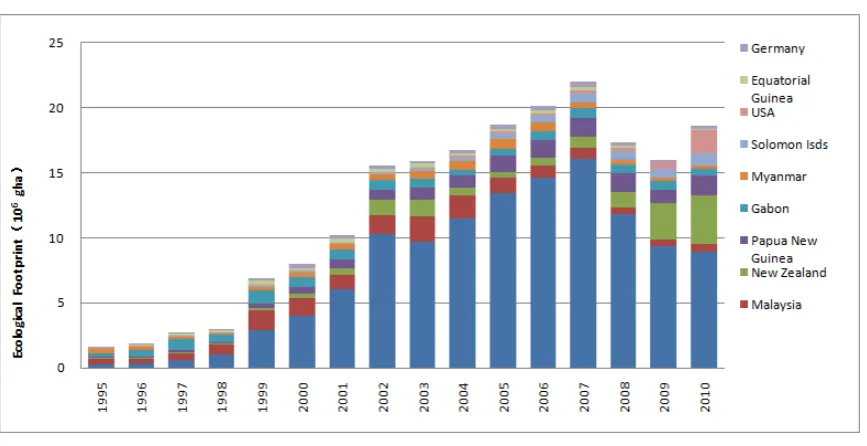
The global forest ecological footprints implied in China’s log imports had sustainable
growth from year 1995 to 2007. In 1995 it was 1.65 million gha, accounting for 4.7%
of that of China’s total log demand, while in 2007 it increased to 36.7% or 23.5
million gha.
The forest ecological footprints transferred from the top ten major source countries
accounted for 91% of that embodied in China’s total import. The forest ecological
footprint inputted from Russia accounted for 96% of Europe’s total export. After
impacted by the recent worldwide economic downturn in 2008, the ecological
footprint from Russia was still as high as 8.9 million gha in 2010. New Zealand,
Papua New Guinea and Solomon islands are the top-three major source countries in
Oceania. The amount of forest ecological footprints from the three countries had
sustainable growth. Malaysia is the largest log export country in Asia. The amount of
forest ecological footprint inputted from Malaysia reached its peak point 2.0 million
from USA began to surge from 2008, and in 2010 it increased to 1.8 million gha,
which accounted for 70% of the total ecological footprints from the continent of
[image:5.595.91.525.163.386.2]North America.
Fig. 1. Transferred ecological footprints of major source countries.
5. ANALYSIS OF TRANSFER OF FOREST ECOLOGICAL STRESS
In 2005 and 2007, the ecological footprints of the major source countries were less
than the normal bio-capacity. They are all in a state of ecological surplus. We
analyzed the forest ecological condition with and without China’s log demand
according to the scientific evaluation indicator: the ecological tension index
(0.04–4.00), which taken from the report released by the World Wildlife Fund (WWF)
in 2004. The criterion of ecological tension index was classified into six grades: At
risk(>2.0), Unsafe (2.0-1.51), Relatively unsafe (1.5-1.01),A bit unsafe (1.0-0.81),
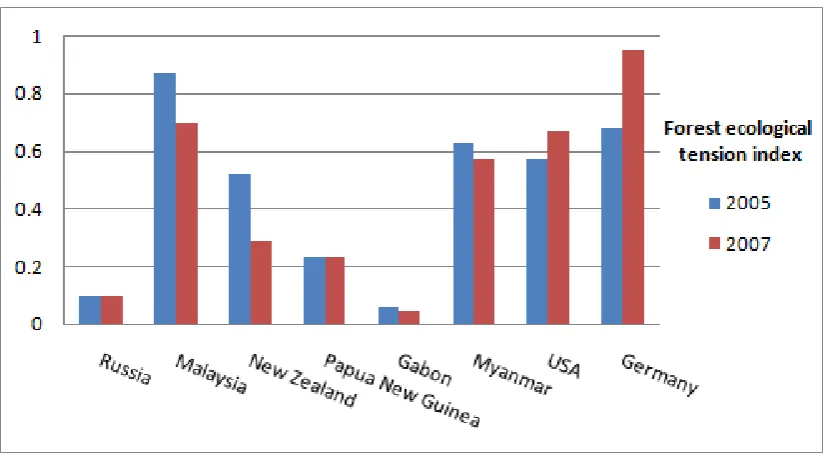
Fig. 2. Forest ecological tension index of major source countries.
Most of the source countries have safe forest ecological state after considering the
impact of China’s log imports (Fig. 2). China’s import of log has increased Russia’s
forest ecological tension by 25%, but Russia’s ecological tension index was 0.1,
indicating its forest state is quite safe. For Gabon, the forest tension index was just
0.06 in 2005 and 0.05 in 2007, including 33% of the ecological stress transferred from
China. In 2005, the forest ecological state was at comparably-safe-grade after
considering the added 10% of the ecological stress transferred from China. While in
2007, the ecological tension index decreased to 0.29, illustrating that the forest
resource was quite safe. Though China had transferred and increased approximately
40% of the ecological tension of Papua New Guinea, the domestic forest in Papua
New Guinea was in quite-safe-grade. Myanmar’s forest was at comparably-safe-grade.
China’s import of log had just increased Myanmar’s forest ecological tension by 3%.
bit-unsafe-grade after plus 10% of the ecological stress transferred from China. For
USA and Germany, China had just increased their ecological tension by less than
1%.And it is worth noting that the entire ecological state of the two developed
countries was unsafe or even at risk.
6. CONCLUSIONS
We can put forward the conclusion that China’s import of log didn’t pose any serious
threat to the forest security and sustainability of major source countries. Due to the
huge forest bio-capacity, most of the import countries have safe-grade forests. The
unsafety of forests in developed countries was probably caused by their own
consumption.
Acknowledgments: This research was supported by the National Social Science
Foundation of China (No.10CJY026) and Kreditanstalt für Wiederaufbau (KfW).
Reference:
1. Van den Bergh, J.C.J.M., Verbruggen, H. Spatial Sustainability. Elsevier Ecological Economics
29, 61 (1999).
2. Warkernagel, M., Rees, W.E. in Our Ecological Footprint: Reducing Human Impact on the
Earth. New Society Publishers, Gabriola Island, Canada (1996). pp. 21-25.
3. Zhang Jing, Liu Yaolin, Chen Xinming. Bulletin of Soil and Water Conservation 28, 185