http://www.scirp.org/journal/ojmh ISSN Online: 2163-0496 ISSN Print: 2163-0461
Estimation of Unit Flood Discharge for Various
Land Use Types with a Focus on Urbanization
Manabu Segawa
*, Toshisuke Maruyama, Keiji Takase
Faculty of Environmental Science, Ishikawa Prefectural University, Ishikawa, Japan
Abstract
We proposed unit flood discharge model that defined as the discharge into end-order (smallest) drainage canals. The discharge acts an important role for estimating re-gional flooding by big rainfall events which leading roughly estimation of flood dis-charge associated with land use changes as urbanization. In some areas of Japan, in-creased urbanization with insufficient drainage canal capacity has led to increasingly frequent flooding and flood damage. The aim of this study was to investigate the ef-fect of urbanization on unit flood discharge using a runoff model for the Tedori Riv-er alluvial fan area, Japan. The discharge was studied as collecting runoff from paddy fields, upland crop fields, and residential lots. A runoff model for various land use types in the study area was developed using actual and physical properties of the ru-noff sites, and parameters for paddy fields. The model was tested using 54 big events and inputted those. The maximum total runoff ratio among different land use types was observed for residential lots, and the ratio remained relatively constant across different flood events. The minimum total runoff ratio was observed for irrigated paddy fields. There was a positive relationship between the total runoff ratio and to-tal precipitation for all land use types. Whereas, the relationship between the peak runoff ratio and peak precipitation was variable. The runoff analysis was carried out using 60-min and 10-min precipitation data. For agricultural land, data for both in-tervals produced similar results.
Keywords
Unit Flood Discharge, Total Runoff Ratio, Peak Runoff Ratio, Runoff Model, Depression Storage
1. Introduction
Rapid urbanization in Japan since the late 1960s has been associated with increasingly
How to cite this paper: Segawa, M., Ma-ruyama, T. and Takase, K. (2016) Estimation of Unit Flood Discharge for Various Land Use Types with a Focus on Urbanization. Open Journal of Modern Hydrology, 6, 195- 211.
http://dx.doi.org/10.4236/ojmh.2016.64016
Received: June 29, 2016 Accepted: August 30, 2016 Published: September 2, 2016
Copyright © 2016 by authors and Scientific Research Publishing Inc. This work is licensed under the Creative Commons Attribution International License (CC BY 4.0).
http://creativecommons.org/licenses/by/4.0/
frequent flood events and flood damage, primarily as a result of insufficient drainage canal capacity. This phenomenon of increased flood discharge likely reflects the wide-spread change in land use from paddy fields and upland crop fields to residential areas.
The relevant researches have been performed widely [1]. Yoshikawa et al. [2][3]
stu-died the characteristics of runoff from paddy fields and investigated the effectiveness of
runoff control devices in drainage outlets using a model. Masumoto et al. [4] developed
a model based on runoff from cultivated and abandoned paddy fields to investigate the
impact of cultivation on runoff characteristics. Yomota and Miura [5] studied flood
discharge from paddy fields and upland crop fields under rotational use. To assist with
flood prevention planning, Senge et al. [6] also developed a runoff simulation model
and investigated the peak discharge ratio for the rotational use of paddy fields and upl-and crop fields.
While previous studies investigated changes in runoff related to cultivation, the effect of urbanization was not directly considered. Furthermore, runoff models of outflow from areas with different land use types have only been proposed conceptually (e.g.,
Maruyama et al. [7]). There is no previous research using models of unit flood
dis-charge based on the actual and physical properties of different runoff sites such as pad-dy fields, upland crop fields, and residential areas. In the present research, unit flood discharge was used as a measure of potential flooding discharge i.e., new concept of drainage. The unit flood discharge was defined as the discharge to end-order (smallest) drainage canals collecting runoff from various land use types.
Using the unit flood discharge, total discharge can be estimated by flood routing ac-cording to discharge systems and the changes in land use associated with urbanization that will be describe next research. A runoff model for various land use types was de-veloped based on actual and physical properties and historic precipitation data were used to estimate total and peak discharge ratios. Another feature of the present research was the consideration of depression storage of precipitation as part of the runoff analy-sis. Special features of the Tedori River alluvial fan area where the study was conducted were that the residential areas were reclaimed from paddy fields on very steep hillsides. Most of the upland field areas were cultivated with soybean or wheat in rotation with rice paddies by rice production control.
In summary, a runoff model based on actual and physical properties of various land
use types was developed [8]. The model’s input parameters were obtained from a field
survey of the Tedori River alluvial fan area. Data on past precipitation events that re-quired flood prevention planning were used to estimate potential unit flood discharge. Using the model and the available data, the relationship between precipitation and flood discharge in the Tedori River alluvial fan area was determined, and the changes associated with urbanization will be identified.
2. Materials and Methods
2.1. Study Site
the cities of Kanazawa to the northeast and Komatsu to the southwest. The study area is representative of the steep landscapes cultivated as rice paddies in the region of
Hoku-riku (Figure 1, Table 1). The elevation falls from about 80 m above sea level at the
in-land limit of the alluvial fan to sea level over about 11 km. The mean gradient is 1 m/140 m, which is relatively steep. The total area of the alluvial fan is 18,000 ha of which about 8000 ha are cultivated paddy fields. About 30% of the paddy fields are used as upland crop fields on the basis of the rice production control. The non-cultivated area of the alluvial fan is made up of residential developments, rivers, canals, and roads. The study area includes many rivers and numerous irrigation ditches and drainage canals. Because of the steep landscape, the lag time between peak of heavy precipitation and flood discharge is only about 2 hours from top to end of alluvial fan. The drainage river have not affected by backwater except special river mouth. Therefore, runoff is strongly affected by discharge from paddy (rice) fields, upland crop fields, and residen-tial areas, i.e., unit flood discharge.
Tedori river alluvial fan
5km 0m
Kanazawa M etelological Observation Station
Prefectural university
Alutitude45~50m
Kanazawa
Nonoichi
Hakusan
Nomi
Komatsu
Altitude 5~10m
Altitude 60m Alutitude20~25m
Tudor river
Kakehashi river
Japan sea
[image:3.595.237.510.296.552.2]Survey points explanatory notes
Figure 1. Outline of the Tedori River alluvial fan area and location of percolation test.
Table 1. Land use of the Tedori River alluvial fan area [9].
Region Paddy Upland Residential River/canal Road Total
Right side 5674 391 5399 532 2177 14,173
Left side 1865 111 650 406 477 3509
Total 7539 502 6049 938 2654 17,682
Ratio 42.6% 2.8% 34.2% 5.3% 15.0% 100.0%
[image:3.595.193.555.605.707.2]2.2. Runoff Model for Various Land Use
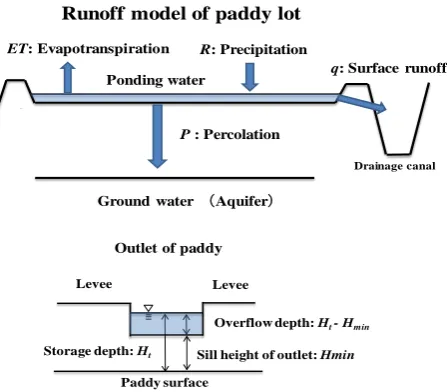
Cultivated paddy fields are enclosed by levees and each individual field (lot) has a
drai-nage outlet (Figure 2). The cross section of a rectangular weir as used for the runoff
model is shown inFigure 2. During a flood, irrigation canals are closed so the only
wa-ter input into paddy fields is from precipitation. The output is from discharge into the drainage canals, evapotranspiration, and percolation. To estimate the outflow discharge, it is necessary to apply a formula for weir discharge and a continuity equation.
2.2.1. Change in Standing Water Level and Discharge from Irrigated Paddy
Fields
The continuity equation and discharge from a rectangular weir are expressed as follows
[10]. Equation (2) shows the backward difference scheme for Equation (1).
3 10 t
t t t
q H
R ET P
t A
−
∆ =− × + − −
∆ (1)
3
1 10
t
t
t t t
t
q
R H
A
H− − × − + −ET −P t
= +
× ∆ (2)
(
)
3 1.5 2min 10 60
t
t H
q =a b× × −H × − × (3)
where Ht−1 and Ht are, respectively, water depth (mm) on the paddy field before and
af-ter calculation. q is the discharge from the weir (m3∙h−1), A is area of an individual
paddy field (set as 1760 m2 based on the average size of paddy fields in the study area),
R is precipitation (mm∙h−1), ET is evapotranspiration (mm∙h−1), P is percolation rate
(mm∙h−1), ∆t is time difference (h) and Hmin is height of the outlet (mm). α is the
dis-charge coefficient of the weir (set as 1.838), and b is the width of the weir (m) set as [b −
0.2 (Ht − Hmin)] [10]. The units of some parameters had to be converted to account for
different time intervals (∆t) of the precipitation data. In addition, ET is usually quite small amount during flooding period.
Runoff model of paddy lot
P : Percolation
Ponding water
R: Precipitation ET: Evapotranspiration
q: Surface runoff
Drainage canal
Ground water (Aquifer)
Outlet of paddy
Levee Levee
Storage depth: Ht Sill height of outlet: Hmin Overflow depth: Ht - Hmin
[image:4.595.262.486.483.679.2]Paddy surface
2.2.2. Discharge from Non-Irrigated Paddy Fields and Upland Crop fields Even at times when paddy fields and upland crop fields are not irrigated, some water from precipitation builds up in the depressions between levees. When this water ex-ceeds the storage capacity of the fields, it is discharged into drainage channels. The vo-lume of depression storage varies depending on the land use type (see the section on Depression storage in Results below).
In upland crop fields previously used as paddy fields, outlets into drainage weirs are usually opened. In this case, Hmin in Equation (3) is replaced by depression storage (Dep) and discharge q is calculated using Equation (2) and Equation (3) with percola-tion rate P (irrigated paddy) replaced by infiltrapercola-tion rate I (non-irrigated paddy, upland and residential area) as follows:
(
)
0 t Dep
q= H < (4)
(
)
0 t 0
P= H < . (5)
The area of individual fields A is again set as 1760 m2.
2.2.3. Discharge from Residential Areas
For runoff analysis for residential areas, to determine the unit time (∆t) runoff analysis was estimated before the runoff model was generated. First, the size of the average
resi-dential lot was estimated based on statistical data from the 2010 national census [11].
The total residential area in the study site was 6049 ha and there were 134,425 individ-ual residential lots. Based on the total population of 364,425 with an average of 2.7
people per lot, the average residential lot was calculated as 449 m2. Second, the stream
length in residential areas was estimated by assuming the shape of a standard residen-tial lot to be a 25 m × 18 m rectangle. Third, the runoff time from waterways upstream of residential areas to drainage ditches below residential areas was estimated. The runoff
time was calculated using a kinematic wave model [12].
The results for precipitation rates of 10, 30, and 50 mm∙h−1; lot gradients of 0.001 and
0.01 m∙m−1; and roughness of 0.03 and 0.05, are shown in Table 2. If the runoff time is
shorter than the time unit (∆t) of the precipitation data, lag time cannot be considered
in the analysis. The longest calculated runoff time was 25.3 min in Table 2, so the
ru-noff hydrograph could not be accurately estimated using a precipitation data interval of 60-min. Therefore, the runoff analysis for residential lots was carried out using 10-min precipitation data.
The runoff from residential lots was estimated using Equation (2) and Equation (6) with percolation rate P replaced by infiltration rate I in Equation (2), to satisfy Equa-tion (4) and EquaEqua-tion (5). The units of some of the parameters in each equaEqua-tion had to be changed to account for the 10-min precipitation data. A' in Equation (6) is the area
of the average residential lot (449 m2).
min ' t
t
H H
q A
t −
= ×
∆ . (6)
2.3. Percolation Rate in Irrigated Paddy Fields
Table 2. Runoff time from water bodies upstream of residential areas to drainage ditches for dif-ferent precipitation rates, lot gradients, and roughness.
Gradient Rainfall intensity N = 0.03 N = 0.05
(mm∙h−1) (min) (min)
0.01 10 9.3 12.7
30 6.0 8.2
50 4.9 6.7
0.001 10 18.6 25.3
30 12.0 16.3
50 9.8 13.3
Note: Slope length: 25 m, N is roughness coefficient.
(Figure 1) before the midsummer drainage period (27th-30th May and 30th June-3th July
2014) and after midsummer drainage (31st July-1st August 2014). The percolation rate
was observed as the change in the distance from the standing water level in the paddy field to the top of outlet height into the drainage weir over 24 h, minus the evaporation when no precipitation period. At the same time, the height of the levee, and the width and height of the drainage weirs were also measured. The evaporation was measured using a pan with 30 cm of diameter placed in standing water among rice plants in the paddy fields.
2.4. Infiltration Rate in Non-Irrigated Paddy Fields, Upland Crop Fields,
and Residential Lots
Infiltration rate was measured at five sites for each land use type in September 2014 us-ing infiltrometers. The infiltrometers had a diameter of 27 - 30 cm and a height of 35 cm, and were inserted about 20 cm into the ground. The measurement conducted at non-irrigation paddy lots, upland crop lots and residential area. The infiltration rate
was calculated based on the method of Philip using Equation (7) [13].
1 2 1 2
I= St− +a (7)
where I is the infiltration rate (mm∙h−1), S is the sorptivity (mm∙h−1/2), t is the time (h)
from the start of the measurement, and a is the final percolation rate (mm∙h−1).
2.5. Precipitation
Precipitation data were obtained from the Kanazawa Meteorological Observation Sta-tion. The station has data for 1883-2015. The data interval has increased over that time from 6 hourly in 1883-1885, to 4 hourly in 1886-1939, to hourly in 1940-2015. Since 2009, 10-min data have also been collected. For the present study, hourly precipitation data from 1940-2015 were used for paddy fields and upland crop fields, and 10-min da-ta for 2009-2015 were used for residential areas. Events that met the flood-planning
For the analysis of paddy fields and upland crop fields, 26 flood events with rainfall >
130 mm∙24-h−1 and seven events with rainfall > 100 mm∙24-h−1 including 10 min.
in-tensity precipitation data were selected. For residential areas, 21 flood events with
rain-fall > 80 mm∙24-h−1 including 10 min. intensity precipitation data were selected. There-
fore, the analysis included 33 events with hourly data and 21 events with 10-min data for a total of 54 flood events. Most of the flood events occurred from June to September (81%), with one event in May, eight in June, 11 in July, nine in August, 16 in Septem-ber, four each in October and NovemSeptem-ber, and one in December.
3. Result of Investigation
3.1. Required Data for the Runoff Model
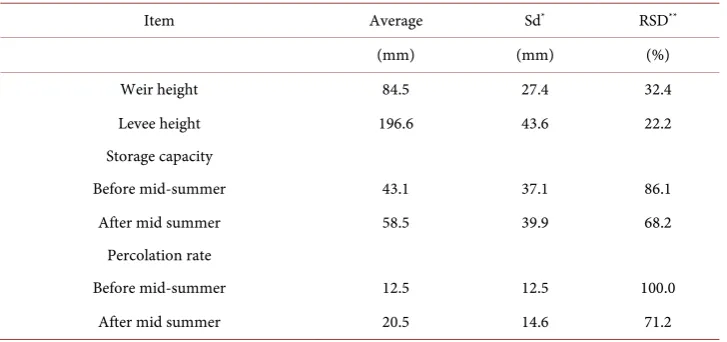
The statistical data of drainage weir height and levee height above the soil surface is
shown in Table 3. The mean (±standard deviation [SD]) weir outlet height was 84.5 ±
27.4 mm (range, 30 - 190 mm) and the mean (±SD) levee height was 196.6 mm ± 43.6 mm (range, 100 - 360 mm). The weir width was constant at about 250 mm. The storage capacity (the difference between the weir outlet height and the water level in the paddy field) is an important parameter in calculating the runoff ratio associated with initial
loss. It differs before and after midsummer drainage (Table 3). Before midsummer
drai-nage there is standing water in the paddy fields most of the time and the mean (±SD) storage capacity was 43.1 ± 37.1 mm (range, 0 - 180 mm). After midsummer drainage, there is standing water in the fields only intermittently and the mean (±SD) storage ca-pacity was 58.5 ± 39.9 mm (range, 0 - 190 mm).
3.2. Investigation of Percolation
The percolation of standing water in paddy fields was calculated by dividing before and after midsummer drainage. The mean percolation rate before midsummer drainage was
12.5 mm∙d−1 ± 12.5mm∙d−1 (range 0 - 62.0 mm∙d−1). The mean percolation rate after
[image:7.595.193.557.524.695.2]midsummer drainage was 20.5 ± 14.6 mm∙d−1 (range, 0 - 57 mm∙d−1). The values for
Table 3. Statistical properties of related items of the fields for runoff model.
Item Average Sd* RSD**
(mm) (mm) (%)
Weir height 84.5 27.4 32.4
Levee height 196.6 43.6 22.2
Storage capacity
Before mid-summer 43.1 37.1 86.1
After mid summer 58.5 39.9 68.2
Percolation rate
Before mid-summer 12.5 12.5 100.0
After mid summer 20.5 14.6 71.2
percolation rate were not normally distributed despite the regular distribution of survey
points (Figure 1). The percolation rate is estimated by subtracting evapotranspiration
from decreasing of standing water depth.
In addition, comparisons were carried out between percolation rates on the right side and left side of the Tedori River, among different elevations, and before and after mid-summer drainage. There was a significant difference in percolation rate before and after midsummer drainage (P-value is 0.06% < 5.0%). Therefore, the analysis was conducted separately for the periods before and after midsummer drainage.
3.3. Estimation of Percolation Rate for Each Land Use Type Using the
Infiltration Test
Based on the infiltration equation, the related parameters determined using observed data by least square method and averaged at five points of those. The estimated sorptivity
rate S and the final percolation rate a were, respectively, 4.6 mm∙h−1/2 and 3.4 mm∙h−1
for paddy fields, 4.1 mm∙h−1/2 and 1.7 mm∙h−1 for upland crop fields, and 11.3 mm∙h−1/2
and 1.58 mm∙h−1 for residential lots. However, if these estimations are applied directly
to the runoff model, there is likely to be considerable error because of the large
differ-ences between sites [15]. Conversely, the estimated values for areas irrigated with a
percolation rate of 20.5 mm∙d−1 after midsummer drainage because the examined events
occurs mainly after mid-summer drainage. Therefore, this percolation rate was applied for irrigated areas. Based on the percolation rate of irrigated area, the infiltration test was used for relative values of non-irrigated paddy fields, upland crop fields, and residential areas.
In previous studies, Ando et al. [16] reported infiltration rates for residential areas of
16 mm∙h−1, and Watanabe and Toyokuni [17] applied a rate of 1.5 mm∙h−1 for their
ru-noff recharge model for residential areas. However, if the total amount of rainfall is >
100 mm∙d−1, the accuracy of the percolation estimation has a minimal effect on the
es-timated peak discharge.
3.4. Depression Storage
If outlet weirs are removed from non-irrigated paddy fields and upland crop fields, the surface drainage is incomplete because of depression storage. There is also a small amount of depression storage in some residential areas. Therefore, depression storage
must be included in runoff analysis. Maruyama [18] investigated the relationship
be-tween depression storage and initial ponding depth and the depression ratio by simula-tion at 24 non-irrigasimula-tion lots in Hikone Shiga prefecture. About 35 mm of 50 mm of precipitation (70%) was stored on the soil surface.
In the present study area, there is non-irrigation of paddy fields and upland crop fields. Therefore, depression storage should be divided into two categories; cultivation that requires furrows, such as soybean crops; and cultivation that does not require fur-rows, such as wheat crops. Non-irrigated paddy fields can be included in the non-fur-
rowed category. Maruyama and Tomita [19] investigated the storage capacity of non-
Shiga prefecture. The results of that study were applied to the present runoff model. The furrow required for soybean cultivation account for 33% of the total area. Above investigated data applied for estimation of depression storage by simulation and put into our model because the character of agricultural land would be quite similar with the Tediri River alluvial fan area.
For residential area, previous research of depression storage in residential was
ap-plied in which lots have 4 - 6 mm [20], 5.0 mm [17] and 6.4 mm [21]. The value of 6.4
mm was used for the present runoff model. The relationships between depression sto-rage and precipitation for non-irrigated paddy fields, upland crop fields, and residential
areas are shown in Figure 3.
3.5. Setting the Initial Conditions
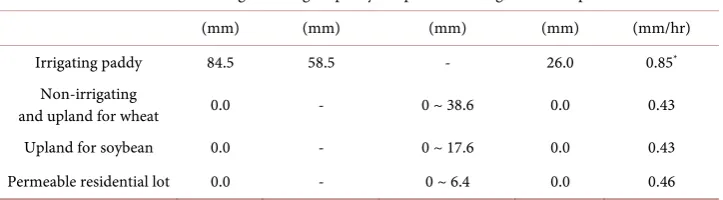
The shape of generated hydrographs differs not only in terms of the amount of the pre-cipitation input into the runoff model but also in terms of the initial conditions. The initial conditions used in the present study to investigate the unit discharge for various
land use types were based on the different sites and periods of major flooding (Table
4). For example, for irrigated paddy fields, the initial condition was set as a storage
ca-pacity of 58.5 mm, which was estimated based on a mean weir outlet height of 84.5 mm
y = 19.8(1-exp(-0.03x))
0.0 5.0 10.0 15.0 20.0 25.0 30.0 35.0 40.0 45.0
0.0 20.0 40.0 60.0 80.0 100.0
D
ep
re
ss
ion
s
tor
age
(
mm
)
Total precipitation(mm)
Non-irrigation paddy, Upland for wheat [18] Upland for soybean
(furrow ratio 33%)[19]
Permeated residential lots[17]
y = 40.2(1-exp(-0.04x))
[image:9.595.234.515.357.531.2] [image:9.595.193.555.593.693.2]y = 6.4(1-exp(-0.91x))
Figure 3. Relationship between total precipitation and depression storage.
Table 4. Initial conditions for runoff analysis.
Weir height Storage capacity Depression storage Initial depth Percolation rate
(mm) (mm) (mm) (mm) (mm/hr)
Irrigating paddy 84.5 58.5 - 26.0 0.85*
Non-irrigating
and upland for wheat 0.0 - 0 ~ 38.6 0.0 0.43
Upland for soybean 0.0 - 0 ~ 17.6 0.0 0.43
minus mean ponding depth of 26.0 mm. For non-irrigated paddy fields, upland crop fields, and residential areas, the initial condition was the depression storage. The standing water depth before precipitation was assumed to be 0 mm. In addition, evapo-transpiration having limited effect on runoff discharge estimated by complementary
relationship using Penman equation [22].
4. Consideration and Discussion
The runoff model for the Tedori River alluvial fan area was based on the data described above. If precipitation data are entered into this model, the flood discharge (potential) can be estimated for various land use types. The following is an overview of simulated potential flood discharge for various land use types.
4.1. Analysis of Total Runoff Ratio
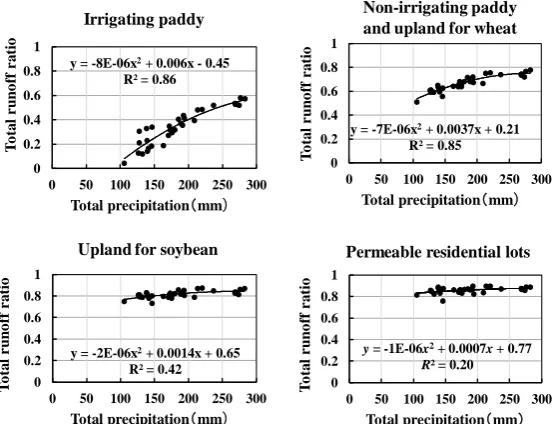
The relationship between total precipitation and total runoff ratio (total runoff/total
precipitation) was relatively smooth except for residential areas (Figure 4). The total
runoff ratio increased in the following order: paddy fields, non-irrigated paddy fields and upland wheat fields, upland soybean fields, and residential lots. The ratio varied depending on the initial conditions, such as the irrigation season. There was a marked difference in irrigated paddy fields, in which the total runoff ratio was strongly affected by paddy water management. The present study focused on the late irrigation season because heavy precipitation tended to occur during this time, and for this reason, the initial loss in irrigated paddy fields was 26.0 mm. Although the relationship between total runoff ratio and total precipitation was relatively smooth, this may change among flood events. The reason for this is the large storage capacity of agricultural land, which averages out the variation in runoff. In contrast, the relationship for residential lots was not smooth because of the low storage capacity.
y = -8E-06x2+ 0.006x - 0.45
R² = 0.86
0 0.2 0.4 0.6 0.8 1
0 50 100 150 200 250 300
T
o
ta
l r
u
n
o
ff r
a
ti
o
Total precipitation(mm)
Irrigating paddy
y = -7E-06x2+ 0.0037x + 0.21
R² = 0.85 0
0.2 0.4 0.6 0.8 1
0 50 100 150 200 250 300
T
o
ta
l r
u
n
o
ff r
a
ti
o
Total precipitation(mm)
Non-irrigating paddy and upland for wheat
y = -2E-06x2+ 0.0014x + 0.65
R² = 0.42 0
0.2 0.4 0.6 0.8 1
0 50 100 150 200 250 300
T
o
ta
l r
u
n
o
ff r
a
ti
o
Total precipitation(mm)
Upland for soybean
y = -1E-06x2+ 0.0007x + 0.77
R² = 0.20
0 0.2 0.4 0.6 0.8 1
0 50 100 150 200 250 300
T
o
ta
l r
u
n
o
ff r
a
ti
o
[image:10.595.235.513.475.687.2]Total precipitation(mm) Permeable residential lots
4.2. Representative Flood Discharge Estimated by 10-min and 60-min
Precipitation Intensity
An example of the analysis of a flood event estimated by 10-min and 60-min is shown in Figure 5. This flood event occurred on 6th-7th of July 2012. The total discharge and
0 10 20 30 40 0 1 2 3 4
1 61 121 181 241
P r e c ip itati on (mm ・ 10mi n -1) Uni t di sc ha r g e ( m m ・ 10mi n -1)
Time(min)
(e) Irrigating paddy (10-mim precipitation)
Total runoff ratio
=0.25 Peak runoff ratio
=0.11 0 10 20 30 40 0 1 2 3 4
1 61 121 181 241
P r e c ip itati on ( mm ・ 10mi n -1) Uni t di sc ha r g e ( m m ・ 10mi n -1)
Time(min)
(f ) Non-irrigating and upland for wheat (10-min precipitation)
Total runoff ratio
=0.60 Peak runoff ratio
=0.22 0 10 20 30 40 0 1 2 3 4
1 61 121 181 241
P r e c ip itati on (mm ・ 10mi n -1) Uni t di sc ha r g e ( m m ・ 10mi n -1)
Time(min)
(g) Upland for soybean (10-min precipitation)
Total runoff ratio
=0.80 Peak runoff ratio
=0.26 0 10 20 30 40 0 5 10 15 20
1 61 121 181 241
P r e c ip itati on ( mm ・ 10mi n -1) Uni t di sc ha r g e ( m m ・ 10mi n -1)
Time(min)
(d) Permeable residential lot (10-min precipitation)
Total runoff ratio
=0.86 Peak runoff ratio
=0.99 0 10 20 30 40 0 5 10 15 20
1 61 121 181 241
P r e c ip itati on ( mm ・ 10mi n -1) Uni t di sc ha r g e ( m m ・ 10mi n -1)
Time(min)
(h) Permeable residential lot (10-min precipitation)
Total runoff ratio
=0.86 Peak runoff ratio
=0.99 0 20 40 60 80 100 0 5 10 15 20 25 30
1 13 25 37
P r e c ip itati on (mm ・ 60mi n -1) Uni t di sc ha r g e ( m m ・ 60mi n -1)
Time(h)
(a) Irrigating paddy (60 min. precipitation)
Total runoff ratio
=0.25 Peak runoff ratio
=0.25 0 20 40 60 80 100 0 5 10 15 20 25 30
1 13 25 37
P r e c ip itas ti on (mm ・ 60mi n -1) Uni t di sc ha r g e ( m m ・ 60mi n -1)
Time(h)
(b) Non-irrigating paddy and upland for wheat (60-min precipitation)
Total runoff ratio
=0.61 Peak runoff ratio
=0.39 0 20 40 60 80 100 0 5 10 15 20 25 30
1 13 25 37
P r e c ip itati on ( mm ・ 60mi n -1) Uni t di sc ha r g e ( mm ・ 60mi n -1)
Time(h)
(c) Upland for soybean (60-min precipitation)
Total runoff ratio
=0.81 Peak runoff ratio
[image:11.595.206.541.145.623.2]=0.46
peak discharge increased in the following order with 10-min and 60-min precipitation intensity together: irrigated paddy fields, non-irrigated paddy fields and upland wheat fields, upland soybean fields, and residential lots. The initial loss from irrigated paddy fields was larger than that for other land use types which can be observed the runoff ratio and peak runoff ratio. Especially upland crop fields with non-furrowed crops had larger initial loss than upland crop fields with furrowed crops. The hydrograph estimated by 10-min and 60-min precipitation intensity is quite similar.
4.3. Comparison of Peak Discharge between 10-min and 60-min
Precipitation Intensity
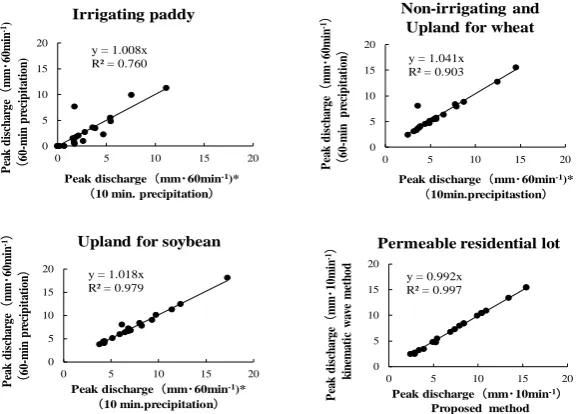
In the previous sections, the flood discharge analysis was conducted using precipitation data with a time interval of 60-min, except for residential lots for which a time interval of 10-min was used. In this section, the entire analysis was carried out with precipita-tion data at an interval of 10-min and 60-min to determine whether the results would be the same because of the large storage capacity of agricultural land. The 21 precipita-tion events for which 10-min data was available were used. The 21 events were
classi-fied as flood events based on The Disaster Recovery Project [14] with precipitation > 80
mm∙24-h−1 and > 20 mm∙h−1.
The analysis was conducted as follows: For agricultural land, hourly and 10-min and 60-min precipitation data were entered into the runoff model expressed as outlined in Equation (2) and Equation (3), and the results were compared. For residential lots, the analysis was conducted using 10-min precipitation data input into Equation (2) and
Equation (6) and the kinematic wave model [12]. The two analyses were then compared
to verify the effectiveness of the proposed method.
The hydrographs obtained from this analysis are shown in Figure 6. For this
com-parison, unit of the 10-min peak discharge can be converted into a 60-min hydrograph
y = 1.008x R² = 0.760
0 5 10 15 20
0 5 10 15 20
P eak d is ch ar ge ( mm ・ 60m in -1) ( 60 -mi n p recip it at io n )
Peak discharge(mm・60min-1)* (10 min. precipitation) Irrigating paddy
y = 1.041x R² = 0.903
0 5 10 15 20
0 5 10 15 20
P eak d is ch ar ge ( mm ・ 60m in -1) ( 60 -m in p recip it at io n )
Peak discharge(mm・60min-1)*
(10min.precipitastion)
Non-irrigating and Upland for wheat
y = 1.018x R² = 0.979
0 5 10 15 20
0 5 10 15 20
P eak d is ch ar ge ( mm ・ 60m in -1) ( 60 -m in p recip it at io n )
Peak discharge(mm・60min-1)*
(10 min.precipitation)
Upland for soybean
y = 0.992x R² = 0.997
0 5 10 15 20
0 5 10 15 20
P eak d is ch ar ge ( mm ・ 10m in -1) ki n emat ic w ave me th od
Peak discharge(mm・10min-1)
Proposed method
[image:12.595.230.519.469.676.2]Permeable residential lot
except residential lot. For residential lots, the latitudinal axes describe flood discharge calculated as precipitation minus infiltration and depression storage, that is, the effec-tive precipitation calculated using Equation (6), while the abscise axis describe the dis-charge estimated by the kinematic model analysis. There was no difference between the results using the 10-min and 60-min precipitation data for all land use types.
Consequently, 60-min precipitation data are sufficient for practical estimation of agricultural land discharge. In addition, in residential lots, the effective precipitation was almost equal to the flood discharge.
4.4. Peak Runoff Ratio Depending on Lag Time between Precipitation
and Runoff
Estimation of the peak discharge is very important for drainage planning. The peak runoff ratio and lag time (the time between peak precipitation and peak discharge tp), are important parameters to determine the peak discharge. However, the estimation of lag time is very difficult because the hyetograph shows random variation i.e., not smooth variation.
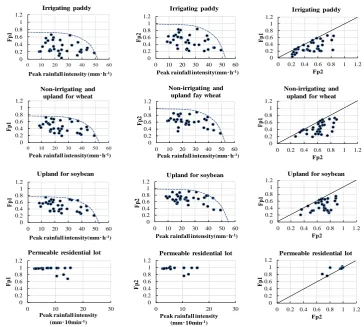
The peak runoff ratio can be estimated in two ways. The first is the ratio Fp1 between the average effective precipitation intensity (rpe) and the peak precipitation intensity (rp) during the unit time (∆t) of the analysis (Fp1 = rpe/rp). The second is the ratio Fp2 be-tween the average effective precipitation intensity (rpe) and the average precipitation intensity (rae) during the lag time tp (Fp2 = rpe/rae). The average effective precipitation
intensity (rpe) is reciprocally determined using the rational formula [23]. The tp is
esti-mated usually using observation data but not here. The tp was relatively longer in paddy fields and upland crop fields, and shorter in residential lots. There was little difference between upland wheat fields and upland soybean fields.
4.5. Analysis of Peak Runoff Ratio
Figure 7 shows the peak runoff ratio Fp1 and peak precipitation intensity for the time unit of the analysis (left column), the peak runoff ratio Fp2 and peak precipitation in-tensity for the lag time tp (center column), and a comparison between Fp1 and Fp2 (right column). The relationship between both peak runoff ratios Fp1 and Fp2 and peak precipitation was not as smooth as the relationship between the total runoff ratio and total precipitation. The Fp1 and Fp2 increased in the following order: paddy fields, upland wheat fields, upland soybean fields, and residential lots. The peak runoff ratio Fp1 was smaller than Fp2 because the time unit of the analysis is usually shorter than the lag time tp. The values for Fp1 and Fp2 were scattered but the maximum values of
the two ratios (the dotted lines in the top and middle rows of Figure 7) are useful to
es-timate the maximum potential flood discharge. There was little difference between Fp1 and Fp2 for residential lots; therefore, both ratios could be used.
0 0.2 0.4 0.6 0.8 1 1.2
0 10 20 30 40 50 60
F
p
2
Peak rainfall intensity(mm・h-1) Irrigating paddy 0 0.2 0.4 0.6 0.8 1 1.2
0 10 20 30 40 50 60
F
p
1
Peak rainfall intensity (mm・h-1) Irrigating paddy 0 0.2 0.4 0.6 0.8 1 1.2
0 0.2 0.4 0.6 0.8 1 1.2
F
p
1
Fp2
Non-irrigating and upland for wheat
0 0.2 0.4 0.6 0.8 1 1.2
0 0.2 0.4 0.6 0.8 1 1.2
F
p
1
Fp2
Upland for soybean
0 0.2 0.4 0.6 0.8 1 1.2
0 0.2 0.4 0.6 0.8 1 1.2
F
p
1
Fp2
Permeable residential lot
0 0.2 0.4 0.6 0.8 1 1.2
0 10 20 30 40 50 60
F
p
2
Peak rainfall intensity(mm・h-1) Non-irrigating and
upland fay wheat
0 0.2 0.4 0.6 0.8 1 1.2
0 10 20 30 40 50 60
F
p
2
Peak rainfall intensity(mm・h-1) Upland for soybean
0 0.2 0.4 0.6 0.8 1 1.2
0 10 20 30
F
p
2
Peak rainfall intensity (mm・10min-1)
Permeable residential lot
0 0.2 0.4 0.6 0.8 1 1.2
0 10 20 30 40 50 60
F
p
1
Peak rainfall intensity(mm・h-1) Non-irrigating and
upland for wheat
0 0.2 0.4 0.6 0.8 1 1.2
0 10 20 30 40 50 60
F
p
1
Peak rainfall intensity(mm・h-1) Upland for soybean
0 0.2 0.4 0.6 0.8 1 1.2
0 10 20 30
F
p
1
Peak rainfall intensity (mm・10min-1) Permeable residential lot
0 0.2 0.4 0.6 0.8 1 1.2
0 0.2 0.4 0.6 0.8 1 1.2
F
p
1
Fp2
[image:14.595.189.554.67.394.2]Irrigating paddy
Figure 7. Relationship between peak rainfall intensity and peak runoff ratio for various land use. There is no remarkable difference in trend between Fp1 and Fp2 although the amount has small difference.
Fp1 is more practical for the runoff analysis because the estimation of lag time tp is very difficult. However, since the relationship between Fp1 and Fp2 and peak precipitation is not smooth, which indicate that there are limitations of the use of peak discharge es-timation for individual precipitation events. To accurately estimate potential flood dis-charge, actual precipitation data must be input into the runoff model. In addition, the
maximum runoff intensity in upland crop fields is 32 mm∙h−1. There is no overflow of
levee because the depth is set as 102 mm at the outlet.
5. Summary and Conclusions
We proposed the unit flood discharge concept as a measure of flooding discharge po-tential to investigate the impact of urbanization on flooding and flood damage. First, a runoff model for paddy fields was proposed. This model differed from models pro-posed in previous research at that point actual and physical properties of the runoff
sites were used. In other word, the previous research on runoff analysis of agricultural
land is limited in to conceptual model rather than physical model, but the proposed
rain-fall event and is roughly estimate of flood discharge associated with land use changes as urbanization.
Data on the area and shape of paddy fields, upland crop fields, and residential lots, the height of drainage outlets, and standing water before and after midsummer drai-nage were collected from 135 lots and used as input for the runoff model. The paddy field storage capacity was 40.3 mm before midsummer drainage and 58.5 mm after
midsummer drainage. Percolation of 12.5 and 20.5 mm∙d−1, respectively, was observed
in paddy fields before and after midsummer drainage. Second, the runoff model as ex-pressed in Equation (2) and Equation (3) was used to analyze 54 rainfall events using 74 years of rainfall data from the Kanazawa Metrological Observation Station. In addition, parameters such as the initial standing water depth and percolation rate were deter-mined by observation at each survey site.
The relationship between total runoff ratio and total precipitation was relatively smooth. The ratio increased in the following order: irrigated paddy fields, non-irrigated paddy fields, upland wheat fields, upland soybean fields, and residential lots. The initial runoff from paddy fields was smaller than that from other land use types and the runoff from upland crop fields was larger for crops requiring furrows (e.g., soybean) than for those that did not require furrows (e.g., wheat). The total runoff ratio is very useful to estimate the impact of urbanization on total runoff.
Runoff analysis for agricultural land was conducted using 60-min and 10-min preci-pitation data. There was little difference between the results using the two data inter-vals. Therefore, the use of 60-min precipitation data is practical and there are abundant data available. For residential lots, kinematic wave analysis was compared with analysis based on 10-min precipitation data. There was little difference between the results of the two methods. Therefore, 10-min precipitation data can be used to directly estimate potential flood discharge in residential areas.
The relationship between peak runoff ratio and peak precipitation was not as smooth as the relationship between total runoff ratio and total precipitation. There was a dif-ference between the peak runoff ratio calculated using 60-min precipitation data (Fp1) and the peak runoff ratio calculated using the lag time between peak precipitation and
peak discharge (Fp2). For the runoff analysis, Fp2 is more theoretically appropriate.
However, Fp1 is more practical because estimation of lag time is very difficult. The
peak runoff ratio is very useful to estimate peak discharge from precipitation; in partic-ular, the highest peak runoff ratio is useful to estimate the maximum potential flood discharge.
It was not possible to compare observed and estimated flood discharge in the present study. However, this study confirms the value of unit flood discharge to measure the potential for flooding and flood damage in areas with various land use types, and to as-sess the impact of urbanization on flooding.
Acknowledgements
information and the students of the Prefectural University for help with the infiltration investigation.
References
[1] Kadoya, M. (1985) A Review of the Study on Runoff Changes Due to Urbanization. Journal of Japan Society of Civil Engineers, 363, 2-4, 23-34.
http://dx.doi.org/10.2208/jscej.1985.363_23
[2] Yoshikawa, N., Nagao, N. and Misawa, S. (2009a) Evaluation of Runoff Detention Function of the Paddy Field Installed with Runoff Control Devices. Japanese Society of Irrigation, Drainage and Rural Engineering, 261, 263-271.
[3] Yoshikawa, N., Nagao, N. and Misawa, S. (2009b) Watershed Scale Evaluation of Flood Mi-tigation Function of Paddy Field Installed with Runoff Control Devices. Japanese Society of Irrigation, Drainage and Rural Engineering 261, 273-280.
[4] Masumoto, T., Nozoe, M., Yoshimura, A. and Matsuda, S. (2003) A Paddy Runoff Model in Hilly Rural Areas for Evaluating Runoff Change due to Abandoned Rice Cultivation. Japa-nese Society of Irrigation, Drainage and Rural Engineering, 224, 175-184.
[5] Yomota, A. and Miura, T. (1982) Evaluation of Surface Discharge of Rotational Land Use of Paddy and Upland. Journal of the Agricultural Engineering Society, Japan, 50, 1027-1031. [6] Senge, M., Nishide, T. and Adachi, T. (1987) Runoff Simulation Model and Unit Area
Sur-face Design Peak Runoff Coefficients of a Rotational Paddy Field. Japanese Society of Irriga-tion, Drainage and Rural Engineering, 131, 43-50.
[7] Maruyama, T., Tomita, M. and Kobayashi, S. (1979) Water Balance Analysis in Special Area Using Composite Reservoir Model, 1. Feature and Structure of the Model. Journal of Agri-cultural Engineering, 47, 97-102.
[8] Segawa, M., Maruyama, T. and Takase, K. (2016) Estimation of Rainfall-Runoff Discharge from Unit Area of Paddy, Upland and Residential Area in the Tedori River Alluvial Fan Area. Japanese Society of Irrigation, Drainage and Rural Engineering, 302, 103-112. [9] Maruyama, T., Noto, F., Yoshida, M., Nakamura, K., Horino, H., Murashima, K. and
Taki-moto, H. (2012) Analysis of Water Balance at the Tedori River Alluvial Fan Areas in Japan. Journal of Japan Society of Hydrology and Water Resources, 25, 20-29.
http://dx.doi.org/10.3178/jjshwr.25.20
[10]The Japanese Industrial Standards Committee (1994) Sampling Methods for Industrial Wa-ter and Industrial WastewaWa-ter, Standard K0094. 19-25.
http://kikakurui.com/k0/K0094-1994-01.html
[11]Ishikawa Prefectural Cultural Affairs Public Access Division Statistics Information Office (2013) Population Such as Basic Aggregate Results in Ishikawa Prefectural of 2010 National Census. 128-132. http://toukei.pref.ishikawa.jp/dl/2332/H22census_jinkou_shiryo.pdf [12]Japanese Society of Irrigation, Drainage and Rural Engineering (1989) Handbook of
Irriga-tion, Drainage and Rural Engineering. Version 5, Maruzen Ltd., Tokyo, 862-863.
[13]Philip, J.R. (1957) The Theory of Infiltration, 1. The Infiltration Equation and Its Solution.
Soil Science, 83, 345-357. http://dx.doi.org/10.1097/00010694-195705000-00002
[14]Tanakamaru, H., Kobayashi, S. and Maruyama, T. (1984) Runoff Analysis in Reclaimed Agricultural Land Considering Spatial Variability of Permeability—Change in Runoff Properties due to Reclamation (Ⅱ). Japanese Society of Irrigation, Drainage and Rural
En-gineering, 113, 8-16.
Basin Considering Infiltration Capacity for Various Land Uses. Proceedings of the Japanese Conference on Hydraulics, 29, 49-54.
[16]Watanabe, M. and Toyokuni, E. (1989) Urban Catchment Modeling and Storm Water Ru-noff Simulations. Natural Disaster Science, 8, 46-63.
[17]Maruyama, T. (1975) Water Balance of Paddy Field, Especially, on Residual Water for Sur-face Runoff in Paddy Field. Physical Properties of Soil, 32, 11-15.
[18]Maruyama, T. and Tomita, M. (1975) Drainage for Residual Water at Furrows. Japanese So-ciety of Irrigation, Drainage and Rural Engineering, 59, 9-14,
[19]Yamaguchi, T., Matsubara, S. and Yamamori, T. (1973) Investigation of Rainfall and Runoff Relationship at Urban Area. Technical Report of Civil Engineering, 15, 37-46.
[20]Tolin, A.L. and Keifer, C.J. (1959) The Hydrology of Urban Runoff. Journal of the Sanitary
Engineering Division, American Society of Civil Engineers, 85, 47-106.
[21]Brustsaert, W. and Stricker, H. (1979) An Advection-Aridity Approach to Estimate Actual Regional Evapotranspiration. Water Resources Research, 15, 443-450.
http://dx.doi.org/10.1029/WR015i002p00443
[22]Disaster Management Office (2011) Ministry of Agriculture, Forestry and Fisheries Rural Development Office Maintenance Section. Disaster Prevention Division, Summary of Farmland and Agricultural Facilities Disaster Recovery Business, 1-7.
http://www.maff.go.jp/j/nousin/bousai/bousai_saigai/b_hukkyuu/pdf/panfu.pdf#search='%
E8%BE%B2%E5%9C%B0%E7%81%BD%E5%AE%B3+%E5%AE%9A%E7%BE%A9'
[23]Japanese Society of Irrigation, Drainage and Rural Engineering (1989) Handbook of Irriga-tion, Drainage and Rural Engineering. Version 5, Maruzen Ltd., Tokyo, 858.
Submit or recommend next manuscript to SCIRP and we will provide best service for you:
Accepting pre-submission inquiries through Email, Facebook, LinkedIn, Twitter, etc. A wide selection of journals (inclusive of 9 subjects, more than 200 journals)
Providing 24-hour high-quality service User-friendly online submission system Fair and swift peer-review system
Efficient typesetting and proofreading procedure
Display of the result of downloads and visits, as well as the number of cited articles Maximum dissemination of your research work
![Table 1. Land use of the Tedori River alluvial fan area [9].](https://thumb-us.123doks.com/thumbv2/123dok_us/7865075.737653/3.595.237.510.296.552/table-land-use-tedori-river-alluvial-fan-area.webp)