Add-on Security Level for Public Key Cryptosystem
using Magic Rectangle with Column/Row Shifting
D.I. George
Amalarethinam,
Ph.DAsso. Prof & Director- MCA, Jamal Mohamed
College Trichy,India
J.Sai Geetha
Asst. Prof,Dept of CS Nehru Memorial College Puthanampatti,Trichy,IndiaK.Mani,
Ph.D Asso.Prof,Dept of CS Nehru Memorial College Puthanampatti,Trichy,IndiaABSTRACT
In today’s world, security is required to transmit confidential information over the network. Security is also demanded in wide range of applications. Cryptographic algorithms play an important role in providing the data security against malicious attacks. The efficiency of cryptographic algorithm is not only based on its time taken for encryption and decryption, and it also accounts for number of stages used to obtain the cipher text from a plain text. Rivest-Shamir-Adleman (RSA) algorithm is a popular encryption scheme that guarantees confidentiality and authenticity over an insecure communication channel. However, several attacks are introduced to break the security of these algorithms due to certain constraints. Also, it may not be guaranteed that the cipher text is fully secured. One such limitation in the past crypto system is using ASCII Characters for numerical representation of the selected text. To overcome the above said issue, an innovative algorithm, namely, Magic Rectangle is being proposed in this work. It is helpful to enhance the security on account of its complexity of the encryption process. The singly even magic rectangle is constructed based on the seed number, start number, row sum and column sum. It is very difficult to trace these values because of their randomness. After construction of the rectangle, the columns / rows of resultant rectangle are shifted based on the seed value. The proposed work introduces additional level of security in public key algorithms such as RSA, ECC and Rabin, Elgamal etc. Finally, Magic Rectangle helps to rectify the existing issues of public key cryptosystem. Cipher text generated by using the proposed method can be completely different when compared to the plain text and will be suitable for the secured communication through the internet. Since this model is acting as a wrapper to public key algorithm, it confirms that the network security is reasonably improved.
Keywords -
Magic Rectangle, Column/Row shifting,Public Key Cryptosystem, RSA, Security, Public key, Secret Key, MR
1.INTRODUCTION
Cryptography is a science of secret writing. It is the technique of defending the information by transforming it into an unreadable format in which a message can be hidden from the casual reader and only the intended recipient will be able to convert it into original text. It is the study of mathematical techniques related to aspects of information security such as confidentiality, Data Integrity, user validation, and data source authentication. Symmetric and Asymmetric keys are the two categories of
Cryptography algorithms. In Symmetric keys encryption or secret key encryption, for encryption and decryption of data a single key is used. The secret key is known only to the sender and receiver of a message who can apply the same key for encryption and decryption process. The main challenge is getting the sender and receiver to agree on the secret key without anyone else finding out. The key should be distributed before transmission between entities. The concept of public-key cryptography was brought into use during 1976[1] by Whitfield Diffie and Martin Hellman to overcome the key management issues. Two separate keys are used in Public-key cryptography. The first key is acting as a secret key and the remaining one is public. Even though these keys are different, the two parts of the key pair are mathematically linked. The algorithms used for public key cryptography are based on mathematical relationships such as integer factorization and discrete logarithms. The generation of the public and the secret keys are uncomplicated by the recipient, to decrypt the message using the private key. The encryption using the public key by the sender is also unproblematic. However, it is extremely difficult for anyone to derive the private key, based on their little knowledge of the public key. It is the sole reason for a public key algorithm does not require a secure initial exchange of one (or more) secret key(s) between the sender and receiver, unlike symmetric key algorithms. Public-key cryptography is an important fundamental approach used by many cryptographic algorithms and crypto-systems[1]. The parameters used in encryption and decryption process of the algorithm plays a vital role for security. In RSA, the secret key is derived from the public key and choosing p and q with very large size. Even though the above parameters are considered carefully in RSA, it is not fully secured because of using ASCII character. The same cipher text value will be repeated if the same character is repeated more than one place in the plain text. To overcome this problem, this paper tries to develop a method with different singly even magic rectangle of the order 32 x 48. Thus preferably different numerals representing the position of ASCII values are taken from magic rectangle. The encryption process is being performed using RSA crypto-system[3].
2. RELATED WORK
Amare Anagaw Aycle and Vuda Sreenivasarao[2] proposed an efficient implementation of RSA algorithm using two public key pairs and applying mathematical logics rather than sending the encryption key(e) value directly as a public key. Because if an attacker has the opportunity of getting the value, they can directly find decryption key (d) value and decrypt the message. Gopinath Ganapathy and K Mani [3] enhanced the efficiency by providing add on security to the cryptosystem. The approach introduced by them increased the security due to its complexity in encryption by using the magic square concept. It provided another layer of security to any public key algorithm. Sonia Goyat[4] proposed an algorithm pertaining to the application of Genetic algorithm to cryptography and modifies the approach to generate keys that have more strength.There is no repetition of random values used in key generation. B.R.Ambedkar and S.S. Bedi[5] proposed a work focuses on factorization of all trivial and nontrivial integer numbers and requires fewer steps for factorization process of RSA modulus N. The Pollard rho factorization method forms the basis for New Factorization method. Sonal Sharma, Saroj Hiranwal, Prashant Sharma[6] present a new algorithm (Modified Subset-Sum cryptosystem over RSA) which is secured against various types of Mathematical attacks on RSA as well as Shamir attacks. Prasant Sharma, Amit Kumar Gupta et al [7] analysed the speed of RSA public key cryptosystem to reduce the time taken for finding factor for a large number. They proposed a new algorithm and its performance was compared with Fermats factorization Algorithm and trial division algorithm. \Ravi Shankar Dhakar, Amit Kumar Gupta et al [8] improved the security of RSA cryptography algorithm based on additive homomorphic properties. The proposed algorithm is secured based on the factoring problem as well as decisional composite residuosity assumption.
3. PROPOSED METHODOLOGY
The methodology of the proposed security model is described in the following steps.
Construct different singly even magic rectangle of order 32x48 and used in lieu of ASCII table with 128 values. The Magic rectangle contains totally 1536 values. It has been divided into 12 quadrants, each consists of 128 characters.
Each character of the plain text is converted into numerals based on its position in magic rectangle in different quadrants. The numerals are then encrypted and decrypted using RSA algorithm. This methodology of the security model is shown in figure 1.
3.1.Construction of Magic Rectangle
3.1.1. Magic Square
The magic square concept forms the basis for magic Rectangle. A magic square of order n is an arrangement of integers in an nxn matrix such that the sums of all the elements in every row, column are equal. In addition, the sums of all elements along the two main diagonals are also equal. The magic constant of a magic square depends only on n and has the value
M (n) =n (n2+1) / 2
Magic square can be classified into three types: odd, doubly even (n divisible by four), singly even (n is even and not divisible by four) [3][9].
Seedvalue , Column sum, Minstart and Maxstart Encryption
Decryption
Figure 1.Security Model
The basic constraint of forming the Magic rectangle is that sums of all the elements in every row as well as columns are to be equal. The order of the matrix is even but not divisible by four such as 4x6, 8x12, 16x24, 32x48 etc. The size of the rectangle is purely based on the rules of perfect rectangle or golden rectangle [10][11] and also the singly even magic rectangle.
Example;
8x12 rectangle
a=8 and b=4 i.e. one 8*8 matrix and increases by four columns
(8+4)/8 ≡ 8/4 1.5 ≡ 2
In general, mxn rectangle
a=m and b=n i.e, one axa matrix and increases by b columns
(a+b) /a ≡ a/b
The divide and conquer strategy[12] is adapted for forming Magic rectangle. In magic rectangle, the initial input column sum is fixed as 32x48. This column sum is divided by two to form the next level of magic rectangle which is in the order of 16x24 . The resultant column sum is further is divided by two to obtain the next level of MR which is in the order of 8x12.
The column sum is calculated by the below formula MRixjcsum= csum / n where n=2,4,8,….
i=x,x/2,x/4,x/8…. Determining the
numeral value from the magic rectangle that corresponds to the position of ASCII value with different quadrants
Plain Text
Encryption process Cipher Text
Generating singly even Magic Rectangle of order 32 x 48.
The magic Rectangle after shifting rows or
columns
Cipher Text
Plain Text Decryption
process
Determining the position of the numeral value in the magic rectangle
j=y,y/2,y/4,y/8…
x and y may be any positive integer divisible by four. MRixj represents the row(i) and column(j) of the Magic Rectangle MR.
The row sum is calculated by using the following formula MRixjrsum= csum +(csum / n) where n=2,4,8,….
i=x,x/2,x/4,x/8…. j=y,y/2,y/4,y/8…
If the initial input column sum is taken as even value, then it matches exactly in column sum of magic rectangle. On the other hand, if the column sum is taken as odd value, then the resultant column sum to be reduced by one because of fractional value. For example, if the initial column sum is taken as 12345, The column sum generated by the rectangle is 12344.
This paper focuses only a singly even magic rectangle implementation and their usefulness in public key crypto-system.
3.1.2. Singly even magic rectangle Concept
In this work, the singly even magic rectangle is generated by using any seed number, starting number and magic column sum. The numbers are generated in a consecutive order.The Notations used in the present work are as follows: MR : Magic Rectangle
nxm : Order of MR
where n=4a and m=6a where a=1, 2, 4, 8 etc MRnxm : MR of order nxm
The values in the MR4x6 are filled as shown in Figure 2. The function is called MR4x6 fill order (Minstart, Maxstart).
Figure 2. Magic Rectangle Filling Order
In Fig.4, ‘*’ represents the places in magic rectangle to be filled having its starting point from Minstart and incremented by 2 each time to get the next number. The places without ‘*’ in magic rectangle to be filled having its starting point from Maxstart and decremented by 2 to get the next number.
3.2. Magic Rectangle generation
The MR algorithm started with the input values Minstart, Maxstart, column sum and seed value. The seed value is the 4 bit binary value. If the input seed value is ‘1’ bit, then either row or column of Magic Rectangle is shifted circularly. Otherwise shifting of row or column is not warranted. The Pseudo code of the above concept is shown in Figure 3.
Figure 3. Magic Rectangle generation algorithm Implementation of the above algorithm will create four magic rectangles. Finally these four MR are combined together to form the next level of MR by using the following method MRixj=MR(i/2)x(j/2)|| MR(i/2)x(j/2)||MR(i/2)x(j/2)||MR(i/2)x(j/2)
4. EXPERIMENTS AND RESULTS
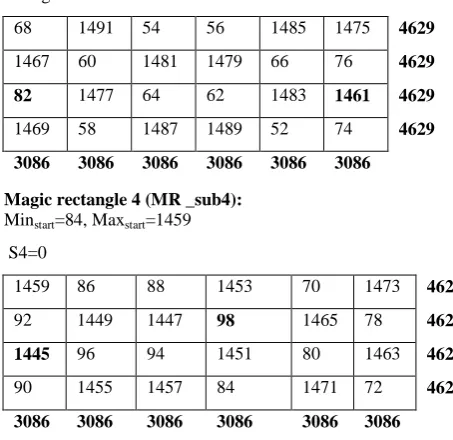
This methodology is implemented in Java. The time taken for encryption and decryption of various size of file message are measured. As an illustration, the following magic rectangles are generated with row sum as 4629 and column sum as 3086. In this experiment, the seed value is 0010. The first, second and the last Magic rectangles are unchanged as the respective seed value is ‘0’. The column values are shifted circularly in the third Magic rectangle since the seed value for the same is ‘1’.
4.1. Illustration of Magic Rectangle
S1=0, S2=0, S3=1, S4=0 MR16x24, csum=12345
MR4x6,csum=12345/4=3086.25=3086 MR4x6, rsum= (3086/2) +3086=4629 Magic rectangle 1 (MR _sub1):
Minstart=4, Maxstart=1539 ,S1=0
1539 6 8 1533 1523 20 4629
12 1529 1527 18 28 1515 4629
1525 16 14 1531 1509 34 4629
10 1535 1537 4 26 1517 4629
3086 3086 3086 3086 3086 3086
Magic rectangle 2 (MR _sub2): Minstart=36, Maxstart=1507; S2=0
1507 38 40 1501 22 1521 4629
44 1497 1495 50 1513 30 4629
1493 48 46 1499 32 1511 4629
42 1503 1505 36 1519 24 4629
3086 3086 3086 3086 3086 3086
Magic rectangle 3 (MR _sub3): Minstart=52, Maxstart=1491 S3=1
Maxstart *(+2) *(+4) -6 -16 *(+16)
*(+8) -10 -12 *(+14) *(+24) -24
-14 *(+12) *(+10) -8 -30 *(+30)
*(+6) -4 -2 *Minstart *(+22) -22
Input: 4 digit seed number, starting number and column sum of magic rectangle.
Output: Singly even magic rectangle Method:
Step 1: Read seed number,Minstart , Maxstart value and Initial column sum
Step 2:compute the row sum and column sum
Step 3: Generate the magic rectangle
Step 4: If ( seed number== 1) Shift either row/column Else
No need of shifting end;
1491 54 56 1485 1475 68 4629 60 1481 1479 66 76 1467 4629 1477 64 62 1483 1461 82 4629 58 1487 1489 52 74 1469 4629 3086 3086 3086 3086 3086 3086
The rectangle is shifted circularly one position to the right because of the seed value s3=1.
68 1491 54 56 1485 1475 4629 1467 60 1481 1479 66 76 4629 82 1477 64 62 1483 1461 4629 1469 58 1487 1489 52 74 4629 3086 3086 3086 3086 3086 3086
Magic rectangle 4 (MR _sub4): Minstart=84, Maxstart=1459 S4=0
1459 86 88 1453 70 1473 4629
92 1449 1447 98 1465 78 4629
1445 96 94 1451 80 1463 4629
90 1455 1457 84 1471 72 4629
3086 3086 3086 3086 3086 3086
Four 4x6 magic rectangles are generated as above. Combination of these four rectangles forms the next level of MR of order 8x12.
MR_sub1(8x12)= MR_sub1(4x6)||MR_sub2(4x6)||
MR _sub3(4x6)|| MR _sub4(4x6).
The sample Magic rectangle of order 8x12 is represented in Figure6.Similarly, MR_sub1(8x12), MR_sub2(8x12), MR_sub3 (8x12) and MR_sub4(8x12) are generated and concatenated to form MR(16x24). The process continues till magic rectangle of order 32x48 is obtained. In MR(32x48), there are totally 1536 values. Since the maximum size of character for ASCII code representation is 128, the obtained value (1536) will be divided into 12 quadrant of size 128. The plain text characters are replaced by the value in different quadrant consecutively.
4.2 Encryption / Decryption of message
using RSA cryptosystem with magic
rectangle.
In public key cryptosystem, RSA is one of the famous and highly secured algorithms. It is the first algorithm known to be suitable for digital signature as well as for encryption. The concept of magic rectangle is applied into RSA algorithm.
4.2.1 RSA algorithm with MR
[image:4.595.53.275.71.152.2]RSA involves a public key and a private key. Reasonable amount of time is required to decrypt the message using the private key when compared with encryption using public key[15]. The Encryption and decryption process of RSA algorithm is illustrated in Figure 4 and Figure 5 respectively.
Figure 4. RSA Encryption process using MR.
Figure 5. RSA Decryption process using MR.
4.2.2 Outcome of RSA algorithm with Magic
Rectangle.
The comparison between cipher text generated by the existing RSA and the proposed RSA with MR is shown in Table1. In plain text, the character ‘M’ takes places twice. In existing encryption, the cipher text value of ‘M’ is same. In contrary, the cipher text value of the ‘M’ is 134 and 160 in the proposed RSA with MR.
Input:Magic rectangle,plain Text ,public key RSA algorithm
Output: cipher text Method:
Step 1: Read plain text .
Step2: Replace the plaintext with numeric value using MR Step 3: Encrypt using public key
Step 4: Produce the cipher text.
Input:Magic rectangle, ciphertext, private key RSA algorithm
Output:Plain text Method:
Step 1: Read cipher text . Step 2: Decrypt using private key
[image:4.595.52.279.175.395.2]Figure 6. Magic rectangle of order 8X12
Table 1. Comparison of Cipher text
The sample plain text “SUMMER” is encrypted and decrypted using ASCII . The screen shot of this process is shown in figure 7.
Figure 7. RSA encryption and Decryption using ASCII
The given message is “SUMMER”. First, each and every character of the message is converted to the numerical value by using magic rectangle. The ASCII value of ‘S’,’U’,’M’,’M’,’E’,’R’ is 83,85,77,77,69 and 82. To encrypt ‘S’, the value in the 83rd
position in the first quadrant is applied. Likewise, the value of each character is taken from the consecutive quadrants. The character ‘M’ is repeated twice in the plain text. The first occurrence of ‘M’ value is taken from one quadrant and the second occurrence uses another quadrant. As a result, the value of the cipher text is different
for each occurrence when same character occurs more than once. It is illustrated in the screenshot in Figure 8.
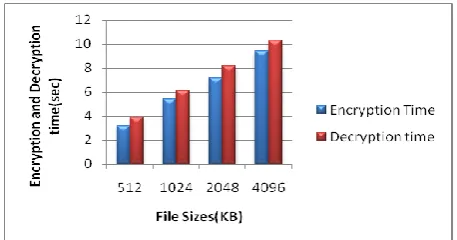
Figure 8. RSA encryption and Decryption using MR. Encryption and decryption time of RSA using MR with various file sizes are shown in Table2.
Table2. Time Comparison with different file size
[image:5.595.53.300.463.627.2]The graphical representation of the above table is shown in Figure 9. It is found that the decryption time is always greater than the encryption time with any file size.
Figure 9.Comparison of Encryption and Decryption time 1539 6 8 1533 1523 20 1491 54 56 1485 1475 68 9258
12 1529 1527 18 28 1515 60 1481 1479 66 76 1467 9258 1525 16 14 1531 1509 34 1477 64 62 1483 1461 82 9258 10 1535 1537 4 26 1517 58 1487 1489 52 74 1469 9258 1507 38 40 1501 22 1521 1459 86 88 1453 70 1473 9258 44 1497 1495 50 1513 30 92 1449 1447 98 1465 78 9258 1493 48 46 1499 32 1511 1445 96 94 1451 80 1463 9258 42 1503 1505 36 1519 24 90 1455 1457 84 1471 72 9258 6172 6172 6172 6172 6172 6172 6172 6172 6172 6172 6172 6172
Existing RSA RSA with MR
Plain Text
ASCII Value
Cipher Text
Plain Text
MR Value
Cipher Text
S 83 194 S 1447 388
U 85 380 U 242 514
M 77 211 M 1395 134
M 77 211 M 1287 160
E 69 276 E 58 261
R 82 94 R 168 402
File size(kb) Encryption time(sec)
Decryption time(sec)
Total Time(sec)
512 3.2 3.9 7.1
1024 5.4 6.1 11.5
2048 7.2 8.2 15.4
[image:5.595.314.543.629.749.2]Figure 10.Comparison of Total time with file size
4.3. RESULT AND DISCUSSION
It is observed that whenever the file size is increases, the total time for encryption and decryption process will also increases as shown in Figure 10. The limitation in the proposed work is that it needs additional time to construct magic rectangle initially. However, encryption and decryption process does not call for any addition time. The randomness of the value of magic rectangle enhances the security of the cipher text. In the existing concept of ASCII, the cipher text values are repeated whenever the same characters are repeated in the plain text. In the proposed magic rectangle, different values are applied in the cipher text for each occurrence of same character in plain text. It enhances of the security of the cipher text. Instead of single ASCII table, 12 tables with different set of values are used. It is more complicated to identify the value of MR assigned into the plain text by any intruders.
It is summarized that,
1. Each communication session uses a newly generated Magic Rectangle
2. Increases the randomness of the cipher text value even though the characters are repeated. 3. Can Generate rectangles from any values with
equal row sums and column sums.
4. No change in the encryption and decryption time using MR.
5. Increases the complexity to derive the plain text from the cipher text by any intruders.
6. Capable of applying MR in any Public key algorithms.
7. To overcome the existing issues in RSA algorithm.
5. CONCLUSION
This proposed work analyzed the various attacks of existing RSA algorithm with ASCII code and introduces security enhancement using singly even magic rectangle. It prohibits any intruders from obtaining the plain text in a readable form. The security aspect is enhanced as there is no repetition of values in Magic rectangle. There are several parameters used to increase the time complexity for the construction of magic rectangle such as seed value, column sum, Minstart and Maxstart values. Even if the intruders found the initial values of MR, it is very difficult to trace the row/column shifting based on the seed value. It plays a vital role in increasing the randomness and security of the algorithm. One of the issues in the
proposed work is additional time needed for the construction of Magic rectangle initially.
6. REFERENCES
[1] A.J.Menezes ,P.C.Van Oorschot, and S.Vanstone , “Handbook of Applied cryptography”, CRC Press, Boca Ration,Florida, USA,1997.
[2] Amare Anagaw Ayele1 , Dr. Vuda Sreenivasarao.,” A Modified RSA Encryption Technique Based on Multiple public keys, International Journal of Innovative Research in Computer and Communication Engineering ISSN (Online): 2320 – 9801Vol.1, Issue 4, June 2013 [3] Gopinath Ganapathy, and K.Mani , “ Add-On Security
Model for public key Cryptosystem Based on Magic Square Implementation”, ISBN 978-988-17012-6-8, Proceedings of the world congress on Engineering and Computer Science 2009 Vol I, San Fransisco, USA. [4] Sonia Goyat.,” Genetic key generation for public key
cryptography “,International Journal of Soft Computing and Engineering (IJSCE) ISSN: 2231-2307, Volume-2, Issue-3, July 2012.
[5] B.R.Ambedkar and S.S.Bedi,”A New Factorization B.R.Ambedkar and S.S.Bedi,”A New Factorization Vol. 8, Issue 6, No 1, November 2011,ISSN :1694-0814. [6] Sonal Sharma, Saroj Hiranwal, Prashant Sharma A new
variant of subset-sum cryptosystem over RSA, International Journal of Advances in Engineering & Technology, Jan 2012.©IJAET ISSN: 2231-1963 [7] Sharma, P. Gupta, A.K. ; Vijay, A. “Modified Integer
Factorization Algorithm Using V-Factor Method” Page(s): 423 - 425 ,978-0-7695-4640-7/12, IEEE 2012. [8] Ravi Shankar Dhakar, Amit Kuar Gupta, Prashant
Sharma ”Modified RSA Encryption Algorithm(MREA)”- 978-0-7695-4640-7/12, IEEE2012 [9] Adam Rogers, and Peter Loly ,”The inertial properties of
Squares and Cubes”, Nov-2004, pp.1-3. [10]en.wikipedia.org/wiki/Golden_rectangle
[11]Omotheinwa T.O, Ramon S.O., “ Fibonacci Numbers and Golden Ratio in Mathematics and Science”, International Journal of Computer and Information Technology (ISSN”2279-0764) Volume 03-Issue 04, July 2013
[12]Mohammad Zaidul Karim and Nargis Akter, “ Optimum Partition Parameter of Divide-And-Conquer Algorithm for solving closest-Pair Problem”, International Journal of Computer Science & Information Technology (IJCSIT) Vol 3, No 5,Oct 2011.
[13]B.Schenier. “Applied Cryptography”, John Wiley & Sons Inc, New York, Second Edition, 1996.
[14]William Stallings, ”Cryptography and Network Security”, Prentice Hall, Upper Saddle River, New Jersy, USA, Second Edition ,1997.