Techniques of Power Optimization for Wireless
Sensor Network
Mukul Pratap Singh
(M.Tech-CSE) Amity School of Engineering & Technology, Amity University, Noida (UP)
Kunal Gupta
(Asst. Professor) Amity School of Engineering & Technology, Amity University, Noida (UP)
ABSTRACT
Wireless Sensor Networks is one of the hottest topic and growing area now days. WSN have become popular due to its wide range applications. There are lots of problems in Wireless sensor networks related to Power, Cost, and Bandwidth etc. Power optimization is the main constraint in WSN and this limitation with a typical deployment of huge figure of nodes has added challenges to the design and management of WSN. They are typically used for remote environment monitoring in areas where providing electrical power is difficult. Therefore, the devices need to be powered by batteries and alternative energy sources. The energy of battery is limited in Wireless sensor Networks.
In WSN, limited transmission range, processing and storage capability as well as power resources are limited of sensor node. In this work, present a survey of new power saving and power optimization techniques for wireless sensor networks, which gives better result and increase the performance of WSN application areas.
General Terms
Power Consumption
Keywords
WSN (wireless senor network), Power consumption, Authentication Scheme, nACO, Data mining.
1.
INTRODUCTION
At first Wireless Sensor Network (WSN) was developed for military applications [1], In WSN, sensors are very powerful, smaller and less expensive, therefor, its use expanded in civilian applications. The sensors used in WSN are advantageous in friendly as well as in harsh conditions without any power and communication lines to periodically sense and transmit data to the sink, hence it is widely used. In present-time, a wide range of civilian applications such as habitat, environment and health monitoring [2] have been deployed. Currently the issue of power consumption is very important in sensor development. Transceiver is an important constituent of sensor node that operates at a specific frequency for data communication which is sensitive to several environmental conditions. As it has already mentioned that sensor nodes which are used in WSNs are usually battery powered but nodes are typically unattended because of their deployment in hazardous, hostile or remote environments. While in the designing of electronic transceiver circuits and in network protocols number of powers saving technique should be used. In reducing the power consumption the first step that should be used is a sound electronic design and selecting the right components and applying appropriate design techniques to each case. One of the major causes of energy loss in the WSN node is the idle mode consumption, when the node is not transmitting/receiving any information but listening and
waiting for information from other nodes. Another reason of energy loss is due to packet collision, because all packets which are involved in collision are discarded and must be sent again.
Reception of packets that are not addressed to the node and transmission & retransmission of control packets are some other causes of power wastage. The main objective of this paper is to present a survey of the different power saving and energy optimization techniques for WSNs, so tackling this issue from several perspectives in order to provide a whole view in this matter. The paper is organized as follows, Section I: introduce the wireless sensor networks and application, Section II: deals with the architectural issues in wireless sensor network. Section III: The description of the typical hardware architecture that can be seen in any sensor node and the power constraints in wireless sensor network are show in section IV. Section V describes the some new power optimization techniques for wireless sensor networks, which helps for flexible network structure. Section VI is shows the performance comparison of power saving.
2.
ARCHITECTURAL ISSUES IN WSN
2.1
Implications on WSN
1. Network Dynamics: Sensor network has three main
components i.e. sensor nodes, sink and monitored events. The main and an important issue in WSN design is the implication of mobility of sink nodes. Routing has its importance in routing messages from or to moving nodes and is even challenging as route stability is an important optimization factor, and even energy, bandwidth etc. 2. Node Deployment: Topological deployment of nodes is also an important consideration. It is application dependent as it makes an impression the performance of the routing protocol. The deployment is deterministic or self-organizing.
3. Energy Considerations: As the transmission power of a wireless radio is proportional to distance squared, multi hop routing; it will consume not more energy than direct communication. At the creation of infrastructure, the setting of routes is influenced by energy.
3.
WIRELESS SENOR NODE HARDWARE
STRUCTURE
3.1 Microcontroller
It is a single chip microcomputer made through VLSI fabrication. A microcontroller controls the functionality of the other sensor node component; it performs tasks and process data in the sensor node. A microcontroller is a general purpose desktop microprocessor, digital signal processor, FPGAs (Field-programmable gate array) and ASICs (Application-specific integrated circuit). A microcontroller is used sensor node because of its low cost; easy connect to other devices, programming easy, low energy consumption. A microprocessor is not used generally because it takes more power than microcontroller, so microcontroller is suitable choice for a sensor node. Process modulation and signal processing tasks of real sensing of data is less complex for wireless communication in wireless sensor networks.
Advantages of DSPs are not much valuable to wireless sensor nodes. FPGAs can be reprogrammed and again configured as requirements, but it takes more time and energy.
Figure1. Structure of Sensor node
3.2 Transceiver
ISM (industrial, scientific and medical) band is used by Sensor nodes very often, which gives free global possibility and radio spectrum allocation. Radio frequency (RF), optical communication (laser) and infrared are the best preferable preference of wireless transmission media. Very less energy is needed by laser but in case of communication sensitive to atmospheric conditions it needs line-of-sight. Infrared needs no antenna like laser but it has limited broadcasting capacity. The most relevant type of communication that fits most of the WSN applications is Radio frequency-based communication. The combination of transmitter and receiver functionalities in one device is called transceiver. It is mostly lack unique identifiers. Transmit, receive, idle, and sleep are the operational states. When operate the transceivers in idle mode, it have almost same power consumed as in receiver mode. When switching from sleep mode to transmit mode, power is consumed in significant amount in order of perform packet transmission.
3.3 Power source
A sensor node use power for sensing, communicating and data processing. Data communication required more energy rather than
The main source of power supply for sensor node is batteries, which can rechargeable and non-rechargeable.
3.4 External memory
On-chip memory of a microcontroller from an energy nature is the most incidental kinds of memory and Cost and Storage capacity are the two main reasons of using Flash memories. Memory requirements are very much dependent on application where it is going to be used. Two types of memory on the basis of the purpose of storage are: program memory which is used for programming the device. It contains recognition data of the device and user memory used for storing application related data.
3.5 Sensors
Sensor is hardware device which is respond to a change in a physical status like pressure, temperature. ADC convertor convert continuous analog signal in to digital signal produces by sensors and processed by controllers. Sensor nodes are very small in size, consume low energy, and operate at high densities mostly in the unattended areas. There are four types of sensors: passive sensor, active sensors, Omni-directional sensors, and narrow-beam sensors; and.
Passive sensor:it senses the data without really manipulating the environmental circumstances. They need energy only to amplify their analog signal.
Active sensor: it effectually senses the environmental conditions, and wants continued energy from a power source to amplify their signal.
Narrow-beam sensor: it employs a well-defined direction to measure data, similar to a camera.
Omni-directional sensor: it does not involve any well-defined direction for data analysis.
Each sensor node has a coverage for which it can sense the data and send the reports. Power is use in conversion of physical signal to electrical signal, ADC, and signal sampling.
4.
POWER CONSTRAINTS IN WSN
The main drawback of wireless sensor network is the limited energy resource. As there are no external power supply through wires that makes lifetime of WSN limited. There are many researches in the field of energy optimization & energy supply for the wireless sensor network like photovoltaic but these techniques are not sufficient to improve the life time of WSN. To make the WSN more efficient & to extend the life time of the WSN it is required that battery life of every participating sensor should be improved and then the total energy of the WSN should be optimized. To achieve this nodes remain functional or activated only when they have to transmit or receive any signal from other nodes. Every node has a radio transceiver that has four modes of operation:-
Transmission: - Information transmission b/w sensor nodes. It consumes the maximum power in the WSN.
Receiving: -Information received b/w sensor nodes. It consumes the medium power.
Stand-by: - Sensor node is currently inactive and turned on & ready for data transmission.
Sleep: -Sensor node is in OFF state.
is valid for only a particular time frame and sensor nodes have to send all the bits to a hub before this particular time frame. Using this approach the end to end transmission delay can be controlled to some extent. Layers of the protocol stack also affect the energy consumption in the WSN. So there is requirement where all the hardware & protocol layers can be used in an efficient manner to improve the life time of the WSN.
5.
NEW POWER OPTIMIZATION
TECHNIQUES
5.1
Authentication
Scheme
based
power
optimization technique
This technique is use for draining the injected invalid data from wireless sensor network and save the power in WSN. In this technique Message Authentication code is used. Message authentication code (MAC) provides knowledge to the recipient of the message which came from the expected sender and has not been altered in transit.
Let h (.) be a secure cryptographic hash function. A MAC in Z2^n can be considered as a keyed hash [13], and defined as
MAC (m, k, n) = h (m||k) mod 2^n
Where m, k, n are a message, a key, and an adjustable parameter, respectively. When n = 1, MAC (m, k, 1) provides one-bit authentication, which can filter a false message with the probability 1/2; while n = α, MAC (m, k, α)can filter a false message with a higher probability 1− ½^α .
To draining the invalid data injected by compromised sensor nodes, this authentication scheme adopts (CNR) CN*R (CN-cooperative neighbour, R-router) based filtering mechanism. As shown in fig,
Figure2. CNR-based authentication mechanism
in the CNR-based mechanism, Through an established routing path RN0 : [R1 → R2 → ・・・ →Rl → Sink], a source node N0 is active to send a report m to sink, firstly it resorts to its neighbouring nodes NN0 : {N1,N2, ・・・ ,Nk} to authenticate the report m, and then sends the report m and the authentication information MAC from N0 ∪NN0 to the sink via routing RN0 , where each macij , 0 ≤ i ≤ k, 1 ≤ j ≤ l, describes Ni’s MAC on m for Rj ’s authentication, and each macis describes Ni’s., MAC on m for the sink’s authentication. As informed in network model, the sink initializes all sensor nodes.
Private Key of each sensor is shares with the sink. At the same time, according to the Elliptic Curve Cryptography [14] based key pair establishment, the relationship between source & neighbours and sink & routers can be established. When a compromised sensor node sends a false data to the sink, the false data can be filtered if there is at least one uncompromised neighbouring node participating in the reporting.
5.2 New Ant Colony Optimization (nACO)
technique
Ant colony optimization is finding good path probabilistic technique for solving computational problems through graphs. This technique is inspired from behaviour of aunts in searching paths for food in colony. They are inspired from the behaviour of aunt for routing in wireless and wired mobile environments.
In addition, Stutzle and Hoos proposed MAX-MIN ant system, namely MMAS; it is an improvement version of ACO. MMAS differs from standard ACO in that
1. Only the best ant adds pheromone trails
2. The minimum and maximum values of the pheromone are explicitly limited. Agassounon proposed interesting work based on ACO to solve information retrieval and resource allocation issues. A good review of available ACO basis, models and new trends can be found in Oscar’s work
ACO algorithms [8] can be applied to find the near-optimal multihop routing path in mobile ad hoc networks, namely AntHocNet, the experimental results indicate AntHocNet algorithm outperforms the other popular Ad hoc On- Demand Distance Vector Routing (AODV) algorithm in conditions of delivery and end-to-end delay ratio. Related problems such as load-balance and routing in computer networks are also investigated in the work by Hsiao et. al, by use of ACO[9]. In sum, performance comparisons between ACO-based algorithm and other routing algorithm show better performance by use of ACO metaheuristics[10].
Figure3. Process of nACO
5.3. Using Data mining technique (Decision tree
algorithm) in ZRP protocol for WSN
A new solution is given of power optimization in WSN, this new technique for wireless sensor networks based on a two-level, ZRP protocol [4] and Decision tree algorithm. In this technique the decision tree algorithm is used in zone based architecture in ZRP (zone routing protocol). This is help to finding the shortest path between nodes and reducing the power consumption in Wireless sensor network.
Zone Routing Protocol or ZRP is the combination of two protocols one is proactive routing protocol and second is reactive routing protocol. Zone routing protocol utilizes the good features of both protocols. ZRP was proposed to minimized the control overhead of PRP (proactive routing protocols) and decrease the latency caused by route discovery in RRP (reactive routing protocols). ZRP explains a zone around each node formation of the node's k-neighbourhood. The first protocol to be part of ZRP is the Intra zone Routing Protocol, or IARP. This protocol is used by a node to communicate with the interior nodes of its zone and as such is limited by the zones radius, the global reactive routing component of the ZRP, the Inter zone Routing Protocol, or IERP, takes advantage of the known local topology of a node’s zone and, using a reactive approach enables communication with nodes in other zones. The importance of decision trees increases in the field of neural networks, as decision trees are used to present rules and it can be easily stated so that humans can understand.
The fields which are very important for prediction, decision trees give us accurate features about them.
Leaf node –it informs the value of the destination node.
Decision node –it indicates that on a single attribute value some test has to be done including sub-tree and single branch for each available output, the path which is selected by the node.
In this new power optimization technique three constituents are used:
o IARP (Intra-zone Routing Protocol)
o IERP (Inter-zone Routing Protocol)
o Decision tree algorithm
Firstly, set of rules are made such as ; if any node has traffic don’t take that node in path, minimum distance ranging between nodes, better secure node, better connectivity node (work proper) etc. for finding best shortest path in Intra zone, after that rules are set for inter zone. That shortest path between source node and destination node helps in optimizes the power consumption in WSN. This new technique is more effective and gives better performance for wireless sensor network.
6.
COMPARISON OF OLD TECHNIQUE
FROM NEW SCHEME
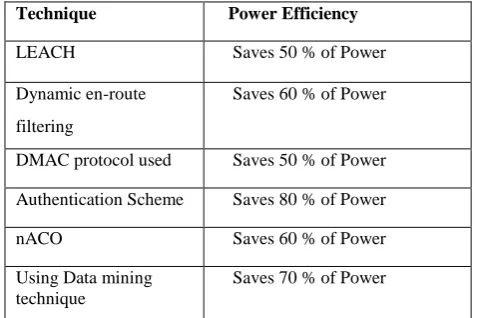
Comparison of some old power optimization WSN techniques and new present schemes are following:
Technique Power Efficiency
LEACH Saves 50 % of Power
Dynamic en-route filtering
Saves 60 % of Power
DMAC protocol used Saves 50 % of Power Authentication Scheme Saves 80 % of Power nACO Saves 60 % of Power Using Data mining
technique
[image:4.595.311.550.316.475.2]Saves 70 % of Power
Table 1: Performance analysis of some technique
7. CONCLUSION
In this paper power related issues in WSN are presented. The power and communication of data are the main problems of a wireless sensor network. With its limitations, it is important to design a network that uses optimal energy resources while transferring reliable data. Through this paper, some techniques are presented that consider energy efficiency as the important objective for routing and design of the infrastructure. These techniques shows the role of ACO in designing the network, draining the injected invalid data technique (Message Authentication Scheme ) from networks, and decision tree algorithm use in ZRP for power optimization in wireless sensor network. These techniques provide the suitable flexible structure of wireless sensor network. This case study is provided a guidance to select suitable scheme according to the application on usage.
8. ACKNOWLEDGEMENT
:9. REFERENCES
[1] Akylidiz, W. Su, Sankarasubramaniam, and E.Cayrici, “A survey on sensor networks”, IEEE Communications Magazine, Volume: 40 Issue: 8,August 2002, pp.102-114.
[2] D.Culler, D.Estrin and M.Srivastava, “Overview of Sensor Networks”, IEEE Computer Society, August 2004.
[3] Ayad Salhieh Jennifer Weinmann _ Manish Kochhal _ Loren Schwiebert, “Power Efficient Topologies
forWireless Sensor
Networks”reference.kfupm.edu.sa/.../power_efficient_to pologies_for_wireless_529104.pdf
[4] Ewa Niewiadomska-Szynkiewicz, Piotr Kwaśniewski, Izabela Windyga, “Comparative Study of Wireless Sensor Networks Energy-Efficient Topologies and Power Save Protocols”
[5] Shuguang Cui and Andrea J. Goldsmith, “Cross-layer Optimization in Sensor Networks with EnergyConstraints”,http://wsl.stanford.edu/projects/ener gy_eff.pdf
[6] Nariman Farsad, “Low-Complexity Energy Optimization of Wireless Sensor Networks”, Thesis, Master of Science, Toranto 2009.
[7] R. Montemanni and L. Gambardella, “Swarm approach for a connectivity problem in wireless networks,” in
Proceedings 2005 IEEE Swarm Intelligence Symposium, pp. 265—272, 2005.
[8] M. Dorigo and T. Stuzle, Ant Colony Optimization. MIT Press, 2004.
[9] W. Agassounon, “Distributed information retrieval and dissemination in swarm-based networks of mobile, autonomous agents,” in Proceedings of IEEE Swarm Intelligence Symposium, pp. 152—159,2003.
[10] O. Cordon, F. Herrera and T. Stuzle, “A review on the ant colony optimization metaheuristic: Basis, models and new trends,” Mathware and software computing, no. 9, pp. 1—35, 2002.
[11] Y. t. Hsiao, C. L. Chuang and C. C. Chien, “Computer network load balancing and routing by ant colony optimization,” in 12th IEEE International Conference on Networks, vol. 1, pp. 313 —318, 2004.
[12] J. Black and P. Rogaway, “Cbc macs for arbitrary-length messages: the three-key constructions,” Journal of Cryptology, vol. 18, no. 2, pp. 111–131, 2005.
[13] W. Mao, Modern Cryptography: Theory and Practice. Prentice Hall PTR, 2003.