5-4-2007
Empirical Likelihood Confidence Intervals for the Sensitivity of a
Empirical Likelihood Confidence Intervals for the Sensitivity of a
Continuous-Scale Diagnostic Test
Continuous-Scale Diagnostic Test
Angela Elaine Davis
Follow this and additional works at: https://scholarworks.gsu.edu/math_theses
Part of the Mathematics Commons
Recommended Citation Recommended Citation
Davis, Angela Elaine, "Empirical Likelihood Confidence Intervals for the Sensitivity of a Continuous-Scale Diagnostic Test." Thesis, Georgia State University, 2007.
https://scholarworks.gsu.edu/math_theses/30
This Thesis is brought to you for free and open access by the Department of Mathematics and Statistics at ScholarWorks @ Georgia State University. It has been accepted for inclusion in Mathematics Theses by an authorized administrator of ScholarWorks @ Georgia State University. For more information, please contact
Under the Direction of Gengsheng Qin
ABSTRACT
Diagnostic testing is essential to distinguish non-diseased individuals from
diseased individuals. More accurate tests lead to improved treatment and thus reduce
medical mistakes. The sensitivity and specificity are two important measurements for the
diagnostic accuracy of a diagnostic test. When the test results are continuous, it is of
interest to construct a confidence interval for the sensitivity at a fixed level of specificity
for the test. In this thesis, we propose three empirical likelihood intervals for the
sensitivity. Simulation studies are conducted to compare the empirical likelihood based
confidence intervals with the existing normal approximation based confidence interval.
Our studies show that the new intervals had better coverage probability than the normal
approximation based interval in most simulation settings.
by
ANGELA E. DAVIS
A Thesis Submitted in Partial Fulfillment of the requirements for the Degree of
Master of Science
in the College of Arts and Sciences
Georgia State University
by
ANGELA E. DAVIS
Major Professor: Dr. Gengsheng (Jeff) Qin Committee: Dr. Yu-Sheng Hsu
Dr. Yichuan Zhao Dr. Xu Zhang
Electronic Version Approved:
“To whom much is given, much more is also required.
”
ACKNOWLEDGEMENTS
I would like to thank my advisor, Dr. Gengsheng Qin, for his leadership and
patience throughout this process. Words can not express how truly grateful I am for all of
your guidance. I would also like to thank the committee members for accepting my
invitation and your assistance.
Many thanks to my parents who set the bar for my sisters and I to follow. Thank
you for all of your support as I traversed through this marvelous world of academia. I
would also like to thank my sisters for their continued support and I want you to know
that I am proud of you. Two down, one to go!
To my classmate, Kenita, from the bottom of my heart you are greatly
appreciated. Thanks for the endless encouragement. Friends come a dime a dozen but
TABLE OF CONTENTS
Acknowledgements v
List of Figures vii
List of Tables viii
Chapter I Introduction 1
Chapter II Concepts and Terminology 4
2.1 Sensitivity and Specificity of a Binary Diagnostic Test 4 2.2 Sensitivity and Specificity of a Continuous-Scale Diagnostic Test 5
Chapter III Existing Methods 6
3.1 Normal Approximation Based Confidence Interval 6
3.2 Empirical Likelihood Interval 7
Chapter IV New Confidence Intervals 9
Chapter V Simulation Studies for the Confidence Intervals 14
Chapter VI Real Application 17
6.1 Detection of Diabetes 17
Chapter VII Discussion 19
References 20
Appendix I: Simulation Tables 22
A. Normal Distribution Tables 22
B. Beta Distribution Tables 28
C. Exponential Distribution Tables 34
Appendix II: Real Application Table 40
Appendix III: S-plus Code for Simulation 41
LIST OF FIGURES
LIST OF TABLES
Chapter V Simulation studies for the confidence intervals 14
Table I. Parameter Settings for the Normal Distribution 14 Table II. Parameter Setting for the Beta Distribution 15 Table III. Parameter Settings for the Exponential Distribution 16
Appendix I Simulation Tables 22
A. Normal Distribution Tables 22
TABLE IV 22
TABLE V 23
TABLE VI 24
TABLE VII 25
TABLE VIII 26
TABLE IX 27
B. Beta Distribution Tables 28
TABLE X 28
TABLE XI 29
TABLE XII 30
TABLE XIII 31
TABLE XIV 32
TABLE XV 33
C. Exponential Distribution Tables 34
TABLE XVI 34
TABLE XVII 35
TABLE XVIII 36
TABLE XIX 37
TABLE XX 38
TABLE XXI 39
Chapter I
INTRODUCTION
Diagnostic testing, an integral facet of medical testing, aids in classifying the
presence or absence of a disease or condition. There are two types of diagnostic tests:
qualitative and quantitative. A qualitative test classifies patients as diseased or
non-diseased based on clinical signs or symptoms. A quantitative test classifies patients
according to c, a predetermined cutoff point. Disease or non-disease status is dependent
upon whether or not the test result falls above or below the cutoff point. A more accurate
diagnostic test leads to more effective treatment and thus reduces medical malpractice
and mortality. The results of a diagnostic test help to answer two questions: If the test is
positive, what is the probability that the person actually has the disease, and if the test is
negative, what is the probability that the person actually doesn’t have the disease? These
questions can simply be answered in terms of the test’s sensitivity and specificity
respectively. A model test would have high sensitivity and high specificity.
The Receiver Operating Characteristic (ROC) curve, developed in World War II,
was initially used in signal detection theory. It has since become widely used in
diagnostic medicine as an efficient way to graphically display the tradeoff between
sensitivity and specificity. When the specificity is high, the sensitivity is low and vice
versa. More specifically, a ROC curve is a plot of 1 - specificity against sensitivity. In
must be defined when the response is continuous. When a level of specificity is chosen
(commonly 80 %, 90% or 95%), it is of interest to construct confidence intervals for the
sensitivity at the selected level of specificity.
Empirical likelihood (EL), introduced by Owen (1988, 1990), is a powerful
non-parametric method. The EL method has many advantages over normal approximation
based methods. For example, it has better small sample performance than approaches
based on normal approximation; EL-based confidence regions are range preserving and
transformation respecting; the regularity conditions for EL-based methods are weak and
natural etc. The use of EL methods has becoming increasingly common in recent years
and is attractive in many applied area (Wu and Rao, 2006). Claeskens et al. (2003), one
of few studies on the EL method for ROC analysis, developed an empirical likelihood
confidence interval for a ROC curve. Their EL confidence interval had better coverage
probability than the normal approximation based interval. However, their method still
needs kernel distribution estimation and the selection of smoothing parameters are
problematic. It thus has not been well applied in practice.
In this thesis, we propose new empirical likelihood based confidence intervals and
compare them with the existing normal approximation based interval. The thesis is
organized in the following manner: Chapter I is an introduction, Chapter II lists concepts
and terminology used throughout the thesis, existing confidence intervals for sensitivity
at a fixed level of specificity for a continuous-scale test are presented in Chapter III,
Chapter IV introduces three new empirical likelihood intervals for sensitivity at a fixed
performance of new confidence intervals and in Chapter VI we apply the proposed
Chapter II
CONCEPTS AND TERMINOLOGY
2.1 Sensitivity and Specificity of a Binary Diagnostic Test
Sensitivity– probability that a diseased patient will have a positive test result.
P(positive test | patient has the disease)
Specificity– probability that a non-diseased patient will have a negative test result.
P(negative test | patient doesn’t have the disease)
Classification of individuals according to diagnostic test results are shown in the following table:
The following formulas are used to estimate the sensitivity and specificity:
FN TP
TP y
Sensitivit
TN FP
TN y
Specificit
Disease/Condition
Test Result Present Absent
Positive True Positive (TP) False Positive (FP) Negative False Negative (FN) True Negative (TN)
2.2 Sensitivity and Specificity of a Continuous-Scale Diagnostic Test
For a continuous-scale diagnostic test, let X be the test result from a non-diseased
patient, and let Y be the test result from a diseased patient. At a given cutoff point c, the
sensitivity and specificity are defined as
Se = P(Y ≥ c), Sp = P(X ≤ c),
respectively. If F is the distribution function of X and G is the distribution function of Y,
the sensitivity and specificity can then be written as
Se = 1-G( c), Sp = F(c).
At a fixed level p of specificity, the corresponding sensitivity of the test is
1
( ) 1 ( ( ))
R p G F p ,
where F1 is the inverse function of F.
One problem that arises is how to construct a (1-α)100% confidence interval for
) (p
R based on, X1,…,Xm, the results from the non-diseased group, and Y1,…,Yn,, the
Chapter III
EXISTING METHODS
3.1 Normal Approximation Based Confidence Interval
If R p( )P Y( F1( )),p then the estimator forR(p)is the observed sensitivity at
the p-th sample quantile from the test results of the non-diseased individuals. If we let Fˆ
be the empirical distribution function based on X1,...,Xm, then the estimator forR(p)
becomes
1 1 ( ˆ ( ))
ˆ( ) .
n j
j I Y F p
R p
n
(1)Linnet (1987) presented a formula for the variance of Rˆ(p)defined as
2 1 2 1
( )(1 ( )) (1 ) ( ( )) ˆ
( ( )) ,
( ( ))
R p R p p p g F p
Var R p
n m f F p
(2)
where f and g are the probability density functions of F and G respectively. It has been
shown that when both m and n are large, R pˆ( ) has an approximately normal distribution
with mean R(p) and variance Var R p( ( ))ˆ , given by (2). By substituting unknown
quantities in (2) by their corresponding sample estimates, we can obtain a (1-α)100%
normal approximation based confidence interval for R(p). However, this interval may be
studied this issue and found via simulation study that the normal approximation based
confidence interval could have poor coverage probability.
3.2 Empirical Likelihood Interval
Let R(p)1G(F1(1 p)) then there exists a quantity such that
1(1 p) G 1(1 )
F .
Using this relationship between sensitivity and specificity, Claeskens, Jing, Peng and
Zhou (2003) proposed a smoothed empirical likelihood for R(p) defined as follows:
m j j n i i q p q p L 1 1 , , sup ) ( subject to the following constraints
p h X G q h Y G
p i j j
n
i
i
1 , 1 2 2 1 1 1 where p and q are probability vectors, G1and G2are known functions and hj'sare
unknown smoothing parameters. Claeskens et al (2003), under certain conditions,
illustrated that the empirical log-likelihood ratio is a chi-square distribution,
2 1
) (
,
and by inversing (), they obtained an empirical likelihood confidence interval for
) (p
R defined as
2
1: ( ) (1 ) .
Their new confidence interval performed much better than the normal approximation
based interval. However, the smoothed empirical likelihood method has two main
drawbacks: (1) The method is computationally extensive, three nonlinear equations have
to be solved to calculate the value of ( ) ; (2) Two smoothing parameters hj'shave to
Chapter IV
NEW CONFIDENCE INTERVALS
Qin and Zhou (2006) successfully applied the empirical likelihood method to the
inference for an area under the ROC curve. We will define the empirical likelihood
method in this section for the sensitivity of a diagnostic test. Pepe (2003) defined a
placement value for a given test value Y from a diseased subject as
). (
1 F Y
U
This value is the proportion of the non-diseased population with a test value greater than
Y, essentially marking the placement of Y within the non-diseased distribution. It is
evident that
1
( ( )) ( ( ) ) ( ( )) ( )
E I U p P F Y p P Y F p R p .
Based on the relationship between R(p) and the placement value U, an empirical
likelihood procedure is derived for the sensitivity of a diagnostic test. Let p =
) ,..., ,
(p1 p2 pn be a probability vector, i.e.,
n j 1pj 1 and pj 0 for all j. The profile
empirical likelihood for R(p) can be defined as
, 0 ) ( , 1 : sup )) ( ( ~
1 1 1
n j n j n j j j jj p p W p
p p
R L
where Wj(p) I(Uj p)R(p) with Uj 1F(Yj), j 1,2,...,n. Placement values,
j
Therefore, by replacing F by its empirical distributionFˆ , we get an adjusted empirical
likelihood for R(p):
, 0 0 ) ( ˆ , 1 : sup )) ( (
1 1 1
n j n j n j j j jj p p W p
p p
R L
where Wˆj(p)I(Uˆj p)R(p)with Uˆj 1Fˆ(Yj) j1,2,...,n. Then, by Lagrange
multiplier, we get
1 ˆ ( ))
, 1,2,... ,1 1 n j p W n
pj j
where λ is the solution of
0. ) ( ˆ 1 ) ( ˆ 1 1
n j j j p W p Wn (4)
Note that
nj 1pj , subject to
1 1n
j pj , attains its maximum n
n at p n1
j . So the
empirical likelihood ratio for R(p)is defined as
( ( )) ( )
1 ˆ ( )
.1 1 1
n j j n jj W p
np p
R
r
The resulting log-pseudo-empirical likelihood ratio is
( ( )) 2log ( ( )) 2 log
1 ˆ ( )
,1
n j j p W p R r p Rl (5)
where λ is the solution of (4).
Qin (2006) established the following theorem for the asymptotic distribution for
Theorem 3.1. If R0(p)is the true value of sensitivity R(p) at a fixed level p of
specificity, and 0 < R(p) <1 for 0 < p < 1, then the limiting distribution of l(R0(p)),
defined by (5), is a scaled chi-square distribution with one degree of freedom. That is,
( ) ( ( )) 2,
1 0 p
R l p
c (6)
where the scale constantc(p) is
) ( ) ( ) ( 2 1 2 p p p c with 2 2 1 2 2
1 2 1
( ) ( )(1 ( )),
( ( ))
( ) ( ) (1 ) .
( ( ))
p R p R p
n g F p
p p p p
m f F p
Here f and g are the density functions of F and G respectively.
In order to construct confidence intervals forR(p)based on Theorem 3.1, we need
to estimate 2(p)and 12(p). Let
2
2 1
2 2
1 2 1
ˆ ˆ
ˆ ( ) ( )(1 ( )),
ˆ
ˆ ( ( ))
ˆ ( ) ˆ ( ) (1 ) ˆ .
ˆ
( ( ))
p R p R p
n g F p
p p p p
m f F p
where Fˆ ( )1 p is the p-th sample quantile of
i
X ’s, fˆand gˆare the estimates of density
functions f and g. Then, a (1-α)-th empirical likelihood based confidence interval, called
( ( )) { ( ):ˆ( ) ( )) 2(1 )},
1 ,
2 R p R p c p R p
CI (7)
where .
) ( ˆ ) ( ˆ ) ( ˆ 2 1 2 p p p c
By Theorem 3.1, CI1,( ( ))R p gives an approximate confidence interval for R0(p) with asymptotically correct coverage probability 1-α, i.e.,
). 1 ( 1 ))) ( ( ) (
(R0 p CI2, R p o
P
The performance of the ELI interval depends on the density estimates fˆ and gˆ,
particularly when the sample sizes are small. We now propose a bootstrap method to
estimate 2( ).
1 p
The bootstrap estimate is motivated by the fact that 2( )
1 p
is the
asymptotic variance of n12(Rˆ(p)R(p)). The procedure for computing the bootstrap
variance can be summarized in the following steps:
1. Draw a resample of size n, Y*'s,
i with replacement from the diseased sample
s
Yi' and a separate resample of size m, X*'s,
i with replacement from the
non-diseased sample Xi's.
2. Calculate the bootstrap version of Rˆ(p),
* 1* 1
* ˆ ( )
ˆ ( ) ,
n i
i I Y F p
R p
n
where Fˆ ( )1* p is thep-th sample quantile based on the bootstrap resample X*'s.
3. Repeat the first two steps B times to obtain the set of bootstrap replications
Rˆ*b(p):b1,2,...,B
. Then, the bootstrap estimate *2( ) 1 p for 2( )
1 p
is defined
by
B bb p R p
R B n p 1 2 * * 2 *
1 (ˆ ( ) ( )) ,
1 )
(
where * * 1
( ) (1/ ) B b( ).
b
R p B
R pNow we propose two new empirical likelihood based confidence intervals
forR(p)by using the bootstrap variance *2( )
1 p
.
The first one, called ELII interval, is defined by
( ): ( ) ( ( )) 2(1 )
,1 *
1 p l R p
c p
R (8)
where .
) ( ˆ ) ( ˆ ) ( *2
1 2 * 1 p p p c
The second one, called ELIII interval, is defined by
( ): ( ) ( ( )) 2(1 )
,1 *
2 p l R p
c p
R (9)
where .
) ( ˆ )) ( 1 )( ( )
( *2
Chapter V
SIMULATION STUDIES FOR THE CONFIDENCE INTERVALS
We conducted three simulation studies to compare the coverage accuracy of the
newly proposed intervals to that of the normal approximation based interval. In
simulation studies, we generate 3,000 random samples of size m from the distribution
function F for test responses of non-diseased patients and another independent random
sample of size n from the distribution function G for test responses of diseased patients.
In these studies, the sample sizes (m,n) were chosen to be (20,50), (50,20), (50,100),
(100,50), (50,50) and (100,100), respectively.
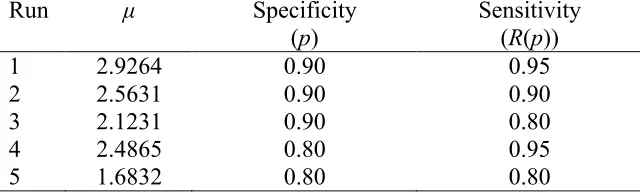
In the first simulation study, the distribution function F was chosen to be a
standard normal distribution whereas the distribution function G was a normal
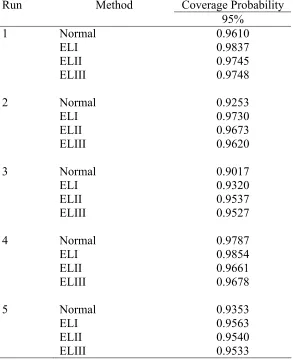
distribution with mean μ and variance 1. The specificity was fixed at 80% or 90% level
for different values of μ (See Table I). The results of the simulation study at the nominal
[image:24.612.164.484.593.689.2]level of 95% are given in Tables IV-IX.
Table I. Parameter settings for the normal distribution at fixed levels of specificity.
Run μ Specificity Sensitivity (p) (R(p))
1 2.9264 0.90 0.95
2 2.5631 0.90 0.90
3 2.1231 0.90 0.80
4 2.4865 0.80 0.95
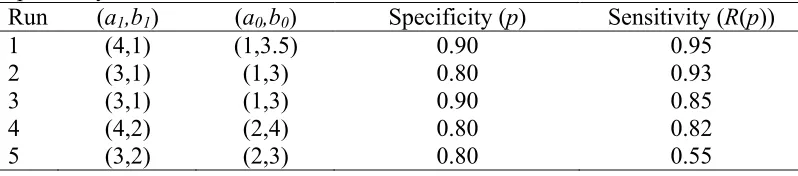
Our distributions, F and G, were beta distributions with parameters (a0,b0) and
(a1,b1) respectively in the second simulation study. The specificity was also fixed at 80%
or 90% for different values of (a0,b0) and (a1,b1) to get the corresponding sensitivities
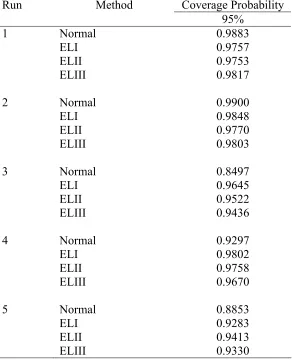
(See Table II). The coverage probabilities resulting from the simulation study at the
[image:25.612.124.523.332.420.2]nominal level of 95% are given in Tables X-XV.
Table II. Parameter setting for the Beta Distribution at fixed levels of specificity.
Run (a1,b1) (a0,b0) Specificity (p) Sensitivity (R(p))
1 (4,1) (1,3.5) 0.90 0.95
2 (3,1) (1,3) 0.80 0.93
3 (3,1) (1,3) 0.90 0.85
4 (4,2) (2,4) 0.80 0.82
5 (3,2) (2,3) 0.80 0.55
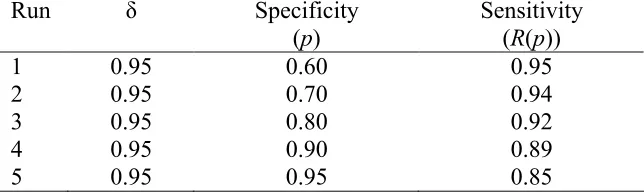
In the third simulation study, we chose the distributions F and G to be the
standard exponential distribution (with rate = 1) and an exponential distribution with rate
= 1/δ - 1, where δ represents the area under the receiver operating characteristic curve
(AUC). Here, δ was taken to be 0.95. Specificity was set at 0.60, 0.70, 0.80, 0.90 and
0.95 along with the corresponding sensitivities (See Table III). The coverage probabilities
resulting from the simulation study at the nominal level of 95% are given in Tables
Table III. Parameter settings for the exponential distribution
Run δ Specificity Sensitivity (p) (R(p))
1 0.95 0.60 0.95
2 0.95 0.70 0.94
3 0.95 0.80 0.92
4 0.95 0.90 0.89
5 0.95 0.95 0.85
The simulation studies illustrate that the newly proposed intervals generally
performed better than the normal approximation based interval at the 95% nominal level
Chapter VI
REAL APPLICATION
In this chapter, we apply the newly proposed intervals to a real life data example.
The data is from 403 subjects out of a group of 1046 who were selected to gain more
understanding regarding the prevalence of diabetes, obesity, etc. among African
Americans in central Virginia. The risk factors that were chosen from the study were the
waist and hip measurements, as they have been known to be a predictor of diabetes.
6.1 Detection of Diabetes
Diabetes is a disease resulting from the way our bodies use blood glucose. The
glucose (sugar) is your body’s energy source. Insulin, produced by the pancreas, helps the
body produce sugar, which is used for energy. Too little insulin or the body using it
improperly causes diabetes. It is the 5th leading cause of death in America and more
prevalent among African Americans. Left untreated, diabetes leads to amputations, organ
failure and even death in some cases.
Our study used the waist and hip measurements (in inches) of 388 female and
male subjects to determine the waist/hip ratio (WHR). The waist/hip ratio is just one way
of detecting diabetes in patients. Excess abdominal fat has been associated with higher
levels of insulin, which can raise blood sugar and pressure among other things. A WHR
patients. Snijder et al. (2004) found that waist and hip measurements are important
factors in predicting diabetes and other diseases.
The new empirical likelihood confidence intervals were applied to the data to
determine the accuracy of the WHR in predicting diabetes. There were 305 non-diseased
patients and 83 diseased patients. The results of the computation are found in Table XXII.
Chapter VII
DISCUSSION
Diagnostic testing is essential in distinguishing diseased patients from
non-diseased patients. When the result of a test is more accurate, there is less misconduct and
better treatment options can be implemented. The ROC curve provides a summary of the
performance of a diagnostic test (Claeskens et. al, 2003). For a quantitative test, the
cutoff point c is imperative because it determines which patients will be classified as
diseased and non-diseased. When the response of a test is continuous, it is of interest to
construct confidence intervals for the sensitivity of the test at this point. Calculating the
sensitivity and specificity of a test at various cutoff points is effective in determining the
best point at which to classify the test. The normal approximation confidence intervals
are inadequate when the distribution is skewed or the parameter range is restricted (Wu
and Rao, 2006). We proposed three new empirical likelihood confidence intervals for the
sensitivity of a continuous scale diagnostic test at a fixed level of specificity. The newly
proposed intervals were shown to generally perform better than the normal
REFERENCES
Claeskens G, Jing BY, Peng L, and Zhou W (2003). An empirical likelihood confidence interval for an ROC curve. The Canadian Journal of Statistics, 31: 173-190.
http://biostat.mc.vanderbilt.edu/twiki/bin/view/Main/DataSets
Linnet K (1987). Comparison of quantitative diagnostic tests: type I error, power, and sample size. Statistics in Medicine, 6: 147-158.
Metz CE (1978). Basic principles of ROC analysis, Sem Nuc Med., 8:283-298.
Owen A (1988). Empirical likelihood ratio confidence intervals for single functional.
Biometrika, 75: 237-249.
Owen A (1990). Empirical likelihood ratio confidence regions. Annals of Statistics, 18:
90-120.
Pepe MS (2003). The Statistical Evaluation of Medical Tests for Classification and Prediction. Oxford University Press, Cary, NC.
Platt RW, Hanley JA and Yang H (2000). Bootstrap confidence intervals for the sensitivity of a quantitative diagnostic test. Statistics in Medicine, 19: 313-322.
Qin GS (2006). Empirical likelihood based confidence intervals for the sensitivity of a continuous-scale diagnostic test at a fixed level of specificity. Manuscript. Department of Mathematics and Statistics. Georgia State University.
Qin GS, and Zhou XH (2006). Empirical likelihood inference for the area under the ROC curve. Biometrics,62: 613-622.
Shapiro DE (1999). The interpretation of diagnostic tests. Statistical Methods in Medical
Research, 8: 113-134
Snijder MB, Zimmet PZ, Visser M, Dekker JM, Seidell JC, and Shaw JE (2004). Independent and opposite associations of waist and hip circumferences with diabetes, hypertension and dyslipidemia: the AusDiab Study. International Journal of Obesity and
Related Metabolic Disorders, 28(3): 402-409.
Zhang Z and Pepe MS (2005), A Linear Regression Framework for Receiver Operating Characteristic(ROC) Curve Analysis. UW Biostatistics Working Paper Series. Working Paper 253.
Http://www.cdc.gov
Zhou XH, and Qin GS (2005). Improved confidence intervals for the sensitivity of a continuous-scale diagnostic test at a fixed level of specificity. Statistical in Medicine, 24:
465-477.
Altan AE, Carlson AM, Nettles A. The glycosolated hemoglobin as a diagnostic and monitoring tool for diabetes: evidence from claims data. AHSR FHSR Annu Meet Abstr
Book. 1996; 13: 11.
Zou KH, Hall WJ and Shapiro DE (1997). Smooth non-parametric receiver operating characteristic (ROC) curves for continuous diagnostic tests. Statistics in Medicine, 16:
APPENDIX I: SIMULATION TABLES
[image:32.612.181.473.277.635.2]A. Normal Distribution Tables
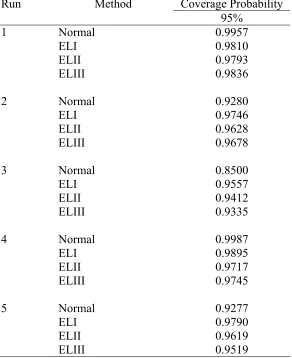
Table IV. Coverage probabilities of intervals at the nominal level of 95 percent when the data are generated from the normal distribution with m=20 and n=50.
Run Method Coverage Probability 95%
1 Normal 0.9957
ELI 0.9810
ELII 0.9793
ELIII 0.9836
2 Normal 0.9280
ELI 0.9746
ELII 0.9628
ELIII 0.9678
3 Normal 0.8500
ELI 0.9557
ELII 0.9412
ELIII 0.9335
4 Normal 0.9987
ELI 0.9895
ELII 0.9717
ELIII 0.9745
5 Normal 0.9277
ELI 0.9790
ELII 0.9619
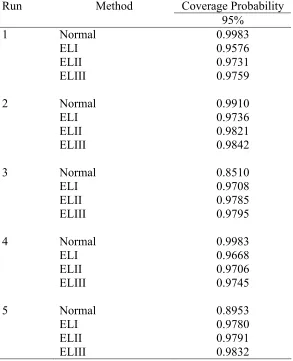
Table V. Coverage probabilities of intervals at the nominal level of 95 percent when the data are generated from the normal distribution with m=50 and n=20.
Run Method Coverage Probability 95%
1 Normal 0.9983
ELI 0.9576
ELII 0.9731
ELIII 0.9759
2 Normal 0.9910
ELI 0.9736
ELII 0.9821
ELIII 0.9842
3 Normal 0.8510
ELI 0.9708
ELII 0.9785
ELIII 0.9795
4 Normal 0.9983
ELI 0.9668
ELII 0.9706
ELIII 0.9745
5 Normal 0.8953
ELI 0.9780
ELII 0.9791
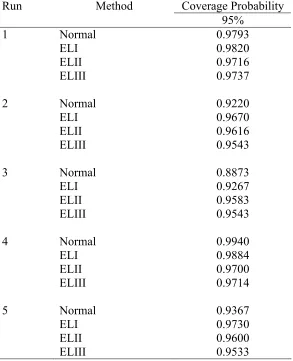
Table VI. Coverage probabilities of intervals at the nominal level of 95 percent when the data are generated from the normal distribution with m=50 and n=100. Run Method Coverage Probability
95%
1 Normal 0.9793
ELI 0.9820
ELII 0.9716
ELIII 0.9737
2 Normal 0.9220
ELI 0.9670
ELII 0.9616
ELIII 0.9543
3 Normal 0.8873
ELI 0.9267
ELII 0.9583
ELIII 0.9543
4 Normal 0.9940
ELI 0.9884
ELII 0.9700
ELIII 0.9714
5 Normal 0.9367
ELI 0.9730
ELII 0.9600
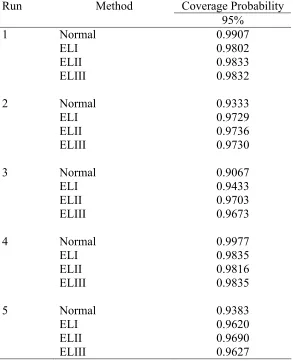
Table VII. Coverage probabilities of intervals at the nominal level of 95 percent when the data are generated from the normal distribution with m=100 and n=50. Run Method Coverage Probability
95%
1 Normal 0.9907
ELI 0.9802
ELII 0.9833
ELIII 0.9832
2 Normal 0.9333
ELI 0.9729
ELII 0.9736
ELIII 0.9730
3 Normal 0.9067
ELI 0.9433
ELII 0.9703
ELIII 0.9673
4 Normal 0.9977
ELI 0.9835
ELII 0.9816
ELIII 0.9835
5 Normal 0.9383
ELI 0.9620
ELII 0.9690
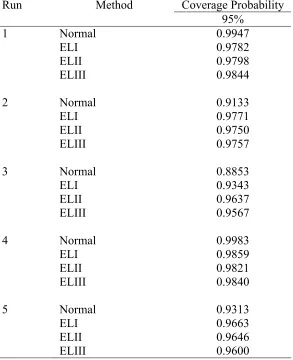
Table VIII. Coverage probabilities of intervals at the nominal level of 95 percent when the data are generated from the normal distribution with m=n=50.
Run Method Coverage Probability 95%
1 Normal 0.9947
ELI 0.9782
ELII 0.9798
ELIII 0.9844
2 Normal 0.9133
ELI 0.9771
ELII 0.9750
ELIII 0.9757
3 Normal 0.8853
ELI 0.9343
ELII 0.9637
ELIII 0.9567
4 Normal 0.9983
ELI 0.9859
ELII 0.9821
ELIII 0.9840
5 Normal 0.9313
ELI 0.9663
ELII 0.9646
Table IX. Coverage probabilities of intervals at the nominal level of 95 percent when the data are generated from the normal distribution with m=n=100.
Run Method Coverage Probability 95%
1 Normal 0.9610
ELI 0.9837
ELII 0.9745
ELIII 0.9748
2 Normal 0.9253
ELI 0.9730
ELII 0.9673
ELIII 0.9620
3 Normal 0.9017
ELI 0.9320
ELII 0.9537
ELIII 0.9527
4 Normal 0.9787
ELI 0.9854
ELII 0.9661
ELIII 0.9678
5 Normal 0.9353
ELI 0.9563
ELII 0.9540
B. Beta Distribution Tables
Table X. Coverage probabilities of intervals at the nominal level of 95 percent when the data are generated from the beta distribution with m=20 and n=50.
Run Method Coverage Probability 95%
1 Normal 0.9883
ELI 0.9757
ELII 0.9753
ELIII 0.9817
2 Normal 0.9900
ELI 0.9848
ELII 0.9770
ELIII 0.9803
3 Normal 0.8497
ELI 0.9645
ELII 0.9522
ELIII 0.9436
4 Normal 0.9297
ELI 0.9802
ELII 0.9758
ELIII 0.9670
5 Normal 0.8853
ELI 0.9283
ELII 0.9413
Table XI. Coverage probabilities of intervals at the nominal level of 95 percent when the data are generated from the beta distribution with m=50 and n=20.
Run Method Coverage Probability 95%
1 Normal 0.9957
ELI 0.9567
ELII 0.9671
ELIII 0.9726
2 Normal 0.9953
ELI 0.9702
ELII 0.9757
ELIII 0.9785
3 Normal 0.9457
ELI 0.9726
ELII 0.9823
ELIII 0.9827
4 Normal 0.9240
ELI 0.9724
ELII 0.9794
ELIII 0.9801
5 Normal 0.9023
ELI 0.9330
ELII 0.9603
Table XII. Coverage probabilities of intervals at the nominal level of 95 percent when the data are generated from the beta distribution with m=50 and n=100.
Run Method Coverage Probability 95%
1 Normal 0.9490
ELI 0.9760
ELII 0.9739
ELIII 0.9732
2 Normal 0.9697
ELI 0.9876
ELII 0.9705
ELIII 0.9685
3 Normal 0.8830
ELI 0.9363
ELII 0.9517
ELIII 0.9477
4 Normal 0.9380
ELI 0.9703
ELII 0.9527
ELIII 0.9470
5 Normal 0.9090
ELI 0.9220
ELII 0.9503
Table XIII. Coverage probabilities of intervals at the nominal level of 95 percent when the data are generated from the beta distribution with m=100 and n=50.
Run Method Coverage Probability 95%
1 Normal 0.9877
ELI 0.9752
ELII 0.9770
ELIII 0.9804
2 Normal 0.9657
ELI 0.9792
ELII 0.9751
ELIII 0.9764
3 Normal 0.8960
ELI 0.9503
ELII 0.9646
ELIII 0.9586
4 Normal 0.9360
ELI 0.9687
ELII 0.9650
ELIII 0.9573
5 Normal 0.9230
ELI 0.9330
ELII 0.9560
Table XIV. Coverage probabilities of intervals at the nominal level of 95 percent when the data are generated from the beta distribution with m=n=50.
Run Method Coverage Probability 95%
1 Normal 0.9817
ELI 0.9702
ELII 0.9744
ELIII 0.9767
2 Normal 0.9800
ELI 0.9841
ELII 0.9789
ELIII 0.9813
3 Normal 0.8847
ELI 0.9558
ELII 0.9648
ELIII 0.9615
4 Normal 0.9260
ELI 0.9696
ELII 0.9616
ELIII 0.9566
5 Normal 0.9070
ELI 0.9290
ELII 0.9547
Table XV. Coverage probabilities of intervals at the nominal level of 95 percent when the data are generated from the beta distribution with m=n=100.
Run Method Coverage Probability 95%
1 Normal 0.9370
ELI 0.9762
ELII 0.9708
ELIII 0.9684
2 Normal 0.9573
ELI 0.9853
ELII 0.9675
ELIII 0.9651
3 Normal 0.8960
ELI 0.9370
ELII 0.9587
ELIII 0.9530
4 Normal 0.9520
ELI 0.9667
ELII 0.9623
ELIII 0.9590
5 Normal 0.9227
ELI 0.9320
ELII 0.9507
C. Exponential Distribution Tables
Table XVI. Coverage probabilities of intervals at the nominal level of 95 percent when the data are generated from the exponential distribution with m=20 and n=50. Run Method Coverage Probability
95%
1 Normal 0.9993
ELI 0.9837
ELII 0.9783
ELIII 0.9791
2 Normal 0.9940
ELI 0.9875
ELII 0.9811
ELIII 0.9840
3 Normal 0.9423
ELI 0.9860
ELII 0.9818
ELIII 0.9846
4 Normal 0.8893
ELI 0.9815
ELII 0.9737
ELIII 0.9690
5 Normal 0.8357
ELI 0.9369
ELII 0.9452
Table XVII. Coverage probabilities of intervals at the nominal level of 95 percent when the data are generated from the exponential distribution with m=50 and n=20. Run Method Coverage Probability
95%
1 Normal 0.9983
ELI 0.9771
ELII 0.9766
ELIII 0.9776
2 Normal 0.9977
ELI 0.9493
ELII 0.9620
ELIII 0.9638
3 Normal 0.9950
ELI 0.9723
ELII 0.9733
ELIII 0.9729
4 Normal 0.9677
ELI 0.9770
ELII 0.9788
ELIII 0.9800
5 Normal 0.9733
ELI 0.9694
ELII 0.9729
Table XVIII. Coverage probabilities of intervals at the nominal level of 95 percent when the data are generated from the exponential distribution with m=50 and n=100. Run Method Coverage Probability
95%
1 Normal 0.9616
ELI 0.9899
ELII 0.9689
ELIII 0.9448
2 Normal 0.9520
ELI 0.9873
ELII 0.9669
ELIII 0.9599
3 Normal 0.9467
ELI 0.9850
ELII 0.9643
ELIII 0.9567
4 Normal 0.9363
ELI 0.9653
ELII 0.9647
ELIII 0.9597
5 Normal 0.9130
ELI 0.9337
ELII 0.9457
Table XIX. Coverage probabilities of intervals at the nominal level of 95 percent when the data are generated from the exponential distribution with m=100 and n=50. Run Method Coverage Probability
95%
1 Normal 0.9773
ELI 0.9709
ELII 0.9764
ELIII 0.9768
2 Normal 0.9806
ELI 0.9867
ELII 0.9765
ELIII 0.9779
3 Normal 0.9063
ELI 0.9763
ELII 0.9736
ELIII 0.9763
4 Normal 0.9087
ELI 0.9625
ELII 0.9678
ELIII 0.9655
5 Normal 0.9127
ELI 0.9489
ELII 0.9619
Table XX. Coverage probabilities of intervals at the nominal level of 95 percent when the data are generated from the exponential distribution with m=n=50.
Run Method Coverage Probability 95%
1 Normal 0.9907
ELI 0.9870
ELII 0.9759
ELIII 0.9773
2 Normal 0.9850
ELI 0.9838
ELII 0.9764
ELIII 0.9792
3 Normal 0.9147
ELI 0.9793
ELII 0.9793
ELIII 0.9806
4 Normal 0.9097
ELI 0.9695
ELII 0.9709
ELIII 0.9702
5 Normal 0.9020
ELI 0.9375
ELII 0.9469
Table XXI. Coverage probabilities of intervals at the nominal level of 95 percent when the data are generated from the exponential distribution with m=n=100.
Run Method Coverage Probability 95%
1 Normal 0.9397
ELI 0.9807
ELII 0.9582
ELIII 0.9548
2 Normal 0.9323
ELI 0.9799
ELII 0.9655
ELIII 0.9592
3 Normal 0.9523
ELI 0.9687
ELII 0.9563
ELIII 0.9543
4 Normal 0.9207
ELI 0.9550
ELII 0.9577
ELIII 0.9540
5 Normal 0.9247
ELI 0.9463
ELII 0.9580
APPENDIX II: REAL APPLICATION TABLE
Table XXII. Confidence Intervals for R(p) for the real data application at the 95% nominal level.
Specificity Method Sensitivity Confidence Intervals Length
(p) R(p)
0.95 ELI 0.1446 (0.0714, 0.2473) .1759 ELII 0.1446 (0.0591, 0.2741) .2150 ELIII 0.1446 (0.0590, 0.2742) .2152
0.90 ELI 0.2410 (0.1457, 0.3576) .2119 ELII 0.2410 (0.1521, 0.3480) .1959 ELIII 0.2410 (0.1505, 0.3503) .1998
0.85 ELI 0.3133 (0.2055, 0.4366) .2311 ELII 0.3133 (0.1989, 0.4454) .2465 ELIII 0.3133 (0.1983, 0.4462) .2479
0.80 ELI 0.4096 (0.2920, 0.5347) .2427 ELII 0.4096 (0.2864, 0.5410) .2546 ELIII 0.4096 (0.2857, 0.5419) .2562
APPENDIX III: S-PLUS CODE FOR SIMULATION
# Computing the pseudo empirical likelihood ratio confidence intervals for ROC curve
#
# December 3, 2005 #
###############################################################################
m<-20 n<-50
#sp<-0.7 # 0.90, 0.80, 0.70 iter<-3000
levelc1<-0.90 levelc2<-0.95
############################################################################ #normal distribution.
#muy<-1 # the mean of diseased population #sens<-1-pnorm(qnorm(sp),muy,1)
#sp = 0.9; muy = 2.9264 #sp = 0.9; muy = 2.5631 #sp = 0.9; muy = 2.1231 #sp = 0.8; muy = 2.4865 #sp = 0.8; muy = 1.6832
#sens<-1-pnorm(qnorm(sp),muy,1)
############################################################################ #Exponential distribution.
#sp<- 0.95 # specificity = 0.6, 0.7, 0.8, 0.9, 0.95 #delta<- 0.95 # AUC = 0.95
#sens<- 1-pexp(qexp(sp), rate= (1/delta -1)) ############################################################################
########################################################################### #Beta(a,b) distribution.
#Table 2:
#Run 1: specificity=1-tt=0.9, sensitivity=0.95
#sp<-0.9; a0<-1; b0<-3.5; a1<-4; b1<-1;# sensitivity=0.946002
# Delete the "#" before "tt" when you run "Run 1" for Beta(a,b) distribution.
#Run 2: specificity=1-tt=0.8, sensitivity=0.93
#sp<-0.8; a0<-1; b0<-3; a1<-3; b1<-1; # sensitivity=0.9284251
# Delete the "#" before "tt" when you run "Run 2" for Beta(a,b) distribution.
#sp<-0.9; a0<-1; b0<-3; a1<-3; b1<-1; # sensitivity=0.8461462
# Delete the "#" before "tt" when you run "Run 3" for Beta(a,b) distribution.
#Run 4: specificity=1-tt=0.8, sensitivity=0.82
#sp<-0.8; a0<-2; b0<-4; a1<-4; b1<-2; # sensitivity=0.8245191
# Delete the "#" before "tt" when you run "Run 4" for Beta(a,b) distribution.
#Run 5: specificity=1-tt=0.8, sensitivity=0.55
#sp<-0.8; a0<-2; b0<-3; a1<-3; b1<-2; # sensitivity=0.5548815
# Delete the "#" before "tt" when you run "Run 5" for Beta(a,b) distribution.
#sens<- 1-pbeta(qbeta(sp,a0,b0),a1,b1) #sensitivity
# Delete the "#" before "Rtt" when you run the S code for Beta(a,b) distribution.
############################################################################
p<-1-sp
coverage1<-0 coverage2<-0
coverageb11<-0 # First bootstrap coverageb12<-0
coverageb21<-0 # Second bootstrap coverageb22<-0
coveraget1<-0 coveraget2<-0
CILT1<-c(rep(0,iter)) CILT2<-c(rep(0,iter))
# Loop
Rp<-0
for ( i in c(1:iter)) {
#normal distribution:
#x<-rnorm(m,0,1) # obs from non-diseased population #y<-rnorm(n,muy,1) # obs from diseased population
#Exponential distribution: rexp(n, rate=1, scale)
#x<-rexp(m, rate= 1) # obs from non-diseased population #y<-rexp(n, rate= (1/delta -1)) # obs from diseased population
#Beta(a,b) distribution:
#x<-rbeta(m,a0,b0) #nondesease:
# Delete the "#" before "x" when you run the S code for Beta(a,b) distribution.
# Delete the "#" before "y" when you run the S code for Beta(a,b) distribution.
u<-rep(100,n) # hat U =1- hat F for (j in 1:n)
{
u[j]<-1-mean((x<=y[j])) }
indU<-(u <= p)*1 # indicator function of U: I(U_j <=p)
Rp[i]<-mean(indU)
# compute the scale constant c(p). if ((Rp[i]!=1) & (Rp[i]!=0))
{
sigma<-Rp[i]*(1-Rp[i]) # estimate for sigma^2
hg<-bandwidth.sj(y, nb=1000, method="dpi") # Uses the method of Sheather & Jones (1991)
# to select the bandwidth of a Gaussian kernel density estimator for g
hf<-bandwidth.sj(x, nb=1000, method="dpi") # Uses the method of Sheather & Jones (1991)
# to select the bandwidth of a Gaussian kernel density estimator for f
quantileF<-quantile(x,1-p)
densityg<-density(y,n=1,window="g",width=hg, from=quantileF)$y #density(.): density estimate at (1-p)-th quantile of F.
densityf<-density(x,n=1,window="g",width=hf, from=quantileF)$y #density(.): density estimate at tt-th quantile of F.
hatsigma1<-sigma + n*p*(1-p)*densityg/(m*densityf) # estimate for sigma_1^2
#sigma1<-sigma + n*p*(1-p)*dnorm(qnorm(1-p), muy, 1)/(m*dnorm(qnorm(1-p),0,1))
# True value of sigma_1^2
#bootstrap estimates for R(p). Bootstap variance estimate of R(p) test<-sensb(y,x,1-p,300,0) Rpboot<-mean(test) Rpvar<-var(test) cp<-sigma/hatsigma1 cpstar1<- sigma/(n*Rpvar) cpstar2<- Rpboot*(1-Rpboot)/(n*Rpvar)
# cat("the scale constant cp=",cp, "\n") wjhat<-indU-sens
funclambda<-function(lam)mean(wjhat/(1+lam*wjhat)) lambda<-solveNonlinear(funclambda, c(0), c(0.01))$x #lambda<-sum(wjhat)/sum(wjhat^2)
coverage1[i]<-(cp*lroc <= qchisq(levelc1,1))*1 coverage2[i]<-(cp*lroc <= qchisq(levelc2,1))*1
coverageb11[i]<-(cpstar1*lroc <= qchisq(levelc1,1))*1 # First bootstrap
coverageb12[i]<-(cpstar1*lroc <= qchisq(levelc2,1))*1
coverageb21[i]<-(cpstar2*lroc <= qchisq(levelc1,1))*1 # second bootstrap
coverageb22[i]<-(cpstar2*lroc <= qchisq(levelc2,1))*1
}else{
coverage1[i]<-NA; coverage2[i]<-NA coverageb11[i]<-NA; coverageb12[i]<-NA coverageb21[i]<-NA; coverageb22[i]<-NA }
# compute the normal approximation based interval.
hwidth1<-qnorm(1-(1-levelc1)/2)*(hatsigma1/n)^(1/2) tlow1<-Rp[i]-hwidth1 # lower limit of the CI tup1<- Rp[i]+hwidth1 # upper limit of the CI
if ((tlow1 <= sens) & (tup1 >= sens))coveraget1<-coveraget1+1 CILT1[i]<-2*hwidth1 # The length of CI
hwidth2<-qnorm(1-(1-levelc2)/2)*(hatsigma1/n)^(1/2) tlow2<-Rp[i]-hwidth2 # lower limit of the CI tup2<- Rp[i]+hwidth2 # upper limit of the CI
if ((tlow2 <= sens) & (tup2 >= sens))coveraget2<-coveraget2+1 CILT2[i]<-2*hwidth2 # The length of CI
}
sink("pseudoelroc1bootres")
#Normal distribution: # Delete the "#"'s before "cat" when you run the S code for normal distribution.
#cat("Normal distribution: m=", m, "n=", n, "specificity=", sp, "sensitivity=", sens, "mu=", muy, "iter=", iter, "\n")
#Exponential distribution: # Delete the "#"'s before "cat" when you run the S code for Exponential distribution.
#cat("Exponential dist: m=", m, "n=", n, "sp=", sp, "sens=", sens, "AUC=", delta, "iter=", iter, "\n")
# Beta distribution: # Delete the "#"'s before "cat" when you run the S code for Beta distribution.
#cat("Beta distribution: m=", m, "n=", n, "iter=", iter, "\n")
#cat("specifity=",sp, "sens=", sens, "a0=",a0,"a1=",a1,"b0=",b0,"b1=",b1, "\n")
cat("CI for sensitivity at level=", levelc1, "\n")
cat("Coverage of the ELRCI :", mean(sort(coverage1)), "\n")
cat("second bootstrap method. Coverage of the ELRCI :", mean(sort(coverageb21)), "\n")
cat("Coverage of the Normal CI :", coveraget1/iter, "\n")
#cat("Average length of ELRCI: ", mean(CIL), " STD=", (var(CIL))^(1/2), "\n") cat("Average length of Normal CI: ", mean(CILT1), " STD=",
(var(CILT1))^(1/2), "\n")
#cat("Midpoint:", mean(Mid), " STD=", (var(Mid))^(1/2), "\n")
cat("---","\n")
cat("CI for sensitivity at level=", levelc2, "\n")
cat("Coverage of the ELRCI :", mean(sort(coverage2)), "\n")
cat("First bootstrap method. Coverage of the ELRCI :", mean(sort(coverageb12)), "\n")
cat("second bootstrap method. Coverage of the ELRCI :", mean(sort(coverageb22)), "\n")
cat("Coverage of the Normal CI :", coveraget2/iter, "\n")
#cat("Average length of ELRCI: ", mean(CIL), " STD=", (var(CIL))^(1/2), "\n") cat("Average length of Normal CI: ", mean(CILT2), " STD=",
(var(CILT2))^(1/2), "\n")
#cat("Midpoint:", mean(Mid), " STD=", (var(Mid))^(1/2), "\n")
cat("Mean estimate for sensitivity:", mean(Rp), " STD=", (var(Rp))^(1/2), "\n")
APPENDIX IV: S-PLUS CODE FOR REAL APPLICATION
# Computing the pseudo empirical likelihood ratio confidence intervals for ROC curve
#
# Jan. 3, 2006
#Diabetes example
xx<-NON[,1] # obs from non-diseased population yy<-DIS[,1] # obs from diseased population
x<-sort(xx) y<-sort(yy)
m<-length(x) n<-length(y)
levelc<-0.95
crit<-qchisq(levelc,1)
sp<- 0.95 # specificity
p<-1-sp # p<-1-sp # False Positive Rate
ELlow<-0 # EL interval ELup<-0
BELlow1<-0 # First bootstrap EL-based CI BELup1<-0
BELlow2<-0 # Second bootstrap EL-based CI BELup2<-0
u<-rep(100,n) # hat U =1- hat F for (j in 1:n)
{
u[j]<-1-mean((x<=y[j])) }
hg<-bandwidth.sj(y, nb=1000, method="dpi") # Uses the method of Sheather & Jones (1991)
# to select the bandwidth of a Gaussian kernel density estimator for g hf<-bandwidth.sj(x, nb=1000, method="dpi")
# Uses the method of Sheather & Jones (1991)
# to select the bandwidth of a Gaussian kernel density estimator for f
indU<-(u <= p)*1 # indicator function of U: I(U_j <=p)
Rp<-mean(indU) # estimate for R(p). Sensitivity
# compute the scale constant c(p).
sigma<-Rp*(1-Rp) # estimate for sigma^2
densityg<-density(y,n=1,window="g",width=hg, from=quantileF)$y #density(.): density estimate at (1-p)-th quantile of F. densityf<-density(x,n=1,window="g",width=hf, from=quantileF)$y #density(.): density estimate at tt-th quantile of F.
hatsigma1<-sigma + n*p*(1-p)*densityg^2/(m*densityf^2) # estimate for sigma_1^2
#bootstrap estimates for R(p). Bootstap variance estimate of R(p)
test<-sensb(y,x,1-p,1000,0) Rpboot<-mean(test)
Rpvar<-var(test)
cp<-sigma/hatsigma1 cpstar1<- sigma/(n*Rpvar)
cpstar2<- Rpboot*(1-Rpboot)/(n*Rpvar)
# cat("the scale constant cp=",cp, "\n")
critcp_crit/cp # EL interval
critcps1_crit/cpstar1 # First bootstrap EL-based CI
critcps2_crit/cpstar2 # second bootstrap EL-based CI
# EL confidence intervals
y<-elciroc(n,indU,critcp) # calling "elciroc" to compute the EL interval.
ELlow<-y[4] # lower limit of the EL CI
ELup<-y[5] # upper limit of the EL CI
# first bootstrap EL based CI:
y<-elciroc(n,indU,critcps1) # calling "elciroc" to compute the EL interval.
BELlow1<-y[4] # lower limit of the bootstrap EL CI BELup1<- y[5] # upper limit of the bootstrap EL CI
# Second bootstrap EL based CI:
y<-elciroc(n,indU,critcps2) # calling "elciroc" to compute the EL interval.
BELlow2<-y[4] # lower limit of the bootstrap EL CI BELup2<- y[5] # upper limit of the bootstrap EL CI
sink("realexampleres")
cat("CI for sens at level=", levelc, "m=", m, "n=", n, "\n") cat("specificity =", sp, "\n")
cat("R(p)=", Rp, "\n")
cat("upper limit of the EL CI :", ELup, "\n")
cat("lower limit of the First bootstrap EL CI :", BELlow1, "\n") cat("upper limit of the First bootstrap EL CI :", BELup1, "\n")
cat("lower limit of the second bootstrap EL CI :", BELlow2, "\n") cat("upper limit of the second bootstrap EL CI :", BELup2, "\n")
cat("---","\n")