2018 International Conference on Communication, Network and Artificial Intelligence (CNAI 2018) ISBN: 978-1-60595-065-5
Study on D2D Relay Transmission Algorithm in Cellular Networks
Chang-fu DONG
1, Zhen-zhen WANG
2, Yi-hui WANG
3and Ran LI
1,*1School of Information Communications, National University of Defense Technology,
Xi’an 710106, P.R. China
2School of Information Engineering, Chang’an University, Xi’an 710064, P.R. China
3School of Electronic Information, Wuhan University, Wuhan 430072, P.R. China
*Corresponding author
Keywords: Device-to-Device communication, Complex field network coding, System achievable rate, Outage probability.
Abstract. The introduction of Device-to-Device (D2D) communication technology can effectively
improve the utilization ratio of spectrum resources of cellular networks. However, when D2D communication multiplexes cellular spectrum resources, the cellular signal and D2D signal would not be obtained by cellular user or D2D receiver due to the interference between cellular signal and D2D signal. To solve this problem, a D2D relay transmission algorithm based on complex field network coding (CFNC) is proposed in this paper. Specifically, as CFNC is adopted in the relay node to encode the received cellular signal and D2D signal, cellular signal and D2D signal are recovered respectively by the D2D receiver and the cellular user with maximum likelihood detection. Performance analyses and simulation results show that, compared with the traditional D2D transmission algorithm, the proposed algorithm can significantly improve the system achievable rate, and moreover reduce the outage probability.
Introduction
As a key technique of 4G communication, Device-to-Device (D2D) communication improves the utilization ratio of cellular spectrum resources by multiplexing the spectrum resources of cellular networks. The transmission power of the terminal user can be reduced due to the short communication distance. Consequently, D2D communication has aroused researchers’ widespread concerns. In [1], D2D communication underlaying a 3GPP LTE-Advanced cellular network is studied, showing that D2D communication can increase the total throughput observed in the cell area. From the perspective of practical application, Cui et al. point out that the application of D2D technology in LTE-A system can increase the throughput of cellular system, but it will causes signal interference at the same time [2].
equipment, Oduola et al. obtained the transmission power range of the D2D users, but the power control scheme cannot reach the maximum system throughput [10]. In [11], the base station is planning an interference limited area around the D2D receiver by setting the lower bound of SNR of the D2D communication. The cellular user channel within the interference limited region cannot be assigned to the D2D user. The methods of power control mentioned above all have some limitations, which limit the range of D2D communication and cellular communication.
Since D2D communication is not reliable when the distance between D2D transmitter and D2D receiver is too far away from each other, it is necessary to introduce the relay cooperation into D2D communication transmission. In [12], a distributed relay selection scheme for D2D communication system is proposed, the performance of which is close to the optimal method. Xia et al. proposed a multi-relay selection strategy in D2D communication [13], using channel state information to ensure the system performance. A variety of relay communication applications are studied in [14], and points out the capacity of the system is obviously higher than simple direct link.
In order to solve signal interference between cellular user and D2D user, and improve transmission reliability of D2D communication, a D2D relay transmission algorithm based on complex field network coding (CFNC) is proposed in this paper. Specifically, when D2D communication multiplexes cellular downlink spectrum resource, cellular user, D2D receiver and relay user will receive the cellular signal sent by the base station and the D2D signal sent by the D2D transmitter simultaneously. D2D relay node adopts CFNC on the received cellular signal and D2D signal. And then cellular signal and D2D signal are recovered respectively by adopting maximum likelihood detection. Comparing with the traditional D2D transmission algorithm, the proposed D2D relay transmission algorithm based on CFNC can guarantee the cellular users and D2D receiver to recover cellular signal and D2D signal reliably, and meanwhile obtains two order diversity gain. Performance analyses and simulation results show that, compared with the traditional D2D transmission algorithm, the proposed algorithm can significantly improve the system achievable rate, and moreover reduce the outage probability.
Background
Complex Field Network Coding
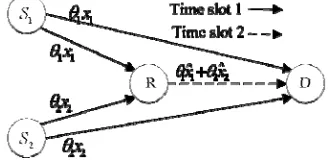
[image:2.612.223.387.532.612.2]Complex field network coding (CFNC) is proposed by Wang et al. [15, 16], which can further improve the network throughput of wireless relay networks. In (2, 1, 1) wireless relay network, the two source nodes can not only directly transmit signals to the destination, but also can transmit through the relay node. Relay transmission model of (2, 1, 1) wireless relay network based on CFNC is depicted in Figure 1.
Figure 1. Relay transmission model based on CFNC.
In time slot 1, two sources S1 and S2 send signal 1x1 and 2x2 to destination node D and relay R. The symbols received by relay R and destination node D is
1 1 1 2 2 2
SR S R S R SR
y h x h x n
(1)
SD D
S D S
SD h x h x n
y 11 1 22 2 (2) where1 and 2 are the agreed coefficients drawn from the complex field. hij denotes the channel fading coefficient, and ~ (0, 2 )
CN
andnSR ~CN(0,N0) , nSD~CN(0,N0). The symbol xˆ1 and xˆ2 can be obtained at R using maximum likelihood detection
2 2 2 2 1 1 1 2
, 1 2
1,ˆ ) argmin|| ||
ˆ
(x x ySR hSR x hSR x
x A x x
R (3)
In time slot 2, the relay node R performs CFNC on the detected signal xˆ1 and xˆ2 to obtain the coded signal 1xˆ1 2xˆ2, and then forwards the coded signal to the destination D. The signal received by the destination D at time slot 2 can be expressed as
RD RD
RD h x x n
y (1ˆ12ˆ2) (4)
where hRD denotes the channel fading coefficient, and nRD ~CN(0,N0) denotes the AWGN noise.
represents a link-adaptive scalar which controls transmit power atR. The maximum likelihood
detection at D based on the data received in the two time slots can be expressed as
1 2
1 2
2 2
1 2 , 1 1 2 2 1 1 2 2
ˆ ˆ
( , ) arg min || || || ( )||
x
D x x A SD S D S D RD RD
x x y h x h x y h x x
(5)
The process of relay transmission based on CFNC requires only 2 time slots, and the network throughput is 1/2 symbol/source/time slot, which obtains full diversity gain.
Traditional D2D Transmission
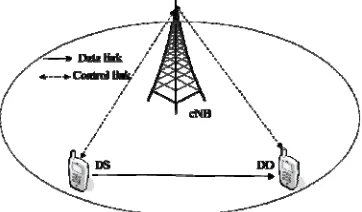
[image:3.612.216.397.458.564.2]Figure 2 illustrates the system model of D2D communication, where eNB is the base station, DS represents D2D sender user, and DD stands for D2D receiver user. In the cellular network, two D2D users at relatively close distance have D2D communication under the control of the base station. Before D2D communication, the D2D transmitter DS transmits the communication request to base station eNB through the control link firstly, and then eNB receives the request, and sends the request to D2D receiver DD. If the request is successful, the D2D communication will be established and D2D data can be directly transmitted between D2D users. Compared with the traditional cellular network communication, in D2D communication, D2D users transmit data through direct-path between DS to DD, which does not need the transmission through the base station, and saves the transmission time.
Figure 2. System model of D2D communication.
D2D Relay Transmission Algorithm Based on Complex Field Network Coding
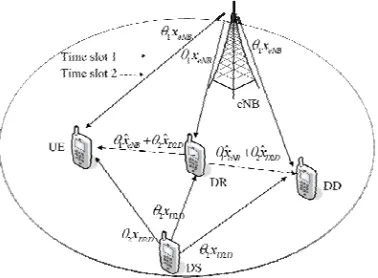
Figure 3. D2D relay transmission model based on CFNC.
To solve the problems above, this paper proposes a D2D relay transmission algorithm based on CFNC. Figure 3 illustrates the D2D relay transmission model based on CFNC. Where UE represents cellular user, DS and DD denotes D2D sender and D2D receiver, DR denotes D2D relay node which cooperates DS and DD to achieve reliable D2D communication. Assuming that all transmission nodes have the same transmit power. Each channel fading coefficient hi is independent of each other and obeys the Rayleigh fading, satisfying [| |2]1
i
h
E . The channel state information at
the receiver is known.
The coefficient 1 and 2 drawn from the complex field is distributed to base station eNB and D2D transmitter DS. In time slot 1, base station eNB sends signal 1xeNB to cellular user UE and idle relay user DR. As D2D multiplexing cellular downlink spectrum resources, D2D receiver DD will also receive a signal 1xeNB transmitted by base station eNB. In the same time slot, D2D sender DS sends signal 2xD2D to D2D receiver DD and relay user DR. The cellular user UE will also receive the signal 2xD2D due to spectrum multiplexing. The signal received by the cellular user UE, D2D relay node DR and D2D receiver DD in time slot 1 can be expressed as
_ 1 _ 2 2
UE eNB UE eNB DS UE D D UE
y h x h x n (6)
DR D D DR DS eNB DR eNB
DR h x h x n
y _ 1 _ 2 2 (7)
DR D D DR DS eNB DR eNB
DD h x h x n
y _ 1 _ 2 2 (8) where hijdenotes the channel fading coefficient, and ~ (0, )
2 ij ij CN
h ( ieNB,DS and jUE,DR,DD).
UE
n , nDR and nDD is the Gauss noise, and nUE ~CN(0,N0), nDR~CN(0,N0), nDD ~CN(0,N0). The maximum likelihood detection is performed at relay node DR can be expressed as
2
2
2 , _ 1 _ 2 2
ˆ ˆ
( , ) arg min || ||
eNB D D x
eNB D D DR DR eNB DR eNB DS DR D D x x A
x x y h x h x
(9) In time slot 2, the detect signal xˆeNB and xˆD2D is encoded at relay node DR with CFNC, and then the encoded signal 1xˆeNB2xˆD2Dis forwarded to cellular user UE and D2D receiver user DD. Thus the signal received by cellular user UE and D2D receiver user DD in time slot 2 can be expressed as
UE D D eNB UE
DR
UE h x x n
y _ (1ˆ 2ˆ 2 ) (10)
_ (1ˆ 2ˆ2 ) DD DR DD eNB D D DD
y h x x n (11)
2
2 2
_
2 , _ 1 _ 2 2 1 2 2
ˆ ˆ
( , ) arg min {|| || || ( )|| }
eNB D D x
DR UE
eNB D D UE x x A UE eNB UE eNB DS UE D D UE eNB D D
x x y h x h x y h x x
(12)
The maximum likelihood detection is performed at D2D receiver DD based on the data received in the two time slots can be expressed as
2
2 2
_
2 _ 1 _ 2 2 1 2 2
, ˆ ˆ
( , ) arg min {|| || || ( )|| }
eNB D D x
DR DD
eNB D D DD x x A DD eNB DD eNB DS DD D D DD eNB D D
x x y h x h x y h x x
(13)
In the D2D relay transmission algorithm based on CFNC, cellular user UE and D2D receiver DD can correctly recover the cellular signal and D2D signal. The cellular user UE and D2D receiver user DD can obtain full diversity gains.
Performance Comparison
System Achievable Rate
Firstly, we analyze the system achievable rate of the D2D relay transmission algorithm based on CFNC, and moreover compared the system achievable rate with that of the traditional D2D transmission algorithm. The system achievable rate can be defined by
n i i C T R ,..., 2 , 1 ) ( 1 (14)where T denotes the total number of time slots in the transmission process. C(i)Blog2(1i) denotes the channel capacity of the ith channel, where i denotes the instantaneous SINR [17]. Using Eq. (14), it is easy to obtain the system achievable rate of the traditional D2D transmission algorithm
) ( )
( _ _
2D eNB UE DS DD
D C C
R
(15)
The system achievable rate of the D2D relay transmission algorithm based on CFNC proposed can be expressed as
)) ( ) ( ( 2 1 )) ( ) ( ( 2 1 _ _ _ _ _
2DCFNC eNBUE DRUE DSDD DRDD
D C C C C
R (16)
0 5 10 15 20 25 30
0 1 2 3 4 5 6 SNR(dB) S ys te m A ch ie va ble R ate ( bit/s /H z)
[image:5.612.166.388.481.644.2]Traditional D2D transmission algorithm D2D relay transmission algorithm based on CFNC
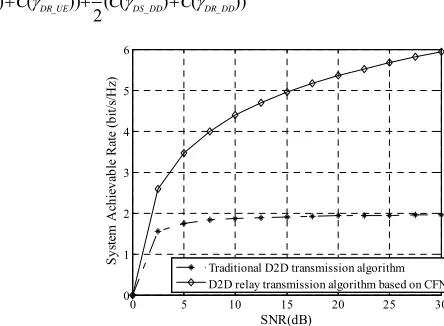
Figure 4. System achievable rate of the two transmission algorithms.
Using C++ to simulate the two transmission algorithms above, we compare the system achievable rate RD2D_CFNC with RD2D. The simulation results are illustrated in Figure 4. With the increase of SNR,
D D
analysis, it is easy to see that the D2D relay transmission algorithm based on CFNC has advantages in the performance of system achievable rate.
Outage Probability
Assuming that the information rate isR, i.e., the sender sends a message at a rateR, the outage
occurs when the instantaneous channel capacity C(i)is less than the information rateR. In the
following, we will analyze the outage probability of the two transmission algorithms.
In the traditional D2D communication, there is only one direct-path from D2D transmitter DS to D2D receiver DD. If the instantaneous channel capacity C(DSDD) of DS to DD is less than the
information rateR, D2D receiver DD cannot correctly retrieve the signal from the sender, and then
the D2D communication has an interruption. In this case, the outage probability of D2D receiver is given by ] 1 2 [ ] ) 1 ( [log ] ) (
[ _ 2 _ _
2
R DD DS DD DS DD DS out D
D PC R P R P
P
(17) Taking 2 _ _ 2 _ 0 | | | | DS DD DS DD eNB DD h h N
into Eq. (17), we can obtain the outage probability of the traditional
D2D communication as
2
0 2 ( 1) 0 1 1
2 0 0 0 0 1 2
2
[ 2 1]
1
N N
out R
D D
P P N e N e d d
(18)where 2R1, 2
1 |hDS DD| /N0
and 2|heNB DD | /2 N0.
In the D2D relay transmission algorithm based on CFNC, two links can be used to transmit signals, which are the D2D direct link and the relay link transmitted through the relay node DR. When the direct link DS-DD transmission fails and D2D receiver cannot correctly receives the encoded signal forwarded by relay node, there will be an interrupt. The outage probability of D2D receiver is given by
2 _ _ _
_ _
[ ( ) ] [ ( ) ] [ 2 1] [ 2 1]
out
D D CFNC DS DD DR DD
R R
DS DD DR DD
P P C R P C R
P P
(19)
Taking
2 _
_ _ 2
_ 0
| |
| |
DS DD DS DD DS DD
eNB DD h h N and 2 _ _ 0
| DR DD|
DR DD
h
N
into Eq. (19), the outage probability of
the D2D relay transmission algorithm based on CFNC can be given as
3
0 0
) 1 (
0 0 1 2
0 0 3 2 1 _ 2 3 0
2 01
2 0 ] 1 2 [ ] 1 2 1 [ d e N d d e N e N P P P N N N R R out CFNC D D
(20)where 2
3 |hDR DD_ | /N0
.
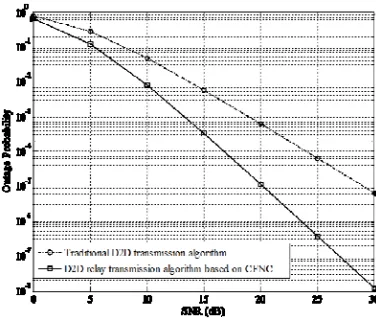
Using MATLAB to calculate the outage probability of the two transmission algorithms, the simulation results are illustrated in Figure 5. Choosing the information rate R is 1.5 bps, it can be
obtained that the outage probability of the two transmission algorithms decreases with the increase of SNR. Moreover, the outage probability of the D2D relay transmission algorithm based on CFNC is always less than the traditional D2D transmission algorithm. Concretely, when SNR is 20 dB, the
outage probability of the D2D relay transmission algorithm based on CFNC is 5
10 126 .
1 , much less
Figure 5. Outage probability of the two transmission algorithms.
Conclusion
In cellular networks, when D2D user multiplexes cellular downlink spectrum resources for D2D communication, both D2D receiver and cellular user will be unable to correctly receive the cellular signal and D2D signal because of signal interference. Thus in this paper, a D2D relay transmission algorithm based on CFNC is proposed. By introducing the relay node to D2D communication, the signal sent by base station and the signal transmitted by D2D transmitter are encoded with the CFNC at relay node, and then the CFNC signal is forwarded to the cellular user and D2D receiver. D2D receiver and cellular user can retrieve the corresponding signal by maximum likelihood detection. Theoretical analysis and experimental simulation show that, the proposed D2D relay transmission algorithm based on CFNC can significantly improve the system achievable rate, and moreover reduce the outage probability.
Acknowledgement
This research was financially supported by the Special Fund for Basic Scientific Research of Central Colleges, Chang’an University (No.300102248104).
References
[1]Doppler K., Rinne M., Wijting C., Ribeiro C.B, Hugl K. “Device to-device communication as
an underlay to LTE-advanced networks”, IEEE Communications Magazine, 47(12): 42-49, December, 2009.
[2]Peng Cui, Li Chen. “The application of D2D technology in LTE-A system”, Modern telecommunication technology (in Chinese), (1): 92-95, 2011).
[3]Peng T., Lu Q.X, Wang H.M, Xu S.Y., and Wang W.B, “Interference avoidance mechanisms in
the hybrid cellular and device-to-device systems”, 2009 IEEE 20th International Symposium on Personal, Indoor and Mobile Radio Communications. Tokyo: IEEE, pp. 617-621, September, 2009. [4]Wu Y., Wang J.H., Qian L.P., Robert Schober, “Optimal power control for energy efficient D2D communication and its distributed implementation”, IEEE Communications Letters, 19(5): 815-818, May, 2015.
[6]Janis P., Koivunen V., Ribeiro C., “Interference-aware Resource Allocation for Device-to-device Radio Underlaying Cellular Network”, Proc. of VTC’09. Barcelona, Spain: IEEE, pp. 1-5, 2009.
[7]Zulhasnine M., Huang C., Srinivasan A. “Efficient resource allocation for device-to-device communication underlaying LTE network”, International Conference on Wireless and Mobile Computing, Networking and Communication: IEEE, pp. 368-375, 2010.
[8]Han. Tao. “Resource reusing and interference coordination of D2D underlaying LTE (in Chinese)”, Hangzhou: Zhejiang University, 2013.
[9]Gu J., Bae. S.J, Choi B.G., Min Y.C. “Dynamic power control mechanism for interference coordination of device-to-device communication in cellular networks”, Proceedings of Third International Conference on Ubiquitous and Future Networks (ICUFN). Dalian: IEEE, pp. 71-75, 2011.
[10]Oduola W.O, Li X.F, Qian L.J, Han Z., “Power control for device-to-device communications
as an underlay to cellular system”, IEEE International Conference on Communications (ICC). Piscataway: IEEE, Sydney, Australia, pp. 5257-5262, June, 2014.
[11]Min H., Lee J., Park S., Hong D., “Capacity enhancement using an interference limited area for device-to-device uplink underlaying cellular networks”, IEEE Transaction on Wireless Communication, 10(12): 3995-4000, 2011.
[12]Ma X., Yin R., Yu G., Zhang Z. “A distributed relay selection method for relay assisted Device-to-Device communication system”, IEEE International Symposium on Personal Indoor and Mobile Radio Communications. Australia, Sydney: IEEE Press, pp. 1020-1024, 2012.
[13]Xia W., Shao S., Sun J., “Relay selection strategy for Device to Device communication. International Conference on Computer”, Networks and Communication Engineering. Dubai: Conference Publications, pp. 318-323, 2013.
[14]Cover T., Gamal A.E. “Capacity theorems for the relay channel”, IEEE Transactions on Information Theory, 25(5): 572-584, 1979.
[15]Wang T., Giannakis G.B. “Complex field network coding for multiuser cooperative communications”, IEEE Journal on Selected Areas in Communications, 26(3): 561-571, 2008. [16]Wang T., Giannakis G.B. “High-throughput cooperative communications with complex field network coding”, The 41st Annual Conference on Information Sciences and Systems. Baltimore, USA: IEEE Press, pp. 253-258, 2007.