2018 3rd International Conference on Information Technology and Industrial Automation (ICITIA 2018) ISBN: 978-1-60595-607-7
The Prognostic Method of Engine Gas Path
Based-on Convolutional Neural Network
Zhongdong Jiang, Hongzheng Fang, Hui Shi, Shuai Ren,
Hao Yang and Fei Wang
ABSTRACT
In recent years, the development of deep learning methods have brought new ideas to engine prognosis and health management. The failure prediction method based on convolutional neural network is studied, and the software platform of the algorithm for engine gas path fault diagnosis and prognosis is realized. Using the test data from engine simulation, verification study shows that prognostic method proposed has better feasibility and effectiveness for the prognostic technology of aircraft engine compared with other data-driven prediction methods.1
INTRODUCTION
The neural networks usually have advantage in solving difficulties in the prognosis and health management (PHM) of typical electro-mechanical equipment, especially for aircraft engines. With the development of artificial intelligence (AI), machine learning algorithms are continuously enriched, the learning depth is deepening, performance of processing is continuously improved, and deep learning methods are widely used. With the technical benefits of AI, the scientific community has achieved unprecedented success in the fields of image processing and machine vision [1, 2]. Among all the methods including Support Vector Machine (SVM), Convolutional Neural Network (CNN), Ridge Regression and Elastic Network, the CNN method is a machine learning model under deep supervision and learning. It is
1
good at mining local features of data adaptively extracting global training features and classification.
Furthermore, the weight-sharing structure network makes them more similar to biological neural networks, which has achieved good results in various fields of pattern recognition [3].There are some studies on prognostic techniques based on deep neural networks [4], but they are rarely used in the PHM system of aircraft engine. In this paper, the prognostic method based on CNN is studied. The proposed method is validated by test data of engine simulation, and compared with other traditional methods. The verification results show that the proposed method has good feasibility and effect, and can be used to conduct research on PHM technology of engine.
CONVOLUTIONALNEURALNETWORK FOR PROGNOSIS
It uses a combination of CNN convolutional neural network and DNN deep neural network to predict the failure of engine gas path.
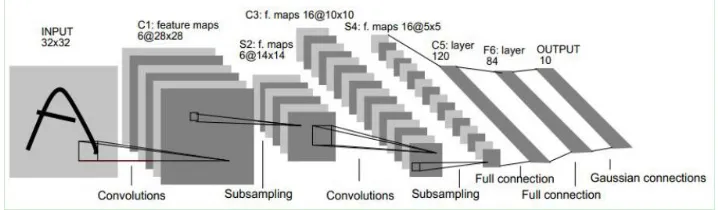
CNN is a deep machine learning model under supervised learning. It has strong adaptability, which is good at mining local features, extracting global training features and classification with weight-sharing structure network. Good results have been achieved in many areas of pattern recognition. The convolutional neural network structure contains a convolutional layer, a down sampling layer, and a full-link layer. Each layer has a plurality of feature maps, each of which extracts a feature of the input through a convolution filter, mapping a plurality of neurons.
The training algorithm is mainly divided into two stages:
The first stage is forward propagation phase: (1) taking a sample from the sample set and inputting the network; (2) calculating the corresponding actual output. In this stage, the information is transformed from the input layer to the output layer. This process is also the network which performs after completing the training.
[image:2.612.118.477.557.662.2]The second stage is backward propagation stage: (1) calculating the difference between the actual output and the corresponding ideal output; (2) adjusting the weight matrix according to the method of minimizing error.
Figure 2. Diagram of training model optimization.
In this paper, CNN is mainly used for data preprocess, while training layer is convoluted. We use every 15 data as a unit of window size. The process of model training is as follows. Firstly, select the data set. Secondly, process the data set to generate the data training file. Thirdly, cut the file through the split operation. Fourthly, use the linear regression to select the parameter network, and finally support the linear regression, parameter network and regression estimator. The data is validated and trained, then the predicted results are generated, in which observed values are compared for model evaluation.
SOFTWAREARCHITECTURE
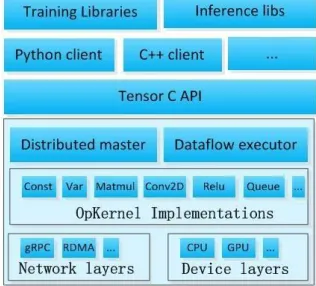
The algorithm implementation is based on the Tensor Flow platform architecture, using Python language to implement deep learning and other algorithms.
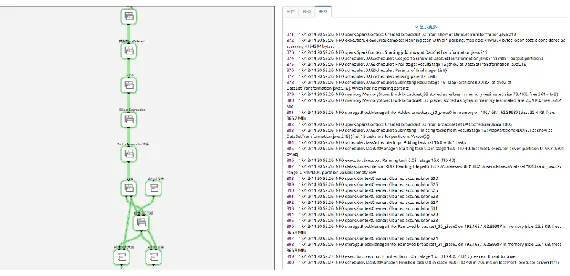
[image:3.612.217.375.501.644.2]Figure 4. Schematic diagram of machine learning modeling and machine learning training page.
Through the API interface layer of core functions, we can achieve related experiments and applications [3]. The system architecture of Tensor Flow is shown in Figure 3. It is divided into device management/communication layer, data operation layer, graph computing layer, API interface layer and application layer from the bottom. Of all layers, the management/communication layer, the data operation layer, and the graph calculation layer are the core layers of the TF.
At the method level, the overall process contains data integration, data processing, feature engineering, model training, data integration, model evaluation, model preservation, and so on. The neural network models such as CNN and DNN are selected, and the evaluation indexes such as MES, RMSE and correlation coefficient are selected to evaluate the prediction accuracy of the test data. While the gas path diagnostic algorithm including a diagnostic process creation module, a process template management module, a data set setting management module, an algorithm model editing management module, an algorithm model training module, and an algorithm performance evaluation module.
EXPERIMENT AND ANALYSIS
Experimental Descriptions
[image:4.612.101.493.625.689.2]The test data of engine is derived by NASA which contains a series of multivariate time series. NASA released these data mainly for the purpose of conducting competitions in engine whole life prediction [5].
TABLE I. DESCRIPTION OF EXPERIMENTAL DATA USED.
Training data Test Data Remaining useful life data
train_FD001 test_FD001 RUL_FD001
train_FD002 test_FD002 RUL_FD002
train_FD003 test_FD003 RUL_FD003
The data is used to carry out research on data-based diagnostic method for the engine. Each set of data is divided into training and test data. Each engine data begins with a certain degree of wear-error, and the degree of wear-error is unknown. The training data contains 100 sets, 260 sets, 100 sets, and 249 sets of engine life test data respectively. While the test data contains 100, 259, and 248 sets of engines data in a life cycle stage in which the remaining life data is given.
The experimental data mainly records the following 26 parameters of the engine every working cycle:
1) Engine number, 2) Cycle number, 3) Operation setting 1, 4) Operation setting 2, 5) Operation setting 3, 6) Fan inlet total temperature T2, 7) LPC outlet total temperature T24, 8) HPC outlet total temperature T30, 9) LPT outlet total temperature T50, 10) Fan inlet pressure P2, 11) Bypass total pressure P15, 12) HPC outlet total pressure P30, 13) Physical fan speed Nf, 14) Physical core machine speed Nc, 15) Engine pressure ratio Epr (P50/P2), 16) HPC outlet static Pressure Ps30 (Psia), 17) Fuel flow Phi, 18) Conversion fan speed NRF, 19) Conversion high pressure speed NRC, 20) Duct ratio (BPR), 21) Combustion chamber oil-gas ratio (FarB), 22) Airflow depreciation (htBleed), 23) Requirements Fan speed Nf_dmd, 24) Requires corrected fan speed NfR_dmd (R/min), 25) HPT cooling flow W31 (Lbm/s), 26) LPT cooling flow W32.
Data selection and Processing
The test_FD002 file is selected as the verification data. Correspondingly, the RUL_FD002 file is selected to observe the value. Then we normalize these data.
Model Verification
The processed training data is trained by the neural network to obtain the trained gas path system diagnostic model. After that, the test data is imported into the model for calculation, and the remaining life of each engine is obtained comparing with the actual results. The evaluation method uses indicators such as MES, RMSE, and Pearson correlation coefficient:
𝑀𝐸𝑆 =𝑛1∑𝑛𝑡=1(𝑂𝑏𝑠𝑒𝑟𝑣𝑒𝑑𝑡− 𝑃𝑟𝑒𝑑𝑖𝑐𝑡𝑒𝑑𝑡) (1)
𝑅𝑀𝑆𝐸 = √𝑀𝑆𝐸 (2)
𝑃𝐶𝐶 =𝑛−11 ∑𝑛 ((𝑋𝑖−X𝑆𝑥 )(𝑌𝑖−Y𝑆𝑦 ))
𝑖=1 (3)
Comparative Analysis of Results
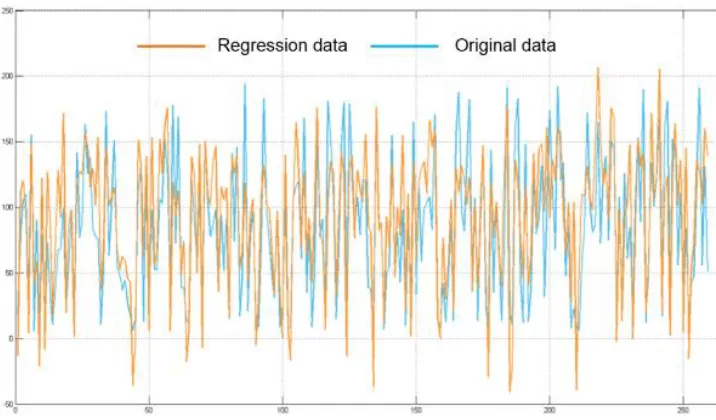
[image:6.612.119.477.398.608.2]The prediction results of various algorithms are shown in Figure 6. According to the MSE, RMSE and Pearson correlation coefficients (PCC) of each algorithm, CNN has the highest prediction accuracy due to its good fault tolerance and self-learning ability. The prediction accuracy based on regression analysis is the worst. SVM has better prediction accuracy and effect due to the advantages of nonlinear and high-dimensional pattern recognition.
Figure 7. Prediction results: (a) SVM, (b) linear regression, (c) ridge regression, (d) elastic network.
TABLE II. COMPARATIVE ANALYSIS OF VERIFICATION RESULT BASED ON EXPERIMENTAL DATA.
CNN Linear
Regression
Ridge Regression
Elastic
Network SVM
MSE 976.1371 3056.32 1627.26 2088.91 1018.6
RMSE 31.2432 55.28 40.34 45.70 31.916
PCC 0.730 0.677 0.723 0.726 0.8108
CONCLUSIONS
In this paper, the prognostic method based on convolutional neural network for engine gas path is studied. The artificial intelligence algorithm platform based on big data architecture is constructed. The artificial intelligence algorithm is more traditional than RBF neural network method and support vector machine. Compared with methods such as regression analysis, there is a big improvement in the accuracy of prediction. The research method can be directly applied to the diagnosis and prediction of aeronautical engine gas path fault under typical experimental environment; after adaptive adjustment and training, the algorithm can also be applied to other types of engine equipment, which has better promotion prospect and value.
ACKNOWLEDGEMENTS
[image:7.612.118.479.335.396.2]REFERENCES
1. H Lee, Grosse R, Ranganath R, et al. Convolutional Deep Belief Networks for Scalable Unsupervised Learning of Hierarchical Representations. In: Proc Intl Conf on Machine Learning (ICML)[C]. International Conference on Machine Learning, ICML 2009, Montreal, Quebec, Canada, June. 2009:609-616.
2. Raina R, Battle A, H Lee, et al. Self-taught Learning: Transfer Learning from Unlabeled Data[C]. International Conference on Machine Learning. ACM, 2007:759-766.
3. Fatih Ertam, Galip Aydın. Data Classification with Deep Learning Using Tensorflow [C]. 2017 International Conference on Computer Science and Engineering (UBMK), 5-8 Oct. 2017, Antalya, Turkey.
4. Hongzheng Fang, et al. Spacecraft Power System Fault Diagnosis Based on DNN. 2017 Prognostics and System Health Management Conference, Haerbin, 2017.