ISSN: 1992-8645 www.jatit.org E-ISSN: 1817-3195
DISTURBANCE REJECTION FOR A CLASS OF NONLINEAR
SYSTEMS WITH INPUT TIME-DELAY
∗WEN XINYU
Lecturer, School of Electronic Information Engineering, Taiyuan University of Science and Technology
E-mail: [email protected]
ABSTRACT
Disturbance-observer-based control (DOBC) has been considered as a robust control scheme against the various unknown disturbances in many applications The existing DOBC methods were only applicable for the case where disturbances satisfy time matching condition, i.e., they enter the system in the same time as the control inputs. By appropriately designing a auxiliary observer, the disturbance of future time is predicted after appropriate coordinate transformation, new disturbance estimation and rejection law are designed in this paper. One novel feature of the proposed method is that the merits of DOBC can be inherited for a class of nonlinear systems with input time-delay. By integrating the disturbance observers with conventional robust control laws, the disturbances can be rejected and the desired dynamic performances can be guaranteed. Simulations demonstrate the advantages of the proposed scheme.
Keywords: Disturbance observer, Time delay, Disturbance rejection, Sinusoidal disturbance
∗
This work was supported by the National Natural Science Foundation of China under Grants 61203049 and Scholar Doctor Priming
Foundation (20122048)
1.
INTRODUCTIONDisturbance observer based control (DOBC) is a
prevalent anti-disturbance control strategy,
compensation for modeling errors and exogenous disturbance has been considered as a robust control scheme when the errors or disturbance can be measured. DOBC was established in the late of 1980s for linear frequency-domain systems, has a simple structure and is easily implemental in engineering (see surveys [1] and references therein).
In another case, if the priori property of disturbance to be estimated is known, DOBC can be implemented where the disturbance compensation dynamic property within a composite system can be analyzed ([2]-[6]). Originating from [6], a hierarchical control strategy is established in ([13]) aiming at multiple disturbances in multi-input multi-output (MIMO) nonlinear system, the outcome shows that the strategy has high precision together with strong robustness. The literatures mentioned above show that the model-based DOBC is feasible for more complex structure and can avoid heavy computation, such as resolve of partial
differential equations (PDEs) compared with output regulation theory ([8]).
However, one of the limitations of the classical DOBC is that the disturbance and input must satisfy time matching condition. The question arises how the DOBC can be extended to the general case in which the system model has input time-delay. In classic DOBC ([5, 7, 9, 10, 12, 15, 16]), the
disturbance is seen as extended state,
inherited. We first construct an auxiliary observer, and then derive the mapping relationship between the disturbance and compensation controller by appropriate transformation coordination.
The organization of the problem is given below. Section 2 gives the problem formulation. In Section 3, the formulation for the disturbance estimation is proposed for a class of nonlinear systems. In Section 4, the compensation controller is designed in DOBC frame with input time-delay. In Section 5, the proposed method is applied to a nonlinear system, simulations demonstrate the advantages of
the proposed scheme. Section 6 provides
conclusions.
2.
FORMULATION OF THE PROBLEMThe following nonlinear continuous MIMO system with input time delay and disturbances is considered:
1 1
( ) ( ) ( ( ), ) [ ( ) ( )] x t =Ax t +F f x t t +B u t− +τ d t (1)
where ( )x t ∈Rn
, ( )u t ∈Rm(m≤n) is the state, the control input and the measurement output,
respectively. A∈Rn n× is the coefficient matrices,
n m
B∈R× satisfies rank(B)=m , F1 is the
corresponding weighting matrices, f x t t1( ( ), ) is
nonlinear functions, d(t)=
[
d1(t),d2(t),dm(t)]
Tis vector of sinusoidal disturbance and
τ
<∞is thedelay time. Such a model can also represent a wider class of time-delay system compared with paper [5,10,12].
To precede our following discussion, rewrite sinusoidal dias
= Γ =
i i i
i i i
w V d
w w
(2)
where wi∈R2 , and the linear uncertain matrix
2 2×
∈
Γi R , (Γi,Vi) is uniformly observable.
Without loss of generality, (Γi,Vi) has observable
canonical form, which can be expressed as:
[ ]
i nVi i
i , 1 0, 1,2 0
1 0
2 = =
− = Γ
ω (3)
from (2-3) we can calculate that wi =φi(t)wi0 with
initial value ωi0 and
− =
) cos( ) sin(
/ ) sin( ) cos( )
(
t t
t t
t
i ω ω ω
ω ω ω
φ , (4)
Similar to the output regulation theory, each
unknown external disturbance di is supposed to be
generated by an exogenous system, model (2) we define as in form (3) can represents sinusoidal disturbance with unknown phase and magnitude. In application, many kinds of disturbances encounter-ed in engineering can be describencounter-ed by this sinusoidal model, for example, the control of aircraft control [6], magnetic bearing control [10], robotic systems [3], etc.
Assumption 1: For system (1), there exists a
stabilizing law u=u0 so that x = 0 is a uniform
globally asymptotically stable equilibrium of :
1 1 0 0
( ) ( ) ( ( ), ) ( )
x t = Ax t +F f x t t +B u t−τ ,
Moreover, there is a function Ω0(x) : R+×Rn
satisfying
) (
)) ( )
), ( ( ) ( ( ) (
, )
( ), ( ) ( ) (
4
0 0 1
1 0
3 0
2 0 1
x
t u B t t x f F t Ax x
x
x x
x x
x x
T
T
γ
τ γ γ
γ
− ≤
− +
+ ∂
Ω ∂
≤ ∂ Ω ∂ ≤
Ω ≤
(5) where γ1(⋅),γ2(⋅) are of K∞-class and γ4(⋅)of
K-class
As ωi0in (2) is unavailable value of disturbance
can not to be obtained directly, a conventional
method is to identify ωi0 with adaptive technique,
but the strategy is sensitive to un-modeled dynamic and lead to semi–negative system ([11]). This paper, we will give the relationship between the parameters Γi(i=1,2m) andd(t), such that the
exogenous disturbance may be compensated by a phase advance controller. The control problem considered will be solved in DOBC frame instead of adaptive control .
3.
NONLINEAR DISTURBANCEOBSERVER
In this section, we suppose that f x t t1( ( ), ) are given and Assumptions 1 hold. When all states of the system are available, it is unnecessary to estimate the states, then the estimation of the disturbance need to be concerned. According to (2), d in (1) can be expressed as follows:
= Γ =
Vw d
w w
ISSN: 1992-8645 www.jatit.org E-ISSN: 1817-3195 } , { }, ,
{ 1 2 m V diagV1 V2 Vm
diag Γ Γ Γ =
=
Γ (7)
Construct an auxiliary MIMO nonlinear system as follows: ) ( ) ( )
( 1 1
= − − − − + = + = x B L t Bu B L Ax B L x f F B L G ψ τ ψ ν ν ψ ν ξ (8) where = = 2 1 2 1 , i i i m ξ ξ ξ ξ ξ ξ ξ
G and L are given constant matrices that satisfy
} ,
{ },
,
{G1 G2 Gm L diag L1 L2 Lm diag
G= =
(9) where = − − = 1 0 , 1 0 2 1 i i i i L g g G
, (10)
and Giis Hurwitz by properly selection of gi1 and
2
i
g . Consideringrank(B)=m, there exist pseudo
i n v e r s e B s u c h t h a t BB=1, s o s y s t e m (8) can be transformed as
Ld G + = ξ ξ
. (11) Comparing (2) and (8) with (11) yields
Γ = w LV G w ξ ξ 0 (12) Lemma 1: For system (8), if Gi(i=1,2m) and Li (i=1,2m) have form of (10), there exists
an invertible matrix Πisuch that
) ( i i i i
i i
i +Π w =G ξ +Π w
ξ (13)
Proof: Considering an invertible matrix
Π = − I I
Pi i
0
1
, (14) where 2 2 2 2 2 1 2 1 2 2 2 2 1 ) ( ) ( ) ( i i i i i i i i i i i i g g g g g g ω ω ω ω ω + − − − − − − = Π
, (15) ,
it is obvious that Πi is invertible in global region ofωi2, furthermore it can be derived that
+ − − − = Π− 2 1 2 2 2 1 2 1 i i i i i i i i g g g g ω ω ω (16) According to (12), notice that
Γ = i i i i i i i w i L V G w ξ ξ 0
Then define the following coordinate transfor -mation = − i i i i i w P w ξ ξ 1 (17) Combining (13) with (15) it is clear that
Γ = − i i i i i i i i i w P i L V G P w ξ ξ 0 1 (18) After calculation it can be verified that
Γ = Γ − i i i i i i i G P i L V G P 0 0 0 1 and Γ = i i i i i w i G w ξ ξ 0 0 (19) Finally (13) can be got directly following (18) and (19).
Q.E.D Based on Lamma1 we can give another form of
i d as
) ( ) ( ) ( )
(t Vw t V t V t
di = i i =− iξi + iξi (20)
where ) ( ) ( )
(t 1 t 1 t
wi i ξi i ξi −
− +Π
Π −
= ,Vi =ViΠi−1 (21)
with ) ( ) ( )
(t i t iwi t i =ξ +Π
ξ (22)
and satisfies
i i Gξ
ξ = (23) Up to now, we have given the another form of
i
d by constructing auxiliary observer ξ, whereas
(20) can not be implanted to reject the disturbance directly for reason that there exist time delay in control input, this is a major hurdle impede the further research and application in DOBC and other disturbance rejection research.
The following will introduce a novel technique to estimate the phase advance of disturbance.
From (13) we can predict that
)} , ( ). , ( ) , ( { ) , ( }, . { 2 , 1 2 , 1 τ ω ψ τ ω ψ τ ω ψ τ ω ψ m m diag diag = Π Π Π = Π − = = ) cos( ) sin( / ) sin( ) cos( ) , ( )} ( ). ( ) ( { )
( , 2
ωτ ωτ ω ω ωτ ωτ τ ω ψ φ φ φ
φ t diag i t t m t
(25)
Following (24) we can get
) ( ) ( ))) ( ) ( ( ) ( )( , ( )
( 1 1
τ τ ξ ξ ξ τ ω ψ τ ξ + Π + + + Π + Π + Π − Π − = + − − t w t t w t t t i i i i i i i i i i (26)
Combining with (20) shows that
) ( ) ( ) , ( ) ( 2 ) ( ) , ( ) ( ) , ( ) ( ) ( ) ( 1 1 1 1 τ δ ξ τ ω ψ τ ξ ξ τ ω ψ ξ τ ω ψ τ ξ τ ξ τ + + Π − = + + Π + Π − = + + + Π − = + − − − − t V t V t V t V t V t V t V t d i i i i i i i i i i i i i i i i i i i (27) where
[
]
+ = + Π = − ) ( ) ( ) ( , 2 ) , ( 1 τ ξ ξ τ δ τ ω ψ t t t V V V i i i i i i i iA notable property of (27) is that di(t+τ) can be
expressed by auxiliary vector ξi(t) and a decay
vector δi(t+τ) So, we can predict the future
disturbance at time t+τas:
) ( ) , ( ) ( ˆ 1 t V t
di τ iψi ω τ i ξi − Π −
=
+ (28)
Thus the proposed method will exhibit classic DOBC property.
4.
NONLINEAR DISTURBANCEOBSERVER
T he structure of the DOB C co ntro ller is formulated as by using of the separation principle.
0
ˆ
( ) ( )
u t = −d t+ +τ u
(29) where
[
]
Tm t d t d t d t
dˆ( +τ)= ˆ1( +τ) ˆ2( +τ) ˆ ( +τ) Thus, the dynamic system (1) can be rewritten as 1 1 0 ( ) ( ) ( ( ), ) ˆ [ ( ) ( ) ( )] x t Ax t F f x t t
B u t τ d t d t
= +
+ − + −
(30)
Theorem 2 For the auxiliary system (8), if (10) is satisfied and under assumption 1 then the close-loop system (30) is asymptotically stable under DOBC law (29).
Proof:
Based on (27) it can be shown that
) ( ) ( ) , ( ) ( 2 ) ( ) , ( ) ( ) , ( ) ( ) ( ) ( 1 1 1 1 τ δ ξ τ ω ψ τ ξ ξ τ ω ψ ξ τ ω ψ τ ξ τ ξ τ + + Π − = + + Π + Π − = + + + Π − = + − − − − t V t V t V t V t V t V t V t d (31) where } , { }, , { 1 1 2 2 1 1 1 2 1 − −
− Π Π
Π = = n n n V V V diag V V V V diag V
[
]
+ = + Π = − ) ( ) ( ) ( , 2 ) , ( 1 τ ξ ξ τ δ τ ω ψ t t t V VV (32)
Compared with (28), the estimation error satisfies ) ( ) ( ˆ )
(t d t V t
d − = δ (33)
and
) ( ) (t Gδ t δ =
where = G G G 0 0 (30)
Notice that G also satisfy Hurwitz condition
according to (10) and (30), We can find P>0 such
that
I PG
GP+ =− (31)
Define a Lyapunov function candidate as
) ( ) ( ) , ( )
(t 0 x t t P t
T δ γδ + Ω = Ω
Take the derivative of Ω(t)along the composite
closed-loop system leads to
2 3 4 0 0 0 1 1 0 ) ( ) ( ) ( ) ( ) )( ( ) ( ) ( )) ( ) ), ( ( ) ( ( ) ( ) ( t t x V x t G P P G t t V x x t u B t t x f F t Ax x x t T T T T δ γ δ γ γ δ γδ δ τ − + − ≤ + + ∂ Ω ∂ + − + + ∂ Ω ∂ = Ω
Based on Assumption 1, one can find
corresponding constant γ5> 0 such that
) ( 5 t x δ γ − ≤
Ω ,
whereγ5 is also of k -class with respective to
xand δ(t).
Thus the proof is completed.
Q.E.D
It is noticed that as Gcan be chosen arbitrarily,
we can determine the value of P as desired, which
influences the convergence property of δ(t)
ISSN: 1992-8645 www.jatit.org E-ISSN: 1817-3195
follows:
Step 1) Select weighting matrices G and L with form of (9) and (10), apply G and L into (8) to
calculate auxiliary vectorξ.
Step 2) According to (28), give another form of disturbance represented by auxiliary vector. Step 3) Apply dˆ(t+τ)and feedback controller u0
into (1), DOBC control can be realized.
5.
SIMULATIONTo show the efficiency of the proposed scheme, Let us consider the system (1) with coefficient matrices
1.0 0.5
0 2.0
A= − −
,
1.5 2.0 B= −
, ,
1
0.1 0
0 0.2
F =
−
.
Nonlinear function f x t t1( ( ), )=x t( ) cos( )t , suppose
exogenous disturbance d=sin(t) and delay time
2 =
τ . In assumption 1 , we choose u0 =Kx, and
[
0.2213 0.2506]
K= − in simulation.
Set
− − − − =
2 1 0 0
1 0 0 0
0 0 2 1
0 0 1 0
G
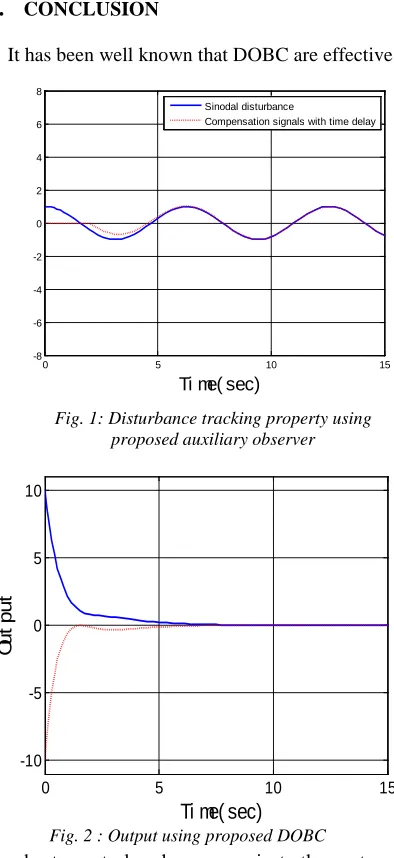
As input with time-delay, the disturbance can not be rejected at real-time. We need to predict the future disturbance which is thought as a stuff task to be completed. Fig.1-2 demonstrates the system performance using the proposed DOBC schemes considering input time-delay, and obviously show that the disturbance estimation error at time
τ +
t and system output converges to zero with
sufficiently small steady error. The results show that although there exists time-delay in the system, the disturbance rejection performance is enhanced and satisfaction system responses can be achieved. Fig.3 plots the estimation error of the sinusoidal disturbances with traditional DOBC method. The results show that if system input suffers time-delay, it may bring larger disturbance estimation error and the control performance is deteriorated (Fig.4).
One can observe that to achieve a good tracking the actual sinusoidal disturbance, need not estimate their true values wi(i=1,2,m). By appropriately coordinate transformation, the disturbance can be approached by an function of auxiliary observer. Furthermore, when suffers system input time-delay,
the future disturbance can be predicted by this type of observer.
6.
CONCLUSIONIt has been well known that DOBC are effective
0 5 10 15
-8 -6 -4 -2 0 2 4 6 8
Ti me( sec)
Sinodal disturbance
Compensation signals with time delay
0 5 10 15
-10 -5 0 5 10
Ti me( sec)
O
ut
put
[image:5.612.323.520.125.554.2]robust control schemes against the external disturbances and the modelling perturbations. Whereas how to reject the disturbance with input time-delay remains to be resolved up to now. A class of MIMO continue systems with nonlinearity and input time-delay are considered in this paper, the sinusoidal disturbance is described by an exogenous system. An auxiliary observer is structured for the estimation of the disturbance and predicts its future influence simultaneously. Simulation examples are given to show the effectiveness of the proposed results compared with the pure DOBC method.
Fig. 1: Disturbance tracking property using proposed auxiliary observer
[image:5.612.334.516.170.335.2]0 5 10 15 -4
-3 -2 -1 0 1 2 3 4
Ti me( sec)
Sinodal disturbance
Compensation signals with traditional disturbance observer
0 5 10 15
-10 -5 0 5 10
Ti me( sec)
O
ut
put
In this paper, we utilize the frequencies of the
sinusoidal disturbance. With the proposed
framework we can extend the problem to the case that frequencies is unknown, which remains our further research.
REFRENCES:
[1] L. Guo, C. Feng, and W. Chen. “A survey of disturbance observer-based control for dynamic
nonlinear system”, Dynamics of Continuous
Discrete and Impulsive Systems-series B: Applications & Algorithms, 2006, 13E: 79-84.
[2] J.Back and H. Shim, “Adding robustness to
nominal output- feedback controllers for uncertain nonlinear systems: A nonlinear
version of disturbance observer”, Automatica,
Vol. 44, No. 9, 2008, pp. 2528-2537.
[3] W. H. Chen, “A Nonlinear Disturbance Observer
for Robotic Manipulators”, IEEE Transactions
on Industrial Electronic, Vol. 47, No. 4, 2000, pp. 932-938.
[4] W. H. Chen, “Disturbance Observer Based Control for Nonlinear Systems”, IEEE/ASME Transactions on Mechatronics, Vol. 9, No.4, 2004, pp. 706-710.
[5] X. K. Chen, C. Y. Su, and Toshio Fukuda, “A
Nonlinear Disturbance Observer for
Multivariable Systems and Its Application to Magnetic Bearing Systems”, IEEE Transactions Control Systems Technology, Vol.2, No. 4, 2004, pp. 569-577.
[6] L. Guo and W. H. Chen. “Disturbance attenua-tion and rejecattenua-tion for systems with nonlinearity via DOBC approach”, International Journal of Robust Nonlinear Control, Vol.15, No.2, 2005, pp. 109-125.
[7] L. Guo and X. Y. Wen, “Hierarchical Anti-Distance Adaptive Control for Nonlinear Systems with Composite Disturbances” , Transactions of the Institute of Measurement and Control, Vol. 33, No.4, 2011, pp. 942-956. [8] A. Isidori, C. I. Byrnes. “ Output regulation of
nonlinear sys tems”, IEEE Transactions on
Automatic Control, Vol.35. No.1, 1990, pp. 131-140.
[9] J. Yang, W. H. Chen and S H Li, “Nonlinear disturbance observer based robust control for systems with mismatched disturbances /uncertainties” . IET Control Theory and Application, Vol.5, No. 18, 2011, pp. 2053 – 2062.
[10] T. Mizuno and T. Higuchi. “Design of magnetic bearing controllers based on disturbance estimation”, The 2nd International Symposium on Magnetic Bearings. Tokyo: NISSEI EBLO. 1990: 281-288.
[11] V. Nikiforov. “Nonlinear servocompensation of unknown external disturbances”, Automatica, Vol.37, No. 10, 2001, pp. 1647-1653.
[12] J. She, Y. Ohyama, and M. Nakano. “A New Approach to the Estimation and Rejection of
Disturbances in Servo Systems”, IEEE
Transactions on Control Systems Technology, Vol.13, No. 3, 2005, pp. 378-385.
[13] X. Wei and L. Guo, “ Composite Disturbance
Observer-Based Control and H∞ Control for
Complex Continuous Models”. International Journal of Robust and nonlinear Control, Vol.20, No.1, 2010, pp. 106-118.
[image:6.612.95.304.76.492.2]Fig. 4 : Output using traditional DOBC Fig.3: Disturbance tracking property using
ISSN: 1992-8645 www.jatit.org E-ISSN: 1817-3195
[14] H. S. Wu. “Adaptive Robust State Observers for a Class of Uncertain Nonlinear Dynamical SystemsWith Delayed State Perturbations”, IEEE Transactions on Automatic Control, Vol.54, No.6, 2009, pp. 1407-1411.
[15] J. Yang, S. H. Li. “Disturbance rejection of ball mill grinding circuits using DOB and MPC ”. Powder Technology, Vol.198, No. 2010, pp. 219-228.