PERFORMANCE ANALYSIS OF MSK MODULATION AND
CODING IN ENERGY EFFICIENT SENSOR NETWORK
PROTOCOL
1M. SHEIK DAWOOD, 2R.AISWARYALAKSHMI, 3G.ATHISHA
1Assoc. Prof., Department of ECE, Sethu Institute of Technology, Pulloor
2 PG scholar, Department of ECE, Sethu Institute of Technology, Pulloor
3
Prof., Department of ECE, PSNA College of Engineering and Technology, Dindigul
E-mail: [email protected], [email protected], [email protected]
ABSTRACT
A wireless sensor network (WSN) consists of several physically separated sensors to monitor and control physical or environmental conditions. In this paper the role of minimum shift keying modulation scheme along with channel coding is analyzed in energy efficient clustered sensor architecture .The performance comparison of MSK with other modulation is also discussed to increase the energy efficiency at their transceiver and improve the lifetime of sensor nodes. The simulation and mathematical results show the appropriate combination modulation and channel coding to improve the lifetime of energy efficient clustered WSN.
Keywords: Sensor Network, Energy Efficiency, Lifetime, MSK, Modulation, Error control code, clustering.
1. INTRODUCTION
Over the few years sensor Networks and its applications have become common, as also has research in academic side and industry in sensor networking devices. Sensor network applications grew over the last decade to support various functions, such as military surveillance, structural health monitoring, environmental monitoring, habitat monitoring, and underwater sensing and disaster management. [1]
A WSN can be defined as a network of nodes, which can sense events in the environment and communicate the information gathered from sensing node to Base station via the cluster head. The nodes can be stationary or moving. It may be aware of their location or not. And they can be homogeneous or not.Many efforts have been taken to increase the lifetime of sensor Networks by optimizing physical layer parameters and to develop an energy efficient communication protocol. In this paper analyze the role of modulation and coding technique to improve the lifetime of sensor node by calculating energy required for transmitting an event sensed.
In a sensor network a unique power efficient modulation technique is used for all the sensor nodes in a cluster is not suitable for energy efficient operation of sensor nodes .Instead of using the same modulation for all sensors, depends on the position of sensor node different modulation techniques are used along with channel codes to reduce energy consumption. In this paper, the performance of MSK with channel coding is analyzed and it is being compared with other modulation techniques.
2. RELATED WORK
energy efficiency and bandwidth efficiency in WSN.
Performance study of adaptive modulation such as BPSK, QPSK, 16-QAM, 64-QAM and convolutional coding for all-participate amplify-and-forward relay network systems were analyzed to achieve a better overall system performance where, the two source nodes have chosen the appropriate modulation and coding scheme based on the information from the feedback channels to ensure that the block error rate (BLER) of the relay system. They furthermore derived mathematical expressions for the system performances over Rayleigh Channels. [10]
Adaptive Modulation and coding techniques for long distance wireless communication is analyzed for the WiMAX environment [21] .The research results show that choice of selecting modulation and coding techniques for yielding higher throughputs while also covering long distances. The authors also implemented AMC features of the WiMAX and LTE access layer using SDR technologies in MATLAB and focused on the physical layer design. Modulation techniques such as BPSK, QPSK, 16-QAM, 64QAM with RS codes applied for performance analysis.
The performance of Reed-Solomon code was evaluated by applying to a binary PSK modulation scheme in symmetric Additive White Gaussian Noise (AWGN) channel. And concluded that the bit error rate (BER) performance is improved as the code rate is decreased and the simulations also showed that the BER performance is also improved for large block lengths. [22]
The importance of designing low power transmitters and reduce energy consumption of sensor node is analyzed by many researchers. CMOS integrated transmitters were designed to reduce energy consumption at the node level. The authors furthermore analyzed CMOS transmitter technology with modulation techniques to improve the lifetime of WSN. [23]
A novel approach was developed for finding appropriate error control codes for WSNs. [11]. Simulations were taken considering both RS codes and Bose, Chaudhuri, and Hocquenghem (BCH) codes) and the result showed that the RS (31, 21) fits both in BER and power consumption criterion.
Performance study of different modulation types such as M-ary QAM (MQAM), MPSK, and M-ary FSK (MFSK), frequently employed in wireless communication is analyzed. The relation between channel capacity and signal to noise ratio (SNR) is studied with authors to find the optimized parameters for minimizing the energy consumption per information bit in a point-to-point wireless link. [4].
The node hop distance estimation was performed to find the minimum number of hops required to relay a packet from one node to another node in a random network by statistical method. The energy consumption and latency are calculated from the minimum number of hops [16].
The performance of M-ary QAM and QPSK modulation schemes in Wideband Code Division Multiple Access (W-CDMA) system was analyzed subjected to AWGN and multipath Rayleigh fading channel. [12]
Analysis of the energy efficiency of LT codes with Non-Coherent M-ary FSK (NC-MFSK), known as green modulation in a proactive WSN over Rayleigh flat-fading channels with path loss was carried out to improve the energy efficiency of WSN. In addition, although uncoded NC-MFSK outperforms coded schemes for d < dT, the energy gap between LT coded and uncoded NC-MFSK is negligible for d < dT compared to the other coded schemes. They proved LT codes are beneficial in practical low power WSNs with dynamic position sensor nodes. [7]
Focused on improvement of life time of each cluster of sensors in hierarchical WSN using optimization techniques was proposed at the physical layer and how the location-aware selection of the modulation schemes for sensors can affect their energy efficiency. [13] Furthermore, the work analyzed how the energy in the network can be distributed more evenly by proper selection of the modulation schemes for different sensors. It also analyzed on how certain physical layer attributes can affect both the lifetime and the end-to-end delay in a hierarchical WSN. [14]
The study on the performance analysis of various error control codes in terms of their BER performance and power consumption on different platforms by transmitting randomly generated data through a Gaussian channel was analyzed. [5] Based on the study and comparison of the three different error control codes such as BCH code, RS code and convolutional code, It identified that binary-BCH codes with ASIC implementation were best suitable for WSNs.
Evaluation of the energy performances of uncoded MPSK, MQAM, and MFSK modulations in both AWGN and Rayleigh fading channels were compared for very short-range (less than 10 meters) communication. And authors concluded that MQAM was more energy more efficient than the other modulation schemes. [15]
[24] The Derivation of a general formula for the lifetime of WSNs was proposed to calculate WSN lifetime, which holds the network model including network architecture and protocol, data collection initiation, lifetime definition, channel fading characteristics, and energy consumption model. And referred to as the max-min approach, this protocol maximizes the minimum residual energy across the network in each data collection.
The impact of applying AMC in third Generation (3G) wireless systems was proposed and analyzed .The new method for selecting the appropriate modulation and coding scheme (MCS) (16QAM, 8PSK, BPSK with turbo codes) was proposed according to the estimated channel condition to maximize the average throughput while maintaining an acceptable Frame Error Rate (FER). [7]
3. ABOUT PROPOSED WORK
Energy is the scarcest resource in sensor network that must be utilized properly because it is impossible to recharge each sensor node so it must be energy efficient as possible as. This paper extends the work of earlier research to improve the energy efficiency of clustered WSNs by analyzing performance study of adaptive modulation technique along with channel code.
This work studies the performance of MSK modulation with error control code in QoS
Enhanced base station controlled Dynamic
Clustering Protocol architecture to derive an energy minimization scheme for node communications in
sensor network. The performance study reveals that among the several modulation and coding combination types, MSK is more energy efficient and bandwidth efficient in clustered sensor network when it is working with convolutional codes. Numerical analysis has been carried out to calculate the lifetime of sensor node by considering energy spent per information bit transmitted.
Our main purpose is to derive a suitable energy efficient modulation and coding format and the optimum physical layer parameters in Base station controlled clustering architecture that achieve minimum energy consumption for a given distance between nodes. In this paper, QoS Enhanced base station controlled Dynamic Clustering Protocol architecture have chosen for clustering sensor nodes because it works energy efficient manner compare with traditional clustering protocols.
3.1 Base Station Controlled Dynamic Clustering Protocol Architecture
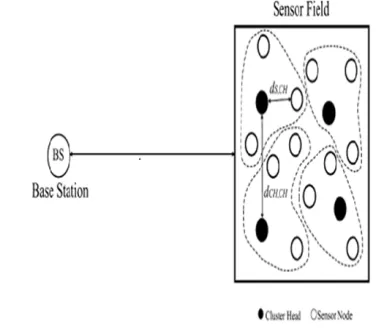
The Example WSN model is shown in figure 1. The network model considered in this paper is as follows:
[image:3.612.324.512.355.522.2]i. The sensor network is considered that have sensor nodes in Spreaded manner in an error prone sensor field. The operational situation is illustrated in Figure 1, here the sensor field is a square area of side at a distance of alone fixed Base station.
ii. The sensor nodes are provided with restrictions on battery power, processing power and memory space.
iii. The sensor nodes are fixed and are grouped physically into clusters. The nodes in a cluster may possibly carry out any of the two functions: cluster head or sensing. Every cluster head carries out the intra cluster and inter cluster communications, data aggregation and data forwarding to the Base station with the help of multi-hop routing. On the other hand, a cluster head node cannot carry out the sensing process. The purpose of cluster head is rotated between the non-sensing nodes in a cluster. Alternatively, a sensing node will be dynamically sensing the event or in the inactive mode if it is not sensing. The nodes to be used for sensing events are decided by the Base station.
iv. The data sensed by the sensing nodes in a cluster are broadcasted straightly to their cluster head that afterwards aggregates and/or pass the data to another cluster head which will direct it to the Base station. Different from the sensor nodes, the Base station is not with the restricted resources. Thus the communication from the Base station to the sensor nodes can be performed straightforwardly.
v. The Base station has information about the position of every node in the network that is situated within the sensor field.
3.2. Energy Efficient Clustering Architecture for Performance Analysis of Modulation and Coding
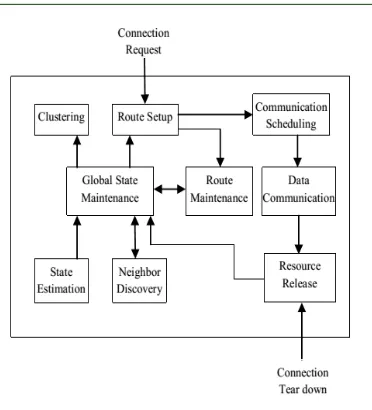
QoS Enhanced Base Station Controlled Dynamic Clustering Protocol (QBCDCP) shown in Figure 2, assume similarity in sensor node's ability and restrictions due to its uncomplicatedness of its deployment and analysis, and for reliability with most of the offered work in routing for WSN. But there are several applications that would advantage from QoS routing for Networks with homogeneous nodes, and methods presented here to realize satisfactory QoS and lesser depletion of energy may also be suitable to the construction of protocol handling with heterogonous Networks. The theory of immobile nodes is based on the detail that, for some applications, sensor nodes will be fixed at certain position after deployment, because the energy necessary to offer mobility to such nodes is inordinate.
QBCDCP is an improved technique of BCDCP with the recently added functionality
of QoS based route selection. QoS is maintained in QBCDCP by including delay and bandwidth detail in route selection. This work mainly focused on the energy necessary for transmission of sensor event. The functional Components of QBCDCP and the associations among them are depicted in Figure 2. Every data round, specified by a fixed time interval, the Base station groups the sensor nodes into balanced clusters with the help of LEACH. [20]
4. PROPOSED WORK
[image:4.612.329.515.87.292.2]In WSN the cluster head node directly collects data from sensors and forwards the data towards the base station. Within a cluster, sensors communicate with the cluster head through TDMA channels, so there is no channel interference between sensors in one cluster. The network lifetime depends on the lifetime of each cluster. In this study, we try to poise the dissemination of energy consumption within each cluster. Assume that cluster head has access to larger energy source than the sensor nodes, so we focus on the energy consumption of the sensors due to data transmission to cluster head. To increase a cluster’s lifetime, the energy consumption in each sensor should be reduced. Energy dissipation due to data transmission is a large percentage of the overall energy consumption within the sensors. To preserve the sensor node energy, we need to choose the appropriate transmission model and it should be implemented in the energy efficient clustering protocol. Hence this work analyzes the performance of energy
efficient modulation and coding in QoS Enhanced base station controlled Dynamic Clustering Protocol, to reduce energy consumption and increase the sensor node lifetime.
The work divided into following components,
1. The choice of selecting the energy
efficient QoS enhanced clustering architecture.
2. Finding out the Optimal distance between
cluster head and event detection node in energy efficient clustering architecture.
3. Optimal Selection of adaptive modulation
and coding technique with energy efficient error control codes.
4. Selection of the most adapted sensor
energy model for calculating transmission energy and lifetime.
5. Performance analysis of modulation and
coding in AWGN channel conditions with respect to the QoS Enhanced base station controlled Dynamic Clustering Protocol.
4.1. The Choice of Selecting the Energy Efficient Clustering Architecture
The simulation result shows that QoS Enhanced base station controlled dynamic protocol clustering technique results in more number of live nodes when compared to the existing cluster based routing technique for wireless sensor network. To achieve higher energy consumption in sensor nodes and cluster, we deploy the adaptive modulation and coding technique into this clustering architecture. It furthermore reduces the energy consumption and increase the cluster lifetime. The BSCDCP has been proven a veracious choice for WSNs over the traditional cluster based routing protocol LEACH. [20]
4.2. Finding out the Optimal Distance between Cluster Head and Sensing Node
Consider a sensor field with several sensors; all sensor nodes are equipped with software enabled radio. An entire sensor field divided into several clusters. It consists of two types of nodes one is for event detection and another for a cluster head role. The information collected by cluster head transfers to base station. Here base station controlled clustering protocol help the cluster head to identify the position of the event detection nodes in a cluster. According to information received from the base station, cluster heads transceiver works adaptively selects the modulation based on distance
between nodes and transmit the information base station and other nodes.
4.3. Selection of Modulation Technique with Energy Efficient Error Control Code
Modulation scheme is considered across the network and the levels adjusted to achieve lower required energy per bit. One common modulation scheme is considered and the target bit rate is adjusted to achieve lower energy per bit. This approach leaves lots of energy shortage in node lifetime .Hence another approach is to consider a dissimilar position based modulation scheme where different nodes may use different modulation schemes under the desired BER value. In position-aware modulation scheme, energy consumption distribution within a cluster is balanced by using various modulation schemes for different nodes within a cluster.
4.5. Performance Analysis of Modulation and Coding
Modulation schemes such as PSK, OQPSK, PAM, QAM, DPSK, FSK and MSK along with convolutional and block codes are analyzed to improve the lifetime of the sensor nodes in a WSN. The codes convolutional and block codes are used with the several modulations to study the performance of WSN.
The scenario I: A unique power efficient modulation and coding technique are used for all the sensor nodes
• Similar modulation techniques used for all
deployed sensor nodes in QBCDCP
• Use a constant desired BER value
• Convolutional and block codes are applied
with modulation techniques
• Performance of MSK modulation and
coding technique is studied in an AWGN channel environment and its performance compared with other modulation techniques.
also compared with the performance of other modulation techniques. In this scenario distance between nodes are considered as 5m, 10m, 40m and 60m.
Scenario II: Disparate Adaptive Modulation and Coding Techniques for Cluster Heads and Sensor Nodes
• Dissimilar modulation techniques used
based on the position of the node for all deployed sensor nodes in QBCDCP
• Use a constant desired BER value
• Convolutional and block codes are applied
with modulation techniques
• Performance of MSK modulation and
coding technique is studied in an AWGN channel environment and its performance compared with other modulation techniques.
There is also a trade-off between modulation power efficiency versus the receiver complexity and bandwidth efficiency. Therefore, using the most power efficient modulation for all sensors in the network may not be desirable. Henceforward different modulation techniques with position based scheme are used for the event detection nodes. In this scenario MSK modulation is used for centrally located sensors that are within 40 meters from their assigned cluster head node. The rest of the sensors that are located more than 40 meters from the cluster head node use other type of modulation techniques. This is an example implementation of our proposed energy efficient position reactive modulation selection .The performance of MSK and other modulation techniques applied for sensor nodes we prefer various modulation techniques with error control code for better performance of the WSN. The higher bandwidth efficiency is also achieved by using MSK with error control codes compared with other modulation and coding schemes.
4.4. Energy Model of Sensor Node
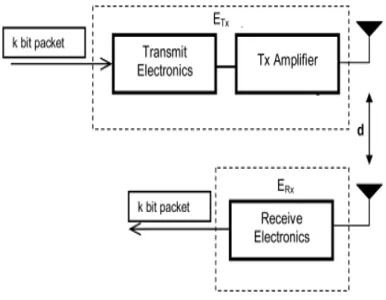
Figure 3 shows a sensor energy model used for this work. This model used in this work has been widely adopted in several studies. Here the energy spent by the transmitter is only considered, the circuit has three modes of operation: on, transient, and sleep. The ‘on’ state is used for the transmission of information. The sleep state is used for saving energy and the short-term state is a temporary one between the two states. The sleep state has a very small power consumption compared to the other states, power is considered
for sleep state almost be zero. Our main aim of this paper is precisely the minimization of the energy spent in the ‘on’ state. [3, 6, 9]
4.5. Calculation of Transmitting Energy per Bit
Calculation of Eb/No theoretically explained by [18] T.S. Rapparport and Proakis [17]
with the various digital modulation schemes its performance over different channel conditions
For any modulation scheme, the BER can be
exemplified as a function of Eb/No which is the ratio of the energy per bit to the noise power spectral density. For a given Eb/No there can be a large difference between the required BER of different modulation schemes and vice versa. [8]
The choice of digital modulation scheme will significantly affect the characteristics, performance and resulting physical realization of a communication system. An energy efficient modulation scheme for WSNs is chosen by the aid of BER Vs Eb/No plot using MATLAB. Here BER is taken as 10-4 and the corresponding Eb value is found and its value used to calculate the transmission energy per bit. The performance comparison of modulation with and without coding for AWGN channel is shown in tables.
The transmission energy per bit is calculated by the equation of a log-distance path loss model, the required energy per transmitted bit in the ith sensor node may be written as:
eTx(i) = KTx. Eb. �4πdλω �e(i),i βe(i),i
[image:6.612.316.509.218.368.2]… … … . . (1) Where, kTx is a constant coefficient,. Eb is the needed energy per bit of the receiver. de(i),i and βe(i),i denote the distance and the path loss exponent between sensor i and its assigned cluster head node. βe(i),i depends on the environment ,whereas λw denotes the signal wavelength.
4.6. Calculation of Network Lifetime
Sensor Node lifetime is calculated using the formula shown in equation 2. The network lifetime is defined as the time span from the sensor deployment to the first loss of coverage. [2]. It is also defined as the time span from the deployment to the instant when the network is considered non-functional, for example the instant when the first sensor dies, a percentage of sensors die, the network partitions, or the loss of coverage occurs [24] and they derived the average network lifetime as
Ε[ι] = εo−Ε[Eω]
Pc+λΕ[Er] ……….. (2)
Ε[ι]=Sεo−Ε[Eω]
Ε[Er] …… ………. (3)
Where, S is the total number of sensors, E0 is the initial energy, E [Ew] is the expected wasted energy (i.e., The total unused energy in the network when it dies), and E [Er] is the expected reporting energy consumed by all sensors in a randomly chosen data collection
5. SIMULATION STUDY
In this study, 1500 sensors placed in a spread manner in a 100x100 m2 field. The sensors are distributed and form clusters based on the base station controlled dynamic clustering algorithm. The packet size is set to 128 bytes. The initial battery energy level of each sensor is 2 KJ. The base station has information about the position of every node in the network that is situated within the sensor field. From this time the position of the sensors and cluster head monitored and controlled by the base station. In according to the position of the event detection node an appropriate modulation is chosen along with error control code for transmitting the sensed information to other sensing nodes, cluster head and base station. The following assumptions are made in this simulation, a fixed BER is considered or entire simulation study, the path loss exponent is chosen depends on the channel in which sensor node transmitting the information.
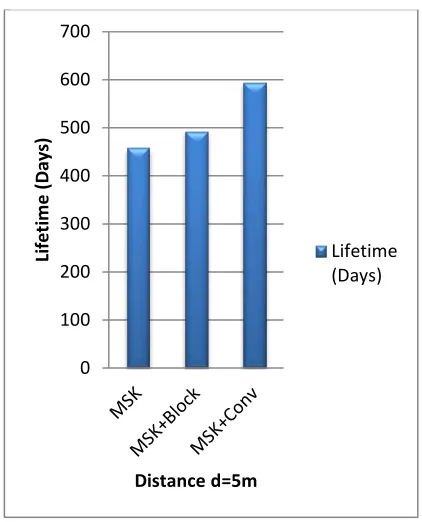
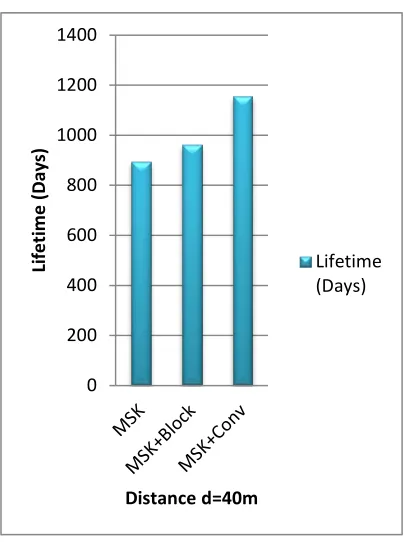
[image:7.612.310.533.124.398.2]By using the equation (2), the network lifetime is calculated for different modulation schemes with codes. Figure 4,5,6,7,8 shows the lifetime of sensor node (days) at BER=10-4 for MSK modulation alongside with convolutional and block codes at different distances 5m, 10m, 40m and 60m.
Figure 5: Comparison Of MSK Modulation With &Without Coding At Distance D=5m
0 100 200 300 400 500 600 700
Li
fet
im
e (
Da
ys
)
Distance d=5m
Lifetime (Days) 0
100 200 300 400 500 600 700 800 900 1000
Li
fet
im
e (
Da
ys
)
Distance (m)
[image:7.612.311.522.428.689.2]Lifetime (Days)
Figure 6: Comparison Of MSK Modulation With &Without Coding At Distance D=10m
Figure 7: Comparison Of MSK Modulation With &Without Coding At Distance D=40m
Figure 8: Comparison Of MSK Modulation With &Without Coding At Distance D=60m
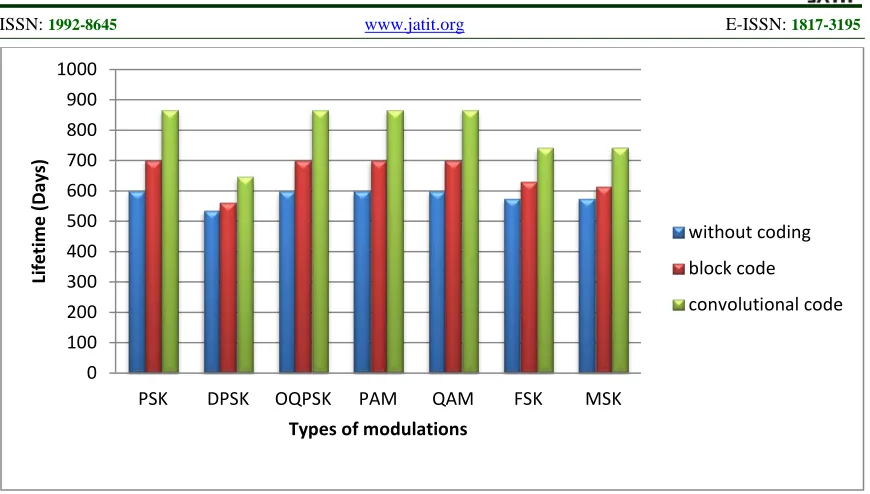
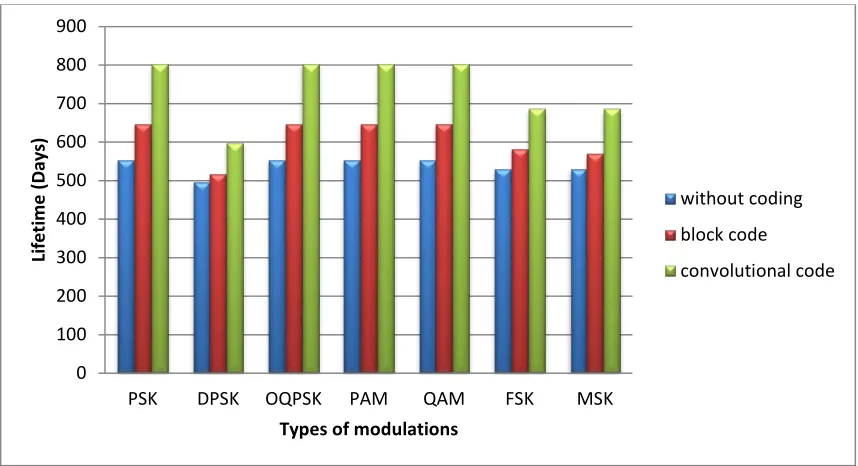
Figure 9,10,11,12 shows the lifetime (days) at
BER=10-4 for different modulations along with
convolutional
and block codes at different distances 5m, 10m, 40m and 60m.It is clear that the value of Eb/No (dB) are same for PSK, OQPSK, PAM and QAM value same for FSK and MSK. The results show that MSK with
convolutional
codes is more energy efficient than other combination of modulation schemes andconvolutional
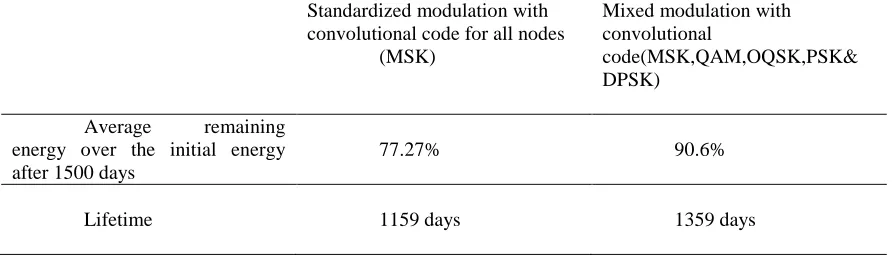
code is more energy efficient than block code with modulation schemes.Table 1 shows the average remaining energy and the network lifetime for both the standardized and mixed modulations without coding. Table 2 shows the average remaining energy and the network lifetime for both the standardized and mixed modulations with block code. Table 3 shows the average remaining energy and the network lifetime for both the standardized and mixed modulations with convolutional code.
5. CONCLUSION AND FUTURE WORK
This paper analyzed the performance of MSK modulation with error control codes in base station controlled Dynamic Clustering Protocol architecture of WSN. QoS Enhanced base station controlled Dynamic Clustering Protocol produce an enhanced energy consumption ratio comparable
0 100 200 300 400 500 600 700 800
Li
fet
im
e (
Da
ys
)
Distance d=10m
Lifetime (Days)
0 200 400 600 800 1000 1200 1400
Li
fet
im
e (
Da
ys
)
Distance d=40m
Lifetime (Days)
0 100 200 300 400 500 600 700 800
Li
fet
im
e (
Da
ys
)
Distance d=60m
[image:8.612.91.295.421.692.2]with conventional route based clustering protocols. Simulation and mathematical results show that if the distance between the nodes is high, MSK performed fighting fit without the addition of error control codes in AWGN channel condition. The results also disclose that when MSK is added with convolutional coding, we have attained higher energy consumption in sensor nodes; the distance between nodes is neither short nor long. It furthermore shows that the combination of MSK with block codes is comparatively consuming more power for sensor data transmission. The future work is to determine the strategies to further improvement in sensor node lifetime and to increase the overall performance of transmission schemes for fault tolerant energy efficient clustered WSN. Distance based adaptive modulation scheme in various channels will be implemented in combination with other energy efficient techniques in order to improve the network lifetime.
REFERENCES:
[1] Ahmad Abed, Alhameed Alkhatib and Gurvinder Singh Baicher, “An Overview of WSNs”, International Conference on Computer Networks and Communication Systems (CNCS 2012), IPCSIT, Vol. 35, 2012.
[2] Bhardwaj, M and Chandrakasan, A.P, “Bounding the Lifetime of Sensor Networks via Optimal Role
Assignments,” in Proceedings of the 21st IEEE
infocom, 2002.
[3] Daniel F. Macedo, Luiz H. A. Correia, Aldri L. Dos Santos, Antonio A. F. Loureiro, Jos´e Marcos S. Nogueira and Guy Pujolle,” Evaluating Fault Tolerance Aspects in Routing Protocols for
Wireless Sensor Networks” published in Fourth
Annual Mediterranean Ad Hoc Networking Workshop,2005.
[4] Felipe M., Costa and Hideki Ochiai,,“A Comparison of Modulations for Energy Optimization in
Wireless Sensor Network Links” in proceedings of
the IEEE Globecom conference,2010.
[5] Gopinath Balakrishnan, M. Yang, Y. Jiang, and Y. Kim, “Performance analysis of error control codes
for Wireless Sensor Networks,” in Proceedings of
International Conference on Information Technology (ITNG’07), 2007, pp.876–879.
[6] Hussain, S.; Martin, A.W., “Hierarchical Cluster based Routing in Wireless Sensor Networks”,
Journal of Network, Vol.2, 2007, pp.87-97. [7] Jamshid Abouei†, J. David Brown, Konstantinos N.
Plataniotis and Subbarayan Pasupathy,”On the Energy Efficiency of LT Codes in Proactive
Wireless Sensor Networks”, IEEE transactions on
Wireless Communications,2009.
[8] James Yang, Amir K. Khandani and Noel Tin,
“Adaptive Modulation and Coding in 3G Wireless
Systems”, Canada, user Report number
UW-E&CE#2002-15, 2002.
[9] Liu. M., Cao. J., Chen, G., Wang, X,. “An Energy Aware routing protocol in Wireless Sensor Networks”. Sensors, Vol. 9, 2009, pp.445-462. [10] Kun Yang and Ling Yang, The song, “Adaptive
Modulation and Coding for Two-Way
Amplify-and-Forward Relay Networks” in proceedings of IEEE
International Conference on Communications, China: CTS, 2012.
[11] Mohammad Rakibul Islam, “Error Correction Codes in Wireless Sensor Network: An Energy
Aware approach” International Journal of
Computer and Information Engineering, Vol.4, No.1, 2010.
[12] Masud M. A., M. Samsuzzaman, M. A. Rahman,
“BER Performance Analysis of Modulation
Techniques of Wideband Code Division Multiple
Access”, Journal of Telecommunications, Vol.1,
No.2, 2010.
[13] Maryam Soltan, Inkwon Hwang, and Massoud Pedram, “. Heterogeneous Modulation for Trading-off Energy Balancing with Bandwidth Efficiency in
Hierarchical Sensor Networks” Proceedings of the
2008 International Symposium on a World of Wireless, Mobile and Multimedia Networks,2008. [14] Maryam Soltan, Inkwon Hwang and Massoud
Pedram, “Modulation-Aware Energy Balancing in
Hierarchical Wireless Sensor Networks” in
proceedings of 3rd International Symposium on wireless Pervasive Computing, 2008.
[15] Mukesh .S. M. Iqbal, Z. Jianhua, Z. Ping, and Inam-Ur-Rehman, “Comparative analysis of M-ary modulation techniques for wireless adhoc
Networks,” in Proceedings of the IEEE 2007
Sensors Applications Symposium, 2007, pp.1–6. [16] Padmavathy and Chitra, “Performance Evaluation of
Energy Efficient Modulation Scheme and Hop
Distance Estimation for WSN” International
Journal of Communication Networks and Information Security (IJCNIS), Vol.2, No. 1, 2010, pp. 44-49.
[17] Proakis, J.G., “Digital Communications”, McGraw-Hill Inc, 2007.
[18] Rapparport, T. S. “Wireless Communications, Principles and Practice”, Prentice Hall, 1996. [19] Sheik Dawood. M., Sajin Salim, S. Sadasivam and
G. Athisha, “Energy Efficient Modulation
Techniques for Fault Tolerant Two-Tiered WSNs”
Journal of Asian Scientific Research,Vol.2,No.3, 2012, pp. 124- 131.
[20] Sheik Dawood. M., S. Sadasivam and G. Athisha,”Energy Efficient Wireless Sensor Networks based on QoS Enhanced base station
controlled Dynamic Clustering Protocol”,
International Journal of Computer Applications, Vol.13, No.4, 2011, pp.0975 – 8887. [21] Sami H. O. Salih and Mamoun M. A. Suliman,
“Implementation of Adaptive Modulation and
Coding Technique” International Journal of
[22] Sanjeev Kumar and Ragini Gupta, “BER Analysis of Reed-Solomon Code for Efficient Communication
System”, International Journal of Computer
Applications, Vol.30, No.12, 2011, pp. 0975-8887. [23] Sreedevi M., and P. Jenopaul, “Analysis of Low
Power Transmitters for Wireless Micro Sensor
Networks”, Journal of Mobile Communication,
Vol. 5, No.2, 2011, pp .31-36.
[24] Yunxia Chen and Qing Zhao, 2005, “On the Lifetime
of Wireless Sensor Networks”, IEEE
Figure 9: Lifetime Of WSN For Different Modulation And Coding At D=5m
Figure 10: Lifetime Of WSN For Different Modulation And Coding At D=10m 0
100 200 300 400 500 600 700 800 900 1000
PSK DPSK OQPSK PAM QAM FSK MSK
Li
fet
im
e (
Da
ys
)
Types of modulations
without coding block code
convolutional code
0 100 200 300 400 500 600 700 800
PSK DPSK OQPSK PAM QAM FSK MSK
Li
fet
im
e (
Da
ys
)
Types of modulations
without coding block code
[image:11.612.95.526.367.615.2]Figure 11: Lifetime Of WSN For Different Modulation And Coding At D=40m
Figure 12: Lifetime Of WSN For Different Modulation And Coding At D=60m 0
200 400 600 800 1000 1200 1400 1600
PSK DPSK OQPSK PAM QAM FSK MSK
Li
fet
im
e (
Da
ys
)
Types of modulations
without coding block code
convolutional code
0 100 200 300 400 500 600 700 800 900
PSK DPSK OQPSK PAM QAM FSK MSK
Li
fet
im
e (
Da
ys
)
Types of modulations
without coding block code
[image:12.612.92.521.390.623.2]Table 1- The Average Remaining Energy And The Network Lifetime For Both The Standardized And Mixed Modulations Without Coding.
Standardized modulation without coding for all nodes
(MSK)
Mixed modulation without coding(MSK, QAM,,OQPSK,PSK & DPSK)
Average remaining energy over the initial energy after 1500 days
59.73% 62.53%
Lifetime 896 days 938 days
Table 2- The average remaining energy and the network lifetime for both the homogeneous and heterogeneous modulations with block code.
Standardized modulation with block code for all nodes
(MSK)
Mixed modulation with block code(MSK,QAM,OQSK,PSK& DPSK)
Average remaining energy over the initial energy after 1500 days
64.13% 72.93%
Lifetime 962 days 1094 days
Table 3- The average remaining energy and the network lifetime for both the standardized and mixed modulations with convolutional code.
Standardized modulation with convolutional code for all nodes
(MSK)
Mixed modulation with convolutional
code(MSK,QAM,OQSK,PSK& DPSK)
Average remaining energy over the initial energy after 1500 days
77.27% 90.6%
Lifetime 1159 days 1359 days
[image:13.612.88.528.346.463.2] [image:13.612.84.530.516.644.2]