“ A NOVEL LOW COMPLEXITY DIAGONAL REDUCTION
ALGORITHM OF LATTICE REDUCTION FOR SIGNAL
DETECTION IN MIMO RECEIVER ”
1 PROF.G.RANJITHAM, 2DR.K.R.SHANKAR KUMAR
1
Department of EEE,SRI RAMAKRISHNA ENGINEERING COLLEGE,COIMBATORE-641022, TAMIL NADU INDIA.
2 Department of ECE,RANGANATHAN ENGINEERING COLLEGE,COIMBATORE-641109,
TAMILNADU INDIA.
E-mail: [email protected] , 2 [email protected]
ABSTRACT
This Paper analyses the performance of Multiple Input Multiple Output (MIMO) wireless communication system by combining it with an efficient algorithm Diagonal Reduction (DR). DR is a powerful tool to achieve more efficiently a high performance with less complexity when applied to MIMO detection. This paper proposes a DR algorithm in order to reduce its complexity named Greedy Diagonal Reduction (GDR) algorithm which gives reduced complexity with efficient performance at the receiver using the MATLAB communication tool box version 7.1 as a simulation tool. From the simulation results of various reduction algorithms it is observed that,DR can reduce the number of iterations using size reduction operations. Proposed DR algorithm gives identical Bit Error Rate (BER) performance with LLL algorithms when applied to Successive Interference cancellation (SIC) decoding. Greedy DR reduces the computational complexity in Multiple Input Multiple Output systems by improving the efficiency in terms of size reduction operations.
Keywords: Mimo, Diagonal Reduction (Dr), Low Complexity, Greedy Diagonal Reduction (Gdr), Bit
Error Rate (Ber)
1. INTRODUCTION
MIMO technology can greatly enhance the capacity of wireless networks, the reliability of data transmission through wireless media. There is ever growing demand of wireless services of higher data rates with limited bandwidth. To achieve a high transmission rate, there is a need to have either high SNR (Signal to Noise Ratio) or wide bandwidth.
In wireless communications, since there are always limitations to increase SNR due to propagation loss, the bandwidth should be wide enough to support high data rate services. However, the lack of wireless spectrum has given the communication engineers a challenge on wireless communication systems with increasing data rate demands. To improve the spectral efficiency in wireless communications, multiple antennas are employed at both transmitter and receiver, where the resulting system is called the MIMO system. The multiple antennas can be used to increase data
rates through multiplexing or to improve
performance through diversity and it also offer high
capacity to wireless systems and the capacity increases linearly with the number of antennas.
MIMO systems use multiple antennas at both link ends and offer good performance gains without requiring additional bandwidth or transmit power. Two important MIMO gains are the multiplexing gain, which corresponds to an increase of the data rate, and the diversity gain, which corresponds to an increase of the transmission reliability.
The transmitter and receiver are equipped with multiple antenna elements. The transmitted symbols go through a channel matrix which consists of multiple receive antennas at the receiver. Then the receiver gets the received signal vectors by the multiple receive antennas and decodes the received signal vectors into the original information. The mathematical equation is given in 1
Y= Hx+N (1)
Where,
N=Noise in Channel
2. LATTICE REDUCTION
Lattice Reduction mainly deals with finding improved representations of a given lattice using algorithms like Lenstra, Lenstra, Lovász (LLL) reduction. It is linked to the search for the shortest vector in a lattice, which in turn is related to the development of the famous sphere decoding algorithm lattice reduction turned out to be extremely useful for detection and pre-coding in wireless MIMO systems. The basic idea here is to develop the discrete nature of the digital data and view the channel matrix that acts on the data as a basis of a point lattice. Lattice reduction approaches have the high capability to get high performance at low computational complexity.
2.1 MIMO Ssystem with lattice
Figure 1 Lattice of Basis Vector
Let us consider a basis B consisting of M real-valued linearly independent basis vectors which are given by
(2 )
where represents linearly
independent basis. Since a lattice can be generated from an integer linear combination of a basis, with B, then lattice defined by
(3)
Where, is a scalar, is a linearly
independent vector, denotes the set of integer
numbers.In this, should be real vector and
should be an integer. MIMO channel model is compared with lattice, its parameters changed as follows.’H’ becomes the basis Thus, the basis vectors of H should be real-valued . ‘x’ is used to produce an integer linear combination of the basis. Therefore, the elements of s need to be integer. ‘Y’becomes a vector in the lattice generated by the basis H.Using the real-valued matrix transformation H can be converted to real valued basis vectors (i.e., column vectors with real values only), and then MIMO channel model can be rewritten as
(4)
Where R(.) , denote the real and imaginary
parts
LR can be applied to MIMO systems to improve the performance of suboptimal MIMO detection, where the resulting detection methods are regarded as the LR-based MIMO detection. Consider two bases H and G that has the same lattice, where each column vector of a basis is an integer linear combination of the column vectors of the other basis. Then it is given by
H = GU ( 5)
Where U is a uni-modular matrix. Then,
the received signal can be rewritten as
Y = GUs + n (6)
Y = GC + n ( 7)
where C=Us is a transformed vector.
In linear algebra, the QR decomposition of a matrix is to decomposition the matrix into an
decomposition is the tool that generates an orthogonal basis in the sense of an uni-modulary transformation . It is also often denoted as QR factorization. As these names indicate the QR decomposition disjoints an intended matrix into two matrices The first matrix contains the orthogonalized portion of A. The second matrix has upper triangular form and shapes the relation between A and Q. A QR decomposition of a real square matrix A is a decomposition of A as
A = QR (8)
where Q is an orthogonal matrix
( and R is an upper triangular
matrix.QR decomposition can be done by two methods namely Gram-Schmidt process and Givens Rotations.
2.2 Modified Diagonal Reduction (MDR) algorithm
An implementation of the DR algorithm especially in real time communication systems suffers from the fact that the complexity depends on the number and positions of column swaps. In comparison to the original DR algorithm, the flow control has been removed and replaced by a fixed complexity structure. The modified DR algorithm have been developed in order to improve the implementation in real-time MIMO communication systems, where lattice reduction techniques can help to improve linear detection at the receiver. In this no back tracking occurs.
2.2.1 Algorithm for MDR
INPUT: Take H = QR where Q €
, R € ,w(1/2 < w < 1)
OUTPUT: Updated Q and R which is diagonal reduced with parameter w and a unimodular Z that reduces R.
STEP 1: Initialize the unimodular matrix as
STEP 2: Check the condition
While R is not diagonally reduced, do
for k =2,3,4,5……n do
STEP 3 : If the condition
, for all 1< k ≤ n is not satisfied then
STEP 4: Check the condition, if then
STEP 5: end if
STEP 6: Now perform swap restore operation by swapping the columns k-1 and k in R and Z.
STEP 7: Find givens rotations G to restore the upper triangular matrix of R by satisfying the conditions
STEP 10: else increment k as
STEP 11: end if condition, for condition and while condition
In this algorithm, step
is not used. So, there is no back tracking problem and hence number of iterations and complexity is reduced.
selective size reduction and column swap, so that diagonal reduction is maximized. The algorithm steps is given below as
2.2.2 Algorithm for Greedy Diagonal Reduction
INPUT: Take H = QR where Q € , R €
,w(1/2 < w < 1)
OUTPUT: Updated Q and R which is diagonal reduced with parameter w and a unimodular Z that reduces R.
STEP 1: Initialize the unimodular matrix as
STEP 2: Use the condition to compute
where
STEP 3: Choose k value as
STEP 4: Check the condition
While do
STEP 5 : If the condition
, for all 1< k ≤ n is not satisfied then
STEP 6: Check the condition, if then
STEP 7: end if
STEP 8: Now perform swap restore operation by swapping the columns k-1 and k in R and Z.
STEP 9: Find givens rotations G to restore the upper triangular matrix of R by satisfying the conditions
STEP 10: Update the upper triangular matrix
STEP 11:the value of k as
STEP 12: end while condition
2.2.3 Procedure for Size Reduction
Take input matrix and perform QR decomposition where Q has ortho-normal columns and R is upper triangular should satisfy the condition,
( 9)
If the condition is not satisfied then the following size reduction procedure is applied to satisfy the condition,
Step 1: reduce (i,j)
Step 2: calculate
Step3: form
Where unit vector
Step 4: apply
R , A
Step 5: check the condition in current R
If it is true then in the updated R
2.2.4 Swap Restore Operation
Take input as A=QR where Q has Orthonormal columns and the updated R matrix as input where R is upper triangular should satisfy the condition,
(10)
2.2.5 Procedure for swap restore
Step 1: swap Restore (i)
Step 2: swap the columns i-1 and i of R and A
Step 3: find Givens Rotation
And apply to R then the updated
matrix R is
3. SIMULATION RESULTS
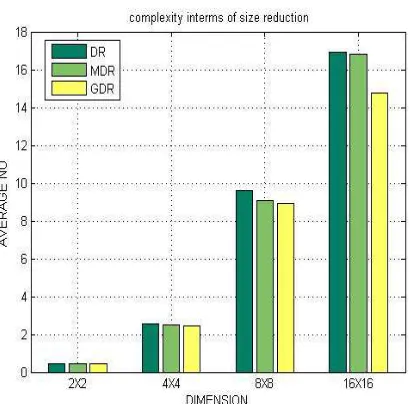
[image:5.612.137.520.62.549.2]The Simulation result shows the comparison of Greedy Diagonal Reduction with Modified Diagonal Reduction and Diagonal Reduction and also includes the comparison of Greedy Effective LLL algorithm with Parallel Effective LLL and Effective LLL. From the graph shown in figure 2, it is inferred that proposed MDR show a better performance characteristics than DR algorithm.
[image:5.612.310.515.317.519.2]Figure 2 Performance Comparison Of Mdr And Dr Algorithm.
Figure 3 Bar Graph Comparison Of Mdr ,Gdr And Dr Algorithm For Computation Complexity Involved.
From Figure 3 it is inferred that MDR algorithm gives a better result in terms of computation complexity compared to DR algorithm.
4. CONCLUSION:
REFRENCES:
[1]. Babai.L, “On Lovász’s(1986) “ lattice reduction and the nearest lattice point problem,”
Combinatorica, vol. 6, pp. 1–13.
[2] Agrell .E, Eriksson.T, Vardy.A, and Zeger.K ,(2002), “Closest point search in lattices,”
IEEE Trans. Inf. Theory, vol. 48, no. 8, pp.
2201–2214..
[3] Mow.W.H ,(2003) “Universal lattice decoding: Principle and recent advances,”Wireless
Commun. Mobile Comput., Special Issue on Coding and Its Application toWireless CDMA Systems, vol. 3, pp. 553–569.
[4] .Wbben.D, Bhnke.R, Khn.V, and Kammeyer.K ,(2004) “Near-maximum-likelihood detection of MIMO systems using MMSE-based
lattice-reduction”, in Proceedings of IEEE
International Conference on communications (ICC), Paris, France, pp. 798–802
[5] Hassibi, B. and Vikalo, H.,(2005) “On the
sphere-decoding algorithm I. Expected
complexity,” IEEE Transactions on signal
processing., Vol. 53, pp. 2806–2818.
[6] Ling.C (2006), “On the proximity factors of lattice reduction-aided decoding,” ,” IEEE
Transactions on signal processing., vol. 59,
no. 6, pp. 2795–2808.
[7] Narasimhan, R.,(2006) “Finite-SNR diversity-multiplexing tradeo for correlated Rayleigh and Rician MIMO channels,” ,” IEEE
Transactions on Information theory,, vol. 52,
pp. 3965–3979.
[8] Taherzadeh.M,Mobasher.A,Khandani.A.K
(2007),”LLL reduction achives the receiver
diversity in MIMO decoding”IEEE
transaction on Information Theory,Vol
53,No.12,pp 4801-4805.
[9] Ling.C and Howgrave-Graham.H ,(2007)
“Effective LLL reduction for lattice
decoding,” in Proc. IEEE Int. Symposium on
Information theory Theory (ISIT), Nice,
France.
[10]..Gan.Y.H,Ling.C,Mow.H.M.,(2009) ”Complex lattice reduction algorithmim for low complexity full diversity MIMO detection “IEEE Transaction on signal processing ., Vol 57,,No 7 ,pp 2701-2710.
[11]. Wübben.D, Seethaler.D, Jaldén.J , and Marz .G,(2011) “Lattice reduction: a survey with applications in wireless communications,”
IEEE Signal Process. Mag., vol. 28, no. 3, pp.
70–91.
[12].Zu.k, De Lamare.R.C, and Haard.M,(2012) “Lattice reduction-aided regularized block
diagonalization for multiuser MIMO
systems”, in Proceedings of IEEE Wireless