ISSN: 1992-8645 www.jatit.org E-ISSN: 1817-3195
BATIK PRODUCTION PROCESS OPTIMIZATION USING
PARTICLE SWARM OPTIMIZATION METHOD
INDAH SOESANTI1, RAMADONI SYAHPUTRA2
1
Department of Electrical Engineering and Information Technology, Faculty of Engineering,
Universitas Gadjah Mada, Yogyakarta, INDONESIA
e-mail: [email protected]; [email protected]
2
Department of Electrical Engineering, Faculty of Engineering,
Universitas Muhammadiyah Yogyakarta, Yogyakarta, INDONESIA
E-mail: [email protected]
ABSTRACT
This paper presents batik production process optimization using particle swarm optimization (PSO) methods. The process steps of batik are designing, ‘nyanting’, staining, ‘pelorodan’, and washing. Batik production cost is determined by the efficiency and calculation of output to input ratio in the production process. In this research, PSO method is used for production process optimization on Yogyakarta batik industry. The main objective of this research optimization is to minimize the cost incurred in the production process of batik in order to obtain maximum benefit. PSO method has successfully optimized the production goals to be achieved by minimization the using of raw materials and production time. Optimization results show that in batik production process, there is a saving of raw materials 14.801% and production time saving of time 10.345%.
Keywords: Batik; Production Process; Optimization; Particle Swarm Optimization.
1. INTRODUCTION
In the future, the creative industries are into a leading industry in most of Yogyakarta. One of the creative industries that are still the flagship is the batik industry [1]. One of the potential of small and medium industries at the local level was developed in an effort to accelerate economic empowerment. It is commodities eminent in the field of creative industries. This industry is one of the leading industries in Yogyakarta province, where the creative industries have developed into becoming an industry cluster. Batik industry is expected to give a significant role in supporting the industrial sector's contribution to the local revenue of Yogyakarta province.
The comparison between the production cost and selling price can affect the competitiveness in the market. Production cost is determined by the efficiency and calculation of input to output ratio in the production process. Efficiency is a measure maximize results by using capital (labor, material and tools) are minimal. Efficiency can also be interpreted as an effort to use the smallest input to
obtain maximum production [2-3]. Thus, the management can combine the factors of production with certain management techniques so as to produce a product effectively and efficiently in the quantity, quality, and time of production.
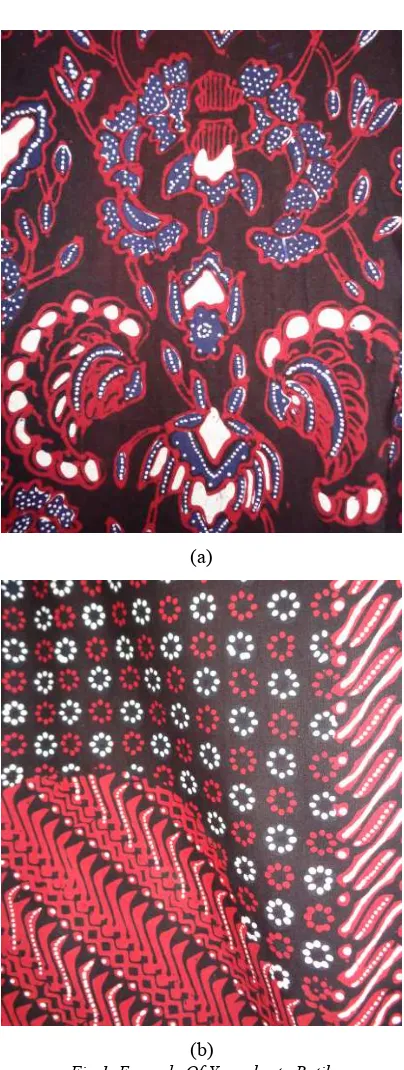
Business potential batik industry in this province can be demonstrated by the availability of labor is quite large, the amount of demand for batik products are relatively stable, and the number of batik production are also relatively stable, although recent years slightly decreased due to the batik products imported from China. In addition, the batik production process optimization opportunities a distinct advantage for the progress and development of the batik industry, especially in Yogyakarta province. Fig 1 shows the example of Yogyakarta batik.
ISSN: 1992-8645 www.jatit.org E-ISSN: 1817-3195
(a)
[image:2.612.94.296.96.631.2](b)
Fig 1. Example Of Yogyakarta Batik
Each company generally wants to get maximum benefit by optimizing the limited resources available. It can be solved using optimization methods based on particle swarm optimization (PSO). PSO is an artificial intelligence-based optimization method that has been widely used in various fields [5] – [7]. The ability of PSO
optimization methods have been tested for computing the low and optimal results [8] – [9].
Tang had presented an improved particle swarm optimization (PSO) method for the hybrid flowshop scheduling (HFS). PSO method is used to minimize total weighted completion time. This problem has a strong practical background in process of industry production [10].
In this study, PSO method is used to optimize the production process of batik on one of Yogyakarta batik industry. The main objective of this research optimization is to minimize the costs incurred in the production process of batik in order to obtain maximum benefit. PSO method can optimize production goals to be achieved by the limits of existing resources. This is confirmed by other scientists who claimed that when companies produce products that vary, the planning method for producing the goods in order to obtain the maximum benefit can be obtained by PSO method. Thus, the PSO method is a method used by the company in producing more than one variation with limited resources.
2. BATIK PRODUCTION PROCESS
Indonesia has been recognized internationally as a pioneer and leading producer of batik. In 2009, UNESCO has named Indonesian batik a masterpiece of the ‘Oral and Intangible Heritage of Humanity’. The crowning of course very proud for Indonesia. This fact reflects UNESCO’s efforts to move beyond the protection of ancient monuments and encourage living artistic traditions.
The batik tradition is particularly prevalent on the Java island and was handed down from generation to generation. Batik is created either by drawing dots and lines of the resist with a spouted tool called a canthing. The process of making batik is described as follows.
1. Process of designing
The first process is a process of drawing or sketching that wanted in the fabric / silk using a pencil or pen.
2. Process of First Nyanting
After completing the process of designing, the second step is nyanting, namely painting fabric with wax using the canting by following a pattern that has been made on both sides of the fabric (back and forth).
ISSN: 1992-8645 www.jatit.org E-ISSN: 1817-3195 The process is the first coloring process on
the part that is not covered by wax by dipping the cloth in a particular color. Once dipped, the fabric in the drying and dried.
4. Process of the Second Nyanting
Once dry, re-do the batik process that is painted using wax using canting using canting to cover parts that will be maintained in the first coloring. Then the process is followed by a second color dyeing process.
5. Process of the First Pelorodan
The next process is to remove the wax of the fabric by putting or boiling the cloth in hot water on the stove.
6. Process of the Third Nyanting
After a clean cloth of candles and dried, can be carried back to the closing of wax batik process (using canting) to hold the first and second color.
7. Process of Opening and Closing of Patterns
The process of opening and closing the wax can be repeated according to the number of colors and the complexity of the desired motif.
8. Process of the Second Pelorodan
The process is that the fabric has changed the color of boiled hot water. The aim is to remove the layer of wax, so the motives which have previously drawn clearly visible, previously seen clearly, this immersion will not make motifs that have been drawn exposed to color, because the top of the fabric is still shrouded in a thin layer (wax not completely faded).
9. Process of Washing
The next process is to wash the batik cloth and then dry it by way of drying or cooling it down in the shade.
3. PARTICLE SWARM OPTIMIZATION
Particle Swarm Optimization (PSO) algorithm was first published by Eberhart and Kennedy. The algorithm was inspired by a flock of birds movement in searching of food. The movement model can be used as a powerful optimizer. In one n-dimensional search space, let us assume that the position of the i-th individual is Xi = (xi1, ..., xid, ..., xin) and the speed of the i-th individual is Vi = (vi1, ..., vid, ..., vin). The particle best experience
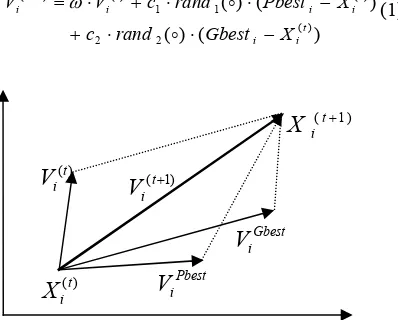
i-th is recorded and represented by Pbesti = (pbesti1, ..., pbestid, ..., pbestin). The best global position for swarm search is Gbesti = (gbest1, ..., gbestd, ..., gbestn). Fig. 2 shows the concept of optimization using PSO. The modified velocity of each particle is calculated based on the personal initial velocity, the distance from the personal best position, and the distance from the global best position, as shown in the following equation:
[image:3.612.316.515.206.366.2]) ( ) ( ) ( ) ( ) ( 2 2 ) ( 1 1 ) ( ) 1 ( t i i t i i t i t i X Gbest rand c X Pbest rand c V V − ⋅ ⋅ + − ⋅ ⋅ + ⋅ = + o o ω (1)
Fig. 2. The Concept Of Optimization Using PSO
Equation (1) determines the velocity vector of the i-th particle. Therefore, the latest position of the particle can be determined by using the equation:
) 1 ( ) ( ) 1
(+
=
+
t+i t i t
i
X
V
X
(2)where i = 1, 2, ..., N is the index of each particle; t
is the number of iterations; rand1(ο) and rand2(ο) are a random number between 0 and 1; and N is the number of the swarm.
Inertia weights ω can be determined by the equation:
t
t
t×
−
−
=
+ max min max max ) 1(
ω
ω
ω
ω
(3)where ωmax is the maximum inertia weight; ωmin is the minimum inertia weight; tmax is the maximum number of iterations; and t is the actual number of iterations. The value of inertia weight decrease linearly from 0.9 to 0.5.
The improved PSO algorithm is described as follows:
1. Input the data of the raw materials and processing time in the production process of batik and initialize the parameters of PSO. 2. Run the program of raw materials and
processing time in the production process of
) 1 (t+
i
X
) 1 (t+
i
V
) (t iV
) (t iX
V
iPbestISSN: 1992-8645 www.jatit.org E-ISSN: 1817-3195 batik to measure the fitness (length) of each
particle (pbest) and store it with the best value of fitness (gbest).
3. Update velocity of particle using (1). 4. Update position of particle using (2).
5. Decrease the inertia weight (ω) linearly from 0.9 to 0.4.
6. Perform violation of particle position: If particle position pos(j)>mp, then pos(j)=mp Else if particle position pos(j)<mp, then pos(j)=1.
7. Perform violation of particle velocity: If particle velocity vel(j)>mv, then vel(j)=mv Else if particle velocity vel(j)<-mv, then pos(j)= -mv.
8. Decrease the inertia weight (ω) linearly from 0.9 to 0.4.
Repeat steps 2-8 until a criterion is obtained.
4. BATIK PRODUCTION PROCESS OPTIMIZATION
The main objective of optimization in this research is to minimize production costs include raw materials and processing time in the production process of batik in order to obtain maximum benefit. The objective function in the optimization is shown in the following equations:
a. Minimization of raw materials
∑
= = k i i R X f 11( ) (4)
b. Minimization of processing time
∑
= = k i i T X f 12( ) (5)
The multi-objective formulation of batik production process could be defined as follow:
(
)
(
)
22 2 2 1 1 2 0 ) ( ) ( || ) ( || ) ( max o o f X f
f X f f X f X J − + − = −
= (6)
Subject to:
F(x) = 0 (7)
max , min
, i i
i
T
T
T
≤
≤
(8)max , min
, i i
i
P
P
P
≤
≤
(9)where f1(X) is a cost function of raw materials;
f2(X) is a cost function of processing time; Ri is a raw variable of batik and Ti is a processing time variable of batik processing.
Furthermore, based on cost functions as expressed in the equation (4) to the equation (7) conducted a multi-objective optimization to optimize the production process of batik in one of Yogyakarta batik industry.
5. RESULTS AND DISCUSSION
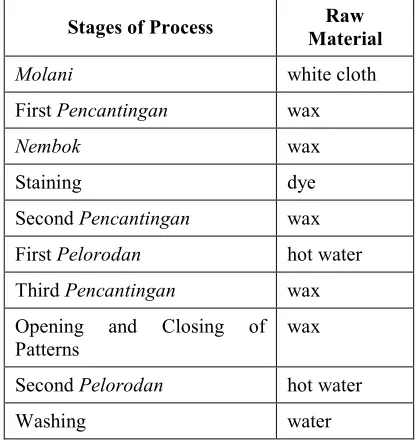
In this section, the results of multi-objective optimizations of batik production process includes raw materials and processing time in the production process of batik are described. Demand for raw materials and process time used in the production process of batik to produce 100 pieces of batik cloth shown in Table I.
[image:4.612.313.521.406.628.2]Table II shows the raw material and process time in batik process production before optimization. Raw material costs are stated in Rupiah, which indicates the amount of the cost needed for the procurement of raw materials to produce 100 batik cloths. The processing time is expressed in hours, which shows the amount of time required for the production process 100 batik cloths.
Table I: Raw Material In Batik Process Production
Stages of Process Raw Material
Molani white cloth
First Pencantingan wax
Nembok wax
Staining dye
Second Pencantingan wax
First Pelorodan hot water
Third Pencantingan wax
Opening and Closing of Patterns
wax
Second Pelorodan hot water
Washing water
In this production process using 4 pieces stove
for mencanting. As for the process pelorodan used
ISSN: 1992-8645 www.jatit.org E-ISSN: 1817-3195 As shown in Table II that prior to the
[image:5.612.92.297.174.420.2]optimization of the production process of batik, the costs of raw materials needed is US$ 787.88 with as many as 116 hours of production time.
Table II: Raw Material Cost And Process Time In Batik Process Production Before Optimization
Stages of Process Raw Material Cost (US$)
Process Time (hours)
Molani
393.94
14First Pencantingan
45.45
24Staining
242.42
10Second
Pencantingan
45.45
22First Pelorodan
7.58
8Third
Pencantingan
30.30
14Opening and Closing of Patterns
7.58
8Second Pelorodan
7.58
8Washing
7.58
8 [image:5.612.94.297.458.716.2]Total
787.88
116Table III: Raw Material Cost And Process Time In Batik Process Production After Optimization
Stages of Process
Raw Material Cost (US$)
Process Time (hours)
Molani
348.48
12First Nyanting
37.88
22Staining
212.12
9Second Pencantingan
22.73
21First Pelorodan
6.82
7Third Nyanting
22.73
12Opening and Closing of Patterns
6.82
7Second Pelorodan
6.82
7Washing
6.82
7Total
671.21
104 Saving (%) 14.801 10.345Results of batik production process optimization using PSO method is shown in Table III. As shown in Table III that after the optimization of the production process of batik, the costs of raw materials needed is US$ 671.21 with as many as 104 hours of production time. Optimization results show that there is a saving of raw materials amounted to 14.801%. Results also showed an optimization of production time savings of 116 hours to 105 hours, or 10.345%. These savings would have an impact on improving operational efficiency in the batik industry. This optimization is expected to help strengthen the competitiveness of Yogyakarta batik industry.
Furthermore, in order to further analyze the results of the production process optimization using PSO method, the optimization results are shown in graph format as shown in Fig. 3 to Fig. 6. Fig. 3 shows raw material cost of batik process production before and after optimization while Fig. 4 shows process of batik process production before and after optimization. In Figure 3 has shown graphically that at each stage of the production process of batik, operating costs decreased significantly with the implementation of PSO optimization method. A decrease in operating costs is very important for the batik industry in Indonesia. It is due to that most of the batik industry in Indonesia is the micro and small-scale industries. Production cost savings is certainly very significant for the survival of the industry.
Fig. 3. Raw Material Cost Of Batik Process Production Before And After Optimization
[image:5.612.312.515.463.617.2]ISSN: 1992-8645 www.jatit.org E-ISSN: 1817-3195 batik industry in Indonesia. A decrease in the
production process time was of course quite an impact on increasing the productivity of the batik industry.
Fig. 4. Process Of Batik Process Production Before And After Optimization
Fig. 5 shows total of raw material cost in batik process production before and after optimization while Fig. 6 shows total of process time in batik process production before and after optimization. As shown in Figure 5, the total cost after optimization decreased very significantly with the implementation of PSO optimization method. Decrease significantly were also seen on the total production time, as shown in Figure 6, the total time of 116 hours to 104 hours. A decrease in the cost and time of production is of course improving the performance and productivity of the batik industry.
Fig. 5. Total Of Raw Material Cost In Batik Process Production Before And After Optimization
Fig. 6. Total Of Process Time In Batik Process Production Before And After Optimization
6. CONCLUSION
This paper presents batik production process optimization using particle swarm optimization (PSO) method. Optimization results show that in batik production process, there is a saving of raw materials 4.801%. Results also showed an optimization of production time saving of 116 hours to 104 hours, or 10.345%. These savings would have an impact on improving operational efficiency in the batik industry. This optimization is expected to help strengthen the competitiveness of Yogyakarta batik industry.
ACKNOWLEDGEMENTS
The author gratefully acknowledges the contributions of The Ministry of Research, Technology and High Education, Republic of Indonesia, for funding this research.
REFERENCES:
[1] I. Soesanti, “Design of Batik Production Process Monitoring Based on Web Technology”, Proceeding of National Seminar CITEE 2009, Electrical Engineering, Universitas Gadjah Mada , Yogyakarta. 2009. [2] S. Freihat, “The Role of Marketing
ISSN: 1992-8645 www.jatit.org E-ISSN: 1817-3195 Production Companies”, IJRRAS, 11(2), May
2012.
[3] H. Afrisal, M. Faris, P. Utomo, Indah Soesanti, F. Andri, “Portable smart sorting and grading machine for fruits using computer vision”, Proceeding - 2013 International Conference on Computer, Control, Informatics and Its Applications: "Recent Challenges in Computer, Control and Informatics", IC3INA 2013.
[4] Soesanti, I. “Batik Pattern Classification and Recognition Based on Statistical Features”, Proceeding of National Seminar CITEE 2015, Electrical Engineering and Information Technology, Universitas Gadjah Mada, Yogyakarta. 2015
[5] R.N. Rohmah, A. Susanto, Indah Soesanti, Lung tuberculosis identification based on statistical feature of thoracic X-ray, 2013 International Conference on Quality in Research, QiR 2013 - In Conjunction with ICCS 2013: The 2nd International Conference on Civic Space, 2013.
[6] I. Soesanti, T.S. Widodo, “Classification of Batik Pattern Based on Eigenimage Feature Extraction”, Proceeding of National Seminar on Annual Engineering Seminar 2013, Engineering Faculty of UGM, Yogyakarta, Indonesia, 2013.
[7] I. Soesanti, A. Susanto, “Image Compression Based on DCT and Adaptive Fuzzy Logics”, Proceeding of National Seminar on Annual Engineering Seminar 2014, Engineering Faculty of UGM, Yogyakarta, Indonesia, 2014.
[8] R. Syahputra, I. Robandi, M. Ashari, “Performance Improvement of Radial Distribution Network with Distributed Generation Integration Using Extended Particle Swarm Optimization Algorithm”, International Review of Electrical Engineering (IREE), Vol. 10, No. 2, 2015, pp. 293-304.
[9] R. Syahputra, I. Robandi, M. Ashari, “Optimization of distribution network configuration with integration of distributed energy resources using extended fuzzy multi-objective method”, International Review of Electrical Engineering (IREE), Vol. 9, No. 3, 2014, pp. 629-639.