397
ADAPTIVE VELOCITY AND DISTANCE BASED ROUTING
PROTOCOL FOR MANET
1
BISENGAR AHMED, 1,2 OUADOUDI ZYTOUNE, 1,2 ENNEYA NOURDDINE,
1
RZIZA MOHAMED, 1 OUADOU MOHAMED
1
LRIT unité associée au CNRST (URAC 29), Faculty of Science, University Mohammed V-Agdal, Rabat, Morocco
2
LARIT Faculty of Science, University Ibntofail, Kénitra, Morocco.
E-mail: [email protected]
ABSTRACT
A mobile ad-hoc network (MANET) is a collection of wireless mobile nodes communicating without any infrastructure. Due to the availability of small and inexpensive wireless communicating nodes, the MANET field has attracted a lot of attention from industry and academia. MANETs can be used in various applications such as mobile classrooms, battlefield communication and disaster relief applications. They may be divided into homogeneous and heterogeneous ones. Homogeneous Ad-hoc Networks nodes possess the same transmission range, but not for heterogeneous ones (i.e, networks consisting of different wireless mobile devices such as laptops, PDAs and cell phones). In AODV routing protocol, the shortest path between source and destination nodes is always selected, without collecting topology information. In this paper, we propose an improvement of AODV protocol called MDAODV (Mobility aware modified AODV). The new algorithm finds optimum path based on distance, relative velocity between two nodes and hop count. It is confirmed by simulation that this improvement has higher packet delivery ratio than standard AODV protocol.
Keywords: Mobile Ad Hoc Networks, AODV, Distance, Transmission Range, Relative Velocity, Weight Function.
1. INTRODUCTION
A mobile ad-hoc network (MANET) [1][2][3] is a self-configuring network of mobile routers connected by wireless links. Each node in a MANET is free to move randomly with the capability of changing its links to other nodes frequently. These networks do not require any existing infrastructure or central administration. Therefore, they are to find a path between the communication end-points of nodes. The problem is further aggravated through the node mobility. In such a network, each node acts both as a router and as a host. Due to the limited transmission range of radio interfaces, multiple hops may be used to exchange data between nodes in the network. So, that is generally used. Another limitation associated with wireless devices is the power constraint of the nodes i.e. each node has only limited battery power which should be used judiciously for the node to survive longer and to provide its services within the network. Nodes cooperate with their neighbors to route data packets to their final destinations. As intermediate nodes may fail, routes between
sources and destinations need to be determined and adjusted dynamically. Routing protocols for ad-hoc networks typically include mechanisms for route discovery and route maintenance.
The most known routing protocol for MANET is the Ad-hoc On-Demand Distance Vector (AODV) [4]. This protocol is a reactive routing algorithm; the routes are created only when they are needed and every intermediate node decides where the routed packet should be forwarded next.
398 less stressed situation (i.e. smaller number of nodes and lower load and/or mobility), DSR outperforms AODV in delay and throughput but when mobility and traffic increase, AODV outperforms DSR. However, DSR consistently experiences less routing overhead than AODV.
Mobility and connectivity metrics are one of the most important research topics on wireless ad-hoc networks.
Most of the routing algorithms for ad hoc networks that the nodes in the network are mobile were proposed in the literature. Yaser et al. have presented PH-MA-AODV and Agg-AODV that use mobility awareness to improve the performance of the routing algorithms with high-speed MANETs. In PH-MA-AODV, each node computes its own mobility periodically; a highly mobile node drops a route-request message to prevent itself from participating in route discovery. In Agg-AODV, each intermediate node adds its own mobility to the RREQ packet and forwards it further towards the destination; the destination chooses the path with minimum mobility [14].
In [5] the authors proposed an analysis model of link duration in multi-hop mobile networks. They gave a formulation to for the link duration between two nodes. This duration is determined by the relative speed between the two nodes and the distance during which the link is connected.
In this paper we propose a new method to find a path based on the distance and relative velocity between two nodes. The basic idea of our solution is to reduce the effect of mobility and therefore, enhance the lifetime of path routing algorithms with the help of additional information. The rest of the paper is organized as follows; in the next section, we describe in detail our solution called Mobility aware modified AODV (MDAODV). In section 3 we evaluate the performance of the proposed protocol via simulation and we conclude in section 4.
2. MOBILITY AWARE MODIFIED AODV
(MDAODV)
To reduce the effect of mobility, we propose MDAODV (mobility aware AODV) protocol that is based on the AODV protocol for MANETs. MDAODV is reactive routing protocol; no permanent routes are stored in nodes. The paths, in this protocol, are chosen based on the distance, relative velocity and hop count. This allows selecting stable routes and so, reducing control message overhead. A neighbor A of node C is no stable or high mobility if node A’s relative velocity
with respect to node C and distance between A and C are very high.
A. Velocity And Distance Estimation
Estimation of distance and relative velocity between mobile nodes was either based on a localization system, such as the Global Positioning System (GPS) [13], or based on analyzing the characteristics of received signal [7].
In [6] the author develops a mechanism called Enhanced Transmission Power Control Mechanism
(ETPCM). The proposed mechanism
adapts transmission power dynamically according to the distance and the distance can be estimated by using a parameter Receiving Signal Strength Indicator (RSSI) between these nodes.
In this work we use RSSI technique [6-7] to estimate the distance and then the relative velocity between two nodes.
Fig.1: Estimation Of Relative Velocity
In figure 1, d1 and d2are the distance estimated
between nodes A and B at the time instant t1 and t2.
We can easily obtain the estimated relative velocity
Vr between A and B using the following expression:
Vr =∆d/∆t
Where
∆t is the time difference between the former packet receiving (time instant t1) and the next packet receiving (time instant t2) which means ∆t=t2-t1. ∆d is the distance difference between the distance d1 and d2 at, respectively, the time t1 and t2. B. Enhanced Route Discovery Mechanism The standard AODV protocol always selects the shortest path between source and destination, due to the limited wireless transmission range or the high relative velocity between neighboring nodes, the shortest path is the easiest broken one.
399 and the network is overloaded to reestablish the route.
On the follow, we present the effect of mobility on the link between two nodes.
Fig.2 (A): RREP Missing Due To The Mobility Ofnode
A
Fig.2 (B): Link Breaks For The Mobility Of Node A
Fig.2 (C): Link Breaks Between S And A
The figure (2.a) illustrates the flow of the RREQ and RREP messages in a scenario where the node A wants to find a route to the node D. initially nodes A, B, C, D and E do not have route to each other. Node A broadcasts a RREQ message to all nodes within its transmission range, which reaches B and C. Nodes B and C re-broadcasts a RREQ message, which reaches the destination node D that sends back a RREP to the source node A. If a mobile node C moves out of the transmission range of node A, RREP missing will occur and the route discovery process will be useless. We can easily
know that several alternative routes built by the RREQ message are ignored.
When the source node S receives a RREP, it can begin, using the route, sending data packets, as shown in Figure 2(b). A route is considered active as long as there are data packets periodically traveling from the source to the destination along that path. Link between nodes A and C may fail due to node C mobility occurs while the route is active, the node A immediately upstream of the break propagates a Route Error (RERR) message to the source node to inform it of the now unreachable destination.
In figure (2.c) node A moves outward direction and goes out of transmission range of node A due to the limited of transmission range and mobility of node A.
i. Relative velocity between two nodes The relative velocity between mobile nodes is one of the key characteristics that determine the quality of communications in MANETs. Many aspects of ad hoc networking use velocity estimation (e.g. predicting link lifetime [12]).
Due to the relative movements between mobile nodes, in MANET, The topology changes frequently. This can decrease the performance of communications. Knowing the inter-node relative velocity can help to predict topological dynamics (e.g. link availability prediction [12]) and then optimizing the routing protocols (e.g. mobility metrics [10]).
Let Vr denote the relative velocity between two mobile nodes A and B.
If Vr=0, the link between nodes A and B is static. If
Vr value is greater than zero the nodes move outward direction, else we assume the nodes moving inward direction, then
The two nodes A and B will be connected for a very long time unless change its direction of motion or velocity.
ii. Distance between nodes
400 Fig.3: AODV Select The First Path And Discards
The Rest
In figure 3, S is source node; D the destination node. Transmission range of each node is 250 meter. In standard AODV a path with minimum hop count is selected; the path is SABD. If node A moves outward direction and goes out of transmission range of node 0, the path is broken and the route discovery process will be useless. When the first path (first RREQ) is selected, discards the rest.
To enhance route lifetime, we suggest that the distance between nodes would be used. We define the normalized distance of each pair of the nodes as:
𝑀𝑖𝑗=𝐷𝑇𝑟𝑖𝑗
𝑖 (1)
Where:
Dij is the distance between node i and node j and Tri is the transmission range of node i.
Let consider the previous figure. If the standard AODV is used, the route selected is SABD
which is the route with minimum hops number. By
evaluating the function max(MSA,MAB,MAD)=max(225/250,150/250,
175/250)=90% presents a significant risk that the link drops. But if we choose the route
SCEFD where
max(MSC,MCE,MEF,MFD) = 30% which means that the fragile link(FD) is more stable because the distance between F and D largely less than the transmission range and this will have an influence on the reliability of the route.
Route discovery mechanism
We propose a modification of AODV’s route discovery mechanism to allow selection of paths that increase the lifetime of route based on distance and velocity between node neighboring. The source node initiates route discovery procedure by broadcasting RREQ. Each node receiver the RREQ calculates the distance normalized is defined by:
𝑀𝑗𝑖=𝐷𝑇𝑟𝑗𝑖
𝑗 (2)
Where
Dji is the distance between node j receiver and node i sender.
[image:4.612.311.524.452.694.2]Trj is the transmission range of node j sender.
Fig.4a: Presence Of Unidirectional Links
To ensure a bidirectional link in case that the network nodes are heterogeneous, we use the parameter Mij. Then, if Mji is greater than one, RREQ is dropped to ensure that the link between nodes i and j is bidirectional.
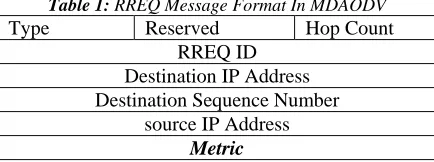
We add new field in the RREQ packet as depicted in Table I.
Metric represent the maximal value of the weight function defined in (3) over the path.
Table 1: RREQ Message Format In MDAODV
Type Reserved Hop Count
RREQ ID Destination IP Address Destination Sequence Number
source IP Address
Metric
The weight function (fij) is the parameter that allows nodes to select the best path. This parameter is defined by:
𝑓𝑖𝑗=𝛼 ∗𝐷𝑇𝑟𝑖𝑗 𝑖+𝛽 ∗
𝑉𝑟𝑖𝑗
𝑉𝑟𝑚𝑎𝑥𝑖𝑗 (3)
Where
α and β are the weights satisfied α + β = 1 Dij is the distance between node i and node j. Tri transmission range of node i
Vrij is the relative velocity between node i and
node j
Vrmaxij is the maximum relative velocity between
[image:4.612.309.526.456.537.2]401 In the following, we give the algorithm of the
proposed protocol:
Calculates RSSI for each node Estimates distance between nodes if node receiver RREQ and Mji >1 then DROP RREQ packet
else calculate fij endif
if fij>RREQMetric then RREQMetric=fij
endif
if node is the destination then if receiving first RREQ then
RouteTableMetric=RREQMetric and select route
elseif
RouteTableMetric >RREQMetric then RouteTableMetric=RREQMetric and select route
elseif RouteTableMetric==RREQMetric and RouteTablehopcount > RREQ hopcount then RouteTableMetric=RREQMetric and select route
else DROP RREQ packet endif
else rebroadcast RREQ packet endif
Our contribution makes the standard AODV conscious to the distance and relative velocity between two mobile nodes when choosing the best route.
Whenever a source node requires communicating with another node for which it does not have a route, it initiates the route discovery phase by broadcasting a Route Request (RREQ) packet to all its neighbors. When a neighboring node received the route request message it checks if Mji is greater than 1. In this case, the RREQ is dropped to ensure that the link is bidirectional else it calculates the parameter fij defined in (3) and stored fij in the Metric field of the ROUTE REQUEST packet. As the RREQ is broadcasted in the whole network, upon receiving the RREQ, an intermediate node first checks whether it has received this RREQ before. If so, it drops the RREQ. The intermediate node checks if the parameter fij is greater than the Metric value in RREQ packet. If yes, it sets the
Metric to fij.
Same as AODV, if a node detects a link break during route maintenance phase, it sends a Route Error (RERR) packet to the source node. Upon
receiving the RERR, the source node initiates a new round of route discovery.
The destination node chooses the path whose
Metric value in RREQ is the least among all paths. The evaluation of the parameter will be made by the destination node at each received RREQ message, and the selected route is that the Metric
value is the smallest possible.
Fig.4b: Our Contribution MDAODV
In figure 4b we present an example applying our approach. We note that AODV protocol selects the first path (Metric=90%) and discards the rest. But MDAODV selects the path with (Metric=30%) which is less mobile and more stable than the other selected routes and this will have an influence on the reliability of the routes.
3. SIMULATION ENVIRONMENT
To evaluate the performance of the proposed MDAODV protocol, it was tested on NS2 and the simulation result was compared with basic AODV protocol.
A. Simulation Parameters
402 Table 2: Parameters Of Simulation
Simulator ns-2.31
Network area 1500 m x 1500 m
Number network of nodes
10, 15, 20, 25, 30, 35, 40, 45, 50
Heterogeneity ratio 500/100, 500/150, 500/200, 500/250, 500/300, 500/350, 500/400, 500/450
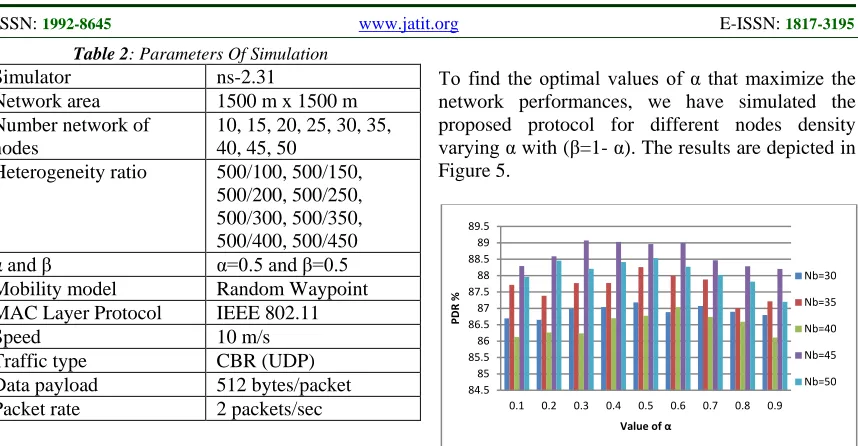
α and β α=0.5 and β=0.5
Mobility model Random Waypoint MAC Layer Protocol IEEE 802.11
Speed 10 m/s
Traffic type CBR (UDP)
Data payload 512 bytes/packet Packet rate 2 packets/sec
Table 2 Shows The Simulation Parameters Used In This Evaluation.
B. Mobility Model
The mobility model is designed to describe the movement pattern of mobile nodes, and how their location, velocity and acceleration change over time.
Various mobility models have been proposed for MANETs in the literature [17-21]. In Broch et al. [16], the authors introduced the random waypoint model which turns out to be the most widely used mobility model. In this model, each mobile node chooses a random destination and moves toward it with a speed uniformly distributed in [0, Vmax], where Vmax is the maximum allowable speed for a node. After reaching the destination, the node stops for a random duration. It then chooses another destination randomly and repeats the whole process. This kind of model has been used in many simulation studies.
C. Performance Metrics
The performance of each routing protocol is compared using the following performance metrics:
-Packe Delivery Ratio (PDR) as a metric to select the best route, transmission rate or power.
PDR is the ratio of the number of number of packets received by the destination to the number of packets sent by the source.
-Normalized routing load is the ratio of the number of control packets propagated by every node in the net work and the number of data packets received by the destination nodes.
- End-to-end delay is the time it takes a packet to travel across the network from source to destination.
To find the optimal values of α that maximize the network performances, we have simulated the proposed protocol for different nodes density varying α with (β=1- α). The results are depicted in Figure 5.
Fig.5: Packet Delivery Ratio Comparison Of MDAODV With Varying Values Of Α
In figure 5 we compared the packet delivery ratio of MDAODV with varying values of α and number of mobile nodes. The results confirmed that the MDAODV with α=0.5 and β=0.5 greater than the others value of α when the number of mobile nodes is 30, 35 and 50.
Results in homogeneous mobile ad hoc Network
[image:6.612.315.525.492.648.2]In homogeneous mobile ad hoc network all nodes have same maximum transmission ranges. We have analyzed the performance of the proposed algorithms by varying the number of mobile nodes in the network.
Fig.6: Packet Delivery Ratio (PDR) Comparison
Figure 6 shows a comparison between both the routing protocols AODV and MDAODV (α=β=0.5) on the basis of Packet delivery ratio (PDR) using a different number of mobile nodes, PDR is almost same in two routing protocols for less network size.
84.5 85 85.5 86 86.5 87 87.5 88 88.5 89 89.5
0.1 0.2 0.3 0.4 0.5 0.6 0.7 0.8 0.9
PD
R %
Value of α
Nb=30
Nb=35
Nb=40
Nb=45
Nb=50
50 55 60 65 70 75 80 85 90 95
10 15 20 25 30 35 40 45 50
PD
R %
Nomber of mobile nodes
mdaodv α=0.5 β=0.5
403 But in a network size of 25, 30, 35, 40, 45 and 50, MDAODV (α=β=0.5) has higher PDR than AODV. By increasing number of nodes brings apparent difference between the two protocols because there are several possible paths in MDAODV that are ignored by AODV.
[image:7.612.316.505.228.379.2]Fig.7: Normalized Routing Load Comparison
Figure 7 shows a comparison between both the routing protocols AODV and MDAODV (α=β=0.5) on the basis of normalized routing load (NRL) using a different number of mobile nodes, NRL is almost same in two routing protocols for less network size But in a network size of 25, 30, 35, 40, 45 and 50, MDAODV (α=β=0.5) is higher NRL than the AODV. By increasing number of mobile nodes brings apparent difference between the two protocols.
Fig.8: Average End To End Delay Comparison
Figure 8 shows a comparison between both the routing protocols of AODV and MDAODV (α=β=0.5) on the basis of Average end to end delay (AEE) using a different number of mobile nodes, AEE is almost same in two routing protocols.
Results in heterogeneous mobile Ad hoc Network
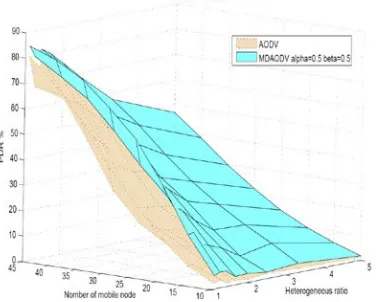
We have also analyzed the performance of the proposed algorithms by varying the number of mobile nodes and the Heterogeneity ratio between nodes in the network heterogeneous.
Heterogeneous Mobile Ad-Hoc Networks (H-MANETs) are composed of nodes with different transmission range.
Heterogeneity ratio is the ratio of the transmission range of transmitting node to the transmission range of receiving node.
Fig.9: Packet Delivery Ratio (PDR) Comparison
Figure 9 shows a comparison between both the routing protocols AODV and MDAODV (α=β=0.5) on the basis of packet delivery ratio using a different number of mobile nodes and the Heterogeneity ratio, MDAODV (α=β=0.5) is higher PDR than the AODV.
Fig.10: Packets Delivery Ratio With Heterogeneity Ratio=500/250
Figure 10 shows that packet delivery ratio with Heterogeneity ratio=500/250 of MDAODV (α=β=0.5) is higher than the AODV, by increasing number of nodes brings apparent difference between the two protocols because there 10
15 20 25 30 35
10 15 20 25 30 35 40 45 50
N
RL
Nomber of mobile nodes
MDAODV α=0.5 β=0.5
AODV
-0.1 6E-16 0.1 0.2 0.3 0.4 0.5 0.6 0.7
10 15 20 25 30 35 40 45 50
EE
D(
se
co
nd)
Nomber of mobile nodes
MDAODV α=0.5 β=0.5
AODV
0 10 20 30 40 50 60
10 15 20 25 30 35 40 45 50
PD
R %
Nomber of mobile nodes
[image:7.612.92.301.465.612.2] [image:7.612.314.524.481.627.2]404 are several possible paths and the link unidirectional ignored in MDAODV (α=β=0.5).
Fig.11:Average End To End Delay With Heterogeneity Ratio=500/250
In figure 11, shows a comparison between both the routing protocols AODV and MDAODV (α=β=0.5) on the basis of average end-to-end delay using a different number of mobile nodes with heterogeneity ratio=500/250, MDAODV (α=β=0.5) has less average end-to-end delay than the AODV.
4. CONCLUSION
Ad-hoc On-demand Distance Vector (AODV) provides best solution for packet routing in mobile wireless ad hoc networks, however, the path selected by this protocol may derivate far from optimal because of inconsideration of distance and relative velocity between sender and receiver that changes when nodes are mobile, resulting in link break. In this paper, an improvement of the AODV is presented. The main idea of this enhancement is based on taking into account the distance and relative velocity when choosing the path. So that, those routes have high stability of link connectivity. Through the simulation, it is confirmed that the MDAODV protocol has higher data package delivery ratio in homogeneous and heterogeneous networks compared to AODV protocol. As future work we will investigate the use of node energy as aggregated metric.
REFRENCES:
[1] Asis Nasipuri, “Mobile Adhoc
Networks,Department of Electrical &
Computer engineering”, The University of
North Carolina,
http://www.ece.uncc.edu/~anasipur/pubs/adho c.pdf.
[2] Scott Carsom and Joseph Macker, “Mobile Ad hoc Networking (MANET): Routing Protocol Performance Issues and Evaluation
Considerations,” internet draft, January 1999
http://www.ietf.org/rfc/rfc2501.txt
[3] C. E. Perkins, Ad Hoc Networking, Addison-Wesley, 2001
[4] C. Perkins, E. Royer, and S. Das, Mobile Ad Hoc Networking (MANET), “Ad-hoc
On-Demand Distance Vector (AODV) Routing”,
IETF RFC 3561.
[5] Yueh-Ting Wu, Wanjiun Liao, Cheng-Lin Tsao, Tsung-Nam, “Link Impact of node mobility on link duration in multihop mobile
network”, IEEE Transactions on Vehicular
Technology, 58 (5) (2009), pp. 2435–2442 [6] Dinesh Ratan Gautam, Sanjeev Sharma, and
Santosh Sahu “Enhanced Transmission Power Control Mechanism based on RSSI for
MANET” International Journal of Computer
Applications (0975 – 8887) Volume 28– No.1, August 2011
[7] Z. Li, L. Sung, and E. C. Ifeachor, “ Range-based relative velocity estimations for
networked mobile devices,” IEEE Trans. Veh.
Technol. 2009.
[8] D. Johnson, Y. Hu, D. Maltz, “The Dynamic Source Routing Protocol (DSR) for Mobile Ad
Hoc Networks for IPv4”, RFC 4728,
February 2007.
[9] P. Samar and S. B. Wicker, “On the behavior of communication links of a node in a
multi-hop mobile environment”, ACM MobiHoc,
June 2004.
[10] F. Bai, N. Sadagopan, and A. Helmy,
“IMPORTANT: A framework to
systematically analyze the impact of mobility on performance of routing protocols for
ad-hoc networks”, in Proc. of IEEE INFOCOM,
April 2003.
[11] N. Meghanathan, “On the Connectivity, Lifetime and Hop Count of Routes Determined using the City Section and Manhattan Mobility Models for Vehicular Ad
hoc Networks”, Proceedings of the 2nd
International Conference on Contemporary Computing, Communications in Computer and Information Science Series, CCIS 40, pp. 170-181, August 2009.
[12] S. Jiang. “An Enhanced Prediction-based
Link Availability Estimation for Manets”,
IEEE Trans. Commun., 52(2):183-186, February 2004.
0 0.5 1 1.5 2 2.5
10 15 20 25 30 35 40 45 50
AE
E
(s
ec
ond)
Nomber of mobile nodes MDAODV α=0.5 β=0.5
405 [13] S. Capkun, M. Hamdi, and J. Hubaux, “
GPS-free positioning in mobile ad-hoc networks”,
Cluster Computing, vol. 5, April 2002
[14] Y. Khamayseh, O. M. Darwish, and S. A. Wedian: “Ma-aodv: Mobility aware routing
protocols for mobile ad hoc networks”,
ICSNC ’09: Proc. of the 2009 Fourth Intl. Conf. on Systems and Networks Communications, Washington, DC, USA: IEEE Computer Society, pp. 25–29 (2009). [15] D. Djenouri A. Derhab and N. Badache. “Ad
Hoc Network Routing Protocols and
Mobility”, The International Arab Journal of
Information Technology , Vol. 3, No. 2, April,2006.
[16] Broch, J; Maltz DA, Johnson DB, Hu Y-C, and Jetcheva J (1998). "A performance comparison of multi-hop wireless ad hoc
network routing protocols". Proceedings of
the Fourth Annual ACM/IEEE International Conference on Mobile Computing and Networking (Mobicom98), ACM, October 1998.
[17] Bai, Fan; Helmy, Ahmed (2006).” A Survey of
Mobility Models in Wireless Adhoc
Networks”. (Chapter 1 in Wireless Ad-Hoc
Networks. Kluwer Academic. 2006. Based on result of Google Scholar search. Additional work needed to identify this book.)
[18] T. Camp, J. Boleng, and V. Davies, “A Survey of Mobility Models for Ad Hoc Network
Research,” Wireless Communications and
Mobile Computing, vol. 2, no. 5, pp. 483– 502, Aug. 2002.
[19] A. K. Saha and D. Johnson, “Modeling
Mobility for Vehicular Ad Hoc Networks,” in
Proc. ACM VANET, Philadelphia, PA, July 2004.
[20] M.McNett and G. Voelker, “Access and
Mobility of Wireless PDA Users,” ACM
Mobile Computing and Communications Review, vol. 9, no. 2, pp. 40–55, Apr. 2005. [21] C. Tuduce and T. Gross, “A Mobility Model
Based on Wlan Traces and its Validation,” in
Proc. IEEE INFOCOM, Miami, FL, Mar. 2005.
[22] T. S.Rappaport. Wireless communications, principles and practice. Prentice Hall, 1996. [23] C.E. Perkins and P. Bhagwat, “Highly
dynamic destination-sequenced distance vector routing (DSDV) for mobile
computers,” in Proc. ACM SIGCOMM 94,
London, UK, Oct. 1994, pp. 234-244.
[24] T. Clausen and P. Jacquet “Optimized Link
State Routing Protocol (OLSR).” RFC 3626,