https://doi.org/10.5194/hess-22-1957-2018 © Author(s) 2018. This work is distributed under the Creative Commons Attribution 4.0 License.
Evaluation of ensemble precipitation forecasts generated through
post-processing in a Canadian catchment
Sanjeev K. Jha1,2, Durga L. Shrestha3, Tricia A. Stadnyk1, and Paulin Coulibaly4 1Department of Civil Engineering, University of Manitoba, Winnipeg, R3T 5V6, Canada
2Department of Earth and Environmental Sciences, Indian Institute of Science Education and Research Bhopal, Madhya Pradesh, 462066, India
3Commonwealth Science and Industrial Research Organization, Clayton South Victoria, 3169, Australia 4Department of Civil Engineering, McMaster University, Hamilton, L8S 4L7, Canada
Correspondence:Sanjeev K. Jha ([email protected]) Received: 10 June 2017 – Discussion started: 7 August 2017
Revised: 31 January 2018 – Accepted: 9 February 2018 – Published: 23 March 2018
Abstract.Flooding in Canada is often caused by heavy rain-fall during the snowmelt period. Hydrologic forecast cen-ters rely on precipitation forecasts obtained from numeri-cal weather prediction (NWP) models to enforce hydrolog-ical models for streamflow forecasting. The uncertainties in raw quantitative precipitation forecasts (QPFs) are en-hanced by physiography and orography effects over a di-verse landscape, particularly in the western catchments of Canada. A Bayesian post-processing approach called rain-fall post-processing (RPP), developed in Australia (Robert-son et al., 2013; Shrestha et al., 2015), has been applied to as-sess its forecast performance in a Canadian catchment. Raw QPFs obtained from two sources, Global Ensemble Forecast-ing System (GEFS) Reforecast 2 project, from the National Centers for Environmental Prediction, and Global Determin-istic Forecast System (GDPS), from Environment and Cli-mate Change Canada, are used in this study. The study pe-riod from January 2013 to December 2015 covered a major flood event in Calgary, Alberta, Canada. Post-processed sults show that the RPP is able to remove the bias and re-duce the errors of both GEFS and GDPS forecasts. Ensem-bles generated from the RPP reliably quantify the forecast uncertainty.
1 Introduction
Quantitative precipitation forecasts (QPFs) obtained from numerical weather prediction (NWP) models are one of the
main inputs to hydrological models when used for stream-flow forecasting (Ahmed et al., 2014; Coulibaly, 2003; Cuo et al., 2011; Liu and Coulibaly, 2011). A deterministic fore-cast, representing a single state of the weather, is unreliable due to known errors associated with the approximate sim-ulation of atmospheric processes and errors in defining ini-tial conditions for a NWP model (Palmer et al., 2005). A single estimate of streamflow using a poor- or high-quality precipitation forecast would have a significant impact on de-cision support, such as management of water structures, is-suing warnings of pending floods or droughts, or scheduling reservoir operations. In recent years, there has been grow-ing interest in movgrow-ing toward probabilistic forecasts, suit-able for estimating the likelihood of occurrence of any fu-ture meteorological event, thus allowing water managers and emergency agencies to prepare for the risks involved during low- or high-flow events, at least a few days or weeks in ad-vance (Palmer, 2002). The precipitation forecasts, however, are constrained by major limitations surrounding the techni-cal difficulties and computational requirements involved in perturbing initial conditions and physical parametrization of the NWP model. The QPFs, ensemble or deterministic, have to be post-processed prior to use as reliable estimates of any observations (e.g., streamflow).
post-processed ensemble forecasts of the future (Roulin and Vannitsem, 2012; Robertson et al., 2013; Chen et al., 2014; Khajehei, 2015; Shrestha et al., 2015; Khajehei and Morad-khani, 2017; Schaake et al., 2007; Wu et al., 2011; Tao et al., 2014). The range of complexity in the post-processing approaches varies from regression-based approaches to para-metric or nonparapara-metric models based on meteorological variables (wind speed, temperature, precipitation etc.) and specific applications. Precipitation is known to have com-plex spatial structure and behavior (Jha et al., 2015a, b). Thus it is much more difficult to forecast than other atmo-spheric variables because of nonlinearities and the sensitive processes involved in its generation (Bardossy and Plate, 1992; Jha et al., 2013). From the perspective of a hydrologic forecast center, the post-processing approach should be ef-fective while involving few parameters. For instance, the US National Weather Service River Forecast System has been using an ensemble pre-processing technique that constructs ensemble forecasts through the Bayesian forecasting system by correlating the normal quantile transform of QPFs and observations (Wu et al., 2011). In order to introduce space– time variability of the precipitation forecast in the ensemble, the post-processed forecast ensemble is reordered based on historical data using the Schaake shuffle procedure (Clark et al., 2004; Schaake et al., 2007). This pre-processing tech-nique requires a long historical hindcast database as it re-lates single NWP forecasts to corresponding observations. In Australia, Robertson et al. (2013) developed a Bayesian post-processing approach called rainfall post-post-processing (RPP) to generate precipitation ensemble forecasts. The approach was based on combining the Bayesian Joint Probability approach of Wang et al. (2009) and Wang and Robertson (2011) with the Schaake shuffle procedure (Clark et al., 2004). In con-trast to the ensemble pre-processing technique, the RPP ap-proach of Robertson et al. (2013) has been described with few parameters and it can better deal with zero value prob-lems in NWP forecasts (Tao et al., 2014) and observations. The RPP approach has been successfully applied to remove rainfall forecast bias and quantify forecast uncertainty from NWP models in Australian catchments (Bennett et al., 2014; Shrestha et al., 2015).
Recent developments in post-processing techniques and the advantage of generating ensembles, and thus estimating uncertainty, are well established in the literature. In an op-erational context, however, forecast centers in Canada tend to use deterministic forecasts in hydrologic models to obtain streamflow forecasts. The main reasons for this are the higher spatial and temporal resolution of the deterministic forecasts over the ensemble QPFs and the associated computational complexities in dealing with ensemble members. The added advantages of using ensemble forecasts over deterministic forecasts have been addressed in many previous studies (e.g., Abaza et al., 2013; Boucher et al., 2011). When the compu-tational facilities are available, using a set of QPFs obtained from different NWP models run by different agencies (such
as the European Centre for Medium-Range Weather Fore-casts, the Japan Meteorological Agency, the National Cen-ter for Environmental Prediction (NCEP), the Canadian Me-teorological Center) seems to be a preferred choice (Ye et al., 2016; Zsótér et al., 2016; Qu et al., 2017; Hamill, 2012). The main hypothesis we want to test in this study is whether the RPP approach can be directly applied to Cana-dian catchments or any modification is required. Based on this hypothesis, the aims of this study are to (a) evaluate the performance of RPP in improving cold regions’ precipita-tion forecasts; (b) compare the ensembles generated from applying RPP to the deterministic QPFs obtained from the Global Ensemble Forecasting System (GEFS) and the Global Deterministic Forecast System (GDPS) (referred to as cali-brated QPFs); and (c) investigate forecast performance dur-ing an extreme precipitation event like that of 2013 in Al-berta, Canada. The methodology and description of the study area and datasets are presented in Sect. 2. Section 3 presents methodology, followed by results in Sect. 4 and discussion and conclusion in Sect. 5.
Although the current study uses the RPP approach previ-ously published in Robertson et al. (2013) and Shrestha et al. (2015), there are many novel aspects of this study, which are listed below.
i. Robertson et al. (2013) demonstrated the application of the RPP approach at rain gauge locations in a catchment in southern Australia. In the present study, we are apply-ing RPP at the subcatchment level usapply-ing subcatchment-averaged forecasts and observations, which is similar to the work presented in Shrestha et al. (2015).
ii. The physiography and orography effects over western catchments of Canada significantly differ from the Aus-tralian catchments considered in Shrestha et al. (2015). In their analysis, Shrestha et al. (2013) considered 10 catchments in tropical, subtropical, and temperate climate zones with catchment areas ranging from 87 to 19 168 km2 distributed in different parts of Australia. Each catchment was further divided into smaller sub-catchments and RPP was applied in each of them. In the present study, we focus on only a specific region of Canada with a cold and snowy climate, consisting of 15 subcatchments with areas ranging from 734 to 2884 km2. We apply RPP to each subcatchment using the forecast and observation data lying within it. The size of the subcatchment plays an important role in es-timating the subcatchment-averaged forecast and obser-vations.
Table 1.Description of precipitation forecasts.
Data NWP Variable Ensembles/ Time period Daily/ Lead time Spatial Forecast source name deterministic subdaily (days) resolution (km) hour NCEP GEFS Precipitation Control run 2013–2015 Daily 5 days 50 km 00:00 UTC ECCC GDPS Precipitation Deterministic 2013–2015 Daily 5 days 25 km 00:00 UTC
data, from the National Centers for Environmental Pre-diction, and the Global Deterministic Forecast Sys-tem (GDPS), from Environment and Climate Change Canada (ECCC). Shrestha et al. (2013) used forecasts from only one NWP model, the Australian Commu-nity Climate and Earth-System Simulator. Further, we compare the performance of RPP applied to GEFS and GDPS forecasts in order to decide which forecast is best suited to our study area.
iv. Although QPFs from the GDPS are routinely used at the forecast centers in Canada, the application of GEFS to catchments in western Canada is not known, to the best of our knowledge (also confirmed from data provider, Gary Bates at NOAA, personal communica-tion, 21 March 2017).
v. In their analysis, Shrestha et al. (2013) considered 3-hourly forecasts for 615 days only. In the current study, 3 years of daily forecasts are used without any gap. The longer data record is recommended as it can help in in-ferring the parameters of RPP more accurately.
vi. In the present study, we explicitly look at an extreme precipitation event that happened in Calgary 2013 and evaluate the performance of the RPP approach in gener-ating ensembles, which was not done in previous works (Shrestha et al., 2015; Robertson et al., 2013).
vii. To the best of our knowledge, this is the first time an approach for generating ensembles from a deterministic QPF is tested in any Canadian catchment explicitly for the benefit of forecast centers. As part of the National Sciences and Engineering Research Council Canadian Floodnet 3.1 project, the first author visited flood fore-cast centers in western Canada. One of the common concerns raised by forecasters was the need for gener-ating ensembles in order to assess risk associated with streamflow forecasts provided to the public. The con-clusions from the present study will be highly relevant and beneficial for flood forecast centers in Canada.
2 Study area and datasets
The selected study area is southern Alberta, located in west-ern Canada (Fig. 1a). The Rocky Mountains are located at the southern boundary with the United States and the
western boundary with British Columbia, with the Canadian Prairies region extending toward the southeastern portion of the province. Topography plays a major role in generating cyclonic weather systems common to Alberta. The Oldman, Bow, and Red Deer River basins, all located at the foothills of the Canadian Rocky Mountain range, are subjected to ex-treme precipitation events. In June 2013 a major flood oc-curred in this region, resulting from the combined effect of heavy rainfall during mountain snowpack melt over partially frozen ground (Pomeroy et al., 2016; Teufel et al., 2016). Some river basins received 1.5×1 :100-year rainfall, esti-mated to be 250 mm rain in 24 h. The 2013 flood affected most of southern Alberta from Canmore to Calgary and be-yond, causing evacuation of around 100 000 people and a re-ported cost of damage of infrastructure exceeding CAD 6 bil-lion (Milrad et al., 2015). The spatial distribution of con-vective precipitation and orography make it difficult for any NWP model to successfully predict the summertime convec-tive precipitation in Alberta. The NWP forecasts at the time predicted less (about half of the actual amount) rainfall dur-ing this event (AMEC, 2014).
pe-riod of 3 years (1 January 2013 to 31 December 2015) with a lead time of 5 days is used in the present analysis.
GDPS precipitation forecasts are obtained from the Cana-dian NWP model, the Global Environmental Multiscale Model. The forecasts are available at approximately 0.24◦ latitude, 0.24◦longitude spatial resolution at an interval of 3 h for forecast lead times up to and beyond 2 weeks. Pre-cipitation forecasts are accumulations from the start of the forecast period. To obtain a forecast for a specific day, for ex-ample day 2, the precipitation forecast at the end of day 1 has to be subtracted from the precipitation forecast at the end of day 2. Three years of continuous GDPS forecasts from 1 Jan-uary 2013 to 31 December 2015 with lead times of 5 days at 00:00 UTC are used in the present analysis.
There are three major rivers passing through the study area: Bow, Oldman, and Red Deer rivers (Fig. 1b). Based on the world map of Peel et al. (2007), the study area is classified as having a warm summer, humid continental climate. The Köppen–Geiger classification system presented for Canada in Delavau et al. (2015) shows that our study area falls within the KPN42 (Dfb – snow, fully humid precipitation, warm summer), KPN43 (Dfc – snow, fully humid precipitation, cool summer), and KPN 62 (ET polar tundra). All of the three river basins are part of the South Saskatchewan River basin, which flows eastward towards the Canadian Prairies. The combined basin area is approximately 101 720 km2 (AEP, 2017). For the purpose of hydrological prediction, the River Forecast Centre in Alberta uses 15 subcatchments (marked with numbers 1 to 15 in Fig. 1b) to delineate the study area, with drainage areas as indicated in Table 2.
The distribution of precipitation gauges and forecast lo-cations is uneven in the various subcatchments (Fig. 1b). For hydrological modeling purposes, average precipitation over each subcatchment is calculated using an inverse-distance weighting method (Shepard, 1968), considering four neighboring gauges. Subcatchment 2 receives the high-est subcatchment-averaged annual precipitation, while sub-catchment 13 receives the lowest average annual precipita-tion during the 3-year study period (Table 2). In each sub-catchment, an area-weighted forecast is calculated by con-sidering the portion of the forecast grid that overlaps with the subcatchment.
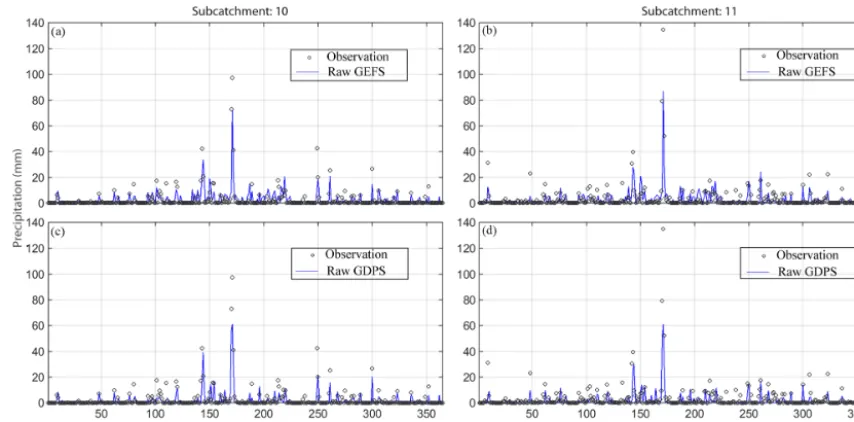
Figure 2 shows the comparison of raw QPFs and ob-served precipitation in subcatchments 10 and 11 for GEFS and GDPS with a lead time of 1 day for 2013. The large peak observed (Fig. 2a–d) is the result of a major rainfall event responsible for severe flooding in Alberta in June 2013. Fig-ure 2 indicates that there is a substantial bias between the raw QPFs and observations. Raw QPFs from GEFS and GDPS consistently underestimate peak events and medium precip-itation amounts, which is of concern to hydrologic forecast centers predicting streamflow peak volume and timing.
3 Methodology
3.1 Post-processing approach
We use the RPP to post-process the precipitation forecasts. The RPP was developed by Robertson et al. (2013) and successfully applied to a range of Australian catchments (Shrestha et al., 2015). Detailed descriptions of the RPP can be found in the above references; here we present a brief overview of the method.
The input to the post processing approach is observations (zo) and raw QPFs (zrf). A log-sinh transformation is applied to both observations and raw precipitation forecasts:
ˆ zo= 1
βo
ln(sinh(αo+βozo)) , (1)
ˆ zrf= 1
βfln(sinh(αf+βfzrf)) , (2)
wherezˆoandzˆrfare transformed observation and raw fore-casts;αoandβoare parameters used in the transformation of zo; andαfandβfare parameters used in the transformation of zrf. It is assumed that the transformed variables (zoˆ andzrf)ˆ
follow a bivariate normal distributionp(zo,ˆ zrf)ˆ ∼N (µ,6), in whichµand6are defined as follows:
µ=
µzˆo µˆzrf
and (3)
6=
" σzˆ2
o ρzˆozˆrfσˆzoσˆzrf ρzˆoˆzrfσzˆoσzˆrf σ
2
ˆ
zrf #
, (4)
whereµzˆo andσzˆo represent the mean and standard devia-tion ofzoˆ respectively;µzˆrf andσˆzrf represent the mean and standard deviation ofzrfˆ respectively;ρˆzozˆrfis the correlation coefficient betweenzˆoandzˆrf. Thus, there are nine parame-ters (αo,βo,µzˆo,σˆzo,αf, βf,µzˆrf,σzˆrf,ρzˆozˆrf) to model the joint distribution of raw QPFs and observations. We infer a single set of model parameters that maximizes the likelihood of posterior parameter distribution using the shuffled com-plex evolution algorithm (Duan et al., 1994). All model pa-rameters are reparametrized to ease the parameter inference. Once the parameters are inferred, the forecast is estimated us-ing the bivariate normal distribution conditioned on the raw forecast. The random sampling from the conditional distribu-tion generates the ensemble of forecasts. The forecast values are then transformed to the original space using the inverse of Eqs. (1) and (2).
Figure 1.Location of the study basin in Alberta, Canada, showing(a)topography, a major driver of different precipitation mechanisms, and
(b)the study area with locations of observed and forecast data.
Table 2.Description of subcatchments in the study area. Italics is used to highlight maximum and minimum values in the corresponding columm.
Subcatchment Name Area Subcatchment-averaged total (km2) annual precipitation (mm) ID Year 2013 Year 2014 Year 2015 1 Up Oldman Willow 2664 808 699 514 2 Crows nest Castle 1848 1206 1196 909
3 Little Red Deer 2574 608 587 458 4 Mid Red Deer 1398 614 549 458 5 James Raven 1464 715 655 541 6 Up Red Deer 2723 897 662 571 7 Low Bow Local Bearspaw 734 628 533 409 8 Up Bow Banff Cascade 2884 663 806 659 9 Mid Bow Local Ghost 1063 871 689 540
Jumpingpound
10 Canmore Ghost Waiparous 1642 900 723 544 11 Spray Kananaskis 1445 1136 983 821 12 Fish Threepoint Low Elbow 1405 646 516 487 13 Low Sheep Highwood 1111 502 440 371
[image:5.612.121.474.481.707.2]Figure 2.Comparison of weighted-area raw QPFs with subcatchment-averaged observations for the year 2013 in subcatchments 10 and 11. Raw GEFS data are plotted in(a)and(b), while(c)and(d)show raw GDPS data, along with observations.
1. For a given forecast date, an observation sample (date and amount of data) of the same size as that of the en-semble is selected from the historical observation pe-riod.
2. The observation sample data for each lead time are ranked. Similarly, the data from the forecast ensemble for each lead time are ranked.
3. A date from the observation sample is randomly lected and the ranks of the observation data for the se-lected date for all lead times are identified.
4. For a given lead time, we select the forecast (from the forecast ensemble) that has the same rank as that of the selected observation.
5. In order to construct an ensemble trace across all lead times, step 3 is repeated for all lead times.
6. Steps 3 to 5 are repeated as many times as the size of ensembles.
The above procedure is extended for both temporal and spa-tial correlation in this study.
An important feature of the RPP is the treatment of (near) zero precipitation values, which are treated as censored data in the parameter inference. This enables the use of the con-tinuous bivariate normal distribution for a problem, which is otherwise solved using a mixed discrete–continuous proba-bility distribution (e.g., Wu et al., 2011).
3.2 Verification of the post-processed forecasts
We assess the processed forecast in terms of deterministic metrics, such as percent bias defined as percent deviation from the observations (bias, %), mean absolute error (MAE in mm), and a probabilistic metric, a continuous rank prob-ability score (CRPS), at each site for the forecast period (t). The percent bias is estimated as follows:
Bias= t
P
1 zf−
t
P
1 zo
t
P
1 zo
·100, (5)
wherezfcould either be raw (zrf) or post-processed forecasts (zpf), andzorepresents observation.
MAE measures the closeness of the forecasts and observa-tions over the forecast period.
MAE=1 t
t
X
1
|zf−zo| (6)
In the case of the ensemble forecast, we use the mean value of forecasts in the calculation of both the bias and the MAE. A low value of both bias and MAE indicates that the fore-casts are closer to observations. A percent bias close to zero indicates that forecasts are unbiased.
The CRPS is a probabilistic measure to relate the cumula-tive distribution of the forecasts and the observations:
CRPS=
∞
Z
−∞
Fzf(t )−Fzo(t ) 2
whereFzfis the cumulative distribution function of ensemble forecasts and Fzo is the cumulative distribution function of observations, which turns out to be a Heaviside function (1 for values greater than the observed value, otherwise 0). In the case of the deterministic forecast, the CRPS reduces to the MAE. The forecast is considered better when the CRPS values are close to zero.
The relative operating characteristic (ROC) curves are used to assess the forecast’s ability to discriminate precipi-tation events in terms of hit rate and false alarm rate. Given a precipitation threshold, the hit rate refers to the probability of forecasts that detected events smaller or larger in magnitude than the threshold; the false alarm rate refers to the proba-bility of erroneous forecasts or false detection (Atger, 2004; Golding, 2000). If the ROC curves (plot between hit rate ver-sus false alarm rate) approach the top left corner of the plot, the forecast is considered to have a greater ability to discrim-inate precipitation events. The discrimination ability of the forecast is considered low when the ROC curves are close to the diagonal.
To compare the spread in forecast ensembles against the observations, we perform spread–skill analysis by plotting the ensemble spread versus the forecast error (e.g., Nester et al., 2012). The ensemble spread is defined as the mean abso-lute difference between the ensemble members and the mean. The absolute difference between the observations and the en-semble mean is defined as the forecast error. For each lead time in the cross-validation period, we compute the ensem-ble spread and forecast error for 1000 ensemensem-ble forecasts, sort them in increasing order, group the values in 10 classes, and calculate the average spread and error in each class. 3.3 Statistical treatment of forecasts
Because of the short record of data (3 years only), few ex-treme events may significantly affect the verification scores. Therefore it is desirable to understand the effect of the sam-pling variability on the verification scores. Accounting for sampling variability in calculating the verification scores adds confidence that results are robust and likely to apply under operational conditions (Shrestha et al., 2015). We cal-culate sampling uncertainty through a bootstrap procedure (e.g., Shrestha et al., 2013). The first 1095 pairs (3 years of data) of forecast–observations are sampled with replace-ment from the original forecast–observation pairs, with re-placement and verification scores calculated (discussed in Sect. 3.1 below). These steps are repeated 5000 times to ob-tain a distribution of the verification score, from which 5 and 95 % confidence intervals are calculated.
3.4 Experimental setup
Post-processing is applied to precipitation forecasts in 15 subcatchments, making use of the subcatchment-averaged precipitation forecast data for the total study duration (i.e.,
2013 to 2015 for GEFS and GDPS), for each day of forecast at 00:00 UTC up to a lead time of 5 days. We apply a leave-1-month-out cross-validation approach. The simulation runs in two modes: inference and forecast. In the inference mode, for example, 36 months of precipitation forecast and obser-vations are used to estimate the model parameters. Once pa-rameters are estimated, the simulation runs in forecast mode to generate 1000 ensembles (or realizations) of precipitation forecasts for the month that was left out of the calibration. The process is repeated 36 times to generate forecasts for 2013 to 2015.
4 Results
4.1 Evaluation of calibrated QPFs
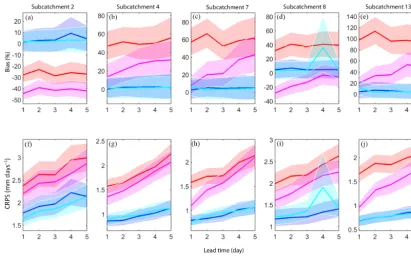
Figure 3 presents the percent bias and CRPS in five subcatch-ments for both GEFS and GDPS forecasts. Out of 15 sub-catchments considered in this study, the maximum and min-imum total annual subcatchment-averaged precipitation for the years 2013 to 2015 occurred in subcatchments 2 and 13, respectively (see Table 2); subcatchments 7 and 8 have mini-mum and maximini-mum size, respectively. The four selected sub-catchments covered the middle and southern portions of the study area; therefore we include subcatchment 4 to facili-tate discussion on the performance of calibrated QPFs in the northern portion of the study area. The percent bias for all 15 subcatchments is provided in Fig. S1a.
Based on visual inspection of bias plots (Fig. 3a–e), the bias in the calibrated QPF is close to zero in almost all five subcatchments (except at lead time 4 in the subcatchment 8), indicating that overall, the RPP is able to reduce the bias in the raw QPF. As shown in Fig. S1b, the inability of calibrated RPP in reproducing a peak precipitation event at lead time 4 in subcatchment 8 resulted in a large bias. The anomaly can be attributed to the fact that subcatchment 8 has the largest area and only a few observation stations lie inside the sub-catchment. In the case of GEFS forecasts for the lead time of 1 day, the raw QPFs have an average bias ranging from
Figure 3.Subcatchment-averaged bias (%) in the raw QPFs and calibrated QPFs for individual daily forecasts as a function of lead time for subcatchments 2, 4, 7, 8, and 13 (a–e, respectively); panels(f–j)show subcatchment-averaged CRPS (mm day−1) in the raw QPFs and calibrated QPFs for daily precipitation as a function of lead time. The shaded region represents 5 and 95 % confidence intervals generated using a bootstrap approach. Note the different scales on the vertical axes.
in bias in different subcatchments can be attributed to topog-raphy and physiographic characteristics. It is worth pointing out that in this study, we are not considering spatial non-stationarity because the goal is to set up a simple Bayesian model that relates the subcatchment precipitation forecasts and the observations. Accounting for the topography and el-evation in the probabilistic model increases the complexity significantly and it is unlikely that the forecast performance will increase given the length of data used to infer the model parameters. Thus, we are not concerned with linking topog-raphy and corrections in the forecasts.
The subcatchment-averaged CRPSs of raw and calibrated QPFs are shown in Fig. 3f–j. It is worth mentioning that for the deterministic forecast, the CRPS reduces to the MAE; thus the plots for raw QPFs (Fig. 3f–j) show the MAE. For simplicity, we therefore refer to the MAE of raw QPFs as its CRPS. The CRPSs estimated on the calibrated QPFs are based on 1000 ensembles generated from the RPP approach. In the case of GEFS, and similar to the bias plots (Fig. 3a–e), we notice that the CRPS first increases then decreases and in-creases again after a lead time of 4 days in the raw QPFs. The CRPS based on the calibrated QPFs, however, consistently increases (except for subcatchment 2), indicating that as the lead time increases, deviation between forecasts and obser-vation will be larger. In the case of GDPS, the CRPS of raw QPFs varies between 1 and 2.2 mm day−1for a lead time of 1
day, almost linearly increasing up to 3 mm day−1for forecast lead times of 5 days. The RPP approach reduces the CRPS significantly for each lead time in all subcatchments (except at a lead time of 4 in subcatchment 8). The reason for de-viation in the CRPS at a lead time of 4 in subcatchment 8 is not trivial; however it can be attributed to RPP’s inability to capture a peak precipitation event as shown in Fig. S1b. Overall the calibrated QPF has a lower CRPS than the raw QPF, which demonstrates that the RPP is able to improve the raw QPF across all lead times. The CRPSs of other subcatch-ments are presented in Fig. S1c.
Figure 4. Relative operating characteristic (ROC) curves at lead times of 1, 3, and 5 days for calibrated QPFs for events of pre-cipitation less than 0.2 mm and events of prepre-cipitation greater than 5 mm for subcatchment 11. Panels(a)and(b)show ROC curves of calibrated GEFS, and panels(c)and(d)show ROC curves of cali-brated GDPS. In the calculation of ROC, the daily data from 2013 to 2015 are used.
for higher rainfall events (>5 mm), where ROC curves are closer to the left corner of the plot (Fig. 4c and d) than for smaller precipitation events (<0.2 mm).
Figure 5 indicates the forecast error versus spread of the ensembles for calibrated GEFS and GDPS forecasts with lead times of 1, 3, and 5 days for subcatchment 11. For days 3 and 5, most of the points seem to fall on the diagonal (1 :1 line), suggesting good agreement between the forecast error and the spread across all the lead times. For day 1, the devia-tion of the points from the diagonal (1: 1 line) is higher, in-dicating a larger bias for day 1 compared to days 3 and 5. To explore this further, we calculated the frequency of observed data lying within the 10–90 % confidence boundary of cal-ibrated QPFs. Figure 6 shows that in the case of calcal-ibrated GEFS, the calculated frequency of observed data for a lead time of 1 to 5 days varies between 0.78 and 0.88. However, for calibrated GDPS, the frequency lies between 0.87 and 0.9. Figure 6 demonstrates that as the lead time increases, the frequency of observed data lying within the [0.1–0.9] confi-dence boundary is higher.
4.2 Performance of calibrated QPFs during an extreme event
As mentioned in Sect. 2, a severe flood event occurred from 20 to 24 June 2013 in Calgary (located near the out-let of subcatchment 7; see Fig. 1b). Therefore we examine subcatchment-averaged precipitation obtained from raw and calibrated QPFs against observed data. From the historical observed data, we notice that most peak precipitation events
tend to occur over the mountains (i.e., in subcatchments 10 and 11). To consider both the peak precipitation event re-sponsible for triggering the 2013 flood and also the series of smaller precipitation events before and after the peak event, we select a 1-month period from 10 June to 10 July 2013. Results for the 1-day lead time in subcatchments 10 and 11 (Fig. 6) relative to observed data suggest there were a se-ries of high precipitation events on day 10, 11, and 12, with almost negligible precipitation on the remaining days rela-tive to these peak events (with the exception of some small events on days 26 and 29). In both subcatchments 10 and 11, raw GEFS forecasts show significantly less precipitation compared to the observations from days 10 to 12 (see Fig. 7a and b). On the remaining days, raw GEFS consistently fore-casts higher magnitudes of precipitation relative to the ob-servations. The raw GDPS forecast also shows significantly lower magnitudes of precipitation relative to that observed during the peak event (days 10 to 12; Figs. 7c and d). The GDPS forecast shows overprediction of a smaller event on day 26 and underprediction on day 29. For the remaining days, the raw GDPS forecast closely matches observed pre-cipitation. The shaded area for the calibrated QPF in the case of both GEFS and GDPS indicates the range of precipitation forecasts obtained from 1000 ensemble forecast members. In both subcatchments 10 and 11, the subcatchment-averaged calibrated QPFs (shaded area) are able to capture peak pre-cipitation and the smaller events (except for day 10 in cali-brated GEFS).
We have also evaluated the ability of the calibrated QPFs to discriminate between events and non-events for large rain-fall events (>5 mm) from 10 June to 10 July 2013. The ROC curves for lead times of 1, 3, and 5 days for both calibrated GEFS and GDPS in subcatchment 11 (Fig. 8) indicate that the calibrated GEFS (lead times of 1 and 3 days) and cali-brated GDPS (lead time of 1 and 5 days) have a greater abil-ity to discriminate between events and non-events.
5 Discussion and conclusion
Figure 5. Scatterplots of forecast error versus spread of the 100 ensembles of calibrated QPFs for lead times of 1, 3, and 5 days for subcatchment 11.
Figure 6.Frequency of observations lying within the 10th and 90th percentile of calibrated GEFS and calibrated GDPS.
The calibrated QPFs have significantly reduced CRPS val-ues in all subcatchments in both GEFS and GDPS forecasts. Furthermore, the ensembles produced from the determinis-tic QPF were mostly able to capture the peak precipitation events within the study area (i.e., June 2013). It is noted that in the absence of ensembles, a hydrological model would take only the raw QPF and would therefore not forecast the resulting streamflow correctly during a major flood event. Ensemble precipitation forecasts would enable uncertainty bands to be produced around the forecast streamflow sim-ulated from a hydrological model, thus increasing the chance of properly assessing the associated risks associated with sudden, high precipitation events.
ROC curves for calibrated QPFs showed that GEFS fore-casts have a greater ability to discriminate between events and non-events for both low and high precipitation across all lead times. The discrimination ability of GDPS forecasts, however, reduces significantly with increasing lead time.
[image:10.612.97.501.254.503.2]topo-Figure 7.Comparison of time series of precipitation obtained from subcatchment-averaged raw QPFs, subcatchment-averaged observations, and subcatchment-averaged calibrated QPFs in subcatchments 10 and 11. The shaded area represents the range of values obtained from 1000 post-processed ensembles. Panels(a)and(b)show results of calibrated GEFS, and panels(c)and(d)show results of calibrated GDPS.
Figure 8. Relative operating characteristic (ROC) curves at lead times of 1, 3, and 5 days for calibrated QPFs for precipitation events greater than 5 mm for subcatchment 11 during 10 June to 10 July 2013, with (a)and(b) showing ROC curves of calibrated GEFS and GDPS, respectively.
graphical conditions, from mountains to western plains, in-ducing different precipitation mechanisms. Unlike raw fore-casts, the post-processed forecast ensembles are able to cap-ture peak precipitation events, which resulted in a major flood event in 2013 within the study area. Future work will involve applying RPP to other Canadian catchments, under different climatic conditions such as coast, plains, and the lake-dominated Boreal Shield, among others. The influence of the density of rain gauges and perhaps the use of a gridded reanalysis product for the observation dataset are left for fu-ture investigations. The authors aim to test the post-processed precipitation forecasts for streamflow forecasting in different Canadian catchments in future work.
Data availability. The observed data used in this research can be obtained by submitting a data request to Alberta River Fore-cast Center and Environment and Climate Change Canada. The precipitation forecast, GEFS, can be directly downloaded from the website of NOAA (https://www.esrl.noaa.gov/psd/forecasts/ reforecast2/). The GDPS forecast can be obtained by submitting a data request to Environment and Climate Change Canada.
Supplement. The supplement related to this article is available online at: https://doi.org/10.5194/hess-22-1957-2018-supplement.
Competing interests. The authors declare that they have no conflict of interest.
[image:11.612.48.288.339.466.2]Edited by: Luis Samaniego
Reviewed by: Fabio Oriani and Geoff Pegram
References
Abaza, M., Anctil, F., Fortin, V., and Turcotte, R.: A comparison of the Canadian global and regional meteorological ensemble prediction systems for short-term hydrological forecasting, Mon. Weather Rev., 141, 3462–3476, 2013.
AEP (Alberta Environment and Parks): https://rivers.alberta.ca/, last access: February 2017.
Ahmed, S., Coulibaly, P., and Tsanis, I.: Improved Spring Peak-Flow Forecasting Using Ensemble Meteoro-logical Predictions, J. Hydrol. Eng., 20, 04014044, https://doi.org/10.1061/(ASCE)HE.1943-5584.0001014, 2014. AMEC: Weather Forecast Review Project for
Opera-tional Open-water River Forecasting, available at: http: //aep.alberta.ca/water/programs-and-services/flood-mitigation/ flood-mitigation-studies.aspx (last access: February 2017), 2014.
Atger, F.: Estimation of the reliability of ensemble-based probabilis-tic forecasts, Q. J. Roy. Meteor. Soc., 130, 627–646, 2004. Bardossy, A. and Plate, E. J.: Space-time model for daily rainfall
using atmospheric circulation patterns, Water Resour. Res., 28, 1247–1259, 1992.
Bennett, J. C., Robertson, D. E., Shrestha, D. L., Wang, Q., Enever, D., Hapuarachchi, P., and Tuteja, N. K.: A System for Continuous Hydrological Ensemble Forecasting (SCHEF) to lead times of 9 days, J. Hydrol., 519, 2832–2846, 2014.
Boucher, M.-A., Anctil, F., Perreault, L., and Tremblay, D.: A comparison between ensemble and deterministic hydrological forecasts in an operational context, Adv. Geosci., 29, 85–94, https://doi.org/10.5194/adgeo-29-85-2011, 2011.
Chen, J., Brissette, F. P., and Li, Z.: Postprocessing of ensemble weather forecasts using a stochastic weather generator, Mon. Weather Rev., 142, 1106–1124, 2014.
Clark, M., Gangopadhyay, S., Hay, L., Rajagopalan, B., and Wilby, R.: The Schaake shuffle: A method for reconstructing space–time variability in forecasted precipitation and temperature fields, J. Hydrometeorol., 5, 243–262, 2004.
Coulibaly, P.: Impact of meteorological predictions on real-time spring flow forecasting, Hydrol. Process., 17, 3791–3801, 2003. Cuo, L., Pagano, T. C., and Wang, Q.: A review of quantitative precipitation forecasts and their use in short-to medium-range streamflow forecasting, J. Hydrometeorol., 12, 713–728, 2011. Delavau, C., Chun, K., Stadnyk, T., Birks, S., and Welker, J.: North
American precipitation isotope (δ18O) zones revealed in time se-ries modeling across Canada and northern United States, Water Resour. Res., 51, 1284–1299, 2015.
Duan, Q., Sorooshian, S., and Gupta, V. K.: Optimal use of the SCE-UA global optimization method for calibrating watershed mod-els, J. Hydrol., 158, 265–284, 1994.
Golding, B.: Quantitative precipitation forecasting in the UK, J. Hy-drol., 239, 286–305, 2000.
Hamill, T. M.: Verification of TIGGE multimodel and ECMWF reforecast-calibrated probabilistic precipitation forecasts over the contiguous United States, Mon. Weather Rev., 140, 2232–2252, 2012.
Jha, S. K., Mariethoz, G., Evans, J. P., and McCabe, M. F.: Demon-stration of a geostatistical approach to physically consistent downscaling of climate modeling simulations, Water Resour. Res., 49, 245–259, 2013.
Jha, S. K., Mariethoz, G., Evans, J., McCabe, M. F., and Sharma, A.: A space and time scale-dependent nonlinear geostatistical approach for downscaling daily precipitation and temperature, Water Resour. Res., 51, 6244–6261, 2015a.
Jha, S. K., Zhao, H., Woldemeskel, F. M., and Sivakumar, B.: Net-work theory and spatial rainfall connections: An interpretation, J. Hydrol., 527, 13–19, 2015b.
Khajehei, S.: A Multivariate Modeling Approach for Gen-erating Ensemble Climatology Forcing for Hydrologic Applications, Dissertations and Theses, Paper 2403, https://doi.org/10.15760/etd.2400, 2015.
Khajehei, S. and Moradkhani, H.: Towards an improved ensemble precipitation forecast: A probabilistic post-processing approach, J. Hydrol., 546, 476–489, 2017.
Liu, X. and Coulibaly, P.: Downscaling ensemble weather predic-tions for improved week-2 hydrologic forecasting, J. Hydrome-teorol., 12, 1564–1580, 2011.
Milrad, S. M., Gyakum, J. R., and Atallah, E. H.: A meteoro-logical analysis of the 2013 Alberta flood: antecedent large-scale flow pattern and synoptic–dynamic characteristics, Mon. Weather Rev., 143, 2817–2841, 2015.
Nester, T., Komma, J., Viglione, A., and Blöschl, G.: Flood forecast errors and ensemble spread – A case study, Water Resour. Res., 48, W10502, https://doi.org/10.1029/2011WR011649, 2012. Palmer, T. N.: The economic value of ensemble forecasts as a tool
for risk assessment: From days to decades, Q. J. Roy. Meteor. Soc., 128, 747–774, 2002.
Palmer, T. N., Shutts, G. J., Hagedorn, R., Doblas-Reyes, F. J., Jung, T., and Leutbecher, M.: Representing model uncertainty in weather and climate prediction, Annu. Rev. Earth Pl. Sc., 33, 163–193, 2005.
Peel, M. C., Finlayson, B. L., and McMahon, T. A.: Updated world map of the Köppen-Geiger climate classification, Hydrol. Earth Syst. Sci., 11, 1633–1644, https://doi.org/10.5194/hess-11-1633-2007, 2007.
Pomeroy, J. W., Stewart, R. E., and Whitfield, P. H.: The 2013 flood event in the South Saskatchewan and Elk River basins: causes, assessment and damages, Can. Water Resour. J., 41, 105–117, 2016.
Qu, B., Zhang, X., Pappenberger, F., Zhang, T., and Fang, Y.: Multi-Model Grand Ensemble Hydrologic Forecasting in the Fu River Basin Using Bayesian Model Averaging, Water, 9, 74, https://doi.org/10.3390/w9020074, 2017.
Robertson, D. E., Shrestha, D. L., and Wang, Q. J.: Post-processing rainfall forecasts from numerical weather prediction models for short-term streamflow forecasting, Hydrol. Earth Syst. Sci., 17, 3587–3603, https://doi.org/10.5194/hess-17-3587-2013, 2013. Roulin, E. and Vannitsem, S.: Postprocessing of ensemble
precipita-tion predicprecipita-tions with extended logistic regression based on hind-casts, Mon. Weather Rev., 140, 874–888, 2012.
Shepard, D.: A two-dimensional interpolation function for irregularly-spaced data, Proceedings of the 1968 23rd ACM na-tional conference, 27–29 August 1968, New York, NY, USA, 517–524, https://doi.org/10.1145/800186.810616, 1968. Shrestha, D. L., Robertson, D. E., Wang, Q. J., Pagano, T. C., and
Hapuarachchi, H. A. P.: Evaluation of numerical weather pre-diction model precipitation forecasts for short-term streamflow forecasting purpose, Hydrol. Earth Syst. Sci., 17, 1913–1931, https://doi.org/10.5194/hess-17-1913-2013, 2013.
Shrestha, D. L., Robertson, D. E., Bennett, J. C., and Wang, Q.: Im-proving precipitation forecasts by generating ensembles through postprocessing, Mon. Weather Rev., 143, 3642–3663, 2015. Tao, Y., Duan, Q., Ye, A., Gong, W., Di, Z., Xiao, M., and Hsu,
K.: An evaluation of post-processed TIGGE multimodel ensem-ble precipitation forecast in the Huai river basin, J. Hydrol., 519, 2890–2905, 2014.
Teufel, B., Diro, G., Whan, K., Milrad, S., Jeong, D., Ganji, A., Huziy, O., Winger, K., Gyakum, J., and de Elia, R.: Investiga-tion of the 2013 Alberta flood from weather and climate perspec-tives, Clim. Dynam., 48, 2881, https://doi.org/10.1007/s00382-016-3239-8, 2016.
Wang, Q. J. and Robertson, D. E.: Multisite probabilis-tic forecasting of seasonal flows for streams with zero value occurrences, Water Resour. Res., 47, W02546, https://doi.org/10.1029/2010WR009333, 2011.
Wang, Q. J., Robertson, D. E., and Chiew, F. H. S.: A Bayesian joint probability modeling approach for seasonal forecasting of streamflows at multiple sites, Water Resour. Res., 45, W05407, https://doi.org/10.1029/2008WR007355, 2009.
WMO: Guidelines on ensemble prediction systems and forecast-ing, World Meteorological Organization, Geneva, Switzerland, Geneva, Switzerland, WMO-No. 1091, 32 pp., 2012.
Wu, L., Seo, D.-J., Demargne, J., Brown, J. D., Cong, S., and Schaake, J.: Generation of ensemble precipitation forecast from single-valued quantitative precipitation forecast for hydrologic ensemble prediction, J. Hydrol., 399, 281–298, 2011.
Ye, J., Shao, Y., and Li, Z.: Flood Forecasting Based on TIGGE Pre-cipitation Ensemble Forecast, Adv. Meteorol., 2016, 9129734, https://doi.org/10.1155/2016/9129734, 2016.