Energetic Android Based Parking
Management System
B.Charanya#1, C.Ranjani#2
PG Scholar, CSE, Sri Ramakrishna Engineering College, Coimbatore, India#1 Assistant Professor, CSE, Sri Ramakrishna Engineering College, Coimbatore, India#2
ABSTRACT: Parking inconvenient is the major problem in most of the cities. Parkers cannot find the parking place as easily as they would like. To overcome these problems drivers need the advantage of new technology that solves the inconvenient in parking. Using those technologies they can easily parked the vehicles smoothly, paid easily. The traffic congestion is occurring due to the number of vehicles is greater than the available street capacity. The proposed system decreases the traffic congestion in main cities using the most recent developing and user friendly android application. Smart parking reduces the car emission in urban areas by reducing the need for people to needlessly circle city blocks searching for free space. It is implemented by using hardware and android application. So the user can lock the parking area easily using their mobile. Thus the performance of the proposed system shows that the detection of the vacant space for parking is accurate and more efficient.
KEYWORDS: Parking inconvenient, android application, smart parking.
I.INTRODUCTION
The Internet of Things is the internetworking of various physical devices, vehicles, buildings and other items-embedded with software, sensors, electronics, actuators, and network connectivity that enable these objects to collect data and also exchange data. Now a days the main problems in cities are traffic congestion due to unavailability of free spaces to park vehicles. Most of the traffic congestion is caused by people cruising for parking, mainly in major cities drivers spend between 3.5 to 14 minutes searching to find for a space each time they park. It is an impact of transport development. The unavailability of free space in urban areas has increased the Demand for parking space especially in Metropolitan cities. This leads to a great Economical impact. The proposed work introduces a concept of new parking reservation system and to reduce the traffic congestion. The android as well as web application is used to increase the efficiency of reserving the parking lot
ISSN(Online): 2320-9801
ISSN (Print): 2320-9798
I
nternational
J
ournal of
I
nnovative
R
esearch in
C
omputer
and
C
ommunication
E
ngineering
(An ISO 3297: 2007 Certified Organization)
Website: www.ijircce.com
Vol. 5, Issue 4, April 2017
parking lot and also reliable. They are introducing a modified version of min-max algorithm to detect the vehicles using magnetometers. Ultrasonic sensor with magnetometers provides an accurate result of vehicle detection.
The advantage of this method is to provide analysis of various sensor characteristics and produces an accurate result of parking availability. The limitation of this method is the energy consumed by the sensor node is high.
In method [11] the SMS (Short Message Service) to solve the parking problem and reduce the time to chase the free space to park the vehicle. In SMS based parking system they are using micro-RTU (Remote Terminal Unit). Micro-RTU is a wireless communication instrumentation device used to send the SMS. It will send the confirmation of booking details of reservation by providing password and parking lot number. This system is fully automated by using Peripheral Interface Controller (PIC). This will help to storing information of free parking spaces; provide passwords to lock the place. The Micro-RTU will generate the request and replay SMS to the user. The SMS system data transmission was carried out using GSM (Global System for Mobile Communication) antenna.
The advantage of this system is the customer can reserve the parking lot before entering in to the parking area using short message service (SMS). This method is fully automatic and more secure.
In method [4] they are implemented using Raspberry pi it is based on the parking sensor. Parking sensor contains pi-camera used to detect the free parking space and the information is stored in the data server. The pi camera is placed on the street light posts or ceiling of the parks. Camera is helpful to check whether the parking lot is free or not. The advantage of this system is helpful to reduce the traffic congestion in the metropolitan cities.
In method [9] they are implemented using wireless sensor network, parking space consists of sensor node. Sensor node equipped with 3-axis Anisotropic Magneto Resistive (AMR) installed in the center of the parking space. The sensor node is powered by batteries. The AMR sensor values are measures periodically using the sensor nodes. When the sensor values are varied abruptly the values are transmitted wirelessly. The data from various nodes are received by server through sink node and a gateway. A server can analyze whether the parking space is occupied or free and maintained the values in the server.
The advantage of this method is the sensor nodes do not need to perform computations for determining whether or not corresponding parking spaces are occupied. The limitation of this method is it is more sensitive to interfering magnetic fields.
II. PROPOSED SYSTEM
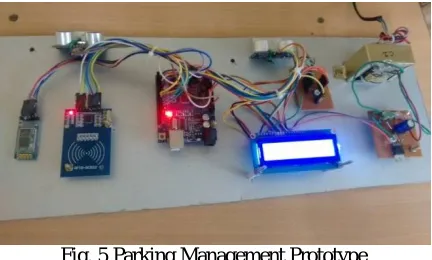
Identifying and parking the vehicles in the free space is more difficult now a day. It is happened due to increasing the number of vehicle in the urban areas. People cannot find the free space to park their vehicle without any interruption. To avoid this kind of inconvenient the proposed system is implemented using android application and arduino board. The parkers can register their details and park their vehicles easily without getting any inconvenient. It will avoid the parker’s time to circle the city to find the vacant space for parking. It will be implemented and explained below. The components used in the implementation phase are ULTRASONIC SENSOR, LCD DISPLAY, ARDUINO BOARD, and BLUETOOTH.
The proposed system consists of three modules
Registration of Vehicles
Vehicle Detection
Fig.1. Parking System architecture
ISSN(Online): 2320-9801
ISSN (Print): 2320-9798
I
nternational
J
ournal of
I
nnovative
R
esearch in
C
omputer
and
C
ommunication
E
ngineering
(An ISO 3297: 2007 Certified Organization)
Website: www.ijircce.com
Vol. 5, Issue 4, April 2017
Fig.2. HC-05 Bluetooth
Fig.2(a) Lane/Slot Occupation Status
II. Vehicle Detection
Fig.3. Ultrasonic Sensor
III. View and Reserve Parking Details.
Parkers can view their parking details using their mobile. Parkers can register their number and their details such as name, address, city, mobile number and their email address along with their vehicle number these details are saved in the server. In parking page the parkers can select their lane and their respective position.The LCD display is placed at the parking area if the vehicle is entered into the parking slot it will display the status that is car in and out status.
- Fig.4. LCD Display
III. RESULTS AND DISCUSSION
ISSN(Online): 2320-9801
ISSN (Print): 2320-9798
I
nternational
J
ournal of
I
nnovative
R
esearch in
C
omputer
and
C
ommunication
E
ngineering
(An ISO 3297: 2007 Certified Organization)
Website: www.ijircce.com
Vol. 5, Issue 4, April 2017
The parkers can connect their Bluetooth device with HC-05 Bluetooth device to register their details. The connectivity page can be depicted in fig. 7
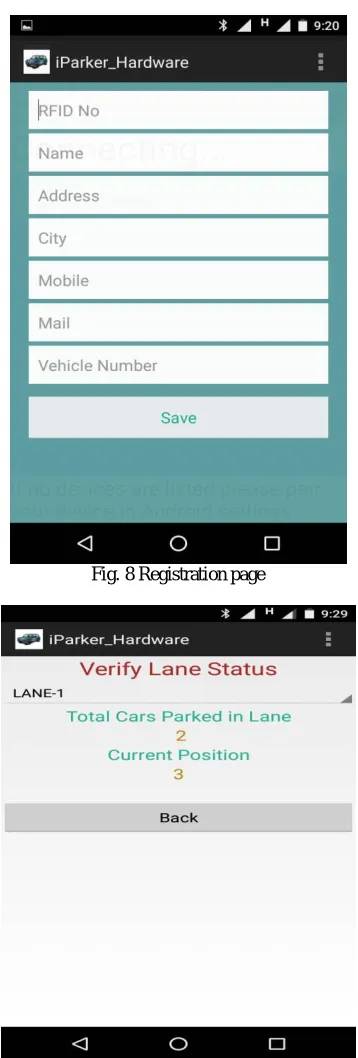
The registration page consists of the RFID no, name, address, mobile number, mail id, and vehicle number. Fig. 8 describes the registration page.
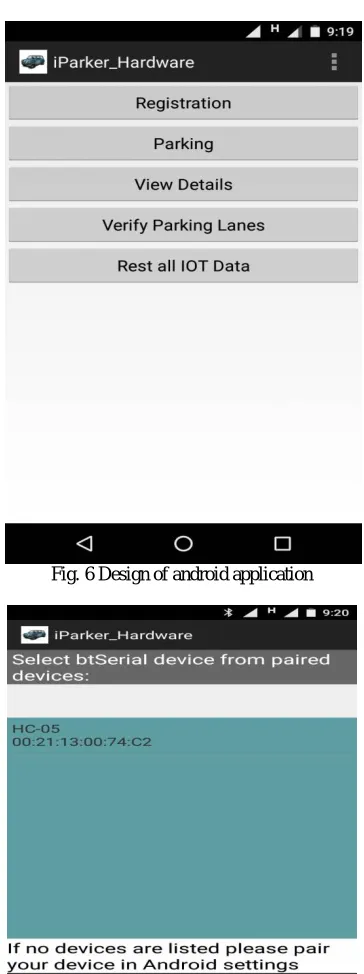
Fig. 6 Design of android application
ISSN(Online): 2320-9801
ISSN (Print): 2320-9798
I
nternational
J
ournal of
I
nnovative
R
esearch in
C
omputer
and
C
ommunication
E
ngineering
(An ISO 3297: 2007 Certified Organization)
Website: www.ijircce.com
Vol. 5, Issue 4, April 2017
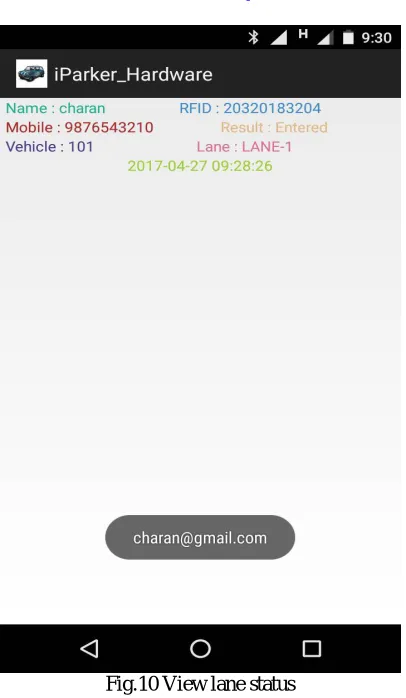
Fig.10 View lane status
Fig. 10 describes the lane status, when the vehicle is parked and the status of the vehicle whether it is entered state or exited state. It also displays the date and time.
IV. CONCLUSION
It can be inferred from the above results that the proposed system is accurate and more efficient in detecting the free space to park the vehicle. The proposed system is economically low cost, easy to use and the maintenance cost is less. The android based parking management system is easy to use and reduce the parker’s time to park the vehicle. The vacancy could be updated in the server based on the occupancy. This method reduces the pollution, traffic congestion and helps the drivers to save their time.
REFERENCES
[1] Albert Domingo, Boris Bellalta, Manuel Palacin, Miquel Oliver and Esteve Almirall, “Public Open Sensor Data: Revolutionizing Smart Cities”, IEEE Technology And Society Association, Vo.32, no.4, pp.50 – 56,S 2013.
[2] Antoine Bagula, Lorenzo Castelli and Marco Zennaro, “On the Design of Smart Parking Networks in the Smart Cities: An Optimal Sensor Placement Model”, Vol. 15, no.7, 2015 doi: 10.3390/s150715443. Online source:www.mdpi.com/journal/sensors edition, 1 July 2015. [3] Arshdeep Bahga and Vijay Madiseti, “Introduction to IoT” in “Interest of Things A Hands-on Approach”, Orient Blackswan Private Ltd, First [4] Basavaraju S R, “Automatic smart parking system using Internet of Things (IoT)”, International journal of scientific and research publications,
Volume 5, Issue 12, December 2015, 2250-3153.
[6] Digi.com, “XCTU:Next Generation Configuration Platform for XBee/RF Solutions”[Online]Available: http://www.digi.com/products/xbee-rfsoutions/xctu software/xctu[Accessed: 2-03-2016]
[7] Jae Kyu Suhr, Ho Gi Jung, “Sensor-Fusion based vacant parking slot detection and tracking”, IEEE transactions on intelligent transportation systems, vol. 15, no. 1,pp.21 – 36, 2014.
[8] Jun Xing, Qi Zeng, “A Model Based Vehicle Detection and Classification Using Magnetic Sensor Data”, M.S Thesis, Department of Signals and systems, Chalmers University of Technology, Goteberg, Sweden, Repor EX075/2007.
[9] Jung-Ho Moon, Tae Kwon Ha, “A car parking monitoring system using wireless sensor networks”, International journal of electrical, computer, energetic, electronic and communication engineering, Vol:7, No:10, 2013.
[10] Mala Aggarwal, Simmi Aggarwal, R.S.Uppal, “Comparative implementation of Automatic Car Parking System with least distance parking space in wireless sensor network”, International Journal of Scientific and Research Publications, Vol.2, no.10, pp. 2250-2254, 2012.
[11] Noor Hazrin Hany Mohamad Hanif, Mohd Hafiz Badiozaman, Hanita Daud, “Smart parking reservation system using Short Message Services (SMS)”.
[12] Sangwon Lee, Dukhee yoon, Amitabha Ghosh (2009), “Intelligent parking lot application using wireless sensor networks”.
[13] Satish V. Reve ,SonalChowdri (2012), “Management of car parking system using sensors”, International journal of Emerging Technology
and Advance Engineering volume 2, Issue 7.