• No results found

Application of Dislocation Dynamics to Assess Irradiation Effect on Materials with Different Grain Size

N/A
N/A
Protected

Academic year: 2020

Share "Application of Dislocation Dynamics to Assess Irradiation Effect on Materials with Different Grain Size"

Copied!
7
0
0

Loading.... (view fulltext now)

Full text

(1)

APPLICATION OF DISLOCATION DYNAMICS TO ASSESS IRRADIATION

EFFECT ON MATERIALS WITH DIFFERENT GRAIN SIZE

P.V.Durgaprasad

*

, B.K.Dutta, H.S.Kushwaha and S.Banerjee

Bhabha Atomic Research Centre, Trombay, Mumbai, INDIA-400085

*

E-mail: [email protected]

ABSTRACT

Irradiation of materials by energetic particles produces defect clusters like vacancies, self-interstitial atoms and

stacking fault tetrahedra. These defect clusters form loops around existing dislocations, leading to their decoration and

immobilization, which ultimately leads to radiation hardening in most of the materials. Effect of irradiation on material shear

yield strength is analyzed using two-dimensional poly-crystal dislocation dynamics (DD) modelling. The plastic flow in the

material is represented as collective behavior of a large number of edge dislocations distributed among many grains. The unit

cell is assumed to have grains of hexagonal shape with uniform size. Grain boundaries are considered to be impenetrable to

dislocations. The irradiation effects are modelled by taking all dislocations being locked by irradiation defects thus

characterizing the fluence. When the total stress on the dislocations exceeds a critical stress value, they get unlocked and

become free to move on their glide planes. Typical stress-strain curves for various critical values are obtained for irradiated

Aluminium with different grain sizes, which reveal the effect of dislocation loops on increased yield stress as a function of

both fluence and grain size. Critical locking stress is correlated to irradiation fluence by using single crystal yield stress

values of irradiated Aluminium from DD analysis and corresponding experimentally available yield stress values.

INTRODUCTION

Irradiation process is a complex phenomenon and the microstructure of irradiated materials evolves over a wide

range of length and time scales, making radiation damage inherently multi-scale phenomenon. The primary source of damage

in the irradiated material is the displacement cascades generated by the primary knock-on atom recoiled under the collision

with the energetic particle. These collisions produce atomic-scale defects like vacancies, self-interstitial atoms and

stacking-fault tetrahedra. Over macroscopic length scale, interaction of these defects with existing dislocations can completely alter

the microstructure causing significant degradation of mechanical and other properties. The main notable features of

irradiation-induced mechanical behavior are: an increased yield strength with irradiation dose, and an instability that results

in plastic flow localization within dislocation channels leading to loss of ductility and premature failure.

In this paper, we analyzed stress-strain behavior of irradiated poly-crystalline [1] material using two-dimensional

discrete DD modelling. The basic single crystal DD formulation of Giessen and Needleman [2] has been extended to

poly-crystalline materials as described by Biner and Morris [3]. The material is assumed to have hexagonal grains of constant size.

In each grain, a single slip system is considered. Grain boundaries are modelled as hard obstacles on the slip planes. The

irradiation induced hardening may be understood in terms of cascade induced source hardening in which the dislocations are

considered to be locked by the loops decorating them. The density and strength of these defect loops depend on the fluence

level. To mimic these irradiation effects, we assume that all the dislocations are locked by the defect loops thus characterizing

the fluence. Stress-strain behavior of irradiated Aluminium is obtained for various grain sizes as a function of critical locking

stress parameter. Finally, critical locking stress is correlated to fluence level using experimental yield stress values of

irradiated single crystal Aluminium. DD formulation for irradiated poly-crystalline material and some numerical results are

presented in next sections. From the results, it can be found that this 2D-DD analysis is very useful to assess irradiation

effects on materials with different grain sizes.

TWO-DIMENSIOANL DD MODELLING OF POLY-CRYSTALLINE MATERIAL

Single crystal DD formulation of Giessen and Needleman [2] has been extended to poly crystalline materials as

described by Biner and Morris [3]. In this model, the plastic flow is represented by collective motion of a large number of

edge dislocations distributed among many grains. The dislocations are treated as line defects in the elastic continuum. Each

dislocation is characterized by its Burger’s vector bi and its slip plane. The body is subjected to time dependent traction and

displacement boundary conditions T=T

o

(t) on S

f

and u=u

o

(t) on S

u

. The deformation process will lead to the motion of

(2)

involves three main computational stages: (i) determining the current stress and strain state of for the current dislocation

arrangement; (ii) determination of the so-called Peach-Koehler force, i.e., the driving force for changes in dislocation

structure; and (iii) determination of the instantaneous rate of change of dislocation structure on the basis of a set of

constitutive equations of motion, annihilation and generation of dislocations. All the three stages of computation are briefly

described below.

The current state of body in terms of the displacement, strain and stress fields is written as the superposition of two

fields [2],

ˆ

ˆ

ˆ

u u u

= +

ε ε ε σ σ σ

= +

= +

in V

(1)

respectively. The dislocation (~) fields associated with the n dislocations in the current configuration but in infinitely large

medium of material. These fields are obtained by superposition of the fields associated with each individual dislocation,

1

1

1

.

n

n

n

i

i

i

i

i

i

u

u

ε

ε

σ

σ

=

=

=

=

=

=

The corresponding displacement (

u

) and stress (

σ

) fields of a dislocation

i

are given by Giessen and Needleman [2].

Doubly periodic boundary conditions are assumed for the unit cell. Dislocations leaving the cell at

x

1

= ±

w

will re-enter at

the opposite side

x

1

=

w

. As the solution for (~) fields is facilitated by virtue of absence of boundaries, the (^) fields are

added to correct the actual boundary conditions on S. This leads to a linear elastic complementary boundary value problem,

the governing equations of which are given by,

ˆ

.

0

ˆ

u

ˆ

in V

σ

ε

=

=

∇ ⎭

ˆ

. ' .

ˆ

o

f

o

u

T

T

T on S

b c s

u u

u on S

=

=

⎪⎭

Fig.1: Schematic model of a unit cell for DD analysis of poly-crystalline material

Solution to this complementary boundary value problem is obtained using finite element method. The motion of the

dislocations is governed by constitutive equations according to linear drag relation given by,

i i

b

Bv

i

τ

=

(2)

where,

τ

i i

b

=

Bv

i

is the Peach-Koeheler force,

B

is the drag coefficient and

v

is the velocity of a dislocation. The result of the

above formulation is a set of non-linear first order differential equations governing the motion of the dislocations, which are

solved using Euler forward time integration method.

The motion of dislocations along a slip plane can be hindered in real crystals by obstacles such as dislocations on

intersecting slip planes, small precipitates etc. We model this by means of point obstacles at which moving dislocations get

d

(3)

pinned down. Such pinned dislocations will be released when the resolved shear strength on them exceeds the obstacle’s

strength (

τ

obs

). Two edge dislocations with opposite Burger’s vector will annihilate each other when they come closer to each

other within a critical annihilation distance L

e

. New dislocations are being generated through the operation of Frank-Read

sources. We assume that sources are point sources on the slip plane, which generate a dislocation dipole when the magnitude

of the shear stress exceeds the critical stress (

τ

nuc

) during a period of time t

nuc

.

STRESS-STRAIN RESPONSE OF IRRADIATED POLY CRYSTALLINE MATERIAL UNDER SIMPLE SHEAR

Using DD formulation of poly-crystalline material described above, we analyzed stress-strain behavior of irradiated

Aluminium for various grain sizes ‘d’ as a function of fluence. Plastic deformation and hardening in irradiated materials is

controlled primarily by the defects due to irradiation (vacancies, self-interstitial atoms and SFT’s) and their interaction with

dislocations. These defect clusters will tend to form loops around existing dislocations, leading to their decoration and

immobilization [4,5]. The density and strength of these defect loops depend on the fluence level. To mimic these irradiation

effects, we assume that all the dislocations are locked by the defect loops thus characterizing the fluence. When the total

stress on the dislocations exceeds a critical value

σ

cr

, they get unlocked and become free to move on their glide planes. The

motion of the dislocations is governed by Eq.(2). During gliding, any dislocation may get pinned down by the point obstacles

within a grain or they may get pinned down at a grain-boundary. Opposite dislocations may get annihilated when they come

closer to each other. New dislocations will be generated by Frank-Read mechanism, which is mimicked here by point

sources. These sources will nucleate a dislocation dipole when stress on a source exceeds a critical value. The effect of

irradiation on stress-strain behavior is then obtained for various grain sizes of ‘d’ ranging from 0.2 to 2.5

μ

m as a function of

critical locking stress parameter.

The simulated Aluminium cell is assumed to be of dimensions 2w × 2h, with 2w =2h= 10

μ

m. The shear modulus,

G

=70 GPa and the Poisson’s ratio is

ν

= 0.3. The drag coefficient B in Eq. (2) is taken as 10

-4

Pa.s. We assume that the

material consists of ray distributed defect structure, such as point obstacles, Frank-read dislocation nucleation sources. The

material is assumed to have an initial dislocation density of

ρ

disinit

= 15

μ

m

-2

, which is then relaxed. During relaxation, the

dislocations will interact with each other and try to attain equilibrium position. In the relaxed configuration, obstacles and

nucleation sources are randomly generated. All the obstacles are assumed to have same strength

τ

obs

=5.7×10

-3

G

. The strength

of sources is selected randomly from a Gaussian distribution with a mean strength of

τ

nuc

=1.9×10

-3

G

corresponding to a

mean nucleation distance of L

nuc

= 125

b

and the nucleation time is taken as t

nuc

=2.6×10⁶ B/

G

. The strength distribution is

assumed to have a standard deviation of 0.2

τ

nuc

. The critical annihilation length is taken as L

e

=6

b

. The unit cell is subjected

to simple shear along top and bottom edges in time incremental manner, with a strain rate of

Γ

:

1

2

2

( )

along

.

( )

0

u t

h t

x

h

u t

= ±

Γ

= ±

=

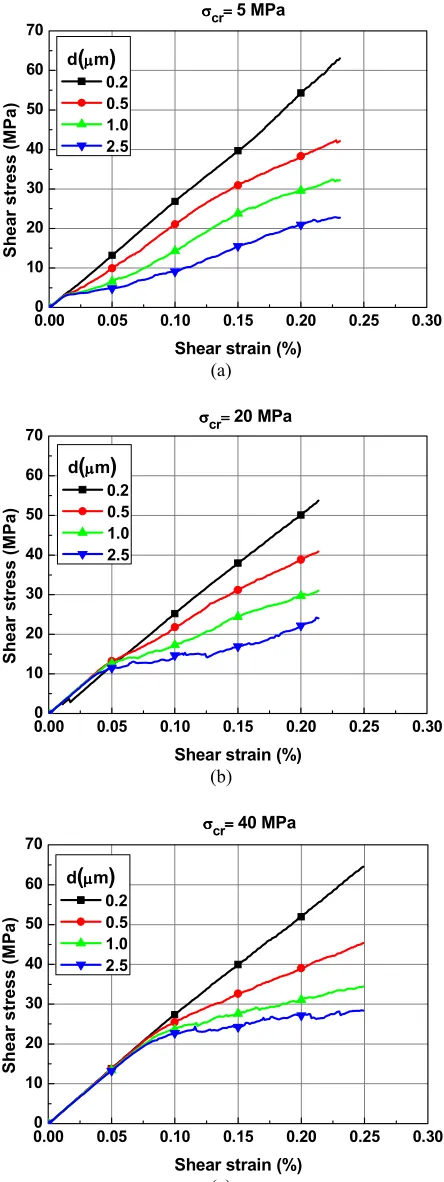
Typical predicted stress-strain responses of irradiated Aluminium for different grain sizes are shown in Fig.2 as a

function of critical locking stress parameter

σ

cr

, which reveal the effect of dislocation loops on increased yield stress. In

Fig.3, snapshots of dislocation configurations at different shear strains are shown for grain size, d=1

μ

m and

σ

cr

= 40 MPa.

From Fig. 2, it can be observed that for each

σ

cr

, the yield stress

σ

y

and hardening increases as the grain size

d

is reduced

which can be understood as the combined effect of both fluence and grain size. The increase in

σ

cr

can be regarded here as

increase in irradiation fluence. For

σ

cr

=5 MPa, when d is decreased from 2.5

μ

m to 0.5

μ

m,

σ

y

increases from 2.5 MPa to 5

MPa. Similarly, for

σ

cr

=20 MPa,

σ

y

increases from 2.5 MPa to 5 MPa and for

σ

cr

=40 MPa,

σ

y

increases from about 20 MPa

to 25 MPa. This can be understood as, when the grain size reduces, the motion of dislocations is hindered at the grain

boundaries and there is increase in the yield stress. Further for smallest grain size considered, d=0.2 m, stress-strain behavior

is almost linear indicating that all the dislocations are getting locked near the grain boundaries irrespective of critical stress

parameter

σ

cr

.

When irradiation induced-defects are present, the yield point rises drastically which can be attributed to the locking

of dislocations by these defects. This can be understood as, with increase in fluence, the density and strength of the defect

loops that lock the dislocations increases. For example, with d=1

μ

m, by increasing

σ

cr

from 5 MPa to 40 MPa,

σ

y

increases

from 3 MPa to 23 MPa. Again, for each grain size, with increase in the shear strain, the dislocations get locked at point

obstacles within the grain and also at the grain boundaries. The pile-up of dislocations near the grain boundaries can be seen

clearly in Fig. 3, at shear strain of 0.15 % and above. This explains the hardening effect after yielding begins. For all values

of

σ

cr

considered, when shear strain is above 0.1%, the dislocation densities start increasing rapidly, because, existing

dislocations get piled up near the grain boundaries and with any increase in the shear stress, the Frank-Read sources start

generating new dislocation dipoles.

(4)

0.00

0

0.05

0.10

0.15

0.20

0.25

0.30

10

20

30

40

50

60

70

Sh

ea

r s

tre

ss

(MPa)

Shear strain (%)

d

(

μμμμ

m

)

0.2

0.5

1.0

2.5

σ

σσ

σ

cr

=

=

=

=

5 MPa

(a)

0.00

0.05

0.10

0.15

0.20

0.25

0.30

0

10

20

30

40

50

60

70

σ

σσ

σ

cr

=

=

=

=

20 MPa

d

(

μμμμ

m

)

0.2

0.5

1.0

2.5

S

h

ea

r s

tre

ss

(MPa)

Shear strain (%)

(b)

0.00

0

0.05

0.10

0.15

0.20

0.25

0.30

10

20

30

40

50

60

70

σ

σσ

σ

cr

=

=

=

=

40 MPa

d

(

μμμμ

m

)

0.2

0.5

1.0

2.5

S

h

ear

str

ess

(M

P

a)

Shear strain (%)

(c)

Fig. 2: Stress-strain behavior for irradiated Al for various grain sizes as function of critical locking stress

σ

cr

.

Figure

Fig. 2: Stress-strain behavior for irradiated Al for various grain sizes as function of critical locking stress  σcr
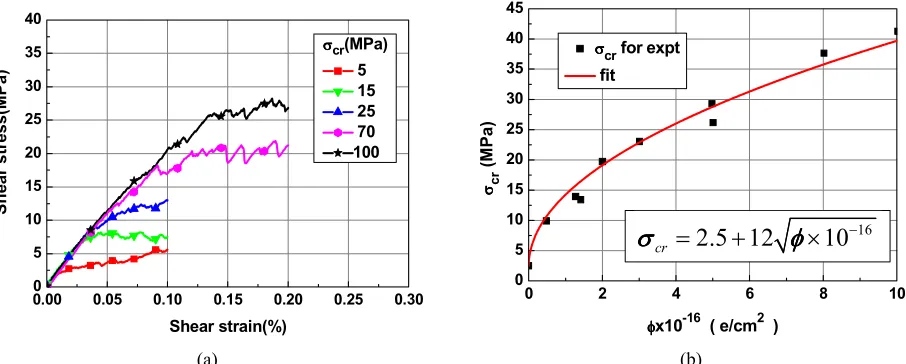
Fig. 4: (a) Stress-strain response of irradiated Aluminium single crystal as a function of critical locking stress σvariation of critical locking stress cr; (b) σcr as a function of fluence φ

References

Related documents

Acute Hospitals, Chronic Disease and Rehabilitation Inpatient and Outpatient Hospitals, Substance Use Disorder Treatment Hospitals, Psychiatric Inpatient Hospitals, Home

In a large multicenter, randomized, controlled trial conducted in the United Kingdom (the Trial of Outcomes for Child and Adolescent Anorexia Nervosa, or TOuCAN study), Gowers

Coaches: Any breach of the following regulations or any deliberate violations of the rules of the events shall be considered unethical conduct, and Executive Council action

1 The introduction of a fully integrated intervention model for occupational back pain can be shown to be not only cost beneficial for the workers’ compensation boards and

Thus, the effect of NAC supplementation on the cryopreservation outcome of post- thawed bone marrow-derived HSPCs was evaluated based on the cell viability, oxidative stress

of rooibos tea to rats receiving combination antiretroviral therapy (cART), may reduce the effects of ADRs at a tissue level.. This study makes use of histomorphometry and

Mobile Devices: Retrieve image I Web Mapping Service Web Feature Service Portrayal Service Web Mapping Service Aggregate Service Address Matching Service centered at desired