Authenticated Encryption: Relations among notions
and analysis of the generic composition paradigm
Mihir Bellare∗ Chanathip Namprempre†
July 14, 2007
Abstract
An authenticated encryption scheme is a symmetric encryption scheme whose goal is to provide both privacy and integrity. We consider two possible notions of authenticity for such schemes, namely integrity of plaintexts and integrity of ciphertexts, and relate them (when coupled with IND-CPA) to the standard notions of privacy (IND-CCA,NM-CPA) by presenting implications and separations between all notions considered. We then analyze the security of authenticated encryption schemes designed by “generic composition,” meaning making black-box use of a given symmetric encryption scheme and a given MAC. Three composition methods are considered, namely Encrypt-and-MAC, MAC-then-encrypt, and Encrypt-then-MAC. For each of these, and for each notion of security, we indicate whether or not the resulting scheme meets the notion in question assuming the given symmetric encryption scheme is secure against chosen-plaintext attack and the given MAC is unforgeable under chosen-message attack. We provide proofs for the cases where the answer is “yes” and counter-examples for the cases where the answer is “no.”
Keywords: Symmetric encryption, message authentication, authenticated encryption, concrete security.
∗Dept. of Computer Science & Engineering, University of California, San Diego, 9500 Gilman Drive, La Jolla,
California 92093, USA. E-Mail: [email protected]. URL:http://www-cse.ucsd.edu/users/mihir. Supported in part by a 1996 Packard Foundation Fellowship in Science and Engineering, NSF CAREER Award CCR-9624439, NSF grants CNS-0524765 and CNS-0627779, and a gift from Intel Corporation.
†Electrical Engineering, Faculty of Engineering, Thammasat University, Klong Luang, Patumtani 12121,
Contents
1 Introduction 3
1.1 Relations among notions . . . 3
1.2 Analysis of generic composition . . . 4
1.3 Prior related work . . . 6
1.4 Subsequent related work . . . 7
2 Definitions 7 3 Relations among notions of symmetric encryption 11 4 Security of the Composite Schemes 14 4.1 Encrypt-and-MAC (E&M) . . . 15
4.2 MAC-then-Encrypt (MtE) . . . 17
1
Introduction
We use the term authenticated encryption scheme to refer to a shared-key based transform whose goal is to provide both privacy and authenticity of the encapsulated data. In such a scheme the encryption process applied by the sender takes the key and a plaintext to return a ciphertext, while thedecryption process applied by the receiver takes the same key and a ciphertext to return either a plaintext or a special symbol indicating that it considers the ciphertext invalid or not authentic. The design of such schemes has attracted a lot of attention historically. Many early schemes, based on adding “redundancy” to the message before CBC encrypting, were broken. Today au-thenticated encryption schemes continue to be the target of design and standardization efforts. A popular modern design paradigm is “generic composition,” where a privacy-only symmetric encryp-tion scheme (for example a block cipher mode of operaencryp-tion like CBC) is combined with a message authentication (MA) scheme (for example HMAC [4] or CBC-MAC).
The goal of symmetric encryption is usually viewed as privacy, but an authenticated encryp-tion scheme is simply a symmetric encrypencryp-tion scheme meeting addiencryp-tional authenticity goals. The first part of this paper formalizes several different possible notions of authenticity for symmetric encryption schemes, and integrates them into the existing mosaic of notions by relating them to the main known notions of privacy for symmetric encryption, via implications and separations in the style of [6]. The second part of this paper analyzes several generic composition methods with regard to meeting the previous notions. Let us now look at these items in more detail.
1.1 Relations among notions
Privacy goals for symmetric encryption schemes include indistinguishability and non-malleability, each of which can be considered under either chosen-plaintext or (adaptive) chosen-ciphertext attack, leading to four notions of security we abbreviate IND-CPA, IND-CCA, NM-CPA, NM-CCA. (The original definitions were in the asymmetric setting [26, 25, 42, 21] but can be “lifted” to the symmetric setting using the encryption oracle based template of [5]). The relations among these notions are well-understood [6, 21, 33].
We consider two notions of integrity (we use the terms authenticity and integrity interchange-ably) for symmetric encryption schemes. INT-PTXT (integrity of plaintexts) requires that it be computationally infeasible to produce a ciphertext decrypting to a message which the sender had never encrypted, while INT-CTXT (integrity of ciphertexts) requires that it be computationally infeasible to produce a ciphertext not previously produced by the sender, regardless of whether or not the underlying plaintext is “new.” (In both cases, the adversary is allowed a chosen-message attack.) The first of these notions is the more natural security requirement while the interest of the second, stronger notion is perhaps more in the implications we discuss below.
These notions of authenticity are by themselves quite disjoint from the notions of privacy; for example, sending the message in the clear with an accompanying (strong) MAC achieves INT-CTXT but no kind of privacy. To make for useful comparisons, we consider each notion of authenticity coupled with IND-CPA, the weakest notion of privacy; namely the notions on which we focus for comparison purposes are INT-PTXT∧IND-CPA and INT-CTXT∧IND-CPA. (Read “∧” as “and”.)
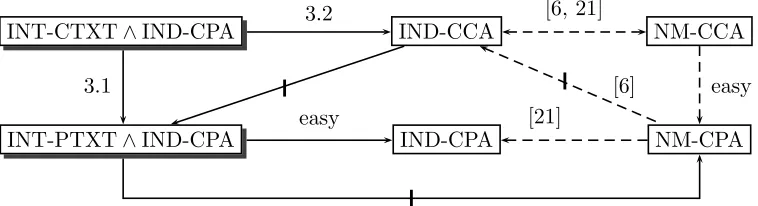
INT-CTXT∧IND-CPA IND-CCA NM-CCA
INT-PTXT∧IND-CPA IND-CPA NM-CPA
3.2 [6, 21]
3.1
easy [21]
easy [6]
Figure 1: Relations among notions of symmetric encryption: An arrow denotes an implica-tion while a barred arrow denotes a separaimplica-tion. The full arrows are relaimplica-tions proved in this paper. Positive results are annotated with the number of the corresponding Theorem. Separation results are derived in Section 3. Dotted arrows are reminders of existing relations, annotated with citations to the papers establishing them.
of relations is explicitly indicated; the relation between any two notions can be derived from the shown ones. (For example, IND-CCA does not imply INT-CTXT∧IND-CPA because otherwise, by following arrows, we would get IND-CCA → INT-PTXT∧IND-CPA contradicting a stated separation.) The dotted lines are reminders of existing relations.
A few points may be worth highlighting. Integrity of ciphertexts —even when coupled only with the weak privacy requirement IND-CPA— emerges as the most powerful notion. Not only does it imply security against chosen-ciphertext attack, but it is strictly stronger than this notion. Non-malleability —whether under chosen-plaintext or chosen-ciphertext attack— does not imply any type of integrity. The intuitive reason is that non-malleability only prevents the generation of ciphertexts whose plaintexts are meaningfully related to those of some challenge ciphertexts, while integrity requires it to be hard to generate ciphertexts of new plaintexts even if these are unrelated to plaintexts underlying any existing ciphertexts. Finally, integrity of plaintexts does not imply integrity of ciphertexts.
1.2 Analysis of generic composition
There are many possible ways to design authenticated encryption schemes. We focus in this paper on “generic composition:” simply combine a standard symmetric encryption scheme with an MA scheme in some way. There are a few possible ways to do it, and our goal is to analyze and compare their security. The motivation, as we will argue, is that these “obvious” methods, as often the case in practice, remain the most pragmatic from the point of view of performance and security architecture design.
Generic composition. Assume we are given a symmetric encryption schemeSEwhose encryption and decryption algorithms we denote byEandD, respectively. (Typically this will be a block cipher mode of operation such as CBC or CTR.) Also assume we are given a message authentication scheme
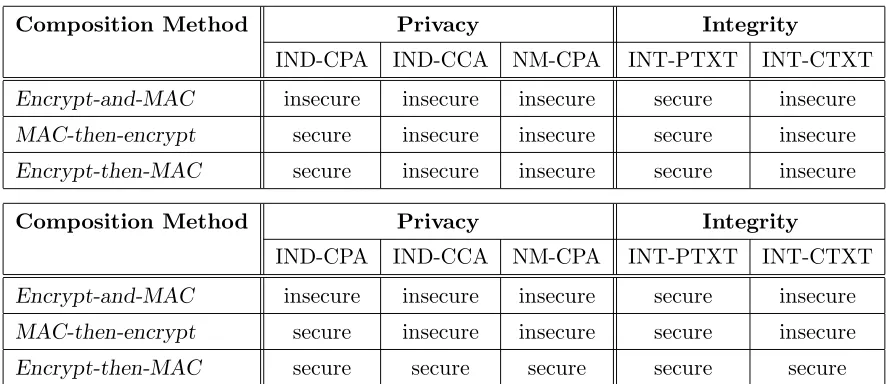
Composition Method Privacy Integrity
IND-CPA IND-CCA NM-CPA INT-PTXT INT-CTXT
Encrypt-and-MAC insecure insecure insecure secure insecure
MAC-then-encrypt secure insecure insecure secure insecure
Encrypt-then-MAC secure insecure insecure secure insecure
Composition Method Privacy Integrity
IND-CPA IND-CCA NM-CPA INT-PTXT INT-CTXT
Encrypt-and-MAC insecure insecure insecure secure insecure
MAC-then-encrypt secure insecure insecure secure insecure
Encrypt-then-MAC secure secure secure secure secure
Figure 2: Summary of security results for the composite authenticated encryption schemes. The given encryption scheme is assumed to be IND-CPA for both tables while the given MAC is assumed to be weakly unforgeable for the top table and strongly unforgeable for the bottom table.
the given encryption and MA schemes to create an authenticated encryption scheme meeting either INT-CTXT∧IND-CPA or INT-PTXT∧IND-CPA. Below are the composition methods we consider. We call them “generic” because the algorithms of the authenticated encryption scheme appeal to the given ones as black-boxes only. In each case Ke is a key for encryption and Km is a key for message authentication. We stress that these keys are independently chosen.
— Encrypt-and-MAC (E&M):E(KekKm, M) =E(Ke, M)kT(Km, M).1 Namely, encrypt the plain-text and append a MAC of the plainplain-text. “Decrypt+verify” is performed by first decrypting to get the plaintext and then verifying the tag. The Transport Layer of SSH uses a variant of this method [48].
— MAC-then-encrypt (MtE): E(KekKm, M) =E(Ke, MkT(Km, M)). Namely, append a MAC to the plaintext and then encrypt them together. “Decrypt+verify” is performed by first decrypting to get the plaintext and candidate tag, and then verifying the tag. SSL uses a variant of this method [23].
— Encrypt-then-MAC (EtM): E(KekKm, M) = CkT(Km, C) where C = E(Ke, M). Namely, encrypt the plaintext to get a ciphertext C and append a MAC of C. “Decrypt+verify” is performed by first verifying the tag and then decrypting C. IPSEC uses a variant of this method [35].
HereEis the encryption algorithm of the authenticated encryption scheme while the “decrypt+verify” process specifies a decryption algorithm D. The latter will either return a plaintext or a special symbol indicating that it considers the ciphertext not authentic.
Security results. Figure 2 summarizes the security results for the three composite authenticated encryption schemes. (We omit NM-CCA since it is equivalent to IND-CCA). The top table of the figure shows the results assuming that the base MAC is weakly unforgeable (WUF-CMA) while
1
the bottom table shows the results assuming that the MAC is strongly unforgeable (SUF-CMA). WUF-CMA is the standard notion [7]— it should be computationally infeasible for the adversary to find a message-tag pair in which the message is “new,” even after a chosen-message attack. SUF-CMA requires that it be computationally infeasible for the adversary to find a new message-tag pair even after a chosen-message attack. (The message does not have to be new as long as the output tag was not previously attached to this message by the legitimate parties.) This notion seems to have first appeared in [19], albeit in the asymmetric setting. We note that any pseudorandom function is a strongly unforgeable MAC, and most practical MACs seem to be strongly unforgeable. Therefore, analyzing the composition methods under this notion is a realistic and useful approach. Entries in the above tables have the following meaning:
— Secure: The composite encryption scheme in question is proven to meet the security requirement in question, assuming only that the base encryption scheme is IND-CPA secure and the base MA scheme is (weakly or strongly, as the case may be) unforgeable under chosen-message attack.
— Insecure: There exists some IND-CPA secure symmetric encryption and some (WUF-CMA or
SUF-CMA) MA scheme such that the composite scheme based on them does not meet the security requirement in question.
In Section 4, we justify the above claims.
Why generic composition? The use of a generic composition method is advantageous from the point of view both of performance and of security architecture. The performance benefit arises from the presence of fast MACs such as HMAC [4] and UMAC [15]. The architectural benefits arise from the stringent notion of security being used. To be secure, the composition must be secure for all possible secure instantiations of its constituent primitives. (If it is secure for some instantiations but not others, we declare it insecure.) An application can thus choose a symmetric encryption scheme and a message authentication scheme independently (these are usually already supported by existing security analyses) and then appeal to some fixed and standard composition technique to combine them. No tailored security analysis of the composed scheme is required.
Interpreting our results. As we can see from the bottom table of Figure 2, EtM is secure from all points of view, making it a good choice for a standard. However, if INT-PTXT∧IND-CPA suffices, then MtE is appropriate too.
We stress that our results are about what happens in general. For example, to say that E&M is IND-CPA insecure means that the composition is insecure forsome choices of base schemes, not all. There could exist specific choices of base schemes whose E&M composition is in fact IND-CPA secure.
Quantitative results and comparisons. Above we have discussed our results at a qualitative level. Each result also has a quantitative counterpart; these are what our theorems actually state and prove. These “concrete security” analyses enable a designer to estimate the security of the authenticated encryption scheme in terms of that of its components. All the reductions in this paper are tight, meaning there is little to no loss of security.
1.3 Prior related work
Three additional notions of privacy are considered and related to these six by [33]. In this paper, we have for simplicity avoided consideration of all the possible notions of privacy, focusing instead on what we consider the (four) main ones and their relations to the notions of authenticity.
Authenticity of an encryption scheme has been understood as a goal by designers for many years. The INT-CTXT notion seems to have first appeared in [11, 34]. (These two works are concurrent and independent.) Katz and Yung [34] consider two other notions of authenticity not considered here. They also observe the implication INT-CTXT∧IND-CPA → IND-CCA and present an authenticated encryption scheme called RPC. Signcryption [49] is an asymmetric analog of authenticated encryption.
1.4 Subsequent related work
A preliminary version of our paper appeared in 2000 [9]. Subsequent to this, there has been a lot of work on authenticated encryption. We summarize some of it below.
Extensions. Rogaway [43] introduces an extension of the notion of authenticated encryption called authenticated encryption with associated data (AEAD). Here the data has two fields, a header and a plaintext. Integrity is required for the whole, but privacy only for the plaintext. Rogaway and Shrimpton [45] explore the problem of cryptographic key transport, referred to as the key wrap problem, and introduce a notion of deterministic authenticated encryption, which they prove to be equivalent to key wrapping.
Generic composition. Canetti and Krawczyk [18] show that EtM implements a “secure channel,” and Krawczyk [37] shows that E&M and MtE in general do not. Krawczyk [37], however, finds some particular instantiations of MtE that do implement secure channels. An, Dodis, and Rabin [2] analyze generic-composition-based signcryption.
Other general approaches. An and Bellare [1] analyze the “encryption with redundency” paradigm in which one attempts to get an authenticated encryption scheme by adding some redun-dancy to the plaintext before encrypting. Bellare and Rogaway [11] introduce the “encode-then-encipher” paradigm where an authenticated encryption scheme is obtained by adding randomness and redundancy to the plaintext and then enciphering (rather than encrypting).
E&M in SSH. Our results about E&M might make one pessimistic about the security of SSH, which as we said above, is E&M-based. However, SSH in fact uses a variant of E&M, and a direct analysis provided by [8] shows that this variant is in fact secure in most ways. This work also extends ours to allow stateful verification and considers notions of security that require protection against replay attacks.
Dedicated schemes. Dedicated schemes are ones that attempt to directly achieve IND-CPA∧
INT-CTXT. These include IACBC [32, 28, 29], OCB [44], XCBC [24], CCM [47], Helix [22], GCM [39], CWC [36] and EAX [13]. Some of these are more efficient than schemes obtained by generic composition, having effectively the same cost as privacy-only schemes.
IND-CCA. Authenticated encryption is not the only approach to achieving IND-CCA. Direct approaches yielding more compact schemes have been provided by Desai [20].
2
Definitions
x1, x2, . . ., and let y denote the output obtained. By a1k. . .kan, we denote a string encoding of
a1, . . . , an from which the latter are uniquely recoverable.
Games. Our definitions and proofs will be in the code-based game-playing style of [12]. We recall some background here. A game —look at Figure 7 for an example— has an Initialize procedure, procedures to respond to adversary oracle queries, and a Finalize procedure. A game G is executed with an adversary A as follows. First, Initialize executes and its outputs are the inputs to A. Then A executes, its oracle queries being answered by the corresponding procedures of G. When A terminates, its output becomes the input to the Finalize procedure. The output of the latter, denoted GA, is called the output of the game, and we let “GA⇒y” denote the event that this game output takes valuey. Boolean flags are assumed initialized to false. Games Gi,Gj areidentical until badif their code differs only in statements that follow the setting ofbad totrue. For example, games G0,G1 of Figure 7 are identical until bad. The following is the Fundamental Lemma of game-playing of [12].
Lemma 2.1 [12] Let Gi,Gj be identical until badgames, and Aan adversary. Then for any y Pr[ GAi ⇒y]−Pr[ GAj ⇒y] ≤ Pr[ Gj setsbad].
Concrete security. A security notion is captured by defining a game and a related advantage for an adversary. The understanding is that “secure” means the advantage is “small” for any adversary of “practical” resources. Resources mean running time and number of oracle queries. By convention, running time is that of the execution of the adversary with the game, meaning includes the time used by the game procedures in this execution. It also includes the size of the adversary description (code), all this in some fixed RAM computation model.
This means “secure” has no formal definition. One can provide one by introducing a security parameter and lifting all definitions to an asymptotic setting, but practical symmetric primitives (e.g. block ciphers, cryptographic hash functions) have no security parameter and so we have preferred to use the concrete setting. Theorems underlying positive results (an implication or a claim that a scheme meets a notion of security under some assumption) are in the concrete style, showing how the advantage and resources of constructed adversaries relate to the original one. Negative results (separations or claims that a composition method fails to preserve a security property) are done less formally. We present the counter-example scheme, which is usually derived from a given underlying scheme, provide the attack, and then state the concrete security result showing that the counter-example scheme retains relevant security attributes of the underlying scheme.
Syntax of symmetric encryption schemes. A symmetric encryption scheme SE = (K,E, D) consists of three algorithms. The randomized key generation algorithm K takes no input and returns a key K. The encryption algorithm E could be randomized or stateful. It takes the key K and a plaintext M to return a ciphertext C. (If randomized, it flips coins anew on each invocation. If stateful, it uses and then updates a state that is maintained across invocations.) The decryption algorithm Dis deterministic and stateless. It takes the keyK and a stringC to return either the corresponding plaintext or the symbol ⊥; we write M ← D(K, C). We require that
D(K,E(K, M)) =M with probability one for all M, where the probability is over the choice ofK and the coins of E. An authenticated encryption scheme is syntactically identical to an encryption scheme as defined above; we will use the term only to emphasize cases where we are targeting authenticity goals.
proc Initialize K ← K$ ; b← {$ 0,1}
proc LR(M0, M1)
C← E$ (K, Mb) ; Return C proc Finalize(d)
Return (d=b)
proc Initialize
K ← K$ ; b← {$ 0,1}; S ← ∅
proc LR(M0, M1)
C ← E$ (K, Mb) ; S←S∪ {C}; ReturnC proc Dec(C)
If C6∈S thenM ← D(K, C) else M ← ⊥
Return M
proc Finalize(d) Return (d=b)
Figure 3: Game IND-CPASE (left) and Game IND-CCASE (right) where SE= (K,E,D).
proc Initialize
K ← K$ ; b← {$ 0,1}; S← ∅
proc LR(M0, M1) Ifpdec thenC← ⊥
Else C← E$ (K, Mb) ; S ←S∪ {C} Return C
proc Enc(M)
C← E$ (K, M) ; ReturnC
proc Dec∗(C∗)
pdec←true
Fori= 1 to |C∗|do
If C∗[i]∈S thenM∗[i]← ⊥else M∗[i]← D(K, C∗[i]) Return M∗
proc Finalize(d) Return (d=b)
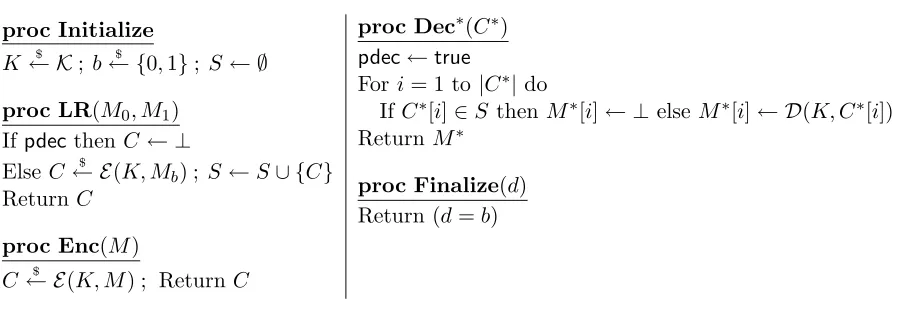
Figure 4: Game NM-CPASE whereSE = (K,E,D).
IND-CPASE of Figure 3 picks a random key K and challenge bit b. The adversary A can then query the LR oracle with any pair M0, M1 of messages of equal length, and the oracle returns an encryption ofMb. (The adversary may query this oracle multiple times, and each encryption uses fresh coins. If encryption is stateful, the state is maintained by the game.) The game returns true if the adversary’s outputdequals the challenge bit b, and falseotherwise. Let
AdvindSE-cpa(A) = 2·Pr[ IND-CPAASE ⇒1 ]−1.
Game IND-CCASE additionally provides the adversary with oracle Dec, and augments LR to do some bookkeeping. Let
AdvindSE-cca(A) = 2·Pr[ IND-CCAASE ⇒1 ]−1. (1) A convention, used throughout this paper, is that the length of a query M0, M1 to a left-or-right encryption oracle is defined as |M0|. (This equals |M1| since the messages must have the same length.) This convention is used in measuring the total length of the queries submitted by the adversary. IND-CPA secure symmetric encryption schemes include the CBC and CTR modes of operation [5].
proc Initialize K ← K$ ; S← ∅
proc Enc(M)
C← E$ (K, M) ; S←S∪ {M}; ReturnC proc VF(C)
M ← D(K, C)
IfM 6=⊥and M 6∈S thenwin←true Return (M 6=⊥)
proc Finalize Return win
proc Initialize K ← K$ ; S← ∅
proc Enc(M)
C ← E$ (K, M) ; S←S∪ {C}; Return C proc VF(C)
M ← D(K, C)
IfM 6=⊥and C6∈S then win←true Return (M 6=⊥)
proc Finalize Return win
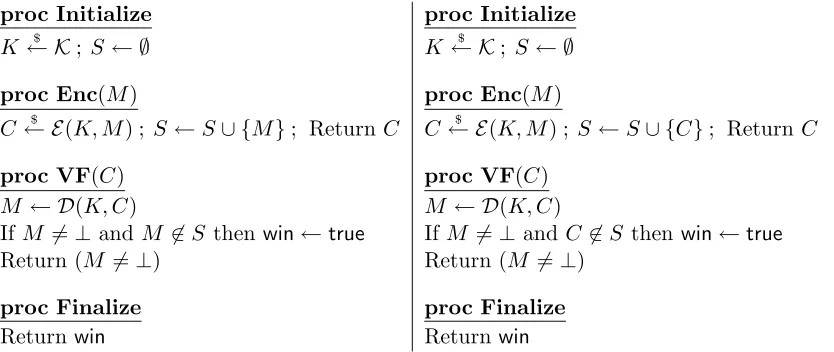
Figure 5: Game INT-PTXTSE (left) and Game INT-CTXTSE (right) where SE= (K,E,D).
[14], adapted to the symmetric setting. This facilitates our proofs and analyses and also facilitates concrete security measurements. Game NM-CPASE provides the adversary with the usual LR oracle to which it can query any pair of equal-length messages. It also provides a parallel decryption oracle Dec∗ to which the adversary is allowed only one query, this to consist of a vector C∗ of ciphertexts. The oracle returns the corresponding plaintext vector. Here and later, the notation
|X∗|denotes the number of components of a vectorX∗ andX∗[i] denotes thei-th component ofX∗. Via the flag pdec, the game takes away access toLR onceA has made its Dec∗ query. However, it continues to have access to the plain encryption oracleEnc. For any adversary A, we let
AdvnmSE-cpa(A) = 2·Pr[ NM-CPAASE⇒1 ]−1.
We do not explicitly define NM-CCA because we do not use it barring its appearance in Figure 1, and the latter only summarizes known relations about this notion. Briefly, the game additionally provides the adversary with a standard decryption oracle and enforces the usual rule, namely that this oracle returns ⊥if queried with a value previously returned byLR.
Integrity. We specify the notions for integrity (authenticity) of a symmetric encryption scheme using the games of Figure 5. Adversary A wins in the INT-PTXTSE game if it submits to VF a ciphertext C whose decryption is a message M 6= ⊥ not previously queried to Enc. It wins the INT-CTXTSE game if it submits to VFa ciphertext C not previously returned by Enc. For any adversaryA, we let
AdvintSE-ptxt(A) = Pr[ INT-PTXTASE ⇒1 ] and AdvintSE-ctxt(A) = Pr[ INT-CTXTASE⇒1 ].
proc Initialize K ← K$ ; S← ∅
proc Tag(M)
τ ← T$ (K, M) ; S←S∪ {M}; Return τ proc VF(M, τ)
b← V(K, M, τ)
Ifb= 1 and M 6∈S thenwin←true Return b
proc Finalize Return win
proc Initialize K ← K$ ; S ← ∅
proc Tag(M)
τ ← T$ (K, M) ; S ←S∪ {(M, τ)}; Returnτ proc VF(M, τ)
b← V(K, M, τ)
If b= 1 and (M, τ)6∈S then win←true Return b
proc Finalize Return win
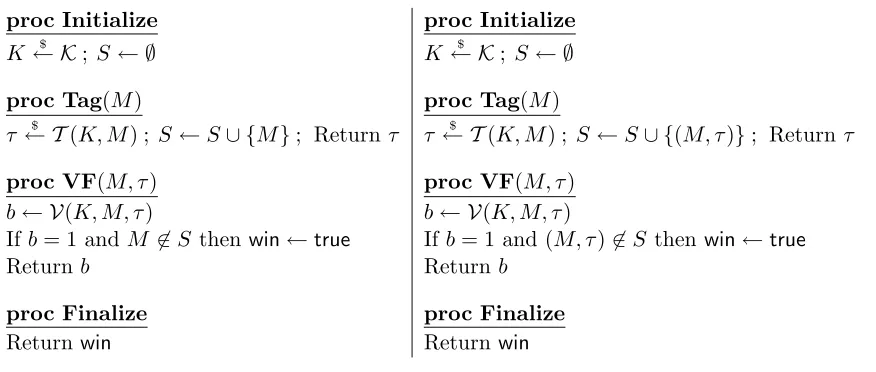
Figure 6: Game WUF-CMAMA (left) and SUF-CMAMA (right) where MA= (K,T,V).
Unforgeability. We specify the security notions of a message authentication scheme using games. Game WUF-CMAMA of Figure 6 captures the standard notion of unforgeability under chosen-message attacks, namely the adaptation of the notion of [27] to the symmetric setting as per [7]. This notion considers the adversary successful if it forges a tag of a message that it did not query to itsTagoracle. Game SUF-CMAMA captures a stronger notion in which, to be successful, not only the message but also the tag in the forgery have to be new. For any adversary F, we let
AdvwufMA-cma(F) = Pr[ WUF-CMAFMA⇒1 ] and AdvsufMA-cma(F) = Pr[ SUF-CMAFMA⇒1 ]. It is easy to see that SUF-CMA implies WUF-CMA, meaning any SUF-CMA secure MA scheme is also WUF-CMA secure. There are many practical MACs that are SUF-CMA secure under standard assumptions, for example, HMAC [4, 3], CBC-MAC [7, 10], EMAC [41], XCBC [16], PMAC [17], TMAC [38], OMAC [30], and CMAC [46]. UMAC [15] and RMAC [31] are randomized WUF-CMA MA schemes.
3
Relations among notions of symmetric encryption
In this section, we detail the results summarized in Figure 1 and provide proofs. We begin with the implications and then move to the separations.
INT-CTXT→INT-PTXT. The following theorem implies that any encryption scheme which is
INT-CTXT secure is also INT-PTXT secure.
Theorem 3.1 LetSE = (K,E,D) be an encryption scheme. Then, for anyA, AdvintSE-ptxt(A)≤AdvintSE-ctxt(A).
proc Initialize Games G0, G1 000 K← K$ ;b← {$ 0,1}; S← ∅
proc LR(M0, M1)
010 C← E$ (K, Mb) ; S←S∪ {C}; Return C proc Dec(C)
020 IfC6∈S then M ← D(K, C) else M ← ⊥
021 IfM 6=⊥thenbad←true; M ← ⊥
022 ReturnM proc Finalize(d) 030 Return (d=b)
proc Initialize Game G2 200 K ← K$ ; b← {$ 0,1}
proc LR(M0, M1)
210 C← E$ (K, Mb) ; Return C proc Dec(C)
220 Return ⊥
proc Finalize(d) 230 Return (d=b)
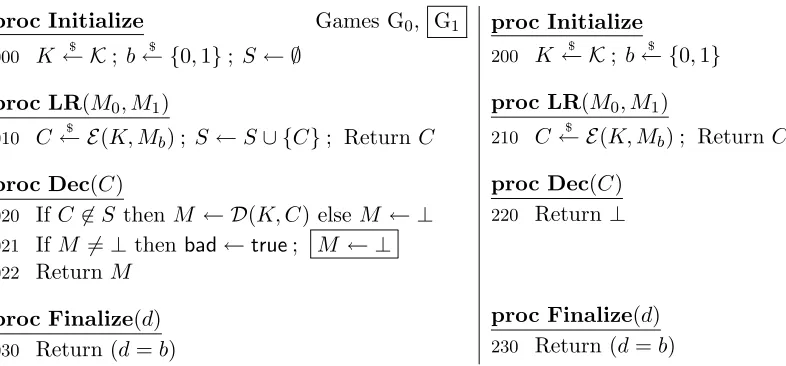
Figure 7: Games G0,G1,and G2 for the proof of Theorem 3.2. Game G1 contains the code in the box while G0 does not.
INT-CTXT∧IND-CPA→IND-CCA. The following theorem implies that any encryption scheme that
is both IND-CPA secure and INT-CTXT secure is also IND-CCA secure, meaning weak privacy coupled with strong integrity implies strong privacy.
Theorem 3.2 LetSE = (K,E,D) be an encryption scheme. LetAbe an ind-cca adversary against
SE running in time t and making qe Enc queries and qd Dec queries. Then, we can construct an int-ctxt adversaryAc and an ind-cpa adversary Ap such that
AdvindSE-cca(A) ≤ 2·AdvSEint-ctxt(Ac) +AdvSEind-cpa(Ap). (2) Furthermore, Ac runs in time O(t) and makesqe Encqueries and qd VFqueries whileAp runs in timeO(t) and makes qe LR queries.
Proof of Theorem 3.2: Consider games G0,G1,G2 of Figure 7. We have Pr[ IND-CCAASE ⇒true] = Pr[ GA0 ⇒true]
= Pr[ GA1 ⇒true] +Pr[ GA0 ⇒true]−Pr[ GA1 ⇒true]
≤ Pr[ GA1 ⇒true] + Pr[ GA1 sets bad], (3) where the last equation follows from Lemma 2.1 because G0,G1 are identical until bad. Now, notice that in the procedureDec of G1, the returned value is always ⊥. Therefore,
Pr[ GA
1 ⇒true] = Pr[ GA2 ⇒true]. (4) We will designAc and Ap so that
Pr[ GA1 sets bad] ≤ Pr[ INT-CTXTAc
SE ⇒true] and (5) Pr[ GA2 ⇒true] ≤ Pr[ IND-CPA
Ap
SE ⇒true]. (6)
AdversaryAc starts by picking a random bitbthen runsAanswering its queries as follows. For an LR queryM0, M1, adversaryAc submitsMb to itsEnc oracle and returns the response toA. For a Decquery C, adversaryAc submitsC to its VF oracle and (regardless of the response) returns
⊥to A.
We define Ap as follows. It simply runsA answeringA’s LR queries using its ownLR oracle and answeringA’s Dec queries with⊥. It outputs whateverA outputs.
Separation approach. We use the approach of [6] to show separations. Namely, to show that a
security notionAdoes not imply a security notionB, we construct a schemeSE that meets notion A but for which we can exhibit an attack showing that it does not meet notion B. Of course, the statement that A 6→ B is vacuously and un-interestingly true if there does not exist any scheme secure under the notion A in the first place. So we make the minimal assumption whenever we show a separation A 6→ B that there exists some scheme secure under the notion A, and obtain
SE by modifying this given scheme. We note that the schemeSE may be artificial. But the point we are making is that it is not possible to prove A→B, and even an artificial example is enough for that.
IND-CCA6→INT-PTXT. Let SE = (K,E,D) be a given IND-CCA secure symmetric encryption
scheme. We define a schemeSE1 such thatSE1 is IND-CCA secure but is not INT-PTXT secure. The idea is simple. A certain known string (or strings) will be viewed byDas valid and decrypted to certain known messages, so that forgery is easy. But these “ciphertexts” will never be produced by the encryption algorithm so privacy will not be affected. Here are the details. The new scheme
SE1 = (K,E1,D1) has the same key generation algorithm as the old scheme and the following modified encryption and decryption algorithms:
Algorithm E1(K, M) C0 ← E$ (K, M) C←0kC0 ReturnC
Algorithm D1(K, C)
ParseC asbkC0 where bis a bit
Ifb= 0 thenM ← D(K, C0) else M ←0 ReturnM
We present an attack onSE1, in the form of an adversary Awho defeats the integrity of plaintexts (meaning, wins Game INT-PTXTSE1) with probability one using only one query to the verification
oracle. AllAdoes is submit the string 10 to itsVForacle. We observe thatD(K,10) = 0, meaning 10 is a valid ciphertext, and it decrypts to a message (namely 0) that the adversary has not queried of its oracle. So
AdvintSE-1ptxt(A) = 1 .
To prove that SE1 is IND-CCA secure, we show that given any adversary A attacking SE1 using time tand making qe LR queries and qd Dec queries, there is an adversaryB attacking SE such that
Advind-cca
SE1 (A)≤Adv
ind-cca SE (B)
and B runs in time O(t) and makes qe LR queries and qd Dec queries. Adversary B works as follows:
AdversaryB Run A
On queryLR(M0, M1)
On queryDec(C)
Parse C asbkC0 whereb is a bit
If b= 0 thenM ←Dec(C0) else M ←0 Return M to A
Until A halts and outputs a bitb Return b
Above, B is using its ownLR oracle to answer calls thatA makes to its LR oracle.
INT-PTXT∧IND-CPA6→NM-CPA. Let SE = (K,E,D) be an encryption scheme that is both
INT-PTXT and IND-CPA secure. We define a scheme SE2 such that SE2 is INT-PTXT and IND-CPA secure but is not NM-CPA secure. The idea is to prepend a redundant bit to cipher-texts. This bit is ignored by the decryption algorithm, resulting in the ability to create two different ciphertexts of the same message, which defeats the non-malleability. Here are the details. The new schemeSE2= (K,E2,D2) has the same key generation algorithm as the old scheme and the following modified encryption and decryption algorithms:
Algorithm E2(K, M) C← E$ (K, M) Return 0kC
AlgorithmD2(K, C)
Parse C asbkC0 wherebis a bit M ← D(K, C0) ; returnM
To prove thatSE2 is not NM-CPA secure, we present an attack onSE2in the form of an adversary A who violates its non-malleability (meaning, wins Game NM-CPASE2) with probability one. It
works as follows: AdversaryA
C ←$ LR(0,1) ; ParseC asxkC0 wherex is a bit C∗[1]←1kC0; P∗ ←Dec∗(C∗) ; Return P∗[1].
To prove that SE2 is indeed IND-CPA (resp. INT-PTXT) secure, we will show that given any adversaryAp (resp. Ac) attackingSE2, we can construct an adversary Bp (resp. Bc) attacking SE such that
AdvindSE2-cpa(Ap) ≤ AdvindSE-cpa(Bp) and AdvintSE-2ptxt(Ac) ≤ Adv
int-ptxt SE (Bc).
Furthermore, the running time ofBp(resp.Bc) is big-oh of that ofAp(resp.Ac) and the constructed adversaries make the same number of oracle queries as the given ones. AdversariesBp andBc work as follows:
AdversaryBp Run Ap
On queryLR(M0, M1) C←$ 0kLR(M0, M1) Return C to Ap
Until Ap halts and outputs a bitb Return b
AdversaryBc RunAc
On queryEnc(M)
C←$ 0kEnc(M) ; ReturnC to Ac On queryVF(C)
Parse C asbkC0 whereb is a bit. Return VF(C0) to Ac
UntilAc halts.
4
Security of the Composite Schemes
MA = (Km,T,V) is a given message authentication scheme which is WUF-CMA or SUF-CMA secure. We refer to these as the base schemes. Associated to them isSE= (K,E,D), an encryption scheme constructed according to one of the three methods we are considering. The presentation below is method by method, and in each case we begin by specifying the method in more detail. We first provide theorems proving positive results for the method then either describe the counter-examples for negative results or explain how the implications can be derived from already proved results in combination with results from Section 3.
In presenting a counter-example (meaning a claim that a certain composition method is inse-cure under some notion of security A) we use the following paradigm. We present a symmetric encryption schemeSE0 and a MACMA0 such thatSE0is IND-CPA secure andMA0is WUF-CMA or SUF-CMA secure but we can present an attack on the composite scheme based on them showing that the composite scheme does not meet notion A. Of course, we make the minimal assump-tions that some scheme SE that is IND-CPA secure, and some scheme MA that is WUF-CMA or SUF-CMA secure, exist, since otherwise the claim is vacuous. We construct SE0 from SE and
MA0 fromMA. Whenever possible, we present the counter-example for the case in whichMA0 is SUF-CMA because the negative result then follows for the case in whichMA0 is WUF-CMA. (If the composite scheme does not meet notion AwhenMA0 is SUF-CMA, then it cannot hope to do so whenMA0 is WUF-CMA.)
In some cases the constructions are artificial. But what we want to assess is whether it is possible to prove that the composite scheme meets notion A assuming only that the constituent encryption scheme is IND-CPA secure and the constituent MA scheme is WUF-CMA or SUF-CMA secure, and a result of the type just explained shows that such a proof is not possible.
4.1 Encrypt-and-MAC (E&M)
TheEncrypt-and-MAC(E&M) composition of base schemesSE= (Ke,E,D) andMA= (Km,T,V) is the encryption scheme SE = (K,E,D) whose constituent algorithms are as follows:
Algorithm K Ke
$
← Ke
Km
$
← Km Return KekKm
Algorithm E(KekKm, M)
C0← E$ (Ke, M)
τ ← T$ (Km, M)
C←C0kτ ReturnC
Algorithm D(KekKm, C) ParseC asC0kτ M ← D(Ke, C0)
v← V(Km, M, τ)
Ifv= 1 then returnM else return⊥.
E&M provides INT-PTXT. E&M does provide integrity of plaintexts. It inherits the integrity of
the MAC in a direct way, with no degradation in security. This is independent of the symmetric encryption scheme: whether the latter is secure or not does not affect the integrity of the composite scheme.
Theorem 4.1 Let SE = (Ke,E,D) be a symmetric encryption scheme, let MA= (Km,T,V) be a message authentication scheme, and let SE= (K,E,D) be the encryption scheme obtained from
SE andMA via the Encrypt-and-MAC composition method. Given any adversary A againstSE, we can construct an adversaryF such that
AdvintSE-ptxt(A) ≤AdvwufMA-cma(F). (7) Furthermore, F uses the same resources asA.
AdversaryF Ke
$
← Ke Run A
On queryEnc(M) C0 ← E$ (Ke, M) ; τ
$
←Tag(M) ; ReturnC0kτ to A On queryVF(C)
Parse C asC0kτ ; M ← D(Ke, C0) ; v←VF(M, τ) ; Return v to A Until A halts
Consider a ciphertextC=C0kτ that yields a successful forgery of a new plaintext M. This means thatM was never queried toEnc, which implies that F never queried it toTageither. Therefore, the pair (M, τ) is a valid weak forgery, and Equation (7) is justified. To justify the claims about the resource parameters used by F, we note that, as per our conventions, the resources for both adversaries include the running time of the game procedures.
E&M does not provide IND-CPA. E&M does not preserve privacy because the MAC could reveal
information about the plaintext. This is true regardless of whether the MAC is weakly or strongly unforgeable. We provide details assuming that the MAC is strongly unforgeable below.
Let MA = (Km,T,V) be a given MA scheme. We define an MA scheme MA0 which is the same as the given one except that it prepends the first bit of the message to the tag. Formally
MA0 = (K
m,T0,V0) has the same key generation algorithm as the given MA scheme and the following tagging and verification algorithms:
Algorithm T0(K, M)
ParseM asxkM0 wherex is a bit ReturnxkT(K, M)
Algorithm V0(K, M, τ)
ParseM asxkM0 where xis a bit Parseτ asskτ0 where sis a bit
Ifx=sand V(K, M, τ0) = 1 then return 1 Else return 0
It is easy to see that ifMAis SUF-CMA secure thenMA0 is SUF-CMA secure. However, ifMA0 is used as the base message authentication scheme in the E&M composition method, the resulting symmetric encryption scheme will not achieve IND-CPA because the first bit of the message is provided to the adversary via the MAC. The adversary can use this to break the scheme in the IND-CPA sense as follows. It queries its LR oracle with two messages M0, M1 such that the first bit of M0 is 0 and the first bit of M1 is 1. It gets back ciphertext C =C0kτ. It lets s be the first bit of τ. As per our construction above,sis the first bit of Mb and hence s=b, so the adversary returns s. The advantage of this adversary is one.
In fact, we can make a stronger statement. Not only do there exist schemes for which the E&M method fails to provide IND-CPA, but it will fail to be so for most of the commonly defined MA schemes, including CBC-MAC and HMAC, because the latter are MACs. Indeed, an adversary can use the MAC present in the ciphertext of the composite scheme to see whether the same message has been encrypted twice, something which should not be possible if the scheme is to meet a strong notion of privacy like IND-CPA. This attack is successful regardless of whether the underlying MAC is weakly or strongly unforgeable. Here are the details. Assuming MA is a MAC. The IND-CPA attack is as follows. Adversary A picks distinct, equal-length messages x, y. It makes LR query x, y to get back a ciphertext C1 =C10kτ1 and then makes LR query x, x to get back a ciphertext C2 =C20kτ2. Ifτ1 =τ2, it returns 0, else it returns 1. Then,
whereF is the following adversary: it makes queryxtoTagto getτ and then makes query (y, τ) to VF. The WUF-CMA security ofMAimplies thatF has low advantage, soAhas high advantage.
E&M does not provide IND-CCA and NM-CPA.Since both IND-CCA and NM-CPA imply IND-CPA,
the above means that E&M providesneither IND-CCA nor NM-CPA secure.
E&M does not provide INT-CTXT.E&M also fails to provide integrity of ciphertexts. This is because
there are secure encryption schemes with the property that a ciphertext can be modified without changing its decryption. When such an encryption scheme is used as the base symmetric encryption scheme, an adversary can query the encryption oracle, modify part of the response, and still submit the result to the verification oracle as a valid ciphertext. We provide details below.
Let SE = (K,E,D) be the given IND-CPA secure symmetric encryption scheme. Let SE2 = (K,E2,D2) be derived from SE as in the INT-PTXT∧IND-CPA 6→ NM-CPA proof of Section 3. We claim thatSE2 is IND-CPA secure but not INT-CTXT secure. The latter claim is justified by the following attack that has advantage one:
AdversaryA
C ←$ Enc(0) ; Parse C as 0kC; VF(1kC)
Note that this attack does not violate integrity of plaintexts because the plaintexts underlying ciphertexts 0kC and 1kC are the same. Finally, we note that the proof that the modified scheme
SE2 is still IND-CPA secure is easy and is omitted.
4.2 MAC-then-Encrypt (MtE)
TheMAC-then-encrypt(MtE) composition of base schemesSE = (Ke,E,D) andMA= (Km,T,V) is the encryption scheme SE = (K,E,D) whose constituent algorithms are as follows:
Algorithm K Ke
$
← Ke
Km
$
← Km Return KekKm
Algorithm E(KekKm, M)
τ ← T$ (Km, M)
C← E$ (Ke, Mkτ) ReturnC
Algorithm D(KekKm, C)
M0 ← D(Ke, C) ParseM0 asMkτ v← V(Km, M, τ)
Ifv= 1 then returnM else return⊥.
MtE provides INT-PTXT and IND-CPA.MtE provides both privacy against chosen-plaintext attack
and integrity of plaintexts. More precisely, if the underlying MA scheme is WUF-CMA secure, then the composite scheme is INT-PTXT secure. Furthermore, if the underlying encryption scheme is IND-CPA secure, then so is the composite scheme.
Theorem 4.2 Let SE = (Ke,E,D) be a symmetric encryption scheme, let MA= (Km,T,V) be a message authentication scheme, and let SE= (K,E,D) be the encryption scheme obtained from
SE and MAvia the MAC-then-encrypt composition method. Given any adversary I againstSE, we can construct an adversaryF such that
AdvintSE-ptxt(I) ≤ AdvwufMA-cma(F). (8) Furthermore,F uses the same resources as I. Similarly, given any adversaryA againstSE, we can construct an adversary Ap such that
Advind-cpa
SE (A) ≤ Adv ind-cpa
SE (Ap). (9)
Proof of Theorem 4.2: We constructF and Ap as follows: AdversaryF
Ke
$
← Ke Run I
On queryEnc(M)
M0←$ MkTag(M) ; C0 ← E$ (Ke, M0) Return C0 to I
On queryVF(C)
M0← D(Ke, C) ; Parse M0 asMkτ
v←VF(M, τ) ; Return v to I Until I halts
Adversary Ap
Km
$
← Km RunA
On queryLR(M0, M1) τ0
$
← T(Km, M0) ; τ1
$
← T(Km, M1) M00 ←M0kτ0; M10 ←M1kτ1
C ←$ LR(M0
0, M10) ; ReturnC to A Until Ahalts and returns b
Returnb
It is easy to see that Equations (8) and (9) follow. The claimed resource usage of F and Ap can also be easily justified.
MtE does not provide NM-CPA. The base encryption scheme might be malleable, and this will be
inherited by the composite scheme. Here are the details. LetSE = (Ke,E,D) be the given IND-CPA secure symmetric encryption scheme, and let SE2 = (K,E2,D2) be as defined in Section 3. We already noted that, if SE is IND-CPA secure, then so isSE2. Let SE be the scheme obtained by MtE based onSE2 and MA. We show that SE is not NM-CPA secure by presenting an attack in the form of an adversary A who violates its non-malleability (meaning, wins Game NM-CPASE) with probability one. It works as follows:
AdversaryA
C ←$ LR(0,1) ; ParseC asxkC0 wherex is a bit C∗[1]←1kC0; P∗ ←Dec∗(C∗) ; Return P∗[1].
MtE does not provide IND-CCA and INT-CTXT. Since IND-CCA implies NM-CPA, MtE does not
provide IND-CCA security either. Furthermore, the fact that it provides IND-CPA security but not NM-CPA security implies that it does not provide INT-CTXT security.
4.3 Encrypt-then-MAC (EtM)
TheEncrypt-then-MAC(EtM) composition of base schemesSE = (Ke,E,D) andMA= (Km,T,V) is the encryption scheme SE = (K,E,D) whose constituent algorithms are as follows:
Algorithm K Ke
$
← Ke
Km
$
← Km Return KekKm
Algorithm E(KekKm, M)
C0← E$ (Ke, M)
τ0← T$ (Km, C0)
C←C0kτ0 ReturnC
Algorithm D(KekKm, C) ParseC asC0kτ0 M ← D(Ke, C0)
v← V(Km, C0, τ0)
Ifv= 1 then returnM else return⊥. The security results for the two composition methods we have covered so far, i.e. E&M and MtE, hold whether or not we assume the base MAC scheme to be weakly or strongly unforgeable. For EtM, however, we have different security results depending on our assumption about the MAC as indicated in the two tables in Figure 2. For clarity, we separate the results accordingly here.
EtM with WUF-CMA base MAC provides IND-CPA and INT-PTXT. The following theorem implies
Theorem 4.3 Let SE(Ke,E,D) be a symmetric encryption scheme, let MA = (Km,T,V) be a message authentication scheme, and let SE = (K,E,D) be the authenticated encryption scheme obtained fromSE and MAvia theencrypt-then-MAC composition method. Given any adversary A againstSE, we can construct an adversaryAp such that
Advind-cpa
SE (A) ≤ Adv ind-cpa
SE (Ap). (10)
Furthermore, Ap uses the same resources as A. Similarly, given any adversary I against SE, we can construct an adversaryF such that
Advint-ptxt
SE (I) ≤ Adv wuf-cma
MA (F). (11)
Furthermore,F uses the same resources as I except that each Tagquery ofF is lbits longer than that ofI wherel is the difference in bits of the length of a ciphertext and that of a plaintext in the scheme SE.
Proof of Theorem 4.3: We constructAp and F as follows: AdversaryAp
Km
$
← Km Run A
On queryLR(M0, M1) C←$ LR(M0, M1) τ ← T$ (Km, C) Return Ckτ to A Until A halts and returns b Return b
Adversary F Ke
$
← Ke Run I
On query Enc(M) C0← E$ (Ke, M) ; τ
$
←Tag(C0) ; ReturnC0kτ to I On query VF(C)
ParseC asC0kτ0; v←VF(C0, τ0) ; Return v to I Until I halts
Equation (10) is easily verified. For Equation (11), letC=C0kτ0 be aVFquery ofI that leads to its winning game INT-PTXTSE. LetM =D(Ke, C0). The unique decryptability ofSE means that if M was not an Enc query of I then C0 was not a Tag query of F. SoF wins WUF-CMAMA whenever I wins INT-PTXTSE.
EtM with WUF-CMA base MAC does not provide NM-CPA.However, a weakly unforgeable base MA
scheme is not enough to obtain a NM-CPA secure composite scheme under EtM. To illustrate this, let MA = (K,T,V) be the given WUF-CMA secure MA scheme. We define a WUF-CMA MA scheme MA0 such that the composite scheme SE formed by EtM based on SE and MA0 is not NM-CPA secure. The idea is that a redundant bit is appended to the tag by the tagging algorithm and ignored by the verification algorithm. Here are the details. The new MA scheme
MA0 = (K,T0,V0) has the same key generation algorithm as that of the original scheme, but its tagging and verifying algorithms are as follows:
Algorithm T0(K, M) τ ← T$ (K, M) Returnτk0
Algorithm V0(K, M, τ)
Parse τ asτ0kbwhere bis a bit. Return V(K, M, τ0)
AdversaryA
C ←$ LR(0,1) ; ParseC asC0kτ ; Parseτ asτ0kxwhere x is a bit τ ←τ0k1 ; C∗[1]←C0kτ ; P∗ ←Dec∗(C∗) ; ReturnP∗[1]
The proof that MA0 is WUF-CMA secure is easy and is omitted.
EtM with WUF-CMA base MAC does not provide IND-CCA and INT-CTXT. Suppose the base MA
scheme is only assumed to be weakly unforgeable. Since IND-CCA implies NM-CPA, EtM does not provide IND-CCA security. Also, since INT-CTXT∧IND-CPA implies NM-CPA and since EtM provides IND-CPA, EtM does not provide INT-CTXT security.
EtM with SUF-CMA base MAC provides INT-CTXT. The following theorem states that EtM
pro-vides IND-CCA and INT-CTXT security assuming a strongly unforgeable base MA scheme. Theorem 4.4 Let SE = (Ke,E,D) be a symmetric encryption scheme, let MA= (Km,T,V) be a message authentication scheme, and let SE = (K,E,D) be the authenticated encryption scheme obtained fromSE and MAvia theencrypt-then-MAC composition method. Given any adversary I, we can construct an adversary F such that
AdvintSE-ctxt(I) ≤ AdvsufMA-cma(F). (12) Furthermore,F uses the same resources as I except that each Tagquery ofF is lbits longer than that ofI wherel is the difference in bits of the length of a ciphertext and that of a plaintext in the scheme SE.
Proof of Theorem 4.4: AdversaryFis the same as the one described in the proof of Equation (11) in Theorem 4.3. LetC =C0kτ0 be aVF query of I that leads to its winning game INT-CTXTSE. If C was not returned to I by Enc then F did not query Tag with C0. So F was SUF-CMAMA whenever I wins INT-CTXTSE.
EtM with SUF-CMA base MAC provides IND-CPA,IND-CCA,NM-CPA,INT-PTXT.Theorem 4.3 says
that EtM provides IND-CPA security. Consequently, Theorem 4.4 and Theorem 3.2 together im-ply that EtM provides IND-CCA security. Now, since IND-CCA security implies NM-CPA, EtM provides NM-CPA security. Finally, since INT-CTXT security implies INT-PTXT security, EtM also provides INT-PTXT security.
References
[1] J. H. An and M. Bellare. Does encryption with redundancy provide authenticity? In L. R. Knudsen, editor,Advances in Cryptology – EUROCRYPT 2002, volume 2332 ofLecture Notes in Computer Science, pages 512–528, Amsterdam, The Netherlands, Apr. 28 – May 2, 2002. Springer-Verlag, Berlin, Germany.
[2] J. H. An, Y. Dodis, and T. Rabin. On the security of joint signature and encryption. In L. R. Knudsen, editor,Advances in Cryptology – EUROCRYPT 2002, volume 2332 ofLecture Notes in Computer Science, pages 83–107, Amsterdam, The Netherlands, Apr. 28 – May 2, 2002. Springer-Verlag, Berlin, Germany.
[4] M. Bellare, R. Canetti, and H. Krawczyk. Keying hash functions for message authentication. In N. Koblitz, editor,Advances in Cryptology – CRYPTO’96, volume 1109 ofLecture Notes in Computer Science, pages 1–15, Santa Barbara, CA, USA, Aug. 18–22, 1996. Springer-Verlag, Berlin, Germany.
[5] M. Bellare, A. Desai, E. Jokipii, and P. Rogaway. A concrete security treatment of symmetric encryption. In38th Annual Symposium on Foundations of Computer Science, pages 394–403, Miami Beach, Florida, Oct. 19–22, 1997. IEEE Computer Society Press.
[6] M. Bellare, A. Desai, D. Pointcheval, and P. Rogaway. Relations among notions of security for public-key encryption schemes. In H. Krawczyk, editor,Advances in Cryptology – CRYPTO’98, volume 1462 of Lecture Notes in Computer Science, pages 26–45, Santa Barbara, CA, USA, Aug. 23–27, 1998. Springer-Verlag, Berlin, Germany.
[7] M. Bellare, J. Kilian, and P. Rogaway. The security of the cipher block chaining message authentication code. In Y. Desmedt, editor, Advances in Cryptology – CRYPTO’94, volume 839 ofLecture Notes in Computer Science, pages 341–358, Santa Barbara, CA, USA, Aug. 21– 25, 1994. Springer-Verlag, Berlin, Germany.
[8] M. Bellare, T. Kohno, and C. Namprempre. Breaking and provably repairing the SSH authen-ticated encryption scheme: A case study of the Encode-then-Encrypt-and-MAC paradigm. ACM Transactions on Information and System Security, 7(2), 2004.
[9] M. Bellare and C. Namprempre. Authenticated encryption: Relations among notions and analysis of the generic composition paradigm. In T. Okamoto, editor,Advances in Cryptology – ASIACRYPT 2000, volume 1976 of Lecture Notes in Computer Science, pages 531–545, Kyoto, Japan, Dec. 3–7, 2000. Springer-Verlag, Berlin, Germany.
[10] M. Bellare, K. Pietrzak, and P. Rogaway. Improved security analyses for CBC MACs. In V. Shoup, editor,Advances in Cryptology – CRYPTO 2005, volume 3621 of Lecture Notes in Computer Science, pages 527–545. Springer-Verlag, Berlin, Germany, Aug. 14–18, 2005. [11] M. Bellare and P. Rogaway. Encode-then-encipher encryption: How to exploit nonces or
redun-dancy in plaintexts for efficient cryptography. In T. Okamoto, editor,Advances in Cryptology – ASIACRYPT 2000, volume 1976 ofLecture Notes in Computer Science, pages 317–330, Kyoto, Japan, Dec. 3–7, 2000. Springer-Verlag, Berlin, Germany.
[12] M. Bellare and P. Rogaway. Code-based game-playing proofs and the security of triple encryp-tion. In S. Vaudenay, editor, Advances in Cryptology – EUROCRYPT 2006, volume 4004 of Lecture Notes in Computer Science, St. Petersburg, Russia, May 29 – June 1, 2006. Springer-Verlag, Berlin, Germany. Available as Cryptology ePrint Report 2005/334.
[13] M. Bellare, P. Rogaway, and D. Wagner. The EAX mode of operation. In B. K. Roy and W. Meier, editors,Fast Software Encryption 2004, volume 3017 ofLecture Notes in Computer Science, pages 389–407. Springer-Verlag, Berlin, Germany, Feb. 5–7, 2004.
[15] J. Black, S. Halevi, H. Krawczyk, T. Krovetz, and P. Rogaway. UMAC: Fast and secure message authentication. In M. J. Wiener, editor, Advances in Cryptology – CRYPTO’99, volume 1666 ofLecture Notes in Computer Science, pages 216–233, Santa Barbara, CA, USA, Aug. 15–19, 1999. Springer-Verlag, Berlin, Germany.
[16] J. Black and P. Rogaway. CBC MACs for arbitrary-length messages: The three-key con-structions. In M. Bellare, editor, Advances in Cryptology – CRYPTO 2000, volume 1880 of Lecture Notes in Computer Science, pages 197–215, Santa Barbara, CA, USA, Aug. 20–24, 2000. Springer-Verlag, Berlin, Germany.
[17] J. Black and P. Rogaway. A block-cipher mode of operation for parallelizable message authen-tication. In L. R. Knudsen, editor, Advances in Cryptology – EUROCRYPT 2002, volume 2332 of Lecture Notes in Computer Science, pages 384–397, Amsterdam, The Netherlands, Apr. 28 – May 2, 2002. Springer-Verlag, Berlin, Germany.
[18] R. Canetti and H. Krawczyk. Analysis of key-exchange protocols and their use for building secure channels. In B. Pfitzmann, editor, Advances in Cryptology – EUROCRYPT 2001, volume 2045 of Lecture Notes in Computer Science, pages 451–472. Springer-Verlag, Berlin, Germany, May 6–10, 2001.
[19] R. Cramer and I. Damg˚ard. Secure signature schemes based on interactive protocols. In D. Coppersmith, editor,Advances in Cryptology – CRYPTO’95, volume 963 ofLecture Notes in Computer Science, pages 297–310, Santa Barbara, CA, USA, Aug. 27–31, 1995. Springer-Verlag, Berlin, Germany.
[20] A. Desai. New paradigms for constructing symmetric encryption schemes secure against chosen-ciphertext attack. In M. Bellare, editor,Advances in Cryptology – CRYPTO 2000, volume 1880 ofLecture Notes in Computer Science, pages 394–412, Santa Barbara, CA, USA, Aug. 20–24, 2000. Springer-Verlag, Berlin, Germany.
[21] D. Dolev, C. Dwork, and M. Naor. Nonmalleable cryptography. SIAM Journal on Computing, 30(2):391–437, 2000.
[22] N. Ferguson, D. Whiting, B. Schneier, J. Kelsey, S. Lucks, and T. Kohno. Helix: Fast en-cryption and authentication in a single cryptographic primitive. In T. Johansson, editor,Fast Software Encryption 2003, volume 2887 ofLecture Notes in Computer Science, pages 330–346. Springer-Verlag, Berlin, Germany, Feb. 24–26, 2003.
[23] A. Freier, P. Karlton, and P. Kocher. The SSL protocol: Version 3.0, 1996.
[24] V. Gligor and P. Donescu. Fast encryption and authentication: XCBC encryption and XECB authentication modes. In M. Matsui, editor,Fast Software Encryption 2001, volume 2355 of Lecture Notes in Computer Science. Springer-Verlag, Berlin, Germany, Apr. 2–4, 2001. [25] O. Goldreich. A uniform complexity treatment of encryption and zero-knowledge. Journal of
Cryptology, 6(1):21–53, 1993.
[26] S. Goldwasser and S. Micali. Probabilistic encryption. Journal of Computer and System Sciences, 28:270–299, 1984.
[28] S. Halevi. An observation regarding Jutla’s modes of operation. IACR ePrint Report 2001/015, 2001.
[29] J. Hastad. The security of the IAPM and IACBC modes.Journal of Cryptology, 20(2):153–163, 2007.
[30] T. Iwata and K. Kurosawa. OMAC: One-key CBC MAC. In T. Johansson, editor, Fast Software Encryption 2003, volume 2887 ofLecture Notes in Computer Science, pages 129–153. Springer-Verlag, Berlin, Germany, Feb. 24–26, 2003.
[31] E. Jaulmes, A. Joux, and F. Valette. On the security of randomized CBC-MAC beyond the birthday paradox limit: A new construction. In J. Daemen and V. Rijmen, editors, Fast Software Encryption 2002, volume 2365 ofLecture Notes in Computer Science, pages 237–251. Springer-Verlag, Berlin, Germany, Feb. 4–6, 2002.
[32] C. Jutla. Encryption modes with almost free message integrity. In B. Pfitzmann, editor, Advances in Cryptology – EUROCRYPT 2001, volume 2045 of Lecture Notes in Computer Science, pages 529–544. Springer-Verlag, Berlin, Germany, May 6–10, 2001.
[33] J. Katz and M. Yung. Complete characterization of security notions for probabilistic private-key encryption. In 32nd Annual ACM Symposium on Theory of Computing, pages 245–254, Portland, Oregon, USA, May 21–23, 2000. ACM Press.
[34] J. Katz and M. Yung. Unforgeable encryption and chosen ciphertext secure modes of opera-tion. In B. Schneier, editor, Fast Software Encryption 2000, volume 1978 ofLecture Notes in Computer Science, pages 284–299. Springer-Verlag, Berlin, Germany, Apr. 10–12, 2000. [35] S. Kent. IP encapsulating security payload (ESP). RFC 4303, Dec. 2005.
[36] T. Kohno, J. Viega, and D. Whiting. CWC: A high-performance conventional authenticated encryption mode. In B. K. Roy and W. Meier, editors,Fast Software Encryption 2004, volume 3017 ofLecture Notes in Computer Science, pages 408–426. Springer-Verlag, Berlin, Germany, Feb. 5–7, 2004.
[37] H. Krawczyk. The order of encryption and authentication for protecting communications (or: How secure is SSL?). In J. Kilian, editor, Advances in Cryptology – CRYPTO 2001, volume 2139 ofLecture Notes in Computer Science, pages 310–331, Santa Barbara, CA, USA, Aug. 19–23, 2001. Springer-Verlag, Berlin, Germany.
[38] K. Kurosawa and T. Iwata. TMAC: Two-key CBC MAC. In M. Joye, editor, Topics in Cryptology – CT-RSA 2003, volume 2612 ofLecture Notes in Computer Science, pages 33–49, San Francisco, CA, USA, Apr. 13–17, 2003. Springer-Verlag, Berlin, Germany.
[39] D. McGrew and J. Viega. The security and performance of the Galois/Counter Mode (GCM) of operation. In A. Canteaut and K. Viswanathan, editors, Progress in Cryptology - IN-DOCRYPT 2004: 5th International Conference in Cryptology in India, volume 3348 of Lec-ture Notes in Computer Science, pages 343–355. Springer-Verlag, Berlin, Germany, Dec. 20–22, 2004.
[41] E. Petrank and C. Rackoff. CBC MAC for real time data sources. Journal of Cryptology, 13(3):315–338, 2000.
[42] C. Rackoff and D. R. Simon. Non-interactive zero-knowledge proof of knowledge and chosen ciphertext attack. In J. Feigenbaum, editor, Advances in Cryptology – CRYPTO’91, volume 576 ofLecture Notes in Computer Science, pages 433–444, Santa Barbara, CA, USA, Aug. 11– 15, 1991. Springer-Verlag, Berlin, Germany.
[43] P. Rogaway. Authenticated-encryption with associated-data. InACM CCS 02: 9th Conference on Computer and Communications Security, pages 98–107. ACM Press, Nov. 18–22, 2002. [44] P. Rogaway, M. Bellare, J. Black, and T. Krovetz. OCB: A block-cipher mode of operation
for efficient authenticated encryption. In ACM CCS 01: 8th Conference on Computer and Communications Security, pages 196–205, Philadelphia, PA, USA, Nov. 5–8, 2001. ACM Press. [45] P. Rogaway and T. Shrimpton. A provable-security treatment of the key-wrap problem. In S. Vaudenay, editor, Advances in Cryptology – EUROCRYPT 2002, volume 4004 of Lecture Notes in Computer Science, pages 373–390, St. Petersburg, Russia, May 29 – June 1, 2006. Springer-Verlag, Berlin, Germany.
[46] J. Song, R. Poovendran, J. Lee, and T. Iwata. The advanced encryption standard-cipher-based message authentication code-pseudo-random function-128 (AES-CMAC-PRF-128) algorithm for the internet key exchange protocol (IKE). RFC 4615, 2006.
[47] D. Whiting, R. Housley, and N. Ferguson. AES encryption & authentication using CTR mode & CBC-MAC. IEEE P802.11 doc 02/001r2, May 2002.
[48] T. Ylonen and C. Lonvick. The secure shell (SSH) transport layer protocol. RFC 4253, Jan. 2006.