A preliminary version of this paper appears inAdvances in Cryptology - CRYPTO ’07 Proceedings. Lecture Notes in Computer Science, Vol. 4622, pp. 535–552, A. Menezes ed., Springer, 2007. This is the full version.
Deterministic and Efficiently Searchable Encryption
Mihir Bellare∗ Alexandra Boldyreva† Adam O’Neill‡
Abstract
We present as-strong-as-possible definitions of privacy, and constructions achieving them, for public-key encryption schemes where the encryption algorithm isdeterministic. We obtain as a consequence database encryption methods that permit fast (i.e. sub-linear, and in fact logarithmic, time) search while provably providing privacy that is as strong as possible subject to this fast search constraint. One of our constructs, called RSA-DOAEP, has the added feature of being length preserving, so that it is the first example of a public-key cipher. We generalize this to obtain a notion of efficiently-searchable encryption schemes which permit more flexible privacy to search-time trade-offs via a technique called bucketization. Our results answer much-asked questions in the database community and provide foundations for work done there.
Keywords: Public-key encryption, deterministic encryption, searchable encryption, database se-curity.
∗Dept. of Computer Science & Engineering, University of California at San Diego, 9500 Gilman Drive, La Jolla,
CA 92093, USA. E-Mail: [email protected]. URL: http://www-cse.ucsd.edu/users/mihir. Supported in part by NSF grants CNS-0524765, CNS-0627779, and a gift from Intel Corporation.
†School of Computer Science, College of Computing, Georgia Institute of Technology, 266 Ferst Drive, Atlanta,
GA 30332, USA. E-mail: [email protected]. URL:http://www.cc.gatech.edu/∼aboldyre. Supported in
part by NSF CAREER award 0545659.
‡
School of Computer Science, College of Computing, Georgia Institute of Technology, 266 Ferst Drive, Atlanta, GA 30332, USA. E-mail: [email protected]. URL:http://www.cc.gatech.edu/∼amoneill. Supported in
Contents
1 Introduction 3
2 Notation and Conventions 6
3 Deterministic Encryption and its Security 7
4 A Useful Fact 9
5 Secure Deterministic Encryption Schemes 10
5.1 Encrypt-with-Hash . . . 10 5.2 RSA-DOAEP, A length-preserving deterministic scheme . . . 11
6 Efficiently Searchable Encryption (ESE) 13
6.1 Encrypt-and-Hash ESE . . . 14
7 CCA and Other Extensions 16
8 Acknowledgments 20
A Proof of Theorem 5.2 23
B Proof of Theorem 6.1 27
C Proof of Theorem 6.2 29
1
Introduction
The classical notions of privacy for public-key encryption schemes, namely indistinguishability or semantic security under chosen-plaintext or chosen-ciphertext attack [35, 44, 47, 28, 10], can only be met when the encryption algorithm is randomized. This paper treats the case where the encryption algorithm is deterministic. We begin by discussing the motivating application.
Fast search. Remote data storage in outsourced databases is of increasing interest [51]. Data will be stored in encrypted form. (The database service provider is not trusted.) We are interested in a public key setting, where anyone can add to the database encrypted data which a distinguished “receiver” can retrieve and decrypt. The encryption scheme must permit search (by the receiver) for data retrieval. Public-key encryption with keyword search (PEKS) [16, 1, 18] is a solution that provably provides strong privacy but search takes time linear in the size of the database. Given that databases can be terabytes in size, this is prohibitive. The practical community indicates that they want search on encrypted data to be as efficient as on unencrypted data, where a record containing a given field value can be retrieved in time logarithmic in the size of the database. (For example, via appropriate tree-based data structures.) Deterministic encryption allows just this. The encrypted fields can be stored in the data structure, and one can find a target ciphertext in time logarithmic in the size of the database. The question is what security one can expect. To answer this, we need a definition of privacy for deterministic encryption.
A definition. One possibility is to just ask for one-wayness, but we would like to protect partial information about the plaintext to the maximum extent possible. To gauge what this could be, we note two inherent limitations of deterministic encryption. First, no privacy is possible if the plaintext is known to come from a small space. Indeed, knowing that c is the encryption under public key pk of a plaintext x from a set X, the adversary can compute the encryption cx of x
underpk for all x∈X, and return as the decryption of c thex satisfying cx=c. We address this
by only requiring privacy when the plaintext is drawn from a space of large min-entropy. Second, and more subtle, is that the ciphertext itself is partial information about the plaintext. We address this by only requiring non-leakage of partial information when the plaintext and partial information do not depend on the public key. This is reasonable because in real life public keys are hidden in our software and data does not depend on them. We provide a semantic-security style definition of privacy for deterministic encryption that takes these issues into account. While certainly weaker than the classical notions met by randomized schemes, our notion, which we call PRIV, is still quite strong. The next question is how to achieve this new notion.
Constructions. Our first construction is generic and natural: Deterministically encrypt plaintext
x by applying the encryption algorithm of a randomized scheme but using as coins a hash of (the public key and) x. We show that this “Encrypt-with-Hash” deterministic encryption scheme is PRIV secure in the random oracle (RO) model of [12] assuming the starting randomized scheme is IND-CPA secure. Our second construction is an extension of RSA-OAEP [13, 31]. The padding transform is deterministic but uses three Feistel rounds rather than the two of OAEP. RSA-DOAEP is proven PRIV secure in the RO model assuming RSA is one-way. This construction has the attractive feature of being length-preserving. (The length of the ciphertext equals the length of the plaintext.) This is important when bandwidth is expensive —senders in the database setting could be power-constrained devices— and for securing legacy code.
trapdoor functions, so our definition is an answer to the question of how much privacy Diffie-Hellman encryption can provide. (We clarify that not all trapdoor functions meet our definition. For example, plain RSA does not.)
In the symmetric setting, deterministic encryption is captured by ciphers including block ci-phers. So far there has been no public key analog. Deterministic encryption meeting our definition provides one, and in particular RSA-DOAEP is the first length-preserving public-key cipher.
Efficiently searchable encryption. We introduce the notion ofefficiently searchable encryp-tion (ESE) schemes. These are schemes permitting fast (i.e. logarithmic time) search. Encryption may be randomized, but there is a deterministic function of the plaintext that can also be com-puted from the ciphertext and serves as a “tag,” permitting the usual (fast) comparison-based search. Deterministic encryption schemes are a special case and the notion of security remains the same. (Our PRIV definition does not actually require encryption to be deterministic.) The bene-fit of the generalization is to permit schemes with more flexible privacy to search-time trade-offs. Specifically, we analyze a scheme from the database literature that we call “Hash-and-Encrypt.” It encrypts the plaintext with a randomized scheme but also includes in the ciphertext a determin-istic, collision-resistant hash of the plaintext. (This is an ESE scheme with the hash playing the role of the tag, and so permits fast search.) We prove that this scheme is PRIV secure in the RO model when the underlying encryption scheme is IND-CPA. With this scheme, loss of privacy due to lack of entropy in the plaintext space can be compensated for by increasing the probability of hash collisions. (This can be done, for example, by using truncated output of the hash function.) The trade-off is that the receiver then also gets “false positives” in response to a search query and must spend the time to sift through them to obtain the true answer. This technique is known as bucketization in the database literature, but its security was not previously rigorously analyzed.
Discussion. Our schemes only provide privacy for plaintexts that have high min-entropy. (This is inherent in being deterministic or efficiently searchable, not a weakness of our particular constructs.) We do not claim database fields being encrypted have high min-entropy. They might or they might not. The point is that practitioners have indicated that they will not sacrifice search time for privacy. Our claim is to provide the best possible privacy subject to allowing fast search. In some cases, this may very well mean no privacy. But we also comment that bucketization can increase privacy (at the cost of extra processing by the receiver) when the database fields being encrypted do not have high min-entropy.
Extensions. Our basic PRIV definition, and the above-mentioned results, are all for the CPA (chosen-plaintext attack) case. The definition easily extends to the CCA (chosen-ciphertext attack) case, and we call the resulting notion PRIV-CCA. Our Encrypt-with-Hash deterministic encryption scheme is not just PRIV, but in fact PRIV-CCA, in the RO model even if the underlying randomized encryption scheme is only IND-CPA, as long as the latter has the extra property that no ciphertext is too likely. In Section 7 we detail this and also discuss how RSA-DOAEP and Encrypt-and-Hash fare under CCA.
Related work. In the symmetric setting, deterministic encryption is both easier to define and to achieve than in the asymmetric setting. Consider the experiment that picks a random challenge bitb and keyK and provides the adversary with a left-or-right oracle that, given plaintexts x0, x1 returns the encryption of xb under K. Security asks that the adversary find it hard to guess
b as long as its queries (x1
0, x11), . . . ,(xq0, xq1) satisfy the condition that x10, . . . , xq0 are all distinct and also x11, . . . , xq1 are all distinct. To the best of our knowledge, this definition of privacy for deterministic symmetric encryption first appeared in [11]. However, it is met by a PRP and in this sense deterministic symmetric encryption goes back to [43].
Previous searchable encryption schemes provably meeting well-defined notions of privacy include [16, 36, 1, 6, 17, 18] in the public-key setting and [52, 34, 23] in the symmetric setting. However, all these require linear-time search, meaning the entire database must be scanned to answer each query. In the symmetric setting, further assumptions such as the data being known in advance, and then having the user (who is both the “sender” and “reciever” in this setting) pre-compute a specialized index for the server, has been shown to permit efficiency comparable to ours without sacrificing security [24]. Follow-on work to ours [4] treats ESE (as we mean it here) in the symmetric setting, providing the symmetric analog of what we do in our current paper.
Sub-linear time searchable encryption has been much targeted by the database security commu-nity [45, 3, 37, 25, 39, 40, 42, 38, 20, 53]. However, they mostly employ weak, standard or non-existing primitives and lack definitions or proofs of security. As a notable exception, Kantarcioglu and Clifton [41] recently called for a new direction of research on secure database servers aiming instead for “efficient encrypted database and query processing with provable security properties.” They also propose a new cryptographic definition that ensures schemes reveal only the number of records accessed on each query, though a scheme meeting the definition requires tamper-resistant trusted hardware on the server.
Definitions that, like ours, restrict security to high min-entropy plaintexts have appeared before, specifically in the contexts of perfectly one-way probabilistic hash functions (POWHFs) [21, 22] and information-theoretically secure one-time symmetric encryption [49, 27]. The first however cannot be met by deterministic schemes, and neither handle the public-key related subtleties we mentioned above. (Namely that we must limit security to plaintexts not depending on the public key.) Also our definition considers the encryption of multiple related messages while those of [21, 22] consider only independent messages.
Use for other applications. We note that one can also use our definitions to analyze other systems-security applications. In particular, a notion of “convergent encryption” is proposed in [2, 29] for the problem of eliminating wasted space in an encrypted file system by combining duplicate files across multiple users. Despite providing some correct intuition for security of their scheme, they are only able to formally show (for lack of a suitable security definition) that it achieves the very weak security notion of one-wayness. One can use our definitions to show that their scheme achieves much stronger security.
2
Notation and Conventions
Unless otherwise indicated, an adversary or algorithm may be randomized. An adversary is either an algorithm or a tuple of algorithms. In the latter case, we say it is polynomial time if each constituent algorithm is polynomial time. Unless otherwise indicated, an adversary or algorithm is polynomial time. By convention, the running-time of an adversary includes both its actual running-time and the time to run its overlying experiment. We let “A(. . .)⇒z” denote the event that algorithm A outputsz when run on the elided arguments.
If x is a string then |x| denotes its length in bits. We let x[i . . . j] denote bits i through j of string x, for 1 ≤ i ≤ j ≤ |x|. By x1k · · · kxn we denote an encoding of x1, . . . , xn from which
x1, . . . , xnare uniquely recoverable. Vectors are denoted in boldface, for examplex. Ifxis a vector
then|x|denotes the number of components ofx andx[i] denotes itsith component (1≤i≤ |x|).
Asymmetric encryption. An (asymmetric) encryption scheme Π = (K,E,D) consists of three algorithms. The key-generation algorithm K takes input the unary encoding 1k of the security parameter k to return a public key pk and matching secret key sk. The encryption algorithm E takes 1k,pk and a plaintext x to return a ciphertext. The deterministic decryption algorithm D
takes 1k,pk,sk and a ciphertext c to return a plaintext. We require that D(1k,pk,sk, c) = x for all kand all x∈PtSp(k), where the probability is over the experiment
(pk,sk)← K(1$ k) ; c← E(1$ k,pk, x)
and PtSp is a plaintext space associated to Π. Unless otherwise indicated, we assume PtSp(k) = {0,1}∗ for allk. We extendE to vectors via
AlgorithmE(pk,x)
For i= 1, . . . ,|x|do y[i]← E(1$ k,pk,x[i])
Return y
We say that Π is deterministic ifE is deterministic.
Standard security notions. Let Π = (K,E,D) be an encryption scheme and let LR be the oracle that on inputm0, m1, breturnsmb. We associate to an adversaryB and a bitbthe following:
Experiment ExpindΠ,B-cpa-b(k) (pk,sk)← K(1$ k)
d←$ BE(1k,pk,LR(·,·,b))(1k, pk)
Return d
Experiment ExpindΠ,B-cca-b(k) (pk,sk)← K(1$ k)
d←$ BE(1k
,pk,LR(·,·,b)),D(1k
,pk,sk,·)(1k, pk)
Returnd
We call B an IND-CPA adversary if every query m0, m1 it makes to its LR oracle satisfies|m0|= |m1| and an IND-CCA adversary if in addition it never queries to D(1k,pk,sk,·) a ciphertext c previously returned by the LR oracle. For atk∈ {cpa,cca}, theadvantage of an IND-atk adversary
B is
AdvindΠ,B-atk(k) = PrhExpindΠ,B-atk-1(k)⇒1i−PrhExpindΠ,B-atk-0(k)⇒1i.
A standard conditioning argument shows that
AdvΠind,B-atk(k) = 2·PrhExpΠind,B-atk-b(k)⇒bi−1,
Note that the definition of IND-CPA (or -CCA) allows an adversary to make as many queries as it likes to its LR-oracle. This is known to be equivalent (with loss in security by a factor less than or equal to the total number of LR-queries made) to allowing only one such query [8].
Game-playing. Our security analyses often employ the code-based game-playing technique of [14]. We recall some game-related language and conventions from [14] that we will use.
A game consists of an Initialize procedure, procedures that respond to an adversary’s ora-cle queries, and a Finalize procedure. In a proof, one typically considers a sequence of games
G1, . . . , Gn. The adversary is executed with each of these games, its execution with Gi being
determined as follows. First, the Initialize procedure executes, and its outputs, as given by the Return statement, are passed as inputs to the adversary. Now the latter executes, oracle queries being answered by the procedures for this purpose associated to Gi. The output of the adversary
becomes the input to the Finalize procedure ofGi. The output of the game is whatever is returned
by the Finalize procedure.
We let “GAi ⇒s” denote the event that the output of GameGiwhen executed with an adversary
A is s. Both for the games and for the adversary, we adopt the convention that boolean variables are automatically initialized to false and arrays begin everywhere undefined.
3
Deterministic Encryption and its Security
Privacy adversaries. A privacy adversary A = (Am, Ag) is a pair of algorithms. We clarify thatAm, Ag share neither coins nor state. Amtakes input 1k butnot the public key, and returns a plaintext vector xtogether with some side information t. Ag takes input 1k,pk and an encryption of xunderpk, and tries to compute t.
The adversary must obey the following rules. First, there must exist functions v(·), n(·) such that |x|=v(k) and|x[i]|=n(k) for k, all (x, t) output by Am(1k), and all 1≤i≤v(k). Second, all plaintext vectors must have the same equality pattern, meaning for all 1 ≤i, j ≤v(k) there is a symbol 3 ∈ {=,6=} such that x[i]3x[j] for all (x, t) output by Am(1k). We say that A has
min-entropy µ(·) if
Prhx[i] =x : (x, t)←$ Am(1k)
i
≤ 2−µ(k)
for all 1 ≤ i ≤ v(k), all k, and all x ∈ {0,1}∗. We say that A has high min-entropy if µ(k) ∈
ω(log(k)). The definition below is for chosen-plaintext attacks (CPA). In Section 7 we extend the definition to take chosen-ciphertext attacks (CCA) into account.
Experiment ExpprivΠ,A-1(k) (pk,sk)← K(1$ k) (x1, t1)←$ Am(1k)
c← E(1$ k,pk,x1)
g←$ Ag(1k,pk,c) Ifg=t1 then return 1 Else return 0
Experiment ExpprivΠ,A-0(k) (pk,sk)← K(1$ k)
(x0, t0)←$ Am(1k) ; (x1, t1)←$ Am(1k)
c← E(1$ k,pk,x0)
g←$ Ag(1k,pk,c) Ifg=t1 then return 1 Else return 0
The advantage of a privacy adversary Aagainst Π is
AdvΠpriv,A(k) = PrhExpΠpriv,A-1(k)⇒1i−PrhExpΠpriv,A-0(k)⇒1i .
Again, a standard conditioning argument shows that
AdvΠpriv,A(k) = 2·PrhExpΠpriv,A-b(k)⇒bi−1,
where the probability is over a random choice of bitband the coins of the experiment. We say that Π is PRIV secure ifAdvprivΠ,A(·) is negligible for every PTA A with high min-entropy.
As usual, in the random oracle (RO) model [12], all algorithms and adversaries are given access to the RO(s). In particular, bothAmand Ag get this access. Let us now discuss some noteworthy aspects of the new definition.
Access to the public key. If Am were given pk, the definition would be unachievable for deterministic Π. Indeed, Am(1k) could output (x, t) where x[1] is chosen at random from {0,1}k, |x|= 1, andt=E(pk,x). ThenAg(1k,pk, c) could returnc, and Awould have min-entropy k but
AdvprivΠ,A(k) ≥ 1−2−k .
Intuitively, the ciphertext is non-trivial information about the plaintext, showing that any determin-istic scheme leaks information about the plaintext that depends on the public key. Our definition asks that information unrelated to the public key not leak. Note that this also means that we provide security only for messages unrelated to the public key, which is acceptable in practice be-cause normal data is unlikely to depend on any public key. In real life, public keys are abstractions hidden in our software, not strings we look at.
Vectors of messages. The classical definitions explicitly only model the encryption of a single plaintext, but a simple hybrid argument from [8] shows that security when multiple plaintexts are encrypted follows. This hybrid argument fails in our setting, and in fact the two versions are not equivalent, which is why we have explicitly considered the encryption of multiple messages. To be more precise, let us say that Π is PRIV1 secure if AdvprivΠ,A(·) is negligible for every privacy adversaryA= (Am, Ag) satisfying
Prh|x|= 1 : (x, t)←$ Am(1k)
i
= 1
for allk∈N. We claim that PRIV1 security does not imply PRIV security. To prove this, we now
AlgorithmE(1k,pk, x)
y← E(1k,pk, x)
z← E(1k,pk, x) Return ykz
AlgorithmD(1k,pk,sk, ykz)
x← D(1k,pk,sk, y)
x′ ← D(1k,pk,sk, z)
If x′ =x then returnx Else return⊥
Above and in what follows, s denotes the bitwise complement of a string s. The assumption that Π is PRIV secure implies that Π is PRIV1 secure. However, the following attack shows Π is not PRIV secure. Consider Am(1k) that picks m1, m2 from {0,1}k and a bitb at random, and if b = 1 outputs ((m1, m1),1) and otherwise ((m1, m2),0). Ag(1k,pk,(y1kz1, y2kz2)) outputs 1 if
z1=y2 and 0 otherwise. ThenA= (Am, Ag) has min-entropy kbut advantage 1/2.
The high min-entropy requirement. In the absence of the high-entropy restriction onA, it is clear that the definition would be unachievable for deterministic Π. To see this, consider Am(1k) that outputs (0,0) with probability 1/2 and (1,1) with probability 1/2. Then Ag(1k,pk, c) could return 0 ifE(pk,0) =c and 1 otherwise, givingA an advantage of 1/2. This reflects the fact that trial encryption of candidate messages is always a possible attack when encryption is deterministic.
Security for multiple users. The classical notions of privacy, as well as ours, only model a single user (SU) setting, where there is just one receiver and thus just one public key. An extension of the classical notions to cover multiple users, each with their own public key, is made in [8, 7], and these works go on to show that SU security implies multi-user (MU) security in this case. We leave it open to appropriately extend our definition to the MU setting and then answer the following questions: does SU security imply MU security, and do our schemes achieve MU security? But we conjecture that the answer to the first question is “no,” while the answer to the second is “yes.”
4
A Useful Fact
Define the max public-key probability mpk(·)AE of AEas follows: for every k, we let mpkAE be the
maximum, taken over allw∈ {0,1}∗, of the quantity
Prhpk=w : (pk,sk)← K(1$ k)i .
The following shows thatmpkAE(·) is negligible for any IND-CPA scheme.
Proposition 4.1 LetAE= (K,E,D) be an encryption scheme. Then there is an IND-CPA adver-saryB such that
mpkAE ≤
q
AdvindAE,B-cpa. (1)
Furthermore, the running-time of B is at that for O(1) computations of K,D, and B makes one LR-query.
We clarify that (1) is a relationship between functions ofk, so we are saying it holds for all k∈N.
For simplicity of notation we omitk here and further in the paper in similar instances.
AlgorithmBE(1k
,pk,LR(·,·,b))(1k, pk)
(pk′,sk′)← K(1$ k)
If pk6=pk′ then return 0 Else c← E(1$ k,pk,LR(0,1, b))
b′ ← D(1k,pk′,sk′, c) Return b′
Then
PrhExpindAE,B-cpa-1⇒1i = Pr
pk=pk′ ≥ (mpkAE)2 .
PrhExpindAE,B-cpa-0⇒1i = 0.
Subtracting, we get
AdvindAE,B-cpa ≥ (mpkAE)2 ,
as desired.
5
Secure Deterministic Encryption Schemes
We propose two constructions of deterministic schemes that we prove secure under our definition. 5.1 Encrypt-with-Hash
We first propose a generic deterministic encryption scheme that replaces the coins used by a stan-dard encryption scheme with the hash of the message. More formally, let AE = (K,E,D) be any public-key encryption scheme. Say that E(1k,pk, x) draws its coins from a set Coinspk(|x|). We
writeE(1k,pk, x;R) for the output ofE on inputspk, xand coinsR. LetH:{0,1}∗ → {0,1}∗ be a hash function with the property thatH(pkkx)∈Coinspk(|x|) for allpk, x∈ {0,1}∗. The RO-model
“Encrypt-with-Hash” deterministic encryption schemeEwH= (K,DE,DD) is defined via
Algorithm DEH(1k,pk, x)
R←H(pkkx)
y← E(1k,pk, x;R) Return y
AlgorithmDDH(1k,pk,sk, y)
x← D(1k,pk,sk, y)
R←H(pkkx)
IfE(1k,pk, x;R) =y then returnx
Else Return⊥
The following implies that the Encrypt-with-Hash construction achieves PRIV-security if the starting encryption scheme is IND-CPA and has negligible max public-key probability.
Theorem 5.1 Suppose there is a privacy adversary A= (Am, Ag) against EwH with min-entropy
µ, which outputs vectors of sizev with components of lengthnand makes at mostqh queries to its hash oracle. Then there exists an IND-CPA adversaryB againstAE such that
AdvprivEwH,A ≤ AdvindAE,B-cpa + 2qhv
2µ + 8qhv·mpkAE , (2)
The proof is readily obtained from the proof of Theorem 7.1, which is in Appendix D. (We comment in the latter in more detail about the differences.)
Although Proposition 4.1 shows that any IND-CPA encryption scheme has negligible max public-key probability, the reduction is not tight. For most specific schemes, one can in fact easily and unconditionally (meaning, without assumption) show that the max public-key probability is asymptotically small. For example, in ElGamal [30], the public key contains a value gx, wherex is a random exponent in the secret key. In this case, the max public-key probability is 1/|G|, where |G|is the order of the corresponding group.
5.2 RSA-DOAEP, A length-preserving deterministic scheme
It is sometimes important to minimize the number of bits transmitted over the network. We devise an efficient deterministic encryption scheme that is optimal in this regard, namely is length-preserving. (That is, the length of the ciphertext equals the length of the plaintext.) Length-preserving schemes can also be needed for securing legacy code. Ours is the first such construction shown secure under a definition of security substantially stronger than one-wayness, and in partic-ular is the first construction of an asymmetric cipher.
RSA and its security. We recall some background on the RSA function [48]. AnRSA trapdoor-permutation generator security parameterkis an algorithmF that on input 1kreturns (N, e),(N, d) whereN is the product of two distinctk/2-bit primes anded≡1 modφ(N). (Hereφ(·) is Euler’s phi function.) Aninverter I against F is algorithm that takes input 1k,(N, e), xe mod φ(N) and
tries to computex. RSA trapdoor permutation generatorF isone-way if for everyI the function:
AdvowfF,I(k) = Prhx=x′ : ((N, e),(N, d))← F(1$ k) ; x← {0$ ,1}k; x′ ←$ I(1k,(N, e), xe)i is negligible.
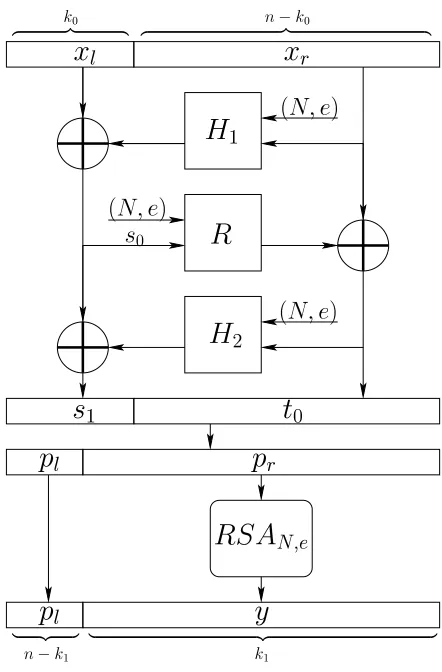
The scheme. Our construction is based on RSA-OAEP [13, 31]. But in place of the randomness in this scheme we use part of the message, and we add an extra round to the underlying transform. Formally, the scheme is parameterized by functionsk0(·), k1(·)>0. The plaintext space PtSp(k) consists of all strings of length at least max(k1(k),2k0(k)+1). We assume here for simplicity that all messages to encrypt have a fixed lengthn=n(k) satisfyingn >2k0 and n≥k1. LetF be an RSA trapdoor-permutation generator with modulus length to k1 =k. The key-generation algorithm of the associated RO-model deterministic encryption scheme RSA-DOAEP (“D” for “deterministic”) runs F and returns (N, e) as the public key and (N, d) as the secret key. Its encryption and decryption algorithms have oracle access to functionsH1, H2:{0,1}∗ → {0,1}k0 and R:{0,1}∗ → {0,1}n−k0, and are defined as follows (see Figure 1 for an illustration of the encryption algorithm):
AlgorithmEH1,H2,R(1k,(N, e), x)
xl ←x[1. . . k0]
xr ←x[k0+ 1. . . n]
s0 ←H1((N, e)kxr)⊕xl
t0 ←R((N, e)ks0)⊕xr
s1 ←H2((N, e)kt0)⊕s0
pl ←(s1kt0)[1. . . n−k1]
pr ←(s1kt0)[n−k1+ 1. . . n]
c←plk(per modN)
Return c
AlgorithmDH1,H2,R(1k,(N, e),(N, d), c)
p1←c[1. . . n−k1]
y←c[n−k1+ 1. . . n]
p←p1k(yd mod N)
s1 ←p[1. . . k0]
t0 ←p[k0+ 1. . . n]
s0 ←H2((N, e)kt0)⊕s1
xr←R((N, e)ks0)⊕t0
t 0
R SA N;e R
s 0
H 2 H
1
(N;e)
s 1
k1
| {z }
n k1 | {z }
0 0
z }| {
z }| {
y p r p
l
p l
(N;e) (N;e) x
l
x r
1
Figure 1: An illustration of the encryption algorithm ofRSA-DOAEP.
Security. The following implies that RSA-DOAEP achieves PRIV-security if RSA is one-way.
Theorem 5.2 Suppose there exists a privacy adversary A= (Am, Ag) against RSA-DOAEPwith min-entropy µ that makes at most qhi queries to oracle Hi for i ∈ {1,2} and qr to oracle R, and
outputs vectors of size v with components of length n. Let qtot =qh1 +qr+qh2. We consider two
cases:
• Case 1: n < k0+k1. Then there is an inverter I against RSA trapdoor-permutation generator F such that
AdvprivRSA-DOAEP,A ≤ qh2v·
q
AdvowfF,I+ 22k1−4(n−k0)+5
+ 2k1−2(n−k0)+5 + 2qrv 2k0 +
2qh1qrv
2µ + 4qtot·
ln(2k1/2−1) 2k1/2−1 . (3) Furthermore the running-time ofI is at most twice that of Aplus O(logv+qh2logqh2 +k
3 1). • Case 2: n≥k0+k1. Then there is an inverter I against RSA trapdoor-permutation generator
F such that
AdvprivRSA-DOAEP,A ≤ v·AdvowfF,I
+ 2qrv 2k0 +
2qh1qrv
2µ + 4qtot·
The proof is in Appendix A.
In practice, we will have e.g. k1 = 1024, and then we can set parameter k0 to, say, 160 bits to effectively maximize security in either case of the theorem. Then, for a given application, the relation between n−160 and 1024 then determines which case of the theorem applies. We note that the weaker security guarantee in Case 1 is analogous to the state-of-the-art for RSA-OAEP itself [31, 46].
Encrypting long messages. Typically, to encrypt long messages efficiently using an asymmetric scheme in practice, one employs hybrid encryption. This methodology in particular applies to the Encrypt-with-Hash construction, in which the starting scheme can be a hybrid one. However, if using hybrid encryption, RSA-DOAEP would no longer be length-preserving (since an encrypted symmetric key would need to be included with the ciphertext). We therefore stress that one can efficiently encrypt long messages using RSA-DOAEP without making use of hybrid encryption. Intuitively, this is possible because the underlying Feistel network in the scheme acts like an “all-or-nothing transform” [19], such that unless an adversary with high min-entropy inverts the RSA image in a ciphertext then it cannot recover any information about the (long) message.
6
Efficiently Searchable Encryption (ESE)
We now turn to the application to outsourced databases, where data is sent to a remote server. The database server is untrusted. The data in each field in the database is to be encrypted separately under the public key of a receiver, who needs to be able to query the server and retrieve encrypted records containing particular data efficiently. Encrypting the data deterministically provides a possible solution to this problem. The database can be then organized into a standard (e.g. tree-based) data structure, and a query, i.e. a ciphertext, specifies the exact piece of data the server needs to locate, so the sever can find it (in say logarithmic time) just like for unencrypted data. In general, though, encryption permitting efficient search does not to be deterministicper se. Accordingly, we first define a more general primitive we callefficiently searchable encryption (ESE).
The new primitive. The idea is to associate a (deterministic) “tag” to each plaintext, which can be computed both from the plaintext and from a ciphertext that encrypts it. The server can compute the tag of a ciphertext to be stored in the database and use it to store the ciphertext appropriately in a data structure. To query a plaintext, the receiver can compute and send its tag, which the server can look up in the data structure, returning any matches and associated data. (The receiver can then decrypt these matches and filter out any false-positives, i.e. ciphertexts with the same tag as the query but which do not decrypt to the intended plaintext.) These two functionalities are captured by the functionsF, G below.
Let AE= (K,E,D) be a public-key encryption scheme with associated plaintext space PtSp(·). We sayAEis aδ-efficiently searchable encryption (-ESE)scheme for some functionδ(·)<1 if there exist deterministic algorithms F, G such that for everyk we have
1. Perfect Consistency: For everykandx1 ∈PtSp(k), the probability that the following experiment returns 1 is 1:
(pk,sk)← K(1$ k) ; c← E(1$ k,pk, x1)
IfF(pk, x1) =G(pk, c) then return 1 ; Else return 0
2. Computational Soundness: For everyk and every algorithmMthat on input 1k outputs a pair
mostδ(k):
(x0, x1)← M(1$ k) ; (pk,sk)← K(1$ k) ; c← E(1$ k,pk, x1) If F(pk, x0) =G(pk, c) then return 1 ; Else return 0
We refer to the output ofF, G as thetag of the message or a corresponding ciphertext.
Above, consistency ensures that the server locatesat least the desired ciphertext(s) on a query, because their tags and those of the plaintext used to form the query are the same. Soundness limits the number of false-positives located as well; if using aδ-ESE scheme, for a sizendatabase we expect to have at most δ·n false-positives on a query, over the choice of data in the database and of the query (both not depending on the remaining), and key-generation and encryption computations. The reasoning for this is as follows. Given query F(pk, x), define for each ciphertext c in the database such thatD(1k,pk,sk, c)6=xthe random variableXctaking value 1 ifF(pk, x) =G(pk, c)
and 0 otherwise. DefineX =P
cXc. The expected number of false positives on the query is then
E[X] = X
c
E[Xc] ≤
X
c
δ ≤ δ·n ,
where the equality is by linearity of expectation and the first inequality follows from soundness. Indeed, any deterministic encryption scheme is a 0-ESE scheme under our definition. Hence the two deterministic encryption schemes we studied, namely Encrypt-with-Hash and RSA-DOAEP, represent two particular 0-ESE schemes. To see this, let DPE= (K,DE,D) be any deterministic public-key encryption scheme. Then letting F and Gbe the algorithms that on inputspk, m and
pk,DE(pk, m), respectively, return DE(pk, m), we see that DPE is 0-efficiently-searchable. That is, the functionδ is identically 0 here, due consistency of encryption.
However, for other ESE schemes δ may be large. This is why Mis not given input pk in the soundness condition; if it were, the condition would not make sense for large δ, because then M could compute tags of messages itself and just output two it finds to agree on their tags. As in our definition of privacy, this restriction is reasonable because real data and queries are unlikely to depend on any public key.
Security of ESE. As our PRIV does not actually require the encryption scheme in question to be deterministic, we can also use it for ESE. Here the rule that a privacy adversary output vectors with the same equality pattern means, intuitively, that we allow the server to learn only which records in the database contain the same field values and how many times each such value occurs (called the occurrence profile of the data), so that it is able to efficiently search. In contrast to deterministic encryption, we will see that using an ESE scheme with large δ can increase privacy (at the cost of more processing by the receiver on a query) when database fields being encrypted do not have high min-entropy.
6.1 Encrypt-and-Hash ESE
We formalize and analyze a probabilistic ESE scheme based on an approach from the database literature in which one appends a (deterministic) hash of the plaintext to a ciphertext to enable efficient search. Let AE= (K,E,D) be any pubic-key encryption scheme andH:{0,1}∗ → {0,1}l
AlgorithmHEH(1k,pk, x)
h←H(pkkx)
y ← E(1k,pk, x) Return ykh
Algorithm HDH(1k,pk,sk, ykh)
x← D(1k,pk,sk, y)
h′ ←H(pkkx)
Ifh′=h then returnx Else Return⊥
Then EaH is a 2−l-ESE scheme. For this, we let F, G be the algorithms that on inputspk, x and
pk,E(pk, x)kH(pkkx), respectively, return the tagH(pkkx); the fact thatδ is identically 2−l here
follows from the fact thatH is a RO with output length l.
The following implies that this construct is PRIV secure if the underlying encryption scheme is IND-CPA, independent ofl.
Theorem 6.1 Suppose there is a privacy adversaryA= (Am, Ag) againstEaHthat outputs vectors of sizev and makes at mostqh queries to its hash oracle. Then there exists an IND-CPA adversary
B againstAEsuch that
AdvEaHpriv,A ≤ 2·AdvAEind,B-cpa + qhv
2µ + qh·mpkAE ,
where mpkAE is the max public-key probability of AE. Furthermore, B makes v queries to its LR-oracle and its running-time is at most that of A.
The proof is in Appendix B.
Bucketization. Theorem 6.1 tells us thatEaH achieves PRIV if plaintexts being encrypted have high min-entropy. But in the case that they do not, one can try to compensate for this by decreasing the length of the hashl(at the cost of more processing by the receiver on a query), resulting in more plaintexts with the same tag. This technique is known asbucketization in the database literature. Intuitively, the scheme may then provide some privacy, even for small message spaces, if an efficient adversary cannot distinguish with too high a probability between ciphertexts whose tags are equal. In the proceedings version of this paper [9], we incorrectly claimed a general bound on the advantage of a privacy adversary A against EaH with hash length l > 0. In fact, our analysis applies only to case that the adversary outputs vectors of size 1 and is interested in recovering the entire message from the ciphertext. The corrected theorem is given below; we leave it open to extend our techniques to the more general case.
Say A= (Am, Ag) is a message-recovery (MR) privacy adversary if the output of Am is always of the form (x, x) for a string x. SupposeAm of a MR privacy adversary A puts a distribution D on a finite set of plaintexts S. LetS ={m1, . . . mM} and pi be the probability assigned to mi by
D, meaningAm outputs (mi, mi) with probability pi. Intuitively, one cannot expect bucketization to increase privacy in all cases because D may be too concentrated at a particular mi. Then, if the adversary sees a ciphertext whose tag is the same as the hash ofmi, it can deduce the latter
decrypts to mi with very high probability. But we show that as long as D is sufficiently “spread
out” overS then bucketization can indeed increase privacy, even if|S|is not too large. The metric we use to measure this is the collision probability Coll[D] of D, which is defined as PM
i=1p2i.
Theorem 6.2 Suppose there is a MR privacy adversary A = (Am, Ag) such that Am puts distri-bution D on a finite set of plaintexts S. Then there exists an IND-CPA adversary B against AE such that
AdvprivEaH′,A ≤ 2·Adv ind-cpa
AE,B + 12·Coll[D]· |S| ·
2−µ·2l
Furthermore, B makes one query to its LR-oracle and its running-time is at most that ofA. The proof is in Appendix C.
Note that it follows from the Cauchy-Schwarz inequality that 1/|S| ≤ Coll[D] above, with equality just when Amputs a uniform distribution on S. So, the closer the collision probability of
Dis to that of the uniform distribution on S, the better our bound. Indeed, it can be shown that the closer the former is to the latter, the “closer”Dis to the uniform distribution onS itself.
We remark that one cannot use a POWHF [21, 22] to compute the tags in place of the RO in the Encrypt-and-Hash construction, because POWHFs are randomized and this will violate the consistency requirement of ESE.
7
CCA and Other Extensions
Our definition, and so far our security proofs, are for the CPA case. Here we discuss extensions to the CCA case and then other extensions such as to hash functions rather than encryption schemes.
PRIV-CCA.ExtendExpprivΠ,A-b(k) to giveAg on input 1k,pk,coracle access toD(1k,pk,sk,·), for
b∈ {0,1}, which it can query on any string not appearing as a component ofc. Note thatAmdoes
not get this decryption oracle. Then let
AdvprivΠ,A-cca(k) = PrhExpprivΠ,A-cca-1(k)⇒1i−PrhExpprivΠ,A-cca-0(k)⇒1i .
Again, a standard conditioning argument shows that
AdvΠpriv,A-cca(k) = 2·PrhExpΠpriv,A-cca-b(k)⇒bi−1,
We say that Π isPRIV-CCA secureifAdvprivΠ,A-cca(·) is negligible for everyAwith high min-entropy.
Encrypt-with-Hash. Deterministic encryption scheme EwH is PRIV-CCA secure even if the starting encryption scheme is only IND-CPAbut meets an extra condition, namely that no cipher-text occurs with too high a probability. More precisely, the max-ciphertext probability mc(·) of AE = (K,E,D) is defined as follows: we let mcAE(k) be the maximum taken over all y ∈ {0,1}∗
and all x∈PtSp(k) of the quantity
Prh(pk,sk)← K(1$ k) ; c← E(1$ k,pk, x) : c=yi .
Then Theorem 5.1 extends as follows.
Theorem 7.1 Suppose there is a PRIV-CCA adversary A = (Am, Ag) against EwH with min-entropy µ, which outputs vectors of size v with components of length n and makes at most qh queries to its hash oracle and at most qd queries to its decryption oracle. Let mpkAE and mcAE be
max public-key and max-ciphertext probabilities ofAE, respectively. Then there exists an IND-CPA adversaryB againstAEsuch that
AdvEwHpriv-,Acca ≤ AdvAEind,B-cpa + 2qhv
2µ + 8qh·mpkAE + 2qd·mcAE . (5)
Furthermore, B makes v queries to its LR-oracle and its running-time is at most that of A plus
The requirement that mcAE(·) be small is quite mild. Most practical encryption schemes have
negligible max-ciphertext probability. For example, the “no-authenticity,” IND-CPA version of RSA-OAEP [14] has max-ciphertext probability equal to 1/2n(k), where n(·) is the length of the messages to encrypt, and ElGamal [32] has max-ciphertext probability 1/|G|, where G is the used group. Thus in practice this does not amount to any extra assumption. Moreover, in general any IND-CPA scheme AE = (K,E,D) can be easily modified to achieve this property. Specifically, define:
Algorithm E∗(1k,pk, x)
r← {0$ ,1}k
c← E(1$ k,pk, x) Return ckr
AlgorithmD∗(1k,pk,sk, ckr)
x← D(1k,pk,sk, c) Returnx
IND-CPA security ofAE∗ follows from IND-CPA security of AE, butmcAE∗ = 2−k.
On the other hand, IND-CPA security does not imply low max-ciphertext probability in general. To prove this, we start with an IND-CPA schemeAE= (K,E,D) and modify it to obtain a scheme AE′ that is still IND-CPA but has high max-ciphertext probability (namely mcAE′ = 1). Scheme AE′= (K,E′,D′) works as follows:
AlgorithmE′(1k,pk, x)
y← E(1$ k,pk,0)
z← D(1k, x, y) Ifz= 0 then return 0 Else return E(1k,pk, x)
AlgorithmD′(1k,pk,sk, c)
If c= 0 then returnsk
Else returnD(1k,pk,sk, c)
Above, we assume that “0” is a special ciphertext not output by E(1k,pk,·) for all k∈N and pk
output byK(1k). It is easy to see that AE′ is IND-CPA butmcAE′ = 1.
RSA-DOAEP.SchemeRSA-DOAEPis not PRIV-CCA, because there is a chosen-ciphertext attack against it. Denote byDOAEPthe three-round Feistel network underlying the scheme andDOAEP−1 its inverse. Consider PRIV-CCA adversary A = (Am, Ag) against RSA-DOAEP that works as follows:
AdversaryAm(1k)
x← {0$ ,1}n Return (x, x)
AdversaryAgD(1k,(N,e),(N,d),·)(1k,(N, e), c)
y← {0$ ,1}k1
c′←c[1. . . n−k
1]k(c[n−k1+ 1. . . n]·ye mod N)
x′ ← D(1k,(N, e),(N, d), c′)
z′← DOAEP(x′)
s←z′[n−k1+ 1. . . n]·y−1 mod N ReturnDOAEP−1(z)
Extensions to other primitives. One can apply (as we do in the proof of Theorem 6.2) our PRIV definition to a more general primitive that we call a (public-key) hiding scheme, which we define as a pair HIDE = (Kg,F) of algorithms, where Kg on input 1k outputs a key K and F takes 1k, K and an inputx to return an output we call the ciphertext. Note that every public-key encryption scheme (K,E,D) has an associated hiding scheme where Kg runs K to receive output (pk,sk) and then returnspk, andF(1k, K,·) is the same asE(1k,pk,·). In general, though, a hiding scheme is not required to be invertible, covering for example the case of hash functions.
Encrypt-and-Hash. PRIV-CCA security of ESE scheme EaH requires IND-CCA security of the starting encryption schemeAEin general, in which case the analogous statements to the theorems in Section 6.1 hold when considering CCA attacks. (In other words, if the starting encryption scheme is IND-CCA then EaH is PRIV-CCA, and more specifically the same bounds as in the theorems hold for PRV-CCA adversaries in this case.) We comment in the proofs of the former how on the proofs change in the CCA case.
In fact, the basic construct generalizes to using any deterministic hiding schemeHIDE= (Kg,F) as defined above in place of the RO in EaH, where we replace a query H(pk, x) in the scheme by F(K,(pk, x)). Let us call the resulting schemeEaHHIDE. Theorem 6.1 then generalizes as follows. Theorem 7.2 Suppose there is a privacy adversary A= (Am, Ag) against EaHHIDE that outputs
vectors of sizev. Then there exists an IND-CPA adversary B against AEand a privacy adversary
A′ againstHIDE such that
AdvprivEaH
HIDE,A ≤ 2·Adv
ind-cpa
AE,B + Adv
priv
HIDE,A′ .
Furthermore, B makes v queries to its LR-oracle,A′ outputs vectors of length v with components of length n, and the running-times of A′, B are at most that of A.
Proof: The proof is similar to the proof of Theorem 6.1, in Appendix B. We define three adver-saries, namelyB, A′ = (A′m, A′g), B′ as follows:
AdvBE(1k
,pk,LR(·,·,b))(1k,pk)
K←$ Kg(1k)
(x1, t1)←$ Am(1k)
c← E(1$ k,pk,LR(0,x
1, b))
y←F(1k, K,x1) Fori= 1 to v do:
c′[i]←c[i]ky[i]
g←$ Ag(1k,(pk, K),c′) Ifg=t1 then return 1 Else return 0
AdvA′ m(1k) (x, t)←$ Am(1k) Return (x, t)
Adv A′
g(1k,pk,c) (pk,sk)← K(1$ k)
y← E($ pk,0) Fori= 1 to v do:
c′[i]←$ y[i]kc[i]
g←$ Ag(1k,(pk, K),c′) Returng
Adv B′E(1k
,pk,LR(·,·,b))(1k,pk)
K ←$ Kg(1k)
(x0, t0)←$ Am(1k) ; (x1, t1)←$ Am(1k)
c← E(1$ k,pk,LR(0,x
0, b))
y←F(1k, K,x0) For i= 1 to v do:
c′[i]←c[i]ky[i]
g←$ Ag(1k,(pk, K),c′) If g=t1 then return 1 Else return 0
The proof is a hybrid argument. Consider modified schemes EaHi = (K′,Ei) for i ∈ {1,2,3,4}
defined as follows. Each EaHi has the same key-generation algorithm, namely K′, which on input
on vectors of size v, and are defined as follows:
E1(1k,(pk, K),x) = E(1k,pk,x)kF(1k, K,x) E2(1k,(pk, K),x) = E(1k,pk,0)kF(1k, K,x)
E3(1k,(pk, K),x) = E(1k,pk,0)kF(1k, K,x′), where (x′, t′)←$ Am(1k) E4(1k,(pk, K),x) = E(1k,pk,x′)kF(1k, K,x′), where (x′, t′)←$ Am(1k).
Above,0denotes the size-vvector with each component 0n, andFis extended to vectors component-wise analogously to encryption, as is “·k·” where both arguments are vectors. Consider a game withA and scheme EaHi fori∈ {1,2,3,4} that goes as follows:
Game 1
(pk, K)← K$ ′(1k)
(x, t)←$ Am(1k)
g←$ Ag(1k, K,Ei(1k,(pk, K),x))
If g=tthen return 1 Else return 0
Denote bypithe probability that this game outputs 1 when run withEaHi. We have by construction
PrhExpprivEaH-1
HIDE,A⇒1
i
= p1; Pr
h
ExpprivEaH-0
HIDE,A⇒1
i
= p4. So, by definition
AdvprivEaH
HIDE,A = p1−p4.
Now we write
p1−p4 = (p1−p2) + (p2−p3) + (p3−p4). (6) To bound the right-hand side above, taking into account the definition of the advantages ofB, A′, B′ we have
AdvindAE,B-cpa = p1−p2; AdvprivHIDE,A′ = p3−p2 ; AdvAEind,B-cpa′ = p4−p3. We substitute these into (6) to get
AdvprivEaH
HIDE,A = Adv
ind-cpa
AE,B + Adv
priv
HIDE,A′ + AdvindAE,B-cpa′ . Now assuming wlog that
AdvindAE,B-cpa′ (k) ≤ AdvindAE,B-cpa(k) and combining-like terms completes the proof.
8
Acknowledgments
We would like to thank Brian Cooper and Cynthia Dwork for helpful discussions, and Alex Dent and Ulrich K¨uhn for feedback on an early draft of this paper. Thanks also to Diana Smetters and Dan Wallach for pointing us to the work of [2, 29]. Finally, we thank the anonymous reviewers of Crypto 2007 for their comments and suggestions.
References
[1] M. Abdalla, M. Bellare, D. Catalano, E. Kiltz, T. Kohno, T. Lange, J. Malone-Lee, G. Neven, P. Paillier, and H. Shi. Searchable encryption revisited: Consistency properties, relation to anonymous IBE, and extensions. In V. Shoup, editor, Crypto ’05, volume 3621 ofLNCS. Springer, 2005. (Cited on page 3, 5.)
[2] A. Adya, W.J. Bolosky, M. Castro, G. Cermak, R. Chaiken, J.R. Douceur, J. Howell, J.R. Lorch, M. Theimer, and R. Wattenhofer. FARSITE: Federated, available, and reliable storage for an incom-pletely trusted environment. In Symposium on Operating System Design and Implementation (OSDI ’02). Springer, 2002. (Cited on page 5, 20.)
[3] R. Agrawal, J. Kiernan, R. Srikant, and Y. Xu. Order preserving encryption for numeric data. In SIGMOD ’04. ACM, 2004. (Cited on page 5.)
[4] G. Amanatidis, A. Boldyreva, and A. O’Neill. New security models and provably-secure schemes for basic query support in outsourced databases. InWorking Conference on Data and Applications Security (DBSec ’07), LNCS. Springer, 2007. (Cited on page 5.)
[5] J.-H. An, Y. Dodis, and T. Rabin. On the security of joint signature and encryption. In L. Knudsen, editor,EUROCRYPT ’02, volume 2332 ofLNCS. Springer, 2002. (Cited on page 17.)
[6] J. Baek, R. Safavi-Naini, and W. Susilo. Public key encryption with keyword search revisited.Cryptology ePrint Archive, Report 2005/151, 2005. (Cited on page 5.)
[7] O. Baudron, D. Pointcheval, and J. Stern. Extended notions of security for multicast public key cryptosystems. InICALP ’00, volume 1853 ofLNCS. Springer, 2000. (Cited on page 9.)
[8] M. Bellare, A. Boldyreva, and S. Micali. Public-key encryption in a multi-user setting: Security proofs and improvements. In B. Preneel, editor, EUROCRYPT ’00, volume 1807 of LNCS. Springer, 2000. (Cited on page 7, 8, 9.)
[9] M. Bellare, A. Boldyreva, and A. O’Neill. Deterministic and efficiently searchable encryption. In CRYPTO ’07, volume 4622 ofLNCS. Springer, 2007. (Cited on page 5, 15.)
[10] M. Bellare, A. Desai, E. Jokipii, and P. Rogaway. A concrete security treatment of symmetric encryption. InFOCS ’97, pages 394–403, 1997. (Cited on page 3.)
[11] M. Bellare, T. Kohno, and C. Namprempre. Authenticated encryption in SSH: provably fixing the SSH binary packet protocol. In Conference on Computer and Communications Security (CCS ’02). ACM, 2002. (Cited on page 5.)
[12] M. Bellare and P. Rogaway. Random oracles are practical: A paradigm for designing efficient protocols. InConference on Computer and Communications Security (CCS ’93). ACM, 1993. (Cited on page 3, 8.)
[13] M. Bellare and P. Rogaway. Optimal asymmetric encryption – how to encrypt with RSA. In A. De Santis, editor,Eurocrypt ’94, volume 950. Springer, 1995. (Cited on page 3, 11.)
[15] D. Boneh and X. Boyen. Secure identity based encryption without random oracles. In M. Franklin, editor,Crypto ’04, volume 3027 ofLNCS. Springer, 2004. (Cited on page 4.)
[16] D. Boneh, G. Di Crescenzo, R. Ostrovsky, and G. Persiano. Public key encryption with keyword search. In C. Cachin and J. Camenisch, editors, EUROCRYPT ’04, volume 3027 of LNCS. Springer, 2004. (Cited on page 3, 5.)
[17] D. Boneh and B. Waters. Conjunctive, subset, and range queries on encrypted data, 2007. (Cited on page 5.)
[18] X. Boyen and B. Waters. Anonymous hierarchical identity-based encryption (without random oracles). In C. Dwork, editor, CRYPTO ’06, volume 4117 ofLNCS. Springer, 2006. (Cited on page 3, 4, 5.)
[19] V. Boyko. On the security properties of OAEP as an all-or-nothing transform. In M. J. Wiener, editor, CRYPTO ’99, volume 1666 ofLNCS. Springer, 1999. (Cited on page 13.)
[20] R. Brinkman, L. Feng, J. M. Doumen, P. H. Hartel, and W. Jonker. Efficient tree search in encrypted data. Technical Report TR-CTIT-04-15, Enschede, March 2004. (Cited on page 5.)
[21] R. Canetti. Towards realizing random oracles: Hash functions that hide all partial information. In B. Kaliski, editor,CRYPTO ’97, volume 1294 ofLNCS. Springer, 1997. (Cited on page 5, 16.)
[22] R. Canetti, D. Micciancio, and O. Reingold. Perfectly one-way probabilistic hash functions. InSTOC ’98. ACM, 1998. (Cited on page 5, 16.)
[23] Y.-C. Chang and M. Mitzenmacher. Privacy preserving keyword searches on remote encrypted data. In J. Ioannidis, A. D. Keromytis, and M. Yung, editors,ACNS ’05, volume 3531 ofLNCS, 2005. (Cited on page 5.)
[24] R. Curtmola, J.A. Garay, S. Kamara, and R. Ostrovsky. Searchable symmetric encryption: Improved definitions and efficient constructions. In A. Juels, R. N. Wright, and S. De Capitani di Vimercati, editors, Conference on Computer and Communications Security (CCS ’06). ACM, 2006. (Cited on page 5.)
[25] E. Damiani, S. De Capitani Vimercati, S. Jajodia, S. Paraboschi, and P. Samarati. Balancing confiden-tiality and efficiency in untrusted relational DBMSs. In S.Jajodia, V. Atluri, and T. Jaeger, editors, Conference on Computer and Communications Security (CCS ’03). ACM, 2003. (Cited on page 5.)
[26] W. Diffie and M. Hellman. New directions in cryptography.IEEE Transactions on Information Theory, 22(6):1130–1140, 1976. (Cited on page 3.)
[27] Y. Dodis and A. Smith. Entropic security and the encryption of high entropy messages. In J. Kilian, editor,TCC ’05, volume 3378 ofLNCS. Springer, 2005. (Cited on page 5.)
[28] D. Dolev, C. Dwork, and M. Naor. Non-malleable cryptography. SIAM Journal on Computing, 30(2), 2000. (Cited on page 3.)
[29] J.R. Douceur, A. Adya, W.J. Bolosky, D. Simon, and M. Theimer. Reclaiming space from duplicate files in a serverless distributed file system. InConference on Distributed Computing Systems (ICDCS’02), 2002. (Cited on page 5, 20.)
[30] T. ElGamal. A public key cryptosystem and signature scheme based on discrete logarithms. IEEE Transactions on Information Theory, Vol. 31, 1985. (Cited on page 11.)
[31] E. Fujisaki, T. Okamoto, D. Pointcheval, and J. Stern. RSA-OAEP is secure under the RSA assumption. In J. Kilian, editor,CRYPTO ’01, volume 2139 ofLNCS. Springer, 2001. (Cited on page 3, 11, 13, 23.)
[33] Y. Gertner, T. Malkin, and O. Reingold. On the impossibility of basing trapdoor functions on trapdoor predicates. In FOCS ’01. IEEE, 2001. (Cited on page 4.)
[34] E.-J. Goh. Secure indexes. Cryptology ePrint Archive, Report 2003/216, 2003. http://eprint.iacr.org/2003/216/. (Cited on page 5.)
[35] S. Goldwasser and S. Micali. Probabilistic encryption.Journal of Computer and System Sciences, 28(2), 1984. (Cited on page 3, 7.)
[36] P. Golle, J. Staddon, and B. Waters. Secure conjunctive keyword search over encrypted data. In M. Jakobsson, M. Yung, and J. Zhou, editors,Applied Cryptography and Network Security Conference (ACNS ’04), volume 3089 ofLNCS. Springer, 2004. (Cited on page 5.)
[37] H. Hacig¨um¨us, B. Iyer, C. Li, and S. Mehrotra. Executing SQL over encrypted data in the database-service-provider model. InConference on Management of data (SIGMOD ’02). ACM, 2002. (Cited on page 5.)
[38] H. Hacig¨um¨us, B. R. Iyer, and S. Mehrotra. Efficient execution of aggregation queries over encrypted relational databases. In Y. Lee, J. Li, K.-Y. Whang, and D. Lee, editors,DASFAA ’04, volume 2973 of LNCS. Springer, 2004. (Cited on page 5.)
[39] B. Hore, S. Mehrotra, and G. Tsudik. A privacy-preserving index for range queries. In M. A. Nascimento, M. Tamer ¨Ozsu, D. Kossmann, R. J. Miller, J. A. Blakeley, and K. B. Schiefer, editors, VLDB ’04. Morgan Kaufmann, 2004. (Cited on page 5.)
[40] B. R. Iyer, S. Mehrotra, E. Mykletun, G. Tsudik, and Y. Wu. A framework for efficient storage security in RDBMS. In E. Bertino, S. Christodoulakis, D. Plexousakis, V. Christophides, M. Koubarakis, K. B¨ohm, and E. Ferrari, editors,EDBT ’04, volume 2992 ofLNCS. Springer, 2004. (Cited on page 5.)
[41] M. Kantracioglu and C. Clifton. Security issues in querying encrypted data. InWorking Conference on Data and Applications Security (DBSec ’05), LNCS. Springer, 2005. (Cited on page 5.)
[42] J. Li and E. Omiecinski. Efficiency and security trade-off in supporting range queries on encrypted databases. In Working Conference on Data and Applications Security (DBSec ’05), LNCS. Springer, 2005. (Cited on page 5.)
[43] M. Luby and C. Rackoff. How to construct pseudorandom permutations from pseudorandom functions. SIAM J. Comput., 17(2), 1988. (Cited on page 5.)
[44] S. Micali, C. Rackoff, and B. Sloan. The notion of security for probabilistic cryptosystems. SIAM Journal on Computing, 17(2):412–426, 1988. (Cited on page 3.)
[45] G. ¨Ozsoyoglu, D. A. Singer, and S. S. Chung. Anti-tamper databases: Querying encrypted databases. InWorking Conference on Data and Applications Security (DBSec ’03), LNCS. Springer, 2003. (Cited on page 5.)
[46] D. Pointcheval. How to encrypt properly with RSA. RSA Laboratories’ CryptoBytes, 5(1), Win-ter/Spring 2002. (Cited on page 13.)
[47] C. Rackoff and D. Simon. Non-interactive zero-knowledge proof of knowledge and chosen ciphertext attack. In Joan Feigenbaum, editor, CRYPTO ’91, volume 576 of LNCS. Springer, 1992. (Cited on page 3.)
[48] R. L. Rivest, A. Shamir, and L. M. Adelman. A method for obtaining public-key cryptosystems and digital signatures. Technical Report MIT/LCS/TM-82, 1977. (Cited on page 11.)
[49] A. Russell and H. Wang. How to fool an unbounded adversary with a short key. IEEE Transactions on Information Theory, 52(3):1130–1140, 2006. (Cited on page 5.)
[51] Arsenal Digital Solutions. Top 10 reasons to outsource remote data protection. http://www.arsenaldigital.com/services/remote_data_protection.htm. (Cited on page 3.)
[52] D. X. Song, D. Wagner, and A. Perrig. Practical techniques for searches on encrypted data. In Sympo-sium on Security and Privacy. IEEE, 2000. (Cited on page 5.)
[53] H. Wang and L.V.S. Lakshmanan. Efficient secure query evaluation over encrypted XML databases. In VLDB ’06. VLDB Endowment, 2006. (Cited on page 5.)
[54] B. Waters. Efficient identity-based encryption without random oracles. In R. Cramer, editor, EURO-CRYPT, volume 3494 ofLNCS. Springer, 2005. (Cited on page 4.)
A
Proof of Theorem 5.2
Since RSA-DOAEPis deterministic, we assume wlog that the plaintext components of a vector x
are distinct for all (x, t) output byAm(1k). We prove Case 1, meaning we suppose thatn−k0 < k1. (This is used in the lemma below.) Case 1 is the “harder” case in the sense that we need to use Lemma 6 from [31]. To state this, we call a partial one-way adversary I′ an algorithm that takes input (N, e), xe modφ(N) and tries to compute just the lastk1−(n−k0) bits ofx. (The fact that it computes thelast n−k0 bits ofxis just for convenience; [31] actually proves something general.) Letk2=k1−(n−k0). For a partial one-way adversary I′, define
AdvpowfF,I′ = Pr
h
((N, e),(N, d))← F(1$ k) ; x← {0$ ,1}k1 ; z←$ I′((N, e), xe) : z=x[k2+ 1. . . k1]
i
.
Intuitively, the lemma says that RSA is one-way if it is partial one-way (andn−k0 is large enough relative tok1).
Lemma A.1 [31, Lemma 6] Let F be an RSA trapdoor permutation generator with modulus length k1 and let I′ be a partial one-way adversary against F. Then there exists an inverter I against F such that
AdvpowfF,I′ ≤
q
AdvowfF,I+ 22k1−4(n−k0)+10 + 2k1−2(n−k0)+5. Furthermore, the running-time ofI is at most twice that of I′ plus O(k3
1).
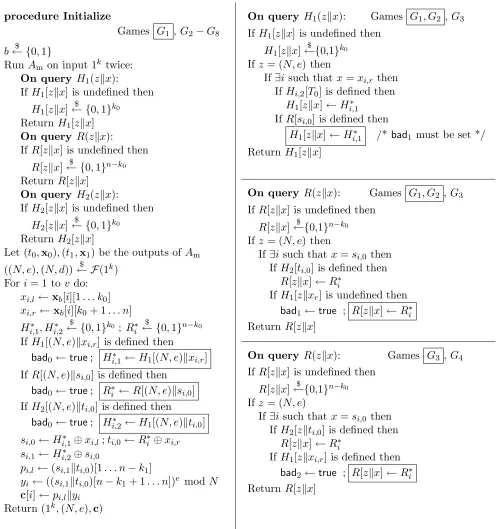
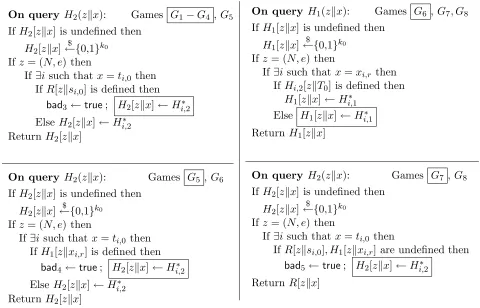
Equation (3) of Theorem 5.2 follows from the following sequence of inequalities, which we will justify below: 1 2 + 1 2Adv
priv-cpa
DOAEP,A = Pr
h
GAg1 ⇒bi (7)
≤ PrhGAg2 ⇒bi + Pr[GAg1 sets bad0] (8) ≤ PrhGAg2 ⇒bi + 2qtot·mpkF (9) ≤ PrhGAg3 ⇒bi + Pr[GAg2 sets bad1] + 2qtot·mpkF (10) ≤ PrhGAg3 ⇒bi + qrv
2k0 + 2qtot·mpkF (11)
≤ PrhGAg4 ⇒bi + qrv
2k0 + Pr[G Ag
3 sets bad2] + 2qtot·mpkF (12) ≤ PrhGAg4 ⇒bi+qrv
2k0 +
qh1qrv
2µ + 2qtot·mpkF (13) ≤ PrhGAg5 ⇒bi + qrv
2k0 +
qh1qrv
2µ + Pr[G Ag
4 sets bad3]
+ 2qtot·mpkF (14)
≤ PrhGAg6 ⇒bi + qrv 2k0 +
qh1qrv
2µ + Pr[G Ag
4 setsbad3]
+ Pr[GAg5 sets bad4] + 2qtot·mpkF (15) = PrhGAg7 ⇒bi + qrv
2k0 +
qh1qrv
2µ + Pr[G Ag
4 sets bad3]
+ Pr[GAg5 sets bad4] + 2qtot·mpkF (16) ≤ PrhGAg8 ⇒bi+qrv
2k0 +
qh1qrv
2µ + Pr[G Ag
4 sets bad3]
+ Pr[GAg5 sets bad4] + Pr[G7Ag sets bad5] + 2qtot·mpkF (17) ≤ 1
2 +
qrv 2k0 +
qh1qrv
2µ + Pr[G Ag
4 setsbad3]
+ Pr[GAg5 sets bad4] + Pr[G7Ag sets bad5] + 2qtot·mpkF (18) ≤ 1
2 + Adv powf
F,GetQuery + qrv 2k0 +
qh1qrv
2µ + 2qtot·mpkF (19) ≤ 1
2 + qh2v·
q
AdvowfF,I + 22k1−4(n−k0)+10 + 2k1−2(n−k0)+5 +qrv
2k0 +
qh1qrv
2µ + 2qtot·mpkF . (20)
As we have seen, the advantage of A is also equal to 2p−1 wherep is the probability that the adversary correctly guesses the challenge bit bin a game where we pick b at random and run the adversary with the first experiment ifb= 1 and the second if b= 0. Equation (7) follows from the fact that GameG1 is just this game written in a convenient way. (The reasoning here is similar to in the proof of Theorem 5.1. We clarify that the two runs of Am in the game have different coins but the same arraysH1, R, H2 are used for the ROs, so they have the same ROs.)
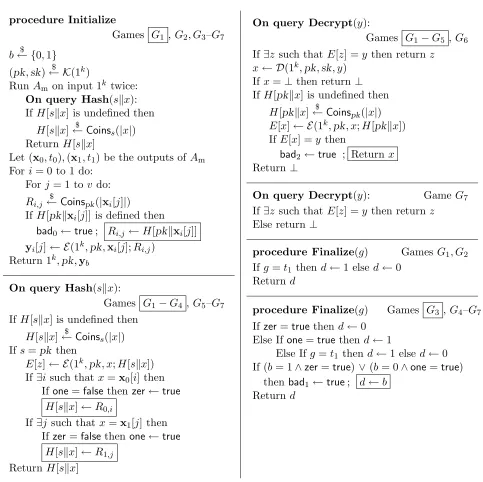
scheme). The probability H1[(N, e)kxi,r], R[(N, e)ksi,0] orH2[(N, e)kti,0] for some i∈ {1, . . . , v} is defined, meaning the array index was queried by Am to its RO, is at most 2q·mpkF because Am, which makes a total of at most qtot queries to all its ROs combined, gets no information about public key (N, e). (The factor of 2 is due to the fact that Am is run twice.) This justifies (9).
As before, the Fundamental Lemma applies to justify (10). To bound the probability that Game G2 when executing Ag sets bad1, note that without Ag querying (N, e)kxi,r (by which we
mean for some i∈ {1, . . . v}) to oracle H1 nor (N, e)kti,0 to H2 (i.e. up to the point that bad1 is set), the values ofH∗
i,1, Hi,∗2, si,1, ti,0 are all random and independently distributed fromxb from its
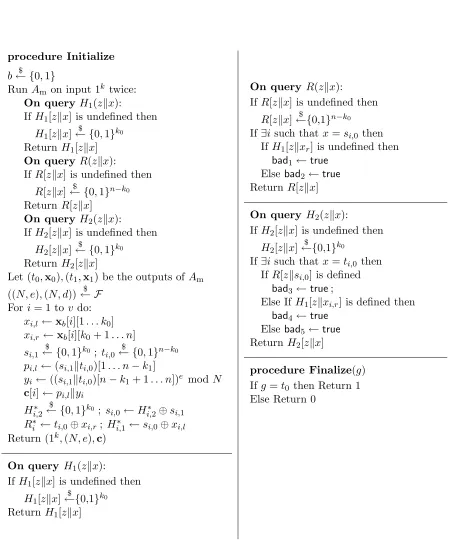
perspective. To be more precise, we define an auxilliary game called Grand, shown in Figure 4, in which all input toAg and answers to its oracle queries are independent and random of xb and the
appropriate independent and dependent variables defined by the game are swapped. We claim that the probability G2 when executing Ag sets bad1 is at most the probability thatGrand does. To see this, we can wlog consider a common finite space of coins associated to the executions games G2 and Grand with Ag where if G2 when executed using some particular sequence of coins from this space setsbad1 thenGrand when executed using this same coin sequence also setsbad1, because the executions of the games on these coin sequences are identical. So the probability of setting bad1 in Grand can only go up as compared to G2. Now, since when executed with Grand, Ag gets no information abouts∗i,0 for any 1≤i≤v, the probability thatGrand when executingAg setsbad1 is at mostqrv/2k0, giving (11).
Equation (12) is again obtained via the Fundamental Lemma in [14]. We bound the probability that G3 when executing Ag sets bad2 by showing that the latter implies Ag has “guessed” xb[i]
without being given any information about it, as follows. This probability is at most the probability thatGranddoes, by an analogous argument to the above. But the probability of thatGrand setsbad2 is, in turn, the same, over a common finite set of coins with whichAgis executed, as the probability that the “knowledge extractor” K shown in Figure 6 outputs a list containing the plaintext xb[i]
for some 1 ≤i≤v, wherex0,x1, b are defined as in Grand. The probability that K outputs such a list is at most qh1qrv/2
µ, because it gets no information about x
b. So we have justified (13).
(We remark that this was the step in the proof where we use the fact that the underlying padding transform of RSA-DOAEP consists ofthree Feistel rounds and not two.)
As usual, the Fundamental Lemma in [14] applies to justify all of (14), (15), and (17). We delay bounding the probabilities here until later.
Next consider when Ag executed with Game G6 queries (N, e)kxi,r to H1 but prior to this has queried neither (N, e)ksi,0to Rnor (N, e)kti,0 toH2. Then, in reply to query (N, e)kxi,r, it receives
H∗
i,1, which is random and independent from everything given toAg so far. Then, after it queries (N, e)kxi,r to H1, we see from the code that the answers given to Ag in reply to any of its queries are likewise random and independent. This means that, instead replying to query (N, e)kxi,r with
the special string H∗
i,1 defined at the beginning of the game, we could simply reply with a random and independent string chosen “on the fly” during the particular invocation of the procedure to respond to H1 queries. In other words, we may drop the “Else” statement in this procedure to result in an equivalent game G6, which justifies (16).
Now, we have that the probability that G8 outputs the challenge bitb chosen randomly at the beginning of the game when executingAg is at most 1/2, because this game does not give Ag any information about xb, giving (18).