Transactions of the 17th International Conference on Structural Mechanics in Reactor Technology (SMiRT 17) Prague, Czech Republic, August 17 –22, 2003
Paper # O01-5
4
+D Virtual Reality Technology for Structural Analysis and Integrated
Maintenance of Nuclear Plants
Il Suk Lee1), Sang Hyuk Yoon2), Kune Y. Suh2)
1)PhiloSOPhIA, Inc., Seoul, Korea 2)Seoul National University, Seoul, Korea
ABSTRACT
In order to timely and competitively respond to rapidly changing energy environment in the twenty-first century there is a growing need to build the advanced nuclear power plants in the unlimited workspace of virtual reality (VR) prior to commissioning. One can then realistically evaluate their construction time and cost per varying methods and options available from the leading-edge technology. In particular a great deal of efforts have yet to be made for time- and cost-dependent plant simulation and dynamically coupled database construction in the VR space. The operator training and personnel education may also benefit from the VR technology. The present work is being proposed in the three-dimensional space and time plus cost coordinates, i.e. four plus dimensional (4+D) coordinates. The 4+D VR
application will enable the nuclear industry to narrow the technological gap from the other leading industries that have long since been employing the VR engineering. The 4+D technologyTM will help nurture public understanding of the
special discipline of nuclear power plants. The technology will also facilitate public access to the knowledge on the nuclear science and engineering which has so far been monopolized by the academia, national laboratories and the heavy industry. The 4+D virtual design and construction will open up the new horizon for revitalization of the nuclear
industry over the globe in the foreseeable future. Considering the long construction and operation time for the nuclear power plants, the preliminary VR simulation capability for the plants will supply the vital information not only for the actual design and construction of the engineered structures but also for the on-line design modification. In this regard it is of utmost importance to employ the 4+D VR technologyTM for the nuclear power plants in their design stage as well
as for the operating plants for optimal maintenance schedules and procedures. By using this technology one can perform structural design optimization needed for building the nuclear power plant. The 4+D VR design and optimized
construction may result in savings of $ 200~300 million per month of reduced construction time for the two units.
KEY WORDS: virtual reality (VR), 4+D VR technologyTM, APR1400, CAD, CFX, ANSYS
INTRODUCTION
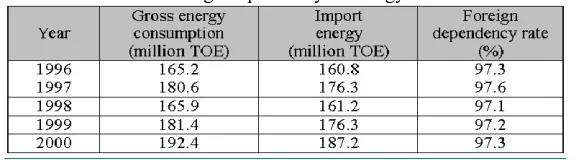
The industrial revolution in the eighteenth and nineteenth centuries is often called the “Energy Revolution.” The civilization has since rapidly advanced the science and technology for relatively a short period of time in the human history. In particular, the twentieth century has witnessed outstanding growth of the energy technology. It is also the energy that deems the destiny of a nation, enriches the human life and supports the economic growth. In Korea about 97% of energy has been dependant on the import and this energy import may further be increased by virtue of the expanding economy and growing industry. The trend appears to persist into the twenty-first century as shown in Table 1.
Table 1. Foreign dependency of energy in Korea
technological challenges imposed by increasing demand for nuclear plants as well as to secure the technological advantage over the alternatives at home and abroad. The current work centers about plant simulation utilizing the virtual reality (VR) technique including database construction based on the simulation in the VR space, because of the economic efficiency in the scientific study and the nuclear plant construction. The outcome of the present work will also supply the indispensable information required to educate and train the nuclear plant personnel.
Thus far, however, the VR research activities in the nuclear sector have been nothing but meager compared to other areas like the automobile, architecture, shipbuilding and aerospace industries. This is most likely because the nuclear technology is relatively more difficult to readily approach and to fully grasp than the other disciplines. In this regard the current paper will focus on the far-reaching effect and economical edge of the four plus dimensional (4+D) technology
materialized in the space and time coordinates simultaneously accounting for the cost of various options in building the nuclear plants [1]. The present effort is concurrent with the world-wide trend in the VR technology and should certainly boost the Korean nuclear industry onto the leading edge.
CHARACTERISTICS OF 4+D VR TECHNOLOGYTM
The VR and 4+D techniques are no longer monopolized by the science fiction movies or digital games. The
technology has already penetrated into our daily lives and is actually being utilized in a wide range of fields. The high-technology industries have come about thanks to the 4+D technique rapidly growing proportional to the progress of the
amazing hardware and the powerful software. Application of this technique will certainly add competitiveness to a specialized industry like the huge nuclear power production market. Development of the simulation technique is in progress for the existing power plants in Korea with the VR technology. If countries like China, a country with great interests in the nuclear power development, and other nuclear power developing and developed countries interested in plant life improvement and extension chooses to apply this new technique, they are expected to get great benefit by reducing construction or maintenance time and cost.
The differences between the conventional two-dimensional (2D) and 4+D technology (including the
three-dimensional modeling) from the design and construction points of view can be summarized as follows. First, the 4+D
VR technologyTM has an intercommunication between a supplier and a user. In this regard the 4+D VR technologyTM
distances itself from the existing 2D technology which is only at the dispense of the supplier. Thus, the 4+D VR
technologyTM allows to cross-communicate between the supplier and the user. Second, much too expensive hardware
and ancillaries were required to realize the 4+D technology until now. The software was not satisfactory, either. But,
these days, the 4+D VR technologyTM is available owing to the software development, the rapid progress of hardware
and the data compressing method. This means that the actualization of VR is no longer limited to the advanced industry. Third, the capability of the 4+D VR technologyTM related to the information transfer far exceeds that of the existing 2D
technology. The technology can suit the purpose and intention of the user regarding the information transfer by using the remarkable modeling and a number of special effects in addition to an image and simple graphic picture. Fourth, the 4+D VR technologyTM overcame the limitation of repetition of the existing 2D technology. It means easier
rearrangement of each component and space organization for the nuclear plants. Fifth, use of the embedded database facilitates jumping over the simple text and picture scan form. The visual databases are available by supplying the definitive design data to the virtual reality space based on the 4+D VR technologyTM. Also, handy search and various
options are available whenever they are needed.
STRUCTURAL ANALYSIS WITH THE 4+D VR TECHNOLOGYTM
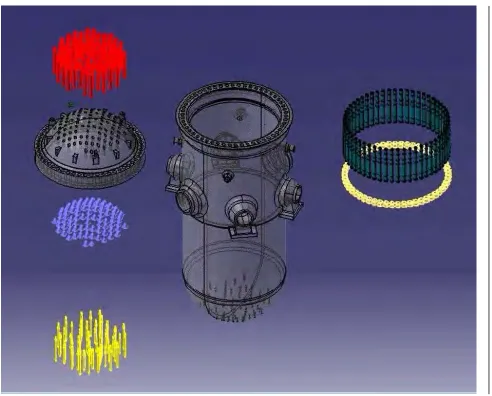
First of all, using the CAD system such as Pro-E, CATIA, Solidwork, etc, each component is digitally mocked up. These models are then converted to a proper file format compatible with the computational fluid dynamics code CFX to compute the flow regime in the structure as shown in Figure 1. Result of the CFX analysis is the proof of efficiency of each component and the boundary conditions for the structural analysis. Finally, using the boundary conditions from the CFX analysis and the model drawn from the CAD system, structural analysis is performed for each component considering the effect of vibration, pressure and mass using the ANSYS code.
DEVELOPMENT OF NUCLEAR PLANT SIMULATOR
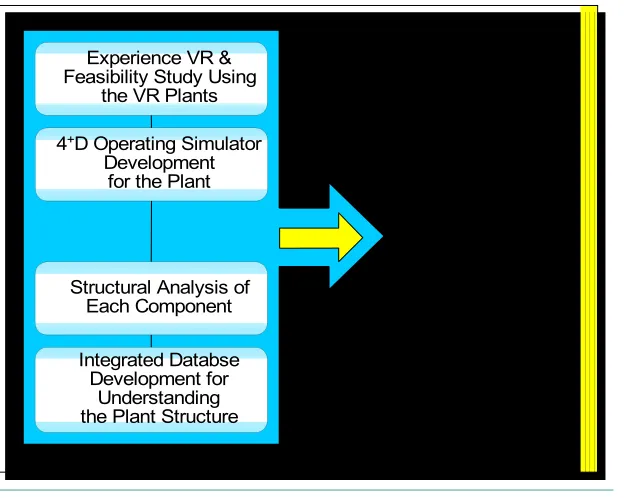
Generally, the plant simulator signifies the 3D structures made with a design drawing in the VR space, not the software for the operator training or education. As we construct the nuclear plants with VR, the space arrangement by various methods can be made and the epochal analysis to promote the efficiency for the space and time can be made about the physical nuclear plants as illustrated in Figure 2.
simple mouse control for each component modification. Second, the component rearrangement and the space organization are facilitated. One can arrange various components in a limited space using the 4+D VR technologyTM that
cannot be tested off-line. Third, there is the linked database. As the database is operated dynamically, the specification and data of each component can be looked up and one can use various options regardless of the time and place.
Figure 1. Direct Import from CAD System Model to Structural Analysis Tool
4+D Modeling & Virtual Reality
Design/ Construction
Experience VR & Feasibility Study Using
the VR Plants
4+D Operating Simulator Development
for the Plant
Structural Analysis of Each Component
Integrated Databse Development for
Understanding the Plant Structure
Pursuant to the above points, one can use the 4+D database and previous construction experience by modularizing
each nuclear plant in order to economize the fabrication process and to improve quality during construction as shown in Figure 3.
Figure 3. Component Modularization
MANAGEMENT OF NUCLEAR PLANTS IN VIRTUAL REALITY
Quite a few companies and research institutions involved with the nuclear plants are integrating, modifying and computerizing the design and construction data. Also, they have supplied various information services to the nuclear market. A great deal of information exists in the form of reports, articles and books, which are just a kind of simple texts and graphic images. But if very large and important information transfer methods are developed for the nuclear plants by means of the 4+D VR technologyTM database, they will tend to greatly benefit the designers, manufacturers,
users and even the public. Moreover, one can understand clearly the total structure of the nuclear plants if the 4+D VR
technologyTM database operates together with the transient analysis simulator. Using these techniques, operators and
engineers can learn about the total structure of the nuclear plants which had not been understood so far. Especially in case of the potential risk in reality, the trainees can safely practice in the VR space. The 4+D VR technologyTM should
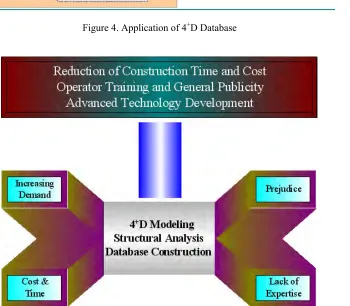
be available for public information about the nuclear industry as well as nuclear plant structure and components. Application may be found in the following areas as suggested in Figure 4.
The characteristics of the 4+D VR technologyTM are that the work is based on the real design and is conducted with
the real delicate 3D modeling according to the size ratio. The 4+D design cooperates with the engineering database very
had to build expensive training facilities. The facilities can now be replaced by VR which cooperates with the 4+D VR
technologyTM database. In addition, one can cut down the cost because of the permanent life cycle of the 4+D VR
technologyTM, as shown in Figure 5.
Figure 4. Application of 4+D Database
Figure 5. Modeling and Database of 4+D VR TechnologyTM
INTEGRATED MAINTENANCE WITH 4+D VR TECHNOLOGYTM
By using the 4+D VR technologyTM one can supply the information to users which couldn’t have been expressed by
the existing technology. Users may not only spin or observe closely the structural elements by simple mouse control, but also know how the main functions work in general. Thus the 4+D VR technologyTM cannot be compared with the
technology that simply enlarges the components. Besides it has a great effect of the information dissemination and the advertisement. Integrated maintenance of the nuclear plants with 4+D VR technologyTM is the manual which can totally
replace the existing data. That is to say, it can actualize the minute details of the components and supply the perfect information about the product by combined flash, 2D photograph and text. Especially, if one applies the 4+D VR
technologyTM to the complex assembly parts or machines, one can clearly experience the effect. Also, if one performs
the integrated maintenance of the nuclear plants with the 4+D VR technologyTM, one can reduce the work hours to the
minimum, and maximize the functioning of each component.
- Simulation of nuclear plants using the 4+D VR technologyTM
- Optimum design of nuclear plants by the 4+D structural analysis
- The 4+D database construction for nuclear plants in VR
- Integrated maintenance of nuclear plants using the 4+D VR technologyTM
Education Education Operation Operation Efficiency Efficiency Simulation of nuclear plants using the 4+D technology
Economics
Economics
Optimum design of nuclear plants by the 4+D structural analysis
The 4+D database construction for nuclear plants in VR
Integrated maintenance of nuclear plants using the 4+D technology
Advanced
Nuclear Industry
Advanced
Advanced
Nuclear Industry
Nuclear Industry
Education Education Operation Operation Efficiency Efficiency Simulation of nuclear plants using the 4+D technologyEconomics
Economics
Optimum design of nuclear plants by the 4+D structural analysis
The 4+D database construction for nuclear plants in VR
Integrated maintenance of nuclear plants using the 4+D technology
Advanced
Nuclear Industry
Advanced
Advanced
Nuclear Industry
Nuclear Industry
Figure 6. Prospect of 4+D VR TechnologyTM
CONCLUSION
This paper has introduced the so-called 4+D VR technologyTM and its impact on tomorrow’s nuclear industry. One
can apply the 4+D VR technologyTM not only to the APR1400 but also to any kind of nuclear plants in the world. By
using this 4+D VR technologyTM, one can pick the optimum construction plan and the optimal structural design for the
nuclear plants. Thus one can expect cost reduction of $ 200~300 million by shortening one month of construction time for the twin units. Also, one can improve the efficiency of business management by dynamically storing voluminous information on the nuclear plants in the 4+D database. One can also anticipate most efficacious control, security,
assurance and transmittal of information on the VR space. The technology will eventually lead to paperless design and construction in the fiercely competitive market of global power generation in the capital societies. The expected benefits of the proposed technology includes simulation of nuclear plants using the 4+D VR technologyTM, optimum design of
nuclear plants by the 4+D structural analysis, the 4+D database construction for nuclear plants in VR, and last, but not
least, integrated maintenance of nuclear plants using the 4+D VR technologyTM.
There is thus an urgent need to develop a technology for VR design and construction for the APR1400 planned to be commissioned by the year 2010. Successful completion of the top-notch 4+D project will most certainly put the
nuclear industry back on the leading edge.
REFERENCES