Volume 2008, Article ID 468693,7pages doi:10.1155/2008/468693
Research Article
Comparing Robustness of Pairwise and Multiclass
Neural-Network Systems for Face Recognition
J. Uglov, L. Jakaite, V. Schetinin, and C. Maple
Computing and Information System Department, University of Bedfordshire, Luton LU1 3JU, UK
Correspondence should be addressed to V. Schetinin,[email protected]
Received 16 June 2007; Revised 28 August 2007; Accepted 19 November 2007
Recommended by Konstantinos N. Plataniotis
Noise, corruptions, and variations in face images can seriously hurt the performance of face-recognition systems. To make these systems robust to noise and corruptions in image data, multiclass neural networks capable of learning from noisy data have been suggested. However on large face datasets such systems cannot provide the robustness at a high level. In this paper, we explore a pairwise neural-network system as an alternative approach to improve the robustness of face recognition. In our experiments, the pairwise recognition system is shown to outperform the multiclass-recognition system in terms of the predictive accuracy on the test face images.
Copyright © 2008 J. Uglov et al. This is an open access article distributed under the Creative Commons Attribution License, which permits unrestricted use, distribution, and reproduction in any medium, provided the original work is properly cited.
1. INTRODUCTION
The performance of face-recognition systems is achieved at a high level when these systems are robust to noise, corrup-tions, and variations in face images [1]. To make face recog-nition systems robust, multiclass artificial neural networks (ANNs) capable of learning from noisy data have been sug-gested [1,2]. However, on large face image datasets, con-taining many images per class (subject) or large number of classes, such neural-network systems cannot provide the per-formance at a high level. This happens because boundaries between classes become complex and a recognition system can fail to solve a problem; see [1–3].
To overcome such problems, pairwise classification sys-tems have been proposed; see, for example, [4]. Pairwise clas-sification system transforms a multiclass problem into a set of binary classification problems for which class boundaries become much simpler than those for a multiclass system. Be-side that, the density of training samples for a pairwise clas-sifier becomes lower than that for a multiclass system, mak-ing a trainmak-ing task even simpler. As a result, classifiers in a pairwise system can learn to divide pairs of classes most effi -ciently.
The outcomes of pairwise classifiers, being treated as class membership probabilities, can be combined into the final class posteriori probabilities as proposed in [4]. This
pro-posed method aims to approximate the desired posteriori probabilities for each input although such an approximation requires additional computations. Alternatively, we can treat the outcomes of pairwise classifiers as class membership val-ues (not as probabilities) and then combine them to make decisions by using the winner-take-all strategy. We found that this strategy can be efficiently implemented within a neural network paradigm in the competitive layer as de-scribed in [5].
However, the efficiency of such pairwise neural-network schemes has not been yet explored sufficiently in face recog-nition applications. For this reason in this paper we are aim-ing to explore the ability of pairwise neural-network systems to improve the robustness of face recognition systems. The exploration of this issue is very important in practice, and that is the novelty of this research. In our experiments, the pairwise neural networks are shown to outperform the mul-ticlass neural-network systems in terms of the predictive ac-curacy on the real face image datasets.
Further inSection 2, we briefly describe a face image rep-resentation technique and then illustrate problems caused by noise and variations in image data. Then inSection 3we in-troduce a pairwise neural-network system proposed to en-hance the robustness of face recognition system. InSection 4
resented as low-dimensional vectors. Principal component analysis (PCA), allowing data to be represented in a low-dimensional space of principal components, is a common technique for image representation in face recognition sys-tems; see, for example, [1–3]. Resultant principal compo-nents make different contribution to the classification prob-lem.
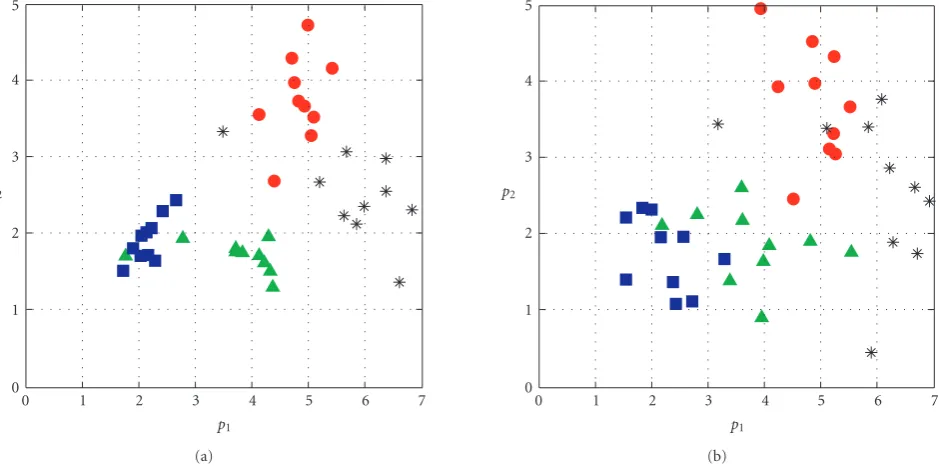
The first two principal components, which make the most important contribution to face recognition, can be used to visualise the scatter of patterns of different classes (faces). Particularly, the use of such visualisation allows us to ob-serve how noise can corrupt the boundaries of classes. For instance,Figure 1shows two examples of data samples repre-senting four classes whose centres of gravity are visually dis-tinct. The left-side plot depicts the samples taken from the original data while the right-side plot depicts the same sam-ples mixed with noise drawn from a Gaussian density func-tion with zero mean and the standard deviafunc-tion alpha=0.5.
From the above plot, we can observe that the noise cor-rupts the boundaries of the classes, affecting the performance of a face recognition system. It is also interesting to note that the boundaries between pairs of the classes do not change much. This observation inspires us to exploit a pairwise-classification scheme to implement a neural network-based face recognition system which would be robust to noise in image data.
3. A PAIRWISE NEURAL-NETWORK SYSTEM FOR FACE RECOGNITION
The idea behind the pairwise classification is to use two-class ANNs learning to two-classify all possible pairs of two-classes. Consequently, forCclasses a pairwise system should include
C∗(C−1)/2 ANNs trained to solve two-class problems. For instance, given C = 3 classes Ω1,Ω2, and Ω3 depicted in
Figure 2, we can setup three two-class ANNs as illustrated in
this figure. The linesfi/ j are the separating functions learnt
by the ANNs to separate classifrom classj. We can assume that functionsfi/ jgive the positive values for inputs
belong-ing to classesiand the negative values for the classesj. Now we can combine functionsf1/2,f1/3, andf2/3to build
up the new separating functionsg1,g2, andg3. The first
func-tiong1combines the outputs of functionsf1/2andf1/3so that
g1=f1/2+f1/3. These functions are taken with weights of 1.0
because bothf1/2andf1/3give the positive output values for
data samples of classΩ1. Likewise, the second and third
sep-arating functionsg2andg3are described as follows:
g2= f2/3−f1/2, g3= −f1/3−f2/3. (1)
In practice, each of the separating functionsg1,. . .,gccan
be implemented as a two-layer feed-forward ANN with a given number of hidden neurons fully connected to the input nodes. Then we can introduceCoutput neurons summing all outputs of the ANNs to make a final decision. For instance,
(−1, +1), and (−1,−1), respectively.
In general, a pairwise neural-network system consists of C(C − 1)/2 ANN classifiers, represented by functions
f1/2,. . .,fi/ j,. . .,fC−1/C, and C output neurons g1,. . .,gc,
wherei < j=2,. . .,C. We can see that the weights of output neuronsgiconnected to the classifiersfi/kandfk/ishould be
equal to +1 and−1, respectively.
Next, we describe the experiments which are carried out to evaluate the performance of this technique on syn-thetic and real face images datasets. The performances of the pairwise-recognition systems are compared with those of the multiclass neural networks.
4. EXPERIMENTS
In this section, we describe our experiments with synthetic and real face image datasets, aiming to examine the proposed pairwise and multiclass neural-network systems. The exam-ination of these systems is carried out within 5-fold cross-validation.
4.1. Implementation of recognition systems
In our experiments, both pairwise and standard multiclass neural networks were implemented in Matlab, using neu-ral networks Toolbox. The pairwise classifiers and the mul-ticlass networks include hidden and output layers. For the pairwise classifiers, the best performance was achieved with two hidden neurons, while for the multiclass networks the numbers of hidden neurons were dependent on problems and ranged between 25 and 200. The best performance for pairwise classifiers was obtained with a tangential sigmoid activation function (tansig), while for multiclass networks with a linear activation function (purelin). Both types of the networks were trained by error back-propagation method.
4.2. Face image datasets
All the face images used in our experiments are processed to be in a grey scale ranging between 0 and 255. Because of large dimensionalities of these data, we used only the first 100 principal components retrieved with function “princomp”.
The face image datasets Cambridge ORL [6], Yale ex-tended B [7], and Faces94 [8], which were used in our exper-iments, were partially cropped and resized in order to satisfy the conditions of using function “princomp”. Image sizes for the ORL, Yale extended B, and Faces94 were 64×64, 32×32, and 45×50 pixels, respectively. For these face image sets, the number of classes and number of samples per subject were 40 and 10, 38 and 60, and 150 and 20, respectively.
4.3. Impact of data density in case of synthetic data
0 1 2 3 4 5 6 7
p1
0 1 2 3 4 5
p2
(a)
0 1 2 3 4 5 6 7
p1
0 1 2 3 4 5
p2
(b)
Figure1: An example of scattering the samples drawn from the four classes for alpha=0 (a) and alpha=0.5 (b) in a plane of the first two principal componentsp1andp2.
f2/3
g3= −f1/3−f2/3 g2=f2/3−f1/2
Ω3 Ω
2
g1=f1/2+f1/3
Ω1
f1/3 f
1/2
x
Figure2: Splitting functionsf1/2,f1/3, andf2/3dividing the
follow-ing pairs of classes:Ω1versusΩ2,Ω1versusΩ3, andΩ2versusΩ3..
xm . . .
x2
x1
f2/3
f1/3
f1/2
−1 −1 +1 −1 +1 +1
g3
g2
g1
C3
C2
C1
Figure3: An example of pairwise neural-network system forC=3 classes.
synthetic data. The synthetic data were generated for four classes which were linearly separable in a space of two vari-ables,p1 andp2 that allowed us to visualise the boundaries
between the classes. Each of these variables ranges between 0 and 1.
The class boundaries are given by the following lines:
y=p1+ 0.5, y=p2+ 0.5. (2)
The number of data samples in each class was given be-tween 10 and 200, making the data density different. Clearly, when the density is higher, the data points are closer to each other, and the classification problem becomes more difficult.
Figure 4shows two cases of the data densities with 10 and
200 samples per class.
From this figure, we see that when the density is high the data samples may be very close to each other, making the classification problem difficult. Hence, when the data den-sity is high or the number of classes is large, pairwise classi-fiers learnt from data samples of two classes can outperform multiclass systems learnt from all the data samples. This hap-pens because the boundaries between pairs of classes become simpler than the boundaries between all the classes.
The robustness of the proposed pairwise and multiclass systems is evaluated in terms of the predictive accuracy on data samples uniformly distributed within (0, 1). The classes
C1,. . .,C4are formed as follows:
C1:p1∈[0, 0.5], p2∈[0, 0.5]; C2:p1∈[0, 0.5], p2∈[0.5, 1.0], C3:p1∈[0.5, 1.0], p2∈[0.5, 1.0];
C4:p1∈[0.5, 1.0], p2∈[0, 0.5].
0 0.25 0.5 0.75 1
p1
0 0.25 0.5 0.75
p2
0 0.25 0.5 0.75 1
p1
0 0.25 0.5 0.75
p2
0.04 0.06 0.08 0.1 0.12 0.14
p1
0.44 0.46 0.48 0.5 0.52
p2
Figure4: High density of data samples makes the classification problem difficult. The zoomed fragment shows how close are the data samples to each other.
15 20 25 30 35 40 45 50 55 60
Number of samples per class 0.75
0.8 0.85 0.9 0.95 1
Pe
rf
o
rm
an
ce
Multiclass Pairwise Yale extended B
Figure5: Performances of the pairwise and multiclass recognition systems versus the numbers of samples per subject. Solid lines and bars are the mean and 2σintervals, respectively.
In our experiments, the numbers of data samples per class were given between 50 and 200.Table 1shows the per-formances of the pairwise and multiclass systems for these data.
From this table we can see that the proposed pairwise system outperforms the multiclass system on 16% and 20% when the numbers of samples are 50 and 200, respectively.
4.4. Impact of data density in case of Yale data
The Yale extended B data contain 60 samples per subject that gives us an opportunity to examine the robustness of the face recognition systems to the data density. In these experiments, we compare the performances of both recognition systems trained on the datasets containing different number of sam-ples per subject. The numbers of these samsam-ples are given 12,
20 40 60 80 100 120 140 160
Number of classes 0.5
0.6 0.7 0.8 0.9 1
Pe
rf
o
rm
an
ce Multiclass (100)
Pairwise Faces94
Figure6: Performance of the pairwise and multiclass-recognition systems over the number of classes. Solid lines and bars are the mean and 2σintervals, respectively.
24, 36, 48, and 60 per subject. Figure 5shows the perfor-mance of the proposed pairwise and multiclass systems over the number of samples per subject.
From this figure, we can see that the proposed pairwise-recognition system significantly outperforms the multiclass system in terms of the predictive accuracy on the test data. For instance, for 24 samples a gain in the accuracy is equal to 9.5%. When the number of samples is 60, the gain becomes 11.5%.
4.5. Impact of the number of classes in case of faces94 data
50 100 150 200 Number of neurons
0.4 0.6 0.8 1
Pe
rf
o
rm
an
ce
25 classes
(a)
50 100 150 200
Number of neurons 0.4
0.6 0.8 1
Pe
rf
o
rm
an
ce
50 classes
(b)
50 100 150 200
Number of neurons 0.4
0.6 0.8 1
Pe
rf
o
rm
an
ce
100 classes
(c)
50 100 150 200
Number of neurons 0.4
0.6 0.8 1
Pe
rf
o
rm
an
ce
150 classes
(d)
Figure7: Performances of the multiclass recognition systems over the number of hidden neurons for 25, 50, 100, and 150 classes. Solid lines and bars are the mean and 2σintervals, respectively.
of the proposed and multiclass recognition systems against different number of classes (subjects). In our experiments, we vary the number of classes between 25 and 150 as depicted
inFigure 6.
From this figure, we can see that when the number of classes varies between 25 and 50, the performance of both systems in terms of predictive accuracy is close to maximal. However, when the number of classes increases, the mance of the multiclass system declines while the perfor-mance of the pairwise system remains near to maximal.
In these experiments, the best performance of the multi-class system was obtained with 100 hidden neurons.Figure 7
shows the performance of the multiclass system versus the numbers of hidden neurons under different numbers of classes.
From this figure, we can observe first that the number of hidden neurons does not contribute to the performance
much. In most cases, the best performance is achieved with 100 hidden neurons.
4.6. Robustness to noise in ORL and Yale datasets
From our observations, we found that the noise existing in face image data can seriously corrupt class boundaries, mak-ing recognition tasks difficult. Hence, we can add noise of variable intensity to face data in order to examine the robust-ness of face-recognition systems. The best way to make data noisy is to add artificial noise to principal components rep-resenting face-image data. An alternative way is to add such noise directly to images. However, this method affects only the brightness of image pixels not the class boundaries loca-tions.
0 0.5 1 1.5
α
0.3 0.4 0.5 0.6 0.7 0.8
Pe
rf
o
rm
an
ce
Multiclass
(a)
0 0.5 1 1.5
α
0.3 0.4 0.5 0.6 0.7 0.8
Pe
rf
o
rm
an
ce
Multiclass Pairwise
(b)
Figure8: Performance of the pairwise and multiclass recognition systems over noise levels alpha. Solid lines and bars are the mean and 2σ intervals, respectively.
Table1: Performance of the pairwise and multiclass recognition systems over the number of data samples. The performances are represented by the means and 2σintervals.
Classification system Number of data samples per class
50 100 150 200
Pairwise 0.965±0.0103 0.981±0.0124 0.983±0.012 0.976±0.0253 Multiclass 0.796±0.157 0.812±0.1485 0.807±0.157 0.774±0.1515
data in order to compare the robustness of the proposed pair-wise and multiclass recognition systems. The performances of the pairwise and multiclass recognition systems over dif-ferent noise levels are shown inFigure 8.
From this figure, we can see that for alpha ranging be-tween 0.0 and 1.3, the proposed pairwise system outperforms the multiclass system. For instance, for alpha=0.0, a gain in the performance is 2.0% on the ORL and 4.0% on the Yale datasets. For alpha=1.1, the gain becomes 10.2% and 14.1%, respectively.
5. CONCLUSION
In order to reduce the negative effect of noise, corruptions, and variations in face images, we have proposed a pairwise neural-network system for face recognition. We assumed that the use of such classification scheme can improve the robust-ness of face recognition. Such assumption has been made on the base of our observations that the boundaries between pairs of classes are corrupted by noise much less than the boundaries between all the classes. High density of data can
also make the recognition task difficult for multiclass sys-tems.
We have compared the performances of the proposed pairwise and multiclass neural-network systems on the syn-thetic data as well as on the real face images. Having esti-mated the mean values and standard deviations of the per-formances under different levels of noise in the image data and different numbers of classes and samples per subject, we have found that the proposed pairwise system is superior to the multiclass neural-network system.
Thus, we conclude that the proposed pairwise system is capable of decreasing the negative effect of noise and varia-tions in face images. Clearly, this is a very desirable property for face recognition systems when the robustness is of crucial importance.
ACKNOWLEDGMENTS
available online. The authors are also thankful to the anony-mous reviewers for their constructive comments.
REFERENCES
[1] S. Y. Kung, M. W. Mak, and S. H. Lin,Biometric Authentica-tion: A Machine Learning Approach, Pearson Education, Beijing, China, 2005.
[2] C. Liu and H. Wechsler, “Robust coding schemes for indexing and retrieval from large face databases,”IEEE Transactions on Image Processing, vol. 9, no. 1, pp. 132–137, 2000.
[3] A. S. Tolba, A. H. El-Baz, and A. A. El-Harby, “Face recognition: a literature review,” International Journal of Signal Processing, vol. 2, no. 2, pp. 88–103, 2005.
[4] T. Hastie and R. Tibshirani, “Classification by pairwise cou-pling,” in Proceedings of the 1997 Conference on Advances in Neural Information Processing Systems 10, pp. 507–513, Denver, Colo, USA, 1998.
[5] V. Schetinin, J. Schult, B. Scheidt, and V. Kuriakin, “Learn-ing multiclass neural-network models from electroencephalo-grams,” inKnowledge-Based Intelligent Information and Engi-neering Systems, vol. 2773 ofLecture Notes in Computer Science, pp. 155–162, Springer, Oxford, UK, 2003.
[6] F. S. Samaria and A. C. Harter, “Parameterisation of a stochastic model for human face identification,” inProceedings of the 2nd IEEE Workshop on Applications of Computer Vision (ACV ’94), pp. 138–142, Sarasota, Fla, USA, December 1994.
[7] A. S. Georghiades, P. N. Belhumeur, and D. J. Kriegman, “From few to many: illumination cone models for face recognition un-der variable lighting and pose,” IEEE Transactions on Pattern Analysis and Machine Intelligence, vol. 23, no. 6, pp. 643–660, 2001.