Volume 2007, Article ID 19675,10pages doi:10.1155/2007/19675
Research Article
Efficient Recursive Multichannel Blind Image Restoration
Li Chen, Kim-Hui Yap, and Yu He
Division of Information Engineering, School of Electrical and Electronic Engineering, Nanyang Technological University, 50 Nanyang Avenue, Singapore 639798
Received 3 May 2006; Revised 25 August 2006; Accepted 26 August 2006
Recommended by Mark Liao
This paper presents a novel multichannel recursive filtering (MRF) technique to address blind image restoration. The primary motivation for developing the MRF algorithm to solve multichannel restoration is due to its fast convergence in joint blur iden-tification and image restoration. The estimated image is recursively updated from its previous estimates using a regularization framework. The multichannel blurs are identified iteratively using conjugate gradient optimization. The proposed algorithm in-corporates a forgetting factor to discard the old unreliable estimates, hence achieving better convergence performance. A key feature of the method is its computational simplicity and efficiency. This allows the method to be adopted readily in real-life ap-plications. Experimental results show that it is effective in performing blind multichannel blind restoration.
Copyright © 2007 Hindawi Publishing Corporation. All rights reserved.
1. INTRODUCTION
Image restoration deals with the estimation of the original images from the observed blurred, degraded images using the partial information about the imaging system. It is an ill-posed problem as the uniqueness and stability of the solution are not guaranteed [1]. In many applications such as remote sensing and microscopy imaging, multiple degraded images of a single scene become available while the blurring function or point spread function (PSF) of each channel remains un-known. Therefore, the recovery of the original scene from its multiple observations is required and this problem is, com-monly, referred to as multichannel blind image restoration [2].
Various researchers have investigated the problem of multichannel image restoration over the years. With the as-sumption that the multichannel PSFs are weakly coprime, and in the absence of noise, the desired image and PSFs can be transformed into the null space of a special matrix con-structed from the degraded images [3–6]. Centered on this idea, several techniques have been proposed which include greatest common divisor (GCD) [3], subspace-based [4,5], and eigenstructure-based approaches [6]. The GCD method is based on the notion that the desired image can be regarded as the polynomial GCD among the degraded images in the z-domain. Subspace-based methods work by first estimating the blurring function using a procedure of min-eigenvector, followed by conventional image restoration using the
identi-fied PSFs. In similar concept, eigenstructure-based algorithm transforms the null space problem into a constrained opti-mization framework and performs directdeconvolver estima-tion. The aforementioned null space-based methods, how-ever, suffer from noise amplification, which often lead to poor solutions in the noisy environments.
single-channel blind image restorations approaches. There-fore, if an extra degraded image becomes available at a later stage, the iterative schemes will require a complete rerun, rather than a recursive process to update the estimate. This is, clearly, inflexible and computationally inefficient.
In view of this, we develop a new efficient algorithm called multichannel recursive filtering (MRF) to solve blind multichannel image restoration. To the best of our knowl-edge, no previous work on recursive filtering has been devel-oped to address blind multichannel image restoration. The estimated image is recursively updated from the previous es-timate using a regularization framework. All the operations of MRF are performed in discrete Fourier transform (DFT) domain, giving rise to fast and simple implementation. The multichannel PSFs are identified iteratively using the conju-gate gradient optimization. The proposed algorithm incor-porates a forgetting factor to discard the old unreliable es-timates, hence achieving better convergence performance. A key feature of the method is its computational simplicity and efficiency. This allows the new method to be adopted readily in real-life applications.
The rest of this paper is organized as follows.Section 2
provides a brief discussion on the multichannel blind restoration problem. InSection 3, the development of recur-sive image restoration algorithm is presented. InSection 4, issues related to the selection of regularization parameters and forgetting factor are discussed. Simulation results are given inSection 5. InSection 6, conclusions and further re-marks are drawn.
2. PROBLEM FORMULATION
In this work, we are interested in the single-input multiple-output (SIMO) multichannel blind image restoration prob-lem. Considering the SIMO linear degradation system that consists ofKmeasurements of the original imagef, the ob-served degraded image of theith-channel can be modeled as [3–6]:
gi=hi∗f+ni, i=1, 2,. . .,K, (1)
where∗denotes two-dimensional (2D) convolution,gi,hi, andnirepresent the degraded image, PSF, and noise of the ith-channel, respectively. To tackle the ill-posed nature of image restoration,Tikhonov-Millerregularization theory has been employed in the restoration scheme, as it is effective in edge preservation and noise suppression. The regulariza-tion principle has been extended to a double regularizaregulariza-tion framework that imposes smoothness constraint in both the image- and blur domains. In terms of theith-channel, it can be described by [7–12]:
gi−hi∗f2
=ni2≤ε2 i,
c∗f2≤γ2, d
i∗hi2≤δi2,
(2)
where · represents theL2-norm.εi,γ,δi are the upper bounds related to the noise, image, and PSF terms, respec-tively.canddiare the regularization operators and usually take the form of a high-pass filter. The first term in (2) is
the data-fidelity term, while the second and third terms are the regularization functionals that impose smoothness con-straints on the image- and blur-domains, respectively. In or-der to perform joint blur identification and image restora-tion for multichannel problem, the following cost funcrestora-tion is formulated overKchannels:
J(f,h)=K
i=1
gi−hi∗f2
+αic∗f2+β
idi∗hi2,
(3)
whereh = {h1,. . .,hK}is the multichannel blurs. The cost function in (3) consists of the data-fidelity term, and the image- and blur-domain regularization terms.αiandβiare the regularization parameters that offer a compromise be-tween least-square fidelity error and the regularity of the so-lutionsfandhi. As it is computationally intensive to perform joint optimization to estimatefandhsimultaneously, an it-erative strategy based on alternating minimization (AM) is adopted to project the overall cost functionJ(f,h) into the image-domain cost functionJ(f | h) and the blur-domain cost functionJ(h | f). It can be shown thatJ(f | h) and J(h|f) are quadratic with positive semidefinite Hessian ma-trices. This suggests that the cost function in each domain is convex, hence ensuring the convergence in their respec-tive domains. In conventional iterarespec-tive multichannel blind restoration algorithms [12–14], if a new degraded image (i.e., (K+1)-th measurement gK+1) becomes available at a later stage, the iterative schemes will require a complete rerun, hence incurring a significant computational cost. The pro-posed method strives to alleviate this difficulty by developing a recursive algorithm to update the estimate, thereby reduc-ing the computational cost.
3. RECURSIVE FILTERING FOR MULTICHANNEL BLIND IMAGE RESTORATION
3.1. Multichannel recursive filtering (MRF)
The overall cost function in (3) consists of two sets of un-known variables: image and blur. As explained earlier, we projectJ(f,h) into the image-domain cost functionJ(f |h) by fixing the blurring filtershto give
J(f|h)=K
i=1
gi−hi∗f2
+αic∗f2. (4)
It is observed that (4) is a convex function with respect to
(i) Initialize the algorithm by setting
f(0)=0, R(0)=0, λ≤1. (5)
(ii) For the (n+ 1)th channeln=0, 1,. . .,K−1, setαn+1,cn+1, and calculate the 2D-DFTa:
f(n)=Ff(n), g n+1=F
gn+1
, Hn+1=F
hn+1
, Cn+1=F
cn+1 .
(6)
Update the old estimate recursively:
f(n+1)(ω)=f(n)(ω) +H H
n+1(ω)gn+1(ω)− Hn+1(ω) 2
+αn+1Cn+1
ω)2f(n)(ω)
R(n+1)(ω) , (7)
whereR(n+1)(ω)=λR(n)(ω) +|H
n+1(ω)|2+αn+1|Cn+1(ω)|2. Calculate the inverse DFT:
f(n+1)=F−1f(n+1) (8)
aIn Matlab, the 2D-DFT of the PSF and regularization operator is implemented usingpsf2otf, while for images, it is implemented usingfft2function.
Algorithm1: Summary of the multichannel recursive filtering for image restoration.
Letf(n)n=1, 2,. . .,K be the estimated image from the observed data{g1,. . .,gn}at thenth recursive step. The es-timatedf(n+1)can be updated by using the information con-tained in the newly received observationgn+1through
f(n+1)=f(n)+u(n+1), (9)
whereu(n+1)is the update term, to be derived in the later part of this section. In the development of MRF, we incorporate a forgetting factorλinto the cost function of (4) to ensure that the data in the distant past are assigned less emphasis [16]. Thus, we can reexpress (4) in the matrix-vector notation with the forgetting factorλas
f(n)=min f
n
i=1
λn−i gi−Hif2
+αiCf2, (10)
whereHiandCare the block-circulant matrices that are con-structed fromhiandc, respectively. The selection issue ofλ,
c,αiwill be discussed in the next section. It is worth men-tioning that the special case ofλ=1 meansinfinite memory as the effect of past data is not attenuated. In contrast, the exponentially decaying memory channel (λ < 1) is used in time-varying environment. The closed-form solution to the least squares problem in (10) using the pseudoinverse is given by
f(n)=R(n)−1r(n), (11)
where R(n) = n
i=1λn−i(HHi Hi + αiCHi Ci) and r(n) = n
i=1λn−iHHi gi. The superscript (·)H denotes the conjugate transpose.
When the cost function (10) includes the newly available (n+ 1)th channel, the estimatef(n+1)is given as
f(n+1)=R(n+1)−1r(n+1), (12)
whereR(n+1)=λR(n)+HH
n+1Hn+1+αn+1Cn+1H Cn+1andr(n+1)= λr(n)+HHn+1gn+1. The estimatef(n+1)will depend on the (n+ 1)th identified blurhn+1, which is estimated from the blur identification step explained in the next subsection.
Substituting (9) and (11) into (12), the update term
u(n+1)is given as
u(n+1)=R(n+1)−1
× HHn+1gn+1− HHn+1Hn+1+αn+1Cn+1HCn+1
f(n).
(17)
Hence, the (n+ 1)th least squares estimatef(n+1)can be com-puted recursively from its previous estimatef(n)using (9) and (17). However, the matrix (R(n+1))−1 cannot be computed readily from (R(n))−1due to the huge computation cost as-sociated with the inversion of the matrix (λR(n)+HH
n+1Hn+1+ αn+1Cn+1HCn+1)−1(dimension ofMN×MN, whereM×Nis the size of the image). To address this issue, we exploit the di-agonalization properties of the 2D-DFT for block-circulant matrix. The recursive filtering in spatial domain is trans-formed into the DFT domain. The proposed MRF image restoration is derived and summarized inAlgorithm 1where the superscript “∼” is used to denote the signal in the fre-quency domain, andω=(ωx,ωy) is used to denote the fre-quency pair along theX- andY-axes, respectively.
3.2. Blur identification
(i) For theith channel (i=1, 2,. . .,K), initialize the conjugate vector by setting
q(0)= −∇
hiJ(0) (14)
(ii) At the (n+ 1)th CGO iteration,n=0, 1,. . ., update thenth iteration blur estimate:
hi(n+1)=hi(n)+η(n)q(n), whereη(n)= ∇hiJ(n) 2
q(n)∗f2+βidi∗q(n)2. (15)
Update thenth conjugate vector:
q(n+1)= −∇
hiJ(n)+ρ(n)q(n), whereρ(k)=
∇h
iJ(n+1) 2
∇h
iJ(n)
2 . (16)
Repeat until convergence or a maximum number of iterations is reached.
Algorithm2: Summary of conjugate gradient optimization for blur identification.
correlation (MCSC) criterion in [17] to perform blur sup-port estimation. The cost function involved in the blur coef-ficients estimation is given by
Jh1,. . .,hK|f
=
K
i=1
gi−hi∗f2
+βidi∗hi2. (17)
The gradient ofJ(h|f) with respect tohi{i=1, 2,. . .,K}is given by
∇hiJ(x,y)=2
hi(x,y)∗f(x,y)−gi(x,y)∗f(−x,−y) + 2βidi(x,y)∗hi(x,y)∗di(−x,−y).
(18)
Conjugate gradient optimization (CGO) is used to minimize the cost function in (17). CGO utilizes conjugate direction instead of local gradient to search for the minima. There-fore, it can achieve faster convergence when compared with steepest descent method. It also requires less storage require-ment and computational complexity when compared with Quasi-Newton method. Conjugate gradient optimization is ideal in this application as the given Hessian matrices are sparse, leading to fast convergence in small number of it-erations. The mathematical formulations of blur identifica-tion based on conjugate gradient optimizaidentifica-tion are derived in
Algorithm 2.
3.3. Schematic overview
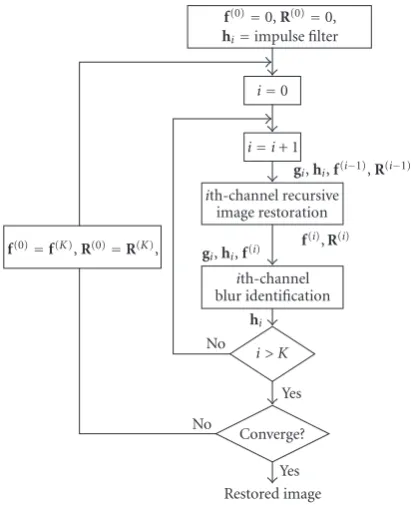
The schematic overview of the proposed algorithm is given in
Figure 1. The idea is to alternately minimize the cost function with respect to the commonfand the PSFshi. The flowchart consists of two key steps. The first step performs recursive image restoration to yieldf(i)usingf(i−1),R(i−1), and the new data of theith-channel. The second step performs blur iden-tification using the conjugate gradient minimization to reach
f(0)=0,R(0)=0, hi=impulse filter
i=0
i=i+ 1
gi,hi,f(i 1),R(i 1) ith-channel recursive
image restoration f(i),R(i) gi,hi,f(i)
ith-channel blur identification
hi
No i > K
Yes No
Converge? Yes Restored image f(0)=f(K),R(0)=R(K),
Figure1: Schematic diagram of the proposed algorithm.
the optimal solutionhi. LetKbe the total number of chan-nels, the inner loop of the procedure will run these two steps alternately until data from all K channels have been com-puted. Unlike recursive filtering in 1D adaptive filter design, multichannel image restoration does not have hundreds of measurements. Therefore, we propose to reuse the estimates
The contributions of the proposed technique, therefore, include the following. (i) As opposed to other multichannel restoration algorithms, it does not require all the data to be available simultaneously as recursive filtering updates the es-timate based on first-come-first-served basis. (ii) All the op-erations of MRF for image-domain minimization are con-ducted in the frequency domain through DFT, hence effi -ciently reduce the computational cost. (iii) It incorporates a forgetting factor to discard the old unreliable estimates, hence achieving better convergence performance.
4. ISSUES ON PARAMETER SELECTION
4.1. Regularization parameters and operators
The regularization framework is instrumental in providing satisfactory results in image restoration. Lete(n)denote the residual error betweenf(n)in (11) and the original imagefin (1). In the DFT domain,e(n)is given by
e(n)(ω)=f(n)(ω)−f(ω)
=
n
i=1λn−iHiH(ω)ni(ω) n
i=1λn−iHi(ω) 2
+αiC(ω)2
− f(ω)
n
i=1λn−iαiC(ω) 2 n
i=1λn−iHi(ω) 2
+αiC(ω)2. (19)
It can be observed that the error consists of two parts: the noise and the image terms. The first part is the noise term, which will be large for smallHi(ω) if there is no regulariza-tion termαi|C(ω)|2. Thus,α
i|Ci(ω)|2will reduce the impact of noise term. However, this is at the cost of producing a small bias to the actual image. In order to makee(n)as small as possible, a reasonable compromise needs to be reached be-tween these two terms by careful determination of regular-ization parameter and operator. Previous work on the selec-tion of the regularizaselec-tion parameter includes set theoretic ap-proach and generalized cross-validation [19]. We follow the idea ofset theoreticin [19] to estimate the regularization pa-rametersαiandβi:
αi= ε 2 i γ2 ≈
MNσ2 i
c∗f2, βi=
ε2 i δ2
i ≈
MNσ2 i
di∗hi2, (20)
whereεi,γ,δiare the upper bounds related to the noise, im-age, and PSF terms in (2).σ2
i is the noise variance in thei th-channel, which can be estimated from the smooth regions of the image. Equation (20) suggests a rule of thumb to choose reasonable regularization parameters based on the noise, im-age, and PSF conditions. In the experiments, the regulariza-tion parametersαiandβiare initialized and remained con-stant during the AM procedure. It is also possible to use the estimatedσi,f, andhto provide an order-of-magnitude esti-mate for the regularization parameters [12,14,19]. The sim-ulation results show that the algorithm is robust towards dif-ferent regularization parameters so long as they fall within a reasonable range.
As PSF is generally a low-pass filter,cshould be taken as a high-pass filter (or simply as an identity matrixC=I), which imposes smooth constraints on the images. The analysis on the regularization operatordiis similar toc. In the appendix, an analysis on how the regularization result of (10) is affected by the error in the PSFs is outlined.
4.2. Forgetting factor
The introduction of forgetting factor is centered on the ob-servation that when the estimated image converges to the original one, the identified blur will approach the actual PSF in the alternating minimization scheme. It can be observed from (10) that if the forgetting factor is 0 ≤ λ < 1, the scheme will diminish older, less reliable estimatedhi, and fa-vor later, more updated estimate. Generally speaking, the for-getting factor plays the role as an adaptive weight to ensure that the data in the distant past are assigned less emphasis. Even though the optimal value of the forgetting factor can be derived theoretically using constrained optimization tech-nique such as Lagrange multiplier method, this optimal value is a function of the original image, PSF, and noise, of which we have no prior knowledge. Therefore, it is tedious and im-practical to estimate this optimal value during iterative min-imization. It should also be noted from the experiments that the proposed method will produce reasonable results so long as the forgetting factor is within a reasonable range. There-fore, estimation of exact optimal value is not required. In this work, we letλ = ζ1/K, whereζ is the memory attenuation rate,K is the number of channels. For example,λ =0.31/K means that the current channel has a weight of only 30% left in its next iteration.
5. EXPERIMENTAL RESULTS
5.1. Multichannel blind restoration under noisy conditions
The effectiveness of the proposed method is illustrated under different blurring conditions. For performance evaluation, peak signal-to-noise ratio (PSNR) is chosen as the objective performance metric. InFigure 2(a), the original “Board” im-age of size 256×256 is selected as the test image. The image is blurred by four 5×5 Gaussian blurs:
h(i,j)=aexp
−
i2+j2
2σ2
, i,j=0,±1,±2, (21)
corresponding to different values ofσi = {2.0, 2.5, 3.0, 3.5}, whereσ is the standard deviation of the Gaussian blur. The parameter a is the normalization constant which ensures the PSF coefficients sum up to 1. Further, the blurred im-age is degraded under different noise levels to produce dif-ferent SNR values{30 dB, 33 dB, 36 dB, 40 dB}. Through this, we can simulate four acquisition channels with variable blur-ring functions and noise levels, as shown inFigure 2(b).
(a) (b)
(c) (d)
Figure2: Multichannel blind image restoration results. (a) Original “Board” image. (b) A sampled blurred image out of the four degraded images. (c) Restored image using the proposed MRF algorithm with identity regularization operator. (d) Restored image using the proposed MRF algorithm with Laplacian regularization operator.
preprocessed using theedgetaperfunction in Matlab to en-sure that the images are circularly symmetric. The forgetting factor is taken asλ=ζ1/K, whereζ =0.05 andK =4. The regularization parameters are calculated according to (20), while the regularization operators are simply taken as iden-tity matrix or high-pass filter. The outer loop iteration num-ber is set to 10, while the CGO iteration for blur identifica-tion is 5.
The restored image using the proposed algorithm is shown in Figures 2(c) and 2(d). Figure 2(c) is the re-stored image with identity regularization operator, while
Figure 2(d)is the restored image with Laplacian filter. It is observed that the approach is effective in recovering detailed information, as demonstrated by the clear numbers on the board. The satisfactory subjective inspection of the image is supported by objective performance measure as our method offers a PSNR of 21.93 dB in Figure 2(c) and 22.43 dB in Figure 2(d), compared to 12.46 dB for the degraded images. Empirical results show that the proposed algorithm is not sensitive to the exact choice of regularization operators so
long as they are reasonable. As the restored image with Lapla-cian operator offers better PSNR value, we will use Laplacian regularization operator for the next experiments.
5.2. Comparison with other multichannel restoration methods
(a) (b) (c)
(d) (e) (f)
Figure3: Comparison of different restoration results in 30 dB noise environment. (a) Original “satellite” image. (b) One of the three de-graded images. (c) Restored image using the proposed MRF algorithm. (d) Restored image using the CGO-AM algorithm. (e) Restored image using the TV-AM algorithm. (f) Restored image using the WF-AM algorithm.
null space of blur are incorporated into the TV-AM scheme. The parameter settings of CGO-AM and TV-AM are calcu-lated according to [12,14]. We have tried different parameter assignments to determine the suitable setting for all meth-ods. The approach of WF-AM is explained as follows. The recursive filtering of image-domain cost function of the pro-posed method is similar to Wiener filtering. Since blind im-age restoration involves imim-age restoration and blur identifi-cation, we replace the ith-channel recursive image restora-tion in Figure 1by Wiener filtering. Conventional Wiener filtering [20] is performed using f(w) = (Hi(ω)THi(ω) + αi)−1Hi(ω)Tgi(ω), whereαi is the power spectrum ratio of the noise to the restored image.Hiandgiare the PSF and de-graded image in theith-channel, respectively. This outlines the WF-AM scheme to perform joint blur identification and image restoration. The iteration number is set to 10 for all methods.
The 256×256 “satellite image” shown inFigure 3(a)is degraded by different blurs under different noisy conditions (30 dB and 40 dB SNR noise). The proposed MRF, CGO-AM, TV-AM, and WF-AM are applied to the blurred image in
Figure 3(b). The restored images are given in Figure 3(c)–
3(f) for 30 dB noisy conditions, where PSNR is tabulated in Table 1 for 30 dB and 40 dB noisy conditions. On aver-age, the proposed method yields 0.6 dB, 3.2 dB, and 3.8 dB improvements over the CGO-AM, TV-AM, and WF-AM
Table1: Comparison of different restoration algorithms.
PSF Gaussian 7×7,σi= {2.5, 3.0, 3.5} Time
Noise level 30 dB 40 dB
Proposed MRF 28.58 dB 29.41 dB 64 s
CGO-AM 27.96 dB 28.70 dB 89 s
TV-AM 25.42 dB 26.10 dB 179 s
WF-AM 24.54 dB 25.85 dB 55 s
0 10 20 30 40 50 60 70
26 26.5 27 27.5 28 28.5 29 29.5 30
Iterations
PSNR
0.6 0.8 1
Figure4: The profile of PSNR versus the number of iterations with different forgetting parametersλ=ζ1/5, whereζ= {0.6, 0.8, 1.0}.
than the CGO-AM and TV-AM methods is due to efficient recursive updating of the images.
5.3. Impact of forgetting factor
To study the impact of forgetting factor experimentally, the proposed MRF algorithm is run with different forgetting fac-tors. The 256×256 “Lena” image is degraded by 7×7 Gaus-sian blurs with σi = {2.0, 2.3, 2.6, 2.9, 3.2}. The regulariza-tion operators are standard Laplacian high-pass filter. Based on the 5 observed degraded images, the proposed MRF al-gorithm is repeated, but with different forgetting parameters λ =ζ1/5, whereζ = {0.6, 0.8, 1.0}. The outer loop iteration number is set to 14. As there are 5 channels, each inner loop iteration will update the image 5 times. The overall iteration of the recursive filtering is 70. The profile of PSNR versus the number of iterations is plotted inFigure 4. It is observed that the curve tends to become flatter when the forgetting factor becomes larger. This indicates slower convergence rate.λ=1 meansinfinite memoryas the effect of past data is not atten-uated and this gives rise to slow convergence rate.
In this work, we simply useλ=ζ1/Kto show that the al-gorithm can have different convergence rate for different for-getting factors. Good results can be obtained if we terminate the algorithm when the relative change in consecutive itera-tion is less than a predefined threshold. Further study on the
effect of forgetting factor is interesting and we hope that this work will stimulate further investigation.
6. CONCLUSION
This paper proposes an iterative blind multichannel image restoration algorithm based on recursive filtering. The mated image is recursively updated from its previous esti-mate using a regularization framework. It incorporates a for-getting factor to discard the old unreliable estimates, hence achieving better convergence performance. The proposed computational structure is novel and it makes the overall computation efficient, especially in the area of multichannel reconstruction. This allows the new method to be adopted readily in real-life applications. Experimental results show that it is effective in performing blind multichannel blind restoration.
APPENDIX
In this appendix, the error bound for the regularization scheme is studied. The error bound for the least squares so-lution to the overdetermined and underdetermined systems
Ax=bis presented in [21]. To examine how the regulariza-tion soluregulariza-tion is affected by the changes inAandb, the reg-ularized solution to the underdetermined/overdetermined systemsAx=bis investigated.
Proposition 1. SupposeA ∈ Rm×n,δA ∈ Rm×n,0 = b ∈
Rm,δb ∈ Rm,0 < α ∈R, andrank(A)=m < n. Letε = max{εA,εb}, whereεA= δA2/A2andεb= δb2/b2. Ifxandxare the regularization solutions that satisfy
x=ATA+αI−1ATb=ATAAT+αI−1b,
x=(A+δA)T(A+δA) +αI−1(A+δA)T(b+δb), (A.1) then
x−x2
x2 ≤ε
κ2(A) +A2 2√α
1 + b2
A2x2
+Oε2.
(A.2)
Proof. LetE andqbe defined byδA/εandδb/ε. It follows that the solutionx(t) to
(A+tE)T(A+tE) +αIx(t)=(A+tE)T(b+tq) (A.3)
is continuously differentiable for allt∈[0,∞).
DefineP1=ATA+αIandP2=AAT+αI, we obtain
P−1
1 AT =ATP−21,
x2=ATP−21b2≥σmP−21b2, P−1
1 2= 1 α, P−1
2 2= 1
σ2 m+α, P−1
1 AT2=maxi σi
σ2
i +α ≤1/
2√α,
(A.4)
By differentiating (A.3) with respect totand setting t=0 in the result, we obtain
˙x(0)=P−1
1 AT(q−Ex) +αP1−1ETP−21b. (A.5) Sincex=x(0),x=x(ε), the error upper bound is given by
x−x2
x2 =ε
˙x(0)2
x2 +O
ε2
≤ε
A2P−11AT2 q
2
A2x2
+ E2
A2
+ α σmA2
P−1 1 2
ET 2
A2
+Oε2
≤εAκ2(A) +A2 2√α
εA+εbAb2 2x2
+Oε2
(A.6)
thereby establishing (A.2).
The extension of error bound to SIMO system in (10) whenC=Iis straightforward by setting
A= ⎡ ⎢ ⎢ ⎢ ⎢ ⎢ ⎣
λnH1 λn−1H 2 .. . Hn ⎤ ⎥ ⎥ ⎥ ⎥ ⎥
⎦, δA= ⎡ ⎢ ⎢ ⎢ ⎢ ⎢ ⎣
λnδH1 λn−1δH 2 .. . δHn
⎤ ⎥ ⎥ ⎥ ⎥ ⎥ ⎦, b= ⎡ ⎢ ⎢ ⎢ ⎢ ⎢ ⎣
λng 1 λn−1g 2 .. . gn ⎤ ⎥ ⎥ ⎥ ⎥ ⎥
⎦, δb= ⎡ ⎢ ⎢ ⎢ ⎢ ⎢ ⎣
λnδg 1 λn−1δg 2 .. . δgn
⎤ ⎥ ⎥ ⎥ ⎥ ⎥ ⎦,
x=f, α=n
i=1 λn−iα
i.
(A.7)
In this case, the regularization operator is taken as impulse filter to simplify the analysis. Suppose that the estimatedHi converges to the actual PSF during the iterative MRF scheme, we will have δHn ≤ · · · ≤ δH2 ≤ δH1. Therefore, δA in (A.7) will be reduced as the forgetting factor assigns less weight to larger error ofδHi. In this sense, the upper bound error will be reduced progressively.
REFERENCES
[1] D. Kundur and D. Hatzinakos, “Blind image deconvolution,” IEEE Signal Processing Magazine, vol. 13, no. 3, pp. 43–64, 1996.
[2] B. R. Hunt and O. Kuebler, “Karhunen-Loeve multispectral image restoration, part I: theory,”IEEE Transactions on Acous-tics, Speech, and Signal Processing, vol. 32, no. 3, pp. 592–600, 1984.
[3] S. U. Pillai and B. Liang, “Blind image restoration using a ro-bust GCD approach,”IEEE Transactions on Image Processing, vol. 8, no. 2, pp. 295–301, 1999.
[4] G. Harikumar and Y. Bresler, “Perfect blind restoration of images blurred by multiple filters: theory and efficient algo-rithms,”IEEE Transactions on Image Processing, vol. 8, no. 2, pp. 202–219, 1999.
[5] G. B. Giannakis and R. W. Heath Jr., “Blind identification of multichannel FIR blurs and perfect image restoration,”IEEE Transactions on Image Processing, vol. 9, no. 11, pp. 1877–1896, 2000.
[6] H.-T. Pai and A. C. Bovik, “On eigenstructure-based direct multichannel blind image restoration,”IEEE Transactions on Image Processing, vol. 10, no. 10, pp. 1434–1446, 2001. [7] N. P. Galatsanos, A. K. Katsaggelos, R. T. Chin, and A. D.
Hillery, “Least squares restoration of multichannel images,” IEEE Transactions on Signal Processing, vol. 39, no. 10, pp. 2222–2236, 1991.
[8] M. G. Kang and A. K. Katsaggelos, “Simultaneous multichan-nel image restoration and estimation of the regularization pa-rameters,”IEEE Transactions on Image Processing, vol. 6, no. 5, pp. 774–778, 1997.
[9] Y. Yang, N. P. Galatsanos, and H. Stark, “Projection-based blind deconvolution,”Journal of the Optical Society of America A, vol. 11, no. 9, pp. 2401–2409, 1994.
[10] Y.-L. You and M. Kaveh, “Regularization approach to joint blur identification and image restoration,”IEEE Transactions on Image Processing, vol. 5, no. 3, pp. 416–428, 1996.
[11] T. F. Chan and C. K. Wong, “Convergence of the alternating minimization algorithm for blind deconvolution,”Linear Al-gebra and Its Applications, vol. 316, no. 1–3, pp. 259–285, 2000. [12] T. W. S. Chow, X.-D. Li, and K.-T. Ng, “Double-regularization approach for blind restoration of multichannel imagery,”IEEE Transactions on Circuits and Systems I: Fundamental Theory and Applications, vol. 48, no. 9, pp. 1075–1085, 2001. [13] R. Molina, J. Mateos, A. K. Katsaggelos, and M. Vega,
“Bayesian multichannel image restoration using compound Gauss-Markov random fields,” IEEE Transactions on Image Processing, vol. 12, no. 12, pp. 1642–1654, 2003.
[14] F. Sroubek and J. Flusser, “Multichannel blind iterative image restoration,”IEEE Transactions on Image Processing, vol. 12, no. 9, pp. 1094–1106, 2003.
[15] G. Panci, P. Campisi, S. Colonnese, and G. Scarano, “Multi-channel blind image deconvolution using the Bussgang algo-rithm: spatial and multiresolution approaches,”IEEE Transac-tions on Image Processing, vol. 12, no. 11, pp. 1324–1337, 2003. [16] S. Haykin,Adaptive Filter Theory, Prentice-Hall, Upper Saddle
River, NJ, USA, 4th edition, 2002.
[17] L. Chen and K.-H. Yap, “A soft double regularization approach to parametric blind image deconvolution,”IEEE Transactions on Image Processing, vol. 14, no. 5, pp. 624–633, 2005. [18] L. Chen and K.-H. Yap, “Efficient discrete spatial techniques
for blur support identification in blind image deconvolution,” IEEE Transactions on Signal Processing, vol. 54, no. 4, pp. 1557– 1562, 2006.
[19] N. P. Galatsanos and A. K. Katsaggelos, “Methods for choosing the regularization parameter and estimating the noise variance in image restoration and their relation,”IEEE Transactions on Image Processing, vol. 1, no. 3, pp. 322–336, 1992.
[20] H. C. Andrews and B. R. Hunt, Digital Image Restoration, Prentice-Hall, Upper Saddle River, NJ, USA, 1977.
Li Chenreceived B.Eng. degree in indus-trial automation from Wuhan University of Technology, Wuhan, China, in 1999, the M.Eng. degree in control theory from Huazhong University of Science and Tech-nology, Wuhan, China, in 2002, and the Ph.D. degree in information engineering from Nanyang technological University, Singapore, in 2006. He is currently a Re-search Associate at Nanyang Technological
University, Singapore. His research interests include image process-ing, statistical pattern recognition, and computer vision.
Kim-Hui Yapreceived the B.Eng. and Ph.D. degrees in electrical engineering from the University of Sydney, Sydney, Australia, in 1998 and 2002, respectively. Currently, he is a Faculty Member at Nanyang Technolog-ical University, Singapore. His research in-terests include adaptive image processing, computational intelligence, and multimedia signal processing. He has more than thirty publications in various international
jour-nals, conference proceedings, and book chapters. He is also the Ed-itor of a book entitledIntelligent Multimedia Processing with Soft Computingby Springer-Verlag in 2005.