Why Generative Phrase Models Underperform Surface Heuristics
John DeNero, Dan Gillick, James Zhang, Dan Klein Department of Electrical Engineering and Computer Science
University of California, Berkeley Berkeley, CA 94705
{denero, dgillick, jyzhang, klein}@eecs.berkeley.edu
Abstract
We investigate why weights from generative mod-els underperform heuristic estimates in phrase-based machine translation. We first propose a sim-ple generative, phrase-based model and verify that its estimates are inferior to those given by surface statistics. The performance gap stems primarily from the addition of a hidden segmentation vari-able, which increases the capacity for overfitting during maximum likelihood training with EM. In particular, while word level models benefit greatly from re-estimation, phrase-level models do not: the crucial difference is that distinct word alignments cannot all be correct, while distinct segmentations can. Alternate segmentations rather than alternate alignments compete, resulting in increased deter-minization of the phrase table, decreased general-ization, and decreased final BLEU score. We also show that interpolation of the two methods can re-sult in a modest increase in BLEU score.
1 Introduction
At the core of a phrase-based statistical machine translation system is a phrase table containing pairs of source and target language phrases, each weighted by a conditional translation probability. Koehn et al. (2003a) showed that translation qual-ity is very sensitive to how this table is extracted from the training data. One particularly surprising result is that a simple heuristic extraction algorithm based on surface statistics of a word-aligned training set outperformed the phrase-based generative model proposed by Marcu and Wong (2002).
This result is surprising in light of the reverse sit-uation for word-based statistical translation. Specif-ically, in the task of word alignment, heuristic ap-proaches such as the Dice coefficient consistently underperform their re-estimated counterparts, such as the IBM word alignment models (Brown et al., 1993). This well-known result is unsurprising: re-estimation introduces an element ofcompetitioninto
the learning process. The key virtue of competition in word alignment is that, to a first approximation, only one source word should generate each target word. If a good alignment for a word token is found, other plausible alignments are explained away and should be discounted as incorrect for that token.
As we show in this paper, this effect does not pre-vail for phrase-level alignments. The central differ-ence is that phrase-based models, such as the ones presented in section 2 or Marcu and Wong (2002), contain an element ofsegmentation. That is, they do not merely learn correspondences between phrases, but also segmentations of the source and target sen-tences. However, while it is reasonable to sup-pose that if one alignment is right, others must be wrong, the situation is more complex for segmenta-tions. For example, if one segmentation subsumes another, they are not necessarily incompatible: both may be equally valid. While in some cases, such as idiomatic vs. literal translations, two segmenta-tions may be in true competition, we show that the most common result is for different segmentations to be recruited for different examples, overfitting the training data and overly determinizing the phrase translation estimates.
In this work, we first define a novel (but not rad-ical) generative phrase-based model analogous to IBM Model 3. While its exact training is intractable, we describe a training regime which uses word-level alignments to constrain the space of feasible segmentations down to a manageable number. We demonstrate that the phrase analogue of the Dice co-efficient is superior to our generative model (a re-sult also echoing previous work). In the primary contribution of the paper, we present a series of ex-periments designed to elucidate what re-estimation learns in this context. We show that estimates are overly determinized because segmentations are used
in unintuitive ways for the sake of data likelihood. We comment on both the beneficial instances of seg-ment competition (idioms) as well as the harmful ones (most everything else). Finally, we demon-strate that interpolation of the two estimates can provide a modest increase in BLEU score over the heuristic baseline.
2 Approach and Evaluation Methodology
The generative model defined below is evaluated based on the BLEU score it produces in an end-to-end machine translation system from English to French. The top-performing diag-and extraction heuristic (Zens et al., 2002) serves as the baseline for evaluation.1 Each approach – the generative model and heuristic baseline – produces an estimated con-ditional distribution of English phrases given French phrases. We will refer to the distribution derived from the baseline heuristic asφH. The distribution
learned via the generative model, denotedφEM, is
described in detail below.
2.1 A Generative Phrase Model
While our model for computing φEM is novel, it
is meant to exemplify a class of models that are not only clear extensions to generative word align-ment models, but also compatible with the statistical framework assumed during phrase-based decoding.
The generative process we modeled produces a phrase-aligned English sentence from a French sen-tence where the former is a translation of the lat-ter. Note that this generative process is opposite to the translation direction of the larger system because of the standard noisy-channel decomposition. The learned parameters from this model will be used to translate sentences from English to French. The gen-erative process modeled has four steps:2
1. Begin with a French sentencef.
1
This well-known heuristic extracts phrases from a sentence pair by computing a word-level alignment for the sentence and then enumerating all phrases compatible with that alignment. The word alignment is computed by first intersecting the direc-tional alignments produced by a generative IBM model (e.g., model 4 with minor enhancements) in each translation direc-tion, then adding certain alignments from the union of the di-rectional alignments based on local growth rules.
2Our notation matches the literature for phrase-based trans-lation:eis an English word,¯eis an English phrase, ande¯I
1is a sequence ofIEnglish phrases, andeis an English sentence.
2. Segment f into a sequence of I multi-word phrases that span the sentence,f¯1I.
3. For each phrasef¯i ∈f¯1I, choose a correspond-ing positionj in the English sentence and es-tablish the alignmentaj =i, then generate
ex-actly one English phrasee¯jfromf¯i.
4. The sequencee¯jordered byadescribes an
En-glish sentencee.
The corresponding probabilistic model for this gen-erative process is:
P(e|f) = X ¯ fI
1,e¯I1,a
P(e,f¯1I,¯eI1, a|f)
= X
¯ fI
1,e¯ I 1,a
σ( ¯f1I|f) Y ¯ fi∈f¯I
1
φ(¯ej|f¯i)d(aj =i|f)
where P(e,f¯I
1,e¯I1, a|f) factors into a segmentation model σ, a translation model φ and a distortion modeld. The parameters for each component of this model are estimated differently:
• The segmentation modelσ( ¯f1I|f)is assumed to be uniform over all possible segmentations for a sentence.3
• The phrase translation model φ(¯ej|f¯i) is
pa-rameterized by a large table of phrase transla-tion probabilities.
• The distortion modeld(aj =i|f)is a
discount-ing function based on absolute sentence posi-tion akin to the one used in IBM model 3.
While similar to the joint model in Marcu and Wong (2002), our model takes a conditional form com-patible with the statistical assumptions used by the Pharaoh decoder. Thus, after training, the param-eters of the phrase translation model φEM can be
used directly for decoding.
2.2 Training
Significant approximation and pruning is required to train a generative phrase model and table – such asφEM – with hidden segmentation and alignment
variables using the expectation maximization algo-rithm (EM). Computing the likelihood of the data
for a set of parameters (the e-step) involves summing over exponentially many possible segmentations for each training sentence. Unlike previous attempts to train a similar model (Marcu and Wong, 2002), we allow information from a word-alignment model to inform our approximation. This approach allowed us to directly estimate translation probabilities even for rare phrase pairs, which were estimated heuristi-cally in previous work.
In each iteration of EM, we re-estimate each phrase translation probability by summing fractional phrase counts (soft counts) from the data given the current model parameters.
φnew(¯ej|f¯i) =
c( ¯fi,e¯j) c( ¯fi)
=
X
(f,e)
P
¯ fI
1: ¯fi∈f¯1I
P
¯ eI
1:¯ej∈¯eI1
P
a:aj=iP(e,f¯1I,¯eI1, a|f)
P
¯ fI
1: ¯fi∈f¯1I
P
¯ eI
1
P
aP(e,f¯1I,e¯I1, a|f)
This training loop necessitates approximation be-cause summing over all possible segmentations and alignments for each sentence is intractable, requiring time exponential in the length of the sentences. Ad-ditionally, the set of possible phrase pairs grows too large to fit in memory. Using word alignments, we can address both problems.4 In particular, we can determine for any aligned segmentation ( ¯f1I,e¯I1, a) whether it is compatible with the word-level align-ment for the sentence pair. We define a phrase pair to be compatible with a word-alignment if no word in either phrase is aligned with a word outside the other phrase (Zens et al., 2002). Then, ( ¯f1I,e¯I1, a) is compatible with the word-alignment if each of its aligned phrases is a compatible phrase pair.
The training process is then constrained such that, when evaluating the above sum, only compatible aligned segmentations are considered. That is, we allow P(e,f¯1I,e¯I1, a|f) > 0 only for aligned seg-mentations ( ¯f1I,¯eI1, a) such that a provides a one-to-one mapping fromf¯1Itoe¯I1where all phrase pairs ( ¯faj,e¯j)are compatible with the word alignment.
This constraint has two important effects. First, we forceP(¯ej|f¯i) = 0for all phrase pairs not
com-patible with the word-level alignment for some sen-tence pair. This restriction successfully reduced the
4The word alignments used in approximating the e-step were the same as those used to create the heuristicdiag-and
baseline.
total legal phrase pair types from approximately 250 million to 17 million for 100,000 training sentences. However, some desirable phrases were eliminated because of errors in the word alignments.
Second, the time to compute the e-step is reduced. While in principle it is still intractable, in practice we can compute most sentence pairs’ contributions in under a second each. However, some spurious word alignments can disallow all segmentations for a sentence pair, rendering it unusable for training. Several factors including errors in the word-level alignments, sparse word alignments and non-literal translations cause our constraint to rule out approx-imately 54% of the training set. Thus, the reduced size of the usable training set accounts for some of the degraded performance ofφEM relative to φH.
However, the results in figure 1 of the following sec-tion show thatφEM trained on twice as much data
asφH still underperforms the heuristic, indicating a
larger issue than decreased training set size.
2.3 Experimental Design
To test the relative performance of φEM and φH,
we evaluated each using an end-to-end translation system from English to French. We chose this non-standard translation direction so that the examples in this paper would be more accessible to a primar-ily English-speaking audience. All training and test data were drawn from the French/English section of the Europarl sentence-aligned corpus. We tested on the first 1,000 unique sentences of length 5 to 15 in the corpus and trained on sentences of length 1 to 60 starting after the first 10,000.
The system follows the structure proposed in the documentation for the Pharaoh decoder and uses many publicly available components (Koehn, 2003b). The language model was generated from the Europarl corpus using the SRI Language Model-ing Toolkit (Stolcke, 2002). Pharaoh performed de-coding using a set of default parameters for weight-ing the relative influence of the language, translation and distortion models (Koehn, 2003b). A maximum phrase length of three was used for all experiments.
To properly compare φEM to φH, all aspects of
Source 25k 50k 100k
Heuristic 0.3853 0.3883 0.3897
Iteration 1 0.3724 0.3775 0.3743
Iteration 2 0.3735 0.3851 0.3814
iteration 3 0.3705 0.384 0.3827
Iteration 4 0.3695 0.285 0.3801
iteration 5 0.3705 0.284 0.3774
interp
Source 25k 50k 100k
Heuristic 0.3853 0.3883 0.3897
Iteration 1 0.3724 0.3775 0.3743
iteration 3 0.3705 0.384 0.3827
iteration 3 0.3705 0.384 0.3827
0.36 0.37 0.38 0.39 0.40
25k 50k 100k Training sentences
BLEU
Heuristic Iteration 1 iteration 3
0% 20% 40% 60% 80% 100%
0 10 20 30 40 50 60 Sentence Length
[image:4.612.103.267.54.223.2]Sentences Skipped
Figure 1: Statistical re-estimation using a generative phrase model degrades BLEU score relative to its heuristic initialization.
3 Results
Having generated φH heuristically and φEM with
EM, we now compare their performance. While the model and training regimen forφEM differ from the
model from Marcu and Wong (2002), we achieved results similar to Koehn et al. (2003a):φEM slightly
underperformedφH. Figure 1 compares the BLEU
scores using each estimate. Note that the expecta-tion maximizaexpecta-tion algorithm for training φEM was
initialized with the heuristic parametersφH, so the
heuristic curve can be equivalently labeled as itera-tion 0.
Thus, the first iteration of EM increases the ob-served likelihood of the training sentences while si-multaneously degrading translation performance on the test set. As training proceeds, performance on the test set levels off after three iterations of EM. The system never achieves the performance of its initial-ization parameters. The pruning of our training regi-men accounts for part of this degradation, but not all; augmentingφEM by adding back in all phrase pairs
that were dropped during training does not close the performance gap betweenφEM andφH.
3.1 Analysis
LearningφEM degrades translation quality in large
part because EM learns overly determinized seg-mentations and translation parameters, overfitting the training data and failing to generalize. The
pri-mary increase in richness from generative word-level models to generative phrase-word-level models is due to the additional latent segmentation variable. Although we impose a uniform distribution over segmentations, it nonetheless plays a crucial role during training. We will characterize this phe-nomenon through aggregate statistics and transla-tion examples shortly, but begin by demonstrating the model’s capacity to overfit the training data.
Let us first return to the motivation behind in-troducing and learning phrases in machine transla-tion. For any language pair, there are contiguous strings of words whose collocational translation is non-compositional; that is, they translate together differently than they would in isolation. For in-stance,chatin French generally translates tocatin English, but appeler un chat un chat is an idiom which translates tocall a spade a spade. Introduc-ing phrases allows us to translatechat un chat atom-ically tospade a spadeand vice versa.
While introducing phrases and parameterizing their translation probabilities with a surface heuris-tic allows for this possibility, statisheuris-tical re-estimation would be required to learn thatchatshould never be translated tospadein isolation. Hence, translatingI have a spadewithφH could yield an error.
But enforcing competition among segmentations introduces a new problem: true translation ambigu-ity can also be spuriously explained by the segmen-tation. Consider the french fragment carte sur la table, which could translate tomap on the tableor
notice on the chart. Using these two sentence pairs as training, one would hope to capture the ambiguity in the parameter table as:
French English φ(e|f)
carte map 0.5
carte notice 0.5
carte sur map on 0.5 carte sur notice on 0.5
sur on 1.0
... ... ...
table table 0.5
table chart 0.5
Assuming we only allow non-degenerate seg-mentations and disallow non-monotonic alignments, this parameter table yields a marginal likelihood
ambigu-ities. However, the following table yields a likeli-hood of 0.28 for both sentences:5
French English φ(e|f)
carte map 1.0
carte sur notice on 1.0 carte sur la notice on the 1.0
sur on 1.0
sur la table on the table 1.0
la the 1.0
la table the table 1.0
table chart 1.0
Hence, a higher likelihood can be achieved by al-locating some phrases to certain translations while reserving overlapping phrases for others, thereby failing to model the real ambiguity that exists across the language pair. Also, notice that the phrasesur lacan take on an arbitrary distribution over any en-glish phrases without affecting the likelihood of ei-ther sentence pair. Not only does this counterintu-itive parameterization give a high data likelihood, but it is also a fixed point of the EM algorithm.
The phenomenon demonstrated above poses a problem for generative phrase models in general. The ambiguous process of translation can be mod-eled either by the latent segmentation variable or the phrase translation probabilities. In some cases, opti-mizing the likelihood of the training corpus adjusts for the former when we would prefer the latter. We next investigate how this problem manifests inφEM
and its effect on translation quality.
3.2 Learned parameters
The parameters ofφEM differ from the heuristically
extracted parametersφH in that the conditional
dis-tributions over English translations for some French words are sharply peaked forφEM compared to
flat-ter distributions generated byφH. This determinism
– predicted by the previous section’s example – is not atypical of EM training for other tasks.
To quantify the notion of peaked distributions over phrase translations, we compute the entropy of the distribution for each French phrase according to
5For example, summing over the first translation ex-pands to 1
7(φ(map |carte)φ(on the table |sur la table)
+φ(map|carte)φ(on|sur)φ(the table|la table)).
it 2.76E-08 as there are 0.073952202
code 2.29E-08 the 0.002670946
to 1.98E-12 less helpful 6.22E-05
it be 1.11E-14 please stop messing 1.12E-05
0 10 20 30 40
0 - .01 .01 - .5 .5 - 1 1 - 1.5 1.5 - 2 > 2
Entropy
% Phrase Translations Learned
Heuristic
1E-04 1E-02 1E+00 1E+02
' , de . la l l ' le et les
Most Common French Phrases
[image:5.612.110.261.101.209.2]Entropy Learned Heuristic
Figure 2: Many more French phrases have very low entropy under the learned parameterization.
the standard definition.
H(φ(¯e|f¯)) =X ¯ e
φ(¯e|f¯) log2φ(¯e|f¯)
The average entropy, weighted by frequency, for the most common 10,000 phrases in the learned table was 1.55, comparable to 3.76 for the heuristic table. The difference between the tables becomes much more striking when we consider the histogram of entropies for phrases in figure 2. In particular, the learned table has many more phrases with entropy near zero. The most pronounced entropy differences often appear for common phrases. Ten of the most common phrases in the French corpus are shown in figure 3.
As more probability mass is reserved for fewer translations, many of the alternative translations un-der φH are assigned prohibitively small
probabili-ties. In translating 1,000 test sentences, for example, no phrase translation withφ(¯e|f¯)less than10−5was used by the decoder. Given this empirical threshold, nearly 60% of entries in φEM are unusable,
com-pared with 1% inφH.
3.3 Effects on Translation
While this determinism of φEM may be desirable
it 2.76E-08 as there are 0.073952202
code 2.29E-08 the 0.002670946
to 1.98E-12 less helpful 6.22E-05
it be 1.11E-14 please stop messing 1.12E-05
0 10 20 30 40
0 - .01 .01 - .5 .5 - 1 1 - 1.5 1.5 - 2 > 2
Entropy
% Phrase
T
ranslations
Heuristic Learned
1E-04 1E-02 1E+00 1E+02
' , . l l ' n ' que qui plus l ' union
Common French Phrases
Entropy
[image:6.612.83.284.60.247.2]Learned Heuristic
Figure 3: Entropy of 10 common French phrases. Several learned distributions have very low entropy.
In particular, the pattern of translation-ambiguous phrases receiving spuriously peaked distributions (as described in section 3.1) introduces new translation errors relative to the baseline. We now investigate both positive and negative effects of the learning process.
The issue that motivated training a generative model is sometimes resolved correctly: for a word that translates differently alone than in the context of an idiom, the translation probabilities can more accurately reflect this. Returning to the previous ex-ample, the phrase table forchat has been corrected through the learning process. The heuristic process gives the incorrect translationspadewith 61% prob-ability, while the statistical learning approach gives
catwith 95% probability.
While such examples of improvement are en-couraging, the trend of spurious determinism over-whelms this benefit by introducing errors in four re-lated ways, each of which will be explored in turn.
1. Useful phrase pairs can be assigned very low probabilities and therefore become unusable.
2. A proper translation for a phrase can be over-ridden by another translation with spuriously high probability.
3. Error-prone, common, ambiguous phrases be-come active during decoding.
4. The language model cannot distinguish be-tween different translation options as effec-tively due to deterministic translation model distributions.
The first effect follows from our observation in section 3.2 that many phrase pairs are unusable due to vanishingly small probabilities. Some of the en-tries that are made unusable by re-estimation are helpful at decoding time, evidenced by the fact that pruning the set of φEM’s low-scoring learned
phrases from the original heuristic table reduces BLEU score by 0.02 for 25k training sentences (be-low the score forφEM).
The second effect is more subtle. Consider the sentence in figure 4, which to a first approxima-tion can be translated as a series of cognates, as demonstrated by the decoding that follows from the heuristic parameterizationφH.6 Notice also that the
translation probabilities from heuristic extraction are non-deterministic. On the other hand, the translation system makes a significant lexical error on this sim-ple sentence when parameterized byφEM: the use
ofcaract´erisein this context is incorrect. This error arises from a sharply peaked distribution over En-glish phrases forcaract´erise.
This example illustrates a recurring problem: er-rors do not necessarily arise because a correct lation is not available. Notice that a preferable trans-lation of degree asdegr´eis available under both pa-rameterizations. Degr´e is not used, however, be-cause of the peaked distribution of a competing translation candidate. In this way, very high prob-ability translations can effectively block the use of more appropriate translations at decoding time.
What is furthermore surprising and noteworthy in this example is that the learned, near-deterministic translation for caract´erise is not a common trans-lation for the word. Not only does the statistical learning process yield low-entropy translation dis-tributions, but occasionally the translation with un-desirably high conditional probability does not have a strong surface correlation with the source phrase. This example is not unique; during different initial-izations of the EM algorithm, we noticed such
pat-6
the situation varies to an
la situation varie d ' une
Heuristically Extracted Phrase Table
Learned Phrase Table
enormous
immense
degree
degré
situation varies to
la varie d '
an enormous
une immense
degree
caractérise the
situation
caract´erise
English φ(e|f)
degree 0.998
characterises 0.001
characterised 0.001
caract´erise
English φ(e|f)
characterises 0.49
characterised 0.21
permeate 0.05
features 0.05
typifies 0.05
degr´e
English φ(e|f)
degree 0.49 level 0.38
extent 0.02
amount 0.02
how 0.01
degr´e
English φ(e|f)
degree 0.64
level 0.26
[image:7.612.115.506.58.195.2]extent 0.10
Figure 4: Spurious determinism in the learned phrase parameters degrades translation quality.
terns even for common French phrases such as de
andne.
The third source of errors is closely related: com-mon phrases that translate in many ways depending on the context can introduce errors if they have a spuriously peaked distribution. For instance, con-sider the lone apostrophe, which is treated as a sin-gle token in our data set (figure 5). The shape of the heuristic translation distribution for the phrase is intuitively appealing, showing a relatively flat dis-tribution among many possible translations. Such a distribution has very high entropy. On the other hand, the learned table translates the apostrophe to
thewith probability very near 1.
Heuristic
English φH(e|f)
our 0.10
that 0.09
is 0.06
we 0.05
next 0.05
Learned
English φEM(e|f)
the 0.99
, 4.1·10−3 is 6.5·10−4 to 6.3·10−4 in 5.3·10−4
Figure 5: Translation probabilities for an apostro-phe, the most common french phrase. The learned table contains a highly peaked distribution.
Such common phrases whose translation depends highly on the context are ripe for producing transla-tion errors. The flatness of the distributransla-tion ofφH
en-sures that the single apostrophe will rarely be used during decoding because no one phrase table entry has high enough probability to promote its use. On the other hand, using the peaked entryφEM(the|0)
incurs virtually no cost to the score of a translation.
The final kind of errors stems from interactions between the language and translation models. The selection among translation choices via a language model – a key virtue of the noisy channel frame-work – is hindered by the determinism of the transla-tion model. This effect appears to be less significant than the previous three. We should note, however, that adjusting the language and translation model weights during decoding does not close the perfor-mance gap betweenφH andφEM.
3.4 Improvements
In light of the low entropy ofφEM, we could hope to
improve translations by retaining entropy. There are several strategies we have considered to achieve this. Broadly, we have tried two approaches: combin-ingφEM andφHvia heuristic interpolation methods
and modifying the training loop to limit determin-ism.
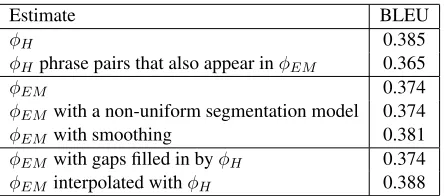
The simplest strategy to increase entropy is to interpolate the heuristic and learned phrase tables. Varying the weight of interpolation showed an im-provement over the heuristic of up to 0.01 for 100k sentences. A more modest improvement of 0.003 for 25k training sentences appears in table 1.
In another experiment, we interpolated the out-put of each iteration of EM with its inout-put, thereby maintaining some entropy from the initialization pa-rameters. BLEU score increased to a maximum of 0.394 using this technique with 100k training sen-tences, outperforming the heuristic by a slim margin of 0.005.
We might address the determinization in φEM
[image:7.612.97.274.448.532.2]training procedure to retain entropy. By imposing a non-uniform segmentation model that favors shorter phrases over longer ones, we hope to prevent the error-causing effects of EM training outlined above. In principle, this change will encourage EM to ex-plain training sentences with shorter sentences. In practice, however, this approach has not led to an improvement in BLEU.
Another approach to maintaining entropy during the training process is to smooth the probabilities generated by EM. In particular, we can use the fol-lowing smoothed update equation during the train-ing loop, which reserves a portion of probability mass for unseen translations.
φnew(¯ej|f¯i) =
c( ¯fi,¯ej) c( ¯fi) +kl−1
In the equation above,l is the length of the French phrase and kis a tuning parameter. This formula-tion not only serves to reduce very spiked probabili-ties inφEM, but also boosts the probability of short
phrases to encourage their use. Withk = 2.5, this smoothing approach improves BLEU by .007 using 25k training sentences, nearly equaling the heuristic (table 1).
4 Conclusion
Re-estimating phrase translation probabilities using a generative model holds the promise of improving upon heuristic techniques. However, the combina-torial properties of a phrase-based generative model have unfortunate side effects. In cases of true ambi-guity in the language pair to be translated, parameter estimates that explain the ambiguity using segmen-tation variables can in some cases yield higher data likelihoods by determinizing phrase translation esti-mates. However, this behavior in turn leads to errors at decoding time.
We have also shown that some modest benefit can be obtained from re-estimation through the blunt in-strument of interpolation. A remaining challenge is to design more appropriate statistical models which tie segmentations together unless sufficient evidence of true non-compositionality is present; perhaps such models could properly combine the benefits of both current approaches.
Estimate BLEU
φH 0.385
φHphrase pairs that also appear inφEM 0.365
φEM 0.374
φEMwith a non-uniform segmentation model 0.374
φEMwith smoothing 0.381
φEMwith gaps filled in byφH 0.374
[image:8.612.317.539.53.151.2]φEMinterpolated withφH 0.388
Table 1: BLEU results for 25k training sentences.
5 Acknowledgments
We would like to thank the anonymous reviewers for their valuable feedback on this paper.
References
Peter F. Brown, Stephen A. Della Pietra, Vincent J. Della Pietra, and Robert L. Mercer. The mathematics of statistical machine translation: Parameter estimation. Computational Linguistics, 19(2), 1993.
Philipp Koehn. Europarl: A Multilingual Corpus for Evaluation of Machine Translation. USC Information Sciences Institute, 2002.
Philipp Koehn, Franz Josef Och, and Daniel Marcu. Sta-tistical phrase-based translation. HLT-NAACL, 2003.
Philipp Koehn. Pharaoh: A Beam Search Decoder for Phrase-Based Statisical Machine Translation Models. USC Information Sciences Institute, 2003.
Daniel Marcu and William Wong. A phrase-based, joint probability model for statistical machine translation. Conference on Empirical Methods in Natual Language Processing, 2002.
Franz Josef Och and Hermann Ney. A systematic com-parison of various statistical alignment models. Com-putational Linguistics, 29(1):19–51, 2003.
Franz Josef Och, Christoph Tillmann, and Hermann Ney. Improved alignment models for statistical machine translation.ACL Workshops, 1999.
Andreas Stolcke. Srilm – an extensible language model-ing toolkit. Proceedings of the International Confer-ence on Statistical Language Processing, 2002.