Unsupervised Classification of Sentiment and Objectivity
in Chinese Text
Taras Zagibalov John Carroll
University of Sussex
Department of Informatics
Brighton BN1 9QH, UK
{T.Zagibalov,J.A.Carroll}@sussex.ac.uk
Abstract
We address the problem of sentiment and objectivity classification of product re-views in Chinese. Our approach is distinct-ive in that it treats both positdistinct-ive / negatdistinct-ive sentiment and subjectivity / objectivity not as distinct classes but rather as a con-tinuum; we argue that this is desirable from the perspective of would-be customers who read the reviews. We use novel unsuper-vised techniques, including a one-word 'seed' vocabulary and iterative retraining for sentiment processing, and a criterion of 'sentiment density' for determining the ex-tent to which a document is opinionated. The classifier achieves up to 87% F-meas-ure for sentiment polarity detection.
1
Introduction
Automatic classification of sentiment has been a focus of a number of recent research efforts (e.g. (Turney, 2002; Pang et al., 2002; Dave at al., 2003). An important potential application of such work is in business intelligence: brands and com-pany image are valuable property, so organizations want to know how they are viewed by the media (what the 'spin' is on news stories, and editorials), business analysts (as expressed in stock market re-ports), customers (for example on product review sites) and their own employees. Another important application is to help people find out others' views about products they have purchased (e.g. consumer electronics), services and entertainment (e.g. movies), stocks and shares (from investor bulletin
boards), and so on. In the work reported in this pa-per we focus on product reviews, with the intended users of the processing being would-be customers.
Our approach is based on the insight that posi-tive and negaposi-tive sentiments are extreme points in a continuum of sentiment, and that intermediate points in this continuum are of potential interest. For instance, in one scenario, someone might want to get an idea of the types of things people are say-ing about a particular product through readsay-ing a sample of reviews covering the spectrum from highly positive, through balanced, to highly nega-tive. (We call a review balanced if it is an opinion-ated text with an undecided or weak sentiment di-rection). In another scenario, a would-be customer might only be interested in reading balanced re-views, since they often present more reasoned ar-guments with fewer unsupported claims. Such a person might therefore want to avoid reviews such as Example (1) – written by a Chinese purchaser of a mobile phone (our English gloss).
(1)
pro-grammable alarm-clock, you have to set it every time, how cumbersome! The back cov-er does not fit! The original software has many holes!
In a third scenario, someone might decide they would like only to read opinionated, weakly nega-tive reviews such as Example (2), since these often contain good argumentation while still identifying the most salient bad aspects of a product.
(2)
The response time of this mobile is very long, MMS should be less than 30kb only to be downloaded, also it doesn't support MP3 ring tones, (while) the built-in tunes are not good, and from time to time it 'dies', but when I was buying it I really liked it: very original, very nicely matching red and white colours, it has its individuality, also it's not expensive, but when used it always causes trouble, makes one's head ache
The review contains both positive and negative sentiment covering different aspects of the product, and the fact that it contains a balance of views means that it is likely to be useful for a would-be customer. Moving beyond review classification, more advanced tasks such as automatic summa-rization of reviews (e.g. Feiguina & LaPalme, 2007) might also benefit from techniques which could distinguish more shades of sentiment than just a binary positive / negative distinction.
A second dimension, orthogonal to positive / negative, is opinionated / unopinionated (or equiv-alently subjective / objective). When shopping for a product, one might be interested in the physical characteristics of the product or what features the product has, rather than opinions about how well these features work or about how well the product as a whole functions. Thus, if one is looking for a review that contains more factual information than opinion, one might be interested in reviews like Example (3).
(3)
(My) overall feeling about this mobile is not bad, it features: 5 alarm-clocks that switch the phone on (off), phone book for 800 items (500 people), lunar and solar calendars, fast switching between time and date modes, WAP networking, organizer,notebook and so on.
This review is mostly neutral (unopinionated), but contains information that could be useful to a would-be customer which might not be in a prod-uct specification document, e.g. fast switching be-tween different operating modes. Similarly, would-be customers might would-be interested in retrieving completely unopinionated documents such as tech-nical descriptions and user manuals. Again, as with sentiment classification, we argue that opinionated and unopinionated texts are not easily distinguish-able separate sets, but form a continuum. In this continuum, intermediate points are of interest as well as the extremes.
A major obstacle for automatic classification of sentiment and objectivity is lack of training data, which limits the applicability of approaches based on supervised machine learning. With the rapid growth in textual data and the emergence of new domains of knowledge it is virtually impossible to maintain corpora of tagged data that cover all – or even most – areas of interest. The cost of manual tagging also adds to the problem. Reusing the same corpus for training classifiers for new domains is also not effective: several studies report decreased accuracy in cross-domain classification (Engström, 2004; Aue & Gamon, 2005) a similar problem has also been observed in classification of documents created over different time periods (Read, 2005).
language. Written Chinese has some specific fea-tures, one of which is the absence of explicitly marked word boundaries, which makes word-based processing problematic. In keeping with our unsu-pervised, knowledge-poor approach, we do not use any preliminary word segmentation tools or higher level grammatical analysis.
The paper is structured as follows. Section 2 re-views related work in sentiment classification and more generally in unsupervised training of classi-fiers. Section 3 describes our datasets, and Section 4 the techniques we use for unsupervised classifi-cation and iterative retraining. Sections 5 and 6 de-scribe a number of experiments into how well the approaches work, and Section 7 concludes.
2 Related Work
2.1 Sentiment Classification
Most previous work on the problem of categoriz-ing opinionated texts has focused on the binary classification of positive and negative sentiment (Turney, 2002; Pang et al., 2002; Dave at al., 2003). However, Pang & Lee (2005) describe an approach closer to ours in which they determine an author's evaluation with respect to a multi-point scale, similar to the 'five-star' sentiment scale widely used on review sites. However, authors of reviews are inconsistent in assigning fine-grained ratings and quite often star systems are not consis-tent between critics. This makes their approach very author-dependent. The main differences are that Pang and Lee use discrete classes (although more than two), not a continuum as in our ap-proach, and use supervised machine learning rather than unsupervised techniques. A similar approach was adopted by Hagedorn et al. (2007), applied to news stories: they defined five classes encoding sentiment intensity and trained their classifier on a manually tagged training corpus. They note that world knowledge is necessary for accurate classifi-cation in such open-ended domains.
There has also been previous work on determin-ing whether a given text is factual or expresses opinion (Yu & Hatzivassiloglu, 2003; Pang & Lee, 2004); again this work uses a binary distinction, and supervised rather than unsupervised approach-es.
Recent work on classification of terms with re-spect to opinion (Esuli & Sebastiani, 2006) uses a three-category system to characterize the opinion-related properties of word meanings, assigning nu-merical scores to Positive, Negative and Objective
categories. The visualization of these scores some-what resembles our graphs in Section 5, although we use two orthogonal scales rather than three cat-egories; we are also concerned with classification of documents rather than terms.
2.2 Unsupervised Classification
Abney (2002) compares two major kinds of unsu-pervised approach to classification (co-training and the Yarowsky algorithm). As we do not use multi-ple classifiers our approach is quite far from co-training. But it is close to the paradigm described by Yarowsky (1995) and Turney (2002) as it also employs self-training based on a relatively small seed data set which is incrementally enlarged with unlabelled samples. But our approach does not use point-wise mutual information. Instead we use rel-ative frequencies of newly found features in a training subcorpus produced by the previous itera-tion of the classifier. We also use the smallest pos-sible seed vocabulary, containing just a single word; however there are no restrictions regarding the maximum number of items in the seed vocabu-lary.
3 Data
3.1 Seed Vocabulary
Our approach starts out with a seed vocabulary consisting of a single word, (good). This word is tagged as a positive vocabulary item; initially there are no negative items. The choice of word was arbitrary, and other words with strongly posi-tive or negaposi-tive meaning would also be plausible seeds. Indeed, might not be the best possible seed, as it is relatively ambiguous: in some con-texts it means to like or acts as the adverbialvery, and is often used as part of other words (although usually contributing a positive meaning). But since it is one of the most frequent units in the Chinese language, it is likely to occur in a relatively large number of reviews, which is important for the rapid growth of the vocabulary list.
3.2 Test Corpus
Our test corpus is derived from product reviews harvested from the website IT1681. All the reviews
were tagged by their authors as either positive or negative overall. Most reviews consist of two or three distinct parts: positive opinions, negative opinions, and comments ('other') – although some
reviews have only one part. We removed duplicate reviews automatically using approximate match-ing, giving a corpus of 29531 reviews of which 23122 are positive (78%) and 6409 are negative (22%). The total number of different products in the corpus is 10631, the number of product cate-gories is 255, and most of the reviewed products are either software products or consumer electron-ics. Unfortunately, it appears that some users mis-used the sentiment tagging facility on the website so quite a lot of reviews have incorrect tags. How-ever, the parts of the reviews are much more reli-ably identified as being positive or negative so we used these as the items of the test corpus. In the ex-periments described in this paper we used 2317 re-views of mobile phones of which 1158 are nega-tive and 1159 are posinega-tive. Thus random choice would have approximately 50% accuracy if all items were tagged either as negative or positive2.
4 Method
4.1 Sentiment Classification
As discussed in Section 1, we do not carry out any word segmentation or grammatical processing of input documents. We use a very broad notion of words (or phrases) in the Chinese language. The basic units of processing are 'lexical items', each of which is a sequence of one or more Chinese char-acters excluding punctuation marks (which may actually form part of a word, a whole word or a se-quence of words), and `zones', each of which is a sequence of characters delimited by punctuation marks.
Each zone is classified as either positive or neg-ative based whether positive or negneg-ative vocabu-lary items predominate. In more detail, a simple maximum match algorithm is used to find all lexi-cal items (character sequences) in the zone that are in the vocabulary list. As there are two parts of the vocabulary (positive and negative), we correspond-ingly calculate two scores using Equation (1)3,
S
i=L
dL
phraseS
dN
d (1)where Ld is the length in characters of a matching
lexical item,Lphraseis the length of the current zone
2This corpus is publicly available at http://www.informatics.
sussex.ac.uk/users/tz21/it168test.zip
3In the first iteration, when we have only one item in the
vo-cabulary, negative zones are found by means of the negation check (sonot+good= negative item).
in characters, Sd is the current sentiment score of
the matching lexical item (initially 1.0), andNdis a
negation check coefficient. The negation check is a regular expression which determines if the lexical item is preceded by a negation within its enclosing zone. If a negation is found then Nd is set to –1.
The check looks for six frequently occurring
nega-tions: (bu), (buhui), (meiyou),
(baituo), (mianqu), and (bimian).
The sentiment score of a zone is the sum of sen-timent scores of all the items found in it. In fact there are two competing sentiment scores for every zone: one positive (the sum of all scores of items found in the positive part of the vocabulary list) and one negative (the sum of the scores for the items in the negative part). The sentiment direction of a zone is determined from the maximum of the absolute values of the two competing scores for the zone.
This procedure is applied to all zones in a docu-ment, classifying each zone as positive, negative, or neither (in cases where there are no positive or negative vocabulary items in the zone). To deter-mine the sentiment direction of the whole docu-ment, the classifier computes the difference be-tween the number of positive and negative zones. If the result is greater than zero the document is classified as positive, and vice versa. If the result is zero the document is balanced or neutral for senti-ment.
4.2 Iterative Retraining
The task of iterative retraining is to enlarge the ini-tial seed vocabulary (consisting of a single word as discussed in Section 3.1) into a comprehensive vo-cabulary list of sentiment-bearing lexical items. In each iteration, the current version of the classifier is run on the product review corpus to classify each document, resulting in a training subcorpus of pos-itive and a negative documents. The subcorpus is used to adjust the scores of existing positive and negative vocabulary items and to find new items to be included in the vocabulary.
are usually used with negation; for example, (the quality is far too bad) is in thepositive part of the vocabulary with a score of –1.70. This means that the item was found in reviews classified by the system as positive but it was preceded by a negation. If during classification this item is found in a document it will reduce the positive score for that document (as it is in the positive part of the vocabulary), unless the item is preceded by a nega-tion. In this situation the score will be reversed (multiplied by –1), and the positive score will be increased – see Equation (1) above.
For all candidate items we compare their relative frequencies in the positive and negative documents in the subcorpus using Equation (2).
difference
=
∣
F
p− F
n∣
F
p
F
n/
2
(2)
If difference< 1, then the frequencies are similar and the item does not have enough distinguishing power, so it is not included in the vocabulary. Oth-erwise the the sentiment score of the item is (re-) calculated – according to Equation (3) for positive items, and analogously for negative items.
F
pF
pFn(3)
Finally, the adjusted vocabulary list with the new scores is ready for the next iteration.
4.3 Objectivity Classification
Given a sentiment classification for each zone in a document, we compute sentiment density as the proportion of opinionated zones with respect to the total number of zones in the document. Sentiment density measures the proportion of opinionated text in a document, and thus the degree to which the document as a whole is opinionated.
It should be noted that neither sentiment score nor sentiment density are absolute values, but are relative and only valid for comparing one docu-ment with other. Thus, a sentidocu-ment density of 0.5 does not mean that the review is half opinionated, half not. It means that the review is less opinionat-ed than a review with density 0.9.
5 Experiments
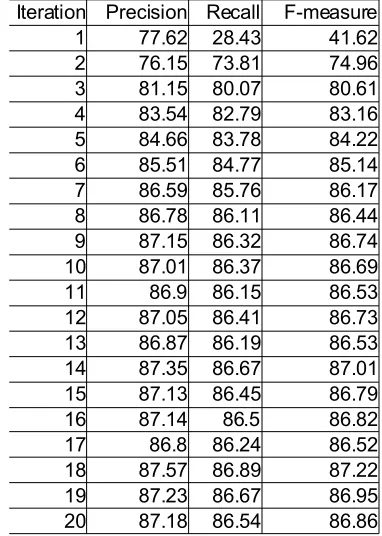
We ran the system on the product review corpus (Section 3.2) for 20 iterations. The results for
bina-ry sentiment classification are shown in Table 1. We see increasing F-measure up to iteration 18, af-ter which both precision and recall start to de-screase; we therefore use the version of the classi-fier as it stood after iteration 184. These figures are
only indicative of the classification accuracy of the system. Accuracy might be lower for unseen text, although since our approach is unsupervised we could in principle perform further retraining itera-tions on any sample of new text to tune the vocab-ulary list to it.
We also computed a (strong) baseline, using as the vocabulary list the NTU Sentiment Dictionary (Ku et al., 2006)5which is intended to contain only
sentiment-related words and phrases. We assigned each positive and negative vocabulary item a score of 1 or –1 respectively. This setup achieved 87.77 precision and 77.09 recall on the product review corpus.
In Section 1 we argued that sentiment and objec-tivity should both be considered as continuums, not
Table 1. Results for binary sentiment classifica-tion during iterative retraining.
4The size of the sentiment vocabulary after iteration 18 was
22530 (13462 positive and 9068 negative).
5Ku et al. automatically generated the dictionary by enlarging
an initial manually created seed vocabulary by consulting two thesauri, including tong2yi4ci2ci2lin2 and the Academia Sini-ca Bilingual OntologiSini-cal WordNet 3.
Iteration Precision Recall F-measure
1 77.62 28.43 41.62
2 76.15 73.81 74.96
3 81.15 80.07 80.61
4 83.54 82.79 83.16
5 84.66 83.78 84.22
6 85.51 84.77 85.14
7 86.59 85.76 86.17
8 86.78 86.11 86.44
9 87.15 86.32 86.74
10 87.01 86.37 86.69
11 86.9 86.15 86.53
12 87.05 86.41 86.73
13 86.87 86.19 86.53
14 87.35 86.67 87.01
15 87.13 86.45 86.79
16 87.14 86.5 86.82
17 86.8 86.24 86.52
18 87.57 86.89 87.22
19 87.23 86.67 86.95
binary distinctions. Section 4.1 describes how our approach compares the number of positive and negative zones for a document and treats the differ-ence as a measure of the 'positivity' or 'negativity' of a review. The document in Example (2), with 12 zones, is assigned a score of –1 (the least negative score possible): the review contains some positive sentiment but the overall sentiment direction of the review is negative. In contrast, Example (1) is identified as a highly negative review, as would be expected, with a score of –8, from 11 zones.
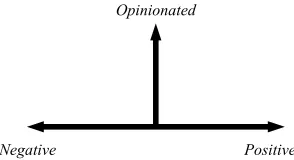
Similarly, with regard to objectivity, the senti-ment density of the text in Example (3) is 0.53, which reflects its more factual character compared to Example (1), which has a score of 0.91. We can represent sentiment and objectivity on the follow-ing scales:
Negative Balanced Positive
Unopinionated Neutral Opinionated
The scales are orthogonal, so we can combine them into a single coordinate system:
Opinionated
Negative Positive
We would expect most product reviews to be placed towards the top of the the coordinate system (i.e. opinionated), and stretch from left to right.
Figure 1 plots the results of sentiment and objec-tivity classification of the test corpus in this two di-mensional coordinate system, where X represents sentiment (with scores scaled with respect to the number of zones so that –100 is the most negative possible and +100 the most positive), and Y repre-sents sentiment density (0 being unopinionated and 1 being highly opinionated).
Most of the reviews are located in the upper part of the coordinate system, indicating that they have been classified as opinionated, with either positive or negative sentiment direction. Looking at the overall shape of the plot, more opinionated docu-ments tend to have more explicit sentiment direc-tion, while less opinionated texts stay closer to the balanced / neutral region (aroundX = 0).
Figure 1. Reviews classified according to sentiment (Xaxis) and degree of
opinionation (Yaxis).
6
Discussion
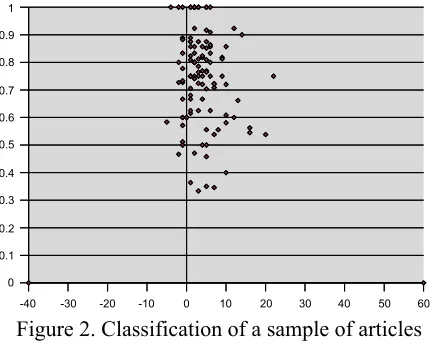
As can be seen in Figure 1, the classifier managed to map the reviews onto the coordinate system. However, there are very few points in the neutral region, that is, on the sameX = 0line as balanced but with low sentiment density. By inspection, we know that there are neutral reviews in our data set. We therefore conducted a further experiment to in-vestigate what the problem might be. We took Wikipedia6 articles written in Chinese on mobile
telephony and related issues, as well as several ar-ticles about the technology, the market and the his-tory of mobile telecommunications, and split them into small parts (about a paragraph long, to make their size close to the size of the reviews) resulting in a corpus of 115 documents, which we assume to be mostly unopinionated. We processed these doc-uments with the trained classifier and found that they were mapped almost exactly where balanced documents should be (see Figure 2).
Most of these documents have weak sentiment direction (X = –5to+10), but are classified as rel-atively opinionated (Y > 0.5). The former is to be expected, whereas the latter is not. When investi-gating the possible reasons for this behavior we no-ticed that the classifier found not only feature
de-scriptions (like nice touch) or
expres-sions which describe attitude ( (one) like(s)), but also product features (for example, MMS or TV) to be opinionated. This is because the presence of some advanced features such as MMS in mobile phones is often regarded as a positive by
6www.wikipedia.org
-40 -30 -20 -10 0 10 20 30 40 50 60 0
Figure 2. Classification of a sample of articles from Wikipedia.
Figure 3. Classification of a sample of articles from Wikipedia, using the NTU Sentiment
Dictionary as the vocabulary list.
authors of reviews. In addition, the classifier found words that were used in reviews to describe situa-tions connected with a product and its features: for example, (service) was often used in descrip-tions of quite unpleasant situadescrip-tions when a user had to turn to a manufacturer's post-sales service for re-pair or replacement of a malfunctioning phone, and (user) was often used to describe what one can do with some advanced features. Thus the clas-sifier was able to capture some product-specific as well as market-specific sentiment markers, howev-er, it was not able to distinguish the context these generally objective words were used in. This re-sulted in relatively high sentiment density of neu-tral texts which contained these words but used in other types of context.
To verify this hypothesis we applied the same processing to our corpus derived from Wikipedia articles, but using as the vocabulary list the NTU Sentiment Dictionary. The results (Figure 3) show that most of the neutral texts are now mapped to the lower part of the opinionation scale (Y < 0.5), as expected. Therefore, to successfully distinguish between balanced reviews and neutral documents a classifier should be able to detect when product features are used as sentiment markers and when they are not.
7
Conclusions and Future Work
We have described an approach to classification of documents with respect to sentiment polarity and objectivity, representing both as a continuum, and mapping classified documents onto a coordinate system that also represents the difference between balanced and neutral text. We have presented a novel, unsupervised, iterative retraining procedure for deriving the classifier, starting from the most minimal size seed vocabulary, in conjunction with a simple negation check. We have verified that the approach produces reasonable results. The ap-proach is extremely minimal in terms of language processing technology, giving it good possibilities for porting to different genres, domains and lan-guages.
We also found that the accuracy of the method depends a lot on the seed word chosen. If the word has a relatively low frequency or does not have a definite sentiment-related meaning, the results may be very poor. For example, an antonymous word to (good) in Chinese is (bad), but the latter is not a frequent word: the Chinese prefer to say (not good). When this word was used as the seed word, accuracy was little more than 15%. Al-though the first iteration produced high precision (82%), the size of the extracted subcorpus was only 24 items, resulting in the system being unable to produce a good classifier for the following itera-tions. Every new iteration produced an even poorer result as each new extracted corpus was of lower accuracy.
On the other hand, it seems that a seed list con-sisting of several low-frequency one-character words can compensate each other and produce bet-ter results by capturing a larger part of the corpus (thus increasing recall). Nevertheless a single word may also produce results even better than those for multiword seed lists. For example, the two-charac-ter word (comfortable) as seed reached 91%
-40 -30 -20 -10 0 10 20 30 40 50 60 0
0.1 0.2 0.3 0.4 0.5 0.6 0.7 0.8 0.9 1
-40 -30 -20 -10 0 10 20 30 40 50 60 0
accuracy with 90% recall. We can conclude that our method relies on the quality of the seed word. We therefore need to investigate ways of choosing 'lucky' seeds and avoiding 'unlucky' ones.
Future work should also focus on improving classification accuracy: adding a little language-specific knowledge to be able to detect some word boundaries should help; we also plan to experiment with more sophisticated methods of sentiment score calculation. In addition, the notion of 'zone' needs refining and language-specific adjustments (for example, a 'reversed comma' should not be considered to be a zone boundary marker, since this punctuation mark is generally used for the enu-meration of related objects).
More experiments are also necessary to deter-mine how the approach works across domains, and further investigation into methods for distinguish-ing between balanced and neutral text.
Finally, we need to produce a new corpus that would enable us to evaluate the performance of a pre-trained version of the classifier that did not have any prior access to the documents it was clas-sifying: we need the reviews to be tagged not in a binary way as they are now, but in a way that re-flects the two continuums we use (sentiment and objectivity).
Acknowledgements
The first author is supported by the Ford Founda-tion InternaFounda-tional Fellowships Program.
References
Abney, Steven (2002) Bootstrapping. InProceedings of the 40th Annual Meeting of the Association for Com-putational Linguistics, Philadelphia, PA. 360–367. Aue, Anthony & Michael Gamon (2005) Customizing
sentiment classifiers to new domains: a case study. In
Proceedings of RANLP-2005.
Dave, Kushal, Steve Lawrence & David M. Pennock (2003) Mining the peanut gallery: opinion extraction and semantic classification of product reviews. In
Proceedings of the Twelfth International World Wide
Web Conference. 519–528.
Engström, Charlotte (2004) Topic dependence in senti-ment classification. Unpublished MPhil dissertation, University of Cambridge.
Esuli, Andrea & Fabrizio Sebastiani (2006) SENTI-WORDNET: a publicly available lexical resource for opinion mining. InProceedings of LREC-06, the 5th
Conference on Language Resources and Evaluation,
Genoa, Italy.
Hagedorn, Bennett, Massimiliano Ciaramita & Jordi At-serias (2007) World knowledge in broad-coverage in-formation filtering. InProceedings of the 30th ACM SIGIR Conference on Research and Development in Information Retrieval. 801–802.
Ku, Lun-Wei, Yu-Ting Liang & Hsin-Hsi Chen (2006) Opinion extraction, summarization and tracking in news and blog corpora. InProceedings of the AAAI-2006 Spring Symposium on Computational
Ap-proaches to Analyzing Weblogs, AAAI Technical
Re-port.
Feiguina, Olga & Guy Lapalme (2007) Query-based summarization of customer reviews. InProceedings of the 20th Canadian Conference on Artificial
Intelli-gence, Montreal, Canada. 452–463.
Pang, Bo, Lillian Lee & Shivakumar Vaithyanathan (2002) Thumbs up? Sentiment classification using machine learning techniques. In Proceedings of the Conference on Empirical Methods in Natural Lan-guage Processing, Philadelphia, PA. 79–86.
Pang, Bo & Lillian Lee (2004) A sentimental education: sentiment analysis using subjectivity summarization based on minimum cuts. InProceedings of the 42nd Annual Meeting of the Association for Computation-al Linguistics, Barcelona, Spain. 271–278.
Pang, Bo & Lillian Lee (2005) Seeing stars: exploiting class relationships for sentiment categorization with respect to rating scales. In Proceedings of the 43rd Annual Meeting of the Association for Computation-al Linguistics, Ann Arbor, MI. 115–124.
Read, Jonathon (2005) Using emoticons to reduce de-pendency in machine learning techniques for senti-ment classification. In Proceedings of the Student
Research Workshop at ACL-05, Ann Arbor, MI.
Turney, Peter D. (2002) Thumbs up or thumbs down? Semantic orientation applied to unsupervised classifi-cation of reviews. InProceedings of the 40th Annual Meeting of the Association for Computational Lin-guistics, Philadelphia, PA. 417–424.
Yarowsky, David (1995) Unsupervised word sense dis-ambiguation rivaling supervised methods. In Pro-ceedings of the 33rd Annual Meeting of the
Associa-tion for ComputaAssocia-tional Linguistics, Cambridge, MA.
189–196.
Yu, Hong & Vasileios Hatzivassiloglou (2003) Towards answering opinion questions: separating facts from opinions and identifying the polarity of opinion sen-tences. In Proceedings of the 2003 Conference on
Empirical Methods in Natural Language Processing,