Aryabhatta Journal of Mathematics & Informatics Vol. 5, No. 2, July-Dec., 2013 ISSN : 0975-7139 Journal Impact Factor (2012) : 0.293
STRUCTURAL ANALYSIS, MODELLING AND DEVELOPMENT OF
ALOGRITHM OF A ROBOTIC SYSTEM
Rishi Kumar and R.K.Garg
Department of Mechanical Engineering, Deenbandhu Chhotu Ram University of Science & Technology, Murthal131039,Haryana,India
ABSTRACT
This paper presents an efficient methodology for structural modelling and analysis of a robot selection system. The methodology is based on graph theory and is termed as Graph Theoretical Methodology (GTM). In one way, the graphical models i.e. structural digraphs have been prepared for a robot selection system considering various criteria and sub-criteria and their interdependencies which affect the evaluation and selection of the robots for any organization. On the other hand, mathematical models have been developed for conversion of structural digraphs into matrix form and then this matrix into a mathematical function called variable permanent function (VPF). The methodology finally leads to the structural identification and comparison of various robots.
1.0 INTRODUCTION
A relationship always exists between the structure of a system and its performance characteristics. Two such projects QSPR (quantitative structure properties relationship) and QSAR (quantitative structure activity relationship) are actively pursued all over the world. The robot selection for any industry is also a complex problem where a number of selection criteria and sub-criteria affect the selection of any robot. However, no methodology has been evolved till date for structural modelling and analysis wherein all criteria, sub-criteria and their relative importance are considered; the need arises and is proposed using graph theory.
1.1 LITERATURE REVIEW
Robot selection is a difficult decision for industrialists and researchers. Sugeno [1974] introduced the concept of fuzzy integral. Although the initial research was far from being application-oriented, fuzzy integrals have later been used in decision making. Kamali et al. [1982] looked at the problem from the point of view of selecting a robot from among other alternative means of production such as manual or hard auto machines. Hinson [1983] stated that the working environment of the robot is a major factor for selection of robots.
Rishi Kumar and R.K.Garg
computation. Devi [2011] used fuzzy VIKOR method in intuitionistic fuzzy environment for robot selection . Tao et al. [2012] applied an integrated multiple criteria decision making model applying axiomatic fuzzy set theory . Karsak [2012] has addressed the problem of robot selection using fuzzy regression-based decision-making approach to give a new direction for robot selection .Vahdani et al. [2013] presented soft computing based on new interval-valued fuzzy modified multi-criteria decision-making method (Fuzzy TOPSIS). The evaluation and selection of robots is mainly dependent on different criteria and sub-criteria e.g. robot type (articulated, SCARA, etc.), degrees of freedom, pay load, horizontal reach, vertical reach, repeatability, power supply, program steps, memory size, control system and cost etc. which directly or indirectly affect the selection process. Therefore, the structural analysis becomes very important and essential which is mainly dependent on the proper identification of these criteria and sub-criteria and their relative importance.
1.2 STRUCTURAL ANALYSIS
In the present paper, the structural analysis of robot selection system is being carried out using a unified and efficient structural approach called GTM (Graph Theoretical Methodology). It is important to consider only the physical structure to explain the methodology in detail. For further analysis in which the abstract structure is necessary, the abstract structure with / without physical structure is considered. The methodology of arriving at an optimal selection is complex not only because of the arithmetic involved but also because of many qualitative judgments. Further, the complexity also increases due to increase in number of the contributing selection criteria/sub-criteria.
2.0 METHODOLOGY
2.1.1 Graph Theory
In order to evaluate the influence of various criteria and sub-criteria on robot selection, a model is developed using Graph Theory. Graph Theory serves as a mathematical model of any system that includes multiple relations among its constituent elements because of its diagrammatic representations and aesthetic aspects. Graph Theory is a subject of combinatorial mathematics and draws a lot from matrix theory. It consists of the digraph representation, matrix representation and permanent function representation. The digraph is the visual representation of the factors and their interdependencies which affects the performance measure. The matrix converts the digraph into mathematical form. The permanent function is a mathematical model that helps to determine numerical value, called performance index.
Graph theoretic approach assumes systems perspective and considers various factors/ nodes and interdependencies among them. It is a three stage unified system approach.
1. Modelling of systems in terms of nodes and edges gives a structural representation to the system and results in a directed graph. This representation is suitable for visual analysis and understanding the interrelationships among various nodes.
2. For further analysis, digraph representation is converted to matrix form, which makes it suitable for computer processing. However the matrix representation is not unique as changing the labelling of nodes can change it.
3. Analysis of matrix model results in permanent function model, which is in the expression form. The permanent function model analyse various combinations among the factors and their interrelationships. Simplified permanent function expression is represented in terms of a single numerical index.
In this work a methodology for the structural analysis and modelling of a robot selection system is presented. In this methodology, a system is analyzed developing the following models in succession:
1 Graphical Model
2 Mathematical Model
Structural Analysis, Modelling And Development Of Alogrithm Of A Robotic System Graphical Model of the system is developed for its evaluation and analysis in terms of its characteristics using graph theory. Graph Theory has been used extensively in various disciplines. Agrawal and Rao [1987, 1989]; Gandhi and Agrawal [1994]; Garg et al. [2007], etc. have solved different types of real life problems using this theory. They presented models for these problems using graph theory and later analyzed them on a computer.
2.1.1.2 Digraph Representation
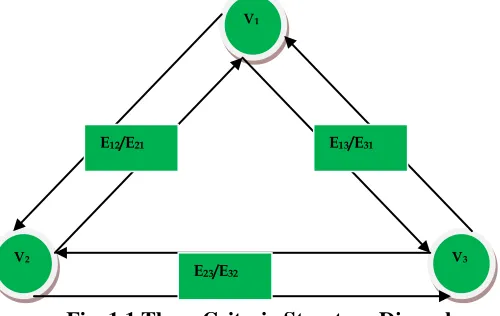
A system is defined as a set of interconnected elements. The elements here mean replaceable units i.e. criteria and sub-criteria affecting the evaluation and selection of robots. The system structure is modeled by structure digraph (SGs). Mathematically, SGs = [Vi, Ei], where Vi is a node and Ei is an edge. The nodes and the edges are shown in the structure digraph by circles and the straight lines, respectively. The nodes correspond to the criteria/sub-criteria and the edges correspond to the interdependencies between them. In this section, it is proposed to consider only the physical structure to explain the concept of graph theory. The system structure digraph is a graphical representation of the system. The complexity of the structure digraph increases with an increase in the number of subsyst ems i.e. robot selection criteria/sub-criteria in a system. This also complicates the visual understanding of the structure digraph. A structure digraph corresponding to 3 – criteria is shown in Fig. - 1.1.
The subsystem structure is also modeled by its corresponding structure digraph similar to that of system structure digraph as explained above. It is represented by SGss and mathematically as: SGss = [Vj*, Ej*], where Vj* is a node and Ej* is an edge that represents the sub-criterion and its connectivity, respectively.
Fig. 1.1 Three Criteria Structure Digraph
2.2.1.3 Mathematical Model
Digraph is a useful entity for representation and visual analysis of a system but not suitable for computer processing. To overcome this problem, the mathematical models of the system are developed using matrix methods. In mathematical modeling, the digraph is represented by an equivalent matrix for developing an algebraic algorithm. Matrices lend themselves easily to mechanical manipulations. Hence the expressions for the analysis and for evaluating the characteristics of a given system (or subsystem) are obtained. Various matrices of the digraph have been defined on the lines of graph theory, Deo [1974] leading to the development of the structural model.
2.3.1.4 Matrix Representation
This matrix, known as variable permanent matrix, is a variant of the structure digraph and is suitable for automatic computation, storage and retrieval of information. The variable permanent matrix corresponding to the structure digraph with ‘N’ number of nodes is written as given in 1.1.
The elements of a variable permanent matrix, if constructed for a criterion shall represent the characteristics of the sub-criteria and their interdependencies and so on.
V1
V2 V3
E12/E21 E13/E31
Rishi Kumar and R.K.Garg
1 12 13 14 1
21 2 23 24 2
31 32 3 34 3
41 42 43 4 4
1 2 3 4
N
N
N
N
N N N N N
V E E E E
E V E E E
E E V E E
E E E V E
E E E E V
(1.1)
2.3.1.5 Variable Permanent Function (VPF)
Both digraph and matrix representations are not unique as they changes by changing the numbering of nodes. To develop a unique representation, a permanent function of the variable permanent matrix is proposed. Permanent is a standard matrix function and is used in combinatorial mathematics, Jukrat [1996]. The permanent function is obtained in a similar manner as its determinant but with all signs positive. The computation process results in a multinomial whose every term has a physical significance. This multinomial representation includes all the information regarding selection criteria and is called variable permanent function of robot selection system, also known as permanent of C (Per C). It is a mathematical expression in symbolic form which considers the presence of all selection criteria and their interdependencies for performance evaluation of robots in terms of a numerical index. The variable permanent function of an Nth order square matrix with diagonal elements as Vi’s and non-diagonal elements as Eij’s, where i, j = 1, 2, 3, ……N, is written as:
VPF = f1 (V1, V2, .. . . ., VN) + f2 (0)
+ f3 (L2, V1, V2, . . . . . . , VN - 2 ) + f4 (L3, V1, V2, . . . . . . ,VN - 3 ) + f5 (L4, V1, V2, . . . . . . ,VN - 4 ) + f6 (L5, V1, V2, . . . . . . ,VN - 5 )
:
:
+ fN (LN-1 , LN-3 , . . . . . . , L2, V1)
+ fN+1 (LN , LN-2 , . . . . . . , L2) (1.2)
Here, Vi and Li represents the characteristic structural feature of the ith criteria and its connectivity loop, respectively. The VPF of a criterion can also be defined on the same line and this process can be extended further for sub-criterion, sub sub-criterion etc. The variable permanent function for ‘
N
’ number of selection criteria iswritten in sigma form as:
1Per ... ...
N
i ij ji k l m N
i i j k l N
C V Σ Σ E E V VV V
... ... ... ...ij jk ki l m N i j k l N
ik kj ji l m N i j k l N
Σ Σ E E E V V V Σ Σ E E E V V V
... ... ... ...ij ji kl lk m n N i j k l N
ij jk kl li m n N i j k l N
Σ Σ E E E E V V V
Σ Σ E E E E V V V
... ... ... ...il lk kj ji m n N i j k l N
ij ji kl lm mk n o N i j k l N
Σ Σ E E E E V V V
Σ Σ E E E E E V V V
Structural Analysis, Modelling And Development Of Alogrithm Of A Robotic System
... ... ... ... ... ...ij ji km ml lk n o N i j k l N
ij jk kl lm mi n o N i j k l N
im ml lk kj ji n o N i j k l N
Σ Σ E E E E E V V V
Σ Σ E E E E E V V V
Σ Σ E E E E E V V V
(1.3)
3.1 STRUCTURAL MODELLING OF ROBOT SELECTION SYSTEM
To meet the objectives and to carry out structural analysis, the robot selection system is given a typical hierarchical structure identifying various selection criteria and sub-criteria. In the present thesis the whole robot selection system is divided into two levels i.e. criteria level and sub-criteria level. The criteria considered are ‘Physical and General’, ‘Static Performance Characteristics’, ‘Dynamic Performance Characteristics’, ‘Robotic Architecture’, ‘Operating Environment’, ‘Instrumentation and control system, and ‘Application’. The hierarchical structure is shown in Fig. - 1.2.
Fig. 1.2 Hierarchical Structure of a Robot Selection Criteria/Sub-Criteria
The abbreviations used in Fig. – 1.2 is detailed as under:
Abbreviations used for Selection Criteria GP General and Physical
SPC Static Performance Characteristics DPC Dynamic Performance Characteristics RA Robotic Architecture
OE Operating Environment
Rishi Kumar and R.K.Garg
ICS Instrumentation and Control Systems
Abbreviations used for Selection Sub-Criteria
GP1 Cost RA3 Axis Motion Range (J2)
GP2 Robot Type RA4 Axis Motion Range (J3)
GP3 Life Expectancy RA5 Axis Motion Range (J4) GP4 Warranty Period RA6 Axis Motion Range (J5) GP5 Reliability RA7 Axis Motion Range (J6)
GP6 Vendor’s Service OE1 Compliance
SPC1 Robot Mass(Kg) OE2 Ambient Temperature SPC2 Repeatability(±mm) OE3 Ambient Humidity SPC3 Load Capacity(Kg) OE4 Vibration
SPC4 Memory Capacity OE5 Protection Level SPC5 Positioning Accuracy OE6 Safety Features
SPC6 Degrees of Freedom ICS1 Programming Methods SPC7 Precision/Resolution ICS2 Man Machine Interface DPC1 Vertical Reach(mm) ICS3 Type of Drive
DPC2 Horizontal Reach ICS4 Control System DPC3 Speed of Travel(JI)) ICS5 Path Control System DPC4 Speed of Travel (J2) ICS6 Sensors
DPC5 Speed of Travel (J3) A1 Material Handling DPC6 Speed of Travel (J4) A2 Welding
DPC7 Speed of Travel (J5) A3 Assembly DPC8 Speed of Travel (J6) A4 Dispensing
RA1 Arm Geometry A5 Processing
Structural Analysis, Modelling And Development Of Alogrithm Of A Robotic System
(1.4)
Rishi Kumar and R.K.Garg
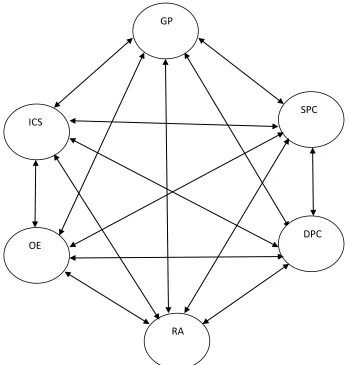
Equation 1.4 is the complete expression for the considered robot selection system, as it considers the presence of all criteria and all of the possible relative importance between the criteria. The terms are the sets of distinct diagonal elements and loops of off-diagonal elements of different sizes (Eij Eji; Eij Ejk Eki; Eij Ejk Ekl Eli; etc.). As already explained this expression is nothing but the determinant of 6×6 matrix but considering all the terms as positive terms. A general expression of Variable Permanent Function for ‘n’ number of nodes is written as given in Eq. – 1.3.
Fig. 1.3 Criteria Based Structural Digraph of a Robot Selection System
4.1 STRUCTURAL ANALYSIS
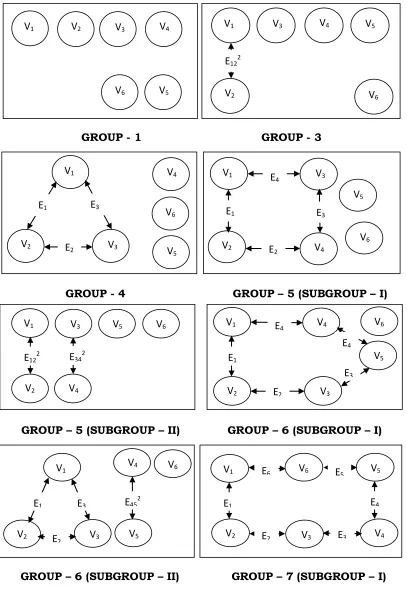
As explained earlier, the variable permanent function (VPF) represents the characteristics of the robot selection system and thus becomes a powerful tool for carrying out the structural analysis of a robot selection system. The terms in the polynomial function contain all possible structural information. Further, each of these terms yields useful information, if a term is interpreted as a set but not the product of structural components. This means that the system is analyzed in all possible ways in terms of its structural components. The physical meaning of the terms appearing in variable permanent function is interpreted as under:
Group - 1
The first group represents a set of structural features of the criteria and may be expressed as: / V1 / V2 / . . . / VN /
GP
SPC
DPC
RA ICS
Structural Analysis, Modelling And Development Of Alogrithm Of A Robotic System
Group - 2
The second group shall be absent because the loops in the structure digraph for a criterion is not possible to be formed.
Group - 3
The third group represents a set of dyad of two criteria (Eij2) and characteristic structural features of the remaining criteria.
/E122/ V3/ V4/ V5/ V6/.../ VN/
Group - 4
The fourth group represents a set of structural loops of three criteria (Eij Ejk Eki), and characteristic structural features of the remaining criteria.
/E12 E23 E31 / V4/ V5/ V6/ .../VN/
Group - 5
i. The first sub-group of the fifth grouping is a set of structural loops of four criteria (Eij Ejk Ekl Eli), and characteristic structural features of the remaining criteria.
/E12 E23 E34 E41 / V5/ V6/ V7/.../ VN/
ii. The second sub-group of the fifth group is a set of two structural dyads of two criteria (Eij2, Ekl2), and characteristic structural features of the remaining criteria.
/E122/ E342 / V5/ V6/ V7/ .../VN/
Group - 6
i. The first sub group of the sixth group is a set of structure loops of five criteria (Eij Ejk Ekl Elm Emi), and characteristic structural features of the remaining criteria.
/E12 E23 E34 E45 E51 / V6/ V7/ .../VN/
ii. The second sub group of the sixth group is a set of structure loops of three criteria (Eij Ejk Eki), a dyad of two criteria (Elm2), and characteristics structural features of the remaining criteria.
/E12 E23 E31 / E452 / V6/ V7/ .../VN/
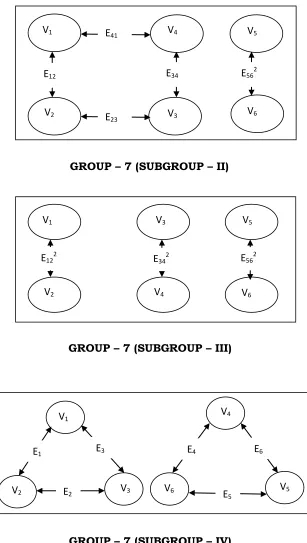
Group - 7
i. The first sub group of the seventh group is a set of structural loops of six criteria (Eij Ejk Ekl Elm Emn Eni), and characteristic structural features of the remaining criteria.
/E12 E23 E34 E45 E56 E61 / V7/ V8/.../VN/
ii. The second sub group of the seventh group is a set of structural loops of four criteria (Eij Ejk Ekl Eli), a structural dyad of two criteria (Emn2), and characteristic structural features of the remaining criteria.
/E12 E23 E34 E41 / E562 / V7/ V8/.../VN/
iii. The third sub group of the seventh group is a set of three structural dyads, each of two criteria (Eij2, Ekl2, Emn2), and characteristic structural features of the remaining criteria.
/E122/E342/E562/V7/V8/.../Vn/
iv. The fourth sub group of the seventh group is a set of two structural loops of three criteria (Eij Ejk Ekl Elm Emn Eni), and characteristic structural features of the remaining criteria.
/E12 E23 E31 /E45 E56 E64/ V7/ V8/.../VN/ (1.5)
Rishi Kumar and R.K.Garg
V1 V2 V3 V4
V6 V5
E122
V1
V2
V3 V4
V6
V5
GROUP - 1 GROUP - 3
V1
V2 V3
V4
V6
V5
E1 E3
E2
V1
V2
V3
V4
V5
E1
2
E3
4
E4
1
E2
3
V6
GROUP - 4 GROUP – 5 (SUBGROUP – I)
V2
V3
V4
V5
V1 V6
E122 E342
V1
V2 V3
V4 V6
V5
E1
2
E4
1 E4
5
E3
4
E2
3
GROUP – 5 (SUBGROUP – II) GROUP – 6 (SUBGROUP – I)
V1
V2 V3
V4 V6
V5
E452
E2
E1 E3
V1
V2 V3 V4
V6 V5
E1 E4
E2
E6 E5
E3
Structural Analysis, Modelling And Development Of Alogrithm Of A Robotic System
V1
V2 V3
V4
V6
V5
E41
E23
E12 E34 E562
GROUP – 7 (SUBGROUP – II)
V1
V2
V3
V4 V6
V5
E122 E342 E562
GROUP – 7 (SUBGROUP – III)
V1
V2 V3
E3
1
E1
2
E2
3
V4
V6 V5
E6
4
E4
5
E5
6
GROUP – 7 (SUBGROUP – IV)
Rishi Kumar and R.K.Garg
5.1 STRUCTURAL IDENTIFICATION AND COMPARISON
The structure identification of the robot selection system for an industry using robots and its comparison with other robot selection system is carried out by considering various terms appearing in the variable permanent function. Let jijs represent the total number of terms of in jth sub group of ith group of VPF. In case, there is no sub group, then jijs shall be same as that the total number of terms of ith group. The sub-groups are arranged in decreasing order of the size of structural terms (e.g., Eij’s) and so on. Based on this, structural identification set for robot selection system is given as:
/J1s/J2s/J3s/J4s/J51s+J52s/J61s+J62s/J71s+J72s+J73s +J74s/ (1.6) This characterizes the complete structure of the robot selection system. Eq. – 1.6 may be used for comparison of two systems or a family of systems. Two systems are exactly similar (isomorphic) from structural point of view, if identification set for them are exactly the same. This means that the numbers of terms in each group/ sub-group are exactly the same. The values of jijs and jis are easily obtained either by visual inspection of the structure digraph or by simple calculations using closed form expression of variable permanent function (VPF).
Structural comparison of the robot selection system is carried out based on coefficient of similarity or dissimilarity. The coefficient is derived from VPF and provides a rational basis for comparison of structures of two robot
selection systems or a family of robot selection systems. If a number of distinct terms in the jth sub group of the ith group of VPF of the two robot selection systems under consideration are denoted by Jijs and jijs, then criterion 1 of coefficient of dissimilarity, Marcus and Minc [1965] is given as:
ij j i s d
y
C
1 1
1
(1.7)
where, y1 = maximum
i j s ij i j sij and J
J
'
(1.8)When sub-groups are absents Jijs = Jis and Jij΄s = Ji΄s
Also ij = (Jijs - Jij΄s ) , when sub-groups exit and
ij = (Jis - Ji΄s ) , When sub-groups are absent. Criterion 2 of coefficient of dissimilarity (Cd-1s)is given as:2 / 1 ij 2 1 2 1
j i s d yC
(1.9)Where ij is as described above, and
Y2 maximum
i j s ij i j sij and J
J )2 ( ' )2
( (1.10)
When sub-groups do not exist, Jijs = Jis and Jij΄s = Ji΄s
Using Eqs. – 4.11 and 4.12, the coefficients of similarity (Cs-1sand cs-2s) are given as:
s d s
s
C
C
1
1
1 (1.11)
C
ss2
1
C
ds2 (1.12)From Eqs. - 1.7 to 1.12, it may be noted that coefficients of similarity and dissimilarity lie in the range of 0 to 1. If two systems have completely similar structure, their coefficient of similarity is one or coefficient of dissimilarity is zero. In case two systems are completely dissimilar, their coefficient of similarity is zero and coefficient of dissimilarity is one. These equations are also useful for comparison among family of systems and can be ranked based on the increasing or decreasing value of coefficient of similarity or dissimilarity. Using this approach, the optimum selection of a system with desired structure can be made among the possible alternatives.
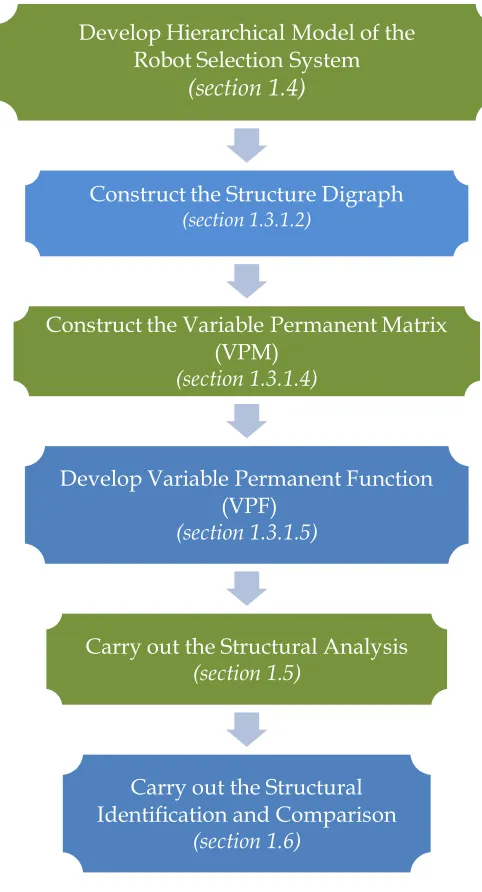
Structural Analysis, Modelling And Development Of Alogrithm Of A Robotic System An algorithm for structural modeling and analysis of a robot selection system based on six criteria and forty sub-criteria has been prepared in accordance to the procedure developed using graph theory and as explained in previous section. The complete algorithm is presented in Fig. - 1.5.
Fig. 1.5 Structural Modelling and Analysis Algorithm
7.1 CONCLUSION
The evaluation, selection and ranking of robots in general imply the identification and study of various selection criteria/ sub-criteria and their interactions considering in an integrated manner. The in-depth study of the structure of the robot is expected to lead to such a selection process that will be more reliable. Since, the criteria and sub-criteria are variable in nature; hence the evaluation and selection of robots may vary from one application to other application. The structural analysis of robot selection system is carried out using a structural approach called GTM (Graph Theoretical Methodology) by considering only the physical structure. Further where the abstract structure is necessary, the abstract structure with / without physical structure is considered. The methodology of arriving at an
Develop Hierarchical Model of the Robot Selection System
(section 1.4)
Construct the Structure Digraph
(section 1.3.1.2)
Construct the Variable Permanent Matrix (VPM)
(section 1.3.1.4)
Develop Variable Permanent Function (VPF)
(section 1.3.1.5)
Carry out the Structural Analysis
(section 1.5)
Carry out the Structural Identification and Comparison
Rishi Kumar and R.K.Garg
optimal selection is complex not only because of the arithmetic involved but also because of many qualitative judgments. The complexity also increases due to increase in number of the contributing selection criteria/sub-criteria. An algorithm for structural modeling and analysis of a robot selection system based on six criteria and forty sub-criteria has been prepared in accordance to the procedure developed using graph theory and is very helpful in development of software for evaluation and selection of industrial robots.
REFERENCES
[1] Agrawal V. P., Rao J. S. "Identification and isomorphism of kinematic chains and mechanisms." Mechanism and Machine Theory, 1989: 24(4): 309-21.
[2] Agrawal V. P., Rao J. S. "Structural classification of kinematic chains and mechanisms." Mechanism and Machine Theory, 1987: 22(5): 489-96.
[3] Bhattacharya A., Sarkar B., Mukherjee S. K. "Integrating AHP with QFD for robot selection under requirement perspective." International Journal of Production Research, 2004: 43(17):3671-3685.
[4] Chatterjee P., AthawaleV.M.,Chakraborty S. "Selection of materials using compromise ranking and out ranking methods." Material Decisions, 2009: 30:4043-53.
[5] Deo, N. "Graph theory with application to engineering and computer science." Engle Wood Cliff, NJ: Prentice Hall, 1974.
[6] Devi, K. "Extension of VIKOR method in intuitionistic fuzzy environment for robot selection." Expert Systems with Applications, 2011: 38:14163-14168.
[7] Garg R.K., Agrawal V.P., Gupta V.K. "Coding, evaluation and selection of a thermal power plant - a MADM approach." International Journal of Electrical Power and Energy Systems - Elsevier Science, 2007: 29(9):657-68.
[8] Goh, C.H. "Analytic hierarchy process for robot selection." Journal of Manufacturing Systems , 1997: 16(5):381-86.
[9] Hinson, R. "Knowing work envelops helps in evaluating robots." Industrial Engineering, 1983: 22-7.
[10] Huang P.Y., Ghandforoush P. "Robotics procedures given for evaluating selecting robots." Industrial Engineering, 1984: 16:44-48.
[11] Kamali J., Moodie C.L.,Sovendy G. "A framework for integrated assembly system: human automation and robots." International Journal of Production Research, 1982: 20:431-448.
[12] Karsak E.E., Sener Z.,Dursun M. "Robot selection using a fuzzy regression-based decision-making approach." International Journal of Production Research, 2012: 50(23):6826-34.
[13] Karsak, E.E. "Robot selection using an integrated approach based on quality function deployment and fuzzy regression." International Journal of Production Research, 2008: 46:723-38.
[14] Khouja M., Booth D.E.,Suh M.,MahaneyJr.J.K. "Statistical procedures for task assignment and robot selection in assembly cells." International Journal of Computer Integrated Manufacturing, 2000: 13(2):95-106.
[15] Kumar R., Garg R.K. "Optimal selection of robots by using distance based approach method." Robotics and Computer-Integrated Manufacturing, 2010: 26:500-506.
[16] Layek A.M., Lars.J.R. "Algorithm based decision support system for the concerted selection of equipment in machining/assembly cells." International Journal of Production Research, 2000: 38(2):323-29.
[17] Parkan C., Wu M.L. "Decision-making and performance measurement models with applications to robot selection." Computers and Industrial Engineering, 1999: 36:503-23.
[18] Sugeno, M. "Theory of fuzzy integrals and its applications, Ph. D. Thesis." Tokoyo Institute of Technology,Tokoyo, 1974.
Structural Analysis, Modelling And Development Of Alogrithm Of A Robotic System [20] Vadhani B., Tavakkoli-Moghaddam R.,Mousavi S.M.,Ghodratnama A. "Soft computing based on new interval-valued fuzzy modified multi-criteria decision-making method." Applied Soft Computing, 2013: 13:165-72.