IMPROVED ROUTING ALGORITHM FOR COMMUNICATION ON INTRUDER SAFE PATH
Deepak kumar*
Ravindra Kumar**
Shashi Bhushan Tyagi***
*M.Tech Student, Deptt. of CSE, Tula’s Institute, Dehradun. ([email protected])
** Assistant Professor, Deptt. of CSE, Roorkee Engg. & Mgt. Technology Institute, Shamli.
*** Assistant Professor, Department of CSE, Tula’s Institute, Dehradun (Uttarakhand).
ABSTRACT
To generate the optimum communication path in terms of energy and distance we perform Routing. But
in an adhoc network, there is a limitation in terms of centralized congestion as well as the attack over
some intruder nodes. In such case to perform the effective communication there is the requirement of
some such routing approach that can provide the routing with elimination of intruder nodes over the
network. In this work, ACO based routing approach is defined to generate the intruder safe path over the
network. The presented approach is implemented in matlab environment and obtained results show the
effective results in terms of optimized distance and energy.
I. INTRODUCTION
Wireless Sensor Networks (WSNs) are self-configured and are without infrastructures. WSN collects data
from the environment and sends it to a destination site where the data can be observed, memorized
and analyzed. Wireless sensor devices responds to a “control site” on specific requests, or can be
equipped with actuators to realize commands.
There are two types of WSNs: structured and unstructured. An unstructured WSN is one that contains a
dense collection of sensor nodes. In a structured WSN, all or some of the sensor nodes are deployed in a
pre-planned manner [4, 5]. Sensor networks represent a significant improvement over traditional
sensors, which are deployed in the following two ways:
Sensors can be positioned far from the actual phenomenon. Several sensors that perform only sensing can be deployed [6].
A sensor network is composed of a large number of sensor nodes, which are densely deployed either
inside the phenomenon or very close to it.
Unique feature of sensor networks is the cooperative effort of sensor nodes. Sensor nodes are fitted
with an on-board processor. Instead of sending the raw data to the nodes responsible for the fusion,
sensor nodes use their processing abilities to locally carry out simple computations and transmit only
the required and partially processed data.
Some of the application areas are health, military, and security. For example, the physiological data
about a patient can be monitored remotely by a doctor. Sensor networks can also be used to detect
foreign chemical agents in the air and the water. They can help to identify the type, concentration, and
location of pollutants. In essence, sensor networks will provide the end user with intelligence and a
better understanding of the environment. Some other commercial applications include managing
inventory, monitoring product quality and monitoring disastrous areas.
A) Challenges in WSN
All security approaches require a certain amount of resources for the implementation, including data
features and challenges in terms of sensor selection, sensing technology, networking and security design
issues. Body sensors should be easy, comfortable to wear, and non-obstructive; the reliability of sensor
nodes is critical in emergency situations and thus is required to be very high; the communication range
is extremely short, rendering most attacks impossible or very difficult. One challenge threatening the
successful deployment of sensor networks is privacy. Sensor network privacy issue that cannot be
adequately addressed by network security is source-location privacy.
B) Unreliable Communication
Unreliable Transfer: Normally the packet-based routing of the sensor network is connectionless and thus
inherently unreliable. Packets may get damaged due to channel errors or dropped at highly congested
nodes. The result is lost or missing packets.
Conflicts: Even if the channel is reliable, the communication may still be unreliable. This is due to the
broadcast nature of the wireless sensor network. If packets meet in the middle of transfer, conflicts will
occur and the transfer itself will fail [1].
Latency: The multi-hop routing, network congestion and node processing can lead to greater latency in
the network, thus making it difficult to achieve synchronization among sensor nodes
C) Security
Often, the utility of a sensor network will rely on its ability to accurately and automatically locate each
sensor in the network. A sensor network designed to locate faults will need accurate location
information in order to pinpoint the location of a fault. Unfortunately, an attacker can easily manipulate
non-secured location information by reporting false signal strengths, replaying signals, etc.
A technique called verifiable multilateration (VM) *59+ in which, a device’s position is accurately
computed from a series of known reference points. In authenticated ranging and distance bounding are
used to ensure accurate location of a node. Because of distance bounding, an attacking node can only
increase its claimed distance from a reference point. However, to ensure location consistency, an
attacking node would also have to prove that its distance from another reference point is shorter. Since
the SPINE (Secure Positioning for sensor Networks) algorithm is used. It is a three phase algorithm based
upon verifiable multilateration.
II. EXISTING WORK
Energy efficiency is the most important issue in all facets of wireless sensor networks (WSNs) operations
because of the limited and non-replenish able energy supply. And WSNs are deployed in environments
where sensors can be exposed to conditions that might interfere with the sensor readings. Moreover, a
variety of sensors may be attached to WSNs to monitor the environment. Data aggregation, eliminating
the data redundancy and improving the accuracy of information gathering, is essential for WSNs. Hence,
BPNDA was proposed, a data aggregation scheme based on back-propagation network (BPN). In the
BPNDA, a three-layer BP neural network was used. The input layer neurons are located in cluster
members (CMs), while the hidden layer neurons and the output layer neurons are located in cluster
head (CH). Only the extracted data that represented the features of the raw data will be transmitted to
the sink, so the efficiency of data gathering is improved and the total energy consumption is reduced [2]
This paper an intelligent analysis is used to process the structure of a wireless sensor network (WSn)
and produce some information which can be used to improve the performance of WSns’ management
application. Wireless sensor networks need to be managed in different ways; e.g. power consumption of
each sensor, efficient data routing without redundancy, sensing and data sending interval control, etc.
The random distribution of wireless sensors, numerous variables which affect WSn’s operation and the
uncertainty of different algorithms (such as sensors’ self-localization) give a fuzzy nature to Wsns.
Considering this fuzzy nature and numerous details, a neural network is an ideal tool to be used to cover
these details which are so hard to be explicitly discovered and modeled. In this paper they introduce our
neural network based approach which results in a more efficient routing path discovery and sensor
power management. They define a set of attributes based on sensors’ location and neighborhood and
use them as inputs of our neural network and the output of the neural network will be used as a factor
in the route path discovery and power management. They designed a simulator based on our approach
and observed the effect of our method on wireless sensor network lifetime and sensor power
consumption which will be presented in this paper [3].
sensing tasks and the potential sensor networks applications are explored, and a review of factors
influencing the design of sensor networks is provided. Then, the communication architecture for sensor
networks is outlined, and the algorithms and protocols developed for each layer in the literature are
explored. Open research issues for the realization of sensor networks are also discussed. [4]
III. PROPOSED WORK
In this present work we have improve the routing approach by improving the existing path selection
algorithm with the inclusion of Ant Optimization approach. According to this proposed approach the bad
node analysis is performed and based on this analysis. The first step is to setup the network with
specific parameters. This parameter includes:
i) Number of Packets: This property represents the number of successful packet delivery for a specific
communication.
ii) Number of Packet loss: Due to the congestion or any block node there are the chances of the data
loss over the network. This parameter will analyze the packet loss over the transmission. It is the
decision parameter that will perform the analysis the next node is a valid node or not.
iii) Packet Delivery Ratio: This parameter is basically defines the ratio of packets transmitted and the
packet successfully arrived to the destination. The packet delivery ratio we have analyzed on 4
intermediate nodes to identify the problem area over the network.
iv) Time Delay: It defines the delay in the communication. The delay will occur because of congestion
over the network.
v) Energy: As each node in the communication is a sensor node, because of this each node is defined
with specific energy we have defined 5 Jule to each node. With each communication over the
network some energy is lost. If the energy is less then minimum required energy or 0 the node will
be dead itself.
vi) Turnaround Time: It is the actual time taken to perform the communication over the network.
1. Define N Number of Sensor Nodes in the WSN with specific parameters in terms of energy,
transmission rate etc.
2. Each Node Ni start Moving in Direction of Specific Direction Di
For (j=1 to M)
{
MaintainFormation (Ni,Nj)
}
4 if DataLoss(Ni)>Threshold and TimeDelay > Threshold1
/* If Bad Node or Congested Node Occur on Node i*/
{
For i=1 to Mi
{
CollectInformation(Ni, Neighbor(Ni));
}
Implement Forward ANT to find the alternate path in each Direction of Neighbor (N(i)).
5 Set the Pheramon on Each Hop and Identify the Possible Path
6 Implement Backward ANT to inform Neighbor Nodes about Backup Path
7 Trace the Pharamons and Communicate of New Path
8 Perform the Normal Communication
}
The description of the Ant concept is presented here
1. At regular interval any nodes (Source) is selected to send data to some destination node d.
2. Each forward ant selects the next hop node using the routing table information. the next node
selected depends on some random scheme. If all nodes already visited a uniform selection will be
3. If the selected node is some attack or damage node or it is not currently available. the forward ant
wait to turn in the low priority node from the queue.
4. It will identify any of the next non visited nodes and pay some delay on it.
5. If some cycle detected the ant is forced to turn on the visited node.
6. When the ant reaches the destination node a backward ant is generated to transfer all its
memory.
7. Backward ant uses same path generated by forward ant.
By default route is chosen on the basis of Path selection formula and i.e. we will choose the lowest
energy path. It means every time the selected path is using lowest energy. In case there is problem in
the selection of the path then we apply the Ant Colony Algorithm the purpose of which is to continue
sending data using the previous path (as from Path selection Algorithm.
Hence we achieved efficiency in terms of energy by applying path selection whereas Ant Colony
Optimization Algorithm gives the required reliability.
IV. RESULTS
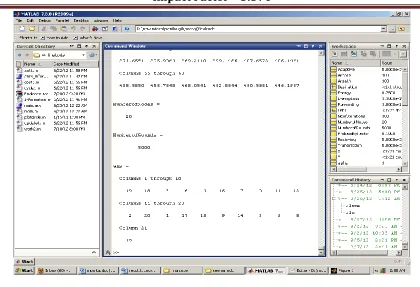
The presented work is implemented in Matlab environment under different scenarios. The scenario
Figure 1: Optimized Path
Figure 1 is showing the optimized path after implementation of proposed ACO based approach. As we
can see the output is showing the node sequence in which the nodes are being visited. In the subplot
one the optimization process is shown and in sub plot 2 the optimized path obtained from the approach
is shown.
V. CONCLUSION
Since in WSNs energy efficiency is a crucial factor for the performance of wireless sensor networks, an
efficient as well as reliable algorithm can extend the lifetime of the sensor network because the energy
dissipation is minimized. In this work, an energy-saving strategy that exploits the combination of Path
Selection and Ant Optimization techniques in Wireless Sensor Networks has been developed. The
proposed strategy has demonstrated its performance superiority in terms of energy efficiency for
different network sizes. By simulation, we have found out that the energy in our protocol is dissipated
less than the other energy-aware routing protocols. By default the route is chosen on the basis of Path
Selection formula i.e. we will choose right path means the lowest energy path. It means every time the
using the previous path (as from Path Selection Algorithm.). This ensures the reliability of the network
communication i.e. data exchange will not stop even in case of failure of any node. Hence we achieved
efficiency in terms of energy by applying path selection whereas Ant Colony Optimization Algorithm
gives the required reliability.
REFERENCES
[1] Xin Tan,” A Hybrid Approach of Path Planning for Mobile Robots based on the Combination of ACO
and APF Algorithms”, 978-1-4244-3894-5/09©2009 IEEE.
[2] Yee Zi Cong,” Mobile Robot Path Planning using Ant Colony Optimization”, 2009 IEEE/ASME
International Conference on Advanced Intelligent Mechatronics.
[3] Michael Rinehart,” Shortest Path Optimization under Limited Information”, Joint 48th IEEE
Conference on Decision and Control and 28th Chinese Control Conference 978-1-4244-3872-3/09©2009
IEEE
[4] João Pedro,” Distributed Routing Path Optimization for OBS Networks based on Ant Colony
Optimization”, IEEE "GLOBECOM" 2009 978-1-4244-4148-8/09©2009.
[5] Maumita Bandyopadhyay,” Zone Based Ant Colony Routing in Mobile Ad-hoc Network”,
978-1-4244-5489-1/10© 2010 IEEE
[6] Ahmed A. A. Zakzouk,” An Ant Colony Optimization Approach for Solving Shortest Path Problem with
Fuzzy Constraints”.
[7] Afshin Ghanizadeh,” A Fuzzy-Particle Swarm Optimization Based Algorithm for Solving Shortest Path
Problem”, 978-1-4244-6349-7/10@ 2010 IEEE.
[8] Xin Tan,” A Hybrid Approach of Path Planning for Mobile Robots based on the Combination of ACO
and APF Algorithms”, 978-1-4244-3894-5/09©2009 IEEE.
[9] Yee Zi Cong,” Mobile Robot Path Planning using Ant Colony Optimization”, 2009 IEEE/ASME
[10] Michael Rinehart,” Shortest Path Optimization under Limited Information”, Joint 48th IEEE
Conference on Decision and Control and 28th Chinese Control Conference 978-1-4244-3872-3/09©2009
IEEE
[11] João Pedro,” Distributed Routing Path Optimization for OBS Networks based on Ant Colony
Optimization”, IEEE "GLOBECOM" 2009 978-1-4244-4148-8/09©2009
[12] Ahmed A. A. Zakzouk,” An Ant Colony Optimization Approach for Solving Shortest Path Problem