BRIEF REPORT
Negative affective environments improve complex
solving performance
Carola M. Barth and Joachim Funke University of Heidelberg, Heidelberg, Germany
Based on recent affect!cognition theories (Bless et al., 1996; Fiedler, 2001; Sinclair, 1988), the present study predicted and showed a differentiated influence of nice and nasty environments on complex problem solving (CPS). Environments were constructed by manipulating the target value ‘‘capital’’ of a complex scenario: Participants in the nice environment (N"42) easily raised the capital and received positive feedback, whereas those in the nasty environment (N"42) hardly enhanced the capital and got negative feedback. The results showed that nasty environments increased negative and decreased positive affect. The reverse was true for nice environments. Furthermore, nasty environments influenced CPS by leading to a higher information retrieval and a better CPS performance. Surprisingly, the influence of environment on CPS was not mediated through affect (cf. Soldat & Sinclair, 2001), as recent affect!cognition theories suggest. The missing influence of affect and the strong impact of environment are discussed.
Keywords:Affect; Affective cue; Problem solving; Processing style; Feedback.
Individuals face complex problems every day, ranging from personal problems like relationships to more general ones like the current banking crisis. Beside the personal ability to solve a problem, the environment has a great influence on problem solving. A manager, for instance, changes the style of leading a company depending on the economic situation. This paper analyses the influence of environments on complex problem solving by distinguishing between a nice and nasty ones.
Theoretical rationale and research review
Complex problem solving (CPS)A problem per definition arises ‘‘when we have a goal*a state of affairs that we want to achieve* and it is not immediately apparent how the goal can be attained’’ (Holyoak, 1995, p. 269). Problem solving consists of an initial state, a goal state, a number of intermediate states, and a set of operators. A problem solver uses the operators to
Correspondence should be addressed to: Carola M. Barth, Department of Psychology, University of Heidelberg, Hauptstraße 47!51, D-69117 Heidelberg, Germany. E-mail: [email protected]
The Postgraduate Fellowship Program of the State of Baden-Wu¨rttemberg provided financial support for this work. Thanks to Klaus Fiedler, Christian Fiebach and Samuel Greiff for comments on this paper, and to Uwe Holderried and Johanna Emich for entering the data.
2010, 24 (7), 1259!1268
1259
#2009 Psychology Press, an imprint of the Taylor & Francis Group, an Informa business
http://www.psypress.com/cogemotion DOI:10.1080/02699930903223766
overcome the barrier between a given state and a desired goal state. Further, a problem is defined as complex when it additionally fulfils the following characteristics (Do¨rner, 1980): (1) Multiple ele-ments are relevant for the solution (complexity). The elements are (2) highly interconnected and (3) change dynamically over time. The structure and dynamics of the problem are (4) intransparent, and the problem solver (5) pursues multiple goals.
Do¨rner (1980) proposed a new method of computer-simulated scenarios to study CPS. These computer scenarios reflect the character-istics of real-life problems by simulating a micro-world. Participants hold an executive function: They manage, for example, a forest fire (Fire Chief scenario), a relief organisation (Moro scenario), or a company (Tailorshop scenario). The complex ‘‘Tailorshop’’ scenario, for example, simulates a company that produces shirts and sells them. Individuals have to manage the company and are tasked with increasing its capital.
The influence of personal and situational variables on CPS
Studies on CPS mainly focused on personal variables and reported a positive correlation between CPS and cognitive variables like intelli-gence, working memory, and expertise (Wenke & Frensch, 2003). Moreover, a high motivation and an internal locus of control also enhanced CPS performance (Bandura & Wood, 1989). In com-parison with the amount of research on personal variables, situational variables have attracted less attention. However, some workers have analysed the influence by contrasting group versus indivi-dual CPS or by analysing the group formations and interactions. Others have varied the presenta-tion of the problem and some changed the circumstances of the problem solving. They showed that goals and feedback delays influenced the acquired knowledge about the variable frame-work. To further explain, individuals with an unspecific goal intensively explored the system and acquired more knowledge than those with a specific goal, who simply tried to achieve a target state (Vollmeyer, Bums, & Holyoak, 1996). Furthermore, a decrease in feedback delay also
increased the acquired knowledge, because the connections between the variables were more obvious (Brehmer, 1995).
Nice and nasty environments
Until now, studies have not analysed the influence of different environments on CPS. Nevertheless, environments should have a great impact on CPS. We defined two different environments: a nice one
and a nasty one. Anice environmentis characterised
by beneficial circumstances, so that individuals get
positive performance feedback. A nasty
environ-ment, in contrast, is obstructive, and individuals
receive negative performance feedback.
Feedback is generally known to influence individuals’ affect: Positive feedback produces positive affect and negative feedback causes negative affect (Westermann, Spies, Stahl, & Hesse, 1996). A huge body of research has demonstrated that affect elicits a shift in proces-sing style. Positive affect entails a heuristic, top-down processing style. Here, individuals refer to a pre-existing knowledge structure. Negative affect, in contrast, leads to an analytic, bottom-up processing style by considering the actual data (Bless, Clore, Golisano, Rabel, & Schwarz, 1996; Fiedler, 2001). Depending on the requirements of the task, affect influences performance differently: Positive affect facilitates creative problem solving (Isen, Daubman, & Nowicki, 1987); negative affect enhances the performance of tasks that require a systematic, analytic approach (Forgas, 2007). Sinclair (1988), for instance, was one of the first to demonstrate the beneficial influence of negative affect. Here, participants received infor-mation about a person and evaluated his perfor-mance. Depressed participants processed the information in a more controlled way, had a more accurate perception of the person and relied less on the halo effect. A complex problem is another example that rewards an analytic ap-proach (Bandura & Wood, 1989; Vollmeyer et al., 1996). Consequently, previous studies, which analysed the influence of affect on CPS, found that negative affect caused a more favourable CPS. Fiedler (1988), for instance, demonstrated that sad participants outperformed
happy participants twice in making fewer incon-sistencies in a multi-attribute decision task. Sper-ing, Wagener, and Funke (2005) proved that negative affect leads to greater information re-trieval than positive affect. In addition, recent studies have highlighted that not only experienced affect but also external affective cues can change processing (Soldat & Sinclair, 2001). Friedman and Fo¨rster (2000, Study 7), for instance, showed that negative bodily feedback (arm extension) improved the performance of analytic reasoning tasks without influencing the experienced affect.
This study: Hypotheses
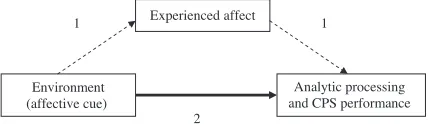
Based on this research, we postulated a differ-entiated influence of nice and nasty environments on CPS. Nice environments represent a positive affective cue and are assumed to increase positive affect. Nasty environments, as a negative affective cue, should enhance negative affect. Given this, we first hypothesised that participants in nasty environments should use more analytic processing and thus have greater information retrieval and spend more time per month working on solving the problem. Accordingly, we assumed, second, that*contrary to naı¨ve expectation*nasty envir-onments would improve CPS performance. And, third, we expected that the influence of environ-ments on CPS would be mediated through the experienced affect (see Figure 1).
METHOD
Material
We used the computer-simulated scenario ‘‘Tai-lorshop’’ (Funke, 1983). Tailorshop simulates a
microworld of a small company that produces shirts and sells them. The aim of the participants was to manage the scenario in such a manner that the capital increased over 12 rounds (called ‘‘months’’). Therefore participants made monthly arrangements such as buying raw materials, establishing the shirt price and so on. In summary, participants could directly influence 10 variables. These exogenous variables had an effect on 24 endogenous variables (21 of them are visible) that represented the business situation (see Appendix 1). Participants worked on Tailorshop by altering the exogenous variables, ending the current month, and receiving feedback about the changes of the endogenous variables. The changes were indicated by small arrows, which specified if a variable rose or fell compared with the preceding month.
Manipulation. We created a nice and a nasty
environment by adding t20.000 monthly to the
target value capital in the nice environment and
subtracting t8.000 monthly from the capital in
the nasty environment. (The different amounts are due to the ‘‘natural’’ capital reduction under normal Tailorshop conditions.) This manipula-tion was intended to influence the general trend of the capital and the performance feedback. So, the capital should show a positive trend in the nice and a negative trend in the nasty environ-ment. Consequently, participants should see an upward directed arrow next to the capital in the nice environment and thus receive positive feed-back, whereas those in the nasty environment should receive negative feedback in terms of a downward directed arrow. The manipulation
Experienced affect
Analytic processing and CPS performance Environment
(affective cue)
1 1
2
Figure 1. Model of relation between environment (affective cues), experienced affect, analytic processing and CPS performance. Part 1 assumes that the influence of environment on analytic processing and CPS performance is mediated though the experienced affect. Part 2 suggests a direct influence of environment (affective cue) on analytic processing and CPS performance.
check proved that the manipulation of the capital had this intended effect.
Participants and procedure
Participants. Participants were 84 undergraduate and graduate students of the University of Heidelberg, Germany, with a mean age of 23.11
years (SD"4.16). The nice environment was
presented to 42 participants (11 male, 31 female), the nasty environment to another 42 participants (12 male, 30 female). Participants received partial
credit for a course requirement or t12 (approx.
$15). The study took place in the Department of Psychology at the University of Heidelberg, Germany.
Procedure. Participants were randomly assigned to the nice or the nasty environment and were tested individually. They first filled out a ques-tionnaire asking for personal data. Then they received a written and spoken instruction for the complex Tailorshop scenario. Both instructions highlighted the goal to elevate the capital. Additionally, the instructions claimed that the study aimed to measure the stress level while working on the Tailorshop. Therefore partici-pants would have to fill out an affective state questionnaire after each of the 12 simulated months. Next, participants started working on Tailorshop by influencing the exogenous vari-ables. After each simulated month, participants received feedback about the changes of the endogenous variables (business situation) in the form of modifying values and arrows (see Appendix 1) and answered the affective state questionnaire.
Measures
CPS measures. We measured analytic processing and CPS performance. Analytic processing was measured with time per month participants worked on Tailorshop and with information retrieval. In order to retrieve information about
the variable framework of Tailorshop participants
had to pay betweent50 andt300, depending on
the chosen level of information. As those in the nasty environment had less money (capital), we divided the amount of money spent on informa-tion retrieval by the capital and labelled it information retrieval. The two indicators, time per month and information retrieval, were
sig-nificantly correlated (r".41, pB.001).
Further-more, we coded CPS performance by calculating the profit (cf. Su¨ß, Oberauer, & Kersting, 1993). Profit is estimated by subtracting the expenses from the revenues. Therefore, we assessed ex-penses by adding all costs like those for salary, social security, advertising, and the purchase of machines and vans. We calculated revenues by multiplying the price per shirt with the number of sold shirts, and added the sale of machines and vans. (For the exact profit calculation see Appendix 2.)
Affect measures. We measured affect 13 times using a paper-and-pencil questionnaire: Once at the beginning of the study (initial state) and 12 times after each simulated month of Tailorshop. Here, participants placed a cross on a 10 cm line
with two poles ‘‘not at all’’ and ‘‘extremely’’. The
cross represented their affective state (‘‘I am. . .’’).
We chose the following six affective items, with each item representing one dimension of the Basic Negative and Positive Emotion Scale (PANAS-X; Watson & Clark, 1994): ‘‘excited’’ (positive dimension ‘‘joviality’’); ‘‘confident’’ (positive di-mension ‘‘self-assurance’’); ‘‘concentrated’’
(posi-tive dimension ‘‘attentiveness’’); ‘‘distressed’’
(negative dimension ‘‘sadness’’1); ‘‘shaky’’ (negative
dimension ‘‘fear’’); and ‘‘angry at self’’ (negative dimension ‘‘guilt’’). We built two factors: (a) ‘‘positive affect’’ included the first 3 items
(Cron-bach’s a".77); (b) ‘‘negative affect’’ consisted of
the last 3 items (Cronbach’sa".71). The factors
were significantly, but moderately, correlated (r" #.43,pB.001) and thus were not combined to one overall scale.
1Watson and Clark (1994) did not include the item ‘‘distressed’’ to measure the dimension sadness. However, an unpublished
study by Ro¨cke and Gru¨hn (2003) proved that ‘‘distressed’’ loaded highly on sadness (Cronbach’sa".76).
RESULTS
We analysed the data by generating four quarters (QI, QII, QIII, and QIV). Each of them representing the mean value of three months.
Then, we carried out a 2$4 analysis of variance
(ANOVA) with Environment as between-subject factor (nice vs. nasty) and Quarter as within-subject factor (4 Quarters). The ANOVAs, con-ducted separately for the dependent variables positive and negative affect, also included the initial state (2$5 ANOVA). Furthermore, we always report the degrees of freedom corrected by using Greenhouse!Geisser, because sphericity was violated in all cases.
Manipulation check
We assumed an affective change depending on the environment condition: The nice environment should enhance positive affect and reduce negative affect, whereas the nasty environment should enhance negative affect and reduce positive affect. So, we carried out two 2$5 ANOVAs on the two dependent variables positive and negative affect.
The assumed affective change occurred for positive and negative affect indicating a successful environment manipulation. The positive and the negative affect were equal at the initial state
in the nice (positive affect: M"5.9, SD"2.4;
negative affect: M"2.5, SD"1.7) and nasty
environment (positive affect: M"5.6, SD"1.1;
negative affect:M"2.6,SD"1.7). Until the last
quarter the positive affect increased in the nice
environment (M"6.5,SD"1.6) and decreased in
the nasty environment (M"4.8, SD"1.4). The
reverse effect appeared for negative affect by
dropping to M"1.9 (SD"1.6) in the nice
environment and rising toM"3.9 (SD"1.9) in
the nasty environment. So, there was a significant
main effect of Environment on positive, F(1,
82)"11.65, p".001, h2".12, and negative
af-fect, F(1, 82)"17.57, p".000, h2".18. The
factor Quarter did not reach significance for positive, F(1.67, 137)"0.50, p".57, h2".01,
and negative affect, F(1.99, 163)"2.23, p".11,
h2".03. However, the interaction of Environment
and Quarter was significant for positive, F(1.67,
137)"7.28, p".002, h2".08, and negative affect,F(1.99, 163)"13.7,p".000,h2".14.
Positive and negative affect diverged more and more between both environments while working on Tailorshop. The nice environment enhanced positive and reduced negative affect over time. The reverse effect occurred in the nasty environ-ment. Thus, we conclude that our manipulation worked properly.
The influence of environments on analytic
processing
We hypothesised that participants in nasty en-vironments would use an analytic processing style and consequently should have a higher informa-tion retrieval and spend more time per month working on the problem. So, we performed two 2$4 ANOVAs on information retrieval and time per month.
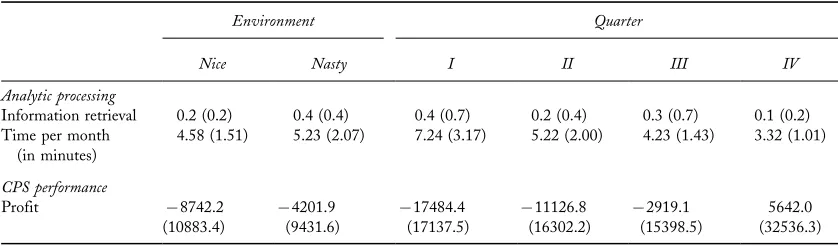
The results show that participants in the nasty environment did indeed spend a higher amount of their capital on information retrieval and worked a little bit longer on the problem than participants in the nice environment. However, the time did not differ significantly. Table 1 shows that the amount of capital spent on information retrieval
was twice as high in the nasty environment (M"
0.4, SD"0.4) than in the nice environment (M"0.2, SD"0.2). Further, participants in the nasty environment spent 5.23 minutes per month (SD"2.07) working on Tailorshop, whereas those in the nice environment worked just 4.58
minutes per month (SD"1.51) and thus a little
less. So, Environment had a significant influence
on information retrieval, F(1, 82)"9.74, p"
.002, h2".10, but not on time per month, F(1,
82)"1.62, p".206, h2".02. Furthermore,
in-formation retrieval and time per month were higher at Quarter I (information retrieval: M"0.4, SD"0.7; time per month: M"7.24, SD"3.17) and decreased to Quarter IV
(infor-mation retrieval: M"0.1, SD"0.2; time per
month: M"3.32, SD"1.01). So, the factor
Quarter was significant for information retrieval,
F(2.0, 165)"4.82, p".009, h2".05, and time
per month, F(1.8, 246)"71.83, p".000, h2" .47. The interaction was not significant, either
for information retrieval,F(2.0, 165)"1.38,p"
.249, h2".02, or for time per month, F(1.8,
246)"0.29,p".730,h2".00.
Taken together, the results support our hy-pothesis: Participants in the nasty environment had substantially higher information retrieval and spent 25 seconds more per month trying to solve the problem.
The influence of environments on CPS
performance
We asked whether nasty environments led to a better CPS performance than nice environments. So, we ran a 2$4 ANOVA on the performance indicator profit (cf. Su¨ß et al., 1993). A negative profit stands for overspending and shows that participants spent more money than they earned. A positive profit indicates a gain.
The results support our hypothesis: Nasty environments caused a higher profit and thus improved CPS performance. Table 1 shows that
participants in a nice environment spent t8742.2
monthly (SD"10,883.4) more than they earned,
whereas participants in a nasty environment only
expendedt4201.9 (SD"9431.6) more than they
acquired. Thus, the factor Environments
signifi-cantly influenced the profit,F(1, 82)"4.17,p"
.044, h2".05. Additionally, the factor Quarter
had a significant effect on profit,F(1.94, 159)"
17.69, p".000, h2".17. The profit improved
during working on Tailorshop. At Quarter I the profit was negative showing an overspend (M" #17,484.4,SD"17,137.5), whereas it was
positive at Quarter IV (M"5642.0, SD"
32,536.3) indicating a gain. The interaction between Environment and Quarter was not sig-nificant,F(1.94, 159)"0.19,p".823,h2".00.
Taken together, the data support the assump-tion that participants in nasty environments showed a better performance than those in the nice environment.
The meditational role of affect
Recent affect!cognition theories assume that affect mediates the connection between environ-ment and CPS (see Figure 1). Therefore, we ran a meditational analysis in order to test this assump-tion. According to Baron and Kenny (1986) we estimated the following three regression equa-tions. (1) First, we tested whether the independent variable Environment predicted the mediator affect. (2) Second, we used the independent variable Environment to predict analytic proces-sing (information retrieval) and CPS performance (profit). And (3) third, we entered the indepen-dent variable Environment and the mediator affect into the regression analyses to predict analytic processing and CPS performance. If affect is a mediator, each of the three regression analyses
should be significant (pB.05). Moreover, the
effect of Environment on CPS must be less in the third equation than in the second.
Table 1. Means and standard deviations of analytic processing and CPS performance in Tailorshop for the environments (nice and nasty) and for the four quarters (n"84)a
Environment Quarter
Nice Nasty I II III IV
Analytic processing
Information retrieval 0.2 (0.2) 0.4 (0.4) 0.4 (0.7) 0.2 (0.4) 0.3 (0.7) 0.1 (0.2)
Time per month (in minutes)
4.58 (1.51) 5.23 (2.07) 7.24 (3.17) 5.22 (2.00) 4.23 (1.43) 3.32 (1.01)
CPS performance
Profit #8742.2
(10883.4)
#4201.9 (9431.6)
#17484.4 (17137.5)
#11126.8 (16302.2)
#2919.1 (15398.5)
5642.0 (32536.3)
Note:aWe did not report the means and standard deviations of the interactions, because they never reached significance.
The regression analyses disproved the assump-tion of the meditaassump-tional role of affect. More specifically, steps 1 and 2 showed a highly significant influence of Environment on affect
(positive affect: b" #.386; negative affect: b"
.466) and a significant influence on information retrieval (b".326), and profit (b".220). Step 3, however, indicated that neither positive nor nega-tive affect influenced information retrieval
(posi-tive affect: b".012; negative affect: b".061) or
lowered the significant influence of Environment
on information retrieval (b".326 vs. positive
affect: b".331; negative affect: b".297). The
same is true for CPS performance. Here, affect
again had no impact on profit (positive affect:b"
.124; negative affect: b".014) or lowered the
significant influence of Environment on profit (b".220 vs. positive affect: b".268; negative
affect: b".214). So, the meditational analysis
showed that affect did not mediate the influence of environment on analytic processing and CPS performance (cf. Soldat & Sinclair, 2001).
DISCUSSION
This study proved that environments have an impact on CPS leading to more analytic proces-sing and a better CPS performance in the nasty environment. More specifically, participants in the nasty environment spent a higher amount of their capital on information retrieval, worked a little longer on the problem and had a higher profit. Furthermore, they experienced more ne-gative and less positive affect while solving the problem. This affective change had, surprisingly, no impact on CPS. CPS was only influenced by the environment. In the following, we present two explanations for this unexpected result.
Explanation 1: External affective cues
influence processing similar to experienced
affect
Soldat and Sinclair (2001) recently postulated that external affective cues have the same influence on processing as experienced affect. They carried out
four studies and used external affective cues like presenting statements written on blue or red paper (Study 1), giving a speech to a confederate, who responded in a positive or serious manner (Study 2), or showing photographs of smiling or frown-ing faces on a screen below of awareness (Studies 3 and 4). All studies demonstrated that partici-pants, who saw positive affective cues, were persuaded by strong and weak arguments, whereas those, who saw negative affective cues, were only affected only by strong arguments. Studies that influenced the experienced affect showed the same pattern of results (Sinclair, Mark, & Clore, 1994). Further, Friedman and Fo¨rster (2000), Study 7) demonstrated that negative affective cues facili-tated analytical reasoning. In both studies (Soldat & Sinclair, 2001; Friedman & Fo¨rster, 2000, Study 7), participants reported no affective change.
This study supports the assumption of Soldat and Sinclair (2001). The constructed environ-ments clearly had an affective connotation. And the following three results prove that nasty environments lead to more analytic processing. First, participants in the nasty environment spent a higher amount of their capital on information retrieval. Higher information retrieval is an indicator of a data-driven approach. Second, those in the nasty environment had a higher profit than participants in the nice environment. A high profit implies calculating the expenses and reven-ues and is thus evidence of analytic processing. And, third, participants in the nasty environment spent slightly more time working on the problem than those in the nice environment. The time difference did not reach significance, as in many other studies that analysed the influence of affect on time (e.g., Forgas, 2007, Study 4; Isen et al., 1987, Study 2; Spering et al., 2005). However, it points in the expected direction.
Nevertheless, there is one great difference between our study and the reported ones (Soldat & Sinclair, 2001; Friedman & Fo¨rster, 2000, Study 7). In our study the experienced affect did change within the task, even though it did not influence CPS. The missing link of affect on CPS could have been caused by the external attribution
of the affect. The affect was elicited by the task and thus participants might attribute their affect to the task. Schwarz and Clore (1983) were the first to prove that external attribution of affect reduced its impact on cognitive processes: If participants were cued to attribute their negative affect to the bad weather, the negative affect had no influence on life satisfaction. Furthermore, participants showed no influence of affect on persuasion, when they attributed their affect to the weather (Sinclair et al., 1994). So, it is possible that participants in our study attributed their experienced affect to the task and thus it had no impact on CPS.
Explanation 2: Motivation overrides the
impact of affect
The finding might further be explained by different motivational states. Bless et al. (1996, p. 677) highlighted that the ‘‘effects elicited by the valence of mood can be overridden by other
factors . . . for example . . . motivation’’. Forgas
(2007, Study 4) supported this assumption by showing that affective effects on persuasive argu-ments can be reduced or eliminated through external motivation. Feedback has a strong influ-ence on motivation. So, it is possible that the positive and negative feedback given in the nice and nasty environment caused different motiva-tional states. Negative feedback informs the individuals that the performance has fallen below an acceptable standard, whereas positive feedback implies that an individual’s performance has exceeded an acceptable standard. Therefore in-dividuals receiving negative feedback are likely to exert more effort than those who receive a positive feedback (Kluger & DeNisi, 1996). However, there are other studies demonstrating that positive affect is associated with an approach-oriented (need for achievement motivation) and negative affect with an avoidance-oriented behaviour (fear of failure motivation; Bartels, 2007). Our data agree with the first assumption. So, we conclude that the positive and negative feedback might have caused different motivational levels, which overrode the impact of affect and led to a higher
motivation and thus to a better performance in the nasty environment. However, we did not measure motivation and thus further studies have to prove the accuracy of our conclusion.
Summary
Taken together, this study points out that nasty environments lead to an analytic processing and improve CPS performance. The performance advantage might be due to the affective connota-tion of the environments, because external affec-tive cues influence cogniaffec-tive processes in the same way as experienced affect. Further, the positive and negative feedback given in the nice and nasty environment may have caused different motiva-tional states that influenced CPS.
Manuscript received 15 April 2009 Revised manuscript received 27 July 2009 Manuscript accepted 28 July 2009 First published online 26 October 2009
REFERENCES
Bandura, A., & Wood, R. E. (1989). Effect of perceived controllability and performance standards on self-regulation of complex decision making. Journal of Personality and Social Psychology, 56, 805!814.
Baron, R. M., & Kenny, D. A. (1986). The moderator!
mediator variable distinction in social psychological research.Journal of Personality and Social Psychology, 51, 1173!1182.
Bartels, J. M. (2007). Dispositional positive and negative affect and approach!avoidance achievement motivation. Individual Differences Research, 5, 246!259.
Bless, H., Clore, G. L., Golisano, V., Rabel, C., & Schwarz, N. (1996). Mood and the use of scripts: Do happy moods really make people mindless? Journal of Personality and Social Psychology, 71, 665!678.
Brehmer, B. (1995). Feedback delays in complex dynamic decision tasks. In P. A. Frensch & J. Funke (Eds.), Complex problem solving: The European perspective (pp. 103!130). Hillsdale, NJ: Lawrence Erlbaum Associates, Inc.
Do¨rner, D. (1980). On the difficulties people have in dealing with complexity.Simulation and Games,11, 87!106.
Fiedler, K. (1988). Emotional mood, cognitive style, and behavior regulation. In K. Fiedler & J. Forgas (Eds.),Affect, cognition and social behavior(pp. 100! 119). Toronto, Canada: Hogrefe.
Fiedler, K. (2001). Affective states trigger processes of assimilation and accommodation. In L. L. Martin & G. L. Clore (Eds.),Theories of mood and cognition: A user’s guidebook(pp. 86!98). Mahwah, NJ: Lawrence Erlbaum Associates, Inc.
Forgas, J. P. (2007). When sad is better than happy: Negative affect can improve the quality and effec-tiveness of persuasive messages and social influence strategies.Journal of Experimental Social Psychology, 43, 513!528.
Friedman, R., & Fo¨rster, J. (2000). The effects of approach and avoidance motor actions on the elements of creative insight. Journal of Personality and Social Psychology,79, 477!492.
Funke, J. (1983). Einige Bemerkungen zu Problemen der Problemlo¨seforschung oder: Ist Testintelligenz doch ein Pra¨diktor? [Some comments to problems of problem solving research, or: An intelligence test is a predictor, isn’t it?].Diagnostica,29, 283!302. Holyoak, K. J. (1995). Problem solving. In E. E. Smith
& D. N. Osherson (Eds.),An invitation to cognitive science: Thinking (pp. 267!296). Cambridge, MA: MIT Press.
Isen, A., Daubman, K., & Nowicki, G. P. (1987). Positive affect facilitates creative problem solving. Journal of Personality and Social Psychology, 52, 1122!1131.
Kluger, A. N., & DeNisi, A. (1996). The effect of feedback interventions on performance: A historical review, a meta-analysis, and a preliminary feedback intervention theory. Psychological Bulletin, 119, 254!284.
Ro¨cke, C., & Gru¨hn, D. (2003).German translation of the PANAS-X. Unpublished manuscript, Free Uni-versity Berlin.
Schwarz, N., & Clore, G. L. (1983). Mood, misat-tribution, and judgments of well-being: Informative
and directive functions of affective states.Journal of Personality and Social Psychology,45, 513!523. Sinclair, R. C. (1988). Mood, categorization breadth,
and performance appraisal: The effects of order of information acquisition and affective state on halo, accuracy, information retrieval, and evaluations. Organizational Behavior and Human Decision Pro-cesses,42, 22!46.
Sinclair, R. C., Mark, M. M., & Clore, G. L. (1994). Mood-related persuasion depends on (mis)attribu-tions.Social Cognition,12, 309!326.
Soldat, A. S., & Sinclair, R. C. (2001). Colors, smiles, and frowns: External affective cues can directly affect responses to persuasive communications in a mood-like manner without affecting mood. Social Cognition,19, 469!490.
Spering, M., Wagener, D., & Funke, J. (2005). The role of emotions in complex problem solving. Cognition and Emotion,19, 1252!1261.
Su¨ß, H.-M., Oberauer, K., & Kersting, M. (1993). Intellektuelle Fa¨higkeiten und die Steuerung kom-plexer Systeme [Intelligence and control perfor-mance on computer-simulated systems]. Sprache & Kognition,12, 83!97.
Vollmeyer, R., Bums, B. D., & Holyoak., K. J. (1996). The impact of goal specificity on strategy use and the acquisition of problem structure. Cognitive Science,20, 75!100.
Watson, D., & Clark, L. A. (1994). The PANAS-X: Manual for the positive and negative affect schedule! expanded form. Iowa City: The University of Iowa Press.
Wenke, D., & Frensch, P. A. (2003). Is success or failure at solving complex problems related to intellectual ability? In J. E. Davidson & R. J. Sternberg (Eds.), The psychology of problem solving (pp. 87!126). New York: Cambridge University Press.
Westermann, R., Spies, K., Stahl, G., & Hesse, F. W. (1996). Relative effectiveness and validity of mood induction procedures: A meta-analysis. European Journal of Social Psychology,26, 557!580.
APPENDIX 1
The user interface of Tailorshop
In the upper part of the interface participants get information about the business situation of the current month. The arrows beside the variables indicate the changes. An arrow facing downward indicates that the variable has decreased compared to the earlier month, whereas an upward pointing arrow signifies an increase. The lower part of the interface displays the possible arrangements.
Business situation of month 1
Cash : 165,775t ! Capital : 250,691t !
Sold shirts : 407 ! Demand : 767 ¡
Raw material price : 4t ¡ Raw material storage : 16
Shirts storage : 81 ¡ Number of 50-machines : 10 !
Workers on 50-machines : 8 Number of 100-machines : 0
Workers on 100-machines : 0 Repair and service : 1200t
Salary per worker : 1080t ¡ Social costs : 50t
Price per shirt : 52t Advertising : 2800t
Numbers of vans : 1 Shop location : city
Employee satisfaction : 57.7% Mechanical demand : 5.9% ¡
Loss of production : 0% ¡
Arrangements in month 2
r"raw material p"price per shirt
a"advertising w"workers
m"machines c" repair and service
y"salary s"social costs
l"shop location v"van
i"information e"end of the month
APPENDIX 2
Calculation of the profit Profit"(1) revenues#(2) expenses.(1) revenues"(price per shirt$number of sold shirts)%sale of machines and vans.
(2) expenses"costs for shirts storage%costs for raw material storage%(purchase of raw material$ raw material price)%
(salary per worker $ number of workers)%(social cost $ number of workers)%costs for shop location%(vans $ 650)% mechanical demand%advertising%purchase of machines and vans.