University of South Carolina
Scholar Commons
Theses and Dissertations
2017
An Evidence-Based Process Change to Improve
Mammography Adherence
Tara E. Smalls
University of South Carolina
Follow this and additional works at:https://scholarcommons.sc.edu/etd Part of theNursing Commons
This Open Access Dissertation is brought to you by Scholar Commons. It has been accepted for inclusion in Theses and Dissertations by an authorized administrator of Scholar Commons. For more information, please [email protected].
Recommended Citation
AN EVIDENCE-BASED PROCESS CHANGE TO IMPROVE MAMMOGRAPHY ADHERENCE
by
Tara E. Smalls
Bachelor of Science in Nursing University of South Carolina, 1998
Master of Science in Nursing University of South Alabama, 2008
Submitted in Partial Fulfillment of the Requirements
For the Degree of Doctor of Nursing Practice in
Nursing Practice
College of Nursing
University of South Carolina
2017
Accepted by:
Sue Heiney, Major Professor
Beverly Baliko, Committee Member
Abbas S. Tavakoli, Committee Member
DEDICATION
I dedicate this dissertation to my Lord and Savior Jesus Christ and my family. Jesus
Christ, you always answer my prayers, and I stand on your word that says “I can do all
things through thee that strengthens me.” A special gratitude to my loving mother Mary J.
Smalls for your unrelenting love, support, and prayer; and my dad the late, Nathan
“Smiley” Smalls for giving me tenacity and courage to always stand for what I believe in.
I am extremely blessed that my siblings, Teresa C. Jennings (Tee) and Corey S. Smalls
are my biggest cheerleaders and I am exceedingly grateful for their perpetual love,
sacrifice, and support of me. Margo, my sister in marriage, thank you for simply loving
me. Morgan, Kory, and Nathan, you all are my inspiration to continuously accomplish
more. Finally, I am abounded with thankfulness for the unconditional love and support
of my beau Joseph D. Mason and my dearest sister- friends Altonya, Senyene, Asumpter,
ACKNOWLEDGEMENTS
This project could not have been possible without the encouragement and support from
my Doctor of Nursing Practice (DNP) Project Committee. Dr. Sue Heiney, thank you for
your time, guidance, and wisdom; your persistent demand that I step out of my comfort
zone maximized my greatest potential through this doctoral experience and we have
developed a significant project. Dr. Baliko, your constant fuel of encouragement paired
with your insightful and honest critique have propelled my thinking beyond measure and
given me the confidence of a DNP. Dr. Tavakoli, you are truly one of the most passionate
professors that I have ever worked with. Your patience and expertise in biostatistics were
crucial in making this project a valid work.
I am sincerely grateful for all my team members at Palmetto Health who
supported this initiative to improve the delivery of healthcare in our community;
especially Rashonda Abrams, who persistently and patiently contributed her time and
knowledge.
Dr. Beth Howard-Brown, Dr. Veronica Deas, Dr. Deitra Watson, thank you all for
taking the time to read my dissertation and encouraging me through this process. Thank
you Maurice Shaw and Taphanie Sanders for the endless technical support. Dr. Tee C.
Jennings we have obtained our DNP—thank you for sacrificing nights of writing and
unremitting prayer.
ABSTRACT
Breast cancer is a significant disease—affecting 12% of American women in a
lifetime. Breast cancer costs $180 billion annually in healthcare expenditures and
productivity. Mammography has been identified as the greatest tool to mitigate
morbidity, yet in many organizations, mammography compliance rates are decreasing.
This process improvement was conducted to address the barriers to patient follow
through with mammography and to recommend strategies to improve the current
breast-screening process.
Principles of the Six Sigma DMAIC framework were utilized to analyze the
breast-screening clinic process. Chart reviews and organization databases were applied to
determine mammography adherence. The opportunities to improve current practices were
identified by outlining the current practice flow, chart reviews, data mining of
mammography adherence, and obtaining a baseline analysis of a sample of clinic patients
who did not follow up with mammography. Informal interviews with providers were
conducted as well. The structure of the organization was outlined and internal and
external resources were identified.
An extensive review of the literature was conducted to identify best practices and
barriers to mammography screening to elicit strategies to improve the breast-screening
of clinic visit, alert staff and providers of participants that meet criteria for
mammography by flagging or marking the patients’ charts, then providing a tailored
provider message regarding the importance of mammography and relevance of all steps
of the screening process, with an emphasis on financial counseling, and streamlining the
current process. The usual care will be compared with the process change. The outcome
measure of mammography proportion was calculated using a two-sample proportion test.
The mammography proportion for the pre-intervention group was 22% and 51% for the
post-intervention group. There was a statistically significant difference (p = 0.01) in
mammography adherence between the pre-intervention group and the post intervention
group. Ultimately, as evidenced by the significant increase in mammography utilization,
the breast-screening clinic will positively impact the disease burden of breast cancer
TABLE OF CONTENTS
DEDICATION ... ii
ACKNOWLEDGEMENTS ... iii
ABSTRACT ... iv
LIST OF TABLES ... vii
LIST OF FIGURES ... viii
CHAPTER 1:INTRODUCTION...1
CHAPTER 2:REVIEW OF THE LITERATURE ...29
CHAPTER 3:METHODOLOGY ...48
CHAPTER 4:RESULTS ...65
CHAPTER 5:CONCLUSION AND RECOMMENDATIONS ...76
REFERENCES ...83
APPENDIX A.EVIDENCE AND QUALITY GUIDE ...97
APPENDIX B.EVIDENCE TABLE ...99
LIST OF TABLES
Table 1.1 Frequency Distribution of Selected Factors of Breast-screening Participants ..13
Table 1.2 Evidence-based Clinical Question ...20
Table 3.1 Timeline for Evidence-based Process Change ...60
Table 4.1 Summary of Variables of the Pre-intervention Population ...68
Table 4.2 Post Intervention Group Frequencies of Selected Variables ...70
LIST OF FIGURES
Figure 1.1 Breast-screening Clinic Process Flow ...11
Figure 1.2 Six Sigma DMAIC Approach Model ...27
CHAPTER
1
INTRODUCTION
Breast cancer is the most commonly diagnosed cancer in women, and the second
most common cause of cancer death (American Cancer Society [ACS], 2015). South
Carolina [SC] was ranked 21st in the nation for breast cancer mortality in 2013 (South
Carolina Department of Health and Environmental Control [SCDHEC], 2016). Early
detection has been identified as crucial to survival. Nationally, when breast cancer is
diagnosed in the early stages, the five-year survival rating is above 99% (American
Cancer Society, 2015). According to a 2009–2013 surveillance report, about 61% of
breast cancers were diagnosed in the early stages (South Carolina Department of Health
and Environmental Control, 2016).
Advances in breast cancer treatment and screening initiatives have afforded
significant declines in breast cancer mortality over recent years. However, breast cancer
continues to be a national priority as every year over 200,000 women will be diagnosed
with cancer, and approximately 40,000 will die (American Cancer Society, 2015).
Recognizing that the incidence of breast cancer-related deaths remains extremely high,
Healthy People 2020 established the goal of decreasing the number of breast cancer
mortalities by 10% (Office of Disease Prevention and Health Promotion, 2016).
Effective breast-screening programs have been at the forefront of addressing the
demand for early detection and treatment, and subsequently diminishing the death
view to record images of the breast. Mammography is instrumental in early detection as it
detects tumors before signs and symptoms manifest. Early detection correlates with
survival. The ACS (2015) screening guidelines state that most women aged 40 to 44
years should have a choice to start annual screening mammograms; women 45 to 54
years should get mammograms yearly, and women 55 years and older can have biannual
or annual screenings. The American College of Obstetricians and Gynecologists [ACOG]
recommends annual screening starting at age 40 years. The United States Preventive
Screening Task Force [USPSTF] recommends biannual screening mammography for
ages 50–74 years. Though the ACS, ACOG, and USPSTF provide different screening
schedule recommendations, there is a consensus that early detection is the best available
approach to decrease mortality related to life-threatening breast cancer (American Cancer
Society, 2015; Newton, 2016).
Description of Clinical Problem
Mammography is considered the gold standard for early detection of
asymptomatic breast cancer and has been linked to up to 39% reduction in mortality from
the disease, yet breast cancer screening remains underutilized in many United States [US]
populations (Newton, 2016). For more than two decades, mammography rates increased,
followed by a period of slight decrease, and then leveled off. In the years 1987, 2000, and
2005–2010 the mammography rates were 39%, 70%, and 67%, respectively (American
Cancer Society, 2015). The prevalence of screening mammography is particularly
reduced in women that are racial or ethnic minorities, uninsured, have low income, less
education, and low health literacy (Alexandraki & Mooradian, 2010; Özmen et al., 2016).
organizations continuously improve the processes by implementing the best practices to
facilitate mammography compliance in the populations served. The scope of this quality
improvement project is to implement an evidence-based intraorganizational process
change that incorporates the best available research to improve screening mammography
compliance.
Scope of the Problem
According to the World Health Organization [WHO] (2014), breast cancer is the
most common cancer worldwide. Breast cancer is the second leading cause of cancer
death for women in the United States (American Cancer Society, 2015). In a five-year
surveillance report from 2008 to 2012, breast cancer was the most commonly diagnosed
cancer and was thesecond leading cause of cancer death in the state of South Carolina
and locally in Richland County (South Carolina Department of Health and Environmental
Control, 2015). In that same report, Richland County ranked among the highest in breast
cancer incidence rates, ranking fourth of the 46 counties in South Carolina (South
Carolina Department of Health and Environmental Control, 2015). There were a total of
271 new cases during that time frame and 48 deaths (South Carolina Department of
Health and Environmental Control, 2015). Data trends suggest that from 2004 to 2014,
breast cancer incidence rates across the United States remained stable (American Cancer
Society, 2015). However, the 2015 estimation of 235,000 new diagnoses of breast cancer,
43,000 deaths related to breast cancer, and the potential for the United States
expenditures for cancer care to reach $156 billion by 2020 signal that prevention and
early detection of breast cancer is a high priority for the U.S. healthcare system
There is a significant need to address the issue of mammography compliance in
healthcare practices, as this correlates with improved outcomes related to breast cancer.
Breast cancer is a significant health condition, seeing that one in eight women in the
United States will develop cancer during their lifetime (American Cancer Society, 2015).
Primary diagnoses of breast cancer for inpatient hospitalizations cost more than $44.0
million in South Carolina during 2014 (South Carolina Department of Health and
Environmental Control, 2016). Furthermore, there were 807 inpatient hospitalizations
related to breast cancer, with an average length of stay of 2.6 days, and netting an average
total cost of stay of $54,526.80 (South Carolina Department of Health and Environmental
Control, 2016). Early detection enables early treatment, which has been shown to
correlate with decreased health costs. The average cost for an occurrence of early-stage
treatment of breast cancer is $14,000 per year (Miller, 2012). The average cost of an
occurrence of late-stage treatment of breast cancer is more than three times the cost of
early-stage treatment, costing approximately $47,000 per year (Miller, 2012).
Mammography compliance correlates with reductions in mortality, morbidity, and cost;
thus, it is essential for organizations to assess and recognize opportunities for
improvement in their delivery system and key processes of mammography screening.
Research has consistently conveyed that mortality rates decrease with adherence
to utilizing mammography screening (Hendrick & Helvie, 2011). In women 40–84 years
old, annual mammography screening has proven to be the most advantageous cancer
intervention, yielding a significant mortality reduction (Hendrick & Helvie, 2011).
Despite the compelling death rate reduction attributed to mammography screening, many
comply with their providers’ recommendation of screening mammography. The increased
incidence of breast cancer among women aged 40 years and older and the prevalence of
women not having mammography screenings has incited a concern to providers and
healthcare leaders to seek solutions to improve mammography adherence.
Barriers to mammography screening. Women’s adherence to breast cancer
screening is contingent upon a multitude of factors. Studies have shown that such
influences or barriers include confusion related to benefits of mammography and
screening guidelines, fear of being diagnosed with cancer, lack of social support, low
levels of income and education, and lack of insurance and access to mammography
screening service (Jones et al., 2014; Schueler, Chu, & Smith-Bindman, 2008). Distrust
of the medical system is another common barrier to mammography, specifically among
black non-Hispanic women (Ramirez et al., 1999; Spalter-Roth et al., 2005).
Socioeconomic barriers are complex and tend to require institutional and
organizational programs and policies that spur financial contribution. Successful
screening programs keep abreast of community resources to eliminate financial access
barriers (Schueler, Chu, & Smith-Bindman, 2008). Studies have found that despite
socioeconomic status (SES), cognitive and psychological factors can be addressed
through initiatives to educate the population on the benefits of screening and early
detection and assist individuals with navigation through the healthcare system to achieve
recommended preventive services (Ferreira, 2005; Peterson et al., 2016; Wells et al.,
2008). Nurse practitioners and physician’s assistants provide preventive care services and
education in health centers, and thus are in an ideal position to influence women to follow
Description and Analysis of the Current Practices
Cancer Health Initiative. The Cancer Health Initiative is one of the programs
integrated through the region’s largest not-for-profit health system. Since 1998, the health
system has pledged to give 10% of their bottom line profits to improving health outcomes
of the Midlands communities. Cancer as the second leading cause of death directed the
priority of improving cancer outcomes. Screening services and programs attend to the
following five cancers, breast, cervical, prostate, colorectal, and lung. ACOG, ACS,
American Urological Association, and American College of Gastroenterology (ACG)
recommendations guide the screening and prevention education.
One of the goals of the Cancer Health Initiative is to provide quality screening
and education to the underserved residents of the surrounding communities (Palmetto
Health, 2016). The breast cancer-screening program includes a clinic visit with a nurse
practitioner or physician’s assistant. During the visit, the provider reviews the patient’s
history, discusses specific breast-related problems or questions, orders mammography
imaging for age-appropriate participants, and refers participants to the Breast Center for
abnormalities that may require immediate attention or additional workup. The Breast
Center is a subsidiary clinic of the health system that is located onsite at one of the acute
health center campuses.
Eligibility for clinic services. Breast cancer screening is a service offered
through the Cancer Health Initiative. The breast-screening clinic provides services for
uninsured and underinsured (i.e., hospitalization and emergency visit insurance coverage
only) patients. Federal eligibility criteria are established by age, income, and residency.
Richland, Lexington, or Fairfield counties. Participants of the breast-screening clinic
have to have an income 200% of the federal poverty line. Mammography screening is
available for participants 40 years or older whose income is 100% of the federal poverty
line. Federal poverty level calculations are dependent on family size and are readjusted
each year. In 2015 the average income at 200% of the poverty line for a household of one
and four was $23,760 and $60,625, respectively (United States Census Bureau, 2015).
The 2016 Poverty Income level thresholds decreased, which likely increased individuals’
eligibility to participate in public programs and receive incentive or assistance for health
insurance through the federal market exchange. The income for a household of one did
not change much in 2016, as it only decreased by $220. However, for a household of four
in 2016 the 200% poverty level income decreased to $48,600. The percentage of the
population for Richland, Lexington, and Sumter with income of less than $25,000 is 25.4,
26.6, and 28.1, respectively (County Health Rankings, 2015; United States Census
Bureau, 2015). The change in poverty level income is a major determinant in the breast
clinic participants’ access to cancer preventive services. Unfortunately, the
mammography, which is the recommended standard of breast cancer screening, has a
higher income-qualifying threshold.
Clinic staff and patient clinic visit flow. An all-female direct patient care team
staffs the health center. The team includes seven nurse practitioners and one physician’s
assistant. The other interdisciplinary team members include registered nurses, a licensed
practical nurse, patient advocates, laboratory technicians, and a medical social worker.
The breast-screening participant’s first point of contact is with patient advocates that
factors, e.g., obesity) transition to the lab for blood glucose screening. Upon completing
the health information paperwork and lab screening, a patient advocate or nurse obtains
the participant’s vital signs and weight. Lastly, the patient is taken to the exam room for
breast-screening and/or cervical-screening assessments.
The nurse practitioner or physician’s assistant performs the breast and/or cervical
screenings and provides patient education. The provider is usually alone with the patient
unless a patient advocate is necessary to translate for Spanish-speaking participants.
There is only one nurse practitioner provider that is fluent in Spanish. The usual practice
is two providers for an average of 16 patients to be seen in a four-hour period.
The provider staff deliver most of the patient education. The AGOG standards for
screening and education are utilized. The ACS is also used as a reference for teaching our
participants the signs and symptoms. The participants are taught about signs and
symptoms of breast cancer. Breast self-awareness is discussed and the techniques of
performing a breast self-exam (BSE) are reviewed as an opportunity for breast
awareness. Written educational material includes a Breast Exam Shower Card that is
given to the patients to take home. Pictures are paired with the verbal education to
promote patient understanding. The education includes discussion of breast abnormalities
such has lumps, hard knots, swelling, and nipple discharge. In addition, it explains how to
feel for changes standing or lying. There is also content regarding examining breasts with
implants. The tool does have the organization referenced and there is a number to call to
schedule a mammography, however, there is no content explaining how to obtain a
mammography screening externally. There is no printed information about breast cancer
regarding relative risk associated with having a family history of breast cancer. Providers
report delivering verbal education-related screening recommendations adjusted for high
risk.
Discussion of clinic outcomes. In 2015, 818 screening participants received
2,505 services, including clinical breast exams, mammography screenings, and
ultrasounds (Palmetto Health, 2016). There was one active breast cancer diagnosis in
2015. This clinic’s 2015 incidence of breast cancer was 1 positive diagnosis per 818
participants (122 per 100,000). The national incidence in 2008–2012 was 123.1 per
100,000. South Carolina’s incidence was 125.3 per 100,000 (National Cancer Institute,
2016), whereas Richland County’s breast cancer incidence was 137.9 per 100,000
(Centers for Disease Control and Prevention [CDC], 2015).
The Cancer Health Initiative’s participants are uninsured or underinsured. The
majority of the population’s demographic is unemployed, low-income grade, and
minority. This population has limited access to healthcare and preventive services.
Despite race or ethnicity, negative health outcomes are most prevalent in
individuals who are uninsured or underinsured, lack access to healthcare, and have low
incomes (Davidson, 2014). South Carolina ranks 13th highest for percent of uninsured
population, and 48% of the uninsured population are women (SCIMPH, 2014). African
Americans/Blacks, Asian Americans, Hispanic/Latinos, American Indians, Alaska
Natives, and underserved Whites are more likely than the general population to have
higher incidence and death statistics for breast cancer and certain other types of cancer
(National Cancer Institute, 2016). Correspondingly, poor health literacy is a gradient to
demographics of the screening participants are compellingly parallel to several of the
defining characteristics of individuals with low health literacy, which links the screening
participants to higher risks for poorer outcomes related to breast cancer among other
diseases.
The author investigated the current practices in the delivery of breast cancer
education and reviewed mammography compliance data. The Cancer Health Initiative’s
mammography compliance was noted to have declined over the past two years.
According to the clinic data, in the fiscal year of 2015, 538 mammograms were ordered,
and only 128 were completed, yielding a compliance rate of 23.7%. In 2016 the
mammography compliance was 27.8%. These rates are far below the national and state
screening rates of mammography, which are 73% and 72%, respectively (South Carolina
Department of Health and Environmental Control, 2016). Since the inception of the
Affordable Care Act, participants have been required to take an additional step of
obtaining financial counseling prior to acquiring a mammography appointment.
Evidence for Need of Change
To identify the barriers and facilitators to mammography screening, the author
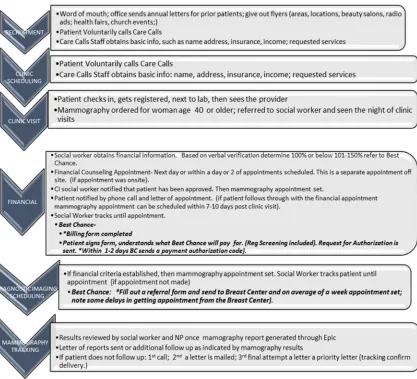
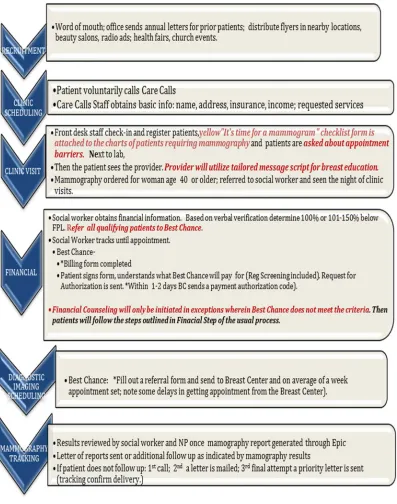
outlined each step of the mammography screening process. Figure 1.1 outlines the six
steps to the breast-screening process: recruiting, scheduling, clinic visit, financial
Figure 1.1 Breast-screening Clinic Process Flow
To evaluate further the problem of decreased mammography rates, a data analysis
of a sample of patients that did not follow through with mammography was obtained. An
Excel spreadsheet was generated by the clinic social worker to log the follow-up contact
with patients that did not follow through with mammography. A random selection of the
sample of patients was conducted utilizing the Excel spreadsheet random function. Chart
reviews and follow-up phone call documentation were examined to create the data in
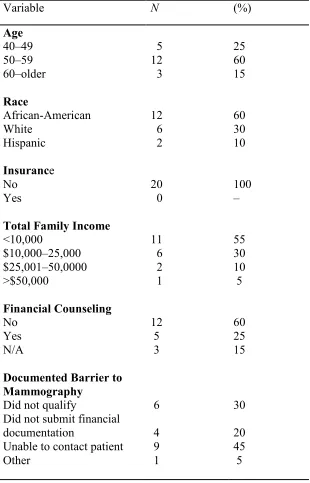
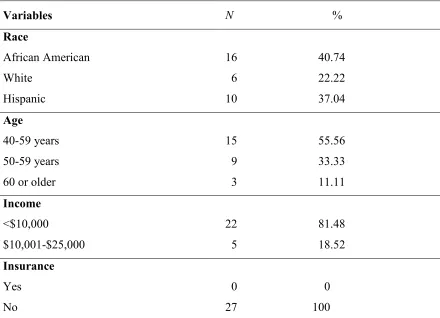
Table 1.1 shows the distribution of the sample population N and percentage of
selected variables. The sample (N = 20) was comprised of randomly selected screening
participants who completed a clinic visit in 2016 but did not follow through with
mammography. Sixty percent (n = 12) of the sample population was in the age bracket
50–59 years; 25% percent (n = 5) were aged 40–49 years, and 15% (n = 3) were aged 60
years or older. The racial composition was predominantly African-American at 60% (n =
12), followed by White at 30% (n = 6) and Hispanic at 10% (n = 2). One hundred percent
of the sample population did not have insurance. Most of the sample had a total income
of less than $10,000 (55%, n = 11), whereas 30% (n = 6) had total income $10,000–
$25,000 and 10% (n = 2) were in the income bracket of $25,001–$50,000. Only 5% (n =
1) of the sample had a total income of >$50,0000. Being unable to contact the patients
after the initial clinic visit was the most common barrier in the mammography screening
process with 45% of the sample not contacted (n = 11). Thirty percent (n = 6) did not
qualify for financial assistance, 20% (n = 4) did not submit required financial
documentation, and 5% (n = 1) had other reasons. Everyone in the sample was uninsured
and most reported a total income of <$10,000, so based on this information they should
meet eligibility for some financial assistance. Under the healthcare reform law, states
have the option to expand Medicaid coverage to everyone under 138% of the poverty
level. The fact that SC did not opt to accept federal funding to expand Medicaid coverage
contributes to the number of uninsured. However, it is important to note patients that did
not qualify for the organization financial assistance program or the Best Chance Network
would not qualify for Medicaid even if it were expanded. The Cancer Health Initiative
poverty line, whereas the Best Chance Network income criterion is 100% to 200% of the
federal poverty line, which increases the threshold for higher family incomes to be
eligible for financial assistance.
Table 1.1 Frequency Distribution of Selected Factors of Breast-screening Participants.
Variable N (%)
Age 40–49 50–59 60–older Race African-American White Hispanic Insurance No Yes
Total Family Income
<10,000 $10,000–25,000 $25,001–50,0000 >$50,000 Financial Counseling No Yes N/A
Documented Barrier to Mammography
Did not qualify
Did not submit financial documentation
The analysis of the mammography process confirms that there is a disconnect
between the patient and the organization after the clinic visit. The mammography
screening process flow contributes to the aforementioned disconnect. The screening flow
is cumbersome, as it requires a total of two visits prior to scheduling the mammography
appointment for patients that are U.S. citizens. Based on the patient reported data, most of
the patients would qualify for some assistance, but they fail to follow through with
counseling. After the initial clinic visit, our program has limited influence on follow
through. That being said, interventions should be geared at influencing the patient prior to
and during the clinic visit, assessing barriers, and simplifying the process.
The clinic visit was identified as the last point of contact to influence the patient
to follow through with mammography. Unfortunately, the current process requires U.S.
citizens to attend a financial counseling appointment. The intent is to assist uninsured and
low-income patients with applications for health financial resources, which includes
healthcare plans afforded by the Affordable Care Act. Though the financial counseling is
a patient-centered effort to address barriers to healthcare in terms of finances, many
patients did not follow through with this opportunity, and thus did not get a
mammography. The clinic social workers have indicated that many patients have
expressed a perception of the financial process as in depth and requiring “too much”
personal information. Many participants felt uncomfortable providing such information.
Emphasis should be placed on ensuring that patients perceive financial counseling as not
only a benefit for mammography but more importantly as a means of obtaining funding
for comprehensive health services. This lack of knowledge marks a significant
Moreover, it is significant to note that our noncitizen patients did not qualify for
financial provisions of the ACA, and thus did not qualify for the financial counseling
services offered by the organization. There was a period of time when the screening
clinic was unable to provide mammography to a significant proportion of our patients,
specifically Hispanics. This barrier was addressed through collaboration with the Best
Chance Network. Best Chance Network served as a funding source for mammography
for noncitizen patients. Thus, our noncitizen patients did not have the extra step of
financial counseling. Opportunities in the financial component of the process were
identified.
Furthermore, in addition to observation of the environment and patient flow, the
author conducted informal interviews with providers and other members of the staff
regarding educational delivery. Five of the seven providers were asked the following
questions:
1. Are you familiar with health literacy?
2. How do you incorporate health literacy principles in practice?
3. Have you had any health literacy training?
4. What breast education do you usually provide?
5. How do you confirm understanding?
6. Is teach-back used always, sometimes, not usually, or never?
7. What barriers do you see in providing breast health education during clinic
visits?
The intent of the interview questions was to assess current health literacy
practices during patient–provider interactions. All the providers indicated that health
literacy was a potential issue for the patient population served.
The aforementioned description and analysis of current practice demonstrate that
there are significant opportunities for improvement in the current mammography process.
In light of the declining mammography rates, it is imperative that the breast-screening
clinic investigates and implements evidence-based interventions to improve
mammography compliance. Improving mammography compliance will consequently
mitigate the negative outcomes of breast cancer for the patient population that the
breast-screening clinic serves.
Discussion of Best Practice to Address the Problem
Utilizing practice research methodology, Aspy, Enright, Halstead, and Mold
(2008) established best practices for mammography screening programs by evaluating the
processes of exemplar practice sites. Exemplar was defined as a practice site having an
80% or higher mammography compliance rate. The best practices were identified as the
following,
• Organizations committed to providing mammography screening and adopting
a screening protocol such as annual mammography for women age 40 years or
over is essential for tracking initiative.
• Use of a clinician reminder system of some sort, for example, a sticker for the
charts of women 40 years or over.
• Make the appointment for the patient. Establishing the best day and time for
• Use one mammography site and obtain an appointment within two weeks of
the clinic visit.
• Track mammography and follow up when appointments are not maintained.
Moreover, the Task Force on Community Preventive Services [The Task Force]
(2008, 2012), an independent panel of experts in primary care and prevention,
systematically reviews the evidence of effectiveness and develops recommendations for
clinical preventive services. The Task Force has established several evidence-based
strategies to increase breast cancer screening. The Task Force (2008, 2012) has outlined
tailored reminders (printed or verbal) that address the individual’s risk profile or other
relevant characteristics, such as assessing barriers to the client seeking screening or
facilitators to encourage the client being screened.
The Task Force (2008, 2012) also recommends one-on-one education and
motivational messages with strong evidence of effectiveness. The educational strategy
can incorporate media, be tailored to reach a particular target population or untailored for
the general population. Health professionals, volunteers, or laypersons can convey
information. Studies have found that patient-centered provider recommendations and
education correlate with mammography adherence (Task Force, 2012). Recent research
found that effective communication correlates with positive patient influences and
increases health literacy (Peterson et al., 2016). Communication, the sharing of
information between individuals, has a significant association with adherences, and thus
is essential to health outcomes (Nouri & Rudd, 2015). For the Cancer Health Initiative,
providing information on the importance of mammography is imperative, nonetheless, it
to navigate internally and externally through the health system to increase the likelihood
of acquiring mammography screening. Communication facilitates adherence, which is the
mediating factor between healthcare recommendations and health outcomes (Nouri &
Rudd, 2015; Rudd, 2013). Effective provider–patient communication has been shown to
have positive effects on patient satisfaction, which correlates with patient adherence to
health recommendations (Koo, Horowitz, Radice, Wang, & Kleinman, 2016). Health
providers’ clear and patient-centered education of relevance to mammogram and
reporting signs and symptoms of breast abnormalities can lead to early detection of breast
cancer and improve survival odds if the patient adheres to the advice and follows through
with the screening test (Koo et al., 2016).
Furthermore, there is strong evidence that proposes that reducing structural
barriers improves mammography compliance (Task Force, 2008, 2012). Structural
barriers are hindrances that impact access to screening, such as inconvenient hours and
location for screening, complex administrative process, or requiring participants to have
multiple clinic visits to obtain a mammography. Strategies to alleviate structural barriers
are effective when combined with interventions to provide participant education,
information about resources or program availability, or measures to reduce out-of-pocket
costs.
Optimal screening rates can be achieved when healthcare organizations tailor
strategies to the steps and interfaces in the cancer-screening process that are most critical
for their organizations, the providers who work within them, and the patients they serve.
The best practices to improve mammography compliance identified through the research
opportunities will include (a) assessment of barriers to mammography during clinic visits,
(b) develop and incorporate a tailored provider message to educate on breast cancer and
mammography and the relevance of financial counseling, and (c) investigate procedures
to streamline the current process. The best available evidence as discussed will be utilized
to develop the process changes.
Statement of Purpose and PICOT
Recognizing that improving mammography rates can prevent breast cancer
mortality has established the relevance of improving breast-screening clinics’
mammography rates. The purpose of this project is to investigate and identify the barriers
to patient follow through with mammography and to identify the best evidence-based
strategies to improve the current breast-screening process. The intent is to implement the
evidence-based process change and evaluate the effects of the process changes on the
mammography rates of clinic participants.
According to Melnyk and Overholt-Fineout (2015), framing questions in the
PICOT format assists clinicians in identifying appropriate evidence to answer questions
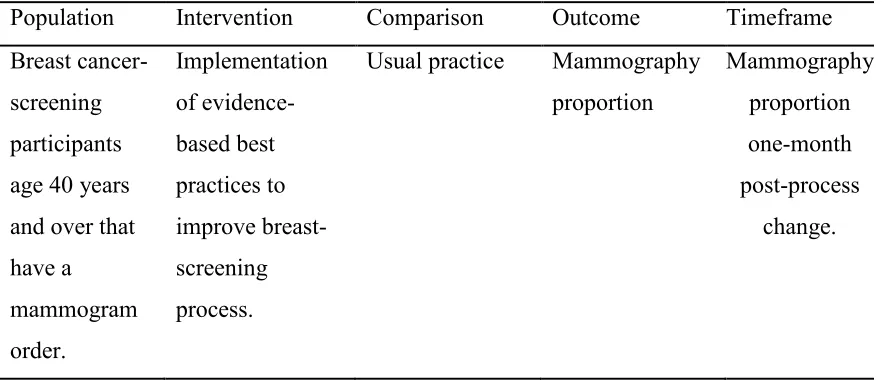
with certainty. The PICOT for the study is: Among breast cancer-screening participants,
what are the best practices to improve mammography screening? The population (P) is
breast-screening participants aged 40 years and over that have a mammogram order.
Intervention (I) is an evidence-based process change, which includes assessing barriers to
mammography during registration of clinic visit, alerting staff and providers of
participants that meet criteria for mammography by flagging or marking the patients’
charts, then providing a tailored provider message regarding the importance of
process. The Intervention is outlined and further discussed in Chapter 3. The comparison
intervention (C) is the usual practice. The outcome (O) is mammography proportion. The
time frame (T) of the intervention will span from one-month post-process change,
wherein the mammography proportion outcome will be evaluated. Table 1.2 outlines the
evidence-based inquiry.
Table 1.2. Evidence-based Clinical Question
Population Intervention Comparison Outcome Timeframe
Breast
cancer-screening
participants
age 40 years
and over that
have a
mammogram
order.
Implementation
of
evidence-based best
practices to
improve
breast-screening
process.
Usual practice Mammography
proportion
Mammography
proportion
one-month
post-process
change.
PICOT Definitions
1. Breast-screening participants for the scope of this project are women aged 40
years or older that have a normal clinical breast exam and do not identify any
abnormal breast symptoms, and who obtain a routine screening mammogram
order during their clinic visit.
2. Evidence-based best strategies are defined as interventions identified through
research studies, literature reviews, as having a significant impact on a particular
phenomenon. The level of evidence correlates with the validity of study findings
define the strength of evidence in terms of effectiveness as strong, sufficient, or
insufficient. For the scope of this project, strategies are
• Assess barriers to mammography defined as investigating actions or lack
of actions that impact mammography screening.
• Flagging charts is an action that serves as a means for alerting or
reminding the staff that screening participants qualify for mammography.
• Tailored provider message is defined as the delivery of health education
that promotes breast health literacy. The tailored message takes place in
the clinic visit interface of the process. The focus is specific to patient–
provider communication. A scripted message that utilizes health literacy
principles of clear communication and confirmation of understanding with
the use of methods such as teach-back. The message content will explain
the importance of mammography, as the intent is to motivate patients to
follow the necessary steps to complete mammography. Added emphasis
will be placed on financial counseling to provide a comprehensive
understanding of breast-screening management.
1. Health education is any combination of learning experiences designed to help
individuals and communities improve their health, by increasing their knowledge
or influencing their attitudes (World Health Organization, 2016, para. 1).
2. Health literacy is the degree to which an individual has the capacity to obtain,
communicate, process, and understand basic health information and services to
3. Breast cancer literacy is having knowledge of the signs, symptoms, and risk
factors of breast cancer and the ability to utilize the information to make decisions
to decrease breast cancer risks or seek medical attention appropriately; also
includes an awareness of screenings to include mammography, clinical breast
exam (CBE), and breast self exam (BSE) or self-awareness (Institute of Medicine,
2004; Williams et al., 2013).
4. Verbal education is the use of sounds and words to deliver health information;
the use of gestures, diagrams, or pictures (Institute of Medicine, 2004).
5. Breast-screening process is the actions that are taken to complete
mammography. There are six steps: recruiting, registration, clinic visit, financial
counseling, mammography appointment, mammography tracking.
6. Usual practice process is defined as the process of mammography screening
before the implementation of the process change, as outlined in Figure 1.1.
7. Provider/Nurse Practitioner is defined as “an advanced level clinical nurse who
through extra education and training is able to practice autonomously, making
clinical decisions and instigating treatment decisions based on those decisions,
and is fully accountable for his/her own practice” (International Council on
Nurses Nurse Practitioner/Advanced Practice Nurses Network, 2016). The nurse
practitioner is a provider staff member that will deliver breast cancer education.
8. Provider/Physician Assistants (PA)is a nationally certified and state-licensed
medical professional. PAs diagnose, treat, and prescribe medications (American
is a provider staff member of the breast-screening clinic who provides breast
cancer education.
9. Clear communication techniques are defined as the use of plain language,
speaking slowly, limiting to two or three messages at a time, and confirming
understanding with the teach-back method (Dewalt et al., 2010; Hersh, Salzman,
& Snyderman, 2015; Weiss, 2007). Plain language is clear, straightforward
communication and avoids complex technical terms and sentences (Dewalt et al.,
2010; Hersh, Salzman, & Snyderman, 2015; Weiss, 2007).
10.Teach-back method confirms that patients understand health information and
best practices for next/subsequent steps by teaching or explaining information
back to the provider (Agency for Healthcare Research and Quality, 2012). After
explaining breast cancer education the provider will ask the patients to explain the
information that was provided. If the patient is unable accurately to explain the
information after the provider has reviewed and explained the materials, then the
provider will clarify the instructions.
11.Provider–patient communication is nonverbal and verbal communication
between healthcare professionals and patients (Hersh, Salzman, & Snyderman,
2015; Institute of Medicine, 2004).
12.Breast cancer education is education that raises the awareness of breast cancer
symptoms and treatment. The knowledge attainment goals are to promote risk
reduction behavior and promote earlier detection of breast cancer, which is
associated with higher long-term survival rates (Institute of Medicine, 2004;
13.Provider perception of understandingis the process by which a healthcare
provider translates sensory impressions into a coherent and unified view; and
assessment of information attainment and comprehension (Institute of Medicine,
2004; Kornburger et al., 2013).
14.Mammography adherence rate is the time interval within which women are
considered compliant with screening guidelines and what constitutes screening
rather than a diagnostic mammogram (ACOG, 2016). The mammography
compliance rates for the breast-screening participants are determined by the
number of women who were referred by providers post-CBE and education visit
and received their recommended mammogram within one year of
breast-screening clinic visit divided by the total number of breast-screening participants within
a set time frame.
Assumptions
The following assumptions are made regarding the project
• The process change variables have a relationship with mammography adherence.
• The providers have the knowledge and skills to deliver the tailored messages
utilizing health literacy principles of clear communication strategies and
teach-back.
• The participants are capable of learning the subject matter.
• The participants will understand the questions being asked.
• The participants will provide honest expressions of their satisfaction with (or lack
Conceptual Framework
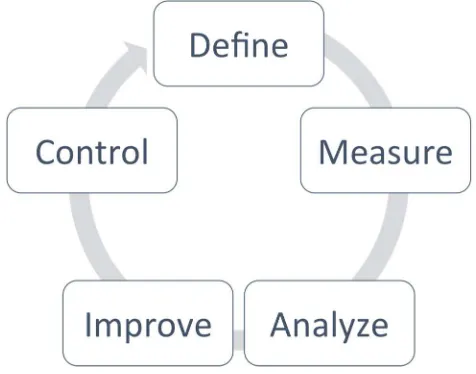
The Six Sigma DMAIC methodology is the framework that was selected to guide
the development, implementation, and evaluation of improving the process of breast
cancer screening. The acronym DMAIC represents Define, Measure, Analyze, Improve,
and Control (Taaffe et al., 2012). This process improvement model provides simple, yet
structured guidelines that have led to successful organizational process improvements in
manufacturing, business, and healthcare. The phases of the DMAIC model facilitate a
systematic approach to problem identification. Emphasis is placed on an in-depth analysis
of current practices and performance. The analysis is essential as this step is where the
underlying causes of flaws within the process are determined. Afterward, planning and
recommendations occur to address the process’ inefficiencies. Finally, proven practices
are implemented to promote sustainable strategies for change. The DMAIC approach to
process change is fitting as the steps are aligned with principles of clinical or translational
research, utilizing statistics and facts to improve the delivery of care.
The Define component is the first phase of the project. Stakeholders and key team
players are established during this phase. The Define actions can be described as “making
the case,” where the problem is clearly identified in terms of the magnitude of the
problem and consequences if the problem is not resolved (Taaffe et al., 2012). From the
beginning, it is essential to establish the need for improvement and identify the possible
opportunities and barriers. Clearly defining the problem and setting feasible and
measurable goals are crucial to the project outcomes.
The Measure component establishes the metrics for a particular setting. During
enables the identification of potential opportunities and facilitators within the process
(Taaffe et al., 2012). Depicting the current process enables a baseline for comparison
with future data. Collecting measurable data provides validation to determine if the
improved practices are meeting the intended objectives or goals established as part of the
problem (Taaffe et al., 2012). This breast-screening clinic’s process was outlined to
establish a baseline for comparison of the clinic’s current practices with best practices as
determined through the best available evidence.
The Analyze phase of the framework begins the task of interconnecting the data
that were collected in the Measure phase (Taaffe et al., 2012). The data are utilized to
determine the underlying root or causes of the problem. The opportunities that are
identified can then be prioritized based on impact relative to the defined problem. Data
analysis leads to an enhanced identification of opportunities within the process
(Bandyopadhyay & Coppens, 2005).
The Improve component of the framework is when the preparation for
improvement takes place. The solutions are determined based on the prioritizing from the
Analyze phase, thus solutions that are hypothesized to have the greatest impact on the
identified problem should be piloted (Taaffe et al., 2012). Continuous process revisions
are essential to maximizing the effects of the process change (Taaffe et al., 2012).
The Control component is the final interface of the framework. During this phase,
if the implemented process changes are successful, then ongoing monitoring must occur
to ensure sustainability. A continuous process system is instrumental, as it may be
necessary to reevaluate the current system and provide further system changes for
The World Health Organization (2009, p. 12) defines quality as the “degree to
which health services for individuals and populations increase the probability that the
desired outcomes are consistent with current professional knowledge.” The process
change intends to eliminate deficits in the breast-screening process in an effort to
improve the outcome of mammography compliance. Improving processes correlates with
improved quality and health outcomes. Thus, utilizing the DMAIC is an appropriate
framework for facilitating the implementation of a breast-screening process change.
Figure 1.2. Adapted from Six Sigma DMAIC Approach Model (Taaffe et al., 2012).
Summary
The complexity of today’s healthcare system makes it difficult for many
individuals to understand and navigate available information and services. It is estimated
that only 12 percent of Americans have proficient health literacy (Joint Commission,
2012). The combined effects of convoluted breast-screening processes and low health
literacy suggest that organizations are challenged to address the incongruence of
individuals’ capabilities and requirements of the healthcare system to facilitate health
impacts accessibility to services and the capacity to make informed decisions, which can
lead to subsequent poor health outcomes.
Health processes that are multifaceted and require numerous actions correlate
with declines in patient participation in health services such as mammography. The
cancer-screening process requires a series of steps that entails collaboration of patient,
organization, and providers. These steps include recruitment, patient attending health
visit, and performance of the screening (Anhang Price, Zapka, Edwards, Taplin, et al.,
2010). The coordination of care is described as “interfaces” or the communication and
transfer of responsibilities among the organization and patient, organization and
providers, and patient and provider (Anhang Price et al., 2010).
Patient education, provider referral, and appointment setting are integral
components of the process; subsequently, failures in any aspects of these steps can
adversely impact follow through with mammography (Anhang Price et al., 2010; Zapka
& Lemon, 2004). Women’s participation in mammography screening is largely
determined by their ability to both access and navigate through health organizations that
provide the services. Research has validated the importance of evaluating and
streamlining the mammography process to increase mammography adherence (Anhang
Price et al. 2010; Goins et al., 2003; Zapka & Lemon, 2004). Thus, the goal of this DNP
project is to implement an evidence-based process change to identify barriers and
implement best strategies to improve the breast-screening process, ultimately to improve
CHAPTER
2
REVIEW OF THE LITERATURE
Description of Search Strategy
Conducting a systematic review of the literature is a key component to
extrapolating relevant scientific evidence that yields support to particular clinical
questions (Melnyk & Overholt-Fineout, 2015). The purpose of this DNP project is to
improve mammography compliance by identifying barriers to mammography,
investigating effective strategies to improve mammography acquisition, and
implementing the proven strategies into the mammography screening process. Reduced
mammography compliance contributes to negative breast cancer outcomes, and
consequently continues to be a significant health issue in the US, with detrimental health
and financial consequences (American Cancer Society, 2015; Hendrick & Helvie, 2011;
National Cancer Institute, 2016).
PUBMED, CINAHL, PsycINFO, Google Scholar, and Cochrane databases were
accessed to obtain substantial evidence to address the clinical question, “Among breast
cancer-screening participants, what are the best practices to improve mammography
screening?” In addition, consultations with medical reference librarians at the University
of South Carolina (USC) and Kaiser Permanente Hospital-Oakland contributed to the
literature that was assessed for relevance for the evidence-based project. For each of the
databases, the search mode was set for Boolean/phrases, peer-reviewed (scholarly)
included setting the publication time frame to five years, sorting by relevance, and the
inclusion of all article types (clinical trials, systematic reviews, etc.) with full-text
availability. The key terms included health education, breast cancer, prevention, early
detection, education, breast education, health literacy, breast cancer pamphlets,
mammography, compliance, adherence, patient compliance, barriers, prevention,
screening, organizational structure, and best practices. The key terms were utilized in
different combinations, applying connectors AND, OR, and NOT to retrieve relevant
content.
An inclusion criterion was established to facilitate obtaining applicable evidence.
The author included studies that referenced healthy women aged 40 years or over,
interventions specific to promoting cancer screening, and mammography screening or
cancer screening. Both clinical and community settings were considered. The exclusion
criteria included articles that were not specific to an intervention that improved
mammography or cancer-screening adherence, did not address a targeted population of
women, or did not have an outcome measure specific to mammography compliance. The
titles and abstracts of the literature found were examined based on these criteria.
Examining bibliographies of articles obtained through initial searches retrieved additional
related studies. This review of the literature yielded 25 relevant studies.
Analysis of Evidence to Support Implementation of Best Practices
Critical appraisal of evidence is a vigilant and systematic process of evaluation of
research, which determines the trustworthiness and relevance of an article or study to a
particular context (Melnyk & Overholt-Fineout, 2015). The author utilized Johns
literature (Dearholt & Dang, 2012). The evidence is ranked from Level I (highest level)
to Level V (lowest level) based on set criteria, and quality is ranked on a scale of A
(highest quality) to C (lowest quality). Appendix A details the standards for ranking the
level and quality of evidence. Appendix C outlines the literature that was retrieved to
address the derived PICOT.
Barriers and Strategies
Socioeconomic Factors. Even though numerous local, state, and national
healthcare programs have been developed to improve access to preventive services and
breast cancer survival rates, disparities still exist among some populations of women. In a
recent review of the literature, researchers established that women with low SES, lower
education levels, a lack of insurance, and lack of regular access to a primary healthcare
provider are among the population of women who have low mammography compliance
(Alexandraki & Mooradian, 2010; Todd & Stuifbergen, 2011). The authors further
discussed that these barriers directly impact the compliance of mammography screenings
(Alexandraki & Mooradian, 2010). Poverty and economic status were found to be the
most influential impediments to mammography compliance (Alexandraki & Mooradian,
2010).
According to the ACS (2016), outreach programs and services should target
women who fall within the parameters of poverty, as this population compared with more
affluent populations tends to have lower rates for screening mammography. A crucial
contributing factor is that low SES is correlated with low educational levels (Todd &
Stuifbergen, 2011). Low education levels influence knowledge levels and impact one’s
predisposes this population of women to less than optimal overall healthcare outcomes
(Alexandraki & Mooradian, 2010; Todd & Stuifbergen, 2011).
In 1990, Congress responded to an overwhelming body of research indicating that
mammographic and cervical screenings were associated with the reduction of death rates
of the aforementioned cancers by approximately two years by authorizing the National
Breast and Cervical Cancer Early Detection Program [NBCCEDP]. The NBCCEDP is
channeled through the CDC, which enables the operation of federally funded programs
by the individual states, territories, and other national partners (Centers for Disease
Control and Prevention, 2016).
The provisions of the NBCCEDP provide preventive healthcare services to
women who fall within subgroups that include low income, uninsured, underinsured, and
those who lack access to timely screening and diagnostic services. These women would
now have access to preventive healthcare services (Centers for Disease Control and
Prevention, 2016). Comprehensive breast health services such as breast exams and
mammograms are provided to diminish adverse breast outcomes (Centers for Disease
Control and Prevention, 2016). Referral and treatment services were additional services
that emerged when the program was enhanced with the Breast and Cervical Cancer
Prevention and Treatment Act in 2000, which authorized Medicaid services for women
who were diagnosed with cancer through NBCCEPD screenings. Research has supported
that in an effort to decrease the rates of cancer occurrences and cancer-related deaths,
information and screenings must be readily available for all women irrespective of their
evidence and accelerated early detection by eliminating SES barriers and providing
financial resources for breast-screening programs.
Socioeconomic Strategy (Identified Resource): Best Chance Network
The Best Chance Network (BCN), one of the first funded programs through
NBCCEDP, was established in SC in 1991. The program provides health resources and
services to all 46 counties in SC. Screening services offered through the BCN include
mammograms, clinical breast exams, pap tests, pelvic exams, and human papillomavirus
tests. Other services include diagnostic testing for women with abnormal screening
results, support services with patient navigation, referral for treatment, and community
education on breast and cervical cancer. Since the BCN’s inception, the program has
provided breast and cervical cancer screenings to more than 11,755 women and 178,162
mammograms (South Carolina Department of Health and Environmental Control, 2016).
In addition, the BCN program has diagnosed more than 1,800 breast cancers and 3,400
cervical cancers since 1991 (South Carolina Department of Health and Environmental
Control, 2017). The appropriation of additional funding from the SC State Legislature in
years 2015 and 2016 has enabled BCN to increase services and expand eligibility criteria,
which allows more women to be screened (South Carolina Department of Health and
Environmental Control, 2017). Best Chance is a resonant resource that moderates the
financial barrier to early detection and partners with organizations to extend assistance to
address low-income populations.
Health Literacy. The IOM (2004) describes health literacy as a mediator between
individuals’ awareness (knowledge) of disease and risk factors and their actions of
research that supports the association of health literacy, knowledge, behavior, and
outcomes (Halverson et al., 2015; Institute of Medicine, 2004; Komenaka et al., 2015;
Smith et al., 2013). Halverson et al. (2015) conducted a cross-sectional study of cancer
patients to evaluate health literacy with health-related quality of life outcomes. The study
concluded that low levels of health literacy at the patient level had a significant
relationship with poor health-related quality of life among breast, lung, prostate, and
colorectal cancer patients (Halverson et al., 2015). Komenaka et al.’s (2015) study
revealed that health literacy had the strongest relationship to the use of screening
mammography compared with all the sociodemographic variables examined. In a Level
I/Quality B experimental study, Smith et al. (2013) conceptualized the dynamic
components of literacy as those components related to knowledge attainment. The
investigation provided evidence that ability, motivation, and heuristic message cues
impacted knowledge scores for individuals receiving messages written for different
literacy levels (Smith et al., 2013). The aforementioned research findings highlight that
an individual’s ability to gain knowledge or comprehend knowledge is a necessary
outcome of health-related information.
Unfortunately, consistent and accurate uses of such principles by primary care
providers and clinic organizations are lacking (Hersh et al., 2015). Significant barriers to
evidence-based practice adoption include lack of knowledge or skills, negative attitudes,
limited time for the patient encounter, and lack of organizational support. Healthcare
providers often do not address health literacy in routine patient care, overestimate
patients’ health literacy, and incorrectly assume that health information and instructions
Health literacy correlates with an individual’s ability to make informed decisions and
choices related to care (Halverson et al., 2015; Institute of Medicine, 2004). Prompt
reporting of new breast symptoms and routine mammography screenings are key
components to early detection of breast cancer (American Cancer Society, 2015).
Moreover, one has to be able to identify risk factors and understand steps to accessing
services before actions to promote risk reduction can be considered. Thus, to address
breast health literacy among breast-screening participants, it is important to provide
patient-centered education via effective patient–provider communication while ensuring
that learning has occurred (Pigone, Dewalt, Sheridan, Berkman, & Lohr, 2005).
Health Literacy Strategies
The growing realization that it is imperative to meet the demand of facilitating
patients’ understanding and the likelihood of acting on health recommendations has
integrated health literacy as an essential aspect in improving healthcare. Several
evidence-based health literacy toolkits have been developed to assist health providers and
organizations to improve patient–provider communication, which has a direct impact on
information understanding and thus indirectly influences health outcomes.
The Agency for Quality Health Research Health Literacy Toolkits provide
straightforward methods to improve patient–provider communication. Some of the
techniques include the use of plain or nonmedical language, listening to the words that
patients use to describe their illness, and then using the common words in conversation
(Agency for Quality Health Research, 2012). Prioritizing conversation and limiting
content to three to five key points have also proven to improve patient understanding
provider communication is the use of the teach-back method. The teach-back method
confirms that patients understand health information and know what to do as a result, by
having patients teach or explain information back to the provider.
Confirmation of understanding has been found to be an essential component of
effective patient education, as patients rarely disclose their lack of understanding of the
information provided (Hersh et al., 2015). Several studies have validated that teach-back
is an effective educational strategy for health professionals to incorporate in healthcare
for improving health behaviors and subsequent outcomes (Dinh et al. 2013; Ferreira,
2005; Schillinger et al., 2003). A study that evaluated 74 diabetic patient encounters by
38 physicians by audiovisual means found that patients whose physicians had assessed
comprehension and recall had significantly lower levels of hemoglobin A1C levels than
patients whose physicians did not (Schillinger et al., 2003). A multiple regression
analysis confirmed that the interactive communication was the variable most associated
with improved glycemic control (Schillinger et al., 2003). Likewise, a quasi-random
control trial of 2,046 veterans due for a colonoscopy screening established that colorectal
cancer-screening rates improved when healthcare professionals incorporated health
literacy communication strategies (Ferreira, 2005). Furthermore, a recent systematic
review of the effectiveness of health education using the teach-back method established
that teach-back is an effective strategy for improving management of chronic disease,
knowledge of informed consent, and reduction in readmission rates (Dinh et al., 2013).
The teach-back method has been used in diverse populations, including health
disease, and it is associated with improved patient knowledge and self-efficacy (Dinh et
al., 2013).
Breast Health Education. Health education is a strategy that has been
emphasized in the U.S. healthcare system in disease prevention and early detection of
diseases such as breast cancer. The literature review resulted in one Level I and Quality B
experimental study, five Level II/Quality B quasi-experimental studies, one Level
III/Quality A meta-analysis, and one Level III/Quality B mixed experimental/qualitative
study that explored the impact of health education (Alkahlili et al., 2015; Burgess et al.,
2009 Dieng et al., 2014). Seven, Akyüz, and Robertson (2015) explored three methods of
education—individual, individual with an educational brochure for spouses, and group—
on participation in breast cancer screening and found that group education was an
effective method of increasing breast cancer knowledge and screening awareness. The
study was derived from an extensive literature review, utilizing block randomization with
a sample size sufficient to achieve statistical significance (N = 327), suggesting that study
findings have significant credibility and generalizability.
Bushatsky et al.’s (2015) quasi-experimental study reinforced that the health
knowledge among a convenience sample of 84 women notably improved after a health
education intervention. The educational content was comprised of breast cancer
symptoms, performance of a BSE, and modifiable risk reductions through dialogue and
visualization (Bushatsky et al., 2015). While the results of the study are relevant, the
study’s design impedes the overall strength and generalizability of the findings.