University of South Carolina
Scholar Commons
Theses and Dissertations
2017
Emergence Of Stranger Fear In Preschoolers With
Fragile X Syndrome And Idiopathic Autism
Spectrum Disorder
Jessica ScherrUniversity of South Carolina
Follow this and additional works at:https://scholarcommons.sc.edu/etd Part of theSchool Psychology Commons
This Open Access Dissertation is brought to you by Scholar Commons. It has been accepted for inclusion in Theses and Dissertations by an authorized administrator of Scholar Commons. For more information, please [email protected].
Recommended Citation
Scherr, J.(2017).Emergence Of Stranger Fear In Preschoolers With Fragile X Syndrome And Idiopathic Autism Spectrum Disorder.
E
MERGENCE OFS
TRANGERF
EAR INP
RESCHOOLERS WITHF
RAGILEX
S
YNDROME ANDI
DIOPATHICA
UTISMS
PECTRUMD
ISORDERby
Jessica Scherr
Bachelor of Science University of North Dakota,2010
Master of Arts
University of South Carolina, 2013
Submitted in Partial Fulfillment of the Requirements
For the Degree of Doctor of Philosophy in
School Psychology
College of Arts and Sciences
University of South Carolina
2017
Accepted by:
Jane Roberts, Major Professor
Richard Nagle, Committee Member
Kimberly Hills, Committee Member
Svetlana Shinkareva, Committee Member
Robert Hock, Committee Member
ABSTRACT
This study investigated multiple behavioral indicators of social fear and their
relationship to symptoms of autism in preschool boys with atypical and normative
development using a stranger approach design. Participants consisted of 101 male
preschoolers that were categorized into four groups: boys with fragile X syndrome (FXS;
N= 29), FXS with elevated autism symptoms (fxASD; N = 25), idiopathic autism
spectrum disorder (iASD; N = 11), and typically developing boys (TD; N = 36). Results
indicated specific behavioral responses to a stranger differentiated preschoolers with
more severe symptoms of autism (e.g. fxASD and iASD groups) from those with low
autism symptomology (e.g. FXS and TD groups). Cross-group comparisons
demonstrated that preschoolers with FXS displayed more avoidant gaze from the stranger
and their parent during the stranger approach with boys with fxASD exhibiting the
greatest proportion of avoidant gaze patterns. The fxASD group also referenced their
parent less during the stranger approach in comparison to the FXS and TD groups. The
iASD group displayed elevated facial fear in response to the stranger that differentiated
them from the FXS, fxASD, and TD groups. No group differences were observed in
escape behaviors. Overall, results from this study indicated specific behavioral patterns
of social fear in response to a stranger using a normative and cross-syndrome approach.
Given the high prevalence of anxiety in FXS and iASD, it is critical to identify how
distinguishable traits of anxiety that can be used to inform targeted assessment,
TABLE OF CONTENTS
ABSTRACT ... iii
LIST OF TABLES ... vii
LIST OF FIGURES ... viii
CHAPTER 1: INTRODUCTION ...1
1.1MEASUREMENT OF ANXIETY: CHALLENGES OF EARLY CLINICAL POPULATIONS .1 1.2ANXIETY IN TYPICALLY DEVELOPING CHILDREN ...6
1.3AUTISM SPECTRUM DISORDER ...9
1.4FRAGILE XSYNDROME ...18
1.5SOCIAL APPROACH IN FXS AND ASD ...27
1.6PRESENT STUDY ...29
1.7PURPOSE OF STUDY ...30
1.8RESEARCH QUESTIONS ...30
CHAPTER 2: METHOD ...32
2.1PARTICIPANTS ...32
2.2MEASURES ...35
2.3PROCEDURES ...40
CHAPTER 3: RESULTS ...47
3.1PRELIMINARY ANALYSES ...47
CHAPTER 4: DISCUSSION ...61
4.1GROUP DIFFERENCES IN STRANGER FEAR ...62
4.2RELATIONSHIP OF AUTISM SYMPTOMS AND SOCIAL ANXIETY ...68
4.3SUMMARY AND IMPLICATIONS ...70
4.3LIMITATIONS AND FUTURE DIRECTIONS ...71
LIST OF TABLES
Table 2.1 Group Means of Variables Across Sites ...42
Table 2.2 Descriptive and Demographic Data of Participants ...43
Table 2.3 Facial Expression Coding Definitions ...44
Table 2.4 Behavioral Variables Coded for Facial Fear, Escape Behaviors, and Gaze ...45
Table 2.5 Correlations Among Behavioral Variables and CBCL Raw Scores ...46
Table 3.1 Post Hoc Results for Gaze Behaviors and Facial Fear ...47
Table 3.2 Predictors of Gaze Behaviors ...48
LIST OF FIGURES
Figure 3.1 Post Hoc Results for Gaze Behaviors and Facial Fear ...54
Figure 3.2 Group Differences in Average Levels of Facial Fear and Escape Behaviors ..55
Figure 3.3 Scatterplot of CBCL Anxiety Subscale and Stranger Gaze Behavior ...56
Figure 3.4 Scatterplot of CBCL Anxiety Subscale and Gazing Away Behavior. ...57
Figure 3.5 Scatterplot of CBCL Anxiety Subscale and Parent Gaze Behavior ...58
Figure 3.6 Scatterplot of CBCL Anxiety Subscale and Escape Behavior ...59
CHAPTER
1
INTRODUCTION
Fragile X syndrome (FXS) is a single-gene disorder and the most common genetic
cause of autism spectrum disorder (ASD; Hagerman, 2008; Crawford et al., 2002).
Accordingly, 60% of individuals with FXS will also meet clinical criteria for an ASD
(Harris et al., 2008). FXS and ASD are highly comorbid with anxiety, which often
compounds the behavioral and emotional impairments exhibited in each individual
disorder (Cordeiro et al., 2011; Muris et al., 2008). Cross-syndrome comparisons of
anxiety in children with FXS and ASD to typically developing children are critical in
order to distinguish how anxiety is expressed similarly and differently across both
atypical and normative development. In order to examine these relationships, this paper
will first discuss methodological considerations for examining anxiety in young children
and various ways to measure anxiety behaviorally that go beyond traditional parent and
self-report methods. Then we will describe anxiety in typical development, followed by
the expression of anxiety in ASD and FXS. Finally, stranger approach paradigms will be
discussed in relation to behavioral profiles of social fear in FXS and ASD.
1.1 MEASUREMENT OF ANXIETY: CHALLENGES OF EARLY CLINICAL
POPULATIONS
Evidence-based assessment of social anxiety in children contains methods of
self-social anxiety in young children are challenging due to a number of developmental
factors. For example, anxiety and fear represent both normative and atypical responses in
development based on age-related experiences and the nature of the setting. A clinical
disorder is implied when anxiety or fear leads to excessive somatic arousal or worry
beyond normative expectations associated with impairment (Silverman & Ollendick,
2005). The measurement of anxiety in young children is complex and self-report
measures in children may be less reliable given that young children often lack or display
limited insight to understand or communicate their symptoms of anxiety. Finally,
methods used to study anxiety in children often have been extended from previous
measures intended and used with adults or adolescents without consideration if
underlying constructs are developmentally similar across age groups (Silverman &
Ollendick, 2005). Therefore, there is a need to study both existing features and
prodromal traits that may predispose young children to anxiety to more accurately
identify and assess traits that are normative in comparison to traits that are maladaptive or
prodromal features of anxiety.
One framework for identifying characteristics associated with social anxiety is a
temperamental approach through behavioral observation (Rapee, Kennedy, Ingram,
Edwards, & Sweeney, 2005; Turner, Beidel, & Wolff, 1996). Behavioral observation is
considered part of the gold standard when assessing clinical levels of social anxiety given
the limitations with parental and self-report for young children (Silverman & Ollendick,
2005). Embracing temperament is one viable model to understand how anxiety disorders
develop and explain how individual features may represent either risk or resilient factors
Moerk, 2005; Lonigan & Phillips, 2001; Rapee & Coplan, 2010). Temperament has been
defined as “individual differences in reactivity and self-regulation” (p. 123) in response
to varying environmental contexts (Rothbart, Ahadi, & Evans, 2000) and is biologically
based with traits emerging early in infancy and remaining relatively stable across time
(Clark & Watson, 1999; Durbin et al., 2005; Rothbart, Derryberry, &Hershey, 2000).
Features of temperament may be influenced both by genetic predispositions, as well as
environmental triggers, and have been studied both physiologically (Brooker et al., 2013;
Tagle, Donzella, Gunnar, 2008) and behaviorally (De Rosnay, Cooper, Tsigaras, &
Murray, 2006; Durbin et al., 2005, Sroufe, 1977). According to Rothbart and colleagues
(2000), temperament is composed of three main factors measuring an individual’s
negative affectivity, extraversion/surgency and effortful control. There are also 16
sub-domains within the three main components of temperament that measure individual
differences with sub-domains of fear and shyness being two of the most robust indicators
for the development of anxiety in children (Degnan et al., 2010; Goldsmith & Lemery,
2000; Kagan & Snidman, 1999).
Previous studies have tied in temperamental aspects to elicit behavioral responses
during observation periods in order to identify certain characteristics that may predispose
young children to experience anxiety (Brooker et al., 2013; De Rosnay et al., 2006;
Greenberg & Marvin, 1982; Tagle et al., 2008). One strong predictor of the later
development of social anxiety in young children is fearfulness to novel situations or
people (Buss & Goldsmith, 2000; Colennesi et al., 2014). One way to study
temperamental traits of fearfulness in children is to examine the behavioral responses to
example, Pisula (2004) studied preschoolers with ASD and their fear responses to a novel
person (e.g. a stranger), as well as responses to their mother during a social approach
task. Specific behavioral responses that have been studied using a temperamental
framework during an approach from a stranger include measures of fearfulness and
inhibitory responses (Brooker et al., 2013; Greenberg & Marvin, 1982; Tonnsen,
Shinkareva, Deal, Hatton, & Roberts, 2013). In a longitudinal study, infants with high
temperament traits of reactivity or fear to novel stimuli exhibited more symptoms of
anxiety later in childhood (Kagan, Snidman, Zentner, & Peterson, 1999). In addition to
reactivity or fear responses, early measures of temperamental shyness have also been
studied in relation to negative emotional responses, such as anxiety (Chariva, Stein, &
Malcarne, 2002; Volbrecht & Goldsmith, 2010). High levels of shyness, such as
increased behaviors of avoidance and gaze aversion, in children have been found to be
related with elevated symptoms of anxiety (Buss & Goldsmith, 2000; Colonnesi,
Naploeone, & Bogels, 2014; Henderson & Zimbardo, 1998).
One method that has been utilized to study fearfulness in children in response to
the approach of an unfamiliar person is the Stranger Approach from the Laboratory
Temperament Assessment Battery (Goldsmith & Rothbart, 1996). The Stranger
Approach is part of a standardized assessment battery that allows for the comparison of
behavioral measures of fear during an observation where a stranger approaches a child
and a parent (Goldsmith & Rothbart, 1996). In order to assess social withdrawal and
temperamental traits of fearfulness within the child, multiple behaviors are examined
directly and indirectly. Direct measures of fear include assessing the intensity of a
a child’s gaze patterns, during the stranger approach also provide useful information in
regards to attentional patterns. Gaze patterns have frequently been studied in relation to
social anxiety in response to novel situations and people (e.g. strangers) through methods
examining social aversion or avoidance (e.g. looking away), social referencing (e.g.
looking to a parent), and selective attention (e.g. looking at the fearful stimulus) (De
Rosnay et al., 2006; Vasey, El-Hag, & Daleiden, 1996). Although it is adaptive to direct
attention and process information in situations that are both novel and threatening;
maladaptive patterns emerge when selective attention creates biases or distortions in the
way individuals process an environmental cue (Vasey et al., 1996).
According to attentional bias theory, individuals pay greater attention to stimuli
that are more threatening and, consequently, cause them more anxiety (Cisler & Koster,
2010; MacLeod, Mathews, & Tata, 1986). Therefore, children that spend longer
durations of time looking towards a stranger, a potentially fear-provoking stimulus, may
be displaying increased behaviors of anxiety. Alternatively, attention orienting theory,
which involves the detection and processing of a novel stimulus (Posner, 1980) suggests
that attention directed towards a stimulus represents interest and cognitive processing.
Attention and emotion are often interrelated and linked through motivational systems
(Bradley, 2009). For example in response to unfamiliar situations, we often direct our
attention to process the novelty of the stimulus and to determine if that stimulus is
threatening. After information has been processed, motivational systems react either with
a defensive or appetitive response which is crucial to survival (Bradley, 2009).
According to these competing models of attention, a child’s visual attention to the
combination of both. Thus, a comprehensive experiment of social fear needs to include
multiple behavioral representations of social fear along with complementary and
potentially validating measures against which the behavioral indicators can be compared.
Specific behavioral variables that have been studied using the stranger paradigm
include examining directed attention during the observation (i.e. at a parent, the stranger,
or away from the stranger and parent), facial fear, vocalizations, escape behaviors, and
attachment behaviors towards a caregiver (De Rosnay et al., 2006; Greenberg & Marvin,
1982; Tonnsen et al., 2013). Various populations have been studied using the stranger
approach design including children with ASD (Pisula, 2004; Sigman & Mundy, 1988),
FXS (Tonnsen et al., 2013), Down syndrome (Pisula, 2004), and typically developing
(TD) children (Brooker et al., 2013). Specifically, Brooker et al., (2013) examined the
trajectories of stranger fear and behavioral inhibition in 6-to-36-month-old TD children
and observed increased levels of fearfulness to a stranger led to more inhibition over
time. Additionally these relationships extended into early childhood; such that infants
who displayed greater stranger fear responses over time were at a greater risk for anxiety
into toddlerhood (Brooker et al., 2013).
1.2 ANXIETY IN TYPICALLY DEVELOPING CHILDREN
Anxiety disorders are common childhood mental disorders with symptoms often
emerging early in life with impact across the lifespan (Egger & Angold, 2006;
Merikangas et al., 2010; Rapee, 2002; Rapee, Schniering, & Hudson, 2009). Estimates
indicate that 9-20% of preschoolers will meet diagnostic criteria for an anxiety disorder
with far more preschoolers exhibiting features of anxiety (Chavira, Stein, Bailey, & Stein,
neurotypical children as young as the first year of life through parent report (Carter,
Briggs-Gowan, & Davis, 2004; Mian, Godoy, Birggs-Gowan, & Carter, 2012) with a
cluster of behavioral responses including social withdrawal, shyness, fearfulness, and
avoidance of novel or unfamiliar situations as primary indicators (Degnan, Almas, &
Fox, 2010; Hudson & Dodd, 2012; Rapee, 2014). Anxiety disorders in childhood are
highly comorbid with the development of depression, externalizing disorder, as well as
other anxiety disorders in later periods of adolescence and adulthood (Aina & Susman,
2006; Bittner et al., 2007; Cassana, Rossi, & Pini, 2003; Gorrman, 1996). Anxiety has
negative influences on development and is related to difficulties in school (Mazzone et
al., 2007), peer relationships (La Greaca & Lopez, 1998), and cognitive performance
(Eysenck, Derakshan, Santos, & Calvo, 2007; Vytal, Cornwell, Arkin, & Grillon, 2012).
Given the pervasiveness and chronicity of symptoms and outcomes related to anxiety
disorders, focus has been directed on the early emergence of anxiety and its
developmental trajectory over time with the aim of directing early intervention and
treatment efforts.
As previously highlighted, measurement is fraught with challenges necessitating
consideration of both symptom and diagnostic aspects of impairment. Therefore,
consideration of multiple indicators and inclusion of early emerging potential prodromal
features is beneficial to efforts aimed at early identification of risk factors for anxiety
disorders in young children. Despite support for early temperamental indicators leading
to the development of anxiety disorders, the continuity or stability of temperament is
limited (Goldsmith & Lemery, 2000). While elevated fear or shyness may result in a
also reflect normal and adaptive responses that help young children learn about their
environment and how to regulate their responses (Muris, 2010). Typically, around 6
months of age, infants are able to discriminate strangers from familiar adults and begin to
regulate fear responses that will continue to develop during the first few years of life
(Brooker et al., 2013; Waters, Matas, & Sroufe, 1975). Inhibitory and fearful behaviors
may indicate increased risk, not deterministic pathways, for anxiety disorders and
highlight the importance to identify early characteristics that are associated with the
emergence of anxiety in order to intervene and provide better outcomes (Kagan &
Snidman, 1999). Buss (2011) highlights the heterogeneity of fearful behavior within
temperament and cautions for the consideration of multiple aspects (e.g. facial
expression, flight or freezing, social withdrawal, etc.) using multiple behavioral
indicators. Studying different behavioral indicators of fearfulness or inhibition in young
children allows us to gain a better understanding in how underlying symptoms of anxiety
develop and change over time both in normative and at-risk populations.
Given the high prevalence and substantial impact of anxiety on individuals across
the lifespan, recent interest has focused on the identification of potential subgroups that
may confer increased risk for psychiatric disorders given their cognitive and genetic
predispositions (Frank et al., 2006; Strang et al., 2012). Individuals that have intellectual
disabilities or cognitive impairment are an identified high risk group given their limited
emotional insight and difficulty regulating their emotions (Einfeld & Tonge, 1996; Gray
et al., 2011). However, children with intellectual impairments are often not identified or
treated for anxiety due to a failure to recognize impairments in this group and challenges
factors should also be considered as a factor associated with anxiety and may impact a
child’s predisposition to develop emotional and behavioral difficulties (Frank et al., 2006;
Trzaskowski, Zavos, Haworth, Plomin, & Eley, 2011). For example, parents that have
higher anxiety tend to have children that display more behavioral inhibition and develop
anxiety disorders themselves later in childhood (Hudson, Dodd, Lyneham, &
Bovopoulous, 2011; Muris, van Brakel, Arntz, & Schouten, 2011) Genetic factors may
also negatively influence a child’s physiological response to stress and increase their
vulnerability to develop anxiety (Merikangas, Avenevolie, Dierker, & Grillon, 1999).
For example, children who have parents with anxiety disorders have been shown to
display increased sensitivity to stress through heightened startle reflexes and autonomic
responses (Merikangas et al., 1999). Therefore, children with genetic predispositions for
anxiety may have a unique biological profile that plays a bidirectional role in the
development and maintenance of anxiety disorders due to dysregulation of physiological
mechanisms and responses to environmental cues. Consistent with the recognition of
biological predispositions that place subgroups at accelerated risk for anxiety disorders,
autism spectrum disorder (ASD) and fragile X syndrome are two disorders that represent
known or suspected genetic syndromes at elevated risk for anxiety.
1.3 AUTISM SPECTRUM DISORDER
Autism spectrum disorder (ASD) is a chronic neurodevelopmental disorder
characterized by impairments listed in the Diagnostic and Statistical Manual of Mental
Disorders, Fifth Edition (DSM-5) that include deficits in social-emotional reciprocity,
nonverbal communicative behaviors, and difficulty developing, maintaining, and
addition to social difficulties, an individual with ASD may also display stereotyped motor
movements, restricted interests, ritualized patterns of behavior, or hyper or
hypo-reactivity to sensory input (APA, 2013). ASD impacts 1 in every 68 children (Center for
Disease Control and Prevention, 2014) with boys being at a five times greater risk at
developing the disorder than girls (Baio, 2014). Alarmingly, the prevalence rates for
ASD have been steadily increasing with a reported 78% increase since the year 2002
(Baio, 2014). Although the precise causal mechanisms for how ASD develops are
unknown, there is clear evidence that genetic influences and environmental mechanisms
put an individual at risk (Geschwind 2008; Geschwind & Levitt, 2007; Geschwind, 2011;
Gurrieri & Neri, 2009). This strong genetic link has been documented in infant sibling
studies of individuals with ASD in that 19% of infants that have an older sibling with
ASD are later reported to develop the disorder themselves (Ozonoff et al., 2011).
Therefore, ASD is likely the result of numerous genetic factors and epigenetic
interactions that influence the expression of the disorder (Schaefer & Mendelsohn, 2013).
This etiological variability of ASD makes it difficult to understand and treat the
underlying mechanisms that cause behavioral and biological symptoms, because these
factors are complex and likely not impacted by a single factor.
ASD is characterized by a unique phenotype with cognitive, behavioral, and
emotional traits associated with this complex disorder (Charman, Jones, Pickles,
Simonoff, Baird, & Happe, 2011; Gray et al., 2012; Horiuchi et al., 2014). Children with
ASD are reported to have poor inhibition skills (Adams & Jarrold, 2012 and increased
emotional reactions (Georgiades et al., 2011), which consequently cause impairments in
behavioral and emotional problems because symptoms are highly prevalent and may
exaggerate or overlap with existing symptoms of ASD (e.g. social impairment,
communication difficulties, etc.; Lainhart, 1999; Lecavalier et al., 2014; Leyfer et al.,
2006). Tseng et al., (2011) investigated the prevalence of emotional and behavioral
problems in children with autism and found that 73% of their sample had at least one
syndrome scale of the Child Behavior Checklist (CBCL; Achenbach, 1991) in the
clinically significant range, which highlights the high prevalence of behavioral problems
in this clinical population.
It is not surprising given the heterogeneous presentation of ASD and high
prevalence of clinical behavioral symptoms that there is a high degree of comorbidity
with other disorders including attention deficit/hyperactivity disorder (ADHD),
oppositional defiant disorder, aggression, and internalizing disorders (Gadow, De
Vincent, Pomeroy, & Azizian, 2004; Mayes, Calhoun, Mayes, & Molitoris, 2012;
Simonoff et al., 2008). Anxiety disorders are one of the most prevalent comorbid
disorders within ASD making differential diagnosis challenging (Kreiser & White, 2014;
Van Steensel, Bogels, & Perrin, 2011;Vasa et al., 2013; White et al., 2014; White,
Oswald, Ollendick, & Scahill, 2009). Symptoms of anxiety and ASD often overlap or
look similar in presentation to anxiety disorders making it difficult to measure anxiety in
ASD (Lecavalier et al., 2014). Past research has focused on distinguishing early
identifiers of ASD, but the importance of examining early comorbid factors in ASD is
gaining attention in order to improve future outcomes (Matson & Goldin, 2013). It is
critical to identify how anxiety emerges in this complex population in order to provide
One of the challenges associated with identifying comorbid conditions, such as
anxiety disorders, and their emergence in ASD is the vast heterogeneity within this
complex disorder. Individuals with ASD present with variable cognitive functioning,
language abilities, and adaptive functioning (Kanne et al., 2011; Wing, 1981) causing
professionals in the field to describe ASD not as a singular disorder, but as a collection of
various etiologies more appropriately termed “the autisms” (Geschwind & Levitt, 2007).
Perhaps most predictive of comorbid mental health disorders in ASD is intellectual
functioning (Hill & Furniss, 2006; Matson & Shoemaker, 2009; McCarthy, 2007).
Individuals with ASD that also have lower intellectual functioning display high rates of
co-occurring psychopathology with anxiety disorders being one of the most common
comorbid conditions (Bradley, Summers, Wood, & Bryson; 2004; Hill & Furniss, 2006).
Reduced intellectual ability in ASD is associated with greater vulnerabilities to develop
comorbid conditions, particularly anxiety disorders; therefore, consideration of how these
relationships emerge in younger children should be explored.
One of the most common comorbid conditions that is particularly debilitating in
ASD are anxiety disorders (e.g., social anxiety, specific phobia, separation anxiety, etc.;
Kreiser & White, 2014; van Steensel, Bogels, & Perrin, 2011;Vasa et al., 2013; White et
al., 2014; White, Oswald, Ollendick, & Scahill, 2009). Individuals with ASD are
reported to exhibit increased symptoms of anxiety (Eussen et al., 2013; Kim, Szatmari,
Bryson, Streiner, & Wilson, 2000; Vasa et al., 2014) and as many as 84% of males with
ASD between 2 and 18 years meet diagnostic criteria for at least one anxiety disorder
(Muris, Steerneman, Merckelbach, Holdrinet, & Meesters, 1998). Age and cognitive
Furniss, 2006; Kim, Szatmari, Bryson, Streiner, & Wilson, 2000; White et al., 2009).
There is mixed evidence as to how intellectual ability is related to anxiety in ASD with
some studies reporting that higher cognitive abilities are associated with greater
symptoms of anxiety in ASD (Mazurek & Kanne, 2010; Sukhodolsky et al., 2008) and
others reporting that increased rates of anxiety disorders, in general, are associated with
lower cognition (Van Steensel et al., 2011). For example, in their sample of adolescents
with ASD and severe intellectual disability (e.g. IQ < 40), Bradley et al. (2004) found a
specific vulnerability to anxiety in participants with autism compared to a control group
with similar intellectual impairments. Similarly, in a sample of 69 children and adults
with ASD and intellectual impairments, 77% percent displayed elevated symptoms of
anxiety compared to 39% in the comparison group with just intellectual impairment (Hill
& Furniss, 2006). MacNeil et al. (2009) argue that the disparities in prevalence rates
between high and lower intellectual functioning individuals with ASD might be due to
challenges in both recognizing and having specific ways to measure symptoms of anxiety
in individuals with lower cognitive functioning. Younger children and individuals with
lower intellectual abilities typically display more behavioral symptoms (e.g. social
avoidance, irritability, etc.) associated with anxiety, whereas older adolescents and
individuals with higher intellectual abilities may present with more cognitive symptoms
associated with anxiety (e.g. maladaptive thought patterns, etc). Nonetheless, these
results highlight a need for more research to examine the emergence of anxiety in
populations that are young and at risk for cognitive difficulties in manners that go beyond
Features associated with anxiety are often similar and are associated with core
symptoms of ASD (White et al., 2009). For example, Lecavalier et al. (2014) highlights
the challenges that are encountered when measuring anxiety in ASD that include: 1) a
high overlap in symptoms between the disorders 2) lower cognitive abilities in children
with ASD 3) the manifestations of anxiety may be unique and 4) and more than one
anxiety disorder may be present which makes differential diagnosis difficult. However,
recent research has started to examine how anxiety can be distinguished from ASD by
studying various measurement tools and the latent structures behind underlying
mechanisms of symptom presentation (Helverschou & Martinsen, 2011; Lecavalier et al.,
2014; White et al., 2014). This work has shown that individuals with ASD may have
trouble recognizing the physiological or somatic symptoms associated with anxiety,
which may lead clinicians to overlook symptoms of anxiety in favor of behaviors
associated with ASD (Helverschou & Martinsen, 2011). Treatment most likely will vary
depending on the unique characteristics and etiology of symptom presentation that are
specific to each individual disorder.
Social anxiety is characterized by symptoms of anxiety surrounding contexts that
involve interpersonal encounters or social situations (e.g. speaking in public, expressing
thoughts, etc.; APA, 2013; Bellini, 2006; Kuusikko et al., 2008; Stein & Stein, 2008).
Symptoms of social anxiety are high in ASD with 49% of adolescents’ self-reporting
elevated symptoms of social anxiety compared to same aged peers on a self-report
measure (Bellini, 2004). A positive relationship between symptoms of ASD and social
anxiety has been documented with higher symptoms of anxiety indicating more
of social anxiety often lead to clinical levels of impairment and it is estimated that 17% of
children under the age of 18 with ASD meet diagnostic criteria for a comorbid social
anxiety disorder (SAD; van Steensel et al., 2011). Social impairments in individuals with
ASD are often better categorized under the diagnostic criteria of ASD than that of SAD,
which may not adequately describe all the symptoms present in that individual especially
if social impairments are due to underlying symptoms of anxiety (White et al., 2009).
The presentation of SAD and ASD together is often more impairing than either disorder
separately and are difficult to differentiate. Taken together, there is a need to identify
how symptoms of social anxiety emerge in children with ASD to accurately identify
targeted intervention efforts and improve later outcomes.
The overlap of symptoms of SAD and ASD contributes to the complexity of
distinguishing comorbid conditions in ASD. For example, individuals with ASD may
avoid social situations because of a lack of social reciprocity or desire to engage in social
interactions with others, which is a core diagnostic symptom associated with ASD (APA,
2013; Kreiser & White, 2014). However, in cases where an individual with ASD has
comorbid SAD they may avoid social contexts because of symptoms of anxiety directly
related to the interpersonal situations or the fear of being rejected or humiliated in some
way. Although the behavior is similar (e.g. social avoidance) the mechanism may be
different for how and why social impairments are manifested. The developmental
interplay of how social anxiety emerges in individuals with ASD is dependent on various
temperamental and biological factors, as well as socially-mediated environmental factors
(Bellini, 2006). Additionally, the relationship between symptoms of social anxiety and
in social contexts that cause social impairments, while social anxiety may further
contribute to an individual avoiding social interaction thus enhancing the effects of each
individual disorder. The interplay of social anxiety and the social impairments inherent in
ASD warrants a developmental approach to studying how co-occurring conditions
emerge in childhood in order to distinguish how these disorders impact functioning to
target treatments to treat each disparate disorder.
There is evidence that autism symptom severity within ASD may be associated
with specific anxiety disorders (Van Steensel, Bogels, & Perrin, 2011) leading to a debate
as to whether SAD in ASD is indeed a distinct disorder or should be conceptualized as
part of the heterogeneous presentation of ASD (Kreiser & White, 2014;Wood & Gadow,
2010). Research has begun to examine the relationships of how anxiety disorders
develop in neurotypical children compared to children with ASD. Evidence suggests that
the latent constructs of anxiety disorders in children with ASD are different than
neurotypical children and these unique features should be considered more in depth
(Ollendik & White, 2013; White et al., 2014). For example, when latent factors
associated with symptoms of anxiety (e.g. separation anxiety, panic, physical anxiety,
social anxiety and harm avoidance) were compared in a sample of children with
comorbid anxiety and ASD against typically developing children with anxiety disorders,
clusters of interrelated items were similar within each group (White et al., 2014).
However, when these relationships were examined between groups, latent factors did not
match across groups which suggests that there may be underlying differences in how
anxiety is manifested and presented in children with ASD compared to TD children
comparison to “traditional” representation of anxiety in neurotypical populations (Kerns
et al., 2014). A recent study found that children with ASD express symptoms of anxiety
both similarly and differently than established DSM diagnostic criteria for anxiety (Kerns
et al., 2014). These disparities suggest that some symptoms of anxiety within ASD may
emerge and develop differently over time and may be influenced by the co-occurrence of
ASD. There is a need to study how specific behavioral symptoms associated with ASD
and anxiety are both distinct and shared in order to begin to conceptualize the underlying
factors that maintain each disparate disorder.
Much of the literature studying social anxiety in individuals with ASD has
examined relationships with high functioning adolescent and adult populations (Bellini,
2004; Kuusikko et al., 2008; Mattila et al., 2010; White, 2009). Older samples with ASD
have been studied because the measures used to assess social anxiety often rely on the
participant’s ability to self-report symptoms through interview questions or responses on
rating scales. This requires the participant to be able to identify and express symptoms
they are feeling and may not be appropriate for children with ASD because of their
difficulty with introspection, which is necessary for accurately self-reporting symptoms
of anxiety (Baren-Cohen, 1985).
Few studies have examined the relationship of social anxiety and ASD in younger
children (Cervantes et al., 2013; Davis et al., 2011; Gadow et al., 2004; Vasa et al.,
2013), potentially because SAD is typically diagnosed in late childhood and adolescence
in community samples, with an average age of onset at 8 years of age (Beesdo et al.,
2007; Simonoff et al., 2008; Vasa et al., 2013). Despite later diagnosis of SAD,
with ASD as well. For example, Davis et al. (2011) found that anxiety tends to rise from
toddlerhood to childhood, decrease from childhood to young adulthood, and then rise
again from young adulthood to older adulthood in individuals with ASD. These
developmental trends suggest that there are specific factors that put an individual with
ASD at risk for experiencing more anxiety during toddler years, and the emergence of
these factors may be expressed differently depending on the developmental and cognitive
level of the child. For example, preschool age children may have limited abilities to
communicate their emotions and feelings and may display more behavioral symptoms
associated with anxiety. Cervantes et al. (2013) demonstrated that toddlers with ASD
who displayed more severe anxiety behaviors had overall higher rates of challenging
behaviors including increased aggression/destruction, stereotypies, and self-injurious
behaviors than children that had little to no anxiety. Despite these differences in
behavioral symptoms associated with developmental level and anxiety, it is critical to
distinguish comorbid disorders early in a child’s development in order to address the
most impairing symptoms and provide treatments that are appropriately targeted to
prevent symptoms from progressing or worsening over time.
1.4 FRAGILE X SYNDROME
Fragile X syndrome (FXS) is a neurodevelopmental disorder and the most
common genetic cause of ASD (Hagerman, 2008; Crawford et al., 2002). FXS is a single
gene disorder caused by expanded CGG trinucleotide repeats (>200 CGG repeats) on the
X chromosome (Hagerman & Hagerman, 2002). This expansion impacts the fragile X
mental retardation 1 (FMR1) gene, which leads to reduced FMR1 protein (FMRP)
and negatively influences development in individuals with FXS in multiple domains
including their cognitive and emotional functioning (Loesch, Huggins, & Hagerman,
2004; McLennan, Polussa, Tassone, & Hagerman, 2011; Schneider, Hagerman, & Hessl,
2009). FXS has an estimated prevalence rate of approximately 1 in 2,500 males
(Cordeiro, Ballinger, Hagerman, & Hessl, 2011; Hagerman, 2008). Females with FXS
are often less affected than males (1 in 6,000 females) because they have two X
chromosomes and may not display significant intellectual impairments (Bennetto et al.,
2001). However, males with FXS are typically mild to severely affected intellectually
and have distinct cognitive profiles (Baker et al., 2011; Kogan et al., 2004; Munir,
Cornish, & Wilding, 2000). Recent attention has been given to how various biological
and behavioral factors influence cognitive and emotional development in this unique
population (Cornish et al., 2009; Roberts, Tonnsen, Robinson, & Shrinkareva, 2012).
Individuals with FXS have a unique behavioral phenotype that puts them at
elevated risk for emotional problems and developing comorbid conditions. Behavioral
features associated with FXS include increased symptoms of inattention, aggression, and
hyperactivity (Cornish, Cole, Longhi, Karmiloff-Smith, & Scerif, 2013; Hessl et al.,
2008; Wheeler et al., 2014). Boys with FXS display higher rates of maladaptive behavior
such as compulsive behavior and self-injurious behavior (Bailey et al., 2008; Hall,
Lightbody, & Reiss, 2008). These problem behaviors often are disruptive and impact an
individual’s functioning in a variety of domains including academics, social relationships,
and adaptive functioning (Hatton et al., 2002; Hatton, Bailey, Hargett-Beck, Skinner, &
Clark, 1999). The behavioral phenotype associated with FXS also overlaps with other
differential diagnosis and treatment challenging (Bailey, Hatton, Mesibov, Ament, &
Skinner, 2000; Bailey, Raspa, Olmsted, & Holiday, 2008; Cornish et al., 2013;
Lesniak-Karpiak, Mazzocco, & Ross, 2003; Rogers, Wehner, & Hagerman, 2001; Sullivan et al.,
2006).
Perhaps the most impairing of the comorbid behavioral conditions within FXS is
that of ASD (Kaufmann et al., 2004; Lewis et al., 2006). The genetic etiology of FXS
allows for a more controlled way to examine biological mechanisms behind the
development of ASD. Therefore, ASD symptoms have been studied in individuals with
FXS in hopes to isolate biological mechanisms that may help explain causal factors of
ASD. ASD and FXS share similar behavioral features, despite having distinct
etiological mechanisms, with 90% of individuals with FXS displaying at least one
symptom associated with ASD (Hagerman, 2002). Increased symptoms of ASD put
individuals with FXS at risk for meeting diagnostic criteria of a comorbid ASD.
Discussion to whether ASD in FXS is similar to idiopathic autism spectrum disorders
(iASD; ASD that is not associated with FXS in this study) has led to the examination of
how these groups are both similar and different in symptom presentation. It has been
proposed that that “the clinical heterogeneity of ASDs might be reduced when subgroups
based on a specific genotype are extracted from the overall genetically heterogeneous
ASD population” (Bruining et al., 2010, p. 3), which suggests that comorbid ASD in FXS
(fxASD may be the result of a distinct etiological genetic mechanism. Moreover, fxASD
may have a specific behavioral phenotype associated with it than what would be expected
There have been mixed findings to whether individuals with fxASD display more
impairments than individuals that have FXS without ASD (McDuffiet et al., 2010; Wolf
et al., 2012). Social behavior has been frequently studied as a differential factor between
FXS and fxASD and a positive relationship between symptoms of autism and social
impairments has been observed (Bailey et al., 2001; Kaufmann et al, 2004; Roberts et al.,
2007). However, some studies have not found differences in social behavior between
FXS and fxASD. For example, McDuffie et al. (2010) used the ADI-R to study
differences in autism symptoms in children and adolescents with FXS, with and without
autism, and did not find any group differences in social reciprocity after controlling for
cognitive impairment. Individuals with fxASD often display greater cognitive
impairments and are at an increased risk to exhibit more psychopathology than
individuals with FXS (Cordeiro et al., 2010; Lewis et al., 2006). Cordeiro and colleagues
(2010) found that their sample of older children and adolescents with fxASD displayed
more diagnostic symptoms of social anxiety and specific phobia than children and
adolescents with FXS. Given their cognitive and behavioral vulnerabilities, individuals
with fxASD may be at a greater risk for developing anxiety compared to individuals with
FXS, despite their similar genetic etiological backgrounds.
Few studies have examined the different behavioral profiles between fxASD and
those with iASD. Of the studies that have been conducted, most compare ASD
diagnostic criteria of children with FXS to those with iASD from the two domains
including social and communicative functioning and repetitive behaviors and interests
(Hall, Lightbody, Hirt, Rezvani, & Reiss, 2010; Rogers et al., 2001; Wolf et al., 2012).
differences observed between individuals with fxASD and iASD (Hall et al., 2010; Wolf
et al., 2012). For example, Hall and colleagues (2010) studied the behavioral profiles of
individuals with FXS using two common diagnostic measures, the Social Communication
Questionnaire (SCQ; Rutter, Bailey, & Lord, 2003) and the ADOS (Lord, 2002) to
determine if autism symptoms were similar in FXS and iASD. Results indicated that
individuals with FXS had lower rates of impairment in social (e.g. social smiling, range
of social expressions, quality of social overtures, and joint attention) than individuals
diagnosed with iASD (Hall et al., 2010). Additionally, Wolf et al. (2012) investigated
symptoms of autism using the ADOS in 3-to-5-year-old boys with fxASD compared to
boys with iASD and found that the FXS group had less severe symptoms of ASD related
to gaze integration, social overtures, social smiling, and facial expressions. However,
differences are less definite between fxASD and iASD for the second diagnostic domain
concerning repetitive behaviors and interests (Wolf et al., 2012). Wolf et al. (2012)
highlighted in their sample that an area of overlap between fxASD and iASD were related
to their restricted, repetitive behaviors rather than specific social impairments. In
summary, although individuals with fxASD display behaviors consistent with diagnostic
criteria for ASD, in comparison to individuals with iASD their behaviors may be less
severe in certain diagnostic domains that involve social behavior. Some argue that ASD
in FXS is driven more by impairments from anxiety than true symptoms of ASD
(Cordeiro et al., 2011; Talisa, Boyle, Crafa & Kaufmann, 2014). Therefore, careful
consideration of factors that are both similar and disparate to FXS, fxASD, and iASD in
regards to measures anxiety and autism should be studied to understand how these groups
Given that FXS has a well-defined, genetic, etiological basis, some studies have
examined neurobiological and physiological factors associated with FXS and iASD
(Belmonte & Bourgeron, 2006; Garcia-Nonell et al., 2008; Hoeft et al., 2011). Potential
biological factors may explain differences in FXS and account for variability in the
presentation with the co-occurrence of other disorders, such as ASD and anxiety
disorders. Patterns of brain growth and development have been studied in preschoolers
with FXS and iASD and neurological differences that distinguish these groups have been
identified (Hazlett et al., 2012; Hoeft et al., 2011). For example, abnormal frontal and
temporal regions—those involved in social cognition—have been observed in toddlers
with fxASD compared to TD controls (Hoeft et al., 2011). Biological and physiological
factors may play a role in how anxiety develops and presents in these disparate disorders.
The fragile X mental retardation protein (FMRP) has been studied in relation to autistic
behavior in FXS (Bailey, Hatton, Skinner, & Mesibov, 2001; Harris et al, 2008; Hatton et
al., 2006). There have been mixed results regarding the role that FMRP plays in ASD in
FXS with one study reporting a negative relationship between symptoms of ASD and
FMRP (Hatton et al., 2006), while other studies have reported no relationship (Bailey et
al., 2001; Harris et al., 2008). Even though FXS and iASD are both highly comorbid
with anxiety disorders, differences in brain structure and physiological mechanisms
suggest that there are behavioral idiosyncrasies between the groups that are functionally
disparate. These biological differences may influence the development and presentation
of anxiety in FXS, fxASD, and iASD.
One physiological measure that has been studied in FXS and iASD as a biomarker
et al., 2006; Hollocks, Papadopoulos, Howlin, & Simonoff; Spratt et al., 2012). Roberts
et al. (2009) found differences in cortisol in boys with fxASD and those with FXS that
was negatively related to social interactions. Boys with fxASD that exhibited more
severe symptoms of autism displayed less reactivity, as measured by cortisol (Roberts et
al., 2009). Collectively, these results suggest that neurobiological and physiological
differences might are apparent in iASD and FXS, which may influence the expression of
anxiety.
Anxiety disorders are common within FXS with 86% of males meeting DMS-IV
diagnostic criteria for one or more anxiety disorders (Cordeiro et al., 2011) and 70%
receiving treatment for anxiety symptoms (Bailey et al., 2008). Despite these elevated
prevalence rates in FXS for comorbid anxiety disorders, research examining anxiety in
FXS is limited (Bailey et al., 2008; Cordeiro et al., 2011; Hall et al., 2012;
Lesniak-Karpiak et al., 2003). To date, only one study has used diagnostic methods to clinically
assess the prevalence of anxiety disorders in FXS using DSM-IV criteria (Cordeiro et al.,
2011). Cordeiro et al. (2011) sampled 97 males and females with FXS and found the
most prevalent anxiety disorders included specific phobia and social phobia. Also, the
co-occurrence of ASD in FXS increased these relationships signifying that individuals
with fxASD are more at risk for anxiety. Parent report also indicates that children with
FXS are at risk for social withdrawal and anxiety that collectively may negatively
influence their ability to learn (Bailey et al., 2008).
Associations between physiological arousal and anxiety, in relation to social
stimuli, have also been investigated in FXS (Boccia & Roberts, 2000; Hall et al., 2012).
during a social task through measuring cortisol and heart activity. Oxytocin was related
to improved eye contact and a decrease in cortisol suggesting that oxytocin may be
beneficial in reducing some of the symptoms associated with anxiety. Anxiety has been
recognized as a considerable feature within the behavioral phenotype of FXS; however,
the mechanisms to how anxiety emerges in this high-risk population have not been
studied in depth.
Among the anxiety disorders comorbid with FXS, social anxiety is particularly
impairing. Individuals with FXS often display high amounts of social anxiety with
behavioral symptoms including shyness, avoidance of social situations, difficulty
understanding social cues, fearfulness, poor socioemotional processing, and poor social
skills during interpersonal interactions (Cordeiro et al., 2011; Lesniak-Karpiak et al.,
2003; Tonnsen, Malone, Hatton, & Roberts, 2013; Williams, Porter, & Langdon, 2014).
Cordeiro et al., 2011 found that 58% of their sample of male and females with FXS
displayed clinical symptoms of a social phobia. Distinct factors that are associated with
the unique genetic and behavioral profiles of FXS have been studied to explain the highly
prevalent symptoms of anxiety that often accompany this population.
Challenges arise when trying to identify social anxiety in FXS. Individuals with
FXS often have cognitive impairments that reduce their ability to self-report or have
insight into the symptoms they are experiencing. Parents may also have a limited
awareness of the symptoms of anxiety that their children with FXS are experiencing. For
example, Lesniak-Karpiak et al. (2003) found that parents did not indicate elevated levels
These results highlight that although parents may be aware of social impairments that
their children with FXS are displaying, they are not attributing the difficulties to anxiety.
Physiological vulnerabilities within FXS may provide a way to distinguish biological
mechanisms that play a role in the presentation of social anxiety (Hall, DeBernardis, &
Reiss, 2006; Hall, Lighbody, McCarthy, Parker, & Reiss, 2012; Hessl et al., 2002; Hessl
et al., 2006; Wisbeck et al., 2000). The physiological systems of individuals with FXS
are dysregulated with abnormal functioning of the sympathetic nervous system causing
them to display more behaviors relating to hyperarousal (Boccia & Roberts, 2000; Hall et
al., 2009; Hessl et al., 2006; Porges, 1996). Hyperarousal in FXS is strongly associated
with anxiety and social avoidance (Boccia & Roberts, 2000; Hall et al., 2009).
Therefore, children with FXS may be at risk for developing symptoms of anxiety given
their unique biological etiology, which is different than what would be expected in
neurotypical children or in other populations, such as children with ASD.
Few research studies have examined how comorbid symptoms of anxiety emerge
in FXS, compared to iASD or neurotypically developing youth. The work that has been
done uses a temperamental framework. Relationships between negative affect and the
development of anxiety over time suggest that children with FXS that display more
severe behavioral indicators of fear and sadness are at greater risk for having increased
anxiety (Tonnsen et al., 2013). However, it is unclear if children with FXS display
comorbid anxiety in similar ways to neurotypical children or children with iASD given
that the etiological pathways to developing comorbid conditions are different. In order
to better understand how comorbid conditions emerge in individuals with FXS attention
at risk for developing comorbid conditions, such as ASD. Despite these findings that
individuals with FXS are displaying clinical levels of symptomology associated with
social anxiety, few studies have examined how social anxiety emerges in groups that are
particularly at risk (Hall, Lightbody, Huffman, Lazzeroni, & Reiss, 2009; Hessl et al.,
2006, Tonnsen et al., 2013). Early behavioral indicators of anxiety should be studied
more in depth in order to target treatment and alter the development or progression of
later anxiety in FXS.
1.5 SOCIAL APPROACH IN FXS AND ASD
As previously discussed, anxiety is highly prevalent in FXS (Bailey et al.,
2008)and is associated with increased impairment in social situations making it difficult
to distinguish symptoms of ASD from symptoms of anxiety (Roberts et al., 2007; Wolf et
al., 2012). Although individuals with FXS have been documented to have poor peer
relationships, communication, and social skills, these impairments may be due to more
underlying symptoms of anxiety rather than symptoms of ASD (Budimirovic &
Kaufmann, 2011). For example, an individual with FXS may have poor eye contact due
to social anxiety rather than lack of nonverbal communication skills or social reciprocity.
Individuals with FXS may also be “slow to warm up” and demonstrate increased social
anxiety initially in response to novel conditions, but improve over time. Roberts et al.
(2007) showed that the eye contact of boys with FXS improved over the course of the
assessment, despite displaying similar initial levels of avoidant eye contact to boys with
fxASD. However, boys with fxASD sustained the avoidance of their eye contact during
the entire course of the observation. Similarly, Cohen et al. (1991) demonstrated
reported that children with FXS had less gaze avoidance when interacting with their
mothers versus a stranger. Children with iASD, on the other hand, avoided gaze
regardless of whether the person was familiar or not (Cohen et al., 1991). Collectively
these results suggest that the gaze avoidance seen in FXS may be due to anxiety from a
novel situation (e.g. the stranger) rather than global impairments in social reciprocity as
seen in ASD across all conditions (e.g. mother and stranger). Therefore, it is important to
distinguish behavioral features in FXS and iASD that may be disparate due to underlying
genetic, or biological mechanisms, or underlying features of another comorbid disorder,
such as anxiety, because diagnosis and intervention would likely look different in these
populations depending on the mechanism for why the behaviors are occurring.
Attention has been given to identify the early social impairments that emerge in
fxASD (Ozonoff et al., 2011; Tonnsen et al., 2013; Watson et al., 2013; Zwaigenbaum,
Bryson, & Garon, 2013). However, only a few studies have examined or compared
behaviors associated with social anxiety in a stranger approach paradigm with children
that have iASD, FXS, and/or fxASD and no study has conducted cross-syndrome
comparisons in children of each respective group (Hobson & Lee, 1998; Pisula, 2004;
Sigman & Mundy, 1988; Tonnsen et al., 2013; Williams et al., 2014). Williams et al.
(2014) demonstrated that individuals with FXS performed worse on a social approach
task in regards to emotion recognition compared to a group of chronologically and mental
age matched controls, which are consistent with patterns of behaviors congruent with
social anxiety. Physiological mechanisms related to social anxiety may also explain
relationships of greater fear responses towards a stranger in FXS given the unique
(2013) found that young children with FXS display more facial fear and greater distress
vocalizations in the presence of a stranger compared to TD controls. Also, this
relationship was associated with increased measures of cardiovascular activity related to
hyperarousal, rather than symptoms of ASD in children with FXS (Tonnsen et al., 2013).
Hobson and Lee (1998) performed a study that examined social engagement between
individuals with and without iASD and found that those with iASD are less likely to
maintain eye contact with a stranger during an interpersonal exchange. Some studies
have also looked at adaptive responses to stranger approach and looked at parent-child
interactions through gaze patterns and social referencing (Cohen et al., 1991; Pisula,
2004; Sigman & Mundy, 1988). An early study examined social comprehension but
studying affective responsiveness and awareness to both familiar (e.g. a parent) and
unfamiliar stimuli (e.g. a stranger) and found that children with iASD were more likely to
direct social behavior to their mothers compared to a stranger and these behaviors
increased after a separation period from their mothers (Sigman & Mundy, 1988).
Collectively these results demonstrate variable responses to a stranger that are dependent
on ASD symptomology and levels of attention or arousal.
1.6 PRESENT STUDY
ASD and FXS are highly comorbid, and overlap in symptom presentation (Hagerman,
2002; Lewis et al., 2006). Additionally, ASD and FXS are both comorbid with social
anxiety (Bellini, 2004; Cordeiro et al., 2011; White et al., 2009). Early research has
focused on identifying early indicators of iASD and FXS (Bailey, Raspa, Olmsted, &
Holiday, 2008; Cornish et al., 2013; Gray et al., 2012), but recent research has recognized
and iASD (Bailey et al., 2008; Cordeiro et al., 2011; Hall, Lightbody, & Reiss, 2008;
Matson & Goldin, 2013). Given the etiological differences between FXS and iASD, it is
important to identify how anxiety emerges in ways that are both similar and disparate in
order to provide targeted assessment and interventions practices that will improve future
outcomes. Few studies have compared behavioral responses of social fear or anxiety in
both typically developing populations, as well as atypical populations, such as FXS and
iASD (Hobson & Lee, 1998; Tonnsen et al., 2013; Williams et al., 2014). To our current
knowledge, no study has examined the early emergence of behavioral indicators of social
fear using cross-syndrome comparisons between FXS, fxASD, and iASD groups.
1.7 PURPOSE OF STUDY
The over-arching purpose of this study is to contrast behavioral indicators (e.g.
facial fear, escape behaviors, and gaze patternos) of social fear in four groups of
preschool boys; (1) FXS with low autism symptoms (FXS) (2) FXS with high autism
symptoms (fxASD) (3) idiopathic autism spectrum disorder (iASD), (4)and typically
developing boys (TD). Secondarily, this study will investigate the relationship of autism
symptomology across a continuum to social fear for the iASD and fxASD groups.
1.8 RESEARCH QUESTIONS
Do behavioral profiles of social fear differ among iASD, FXS, and fxASD and
TD groups? We hypothesize that preschoolers with higher autism symptoms will display
more behaviors of social fear to a stranger with the fxASD group showing the most
behavioral responses of fear, followed by the iASD group, then the FXS group, and the
typically developing control group displaying the least amount of fear compared to the
stranger, the potential fear- provoking stimulus, will display the most anxiety, followed
by gaze patterns of looking at a parent. Finally, preschoolers that spend the greatest
amount of time looking away (e.g. not at the stranger or parent) are displaying the least
amount of anxiety to the stranger. Groups that display more escape behaviors, as well as
facial fear, exhibit more social fear in response to the stranger. We predict that the
fxASD, followed by the iASD, then the FXS groups will display the most escape
behaviors and facial fear in response to a stranger in comparison to the typically
developing control group.
What is the relationship between behavioral indicators of social fear and autism
symptoms in preschool boys with iASD compared to those with fxASD? We first
hypothesize that autism symptoms are positively associated with all behavioral measures
of social fear (e.g. gaze, escape behaviors, and facial fear). Additionally, we predict that
there will be an interaction between our iASD and fxASD groups and symptoms of
autism on social fear. We predict that the fxASD group will display a stronger
relationship of symptoms of ASD associated with more behaviors of social fear to the
CHAPTER 2
METHOD
2.1 PARTICIPANTS
Participants included a total of 101 male preschoolers between the ages of 2 and 5
years of age categorized into the following four groups: FXS with low ASD symptoms
(FXS; N = 29), FXS with high ASD symptoms (fxASD; N = 25), idiopathic ASD (iASD;
N = 11), and a typically developing control group (TD; N= 36). Data were collected
from participants across two associated studies examining temperament and early
development in FXS. The first study is a completed project from the University of North
Carolina (UNC; PI: Bailey) that focused on preschool aged males with FXS. The second
study is from an ongoing study at the University of South Carolina (USC; PI: Roberts)
focused on infant and preschool development in children with FXS. Data obtained from
the completed study at UNC represented a total of 75 participants that included 28 boys
with FXS, 17 with fxASD, and 30 TD boys. Data collected at USC are part of an
ongoing study led by the final author (JER), who also was an investigator at UNC. The
USC study added a total of 26 participants that included 1 boy with FXS, 8 boys with
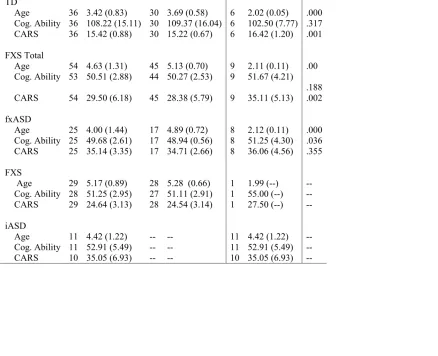
fxASD-, 6 TD boys, and 11 boys with iASD. Table 2.1 lists the distribution of
participants across each respective study.
Data collected at USC were obtained using the same standard assessment
series of independent samples t-tests for the groups with fxASD and TD but not for the
iASD and FXS given that only 1 participant with FXS was from the USC site and no
participants with iASD were from the UNC site. Results indicate that the participants
from the UNC study were older across the groups (FX+ASD, and TD) with average ages
of 4.9, and 3.7 years respectively contrasted to the USC participants with average ages of
2.1, and 2.0 years. Cognitive ability was higher in the USC site (51.25 vs. 48.95) for the
fxASD group as was autism symptomology (16.42 vs. 15.22) for the TD group. While
these site differences are statistically different, they do not represent large differences
based on the mean values and are of minimal clinical significance (e.g., the cognitive
abilitystandard scores are within the same range for both sites and the CARS scores for
the TD are far below clinical cutoffs for both sites). Also, these site differences are
expected given the younger developmental focus at the USC site and that younger age is
associated with elevated cognitive ability in FXS (Roberts et al., 2009) and more
variability in typical development. So site differences are not controlled for in the
analyses as they are redundant with age and cognitive ability. Site descriptive statistics
and results from the t-tests are provided in Table 2.1.
When multiple assessments were available, the youngest age point for each
participant was used in the current study (i.e., between 2-5 years) due to our focus on
very early behavioral development. Participants were included in our study if they were
born full-term, currently lived with their biological mother, and if English was the
primary language spoken in their home. Participants from all groups were excluded
from the study if they had been previously diagnosed with another known medical or
Participants were recruited through a national registry for research, support groups, or
advertising through community centers near the universities.
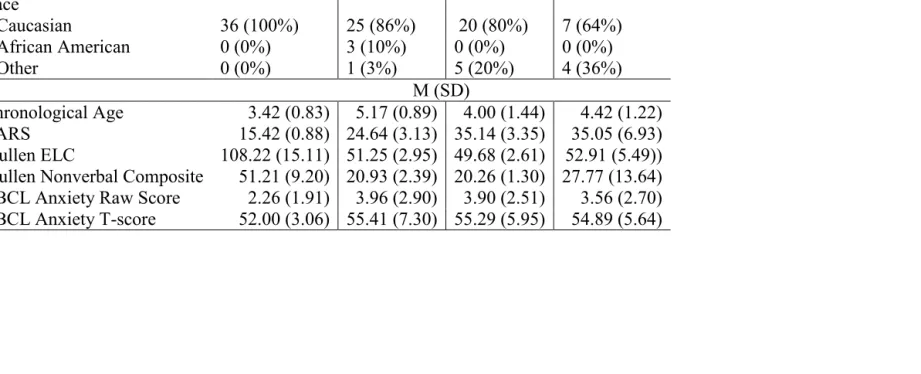
Participants in the FXS and fxASD groups together comprised 54 boys who had
previous genetic testing to confirm the presence of the disorder. Participants were
recruited nationally through support groups and current national research databases.
Within the collective FXS groups, 8 boys (15%) had an ADOS-2 completed with 100%
having a CARS score. Thus, the CARS scores were used to determine groups based on
high and low ASD features with the ADOS-2 scores used to validate the CARS scores( r
= .86). Based on the CARS, 25 boys (46% of the sample) had a total score of a 30 or
greater indicating increased symptoms of autism reaching the established clinical cutoff.
This subgroup of boys with FXS and elevated symptoms of autism were categorized as
the fxASD group. The FXS group included 29 boys (54% of the sample) and was
determined by CARS total scores below 30 indicative of low autism symptomology. Of
the fxASD group, 7 (28%) boys and 1(17%) boy within the FXS group had an ADOS-2
completed. Additionally, of the fxASD and FXS groups that had ADOS-2 data, 7
(100%) of the boys with fxASD displayed elevated autism symptomology on the CARS
(e.g. a total score above 30), compared to none of the boys with FXS. Both groups were
matched on cognitive ability with the fxASD displaying an average ELC standard score
on the Mullen Scales of Early Learning of 49.68, which was similar to the FXS average
ELC standard score of a 51.25. Further descriptive and demographic information about
the FXS groups are provided in Table 2.2.
The iASD group consisted of 11 preschool aged boys with an average
on having met DSM-criteria for ASD documented through a diagnostic evaluation by a
qualified community professional (e.g., psychologist; N=10) or by meeting threshold on
the ADOS-2 (N=1) as well as receiving a total score higher than 30 on the CARS through
participation in the USC study (N=11). Also, one participant with both CAR-2 and
ADOS-2 data met diagnostic criteria on both measures. Community diagnoses were
confirmed by CARS scores calculated as part of study participation. Participants with
iASD were excluded from participating if there were known genetic (e.g. FXS) or
medical conditions reported in the family history report or during the initial screening.
The iASD group was matched on cognitive ability to the FXS and fxASD groups and had
an average Early Learning Scale standard score of a 52.91 on the Mullen Scales of Early
Learning. Demographic and descriptive information concerning the iASD group is
provided in Table 2.2.
Boys in the typically developing (TD) group included 36 participants with an
average age of 3.33 years and an average CARS score of 15.42. Participants were
included in the TD group if they were reported to have no developmental concern by
parental report. Additionally, participants in the TD group were required to perform
within the average range on developmental measures of functioning as measured by the
Mullen Scales of Early Learning. Descriptive and demographic data for the TD group
are provided in Table 2.2.
2.2 MEASURES
The Stranger Approach observation from the Laboratory Temperament
Assessment Battery (Lab-TAB; Goldsmith & Rothbart, 1996) was used to elicit