Separable Reversible Data Hiding In
Encrypted JPEG Bitsream
Bushra M.P1, Najiya K.V2
M.Tech Student, Dept. of ECE, Cochin College of Engineering and Technology, Malappuram, Kerala, India1
M.Tech Student, Dept. of ECE, Cochin College of Engineering and Technology, Malappuram, Kerala, India 2
ABSTRACT: Reversible data hiding in encrypted images (RDH-EI) are developed most techniques for uncompressed images, this paper provides a separable reversible data hiding protocol for encrypted JPEG bitstreams. Here a JPEG encryption algorithm is first proposed, which enciphers an image to a smaller size and keeps the format compliant to JPEG decoder. After a content owner uploads the encrypted JPEG bitstream to a remote server, a data hider embeds an additional message into the encrypted JPEG bitstream without changing the bitstream size. On the recipient side, the original bitstream can be reconstructed losslessly using an iterative recovery algorithm based on the blockingartifact. Though message extraction and image recovery are separable, anyone who has the embedding key can extract the message from the marked encrypted copy.A random error is introduced to obtain the PSNR and error values of different JPEG images and make a comparative study. Experimental results show that the proposed method outperforms a previous work in terms of separation capability, embedding capacity and security.
KEYWORDS:Reversible data hiding, Jpeg encryption, Jpeg decryption,Image recovery
I.INTRODUCTION
Signal processing in encrypted domain (SPED) for privacy preserving has attracted considerable research interests in recent years. In cloud computing and delegated calculation, users who are unwilling to reveal contents of the original signal may send an encrypted copy to a remote server. The server has to accomplish signal processing in the encrypted domain. Many approaches have been proposed for different applications, for example, compressing encrypted images, signal transformation in cipher texts, pattern recognition in encrypted domain, watermarking in encrypted multimedia, data searching in encrypted dataset etc. Reversible data hiding in encrypted images (RDH-EI) is another topic of SPED.
MOTIVATIONS AND CONTRIBUTIONS
RHD-EI allows a server to embed additional message into an encrypted image uploaded by the content owner, and guarantees that the original content can be losslessly recovered after decryption on the recipient side. Generally, reversibility is closely related to the embedding payload. If the original image can be losslessly recovered when the payload does not exceed the achievable capacity, we say it is reversible. Meanwhile, RDH-EI protocols are always designed for natural images. Since a natural image always contains large smooth areas, i.e., redundancies, one can embed data into the original image and losslessly recover it. Unlike robust watermarking, reversible data hiding are widely used when perfect image reconstruction and data extraction are emphasized while robustness against malicious attacks is not considered.
II.LITERATURE REVIEW
A literature survey is done for specified papers which are essential to know the existing techniques their significance and limitations. It also includes various supporting papers for the proposed technique and their advantages. Here all the papers are viewed based on its algorithm architectural flow.
BACKGROUND WORK
Reversible Data Hiding in Encrypted Image
Reversible data hiding is a technique to embed additional message into some distortion-unacceptable cover media, such as military or medical images, with a reversible manner so that the original cover content can be perfectly restored after extraction of the hidden message. A number of reversible data hiding methods have been proposed in recent years. This work proposes a novel reversible data hiding scheme for encrypted image, which is made up of image encryption, data embedding and data-extraction/image-recovery phases. The data of original cover are entirely encrypted, and the additional message is embedded by modifying a part of encrypted data. At receiver side, with the aid of spatial correlation in natural image, the embedded data are successfully extracted while the original image is perfectly recovered.
A. Efficient Compression of Encrypted Gray scale Images
This paper shows an efficient way to compress encrypted images through resolution-progressive compression (RPC). The encoder starts by sending a down sampled version of the cipher text. At the decoder, the corresponding low-resolution image is decoded and decrypted, from which a higher-low-resolution image is obtained by intra frame prediction. The predicted image, together with the secret encryption key, is used as the side information (SI) to decode the next resolution level. This process is iterated until the whole image is decoded. By doing so, the task of de-correlating the pixels, which is not possible for the encoder, is shifted to the decoder side. In addition, by having access to a lower-resolution image, the decoder is able to learn the local statistics, doing much better than “blind” decoding. Moreover, by avoiding exploiting the Markovian property in Slepian-Wolf decoding, the decoder’s complexity is significantly reduced.
B. Reversible Data Hiding in Encrypted JPEG Bitstream
Reversible data hiding (RDH) is a technique that embeds secret information into a cover image in a reversible manner. On the receiving side, the hidden message can be extracted and the original image perfectly restored. This technique is especially useful in applications such as medical and military imaging where the original image must not be altered after the embedded data are extracted. Unlike robust watermarking, RDH emphasizes perfect image reconstruction and data extraction, but not the robustness against malicious attacks. This is useful, for example, in cloud storage. When a database manager tries to label the files using RDH methods, no transmission is involved, therefore no errors and attacks either. This correspondence proposes a framework of reversible data hiding (RDH) in an encrypted JPEG bitstream. Unlike existing RDH methods for encrypted spatial-domain images, the proposed method aims at encrypting a JPEG bitstream into a properly organized structure, and embedding a secret message into the encrypted bitstream by slightly modifying the JPEG stream. We identify usable bits suitable for data hiding so that the encrypted bitstream carrying secret data can be correctly decoded. The secret message bits are encoded with error correction codes to achieve a perfect data extraction and image recovery. The encryption and embedding are controlled by encryption and embedding keys respectively. If a receiver has both keys, the secret bits can be extracted by analyzing the blocking artifacts of the neighboring blocks, and the original bitstream perfectly recovered. In case the receiver only has the encryption key, he/she can still decode the bitstream to obtain the image with good quality without extracting the hidden data.
C. Reversible Data Hiding in Encrypted Images by Reserving Room Before Encryption
restoration. In this paper, we propose a novel method by reserving room before encryption with a traditional RDH algorithm, and thus it is easy for the data hider to reversibly embed data in the encrypted image. The proposed method can achieve real reversibility, that is, data extraction and image recovery are free of any error. Experiments show that this novel method can embed more than 10 times as large payloads for the same image quality as the previous methods, such as for PSNR= 40 dB.
D. Protection and Retrieval of Encrypted Multimedia Content: When Cryptography Meets Signal Processing In the past few years, the processing of encrypted signals has emerged as a new and challenging research field. The combination of cryptographic techniques and signal processing is not new. So far, encryption was always considered as an add on after signal manipulations had taken place. For instance, when encrypting compressed multimedia signals such as audio, images, and video, first the multimedia signals were compressed using state-of-the-art compression techniques, and next encryption of the compressed bit stream using a symmetric cryptosystem took place. Consequently, the bit stream must be decrypted before the multimedia signal can be decompressed. An example of this approach is JPSEC, the extension of the JPEG2000 image compression standard. This standard adds selective encryption to JPEG2000 bit streams in order to provide secure scalable streaming and secure transcoding.
CONCLUSION OF LITERATURE REVIEW
All the above papers described about reversible data hiding system that consists of image encryption, data embedding and data extraction/ image-recovery phases. The data of original image are entirely encrypted by a stream cipher. Although a data-hider does not know the original content, he can embed additional data into the encrypted image by modifying a part of encrypted data. With an encrypted image containing embedded data, a receiver may firstly decrypt it using the encryption key, and the decrypted version is similar to the original image. According to the data-hiding key, with the aid of spatial correlation in natural image, the embedded data can be correctly extracted while the original image can be perfectly recovered. Although someone with the knowledge of encryption key can obtain a decrypted image and detect the presence of hidden data using LSB-steganalytic methods.
III.EXISTING WORK
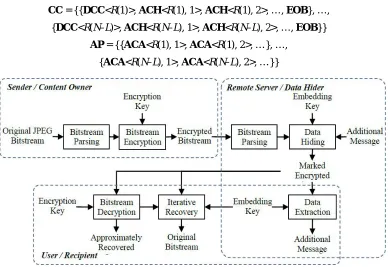
The framework of the proposed method is depicted in Fig. 1. The JPEG RDH-EI workflow includes three parties: content owner, data hider, and recipient. Given a JPEG bitstream and an encryption key, the content owner generates a ciphertextbitstream after syntax parsing and encryption. In the process, the file size is kept unchanged and the format is compliant to common JPEG decoders. When a remote server receives the encrypted bitstream, the data hider parses the bitstream and hides additional messages in it using an embedding key. After the marked encrypted bitstream is constructed, the file size and format compliance are preserved. In this scheme, the server can extract additional messages from the marked encrypted bitstream using the embedding key. On the recipient side, the additional messages can also be extracted from the received bitstream if the embedding key is available. A recipient with only the encryption key can view an approximate image by a direct decryption. If both the encryption and embedding keys are available, the recipient can losslessly recover the original bitstream after decrypting the marked encrypted JPEG bitstream.
JPEG ENCRYPTION AND DECRYPTION
In this section, we develop an encryption/decryption algorithm for baseline JPEG bitstreams. The encryption aims at preserving file size of the bitstream, avoiding leakage of image contents, and keeping the encrypted bitstream compliant to the common JPEG decoder. JPEG compliance here means an encrypted bitstream with suffix “.jpg” or “.jpeg” can be directly decoded by commonly-used JPEG decoders.
A. JPEG Encryption
AC coefficients, as shown in the third layer of Fig. 2. Denote the codes of DC and AC coefficients in the i-th segment as DCC<i> and ACC<i, j>, respectively, where i=1, 2, …,N and 0 ≤ j < 64. In the fourth layer, both codes of DC and AC coefficients contain Huffman code and appended bits. Let DCH<i> and DCA<i> be the Huffman codes and appended bits for DC coefficient, ACH<i, j> and ACA<i, j> for AC coefficient, respectively. Thus, each entropy-coded segment can be represented by
ECSi= {DCC<i>, ACC<i, 1>, ACC<i, 2>,…,EOB} = {{DCH<i>, DCA<i>}, {ACH<i, 1>, ACA<i, 1>},
{ACH<i, 2>, ACA<i, 2>}, …,EOB}.
With an encryption key Kenc, the content owner pseudo-randomly selects entropy-coded segments corresponding to L blocks from the entropy encoded data, where 1<L<N. The encryption key Kenc is private to the content owner. Since all DC coefficients are encoded by DPCM starting from the first block, this block must be selected so that the encrypted bitstream can be correctly decoded by a JPEG decoder. Denote indexes of the selected L blocks as {S(1), S(2), …, S(k), …, S(L)}, and the remaining N–L blocks as {R(1), R(2), …, R(N–L)}. S(∙) and R(∙) are selection
functions: S(1)=1, 1<S(k)<N (k=2, 3, …, L), and 1<R(i)<N (i=1, 2, …, N–L).
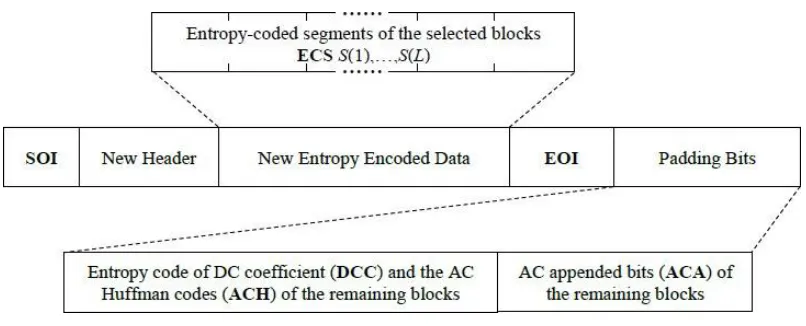
Next, the content owner generates a new bitstream including an SOI marker, a new JPEG header, entropy-coded segments of the selected L blocks, an EOI marker, and padding bits. Two integers h and w, which are multiples of eight and satisfy h×w=64L, are chosen to specify the size of a new image. The new JPEG header is modified to store the size. Compressed bits of the remaining N–L blocks are recomposed to construct the padding bits, whose syntax is illustrated in Fig. 3. These padding bits include two parts. The first part consists of the entropy code of DC coefficient and Huffman codes of all AC coefficients in the remaining blocks. The second part consists of the appended bits of all AC coefficients in the remaining blocks. We denote the padding bits as
P = {CC, AP} where,
CC = {{DCC<R(1)>, ACH<R(1), 1>, ACH<R(1), 2>, …, EOB}, …,
{DCC<R(N–L)>, ACH<R(N–L), 1>, ACH<R(N–L), 2>, …, EOB}}
AP = {{ACA<R(1), 1>, ACA<R(1), 2>, …}, …,
{ACA<R(N–L), 1>, ACA<R(N–L), 2>, …}}
Fig. 2 Simplified syntax of JPEG baseline. SOI, EOI and EOB stand for start-of-image, end-of-image and end-of-block respectively. Acronyms in the parentheses are used in the discussion for brevity.
Fig. 3 Syntax of the new JPEG bitstream
As a result, when modifying AP to accommodate additional messages by a data hider, no Huffman codes are destroyed. This is why ACHs are separated from ACAs to make sure there is no Huffman code inside AP.
Assume there are M bits in the padding data and P=[p1, p2, …, pM]. With the encryption key Kenc again, the content owner generates a key stream K=[k1, k2, …, kM] using a stream cipher algorithm such as RC4 and SEAL. The padding bits are then encrypted to P'=[p1', p2', …, pM'] where
pi' piki, 1 iM
In the same way, the content owner also encrypts all appended bits of the DC and AC Huffman codes inside the L selected segments. Next, we embed the encrypted padding bits P' and the parameters H and W into the reserved application segments, marked as APPn in the JPEG header, in the same way. After the processing, an encrypted JPEG bitstream is generated. The encrypted bitstream has the same amount of data as the original, and is compliant to the JPEG standard. As all bits between SOI and EOI are strictly structured following the JPEG syntax, the bitstream can be decoded to an image sized h×w using commonly-used JPEG decoders.
bits of all coefficients are encrypted by a stream cipher, the decoded AC coefficients are different from the original values.
B. JPEG Dencryption
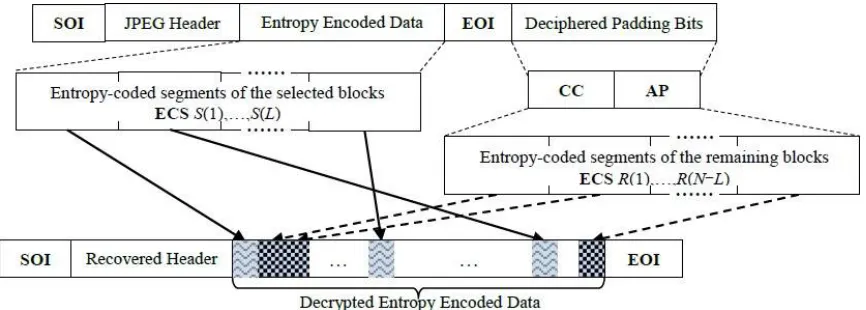
When deciphering the encrypted bitstream, the new JPEG header and entropy encoded data can be extracted by parsing the bitstream. Meanwhile, the padding bits data can be extracted by parsing the bitstream. Meanwhile, the padding bits P'=[p1', p2',…, pM'] can be extracted from the reserved application segments marked as APPnin the JPEG header. With the encryption key Kenc, the appended bits of L selected entropy-coded segments and the padding bits P={CC, AP} can be deciphered in the same way as (1).
From the JPEG header, we extract the DC and AC Huffman tables. With these tables, we parse the Huffman codes in CC and the appended bits in AP to reconstruct the N–L remaining entropy-coded segments ECSu, u=R(1), R(2), …, R(N–L). Meanwhile, the L selected entropy-coded segments ECSv (v=S(1), S(2), …, S(L)) are extracted from the new entropy encoded data. With the encryption key Kenc, the original indexes of the selected blocks can be recovered.
After that, the original JPEG bitstream is reconstructed containing SOI, the JPEG header, the decrypted entropy-coded segments, and EOI. The selected ECSu(u=R(1), R(2), …, R(N–L)) and the remaining ECSv(v=S(1), S(2), …, S(L)) are sequentially put back to the original positions, and the JPEG header is modified to restore the original image size H×W. The decryption procedure is depicted in Fig. 5.
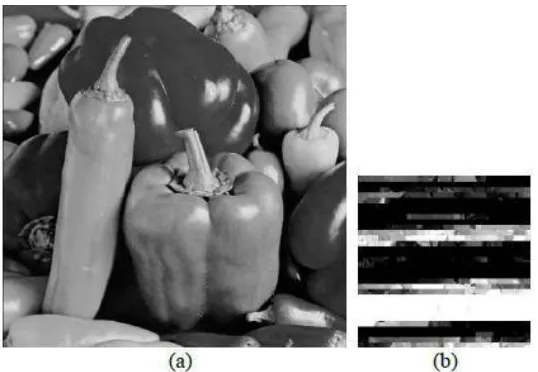
Fig. 4 Encryption of JPEG bitstream: (a) image decoded from the plaintext JPEG bitstream; (b) image decoded from the encrypted bitstream
DATA HIDING IN ENCRYPTED JPEG BITSTREAM
Based on the JPEG encryption algorithm, the content owner enciphers the JPEG bitstream and uploads the encrypted copy to a remote server. On the server side, the data hider extracts the encrypted padding bits from the header and embeds an additional message M into the encrypted padding bits. The procedure is depicted in Fig. 6. We denote all encrypted AC appended bits inside the encrypted padding bits as A, i.e., encrypted bits of AP, which contains m bits. Although it is difficult to identify the value of m directly from the encrypted padding bits, two solutions are provided at the end of this subsection.
The data hider evenly divides the binary vector A into s groups {A1, A2, …,As}, where s=m/n, n=β∙e, β is a positive integer, and e is the average number of appended bits of all AC coefficients inside each block. The value of e is identified by parsing all AC appended bits in L selected entropy-coded segments. Assuming there are ma such bits, the value of e is calculated by e=ma/L.Subsequently, the data hider constructs a k×n binary matrix H by
whereQ is a pseudo-randomly generated binary matrix, and r=n–k. Many algorithms like RC4 and SEAL can be used to generate Q.
For each group At (t=1, 2, …,s), the data hider further computes
[ ( ), ( ), … , ( )] = . [ ( ), ( ), … , ( )]
in which all calculations are binary arithmetic. Thus, each group Atcontaining n bits is compressed to a vector Bi with k bits. After compressing all groups from m bits to ksbits, the additional message M containing m–ksbits are appended to generate
Pm={CC, {B1, B2 …, Bs, M}}.
With an embedding key Kemb, the data hider shuffles Pm to produce a sequence E. These bits are then embedded into the reserved application segments marked as APPnin JPEG header. This way, a marked encrypted JPEG
bitstreamcontaining additional messages is generated.
To extract the additional messages, one can reshuffle the padding bits of the marked encrypted bitstream using the embedding key Kemb, and obtain the additional messages by extracting the last m-ks bits. Since extraction is done in the encrypted domain without revealing image contents, the proposed RDH-EI method is therefore separated from image recovery.
Next, we explain how the parameter m is estimated. There are two possible solutions. A simple solution is to transmit the parameter m along with the encrypted JPEG bitstream, by embedding it inside the reserved application segments marked as APPn in JPEG header. Another is to estimate the length of encrypted padding bits. If there are ns bits in L selected entropy-coded segments and nr bits in the N–L remaining segments, m can be estimated by m=[λ∙(nr/ns)∙ma],
where [∙] is a rounding operator, and λ a scaling factor (0<λ<1) used to avoid modifying the encrypted Huffman codes
during data hiding.
Fig. 6 Procedure of data embedding
ITERATIVE RECOVERY OF ORIGINAL IMAGE
On the recipient side, the marked encrypted JPEG bitstream can be directly decoded by the JPEG decoder to construct an encrypted image of a smaller size. With the embedding key Kenc, the recipient can parse and decipher the marked encrypted JPEG bitstream using the proposed JPEG decryption algorithm described in Section III-A. Since only the AC appended bits of the remaining entropy-coded segments were modified in data hiding, an approximate image with reduced quality can be reconstructed after decryption.
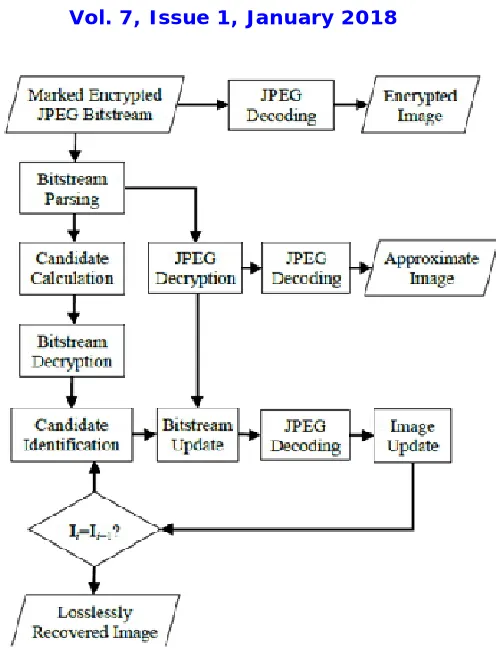
With both the encryption and embedding keys, the recipient can losslessly recover the original JPEG image. Although the compression algorithm in (3) is irreversible, we have several solutions to identify the original bits according to the changes of blocking artifacts. A flowchart of the recovery is shown in Fig. 7. The recipient first parses and extracts the encrypted padding bits E from the marked encrypted JPEG bitstream and reshuffles E to restore Pmusing the embedding key Kemb, where
Pm={CC, {B1, B2, …,Bs, M}}.
According to the binary matrix H, the recipient generates a binary matrix G,
G = [QTk
×r ,Ir×r]
wherer=n–k and n=βe. For each group Bt, the recipient calculates
[ ( )( ), ( )( ) … ( )( )]
= ( ), ( ) … ( ), … + [ , , … , ]∙
where[ , , … , ]is an arbitrary binary vector, and ( )the 2r possible candidates for each group At, t=1, 2, …, s, and
c=1, 2, …, 2r.
With the encryption key Kenc, the candidate vectors A( )are decrypted to plaintext candidates D( )using the stream cipher algorithm. According to the syntax of the recomposed JPEG bitstream, lossless recovery is equivalent to identifying the suitable one from the 2rpossible plaintext candidates to recover the padding bits. Assume that the AC appended bits in each candidate Dt(c) belongs to several entropy-encoded segments, i.e.,
( )
Here F stands for the fragment AC appended bits of a segment, and ACAP<ta> for the candidate of all AC appended bits in the ta-th remaining segment, t=1, 2, …, s, ta∈{R(1), R(2), …, R(N–L)}, and a=1, 2, ..., l. The value of l is identified by parsing the AC Huffman codes in the decrypted padding bits. Meanwhile,
= { , , , , … }
whereACA<ta, j> is a candidate of appended bits, and 0≤j<64. Thus, 2rcandidates for l entropy-coded segments can be generated,
ECSta (c)={DCC<ta>, ACH<ta, 1>, ACA<ta, 2>, …, EOB}
Accordingly, 2rcandidate pixel blocks {PBt1(c), PBt2(c), …,PBtl(c)} are constructed by entropy decoding {ECSt1(c), ECSt2(c), …, ECStl(c)}.
Next, the recipient identifies the suitable candidate Dt(bt) from Dt(c) (c=1, 2, …, 2r) by calculating the blocking artifacts of the candidate blocks, where
= arg min ( ( ))
andf is the blocking artifact function,
f(X) = ∑ |X(1, i)−UP(8, )| + | ( , 1)− ( , 8)|
The blocking artifact function is illustrated in Fig. 8, in which X is the present block, UP and LF are the up and left neighboring blocks. We use the up and left blocks when calculating blocking artifact as blocks are constructed orderly from left-to-right and top-to-bottom, and only these two blocks are available in the first round of recovery.
The reason we use this function as the criteria of recovery is that data embedding by coefficient modification always increases blocking artifacts. It should be noted that over-smooth in the recovered image may occur when a small parameter n is used during embedding. As long as n is large, i.e., enough blocks are used together to evaluate the blocking artifacts, the over-smooth effect can be avoided.
After sequentially processing all groups {B1, B2, …,Bs}, suitable candidates {D1(b1), D2(b2), …, Ds(bs)} constituting updated padding bits are identified. This way, a new image I0 is constructed by decoding the updated JPEG bitstream. The image I0 has better quality than the directly deciphered image. The first round of recovery using blocking artifact function may be inaccurate. In the next stage, the recipient iteratively refines the updated JPEG bitstream to losslessly recover the original image, using contents in the existing image as a reference. With the updated padding bits and the candidates Dt(c) (c=1,2,…,2r), the recipient iteratively finds the best candidates.
Fig. 7 Flow chart of iterative recovery
As shown in Fig. 8, UP, LF, DW and RT are neighbouring blocks around the present block X. In each iterative step, the recipient updates the bitstream and generates a refined image. The generated image is compared with the resulting image of the previous round. The iteration runs until no difference is found. This way, the recipient can losslesslyrecover the original JPEG image.
IV.EXPERIMENTAL ANALYSIS
To verify the proposed method, we use a grayscale image sized 512×512, and compress them to JPEG bitstreams with different quality factors. The encrypted padding bits, and the parameters m, H, and W are hidden into the JPEG header.
Let α=L/N be the ratio of selected blocks.
An example is given in Fig. 9, in which shows the original images compressed with a quality factor 80. The encrypted bitstreams have the same lengths as the original. Secret messages containing 1023 bits are embedded into each encrypted bitstream using an embedding key Kemb. On the recipient side, additional messages can be extracted without any errors if error value is zero otherwise there is an error. The key Kemb is available. When both keys are available, the original bitstreams can be recovered without loss.
Quality factor used for scaling the default quantization table is an important factor in JPEG compression, and it also impacts embedding payloads.
(a)
(b)
(d)
Fig. 9. RDH-EI in the bitstreams corresponding to Lena and Baboon: (a) original JPEG images, (b) encrypted images, (c) directly decrypted images, and (d) losslessly recovered images
The proposed system is securer than an improved reversible data hiding in encrypted images using side match, in which the quantization tables and all appended bits are encrypted, while all Huffman codes are unchanged. If an adversary uses all Huffman codes and sets all appended bits to zero, a contour of the original image can be revealed. While in the proposed method, only part of the bitstream segments are randomly selected to construct a smaller sized JPEG image. Most of the entropy-coded segments are rearranged to the padding bits that are further encrypted with a stream cipher. Thus, the adversary cannot reconstruct a contour of the original image with limited Huffman codes.
V.RESULT AND DISCUSSION
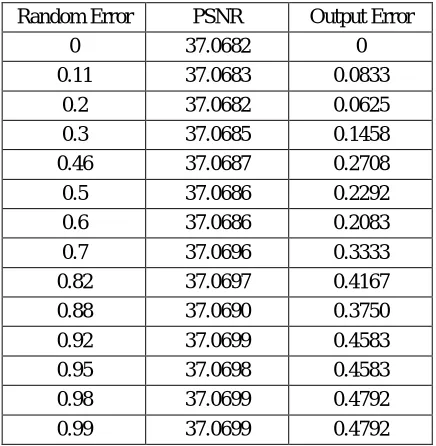
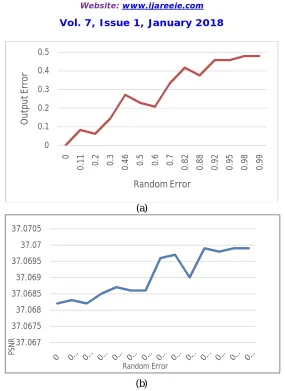
The following figures depicts the simulation results. The figure 9 shows the losslessly recovered images of Lena and Baboon.The PSNR and output error is obtained for different random error.
Random Error PSNR Output Error
0 37.0682 0
0.11 37.0683 0.0833 0.2 37.0682 0.0625 0.3 37.0685 0.1458 0.46 37.0687 0.2708 0.5 37.0686 0.2292 0.6 37.0686 0.2083 0.7 37.0696 0.3333 0.82 37.0697 0.4167 0.88 37.0690 0.3750 0.92 37.0699 0.4583 0.95 37.0698 0.4583 0.98 37.0699 0.4792 0.99 37.0699 0.4792
(a)
(b)
Fig. 10. (a) Graphical representation of output error verses random error (b) Graphical representation of PSNR verses random error of the image Lena
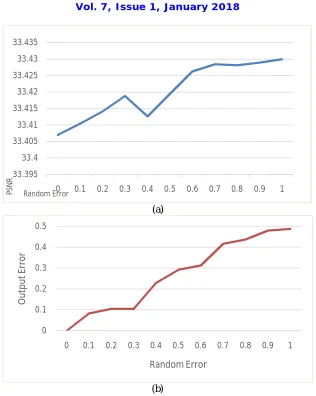
Random Error PSNR Output Error
0 33.4070 0
0.1 33.4104 0.0833
0.2 33.4142 0.1042
0.3 33.4189 0.1042
0.4 33.4127 0.2292
0.5 33.4195 0.2917
0.6 33.4263 0.3125
0.7 33.4285 0.4167
0.8 33.4282 0.4375
0.9 33.4290 0.4792
1.0 33.4300 0.4876
Table 2.Values of PSNR and output error for different random errors for baboon
0 0.1 0.2 0.3 0.4 0.5 0 0. 1 1 0
.2 0.3
0.
4
6
0
.5 0.6 0.7
(a)
(b)
Fig 11. (a) Graphical representation of PSNR verses random error (b) Graphical representation of output error verses random error of the image baboon.
VI.CONCLUSION
This paper proposes a separable reversible data hiding scheme for the encrypted JPEG bitstream. A JPEG encryption and decryption algorithm is developed to hide the content of an original image. When the server receives the enciphered bitstream, a data hider can embed additional messages into the encrypted copy by compressing the padding bits of the bitstream. With an iterative recovery method based on blocking artifacts, the recipient can losslessly recover the original bitstream. The proposed method provides larger embedding capacity than the previous approach. It is separable because anyone who has the embedding key can extract the additional message from the marked encrypted bitstream without revealing the original content of the JPEG image.
The proposed method also offers better security than the previous work. A new JPEG bitstream corresponding to a smaller sized image is constructed. Therefore, information leakage of the original content, e.g., contour of an image, can be avoided. The procedure is realized by rearranging some entropy-coded segments to generate the padding bits. These bits are embedded into the reserved segments labeled by APPn in the JPEG header. The encrypted bitstream can still be decoded by the commonly-used decoders, e.g., the decoder incorporated in the Windows operating system. Meanwhile, the amount of data of the bitstream is unchanged.
33.395 33.4 33.405 33.41 33.415 33.42 33.425 33.43 33.435
0 0.1 0.2 0.3 0.4 0.5 0.6 0.7 0.8 0.9 1
P
SN
R
Random Error
0 0.1 0.2 0.3 0.4 0.5
0 0.1 0.2 0.3 0.4 0.5 0.6 0.7 0.8 0.9 1
O
u
tp
u
t
E
rr
o
r
REFERENCES
1. Z. Qin, X. Zhang and S. Wang, “Reversible data hiding in encrypted JPEG bitstream,” IEEE Trans. Multimed., vol. 16, no. 5, pp. 1486-1491, 2014.
2. X. Zhang, Z. Qian, G. Feng and Y. Ren, “Efficient reversible data hiding in encrypted images,” J. Visual Comm. Image Representation, vol. 25, no. 2, pp. 322-328, 2014..
3. W. Zhang, K. Ma and N. Yu, “Reversibility improved data hiding in encrypted images,” Signal Process., vol. 94, pp. 118-127, 2014
4. K. Ma, W. Zhang, X. Zhao, N. Yu and F. Li, “Reversible data hiding in encrypted images by reserving room before encryption,” IEEE Trans. Inf. Forensics Security, vol. 8, no. 3, pp. 553-562, 2013
5. W. Hong, T. Chen and H. Wu, “An improved reversible data hiding in encrypted images using side match,” IEEE Signal Process. Lett., vol. 19, no. 4, pp. 199-202, 2012.
6. X. Zhang, “Separable reversible data hiding in encrypted image,” IEEE Trans. Inf. Forensics Security, vol. 7, no. 2, pp. 826-832, 2012. 7. X. Zhang, “Reversible data hiding in encrypted image,” IEEE Signal Process. Lett., vol. 18, no. 4, pp. 255-258, 2011.
8. W. Liu, W. Zeng, L. Dong, and Q. Yao, ―Efficient compression of encrypted grayscale images,ǁ IEEE Transactions on Image Processing, vol. 19, no. 4, pp. 1097-1102, 2010
9. Z. Ni, Y. Q. Shi, N. Ansari and W. Su, “Reversible data hiding,” IEEE Trans. Circuits Syst. Video Technol., vol. 16, no. 3, pp. 354-362, 2006. 10. J. Fridrich, M. Goljan and R. Du, “Invertible authentication,” Proc. SPIE, San Jose, CA, vol. 3971, pp. 197-208, 2001.
11. J. Fridrich, M. Goljan and R. Du, “Lossless data embedding: new paradigm in digital watermarking,” EURASIP J. Appl. Signal Process., vol. 2, pp. 185-196, 2002.
12. M. U. Celik, G. Sharma and A. M. Tekalp, “Lossless watermarking for image authentication: a new framework and an implementation,” IEEE Trans. Image Process., vol. 15, no. 4, pp. 1042-1049, 2006.
13. J. Tian, “Reversible data embedding using a difference expansion,” IEEE Trans. Circuits Syst. Video Technol., vol. 13, no. 8, pp. 890-896, 2003.
14. D. M. Thodi and J. J. Rodríguez, “Expansion embedding techniques for reversible watermarking,” IEEE Trans. Image Process., vol. 16, no. 3, pp. 721-730, 2007.
15. P. Tsai, Y. Hu and H. Yeh, “Reversible image hiding scheme using predictive coding and histogram shifting,” Signal Process., vol. 89, no. 6, pp. 1129-1143, 2009.
16. Z. Erkin, A. Piva, S. Katzenbeisser, et al., ―Protection and retrieval of encrypted multimedia content: when cryptography meets signal processing,ǁEURASIP Journal on Information Security, 2008.