Interseeding
and Pitting
on a
Site in Eastern
Montana
1. ROSS WIGHT AND LARRY M. WHITE
Highlight: A srudy of the effects of interseeding and pining on herbage yield, sperm composition, soil wafer confent, and nitrogen uptake was conducted on a sandy range site in eastern Montana from 1967 f~ 1972. Over these 6 years, inferseed- ing with (I lister and rorary tiller increased perennialgrass yields 30 and 24%, respective- fy. Pining increased the yield of sedges (Carex spp.J ow mo~f of the 6 years, but increased rotal grass yield only in 1969. The yield increase from inferseeding wasdue fo increased growth of native western wheatgrass (Agropyro” smithii) and inferseeded specier. An interseeded mixture of wesfern wheatgrass, bluebunch wheargras.r (A. spicatum), green needlegrass (Stipa viridula), and little bluestem (Andropogon scoparius/ produced two fo three times more than any individual species. Interseeding by lister and rofary filler increased perennial grass yields in the sixth year after treaf- menf by 58 and 41%, respectively, indicating pofential long-term benefits from infer- seeding. Of the treafments, only lister interseeding showed evidence of increasing soil wnfe~ recharge on this sandy range site. Tillage associated with the interseeding and pitting freatmenfs increased the uptake of nitrogen by plants for af least 2 years after ti-eafmenf
Overgrazing and drought have deteri- orated a significant acreage of rangeland in the northern Great Plains. Approxi- mately 22 million acres in eastern Mon- tana need improvement (Montana State Soil Conservation Committee, 1970). The climax species on much of this range is now so sparse that proper livestock man- agement alone would take a prohibitively long time to restore the range to its potential productivity. Under these cir. cumstances, it is often profitable to me. chanically OI chemically renovate the range to create a favorable environment for the reestablishment of native grasses or to seed the desired species. Inter- seeding and pitting are two commonly used methods of range renovation and inlprovement.
Interseeding and pitting have bee” used in the northern Great Plains with various degrees of success. Nichols (1969) found that interseeding yellow sweet- clover (Melilotus offlcinalis) increased
production on dense clay range sites. Housto” and Adams (1971) reported that interseeding on clayey and panspot range sites in southeastern Montana increased herbage production. Vallentine (1971) concluded from a literature review that titerseeding has been more successful on coarse-textured than on medium- OI tine- textured soils. Ryerson et al. (1970) found that interseeding and pitting in- creased herbage production on range sites infested with clubmoss (&&gin& densa), and that interseeding usually was
Sandy
Range
more effective than pitting. Rauzi (1968) reported that lamb gain over a 24.year period averaged 7.2 lb/acre more on pitted shortgrass rangeland than on moderately grazed nonpitted rangeland in eastern Wyoming. Houston (1971) found that pitting moderately increased herbage production on overflow and clayey range sites but not on a silty range site. Nichols (1969) concluded that furrowing and pitting on dense clay range sites were of questionable value, because the furrows and pits rapidly eroded or refilled with sediment and thus lost their ability to retard runoff. Taylor (1967), after re- viewing the literature on range pitting in the northern Great Plains, concluded that, “This practice seems most practical on ranges whose composition of cool- season mid-grasses is less than its poten- tial, and when moisture runoff is likely to occur.” He also concluded that pitting did not produce a suitable environment for artificial revegetation.
is needed on site-treatment interactions and how different range renovation treat- ments affect the microenvironment and the associated vegetational response. This paper reports and discusses the effect of interseeding and pitting on the vcgeta- tion, soil water, and soil nutrient availa- bility of a sandy range site in eastern Montana.
Methods
This study was conducted from 1967 through 1972 near Sidney, Mont., on a sandy, glaciated plains range site ( 12. to
14.inch precipitation zone) with a 3 to 10% slope. Western wheatgrass (&ro- pyron smithii), blue grama (Boutelouo gracilis), needleandthread (Stipa comnta),
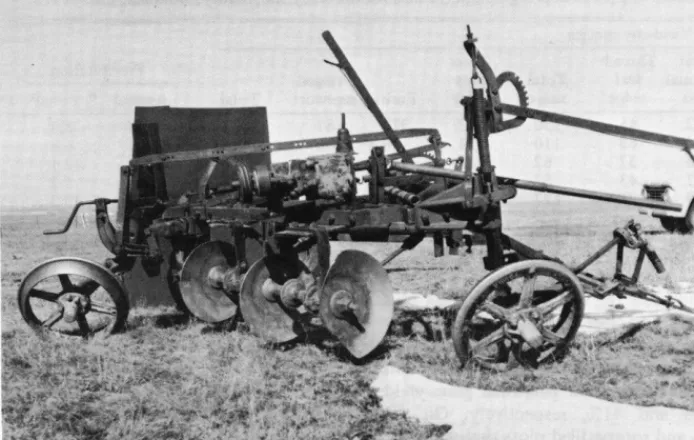
prairie Junegrass (Koeleria crirtata), threadleaf sedge (Car&x filifolia), and fringed sagewort (Artemisia frigida) were the dominant species. Clubmoss consti- tuted a significant portion of the ground cover. Site vegetation and precipitation characteristics are shown in Table 1. Site condition class, according to the U.S. Soil Conservation Service range site classifica- tion system, was between fair and good. Interseeding was done with a lister (L-interseeding) and a rotary tiller (R- interseeding). The interseeding and pit- ting treatments were applied in early April, 1967. Lister furrows 22 inches wide and 3 inches deep on 60-&h centers were formed with a machine (Fig. 1) similar to the one described by Ryer- son et al. (1970). The R-interseeding treatment consisted of 24-inch strips tilled to about a 3-inch depth alternating with 24.inch “ontilled strips. This spacing was achieved by removing the appropriate “umber of blades from a commercial rotary tiller. Pitting was done with modi- fied discs on a one-way plow (Fig. 2), as
described by Ryerson et al. (1970). Pits averaged about 48 inches long, 6 inches wide, and 4 inches deep. The L-inter- seeding, R-interseeding, and pitting treat- ments removed 37, 50, and 15% of the vegetation cover and disturbed an addi- tional 37, 0, and 15% of the area, leaving 26, 50, and 70% undisturbed, respec- tively. A Plant& Junior’ hand seeder with a double disc opener was used to seed a single row in the lister furrows and rototilled strips. The seeds were planted s to Y= inch deep and covered with the mu.11 press wheel on the seeder. Species seeded and seeding rates are show” in Table 2. Treatments were applied on the contour on 30. by SO-ft plots arranged in a randomized complete black design with three replications.
Nitrogen (N) and phosphorus (P) fer- tilizer (40 lb N and 18 lb P/acre broadcast at seeding time) and herbicide (2 lb acid equivalent, low volatile ester of 2,4-D in
10 gallons of water per acre applied in mid-June 1968) were applied in factorial combinations with the check, pitting, and the L-interseeding and R-interseeding treatments that were interseeded with the grass mixture. This segment of the experi- ment was analyzed as a factorial with four mechanical treatments (L- interseeding, R-interseeding, pitting, and check), two herbicide treatments (0 and 2 lb 2,4-D per acre), and two fertilizer treatments (0 to 40 lb N plus 18 lb P/acre). Because the study site was in- herently deficient in N and P, both were added as a fertilizer treatment to deter- mine the potential benefit of fertilization of interseeding treatments.
Establishment of seeded species was
‘Trade namw and company names are in- cluded for the benefit of the reader and do not infer any endorsement or preference of the prOdUct by the U.S. Department of Agriculture.
determined in July, 1967, by counting seedlings per 4 lineal feet of row. Stand establishment was rated visually in 1972. Comparative production of seeded species was determined in 1972 by harvesting a 13.2.ft segment of seeded row.
Total production was measured in 1967, 1968, 1969, 1971, and 1972 by hand clipping herbage at ground level in a 10.8.ft* area within each plot. The forage was harvested about mid-July when the major grass species matured. Seeded spe- cies were not harvested in 1967. Har- vested forage was separated by species, ovendried at 70°C, and weighed. Western wheatgrass and blue grama samples were ground to pass a 20.mesh screen and later analyzed for N. The study area was fenced, and grazing was deferred for 2 years. Beginning in 1969, cows were allowed to graze the study plots during fall months.
Yield data for individual species and species groups were analyzed by the appropriate analysis of variance tech- nique, and significant differences were established at the 90% probability level. Yields shown in Table 3 are expressed as percent of the check and were calculated from the mechanical and fertilizer treat- ment means of the factorial analysis. The mechanical treatments (L-interseeding, R-interseeding, pitting, and check) all responded similarly to the fertilizer and herbicide treatments, thus permitting the comparisons in Table 3 to be made on the basis of the mechanical treatment means from the factorial analyses.
Soil water content was measured peri- odically throughout the 1967, 1968;and 1969 growing seasons in a” L-interseeded, R-in&seeded, pitted, and check plot in each replication. These plots received neither fertilizer “or herbicide and in- cluded plots interseeded with the grass mixture. Soil water was measured by the neutron method in two access tubes in each plot. In the pitted and interseeded plots, one access tube was located in the tilled area and the other tube in the adjacent undisturbed area. Measurements were made at 1.ft intervals to the 4.ft depth.
Results
Adequate soil water during the spring of 1967, the year of seeding, resulted in a” excellent stand of most seeded species. Growing conditions were generally favor- able throughout the 6.year study. Herb- age yields were lowest in 1968 and 1971 and generally corresponded to variations in precipitation (Table 1).
Establishment and survival of seeded species are shown in Table 2. Seedling establishment of all species was success- ful. However, seedling establishment of the grass mixture was better in the lister
Table 1. Herbage yields (lb/acre) of the check plot and annual and seasonal precipitation (inches) for the study site, Sidney, Montana, 1967-1972.
Yields by species
Year
1967 1968 1969 1971 1972
Western Blue Prairie wheatgrass grama junegrass
Needle- and- thread
51 159 113 128
30 106 54 173
42 288 128 290
73 95 116 203
178 100 43 322
‘April, May, June, and July precipitation.
furrows (69%) than in rotary-tilled strips (36%). After 6 years, only the grass species survived in sufficient number to be considered successfully established. The two saltbush species and winterfat did not grow beyond the seedling stage. Stands of sainfoin, which had become well established, were deteriorating at the end of the 6 years.
check plots. Water content was highest in L-interseeded plots-plots in which ap- proximately 74% of the vegetation had been removed or covered during treat- ment.
Six years after seeding, the grass mix- ture produced significantly more herbage (0.24 lb per 13.2 ft of row) than any other seeded species. Production of blue- bunch wheatgrass was about double that of any other individually seeded species but was only half that of the grass mixture. Seeded species were still in well-defined rows and had not spread into surrounding tilled areas or adjacent native sod.
The increase in western wheatgrass plus the 185 and 156 lb/acre contributed by seeded species (grass mixture) on L-inter- seeded and R-interseeded plots resulted in an increase in total perennial grass yield of 58 and 41%, respectively. On the lister- and rotary-tilled plots that were not seeded (tillage only), western wheatgrass yields were 3.2 and 1.4 times more than on the check plots, respectively. On these plots, only L-interseeding increased total perennial grass yield (44% more than the check).
Pitting, which was not as severe a treatment as interseeding, had little meas- urable effect on the vegetation. Total perennial grass yield was increased only in 1969. In 1972, 6 years after treatment, the only measurable effects of pitting were an increase in sedge and a decrease in forb production. However, for the 6-year period, there was a 13% increase in the grass plus sedge production.
The only other measurable differences in soil water content occurred in early spring of 1968 and 1969. During April and May of 1968, soil water content in the surface 2 ft of L-interseeded plots was about twice that of check plots. Again in early April, 1969, soil water content in the upper 2 feet of L-interseeded plots was about 25% more than in check plots. Soil water content was higher in tilled and disturbed areas than in undisturbed areas during most of 1967 and 1968, but not in 1969.
The effects of interseeding and pitting on herbage yields are shown in Table 3. Interseeding depressed yield of most spe- cies in 1967, the year of treatment. In 1968, yields of western wheatgrass, forbs, and shrubs increased. Western wheatgrass response was greater on L-interseeded plots than on R-interseeded plots and did not reach a maximum on the L-inter- seeded plots until 1971 as compared to 1969 on the R-interseeded plots. The yield response of forbs and shrubs on interseeded plots reached a maximum the second or third year following treatment, then gradually decreased.
Soil water content was higher in inter- seeded and pitted plots than in check plots during the summer of 1967. At the end of the growing season (mid-July), water content of interseeded and pitted plots was 75 to 100% greater than that of
Tillage associated with interseeding and pitting increased the growth and N content of plants. In 1967, N content of western wheatgrass was 1.84, 1.54, 1.50, and 1.43% on the L-interseeded, R-inter- seeded, pitted, and check plots, respec- tively. N content of blue grama followed the same pattern. This same year L-inter- seeding (26% cover), R-interseeding (50% cover), and pitting (70% cover) produced 63, 7 1, and 86% as much herbage as did
Interseeding depressed yield of sedges and native grasses, other than western wheatgrass, throughout most of the study period. However, both interseeding treat- ments significantly increased total peren- nial grass yield except in 1967 on the L-interseeded plots and in 1967 and 1968 on the R-interseeded plots. Yield in- creases on interseeded plots resulted from production of seeded species and in- creased production of native western wheatgrass. In 1972, for example, west- ern wheatgrass yielded 2.6 and 2.0 times more on L-interseeded and R-interseeded plots than on check plots, respectively.
Table 2. Seeding treatments, seedling establishment, and stand ratings.
Percent Live seeds seedling planted per establishment,
Method and species lineal foot 1967 Stand rating, 1972
Lister interseeding
Green needlegrass (St@ viridukr) 15 53 Successful
Western wheatgrass (Agropyron smithii) 15 50 Successful Little bluestem (Andropogon scoparius) 15 9 Successful Bluebunch wheatgrass (Agropyron spicatum) 15 53 Successful Thickspike wheatgrass (Agropyron dasystachyum) 15 73 Successful
Mixture’ 20 69 Successful
Nuttali saltbush (Atriplex nuttalli) 1 100 Unsuccessful Fourwing saltbush (Atriplex canescens) 26 73 Unsuccessful
Winterfat (Eurotia Zanata) 15 7 Unsuccessful
Sainfoin (Onobrychis viciaefolia) 20 69 Partially successful
Rototiller interseeding
Mixture’ 20 36 Successful
Winterfat 15 Unsuccessful
Sainfoin 20 650 Partially successful
~ _________-
’ Mixture consisted of 2 parts western wheatgrass, 2 parts green needlegrass, 1 part little bluestem, and 1 part bluebunch wheatgrass all of which are either decreasers or increasers in the climax vegetation. Parts were determined on a pure live seed basis.
208 JOURNAL OF RANGE MANAGEMENT 27(3), May 1974
Total Thread perennial leaf grass sedge
452 45
364 63
756 37
497 43 649 97
Total sedge
Grass plus sedge
Fringed Forbs sagewort
377 87
90 86
348 83
274 53
602 64
Total
130 582 110 474 62 817 52 549 127 776
1047 651 1247 876 1442
Precipitation
Annual Seasonal’
15.1 8.4 13.5 6.8 15.1 12.1 15.4 5.2 18.0 10.3
Table 3. Herbage production, expressed as percent of the check, of a sandy range site near Sidney, Montana, after interseeding and pitting treatments.
Species and groups
Method’ Needle- Total Thread- Grass
and Western Blue Prairie and- perennial leaf Total plus
year wheatgrass grama junegrass thread grass? sedge sedge sedge Forbs Shrubs Total
L-interseeding 1967 1968 1969 1971 1972 Total
R’--interseeding 1967 1968 1969 1971 1972 Total
Pitting 1967 1968 1969 1971 1972 Total
75 50” 45* 57” 55* 45* 49* 53* 73” 70 63*
384* 48* 118 108 154” 38* 57* 128” 431* 497* 168*
470* 54* 91 79 132* 93 104 127* 206* 705* 158*
521* 64 59 67” 166h 65 115 156* 114 495* 165*
255* 36* 56 64 158* 61 91 146* 125* 193” 147*
316* 51* 71 74” 130* 61” 78” 119* 129* 163” 128*
100 75*
184 63*
266” 94
246* 110 197* 63*
198* 82
149 92 63* 104 97
218 86 129 111 114
191 116 173 119 135”
120 101 90 80 93
146 97 144 80 107
158 101 115 105 111
37* 160* 118* 81 67 88
88 75* 104 82 77* 55* 75 71*
85 116 57* 65* 102 161 640” 132*
97 141* 74 96 132* 115 390 137*
84 156” 65 103 146” 73 346* 141”
58* 141* 66 73* 117 119 149 148*
83 124* 73* 83* 115 96 144 120”
100 88 88 79 79 86
97 113 114* 157 351 128*
109 132” 134* 103 551 141*
120 149 103 94 256 110
145 141* 113 72* 167 111 110 119” 113* 85 137 112*
1 L-interseeding = lister interseeding and R-interseeding = rototiller *Significantly different from the check at the 90% probability level.
interseeding.
TIncludes seeded grasses.
the check, respectively. Increased growth of individual species generally dilutes the mineral content of plant tissue. Thus, the small differences in N content as a result of treatment are more significant. Meas- urable fertility effects as a result of treatment disappeared during the second and third year after treatment.
Fertilization with 40 lb N and 81 lb P/acre in 1967 increased perennial grass production 50 and 18% the first and second year after application. Thereafter, no response was measured. The seeded grass mixture responded to fertilization in
1968 and 1969, producing 100 and 120% more than the unfertilized plots, respec- tively. There were no measurable fertil- izer effects on forbs or shrubs.
The herbicide treatment reduced forb and shrub yields during most of the study. In 1968, the year of herbicide application, forb and shrub yields were reduced 65 and 90% respectively. Resid- ual effect of the herbicide treatment reduced forb production 25% in 1972. There was no measurable herbicide effect on shrubs in 1972. Only in 1969 was there a measurable increase in grass pro- duction on the sprayed plots.
Lister furrows and pits showed only moderate weathering over the 6-year period and their effective life was esti- mated to be at least another 10 and 20 years, respectively. Western wheatgrass, prairie Junegrass, and annual forbs were
the primary reinvading species of both the lister furrows and pits. Lister furrows that had not been seeded were 50 to 80% revegetated, with considerable variation among plots. Where a good stand of seeded species was present, reinvasion by native species was slight. However, on L-interseeded plots, native western wheat- grass increased significantly between fur- rows. Rotary-tilled strips revegetated more rapidly than lister furrows or pits, and the main species found on these disturbed areas included prairie Junegrass and needleandthread.
Discussion
Wight and Siddoway (1972) suggested that mechanical treatments can improve production on semiarid rangelands in at least three ways: (1) improved species composition, (2) improved soil water regime, and (3) improved soil fertility. In this study, yield increases on treated plots were mainly due to change in species composition. Improved soil fertility and soil water regimes were both evident, but were not of major significance.
Mechanical treatments, primarily inter- seeding, altered the species composition considerably. Western wheatgrass, seeded grass, forbs, and shrubs initially replaced clubmoss, blue grama, and sedges in tilled areas. At the end of 6 years, western wheatgrass and the seeded grass species were still present, but forbs and shrubs
JOURNAL OF RANGE MANAGEMENT 27(3), May 1974 209
were being replaced by reinvading prairie Junegrass-and needleandthread. This spe- cies composition was more productive than the original and should have long- term benefits.
However, on this sandy site, runoff is infrequent and the furrows would not be as effective as on finer textured sites. Houston (1965) found that pitting in- creased the soil water on a fine-textured range site but not on a coarse-textured range site. Ryerson et al. (1970) working on a medium-textured range site found that the effectiveness of interseeding and pitting as water conservation practices varied with the amount of annual precipi- tation. Interseeding (lister type) and pit- ting only improved the soil water regime during years of normal or above-normal precipitation.
Mechanical disturbance of native sod causes the release of plant nutrients through soil weathering and decomposi- tion of organic matter. The initial re- sponse to interseeding and pitting in this study was due to nutrient enrichment of the soil plus reduced competition for available nutrients.
Both interseeding methods were about equally effective in increasing grass yields. The firm seedbed of lister furrows was better suited for establishment of the seeded grasses than was the loose seedbed of rotary-tilled strips. Where a rough surface such as is caused by lister furrows is undesirable, R-interseeding would be preferable. However, some method of
firming the seedbed probably would be needed.
Results of this study do not provide adequate information to make an accu- rate economic evaluation of the interseed- ing and pitting treatments. Good esti- mates of the permanency of the changes in species composition are not available. However, assuming an effective life of 25 and 15 years for L-interseeding and pit- ting, respectively, and based on the pro- duction of grass plus sedge for 1968-1972, L-interseeding and pitting would increase carrying capacity of the study site a total of 2.7 and 0.8 animal unit months per acre over a 25- and 15- year period, respectively. With an esti- mated treatment cost of $8.00 and $3.50 per acre for L-interseeding and pitting, respectively, (Ryerson et al., 1970) plus other costs such as equipment deprecia- tion and interest, pitting would be uneco- nomical. The draft requirement of the rotary tiller is somewhat greater than for the L-interseeder and pitter and no at- tempt has been made to estimate the cost of this treatment. However, we estimate potential benefits of R-interseeding to be somewhere between those of the L-inter- seeding and pitting.
Literature Cited
Houston, Walter R. 1965. Soil moisture re-
sponse to range improvement in the north- ern Great Plains. J. Range Manage. 13:25-30.
Houston, Walter R. 1971. Range improvement methods and environmental influences in the northern Great Plains. U.S. Dep. Agr. Prod. Res. Rep. 130.
Houston, Walter R., and Robert E. Adams. 197 1. Interseeding for range improvement in the northern Great Plains. J. Range Manage. 24:457461.
Montana State Soil Conservation Committee (Jackson, Peter V., Assembler). 1970. Mon- tana rangeland resource program. Montana State Ext. Serv., Montana State Univ., Boze- man. 106 p.
Nichols, James T. 1969. Range improvement practices on deteriorated dense clay wheat- grass range in western South Dakota. South Dakota Agr. Exp. Sta. Bull. 552. 23 p.
Rauzi, Frank. 1968. Pitting and interseeding native shortgrass rangeland. Wyoming Agr. Exp. Sta. Res. J. 17. 14 p.
Ryerson, D. E., J. E. Taylor, L. 0. Baker, Harold A. R. Houlton, and D. W. Stroud. 1970. Clubmoss on Montana rangelands. Montana Agr. Exp. Sta. Bull. 645. 116 p.
Taylor, John Edgar. 1967. Range pitting and nitrogen fertilization on mixed prairie range- land in northern Montana. MS Thesis. Mon- tana State Univ. 71 p.
VaIlentine, John F. 1971. Range development and improvements. Brigham Young Univ. Press, Provo, Utah. p. 301-317.
Wight, J. Ross, and F. H. Siddoway. 1972. Improving precipitation-use efficiency on rangeland by surface modification. J. Soil Water Conserv. 27: 170-174.
SRM
28th Annual Meeting
l Maria Isabel-Sheraton
l Mexico City
l February 4-9, 1975