UNIVERSITY OF TWENTE
Implicit and explicit
determinants of cannabis
consumption
The role of intoxication, attitude and implicit
processes.
Bachelorthese
Hannah Holländer (s1188305)
1ste begeleider: Dr. Marcel E.
Pieterse
2de begeleider: Hanneke Kip
Section: Gedragswetenschappen
2
Summary
Cannabis consumption is still a relevant topic in public. Even though people are aware of the negative consequences of cannabis, they still make use of it. One significant reason why people do not stop using cannabis or still use it, is, that most of the consumers are not always aware of their behavior. The habits they have underlie automatic, implicit processes which cause cognitive and memorial biases. Those biases can change the reaction and attention towards typical stimulus-related cues. Furthermore the research tries to find out whether implicit bias decrease after saturation, due to the consumption of the deserved product. Next to those implicit processes, also explicit processes as attitude towards cannabis plays an important role in cannabis related behavior.
The research includes participants who make regular use of cannabis. A questionnaire was taken together with two IATs, to measure the implicit processes of the candidates. One IAT was taken before the intoxication with cannabis and one after.
3
Table of Contents
1. Introduction ... 4
2. Research Methods ... 9
2.1 Participants ... 9
2.2 Procedure ... 9
2.3 Materials & Equipment ... 10
2.3.1 Questionnaire ... 10
2.3.2 IAT ... 11
2.3.3 Treatment ... 12
2.4 Statistical Analysis ... 12
3. Results ... 14
3.1 Change in implicit attitude due to cannabis intoxication ... 16
3.2 Finding associations between the different test categories ... 16
3.3 Differences in gender and smoking behavior ... 20
Discussion ... 23
3.4 Implicit memory bias as predictor of cannabis use ... 23
3.5 Social-cognitive constructs as predictor of cannabis use ... 25
3.6 Differences in smoking habits ... 26
3.7 Differences in gender ... 27
3.8 Conclusion ... 28
4. References ... 30
4
1.
Introduction
Just as alcohol, caffeine and nicotine, there is a high prevalence of individuals, who make use of cannabis. In the year 2007 almost 5 percent of the 15 to 64 year-old people in the Netherlands used cannabis in the last 30 days, whereas there is a higher percentage for the younger ones at the age of 15 to 29(11%) , than for users at the age 30 or older (3%) (CBS, 2014).
Longitudinal studies show that a consequent use of cannabis can lead to ‘respiratory problems, general malaise, neurocognitive problems, and lower academic achievement and functioning’ (Brook, Stimmel, Zhang, & Brook, 2008). Referring to Brook et al. (2008) the younger the users are, the higher the side effects of the drugs can be. It is said that cannabis use at a young age is associated with social problems, higher risk taking in e.g. general and violence behavior (Brook, Balka, & Whiteman, 1999) and as already mentioned in lower academic achievements (Lynskey, & Hall, 2000). There is also research who states that cannabis counts as an independent risk factor for schizophrenia (Andréasson, Engström, Allebecka, & Rydberg, 1987).
Even though most of the users of marihuana are aware of the negative consequences they still use the drug. The question that follows is why does it happen? In recent studies a number of dual-process theories play an important role in the behavior of individuals in relation to substance use (Cousijn, Snoek, & Wiers, 2013; Richardson, & Hardesty, 2012). Within dual-process theories distinction is made between implicit and explicit dual-processes, which imply the fact that individuals are not always aware of the things they do (implicit) and multiple actions are made unconscious (Metz-Göckel, 2010). According to Richardson and Hardesty (2012) implicit processes consist amongst other things of impulsivity, risk-taking and short-term thinking, while explicit processes, that can be controlled, enfold careful considerations of risks, long-term thinking of planning, and prosocial behaviors. This implies, in relation to drug abuse, that a high level of substance use is caused by impulsivity and through unconscious processes (Richardson, & Hardesty, 2012). According to Johnston et al. (1992), boys are at a greater risk to use drugs as cannabis and alcohol than adolescent girls. Reason for that could be a higher impulsivity and higher risk-taking thinking (Richardson, & Hardesty, 2012).
5
the imbalance between the substance-oriented motivational system and the compromised reflective system. The motivational system is responsible for fast automatic processes that evaluate stimuli in how great their emotional and motivational significance is. While making use of specific drugs it is said that this system becomes conditioned to certain ‘substance-related cues’ (Cousijn et al., 2013). In this case substance ‘substance-related cues means that the respondents, who are used to regular cannabis use, become sensitized regarding to cues that they relate with cannabis. Those cues can for example be words (‘smoking’, or ‘joint’), or pictures (image of cannabis herb, or ‘long paper’). This motivational system stands on the opposite of the reflective system that regulates the reaction of the person on the current situation. It makes use of the knowledge and former experience of the person. As mentioned by Stacy and Wiers (2010), the reflective system by cannabis users has slower regulation processes and with this it is more difficult for users to control their impulses. To come out of this automated processes it is necessary to have sufficient executive resources. According to Bechara (2005) people who made constant use of substances have a lack of this ability that hinders a constant break of cannabis use. There are different terms used for cognitive biases as mentioned before. This research concentrates on memory bias in cannabis- abusing individuals. Memory biases are characterized by an influence on the recall of stored memories due to certain circumstances (Cousijn et al., 2013). In this case the circumstances are a constant use of cannabis and it will be looked after how this will affect the recall of memories. This recall can show both, positive and negative biases towards cannabis. According to further research as by Wiers et al (2010) it can be expected that participants can restore memory faster if it is related to an addicted substance than if it is neutral.
6
contra-cannabis bias of the participants in categorizing cannabis-related words in either positive- or negative-marked directions (Meade, 2009).
Next to the implicit processes, the explicit processes as attitude also play an important part in cannabis use (Armitage et al., 1999). As stated by Petraitis, Flay and Miller (1995) there is a special experimental phase people go through until they begin using (illicit) drugs. This phase is called the stage of experimental substance use (ESU) and contains amongst others the beliefs about which costs and benefits a substance holds. The user makes a hold of what the positive effects of the drug can be and those are more valued than the possible costs of the drug (Petraitis et al., 1995). As it does imply a certain positive or negative attitude towards cannabis, the research will also focus on the pro-cannabis attitude of the participants. Although the research only focuses on explicit processes as attitude it is important to hold in mind that also the social environment, like social norms, culture, and the family situation can lead to drug use. It is stated that there is a higher chance for adolescents to use drugs if they are part of the minority of the society (Petraitis et al., 1995).
With regard to the research, there is also attention on the physical effect of cannabis. The active component of cannabis is the chemical Δ9- tetrahydrocannabinol (Δ9-THC) that is the main cause of the effect of cannabis (Kalad, 2009). The most common psychological effects of cannabis are said to be a sensitization of the sensory experiences, a feeling of release and the illusion that time is slowing down. Cannabis causes an indirect release of dopamine in the human brain that leads to an experience of pleasure in the user’s sensation (Kalad, 2009). The drug can be both eaten and inhaled, while the more common way is to inhale the drug through smoking. This research is concentrated on drug use through smoking that mostly includes the use of nicotine. Although the focus is on the direct effect of cannabis use, the addiction to nicotine, which is in the tobacco, can have a certain effect on the study and the results. According to Pesta, Angadi, Burtscher, and Roberts (2013) nicotine use has high effect on the cognitive functions, including learning and memory, reaction time and fine motor abilities. It could strain the results in measuring the implicit processes. With this in mind it is also looked at the smoking behavior of the participants.
7
and after the treatment with cannabis. It is looked whether the implicit processes are a stronger determinant of cannabis use and if this effect decrease when saturated.
If there is proof that a huge part of addictive behavior depends on implicit processes and in detail on the cognitive and memory biases that are changing during cannabis consumption, the results can be used for further work with addicted respondents trying to get clean.
Relating to the purpose, there are two research questions:
a. Does the difference between the IATs decreases when in an intoxicated state?
b. Is an implicit memory bias towards cannabis (measured with IAT) a stronger determinant
of cannabis use than the attitude toward cannabis?
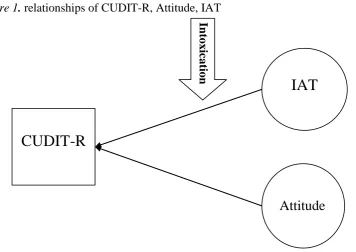
According to the first research question the following hypotheses can be made:
1. There is a higher bias of the IAT noticeable made in a sober state than made after the use
of cannabis.
According to the second research question the following hypotheses can be made:
2. A positive correlation can be noticed between cannabis use and the score of the IAT0.
3. A positive correlation between attitude and the score of an IAT0 can be noticed.
4. The score of the IAT in a sober state is a stronger predictor for cannabis use than Attitude.
CUDIT-R
IAT
Attitude
In
toxic
at
ion
8
5. Heavy-smoking participants score significant higher on cannabis use, the IAT and Attitude.
9
2.
Research Methods
2.1 Participants
In this study 26 participants were involved. The participants were assembled via ´convenience sampling’ and ‘snowball sampling’. To create a trusted and safe setting in which the participants feel free to perform cannabis use, which may be seen by others as controversial, the researcher is known by the participants and the other way around. Due to the fact that the participants need to consume a risk-taking drug, in this case through smoking cannabis, the participants need to be at least 18 years old, so that he or she can be fully aware of their risky behavior. Furthermore they also need to be used to regular cannabis consumption and the possible side effects of cannabis so that they know which risks they are taking. That means that all the participants of this research are using at least once a month cannabis through smoking and this for at least a six month period of time. Further points, that characterize the participants, are that they have no problem in staying absent of alcohol, cannabis and other drugs, apart from nicotine and caffeine, for at least 12 hours before the research, and that they are willing to smoke cannabis in form of a ‘joint’ in front of the researcher. Most of the participants are German or have at least extreme good German-language skills. The participants are informed in the way of testing and the different conditions it holds, by the researcher itself. They can ask questions about the procedure of the research at all times.
2.2 Procedure
The whole procedure is ethical approved by the ethical commission of the University of Twente. Before starting with the experiment the participants get to know about the possible risks and the purpose of the study by a brochure. It is made sure that everyone reads the brochure and that they also behave in a correct way after consuming the drug. That includes not doing any risky behavior like driving, operating etc.
10
2.3 Materials & Equipment
The research is experimental. The whole experiment includes a questionnaire, an experimental test, and the treatment with cannabis. According to the fact that most of the participant’s mother-language is German, the whole questionnaire and the IATs are in German.
2.3.1 Questionnaire
2.3.1.1CUDIT-R
During the questionnaire the participants have to answer questions according their habits in relation to cannabis consume, this happens with help of the CUDIT-R (Adamson et al., 2010). One example of a question in the CUDIT-R is; ‘how often do you use cannabis?’ Those questions are closed ones where you can decide between 5 different answers that are stated. For example in this question the possible answers are; Never/ Monthly or less/2-4 times a month/ 2-3 times a week/ 4 or more times a week. With the results a clinical picture of the use of cannabis during the last 6 months can be made. The CUDIT-R is an accepted instrument for giving a sufficient clinical picture about the cannabis use of people. Due to the fact that different categories of cannabis use are asked it is not possible to gain a high reliability on the CUDIT-R. However, according to Adamson et al (2010) the CUDIT-R has a high sensibility and specificity.
2.3.1.2Nicotine Use
The second part of the questionnaires asks for the nicotine use of the participant. In this research it is important to know whether the participants also have an addiction according to nicotine, due to the fact that you smoke tobacco too, when consuming cannabis through smoking. All the questions are closed ones, whereas the first question, ‘do you smoke cigarettes?’ can only be answered with yes or no and the second question has five different
possible answers. The nicotine use questions are based on CUDIT-R and are developed especially for this research.
2.3.1.3Attitude
11
Direct Attitude
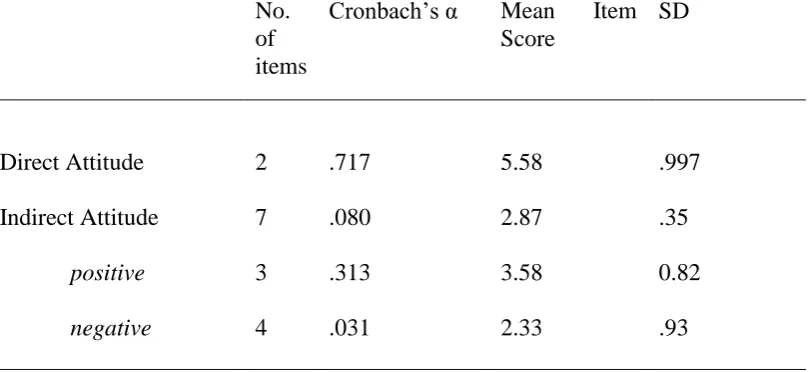
The first part asks for the direct attitude. It makes two ‘cannabis is…’ statement where you can choose on a 7-point-scale between two bipolar adjectives. Those are good/bad and comfortable/uncomfortable. With α=.717 the internal consistency of the 2 Items constructs is high.
Indirect Attitude
The second part of the construct holds seven statements with a 5-point-likert scale where the participants have to choose between ‘total agreement’ to ‘totally no agreement’. One example of a statement is; ‘When I smoke cannabis I feel very relaxed’. The internal consistency of the construct which questions are adopted from another study by Solinski (2009) is really low (α=.080), which points at a low reliability (Table 1). That’s why the focus is more on the single items of the indirect attitude construct.
2.3.2 IAT
After the questionnaire, the participant does an IAT. For measuring this, the participant needs to do different task on the computer, categorizing words in target and attribute words.
The first two target categories are ‘cannabis’, and ‘workplace’. In this task the participant sees a word that is either cannabis- or workplace-related. Workplace words are; ‘Büro, Löschblatt, Kaffee, Meeting, Hefter, Stift, Locher, notieren’; while the cannabis words are the following; ‘Blunt, Longpaper, Coffee Shop, Weed, Hanf, Joint, High, kiffen’. Those words were created by the researcher herself and aren’t based on recent tests. The focus on the cannabis words lays on finding words that are only associated with cannabis use and not with other substances like tobacco, as for example ‘joint’ would be. The characteristics of the workplace words are that they are neutral and not associating with other substances that may cause testing errors.
The attribute categories are ‘positive’ and ‘negative’. Those categories appear during the
second task. The positive words are; ‘Gut, Freude, Liebe, Frieden, Wunderbar, Vergnügen, Lachen, Glücklich‘, while the negative words are; ‘Schlecht, Trauer, Furchtbar, Schrecklich, Ekelhaft, Böse, Gehässig‘. All of this words are found in the FreeIAT-program of Meade (2009).
12
cannabis/workplace word. The participant has to push the words with the right and left arrow keys to cannabis/positive or to workplace/negative.
The fourth task also mixes the already mentioned categories, but this time it is a reversed categorization. Now the participant has to push the words with the arrow keys to the right or the left. The words are in the category cannabis/negative or in the category
workplace/positive.
The IAT-score that is the most relevant for this study is the Greenwald, Nosek, and Banaji (2003) overall IAT score, called the GNB-score. A high GNB-score denotes a Pro-Cannabis bias whereas a low score means the opposite. The GNB-score ‘returns a score of "TooFast" for participants who have less than 300ms reaction time for more than 10% of their trials; computes the mean reaction time for items in Block 3 in which the initial response was correct,; computes the mean reaction time for items in Block 5 in which the initial response was correct; computes the (…) pooled standard deviation; computes the mean reaction time for items in Block 5 in which the initial response was correct; (and) replaces the reaction time for items initially answered as incorrect with the Block Mean of Correct items’ (Meade, 2009).
The scores of the IAT will be visible for neither the researcher nor the participant during the procedure. Only afterwards participants can have access to their individual scores on request.
2.3.3 Treatment
After the questionnaire and between the first and second measurement of the IAT the participant needs to smoke one dose of cannabis. This dose depends on the dose the participant regular smokes, so it varies from person to person. The participant smokes in a well-known area to create a trustful environment. Even though cannabis works right after inhaling, there is a 10 minute long break before the second IAT is made. With this it is made sure that THC of the Cannabis really affects the participant. There are two test-measurements of the IAT. The first one is in a sober state (IAT0) and the second one is in an intoxicated state (IAT1).
2.4 Statistical Analysis
13
testes are used. However the use of parametrical test is sometimes also necessary, just for the reason that no non-parametrical tests are available or to compare the results of both tests.
The most important variables in the correlation and the regression analysis are attitude, as present in direct attitude and indirect attitude, cannabis use, as present in the CUDIT-R score and ’implicit processes’ present in IAT0 and IAT1. The used IAT score is the GNB-score, the
direct and indirect attitude score is the mean score of all the questions in the categories, and the used CUDIT-R-score is the sum of all the Item-scores.
Using the statistical program SPSS it is tested whether there is a correlation between ‘cannabis use’ and the three mentioned variables. It is looked after Pearson’s and Spearman’s
correlation coefficient. The correlation coefficient is no proof for a causal relation, but it counts as a reliable instrument to predict the causality between two variables. To get to know whether there are any outliners affecting the results there is also looked after the Spearman correlations of the variables.
The T-test is used to see whether there is a significant difference between the scores of the first IAT and the IAT after the intoxication.
With the Mann-Whitney U test, it is looked after the different scores between two categories. In this research the attention lays on the differences in gender and smoking behavior.
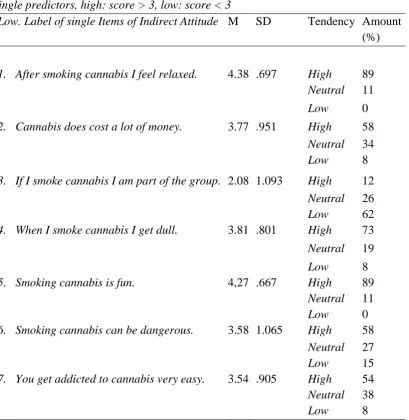
According to the fact that no reliable construct can be formed of the indirect attitude (table 1) the 7 items of its construct are used for the following analyses.
Table 1. Cronbach’s Alpha (Cronbach’s α), Mean Item score and standard deviation (SD) of
the constructs Direct Attitude and Indirect Attitude
No. of items
Cronbach’s α Mean Item Score
SD
Direct Attitude 2 .717 5.58 .997
Indirect Attitude 7 .080 2.87 .35
positive 3 .313 3.58 0.82
16
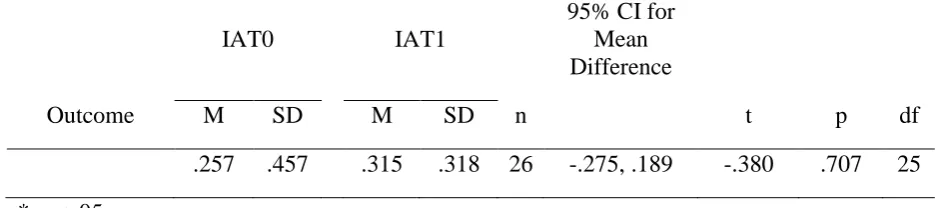
3.1 Change in implicit attitude due to cannabis intoxication
Even though there is a difference noticeable between the mean score of the IAT0 and IAT1, the results of the paired-samples t-test show that the mean score of the IAT before the treatment (M= .257, SD= .457) does not differ at a .05 level of significance to the mean score of the IAT after the treatment (M= .315, SD .318) (Table 4). This means there is no proof for H1: There is a higher score of the IAT noticeable made in a sober state than made after the use of cannabis.
Table 4. Results of paired sample t-test and Descriptive Statistics for IAT before and after intoxication
IAT0 IAT1
95% CI for Mean Difference
Outcome M SD M SD n t p df
.257 .457 .315 .318 26 -.275, .189 -.380 .707 25 * p < .05.
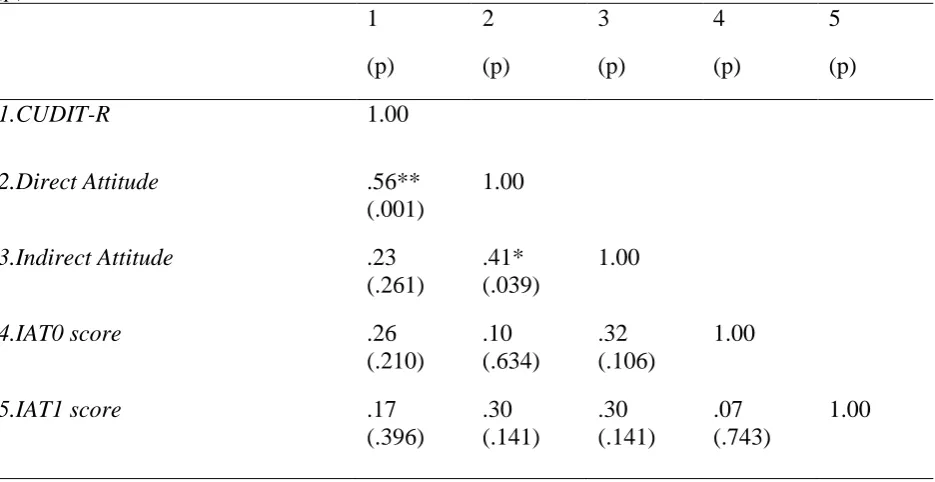
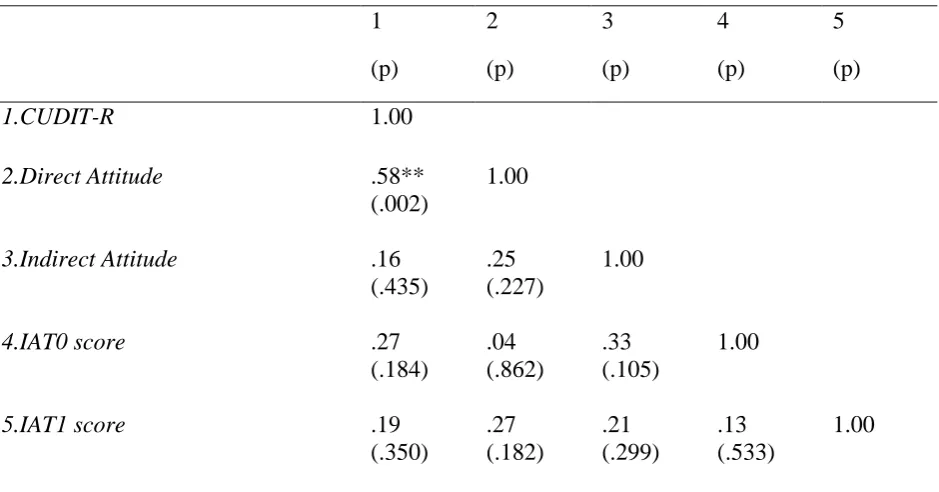
3.2 Finding associations between the different test categories
21
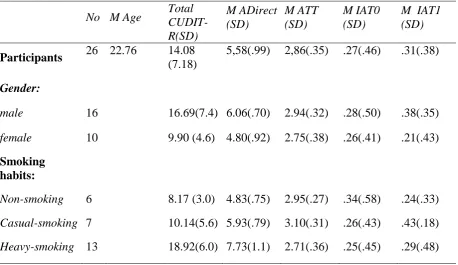
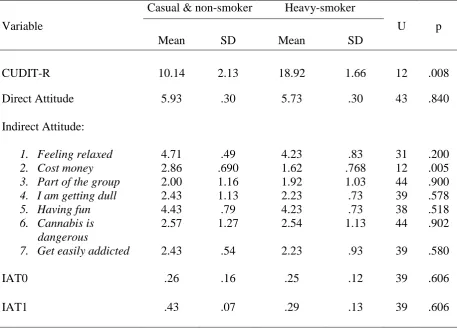
be proven. There is significant proof that they score higher on cannabis use, but not on the IAT or Attitude.
Table 9. Smoking behavior as dependent variable in the Mann-Whitney U-test (U)
Casual & non-smoker Heavy-smoker
Variable U p
Mean SD Mean SD
CUDIT-R 10.14 2.13 18.92 1.66 12 .008
Direct Attitude 5.93 .30 5.73 .30 43 .840
Indirect Attitude:
1. Feeling relaxed 4.71 .49 4.23 .83 31 .200
2. Cost money 2.86 .690 1.62 .768 12 .005
3. Part of the group 2.00 1.16 1.92 1.03 44 .900
4. I am getting dull 2.43 1.13 2.23 .73 39 .578
5. Having fun 4.43 .79 4.23 .73 38 .518
6. Cannabis is dangerous
2.57 1.27 2.54 1.13 44 .902
7. Get easily addicted 2.43 .54 2.23 .93 39 .580
IAT0 .26 .16 .25 .12 39 .606
IAT1 .43 .07 .29 .13 39 .606
22
Table 10. Gender variable in the Mann-Whitney U-test (U)
male female
Variable U p
Mean SD Mean SD
CUDIT-R 16.69 - 9.90 - 39 .030
Direct Attitude 6.06 .70 4.80 .92 20 .001
Indirect Attitude
1. Feeling relaxed 4.50 .63 4.20 .79 63 .322
2. Cost money 2.13 .89 2.40 1.08 66 .439
3. Part of the group 1.94 .93 2.30 1.34 68 .504
4. I am getting dull 2.38 .89 1.90 .57 56 .157
5. Having fun 4.50 .63 3.90 .57 40.5 .021
6. Cannabis is dangerous
2.26 1.15 2.20 .92 65.5 .425
7. Get easily addicted 2.56 1.03 2.30 .68 70 .571
IAT0 .28 .50 .26 .41 80 1.000
23
Discussion
In the research questions it was asked if the IAT could count as a predictor for cannabis use and whether saturation decreases the predictive strength of implicit processes. Regarding to former research, cannabis use can be explained by dual-process theories, that include explicit and implicit processes. In this research it was looked whether there is any support for this theory and if the explicit and the implicit processes play a major role in predicting cannabis use (Richardson, & Hardesty, 2012).
This research is trying to answer two questions. The first one is about the effect of intoxications on implicit processes regarding cannabis consumption. With regard to the automatic, implicit processes, as measured with the IAT, there is not enough evidence to state that saturation of cannabis can decrease the predictive strength of the IAT. However a higher correlation with cannabis use before smoking cannabis than after the intoxication was noticeable regarding the fact that there is no significant proof for those correlations.
The second research question asks whether attitude and the performance of the IAT can count as a predictor for cannabis use, as measured with the CUDIT-R. It was looked after the different smoking behaviors and the gender of the participants and if this causes any differences in the score of the CUDIT-R. During the study it was found out that attitude in general, could count as an explanatory value. Furthermore both the IAT0 (before intoxication) as well as the IAT1 do not seem to have significant explanatory value regarding cannabis use. When splitting the scores into different categories, as male/female and non-smoking/heavy-smoking a tendency to higher cannabis use dependent on the gender and non-smoking/heavy-smoking behavior can be found.
3.4 Implicit memory bias as predictor of cannabis use
25
after the intoxication cannot support the third hypothesis, a positive correlation between attitude and the score of an IAT0 can be noticed. There seems to be a relative high positive correlation between IAT1 and Attitude, but there is not enough proof to manifest this thesis.
Another important factor that could play a role in the results of the IAT is the amount of errors during the test approval. It was noticed that a lot of participants were confused about the word ‘furchtbar’(horrible) in mistaking it for the term ‘fruchtbar’(fertile) which is more a positive word than a negative. Also the neutral term ‘Kaffee’ stood out because a lot of participant mistook it for a cannabis-related word instead of a work-place related. The participants declared it with the fact that they often drink coffee when they smoke or have a higher craving for caffeine after smoking cannabis. In further study, the trials with these data should be left out. However, while only making use of the GNB-score, which is already corrected of such errors (Meade, 2009) those factor should not make a meaningful difference regarding the test result.
In addition to the already mentioned arguments another important one is the number of participants. Even big differences cannot count as significant because there is only a low pool of participants (n= 26). There is a high chance that a higher pool could lead to more significant results.
3.5 Social-cognitive constructs as predictor of cannabis use
As already stated in the introduction by Armitage et al. (1999), the attitude is a good explanatory value for the participants cannabis use. This could also be proven with the results of the research where attitude seems to be a significant predictor for the results of the CUDIT-R and also has a high correlation with it (figure 1). With those results there is enough statistical proof for the alternative hypothesis of the fourth hypothesis, the score of the IAT in a sober state is a stronger predictor for cannabis use than Attitude.
26
think it would be more fun. The sensation seeking and the impulsivity which play a major part in substance use (Petraitis et al., 1995) could be higher in younger people than older ones. In research with participants of different life spans the results could show that older people or people who are already working answer different to those questions.
Another interesting fact is that the reliability of the indirect attitude is low even if the items are separated in positive and negative attitude. This could have different declarations. At first it could be that the single items of the construct are no good choices that do not show the attitude of the participant towards cannabis. According to Fishbein and Ajzen (2010) a questionnaire needs to pass different steps before developing the questions. At first it is important to clearly define the single terms of the questionnaire and to make interviews with the target persons. This did not happen in developing the questionnaire for the attitude construct.
However, in looking more closely at the single items it is noticeable that most of the participants do have different opinions to each of the statements, which means that there is no single construct for the attitude. Not all of them think that cannabis do cost a lot of money but mostly all of them think that smoking cannabis can be dangerous, and the same participants think again that smoking cannabis is a lot of fun. This leads to the result that the researcher has to be aware of the incongruities of thinking between the different participants. The fact that there is still a low internal consistency leads to the consideration, that not all of the participants do have this ambiguous attitude towards cannabis. If it is only asked for the pleasure of smoking cannabis and whether the applicant likes it or not as stated in the direct attitude construct you get a high reliability. This means that in further research it is important to define the attitude towards cannabis in multiple different terms. Those terms can be: economical factors (money, time), effect factors (feeling relaxed, dull) and possible negative consequences (addiction, dangerous effects).
3.6 Differences in smoking habits
heavy-27
smoking participants have higher scores on the CUDIT-R than casual- or non-smoking participants. As already mentioned, cannabis-related behavior as well as other substance use can be declared by a low impulse control (Petraitis et al., 1995). If the participants are smoking, there is a high chance that they have a low impulse control and this could again declare the cannabis-smoking behavior.
Another interesting fact found out is that there is a difference in the statement whether smoking cannabis does cost a lot of money. It seems that casual- or on-smoking participants agree more often to this statement than the other group. A declaration for this finding could be that the heavy-smoking participants already pay a lot for the smoking materials and only have to buy the cannabis. Casual- or non-smoking participants do have to pay extra for the tobacco they have to use in the joint, and this may lead to the different kind of thinking. With regard to this outcomes there is nearly enough proof for the fifth hypothesis, Heavy-smoking participants score significant higher on cannabis use, the IAT and Attitude. The fact that the memory bias by heavy smoking participants is higher could not be proven.
A declaration for the findings could also be that smoking cannabis could be some sort of ‘life style’. There is a limitation of the pool of participants due to the fact that all of them are between 20 and 25 years old, and nearly all of them are students. There could be a high chance that the person sees his own behavior as something he identifies himself and others with and that he is more influences by others.
3.7 Differences in gender
In comparing the results between male and female participants there is much support for the last thesis: women score significant higher on cannabis use, the IAT and Attitude. Not only that male participants seem to make higher use of cannabis than female it is also noticeable that they have a higher positive attitude towards cannabis including having fun while smoking cannabis. Those results are significant even though there is only a small pool of participants. Those findings support the research of Johnson et al. who declares that boys have a higher risk for substance use than girls (Johnston et al., 1992). Petraitis et al. (1995) try to explain it in a higher impulsivity and risk-taking behavior of boys in contrast to girls, which could also slightly be seen in the results, where girls score slightly less on the IAT than boys.
28
could be that women have consumed a smaller amount of cannabis which could cause less bias on the performance of the IAT. In further research it should be noted how much the participant smokes and also how high the influence of the cannabis could be on the explicit processes.
3.8 Conclusion
To come back to the research questions, ‘Does the difference between the IATs decreases when in an intoxicated state?’, and ‘Is an implicit memory bias towards cannabis (measured with IAT) a stronger determinant of cannabis use than the attitude toward cannabis?’ no real conclusive outcome can be noticed. It was found that attitude plays an important part in the cannabis use but there was just not enough proof for this fact. In addition there is not enough proof for stating that the IAT before and after the intoxication is a sufficient predictor for cannabis use. A possible solution for those findings could be another task testing the implicit memory bias. As already mentioned above there is a high possibility that the reaction of the participants slowed down which caused the non-significant results.
Apart from the implicit memory bias and the attitude also the smoking behavior and the gender of the participants can be an important fact regarding cannabis use. Although they may not directly count as a predictor they could count as a moderator. Female participants could be more concerned with the negative consequences and that could lead to less use of cannabis. Furthermore it could be that smoking participants do have other coping strategies. It could be possible that they think smoking cannabis would not harm them more than smoking cigarettes. However, regarding those conclusions further research is necessary.
Even though some relevant results were found, the research has a lot of limitations. It was a small pool of applicants which were not chosen with purpose sampling but with snowball sampling. This means that the results are not representative for normal society. All of the participants had a similar age and were students. Furthermore the study was made cross-sectual, which means that the results may be dependent on the day’s form of the participants. In further research a longitudinal research may show more significant results.
29
30
4.
References
Adamson SJ, Kay-Lambkin FJ, Baker AL, Lewin TJ, Thornton L, Kelly BJ, and Sellman JD. (2010). An Improved Brief Measure of Cannabis Misuse: The Cannabis Use Disorders Identification Test – Revised (CUDIT-R). Drug and Alcohol Dependence 110:137-143.
Andréasson, S., Engström, A., Allebecka, P., Rydberg, U., (1987), Cannabis and Schizophrenia: A Longitudinal Study of Swedish Conscripts, The Lancet, Volume 330, Pages 1483–1486, DOI: 10.1016/S0140-6736(87)92620-1
Armitage, C.J., Conner, M., Loach, J., & Willetts, D. (1999), Different perceptions of control: applying an extended theory of planned behaviour to legal and illegal drug use. Basic& applied social psychology, 21, 301-316
Brook, J.S., Balka, E.B., Whiteman, M., 1999, The risks for late adolescence of early adolescent marijuana use American Journal of Public Health, 89 (10), pp. 1549-1554.
Brook, J.S., Stimmel, M.A., Zhang, C., Brook, D.W., 2008, the association between earlier marijuana use and subsequent academic achievement and health problems: A longitudinal study, American Journal on Addictions, 17 (2), pp. 155-160. DOI: 10.1080/10550490701860930
CBS, Cannabisgebruik in de afgelopen 30 dagen bij 15-64-jarigen naar geslacht en leeftijd, as seen in February 2014 on CBS: http://www.cbs.nl/nl-NL/menu/themas/gezondheid-welzijn/cijfers/incidenteel/maatwerk/2484-tab.htm
Cousijn, J., Snoek, R.W.M., Wiers, R.W., 2013. Cannabis intoxication inhibits avoidance action tendencies: a field study in Amsterdam coffee shops, Springer-Verlag Berlin Heidelberg, Psychopharmacology (2013) 229: 167-17, DOI: 10.1007/s00213-013-3097-6
Fishbein, M., & Ajzen, I. (2010).Predicting and changing behavior: The reasoned action approach. New York: Psychology Press
31
Johnston, L. D., O'Malley, P. M, & Bachman, J. G. (1992). Smoking, drinking, and illicit drug use among American secondary school students, college students, and young adults, 1975-1991. Rockville, MD: National Institute on Drug Abuse.
Kalat, J.W., (2009), Biological Psychology, 10th edition. Wadsworth: Cengage Learning, International Student Edition, ISBN-13: 978-0-495-60311-5
Lynskey, M., Hall, W., (2000), The effects of adolescent cannabis use on educational attainment: A review Addiction, 95 (11), pp. 1621-1630. DOI: 10.1046/j.1360-0443.2000.951116213.x
Metz-Göckel, H., (2010), Gestalttheorie: Dual-Process-Theorien, Wien: Krammerverlag, ISBN 3 901 811 36 2
Meade, A. W. (2009). FreeIAT: An open-source program to administer the implicit association test. Applied Psychological Measurement, 33, 643.
Pesta, D.H., Angadi, S.S., Burtscher, M., Roberts, C.K., (2013) The effects of caffeine, nicotine, ethanol, and tetrahydrocannabinol on exercise performance, as seen in June 2014 on Nutrition & Metabolism: http://www.nutritionandmetabolism.com/content/10/1/71, DOI: 10.1186/1743-7075-10-71
Petraitis, J., Flay, B.R., Miller, T.Q., (1995), Reviewing Theories of Adolescent Substance Use: Organizing Pieces in the Puzzle; Psychological Bulletin 1995, Vol. 117, No. 1, 67-86, the American Psychological Association, Inc
Richardson, G.B., Hardesty, P., (2012), Document Immediate survival focus: Synthesizing life history theory and dual process models to explain substance use, Evolutionary Psychology: www.epjournal.net – 2012. 10(4): 731-749
Rooke, S.E., Hine, D.W., Thorsteinsson, E.B., (2008), Implicit cognition and substance use:
Elsevier Ltd; Addictive Behaviors 33 (2008) 1314–1328, A meta-analysis, University of New England, NSW, Australia, doi:10.1016/j.addbeh.2008.06.009
32
Schoenmaker, T.M., Wiers, R.W., (2010), Craving and attentional bias respond differently to alcohol priming: a field study in the pup. Eur Addict Res 16: 9-16
33
Appendix
Questionnaire
Fragebogen
Liebe/r Teilnehmer/in,
Vielen Dank für Ihre Teilnahme an meiner Untersuchung.
Im Anhang der Einleitung finden Sie einen Fragebogen mit Verschiedenen Fragen. Bei der Beantwortung der Fragen bitte ich Sie, diese so gut und ehrlich wie möglich auszufüllen, es gibt keine richtigen oder falschen Antworten. Bei eventuellen Fragen stehe ich Ihnen gerne zur Verfügung.
Bitte notieren sie hier Ihre Teilnehmernummer: ____________
Teil 1.
Geben Sie bitte im folgenden Abschnitt ihre demografischen Gegebenheiten an.
Alter:
Geschlecht: o männlich o weiblich
Geben Sie hier Ihre Tätigkeit an:
o Student o Auszubildener o Berufstätig
o Weiteres, nämlich:
Teil 2.
Dieser Teil des Fragebogens beschäftigt sich mit der Nachfrage Ihres allgemeinen Cannabisgebrauchs. Wenn Sie die erste Frage mit „Ja“ beantworten können, so füllen Sie bitte auch die restlichen Fragen aus.
1. Haben Sie innerhalb der letzten 6 Monate Gebrauch von Cannabis gemacht?
o Ja (weiter mit Frage 2)
35
o Nie o Weniger als
monatlich
o Monatlich o Wöchentlich o Täglich oder beinahe täglich
9. Haben Sie jemals daran gedacht Ihren Cannabiskonsum schrittweise zu senken oder zu stoppen?
o Niemals o Schon, aber nicht in den letzten 6 Monaten
o Ja, innerhalb der letzten 6 Monaten
Teil 3.
Der letzte Part des Fragebogens behandelt allgemeine Information bezüglich Ihrer Person und Einstellung.
10.Konsumieren Sie regelmäßig Nikotinhaltigen Tabak, abgesehen von der Menge die im Joint vorhanden ist?
o Ja o Nein
11.Wie oft in den letzten 6 Monaten haben Sie Nikotin konsumiert?
o Nie o Monatlich oder weniger
o 2-4 Mal im Monat
o 2-3 Mal die Woche
o 4 Mal oder öfter die Woche
Bitte kreuzen in den folgenden 2 Fragen den Punkt an, der mit Ihrer Meinung am meisten Übereinstimmt. Der mittlere Punkt bedeutet, dass Sie neutraler Meinung sind.
Cannabisgebrauch ist:
12. Gut 0 0 0 0 0 0 0 Schlecht
37
Informationsbroschüre hinsichtlich der Bacheloruntersuchung:
Kontakte
Verantwortliche:
(bei Fragen bezüglich der Untersuchung )
Bei Beschwerden richten Sie sich bitte an die folgende Kontaktperson:
Prozedur der Untersuchung:
Die Untersuchung findet unter folgenden Umständen statt. (Anschließende männliche Bezeichnungen beinhalten zu gleicher Maßen auch weibliche Teilnehmerinnen.)
1. Der Teilnehmer steht mindestens 12 Stunden vor der Untersuchung nicht unter dem Einfluss von Drogen, mit Ausnahme von Kaffee und/oder Nikotin.
2. Der Teilnehmer füllt so ehrlich wir nur möglich den gegebenen Fragebogen aus. 3. Anschließend absolviert der Teilnehmer einen IAT (implicit association task). 4. Der Teilnehmer raucht einen Joint in der für den Teilnehmer üblichen Dosis. Die
benötigten Materialien hierzu werden von dem Teilnehmer selbst gestellt. 5. Der Teilnehmer absolviert erneut einen IAT
Die Gesamte Untersuchung wird im Durchschnitt ca. 2 Stunden andauern.
Die zu Untersuchende Person wird in einem ihr vertrauten Umfeld untersucht. Hannah Maria Holländer Reutumbrink 22
7544 XM Enschede +31610667859
e.nl
Jeanine Lodeweges-de Vries Universiteit Twente
38
Falls die Untersuchung nicht bei dem Teilnehmer Zuhause erfolgt wird dem Teilnehmer die Möglichkeit zuteil, von der Untersuchenden nach Hause gefahren zu werden, oder die entsprechenden Gebühren für öffentliche Verkehrsmittel erstattet zu bekommen.
Die Teilnehmer verpflichten sich bei Teilnahme der Untersuchung dazu, bis zu 20 Stunden
nach eben genannter Untersuchung keinerlei Aktivitäten auszuüben, die unter
Cannabiseinfluss verboten sind, bzw. zu einem hohem Risiko führen (Auto fahren, Operieren,
Fahrrad fahren, etc.).
Risiken:
Bei Teilnahme der Untersuchung setzt sich die zu untersuchenden Person unter Umständen
den folgenden Risiken und Nebenwirkungen aus:
Beeinträchtigung der Fahrtauglichkeit Benommenheit
Entwicklung einer psychischen Abhängigkeit Halluzination
Erhöhtes Risiko, eine chronische Bronchitis auszubilden Desorientierung
Eventuelle Erhöhung des Risikos der Ausbildung einer Schizophrenie
Übelkeit
Erhöhtes Risiko einer Krebserkrankung Schwindel
Sollten oben genannte Nebenwirkungen oder ähnliches während der Untersuchung auftreten, so verpflichtet sich die untersuchende Verantwortliche dazu, sofern notwendig, ärztliche Hilfe zu besorgen und der teilnehmenden Person bis zum Eintreten eben genannter beizustehen.
Voraussetzungen, Rechte und Anonymität der Teilnehmer:
Der Teilnehmer ist mindestens 18 Jahre alt und macht seid mindestens 6 Monaten im Durchschnitt einmal im Monat regelmäßigen Gebrauch von Cannabis.
Teilnehmende Personen sind jederzeit dazu berechtigt die Untersuchung abzubrechen. Des Weiteren haben Sie das Recht dazu, bis zu 24 Stunden nach der Untersuchung ihre Teilnahme zurück zu ziehen, in folgedessen ihre Daten vollständig gelöscht werden.
Die Kandidaten nehmen freiwillig an der Untersuchung teil und sind zu keiner Zeit dazu verpflichtet etwas gegen ihren Willen zu tun.
39
Jegliche persönliche Daten der Teilnehmer, sowie die Teilnehmer selbst, werden vertraut
behandelt, bleiben anonym und werden nicht an Dritte weitergegeben.
Belohnungen:
Bei eventuellem Interesse an „Proefpersonenpunten“ erhalten die Teilnehmer bei Anfrage 2 Punkte. Diese werden über Sona Systems geregelt.
Ziel der Untersuchung:
Ziel der Untersuchung ist es heraus zu finden ob unbewusste Denkfehler Cannabis Gebrauch erklären können. In dieser Studie wird bei regelmäßigen Cannabiskonsumenten auf die unbewusste Bevorzugung von Cannabisrelatierten Stoffen geachtet. Diese werden mithilfe des IATs gemessen. Durch die Analyse der Daten soll anschließend festgestellt werden, welche Faktoren Indikatoren für regelmäßigen Cannabiskonsum sein können.
Wenn es noch weitere Fragen vor, während oder nach der Untersuchung geben sollte, so können die Teilnehmer sich via Email an die Verantwortliche Person, wie oben vermerkt wenden.
Schriftliche Einwilligung des Teilnehmers zur Teilnahme der
Bacheloruntersuchung:
Implicit & explicit Determinants of cannabis use
Teilnahmeerklärung:
40
zu 20 Stunden nach der Untersuchung keinerlei Aktivitäten ausübe( wie z.B. Auto fahren), die unter Einfluss zu hohem Risiko führen können.
Mit der hiesigen Unterschrift Stimme ich den oben erwähnten Aussagen und einer Teilnahme an der Untersuchung zu:
Name (Teilnehmer) : ___________________________
Unterschrift (Teilnehmer) :___________________________
Name (Untersucher) : Hannah Holländer