A Framework for Identity Resolution and Merging for Multi-source
Information Extraction
Milena Yankova
∗,†, Horacio Saggion
†, Hamish Cunningham
††Department of Computer Science
University of Sheffield
211 Portobello Street - Sheffield, England, UK
∗Ontotext Lab, Sirma Group
135 Tzarigradsko Chaussee - Sofia, Bulgaria
{milena,saggion,hamish}@dcs.shef.ac.uk
Abstract
In the context of ontology-based information extraction, identity resolution is the process of deciding whether an instance extracted from text refers to a known entity in the target domain (e.g. the ontology). We present an ontology-based framework for identity resolution which can be customised to different application domains and extraction tasks. Rules for identify resolution, which compute similarities between target and source entities based on class information and instance properties and values, can be defined for each class in the ontology. We present a case study of the application of the framework to the problem of multi-source job vacancy extraction.
1.
Introduction
Ontology-based extraction (OBIE) is the process of iden-tifying in text or other sources relevant concepts, proper-ties, and relations expressed in an ontology. In the context of ontology-based information extraction, one fundamental problems to be addressed is that of identification and merg-ing ontological instances extracted from multiple sources (the problem is known as ontology population in the Se-mantic Web community).
A consolidation procedure aims at identifying newly ex-tracted (e.g. from text) facts and linking them to their previ-ous mentions. Unlike classical information extraction (see (Grishman, 1997)) where the extracted facts are only clas-sified as belonging to pre-defined types, identity resolution aims at establishing a reference link between an object re-siding in the system’s knowledge base and its mention in context (e.g. text).
This paper presents a framework for Identity Resolution: the process of deciding if a particular fact extracted from text can be linked to identical/similar facts in the ontol-ogy. Recognising identical or similar information across different sources is of paramount importance and in par-ticular can lead to improved extraction performance from single sources. Aggregation of extracted information al-lows for: (i) improving the completeness of the extraction; (ii) avoiding the extraction of incorrect information; (iii) adding a degree of trust to the extracted facts. Here we will introduce our Identify Resolution Framework (IdRF) which provides infrastructure for resolving identity of dif-ferent classes of entities. The framework uses an ontology as an internal knowledge representation that provides de-tailed entity description formalism complemented with se-mantics. The framework is adaptable to different applica-tion domains and tasks.
The paper is organised as follows: Section 2 gives an overview of the framework. Its main components are briefly described whith special emphasis on the first or-der probabilistic engine used for entity comparison.
Sec-tion 3 provides background informaSec-tion for our informa-tion extracinforma-tion applicainforma-tion use case and details implemen-tation and evaluation results. The related work is discussed in Section 4 and conclusions and further work are given in Section 5.
2.
Identity Resolution Framework
The framework is intended to provide a general solution to the identity problem that can be used within different ap-plications regardless of their particular domain or type of entity which need to be resolved. The input is an entity to-gether with its associated properties and values, the output is an integrated representation of the entity which will have new properties and values in the ontology.
A customisable identity criteria is in place to decide on the similarity between two instances. This criteria uses onto-logical operations and similarity computation between ex-tracted and stored values which are weighted. The weight-ing criteria is specified accordweight-ing to the type of entity and the application domain.
2.1. Knowledge representation
The IdRF uses an ontology for internal and resulting knowl-edge representational formalism. The ontology not only contains the representation of the domain, but also known entities and properties. After identity resolution, the ontol-ogy Knowledge Base (KB) will contain entities with their full semantic description aggregated during the process. As a side effect of this continuous updating of the KB, the identity criteria is refined, thus improving the identity res-olution by both refining the evidence calculation and intro-ducing new entities serving as identity goals. Details about the two effects are given below:
ex-Figure 1: IdRF Architecture
ample if the person age is added to his/her description, the age restriction will be added a new identity crite-rion.
• New entities added to the knowledge base represent potentially new goals for resolution. They are created by insertion of entirely new objects to the KB. When entities are processed in a later stage, they have to be compared not only two the previously available enti-ties but also to the newly added instances.
Current implementation of the IdRF is based on the PRO-TON (Terziev et al., 2005) ontology, which can be easily extended for any particular domain or specific task. The knowledge base that actually contains the ontology and the instances associated with it is stored in the semantic repos-itory provided by KIM (Popov et al., 2004) that is based on OWLIM (Kiryakov et al., 2005) and Sesame.
2.2. IdRF Main Components
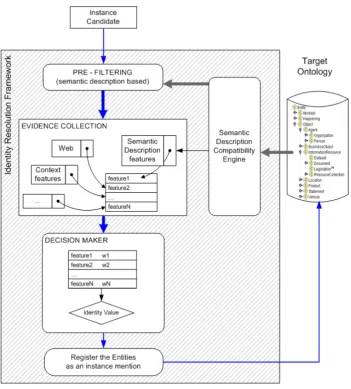
The IdRF framework receives an instance (e.g. type of in-stance and properties and values) and updates the ontology either asserting a new instance with its properties or updat-ing an already existupdat-ing instance. The IdRF architecture (see Figure 1) consists of four main stages.
• Pre-filtering- It filters out the irrelevant part of the ontology and forms a smaller set of instances simi-lar to the source entity. It is intended to restrict the whole amount of ontology instances to a reasonable small number, to which the source entity will be com-pared. It can be regarded as pre-selection of ontology objects that are eligible to identification. The selected instances are potential target instances that might be identical to the source object; they already appear in the knowledge base and are somehow similar to the source object. Pre-filtering is realised by the Seman-tic Description Compatibility Engine (SDCE) which is described in details later on.
• Evidence Collection- It collects as much as possible evidence about the similarity between the source en-tity and each of the targets in the ontology. A set of similarity criteria is computed by SDCE by compar-ing correspondcompar-ing attributes in the entity descriptions. Different comparison criteria are possible: some are based on string representation e.g. text edit distance, inverted frequency based matching; others can be web appearance, context similarity, etc.
de-Figure 3: Single Vacancy extraction from a web page
recruitment agencies – where it is possible to rely on many sources to improve the extraction of the facts we search for. The proposed approach is to extract all available facts (in the job vacancy domain) from any single document, and then to combine/merge them on several levels to retrieve the most accurate facts, while at the same time filtering out wrong and redundant information.
3.1. Vacancy Extraction
The algorithm takes web-pages one by one and processes them separately, extracting listed vacancies. At this prelim-inary stage each page is pre-processed and certain types of named entities are recognised and annotated with respect to the ontology. After that, the set of extracted vacancies is further analysed to detect duplicates and finally inserted into the knowledge base.
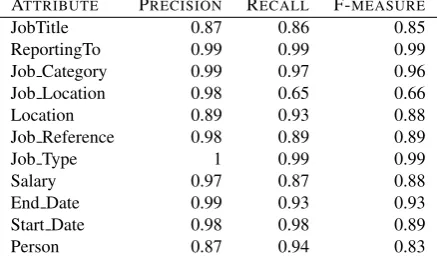
Vacancy facts are defined by templates, which slots should be filled by concept instances in our KB. The extrac-tion task consist on the extracextrac-tion of the following infor-mation from text: JobTitle; ReportingTo; Job Category; Job Location; Location; Job Reference; Job Type; Salary; End Date; Start Date and Person. The proposed values for these attributes are named entities recognised by our sys-tem. Hence the extracted facts are actually a compilation of the attribute values in accordance with the domain con-straints (see Figure 3). In Table 1, we present an evaluation of the extraction performance by slot. Overall, we have ob-tained F-score 87,4% (Precision 83,1% and Recall 92,3%) for single vacancy extraction.
3.2. Vacancy Merging
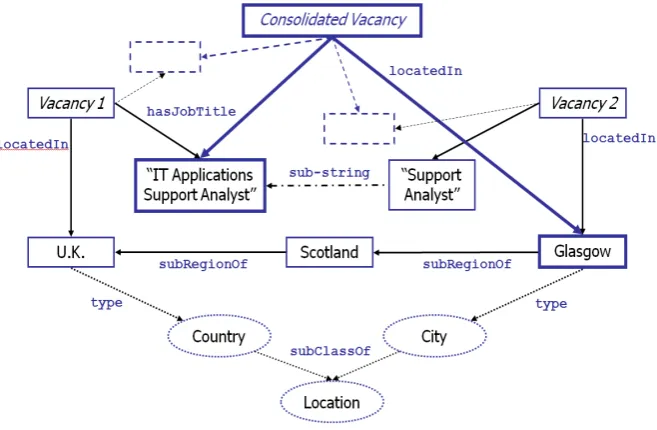
Once the vacancies are extracted the system proceeds with identification of those that are unique. For this purpose, we define Vacancy semi-equivalence is defined as follows: (i) equivalent “Vacancy Title” attribute values, or if one is a substring of the other, and (ii) the values of the rest of their attributes are semantically compatible according to the knowledge base, i.e. the two compared instances are connected with certain types of relation that is semantically consistent.
An example for such a relation issubRegionOf and we say that “locatedInWales” is comparable to “locatedIn UK”,
ATTRIBUTE PRECISION RECALL F-MEASURE
JobTitle 0.87 0.86 0.85
ReportingTo 0.99 0.99 0.99
Job Category 0.99 0.97 0.96
Job Location 0.98 0.65 0.66
Location 0.89 0.93 0.88
Job Reference 0.98 0.89 0.89
Job Type 1 0.99 0.99
Salary 0.97 0.87 0.88
End Date 0.99 0.93 0.93
Start Date 0.98 0.98 0.89
Person 0.87 0.94 0.83
Table 1: Evaluation of single attributes extraction
since “Wales” is asubRegionOf of “UK”. What we achieve as a result of merging two vacancies is a new vacancy com-posed out of the most specific values among the two pro-posed values for each and for every attribute. All attribute values presented only in one of the merged facts are also taken. A very simple diagram on Figure 4 presents the choice of most specific values for“Vacancy Title”and “Va-cancy Location”attributes presented as KB relations. The motivation for the merging is the fact that one and the same vacancy is often promoted several times on a single (company) web-site. It starts from a list of vacant positions, followed by a very short description or a separate page with a detailed description of full vacancy details. The identity resolution is supported by the fact that all extracted posi-tion are offered in one and the same organisaposi-tion. All this information gives us a chance to check the extracted facts and to collect all the available information provided by the employer when it is distributed on several pages.
Figure 4: Example of consolidation of two Vacancy facts
STATISTICS
web-sites with extractedVacancies 2,922 web-sites with redundancy 2,171
Vacanciesbefore merging 29,963
Vacanciesafter merging 16,592
Table 2: Redundancy Statistics
PRECISION RECALL F-MEASURE
0.82 0.89 0.85
Table 3: Evaluation of Intra-site vacancy merging
4.
Related Work
Previous experiments in multi-source information extrac-tion have been taken mainly in the area of Text Summariza-tion, Databases and Co-reference Analysis. Bilenko and Mooney (Bilenko and Mooney, 2003) present a framework for duplicate detection using trainable measure of textual similarity (a learnable text distance function). Comprehen-sive survey about different methods used for de-duplication in database field is given by (Elmagarmid et al., 2007). However all the presented approaches are based on the string content of the corresponding field and hardly use even the fields’ interdependence.
A notable aspect of using semantics for matching knowl-edge representation structures is presented by (Giunchiglia et al., 2004). The authors define Match as an operator that takes two graph-line structures and produces map-pings among the nodes that correspond semantically to each other. However, the processing is based mainly on the node labels, even if their comparison is based on WordNet (Miller, 1994) and the graph structure is restricted to a tree. The IdRF proposed knowledge representation – ontologies – are already used for approaching the identity resolution problem. (Funk et al., 2007) present the advantages of se-mantically enhanced annotation for resolving co-references from different sources. Another example of using
ontolo-gies in this domain is the innovative work of (Klein et al., 2007) for extending standardised ontology description lan-guages to unable approximation of instances. The authors introduce new “Rough Description Language” to represent and reason about similarity of instances.
dif-ferent document contexts (e.g. full document, summary) and term representations (e.g. words, named entities) for entity clustering. An approach which uses named entities of type organisation to disambiguate person names proved to be very competitive.
5.
Conclusions and Furure Work
We have presented a general framework for identity reso-lution which can be adapted to different ontology-based in-formation extraction and ontology-population applications. We have also demonstrated and evaluated the application of the framework in the context of an ontology-based in-formation extraction system. We are currently working on merging vacancies as well as organisations from sources different to corporate websites, e.g. job-boards. The ap-proach taken uses consequential resolving of organisations followed by vacancy merging. Our future work will look into adapting the framework in the context of ontology pop-ulation for business intelligence applications in financial risk management and internationalisation where target enti-ties (e.g. companies, persons, locations) are extracted from multiple reduntant sources requiring consolidation.
Acknowledgements
This work was partially supported by the EU-funded projects MUSING (IST-2004-027097) and MediaCam-paing (027413).
6.
References
Niraj Aswani, Kalina Bontcheva, and Hamish Cunning-ham. 2006. Mining information for instance unifica-tion. In 5th International Semantic Web Conference (ISWC2006), Athens, Georgia.
A. Bagga and B. Baldwin. 1998. Entity-Based Cross-Document Coreferencing Using the Vector Space Model. In Proceedings of the 36th Annual Meeting of the As-sociation for Computational Linguistics and the 17th International Conference on Computational Linguistics (COLING-ACL’98), pages 79–85.
A. Bagga and A. W. Biermann. 2000. A methodology for cross-document coreference. InProceedings of the Fifth Joint Conference on Information Sciences (JCIS 2000), pages 207–210.
Mikhail Bilenko and Raymond J. Mooney. 2003. Employ-ing trainable strEmploy-ing similarity metrics for information in-tegration. InIJCAI-2003, Mexico.
Ahmed K. Elmagarmid, Panagiotis G. Ipeirotis, and Vas-silios S. Verykios. 2007. Duplicate record detection: A survey. Technical report, TKDE, January.
Adam Funk, Diana Maynard, Horacio Saggion, and Kalina Bontcheva. 2007. Ontological integration of informa-tion extracinforma-tion from multiple sources. In International Workshop on Multi-source, Multi-lingual Information Extraction and Summarisaton.
F. Giunchiglia, P. Shvaiko, and M. Yatskevich. 2004. S-match: an algorithm and an implementation of semantic matching. InESWS, pages 61–75.
R. Grishman. 1997. Information Extraction: Techniques and Challenges. InInformation Extraction: a Multidis-ciplinary Approach to an Emerging Information Technol-ogy.
Atanas Kiryakov, Damyan Ognyanov, and Dimitar Mano. 2005. Owlim a pragmatic semantic repository for owl. InSSWS 2005, WISE, USA.
Michal C.A. Klein, Peter Mika, and Stefan Schlobach. 2007. Approximate instance unification using roughowl. InWorkshop on Uncertainty Reasoning for the Semantic Web (URSW).
G. S. Mann and D. Yarowsky. 2003. Unsupervised per-sonal name disambiguation. In W. Daelemans and M. Osborne, editors,Proceedings of the7thConference on Natural Language Learning (CoNLL-2003), pages 33–40. Edmonton, Canada, May.
George A. Miller. 1994. Wordnet: a lexical database for english. InHLT ’94, USA.
X.-H. Phan, L.-M. Nguyen, and S. Horiguchi. 2006. Personal name resolution crossover documents by a semantics-based approach. IEICE Trans. Inf. & Syst., Feb 2006.
Borislav Popov, Atanas Kiryakov, Damyan Ognyanoff, Dimitar Manov, and Angel Kirilov. 2004. Kim - a se-mantic platform for information extaction and retrieval. InJournal of Natural Language Engineering. Cambridge University Press.
H. Saggion. 2008. Experiments on semantic-based clus-tering for cross-document coreference. InInternational Joint Conference on Natural Language Processing, Hy-derabad, India, January. AFNLP.